SEMI-ACTIVE SECONDARY SUSPENSION CONTROL USING FUZZY
SKYHOOK FOR IMPROVING RAILWAY VEHICLE DYNAMICS
PERFORMANCE IN LATERAL DIRECTION
M. Hafiz Harun1, M. Razali Yunos1, M. Z. Sariman2, Fauzi Ahmad2, K. Hudha3, and Rosli A. Bakar4 1 Faculty of Engineering Technology, Universiti Teknikal Malaysia Melaka, Hang Tuah Jaya, Malaysia
2dvance Vehicle Technology Research Group, Center of Automotive Research and Energy, Faculty of Mechanical Engineering,
Universiti Teknikal Malaysia Melaka, Hang Tuah Jaya, Durian Tunggal, Melaka, Malaysia
3Department of Mechanical Engineering, Faculty of Engineering, Universiti Pertahanan Nasional Malaysia, Kuala Lumpur, Malaysia 4Faculty of Mechanical Engineering, Universiti Malaysia Pahang, Pekan, Pahang, Malaysia
Email: [email protected]
ABSTRACT
In railway vehicle technology, there are continuously increasing requirements regarding riding comfort, running safety, and speed of railway vehicles. These requirements are opposed by the fact that the condition of the tracks is getting worse and maintenance is becoming expensive. In view of this conflict, conventional suspension concepts are unable to accommodate those needs. This paper investigates the performance of semi-active control of lateral suspension system namely fuzzy body-based skyhook and fuzzy bogie-based skyhook for the purpose of attenuating the effects of track irregularities to the body lateral displacement, body roll angle and unwanted yaw responses of railway vehicle. In fuzzy bogie-based skyhook, a virtual damper is attached between bogie and sky to damp out unwanted vibratory motion of the bogie and to prevent the motion to be transmitted to the body. For fuzzy body-based skyhook, the virtual damper is attached between the body and the sky. The controller is optimized on 17-DOF railway vehicle dynamics model and shown 35 % better dynamics performance than its counterparts.
Keywords: railway vehicle, fuzzy body-based skyhook, fuzzy bogie-based skyhook.
INTRODUCTION
The vibration control of the car bodies of railway vehicles is important in improving the ride comfort and safety of trains. There are many types of suspension systems connecting the bogies and the car bodies of railway vehicles have been designed to prevent the passengers from vibrations. Basically, the suspension systems used in railway vehicles can be categorized as passive, active, and semi-active types. Passive suspension systems for railway vehicles using springs and pneumatic or oil dampers have some advantages such as the simple design and cost-effectiveness. Nevertheless, the performances due to the wide frequency range of excitations encouraged by the rail track irregularities may be limited. Because of that, the active suspension technologies for railway vehicles, which utilize oil cylinders and pneumatic actuators, have been proposed and investigated by many researchers (Goodall et al., 2002), (Peiffer et al., 2005).
An electronically controlled suspension system consists of actuators, sensors and a specific control law, which generates the force demand for the actuator. The actuator should be able to generate the demanded control force in attenuating unwanted vehicle body motions. The effectiveness of control force in attenuating unwanted vehicle body motions depends on the characteristics of the actuator. There are various types of actuators that can be applied in railway vehicles, such as electro-mechanical, electro-magnetic, hydraulic, servo-pneumatic and rheological (electrical or magnetic) systems. An appropriate control strategy has to be chosen together with
the actuator. One of the most implemented and analyzed suspension control strategy during the years is skyhook.
In automotive systems, the skyhook principle for the semi-active suspension control has been widely investigated (Nguyen et al., 2009), (Chen, 2009), (Savaresi et al., 2009), (He et al., 2010). The principle involves applying a force through the actuators installed between the car body and the wheel. This force corresponds to the force of a damper for the car body and wheel acting against the inertial frame (Karnopp, 1990). Like most other methods of comfort improvement, the skyhook principle in railway vehicle sets its focus on the reduction of the effects of external disturbance due to track irregularities.
This paper is organized as follows: the first section presents introduction and review of some related works, the second section introduces the proposed control structure for the semi-active lateral suspension system. The third section introduces the proposed disturbance rejection control using fuzzy body-based skyhook and fuzzy bogie-based skyhook. The improvements on railway vehicle dynamics performance in terms of reducing body roll angle, unwanted yaw and unwanted lateral displacement responses using the proposed control strategy are presented in the fourth section. Finally, the last section presents some conclusions.
CONTROL STRUCTURE OF SEMI-ACTIVE SUSPENSION SYSTEM FOR RAILWAY VEHICLE
namely outer and inner loops. The outer loop is used as disturbance rejection control to reduce the unwanted vehicle’s motions. The equations of motion for 17-DOF railway vehicle dynamics model are using the same expression that has been derived in Hudha et al., 2011. The inputs of the outer loop controller are vehicle’s states namely body velocity and wheel velocity. Whereas, the output of the outer loop controller is the target force that must be tracked by the MR damper. On the other hand, the inner loop controller is used as force tracking control of the MR damper in such a way that the force produced by the MR damper is as close as possible to the target force produced by the disturbance rejection control. The MR damper model in this study using a sixth order polynomial model that have been discussed in (Harun et al., 2012).
Figure-1. The controller structure of semi-active suspension system (Hudha et al. 2011).
DISTURBANCE REJECTION CONTROL USING FUZZY BODY-BASED SKYHOOK AND FUZZY BOGIE-BASED SKYHOOK
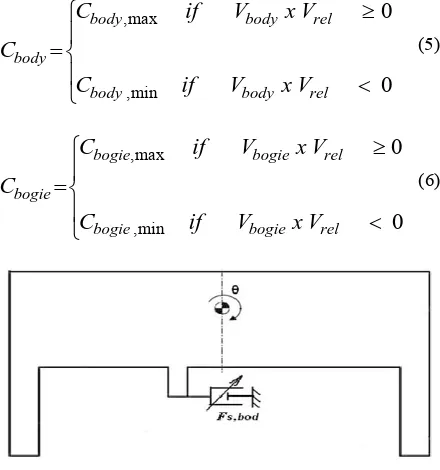
Skyhook control strategy was introduced by Karnopp, 1990, in which a fictitious damper is inserted between the sprung mass and the stationary sky as a way of suppressing the vibratory motion of the sprung mass and as a tool to compute the desired damping force. In this study two types of skyhook control was implemented namely body-based and bogie-based skyhook as shown in Figure 2. The equation governing body-based skyhook controls for front and rear lateral dampers (Hudha et al. 2011) are expressed as:
)
L
Y
(
C
F
sf,bod
body .
. (1))
(
. .,
C
Y
L
F
srbod
body
(2)Whereas, the equation governing bogie-based skyhook controls for front and rear lateral dampers (Hudha et al. 2011) are expressed as:
11 .
,
C
Y
F
sfbog
bogie (3)12 .
,
C
Y
F
srbog
bogie (4)where
bod sf
F , ,Fsr,bod ,Fsf,bog and Fsr,bog are
front and rear body-based and bogie-based skyhook damping forces, Y. and . are carbody lateral rate and yaw rate, 11
.
Y and 12 .
Y are front and rear bogie lateral rate respectively. The damping constants for body-based and bogie-based skyhook namely
body
C and Cbogie (Hudha et
al. 2011) are determined with the following rule:
0
0
min , max , rel body body rel body body bodyV
x
V
if
C
V
x
V
if
C
C
(5)
0
0
min , max , rel bogie bogie rel bogie bogie bogieV
x
V
if
C
V
x
V
if
C
[image:2.612.318.538.319.554.2]C
(6)Figure-2. Body-based skyhook (Hudha et al., 2011).
Figure-3. Bogie-based skyhook (Hudha et al., 2011).
[image:2.612.334.521.576.648.2]good to handle such a need because the desired damping constant can be determined by considering the moving direction between railway vehicle carbody and bogies. The output of the controller as determined by the fuzzy logic may exist between the high and low states damping. In fuzzy logic development, it is important to define certain parameters and conventions that will be used throughout the controller development. Referring to the Figure-2 and Figure-3, for all sign assignment, the movement of railway vehicle carbody and bogies are positive in clockwise direction.
Fuzzy logic control consists of the fuzzification of the controller inputs, the execution of the rules of the controller and the defuzzification of the output to a value to be implemented by the controller. The first step of a fuzzy logic controller is the fuzzification of the controller inputs which is accomplished through the structure of a membership function for each of the input. In the railway vehicle system, the fuzzy logic is designed with two inputs including the carbody lateral velocity Vbody and the relative velocity of the carbody and bogies Vrel. The possible shapes of these membership functions are infinite, though the shape that most widely used are the triangular-type, trapezoidal-triangular-type, Gaussian-type and singleton membership functions. In this study, a Gaussian-type is used for each input. Each membership function is defined by three linguistic variables, Negative (N), Zero (Z) and Positive (P) and is symmetric about zero. Figure-4 and Figure-5 define each input and their membership functions,
Figure-4. Input membership function of carbody velocity Vbody.
Figure-5. Input membership function of relative velocity of the carbody and bogies Vrel.
The second step is the execution of the rule of the controller where the generic form of the fuzzy rule is as follows,
If Vbody is (A) andVrelis (B) thenCd is (C) (7)where A, B and C represent the linguistic values for the absolute carbody velocity, the relative velocity of the carbody and bogies and the desired damping coefficient. In this study, fuzzy type used is Sugeno type and therefore the prescribed output values are constant. The prescribed output values of the fuzzy systems are listed in Table-1 where the values are determined by choosing several damping constant values between the high and low states damping. The seven linguistic variables are as follows,
)
,
,
,
,
,
(
C
d1C
d2C
d3C
d4C
d5C
d6L
(8)The rules of the system can now be developed. The fuzzy logic controller rule-base for the railway vehicle model is detailed in Table-2.
Table-2. Fuzzy logic rule.
The fuzzy logic of rule shown in Table-2 may be referred by skyhook based fuzzy logic control. By examining the rule table, it can be seen that the rule is in agreement with the skyhook policy since both the absolute carbody velocity and relative velocity of the carbody and bogies are fully negative or fully positive. The Cd6 is defined as the maximum damping coefficient and will be employed since two input variables have the positive or negative sign which is known to be fully positive. Where the product between each input variables has a negative sign, it can be called as fully negative in which the Cd1 is employed. However, when each input is not fully positive or fully negative, the fuzzy skyhook is used according to the membership function.
The last step is defuzzification which converts the fuzzy values obtained from execution of the rule tables into a single value. The non-linear behavior of the fuzzy system can be recognized from the 3D graphical representation as shown in Figure-6. The output of the outer-loop controller is the desired damping coefficient Cd. However, the inner loop controller needs desired damping force Fd as the controller input. The desired damping force can be obtained by multiplying the desired damping coefficient with the damper velocity as follows,
rel d
d
C
V
F
(9)Figure-6. Surface map of proposed fuzzy system.
SIMULATION RESULTS OF FUZZY BODY-BASED SKYHOOK AND FUZZY BOGIE-BASED
SKYHOOK
Simulation works were performed in the MATLAB Simulink environment to investigate the performance of fuzzy body-based skyhook and fuzzy bogie-based skyhook. Track irregularities were modelled as a sine wave with magnitude of 0.07 m and the frequencies of excitation of 1 rad/sec, 3 rad/sec and 5 rad/sec (Hudha et al., 2011). These frequencies are common range of train working frequency. Three performance criteria are considered in this study, they are: body lateral displacement, unwanted body roll response and unwanted body yaw response at the body center of gravity.
The response of railway vehicle model for a sinusoidal track irregularity with the amplitude of 7 cm and 1 rad/sec excitation frequency are presented in Figures-7, Figure-8 and Figure-9 in which the solid line indicate the response of fuzzy bogie-based skyhook, the dashed line indicate the response of fuzzy body-based skyhook and the dotted line is the response of the passive system. Figure-7 shows that the fuzzy bogie-based skyhook has significantly better performance in reducing body lateral displacement response compared to passive and also shows slight improvement as compared to the fuzzy body-based skyhook.
Table-3 shows the root mean square (RMS) values of simulation results on passive system, fuzzy body-based skyhook and fuzzy bogie-based skyhook at 1 rad/sec excitation frequency. It is noted that the RMS value of body lateral displacement for semi-active suspension system with fuzzy bogie-based skyhook is 0.0153 m, while under fuzzy body-based skyhook is 0.0205 m respectively. On the other hand, RMS value of body lateral displacement for passive system is 0.0336 m respectively. This table shows significant improvement on the semi-active suspension system in body lateral displacement with fuzzy bogie-based skyhook control by 54.46 % improved over passive system.
Figure-7. Lateral displacement response for 1 rad/sec excitation frequency.
Figure-8. Roll angle response for 1 rad/sec excitation frequency.
Figure-9. Yaw angle response for 1 rad/sec excitation frequency.
Table-3. RMS values of simulation results on passive system, fuzzy body-based skyhook and fuzzy bogie-based
skyhook control for 1 rad/sec excitation frequency.
The response of railway vehicle model for a sinusoidal track irregularity with the amplitude of 7 cm and 3 rad/sec excitation frequency are presented in Figure-10, Figure-11 and Figure-12. From the figures, it can be seen that fuzzy bogie-based skyhook is able to damp out unwanted vehicle motion effectively and shows better performance in all three performance criteria compared to fuzzy body-based skyhook and the passive system. This is due to the fact that fuzzy bogie-based skyhook is able to cancel out the effect of track irregularity before being transmitted to the car body. Table-4 shows the RMS values of simulation results on passive system, fuzzy body-based skyhook control and fuzzy bogie-based skyhook control for 3 rad/sec excitation frequency. Results, as shown in Table 4, strongly proved that fuzzy bogie-based skyhook improved all three performance criteria by 49.87 % for body lateral displacement, 35.93 % for unwanted body roll angle and 36.82 % for unwanted body yaw angle over passive system.
Figure-11. Roll angle response for 3 rad/sec excitation frequency.
Figure-12. Yaw angle response for 3 rad/sec excitation frequency.
Table-4. RMS values of simulation results on passive system, fuzzy body-based skyhook and fuzzy bogie-based
skyhook control for 3 rad/sec excitation frequency.
The response of railway vehicle model for a sinusoidal track irregularity with the amplitude of 7 cm and 5 rad/sec excitation frequency are presented in Figures-13, Figure-14 and Figure-15. Similar trend with the response of 3 rad/sec excitation frequency are found from the figures where the fuzzy bogie-based skyhook is able to eliminate unwanted vehicle motion effectively and shows better performance in all three performance criteria compared to fuzzy body-based skyhook and the passive system. Again, this is due to the fact that fuzzy
bogie-based skyhook is able to cancel out the effect of track irregularity before being transmitted to the car body.
Table-5 shows the RMS values of simulation results on passive system, fuzzy body-based skyhook control and fuzzy bogie-based skyhook control for 5 rad/sec excitation frequency. Even though the excitation frequency has been increased from 3 rad/sec to 5 rad/sec, the semi-active suspension system with fuzzy bogie-based skyhook still able to improve the body lateral displacement by 45.29 %, 35.89 % for unwanted body roll angle and 36.17 % for unwanted body yaw angle over passive system. It turns out that, the semi-active suspension system with fuzzy bogie-based is able to eliminate unwanted vehicle motion effectively and shows better performance in body lateral displacement, unwanted body roll angle and unwanted body yaw angle compared to fuzzy body-based skyhook and the damper which is a passive system.
Figure-13. Lateral displacement response for 5 rad/sec excitation frequency.
Figure-15. Yaw angle response for 5 rad/sec excitation frequency.
Table-5. RMS values of simulation results on passive system, fuzzy body-based skyhook and fuzzy bogie-based
skyhook control for 5 rad/sec excitation frequency.
CONCLUSIONS
The 17-DOF railway vehicle model, MR damper model along with fuzzy bogie-based skyhook and fuzzy body-based skyhook have been developed and simulated in Matlab Simulink software. The sine wave track irregularity with the excitation frequencies of 1, 3 and 5 rad/sec has been considered in this study to observe the potential benefit of the proposed controller. The performance of the two semi-active controllers was compared with passive system in terms of the body lateral displacement, body roll angle and body yaw angle. From the simulation results, fuzzy bogie-based skyhook can outperform the passive system as well as the fuzzy body-based skyhook and is able to improve all three performance criterions, namely body lateral displacement, body roll angle and body yaw angle.
ACKNOWLEDGEMENTS
This work is supported by the Ministry of Science, Technology and Innovations (MOSTI) of Malaysia through FRGS Project entitled “Design and Development of Semi-Active Lateral Suspension for Railway Vehicle” lead by Dr. Khisbullah Hudha. This financial support is gratefully acknowledged.
REFERENCES
[1] Chen, Y. (2009). Skyhook surface sliding mode control on semi-active vehicle suspension system for ride comfort enhancement. Engineering 1, pp. 23.
[2] Gao, G.S. and Yang, S.P. (2006). Semi-active control performance of railway vehicle suspension featuring magnetorheological dampers. 1st IEEE Conference on Industrial Electronics and Applications (ICIEA), Marina Mandarin Singapore, pp. 1.
[3] Goncalves, F.D. (2001). Dynamic Analysis of Semi-Active Control Techniques for Vehicles Applications. Blacksburg, Virginia, Master Thesis.
[4] Goodall, R. (2009). Control of rail vehicles: mechatronics technologies in dynamics analysis of vehicle system. W. Schiechlen. Ed. New York: Springer Wien, 497, pp. 231.
[5] Goodall, R. M. and Kortm, W. (2002). Mechatronic Developments for Railway Vehicles of the Future. Control Engineering Practice, Vol. 10, No. 8, pp. 887.
[6] Harun, M.H., Hudha, K. and Harun, M.H., Zainordin, A.Z. and Ahmad, F. (2012). Modeling and Validation of Magnetorheological Damper for Lateral Suspension of Railway Vehicle Using Interpolated Sixth Order Polynomial. Journal of Mechanical Engineering (Strojnicky Casopis), Slovakia, 63, pp.4
[7] He, P., Wang, Y., Zhang, Y., Liu, Y. and Xu, Y. (2010) Integrated control of semi-active suspension and vehicle dynamics control system. In Proc. of International Conference on System Modeling and Computer Application, Taiyuan –China, 5, pp. 63.
[8] Hudha, K., Harun, M.H., Harun, M.H. and Jamaluddin, H. (2011). Lateral Suspension Control of Railway Vehicle Using Semi-Active Magnetorheological Damper. Proceeding of the 2011 IEEE Intelligent Vehicles Symposium (IV). June 5-9, Baden-Baden Germany.
[9] Karnopp, D.C. (1990). Design principles for vibration control systems using semi-active dampers. ASME Journal of Dynamic Systems, New York, ETATS-UNIS, 112, pp. 448.
[10]Ma, X.N. and Yang. S.P. (2008). Self-adapt fuzzy control of a semi-active suspension of high speed locomotive with MR dampers. in Proc. Of the 7th International conference on Machine Learning and Cybernetics, Kunming-China, pp. 2120.
semi-active suspension systems. In Proc. of ICROS-SICE International Joint Conference, Fukuoka - Japan, pp. 4698.
[12]Peiffer, A., Storm, S., Roder, A., Maier, R. and Frank P. G. (2005). Active Vibration Control for High Speed Train Bogies. Smart Material Structure, Vol. 14, No. 1, pp. 1.