Analysis of Routing Protocols for Wireless Sensor
Networks
Bharath S S1, Dr.Indumathi T S2 1
Department of Digital Electronics and Communication Systems, Visvesvaraya Institute of Advanced Technology, Muddenahalli, chikkaballapur, India
2PG Co-ordinator, Visvesvaraya Institute of Advanced Technology, Muddenahalli, chikkaballapur, India 1[email protected], 2[email protected],
Abstract: Wireless Sensor Networks (WSNs) are large networks made of numerous sensor nodes with sensing, computation, and wireless communication capabilities. Due to the achievement in low-power digital circuit and wireless communication, many applications of the WSN are developed and already been used in habitat monitoring, military object and object tracking. The energy of nodes is the most important consideration among them because the lifetime of Wireless Sensor Networks is limited by the energy of the nodes.
This work focuses on analyzing the optimization strategies of routing protocols with respect to energy utilization of sensor nodes in Wireless Sensor Network (WSNs). Different routing mechanisms have been proposed to address energy optimization problem in sensor nodes. Clustering mechanism is one of the popular WSNs routing mechanisms. To check the efficiency of different clustering scheme against modeled constraints, three cluster based routing protocols are selected; Low Energy Adaptive Clustering Hierarchy (LEACH), Threshold Sensitive Energy Efficient sensor Network (TEEN) and Stable Election Protocol (SEP).To validate the results, analytical simulations are carried out using MATLAB by choosing various performance metrics.
Index Terms: Base station, LEACH, node, SEP, TEEN, WSN.
I. INTRODUCTION
ow a days, the human life is very much attracted to recent technological advances in improving their life by involving in research field. Especially, Incase of analysing any event or physical phenomenon, which is nearly impossible or can’t be feasible to monitor manually the wireless sensor networks play very important role. Due to the modern advancment in technology, the manufacture and production of useful sensors has became major area. The electronics behind the sensor is used to measure the releavent conditions of the environment sorrounding the sensors, and sensed information transforms into some sort of electrical signal which provides charecterstics about the sensed event or phenomena.
Sensor nodes are grouped together to form a wireless sensor network(WSN), which are deployed in an environment, where there is a desire of information. The sensor nodes sense the information according to their configuration, and the sensed
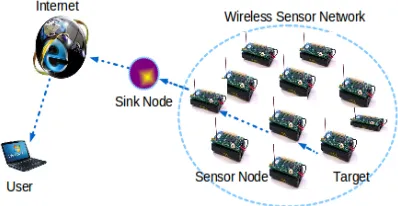
[image:1.612.356.555.361.464.2]information is transformed and transmitted to the recievers.Each sensor nodes are configured with its components like sensing unit, processor unit, memory unit, communication system, and power units. Sensor nodes are generally distributed in an environment, where users want to measure the characteristics. All the randomly deployed sensor nodes has the capability to collect and route data either to other sensors or back to an external Base Station (BS). A BS may be a fixed node or a mobile node is designed, such that it is capable of connecting the sensor network to an existing communications infrastructure or to the Internet where a user can have access to the reported data.
Fig 1 Typical wireless sensor network
Figure 1.1 shows the typical wireless sensor network in which the sensor nodes are deployed in an environment, where we want to monitor the related event. Usually wireless sensor networks(WSN) consists of more number of sensor nodes, offcourse they are necessary for the accurate measurement of the physical phenomenon or event. The nodes that are deployed in the network must have longer life. Because of the compact configuration of the sensor nodes, the battery capacity associated with the nodes are also low, and also it is infeasible to change the battery of the sensor nodes that are deployed in the environment. So some solution we should have to find out for longer life network. And the researchers found out the solution as efficient usage of energy associated with the sensor nodes.
network. Once a sensor node is deployed, the network can keep operating only until the battery power is available.
Several routing techniques have been proposed to accomplish the energy optimization problem in the sensor nodes. In general, classification of a WSN routing technique can be done into two main categories, based on network structure or based on the protocol operation.
Depending on the network structure, a sensor network can be non-hierarchical or flat meant that every sensor node has the same role and functionality. Hence the connections between the sensor nodes are set in short distance to establish radio communication. Alternatively, a sensor network can be hierarchical or cluster based model, where the network is divided into clusters comprising of sensor nodes Cluster head, which is master node, and is responsible for the routing the information to other cluster head or to the base station.
These protocols support the practical existence of WSNs and we can say that it has become essential part of our daily life. Because of large deployment of sensor nodes, routing is much more complex than the other wired or wireless sensor networks. And it is obvious that the energy is the limiting resource in a WSN, the routing protocol must be assure of energy efficiency. Many protocols were proposed in the literatures which introduce to energy awareness. In this work, an attempt has been made in surveying some energy efficient routing algorithms proposed for WSNs and a comparative analysis of the same on various network parameters is done. Wireless Sensor Networks has a wide range of applications. Wireless sensor network consists of a large number of such sensor nodes that are able to collect and disseminate data in areas where ordinary networks are unsuitable for environmental and/or strategic reasons.
II. CLUSTERINGARCHITECTURE
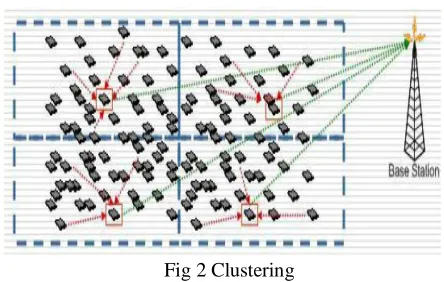
[image:2.612.348.570.54.195.2]Clustering techniques in wireless sensor networks[1] aims at gathering data among groups of nodes, which elect leaders among themselves. The leader or cluster-heads has the role of aggregating the data and reporting the refined data to the BS. The advantages of this scheme is that it reduces energy usage[2] of each node and communication cost. One of the earliest work proposing this approach in WSNs is LEACH[3] (Low Energy Adaptive Clustering Hierarchy).
Fig 2 Clustering
Recently, there have been lots of other clustering techniques which are mostly variants of LEACH protocol with slight improvement and different application scenarios. SEP[4] (Stable Election Protocol) and Threshold Sensitive Energy Efficient sensor Network (TEEN[5]) are all clustering techniques proposed with the objective of minimizing energy usage, while extending network life time. The basic objective of any routing protocol is to make the network useful and efficient. A cluster based routing protocol groups sensor nodes[6] where each group of nodes has a CH or a gateway. Sensed data is sent to the Cluster head[7] rather than send it to the BS, CH performs some aggregation function on data it receives then sends it to the BS where these data is needed.
Clustering Objectives
There are many objectives has been considered by in case of designing clustering architecture for wireless sensor networks. Most of the objectives are set to meet the application constraints. This section present three main objectives that are relevant to the focus of this work.
Maximizing network Life-time: Unlike in cellular networks, where mobile gadgets (e.g. phones) can easily be recharged constantly after battery drainage, thus power management in these networks remains a secondary issue. However, WSN is heavily constrained in this regard, apart from being infrastructure-less system, their battery power is very limited. Most of the sensor nodes are equipped with minimal power source; for example the Berkeley's MICA motes are powered by two AA alkaline batteries. Thus, power efficiency will continue to be of growing concern and will remain one of the main design objectives of WSN. In order to cope with energy management in WSN, clustering scheme has been pursued, to extend network life-time and help ease the burden of each node transmitting directly to BS as in conventional protocols like Direct Transmission.
clustering techniques have been proposed to address the problem of node failure by using proxy cluster-heads, in the event of failure of the original elected cluster head or have minimal power for transmission. Some other works have employed adaptive clustering scheme, to deal with node failures such as rotating the cluster-head. Tolerating node failure is one of the other design goals of clustering protocols.
Load balancing: Load balancing technique could be another design goal of clustering schemes. It is always necessary not to over burden the cluster-heads as this may deplete their energies faster. So, it is important to have even distribution of nodes in each cluster. Especially in cases where cluster-heads are performing data aggregation or other signal processing task, an uneven characterization can extend the latency or communication delay to the BS.
III. ROUTNGPROTOCOLS
A. LEACH
In this work we considered hierarchical routing which performs energy efficient routing in WSNs, and contributes to overall system scalability and lifetime. In this architecture, sensor nodes that are deployed in the region organize themselves into clusters and the nodes with the lower energy level are used to perform sensing in the proximity of phenomenon. They are also used for electing the cluster head. The cluster head is responsible for data processing, aggregation and forwarding the information to the potential layer of clusters among themselves toward the base station. In this section we introduce 3 cluster based scheduling mechanisms.
The operation of LEACH protocol has two phases, the set-up phase and the steady phase. In set-up phase, the nodes are divided into the clusters, and then steady state phase involves transmission of the information from sensor nodes to the cluster heads and then to the base station.
This protocol is divided into rounds; each round consists of two phases;
Setup Phase
The set up phase is divided into two phases where in the first phase, according to the proposed algorithm, each nodes decides themselves whether to become the cluster head or not without considering other nodes present in the network. Many factors are taken into consideration to choose the node as head such as the node should not have been selected as the head for a long time or just previous one. Once the cluster heads decides themselves, they send the advertisement packets which includes some id of the base station to their neighbors. The need of sending advertisement packet is that they want to become cluster head also to inform other nodes to join the clusters. The other
nodes receives the advertisement packets from nearest possible cluster heads, the packet with the highest energy will be considered by the sensor nodes to join the clusters.
The algorithm to select the live node as head of the cluster is as follows. The number in between 0 to 1 is generated in a random fashion by the sensor nodes. The generated number is compared with some threshold value T(n), and if it falls below the threshold value, the sensor nodes receive a notification message with the message informing that it has been elected as cluster head. Once a single node has been elected as head, the value of t(n) is made zero so that it doesn’t get elected as cluster head in the next round.
T(n) can be expressed as:
T(n)= ... (4.1)
Where parameter P is the percentage of the number of clusters in the network (usually P is 0.05)r is the number of the election rounds, rmod(1/ P) is the instantaneous number of cluster heads in te round r, and G is the group of nodes that has not been elected as cluster heads in round r.
Steady-state phase:
Steady state phase starts with data transmission, member nodes send their sensed information to the cluster head according to the allocated TDMA schedule. The transmission of the data to the local base station must uses less energy and it is facilitated at the stage of joining the cluster only(chosen based on the received strength of the CH advertisement). All other nodes must be in sleep mode according to the TDMA schedule, thus minimizing the energy dissipation in these nodes when all the data has been received, cluster head aggregates these data and send to the BS.
B. SEP
head is assigned based on the ratio of energy of each node to initial energy of normal nodes.
There are several additional parameters included in SEP protocol in-order to introduce the case of heterogeneity in clustering hierarchy. There are percentage of advanced nodes(m) and additional energy factor(α). In order to lengthen the stable region, SEP tries to maintain the energy constraint in well balanced condition. i.e. the nodes with comparatively higher energy called advanced nodes were assigned by a more probabilistic weight to become the cluster head. This arrangement doesn’t come to effect the total number of nodes in the network. But the total energy of the network is going to change due to the addition of advanced nodes. If Eo is the initial energy of each normal sensor. The initial energy associated with the advanced node will be more with a factor of α. i.e.
Eo · (1 + α) ………..(4.2)
The total energy of the network is equal to:
n · (1 − m) · Eo + n · m · Eo · (1 + α) = n · Eo · (1 + α · m)………….(4.3)
where m is the advanced nodes fraction
So, the total energy of the system is increased by 1+α ·m times.
In this protocol, after every stage of cluster formation, cluster head broadcasts following variables to its member nodes.
• Hard Threshold (HT): Hard Threshold is the maximum value of the attribute to be sensed. After the node senses the attribute, if the sensed attribute is greater than the threshold, then transmitter switches on, and sensed information is transmitted to the cluster head.
• Soft Threshold(ST): Soft Threshold refers to the resolution of the attribute, i.e. small deviation in the measurement of sensed attribute, which causes switching on of transmitter and hence the beginning transmission
All the nodes in the network senses the environment continuously, but the updating of cluster head by the sensor nodes depends on the protocol used. Since the message transmission will be comparatively more energy consuming compared to sensing the environment. So, in case of TEEN protocol, at first time when the sensed value of an attribute crosses hard threshold value the transmitter associated with the node gets on and transmission begins. This sensed value is stored internally in the variable called sensed value(SV). The transmission will starts in current cluster period, with only following conditions get satisfied.
1. The measured value of the sensed attribute crosses the hard threshold.
2. The current value of the sensed attribute must be differed to SV by an amount greater than or equal to soft threshold.
The internal variable, sensed value (SV) will gets updated for every time when the node transmits the sensed data. This regular updating of the variable limits the number of message transmission to the cluster head by considering the nodes to transmit only when sensed attribute is required. Other variable soft threshold will also play important role in decreasing the energy transmission as follows. If there occurs a small or no change in the sensed attribute compared to soft threshold, then also the message transmissions are eliminated.
TEEN protocol is very similar to LEACH protocol except the fact that periodic transmission of messages won’t be existed in case of TEEN. In this case, every sensor nodes decides to transmit their sensed data based on the threshold value.
The main features of this scheme are as follows:
1. Since in TEEN protocol, the user gets updated instantaneously by the time critical data. This scheme is very useful in case of time critical data sensing applications.
2. It is also observed that the message transmission will be more the energy consuming compared to the data sensing. So, although the nodes are continuously sensing the attribute, energy consumption will be very less than in any other routing protocol. Because the data transmissions are done very rarely.
3. Depending on the application the resolution of the attribute i.e. the soft threshold value can be varied. 4. Lesser the value of the soft threshold value, there will
be more accuracy in analyzing the attribute. But it causes more energy transmission. It allows the user to trade-off between accuracy of the attribute and associated energy consumption.
5. After every stage of cluster formation, the attributes are broadcasted afresh. Hence use can control it as per the requirement.
IV. RESULTSANDDISCUSSIONS
[image:5.612.316.589.61.242.2]Comparative analysis of performance for LEACH, SEP and TEEN protocols
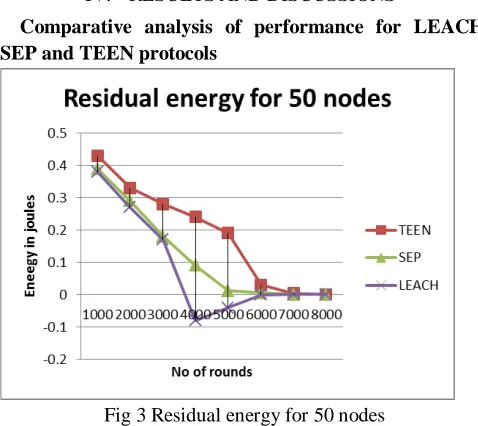
Fig 3 Residual energy for 50 nodes
The figure above depicts the comparative analysis of energy levels for LEACH, SEP AND TEEN protocols for 50 nodes. Here energy (joules) is plotted along y-axis and number of rounds along x-axis. For 50 nodes, the residual energy of individual nodes is higher for TEEN protocol, Hence TEEN protocol is most efficient than other two. Around 4000 rounds, we can see that the remaining liveliness of the nodes in LEACH protocol goes negative, hence LEACH is worst in terms of energy efficiency among the three for large WSNs having large number of nodes.
0 1 2 3 4 5 6
1000 2000 3000 4000 5000 6000 7000 8000
No
o
f d
ea
d a
dv
an
ce
d n
od
es
No of rounds
Performnace of advanced nodes(number of dead_a nodes)
[image:5.612.54.293.66.279.2]TEEN SEP LEACH
Fig 4 Performance of Advanced nodes
The figure above depicts the performance of advanced nodes .Here a plot of no. of dead nodes versus number of rounds is shown, where we can conclude that the no. of dyeing nodes are less in TEEN protocol ,hence TEEN is best in this scenario.
0 1 2 3 4 5 6 7 8 9 10
1000 2000 3000 4000 5000 6000 7000 8000
no
o
f p
ac
ke
ts
No of rounds Packets from CH to BS
TEEN SEP LEACH
Fig 5 Packets from CH to BS
The figure above depicts the number of packets routed from CH to BS .Here packets routed using TEEN protocol is maximum at around 3000 rounds.
0 10 20 30 40 50 60
1000 2000 3000 4000 5000 6000 7000 8000
To
ta
l n
o o
f d
ea
d
no
de
s
No of rounds
comparitive analysis of network lifetime
[image:5.612.351.586.294.476.2]TEEN SEP LEACH
Fig 6 Comparative analysis of network lifetime.
Comparative analysis of network lifetime is plotted as “total number of dead nodes” along y-axis and “number of rounds” along x-axis. From the graph we can conclude, the lifetime of a network using LEACH protocol is more compared to the networks using SEP or TEEN.
V. CONCLUSION
The simulations of both proactive and reactive routing protocols for WSNs have been performed. Energy associated with the node is the scarcest resource in WSNs which demands for energy efficient communication and thereby increasing overall network life time.
[image:5.612.41.303.431.614.2]it has been proved that TEEN protocol performs better in terms of spreading overall network lifespan.
In this work, we have investigated, gathering focused distributing so as to steer conventions that lessens worldwide vitality use the heap to every one of the hubs at distinctive focuses in time. Youngster convention outflanks static requiring so as to group calculations hubs to volunteer to be high-vitality bunch heads and adjusting the relating bunches taking into account the hubs that be group heads at a given time. At distinctive times, every hub has the weight of gaining information from the hubs in the bunch, intertwining the information to acquire a total flag, and transmitting this total sign to the base station in a responsive way in this way being most vitality effective.
REFERENCES
[1] D. Puccinelli and M. Haenggi, “Wireless Sensor Networks-Applications and Challenges of Ubiquitous Sensing,” IEEE Circuits and Systems Magazine, Aug. 2007
[2] L. Qing and Qingxin Zhu, Design of a distributed Energy-Efficient Clustering algorithm for heterogeneous Wireless sensor Networks, Computer Communications, pp. 2230-2237, 2006.
[3] W. Heinzelman, A.Chandrakasan, and H. Balakrishnan, "Energy-efficient communication
protocol for wireless microsensor networks", in the Proceedings of the 33rd International Conference on System Science (HICSS’00), Hawaii, U.S.A., January 2000.
[4] G. Smaragdakis , and I. Matta, “SEP: A Stable Election protocol for clustered heterogeneous Wireless sensor Networks”, Boston University Computer Science Department, 2004.
[5] L. Qing , and Q. Zhu, “Design of a distributed Energy- Efficient Clustering algorithm for heterogeneous Wireless sensor Networks”,Computer Communications, 2006 ,pp. 2230-2237.
[6] Ye, M.; Li, C.; Chen, G.; Wu, J. An energy efficient clustering scheme in wireless sensor networks. Ad Hoc Sens. Wirel. Netw.2006, 3, 99–119.