S T U D Y P R O T O C O L
Open Access
Sequential learning of psychomotor and
visuospatial skills for laparoscopic suturing
and knot tying
–
study protocol for a
randomized controlled trial
“
The shoebox
study
”
Jonathan D. Hendrie
1, Felix Nickel
1, Thomas Bruckner
2, Karl-Friedrich Kowalewski
1, Carly R. Garrow
1,
Maisha Mantel
3, Philipp Romero
3and Beat P. Müller-Stich
1*Abstract
Background:Laparoscopy training has become an integral part of surgical education. Suturing and knot tying is a basic, yet inherent part of many laparoscopic operations, and should be mastered prior to operating on patients. One common and standardized suturing technique is the C-loop technique. In the standard training setting, on a box trainer, the trainee learns the psychomotor movements of the task and the laparoscopic visuospatial orientation simultaneously. Learning the psychomotor and visuospatial skills separately and sequentially may offer a more time-efficient alternative to the current standard of training.
Methods: This is a monocentric, two-arm randomized controlled trial. The participants are medical students in their clinical years (third to sixth year) at Heidelberg University who have not previously partaken in a laparoscopic training course lasting more than 2 hours. A total of 54 students are randomized into one of two arms in a 1:1 ratio to sequential learning (group 1) or control (group 2). Both groups receive a standardized introduction to the training center, laparoscopic instruments, and C-loop technique. Group 1 learn the C-loop using a transparent shoebox, thus only learning the psychomotor skills. Once they reach proficiency, they then perform the same knot tying procedure on a box trainer with standard laparoscopic view, where they combine their psychomotor skills with the visuospatial orientation inherent to laparoscopy. Group 2 learn the C-loop using solely a box trainer with standard laparoscopic view until they reach proficiency. Trainees work in pairs and time is recorded for each attempt. The primary outcome is mean total training time for each group. Secondary endpoints include procedural and knot quality subscore differences. Tertiary endpoints include studying the influence of gender and video game experience on performance.
Discussion: This study addresses whether the learning of the psychomotor and visuospatial aspects of laparoscopic suturing and knot tying is optimal sequentially or simultaneously, by assessing total training time, procedural, and knot quality differences between the two groups. It will improve the efficiency of future laparoscopic suturing courses and may serve as an indicator for laparoscopic training in a broader context, i.e., not only for suturing and knot tying.
Trial registration:This trial was registered on 12 August 2015 with the trial registration number DRKS00008668.
Keywords:Laparoscopy, Training, Education, Minimally invasive surgery, Suturing, Knot tying
* Correspondence:[email protected]
1Department of General, Visceral, and Transplantation Surgery, University of
Heidelberg, Im Neuenheimer Feld 110, 69120 Heidelberg, Germany Full list of author information is available at the end of the article
Background
Minimally invasive surgery (MIS) involves learning a separate skill set from that of open surgery. Although some of the necessary qualities are the same, e.g., bimanual dexterity and steadiness, many of the basic skills must be learned for the first time or anew, e.g., the fulcrum effect, tissue grasping, needle manipulation, knot tying, etc. These basic psychomotor skills give sur-geons the tools necessary to complete full operations; therefore, the learning of them has become one of the cornerstones of laparoscopic training curricula [1–3]. As many surgical operations defer to the laparoscopic approach, it has become imperative for surgical trainees to demonstrate proficiency in basic and procedural skills prior to operating on patients. Training modalities, e.g., virtual reality (VR) simulators, inanimate box trainers, and cadaveric organ trainers can be used as a safe, ethical, and effective means to do this [4–8].
Box trainers provide a realistic platform for the learning of laparoscopic skills with real instruments [9]. Intracorpor-eal suturing and knot tying [10] is an invaluable skill needed for minimally invasive operations [11, 12]. Suturing skills learned via a box trainer suture model have been shown to transfer to the operating room (OR) [13]. Training within the box trainer familiarizes trainees with the two major facets of laparoscopy: psychomotor control and visuospatial orientation [14–18].
Surgeons need to be familiar with depth perception and 2D–3D visuospatial understanding, since laparoscopy
utilizes an indirect view. However, it remains to be deter-mined if the learning of psychomotor and visuospatial skills simultaneously is optimal, as in a box trainer. Learn-ing these two skills separately and sequentially may offer a more effective training alternative that reduces the learn-ing or teachlearn-ing time for trainees and mentors respectively. This would lower the workload of tutors and the learning curve of trainees, and save limited time and resources in a training center. Therefore, we aim to explore whether sequential learning with a transparent shoebox, where one learns the psychomotor movements, followed by training on a box trainer with the indirect laparoscopic view, expedites the learning of the surgical C-loop technique in comparison to training solely on a box trainer with the indirect laparoscopic view, where one learns the psycho-motor and visuospatial skills simultaneously.
Methods
Objective
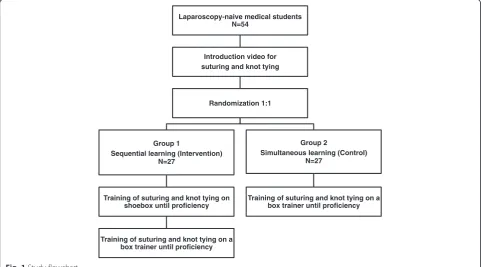
The primary goal of this study is to identify if students in group 1, who learn the surgical C-loop technique using a transparent shoebox before using a box trainer with laparoscopic view, have a shorter learning curve than students in group 2, who learn the technique using solely a box trainer with laparoscopic view (Fig. 1). Sec-ondary endpoints include number of attempts taken to gain proficiency, and examining procedural and knot quality subscore differences. In subgroup analyses we will separately explore possible gender differences and
Laparoscopy-naive medical students N=54
Introduction video for suturing and knot tying
Randomization 1:1
Group 2
Simultaneous learning (Control) N=27
Training of suturing and knot tying on a box trainer until proficiency Group 1
Sequential learning (Intervention) N=27
Training of suturing and knot tying on shoebox until proficiency
Training of suturing and knot tying on a box trainer until proficiency
[image:2.595.57.539.455.722.2]influence of previous video game experience on training time, number of attempts needed to reach proficiency and knot quality respectively.
Study design
This is a registered prospective, single-center, two-arm, parallel group randomized controlled trial.
Setting and participants
This study is conducted in the MIS training center of Heidelberg University Hospital’s Department of General, Visceral, and Transplantation Surgery. It offers a voluntary laparoscopic training course to medical students. Training tutors are specially trained medical students (n= 4) at Heidelberg University, non-blinded to the training groups, who receive a standardized rater training prior to the beginning of data collection.
Inclusion and exclusion criteria
The inclusion criterion mandates that participants are medical students in their clinical years (third to sixth year) at Heidelberg University. Exclusion criteria include students who have previously participated in a laparoscopic training course of more than 2 hours duration or who had training in laparoscopic surgery in the OR.
Video introduction to laparoscopic suturing and knot tying
All students receive a standardized video-based intro-duction to the suturing and knot tying technique at the start of the study. Students may refer to this video throughout the course of their participation.
Introduction to the training modalities in the training center
Trained student tutors provide a standardized introduc-tion for the box trainer, shoebox, and laparoscopic in-struments, as well as instructions for their use. Students can, therefore, familiarize themselves with the training modalities, workspace, and terminology prior to the induction of their training.
Randomization
Participants are randomly allocated to either the sequen-tial learning group (group 1) or control group (group 2) in a 1:1 ratio. The randomization of subjects is performed by an employee otherwise not involved in the study using sealed envelopes labeled by block. Trainees are allocated to groups without stratification by gender or gaming experience. Although this study would benefit from a 1:1 ratio of men to women, this cannot be mandated since the data is collected through participation in a university elective course which is offered on a first-come-first-serve basis. Consequentially, we cannot explore outcome
differences in heterogeneous or homogeneous groups, e.g., male-female, male-male, female-female, in a standard-ized manner; there may be an influencing factor that stems from the communication dynamic, previous experi-ence of a partner, etc. We aim to explore these differexperi-ences by comparing outcomes between pair group subgroup analysis following data acquisition. An employee of the Department of Medical Biometry at Heidelberg University, who is otherwise not involved with the training, tests, or data collection from the present study, assigned block randomization.
Training curriculum
The sequential learning group (group 1) learn the psy-chomotor aspects of laparoscopic suturing and knot tying first on the transparent shoebox without having to adjust to the visuospatial orientation inherent to the lap-aroscopic view of a box trainer. Once they reach the pre-defined proficiency criteria explained below (Tables 1, 2 and 3), these students then train on the box trainer with laparoscopic view until proficient (Fig. 2). The control group (group 2) learn the psychomotor skills and visuo-spatial aspects of laparoscopy simultaneously, as is trad-itionally done. They train using the box trainer with laparoscopic view until proficient in the predefined cri-teria. Specially trained peer tutors assist trainees during the course of the study and are available on demand in the training room for both groups; this has proven to be beneficial to trainee learning [19].
Following randomization, participants are put into training pairs, which is a common practice within surgical training [20, 21]. This allows the trainees to give each other real-time competency assessment and feedback, which is motivational [22, 23], in addition to saving time for the trainers, and space in the training center. We re-cently explored the difference between laparoscopic train-ing alone and in pairs and found there to be no distinction in outcome between the two groups (protocol, own data, unpublished). It has been shown that students–whether alone or in a collaborative pair–can learn as much by ob-serving their peers learn a task as they can by performing the task themselves [24, 25]. This is known as vicarious learning, which typically does not provide for communica-tion between the student being tutored and the student watching. It should be made clear that students in our training environment can communicate directly with one another, which may prove even more useful. Based on these grounds, we believe that the pragmatic aspect of sav-ing time and resources in a busy trainsav-ing center outweighs the potentially confounding effect of partner training.
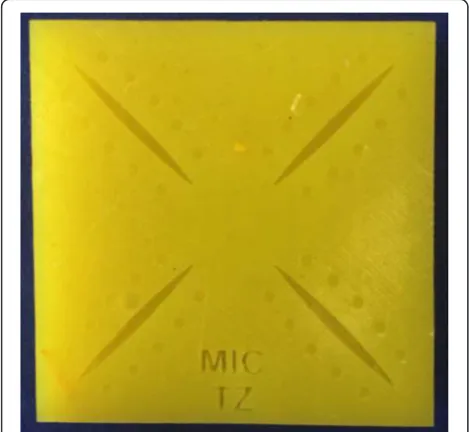
time per attempt must be recorded for each trainee. In the event of technical or instrument failure, e.g., the suture thread getting stuck in the grooves of the instru-ment, time is stopped and recorded, and “N/A” and a brief description of what happened are written next to the attempt. Rather than mass practice, we implement the more effective interval training [26–28]; trainees are required to switch positions at least every five completed knot attempts. Students train using two laparoscopic needle holders (KARL STORZ GmbH & Co. KG, Tuttlin-gen, Germany) and a standardized silicone suture pad with diagonal incisions and predefined suture entry and
exit points (Fig. 3) (Big Bite Medical GmbH, Heidelberg). The suture material is a Polysorb 3-0 braided absorbable suture with a CV-23 taper ½ 17-mm needle (CovidienTM, Minneapolis, MN, USA).
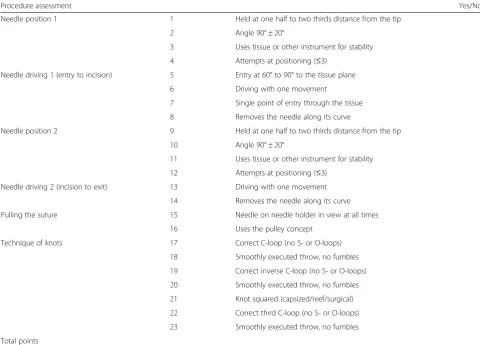
Training pairs are required to rate each other through-out the training process until they reach the predefined competency levels for knot quality, suture position, and time. Procedural competency is assessed using a previ-ously validated modified 23-point implementation checklist [14] (Table 1), originally published by Munz et al. [29].
[image:4.595.56.537.100.445.2]Knot quality is scored using a 5-point scale designed by Muresan et al. [10], which assesses a knot’s throws, tightness, edge opposition, and ability to hold under Table 2Knot quality checklist
Knot quality assessment Available
points
No visible gaps between stacked throws 1
Knot tight at base 1
Only edges are opposed (no extra tissue in knot, e.g., back wall)
1
Knot holds under tension 2
Maximum 5
Table 3Competency checklist
Competency assessment Goal Yes/No
Time (min:sec) ≤01:15
Procedure ≥18
Knot quality ≥4
Accuracy (mm) ≤2
[image:4.595.56.290.630.731.2]Competency (if all“Yes”above)
Table 1Procedural proficiency checklist
Procedure assessment Yes/No
Needle position 1 1 Held at one half to two thirds distance from the tip
2 Angle 90° ± 20°
3 Uses tissue or other instrument for stability
4 Attempts at positioning (≤3)
Needle driving 1 (entry to incision) 5 Entry at 60° to 90° to the tissue plane
6 Driving with one movement
7 Single point of entry through the tissue
8 Removes the needle along its curve
Needle position 2 9 Held at one half to two thirds distance from the tip
10 Angle 90° ± 20°
11 Uses tissue or other instrument for stability
12 Attempts at positioning (≤3)
Needle driving 2 (incision to exit) 13 Driving with one movement
14 Removes the needle along its curve
Pulling the suture 15 Needle on needle holder in view at all times
16 Uses the pulley concept
Technique of knots 17 Correct C-loop (no S- or O-loops)
18 Smoothly executed throw, no fumbles
19 Correct inverse C-loop (no S- or O-loops)
20 Smoothly executed throw, no fumbles
21 Knot squared (capsized/reef/surgical)
22 Correct third C-loop (no S- or O-loops)
23 Smoothly executed throw, no fumbles
[image:4.595.305.539.647.731.2]tension (Table 2). Furthermore, accuracy is recorded by measuring the distance (mm) of the stitch from the edge of the entry and exit points of the standardized suture pad. Operative time is also recorded.
A trainee demonstrates competency for the C-loop upon finishing it in ≤01:15 (min:sec), attaining ≥18 points on the procedural implementation checklist, scor-ing≥4 on the knot quality scale, and maintaining stitching ≤2 mm from the edge of the suture pad’s entry and exit points (Table 3). According to the available medical litera-ture, experienced surgeons (expert level) reach these goals for the surgical C-loop [14]. Once a student has reached competency according to his or her training partner, a specially trained peer tutor is asked to provide expert assessment. If the participant then performs a C-loop, attaining the aforementioned competency criteria under
supervision of the tutor, he or she is considered proficient in the technique; thus proficiency is achieved once a trainee completes the C-loop suturing technique on two consecutive occasions with the predefined competency criteria–once for the partner and once for the peer tutor assessment.
Primary endpoint
The primary endpoint is total training time needed to reach proficiency in a predefined standardized suturing and knot tying technique.
Secondary endpoints
Secondary endpoints include the number of attempts, procedure subscore differences, and knot quality sub-score differences.
Tertiary endpoints
Tertiary endpoints involve subanalyses of gender differ-ences and the influence of video game experience. Sur-gery has traditionally been a male-dominated field and research has demonstrated that male medical students are faster at acquiring surgical skills and demonstrate superior visuospatial skills in comparison to their female peers [30–33]. We will explore this further by comparing male and female performance in both groups for total time taken and number of attempts. Furthermore, we will explore the influence of video game experience, in years, on total time taken and number of attempts, for both groups.
Statistical analysis
The empirical distributions of all parameters of interest are described using mean and standard deviation in case of continuous data, with absolute and relative frequencies in case of categorical parameters. Possible difference in the primary outcome, time to reach proficiency, will be tested using a two-sided ttest. All secondary parameters including subgroup analyses will be descriptively analyzed according to their underlying distribution, two-sided Mann-WhitneyUtests in case of continuous parameters, and Chi-square test in case of categorical data. Graphical statistical methods will illustrate the findings, whenever appropriate.
Sample size determination
Sample size calculation was done with respect to the pri-mary endpoint. A previously evaluated pilot study showed the following data for total training time needed to reach proficiency: mean difference between group 1 and group 2 was 15 seconds; standard deviation in group 1 was 15.6 seconds, whereas it was 22.2 seconds in group 2. This difference can be detected with a two-sided significance Fig. 3Standardized silicone suture pad
[image:5.595.56.291.88.246.2] [image:5.595.56.291.496.712.2]levelα= 0.05 and a power of 1−β= 0.8, with a group size of 27 participants randomized to each group.
Ethical and legal aspects
All data for the study is recorded anonymously, treated confidentially, and is evaluated by authorized staff for scientific purposes only. Participants’ names are kept separate from all study data and are not used for the study. Each participant is assigned a designated code that is used for the entire study documentation and data collection. This study is offered in addition to compul-sory university courses. Participation in this study is vol-untary and may be ended at any time. There are no foreseeable negative consequences related to participa-tion. The participating staff of the Heidelberg MIS train-ing center is experienced in the handltrain-ing of traintrain-ing devices and in tutoring MIS. The benefits of training for students are numerous: stamina, concentration, and manual adroitness are enhanced and practiced, surgical interest may be sparked or strengthened, and students receive practical laparoscopy experience, which may be used during later work. In the event that a participant’s physical or mental health becomes jeopardized due to participation in the present study, the participant will be withdrawn immediately and excluded from the study. Written informed consent is obtained from each trainee. Ethical approval was obtained from the Ethics Commit-tee of the Medical Faculty at Heidelberg University prior to the beginning of the study (Code S-334/2011). The Consolidated Standards of Reporting Trials (CONSORT) guidelines for randomized controlled trials and Standard Protocol Items: Recommendations for Interventional Trials (SPIRIT) guidelines for implementation of study protocols were followed [34, 35]. This trial was regis-tered with the German Clinical Trials Register (DRKS) in Freiburg, Germany on 12 August 2015 with the trial registration number DRKS00008668.
Discussion
This study aims to assess the differences in the learning of the psychomotor and visuospatial aspects of laparo-scopic suturing and knot tying between those who learn them sequentially and those who learn them eously. Trainees typically learn these aspects simultan-eously, but no support was found necessitating this methodology. We expect that trainees who start on the shoebox will learn the C-loop much quicker than those who begin with the box trainer. However, it remains to be determined whether these skills quickly transfer to the box trainer with laparoscopic view. Nonetheless, it is important to ascertain which training method will be the most efficient for training centers. The potential for shorter learning curves and more effective use of re-sources, e.g., training center space, time, and trainers is
rationale in itself to explore alternatives to current stan-dards. The results of this study have the potential to shift the current paradigm for the training of laparoscopic su-turing and knot tying or strengthen the present standard.
Trial status
Recruitment started in April 2015 and is expected to finish by December 2015.
Consent
Written informed consent was received from the partici-pants for publication of this manuscript and accompany-ing images. A copy of the written consent is available for review by the editor-in-chief of this journal.
Abbreviations
ICC:intraclass correlation coefficient; LC: laparoscopic cholecystectomy; MIS: minimally invasive surgery; OR: operating room; VR: virtual reality.
Competing interests
The authors hereby declare that they have no competing interests.
Authors’contributions
Study conception and design: BPMS, FN, JDH, MM, K-FK, CRG and PR. Statistical planning: TB. Drafting of manuscript: JDH, FN, K-FK, MM and CRG. Critical revision: BPMS, PR and FN. All authors read and approved the final version of this manuscript.
Acknowledgements
We would like to thank Marion Link for her help with organizing this study.
Funding
This project was supported by the Heidelberg Foundation for Surgery.
Author details
1Department of General, Visceral, and Transplantation Surgery, University of
Heidelberg, Im Neuenheimer Feld 110, 69120 Heidelberg, Germany.2Institute
for Medical Biometry and Informatics, University of Heidelberg, Im Neuenheimer Feld 305, 69120 Heidelberg, Germany.3Department of
Pediatric Surgery, University of Heidelberg, Im Neuenheimer Feld 110, 69120 Heidelberg, Germany.
Received: 15 September 2015 Accepted: 23 December 2015
References
1. Watanabe Y, McKendy KM, Bilgic E, Enani G, Madani A, Munshi A, et al. New models for advanced laparoscopic suturing: taking it to the next level.Surg Endosc, 2015. [Epub ahead of print]
2. Nickel F, Brzoska JA, Gondan M, Rangnick HM, Chu J, Kenngott HG, et al. Virtual reality training versus blended learning of laparoscopic
cholecystectomy: a randomized controlled trial with laparoscopic novices. Medicine (Baltimore). 2015;94(20), e764.
3. Nebiker CA, Mechera R, Rosenthal R, Thommen S, Marti WR, von Holzen U, et al. Residents’performance in open versus laparoscopic bench-model cholecystectomy in a hands-on surgical course. Int J Surg. 2015;19:15–21. 4. Aggarwal R, Balasundaram I, Darzi A. Training opportunities and the role of
virtual reality simulation in acquisition. J Surg Res. 2008;145(1):80–6. 5. Undre S, Darzi A. Laparoscopy simulators. J Endourol. 2007;21(3):274–9. 6. Korndorffer Jr JR, Stefanidis D, Scott DJ. Laparoscopic skills laboratories: current assessment and a call for resident. Am J Surg. 2006;191(1):17–22. 7. Aggarwal R, Darzi A. Training in laparoscopy–which model to use? Indian J
Gastroenterol. 2005;24(3):95–6.
8. Aggarwal R, Moorthy K, Darzi A. Laparoscopic skills training and assessment. Br J Surg. 2004;91(12):1549–58.
curriculum for laparoscopic surgery? Study protocol for a randomized controlled trial–DRKS00004675. Trials. 2014;15:137.
10. Muresan 3rd C, Lee TH, Seagull J, Park AE. Transfer of training in the development of intracorporeal suturing skill in medical student novices: a prospective randomized trial. Am J Surg. 2010;200(4):537–41.
11. Nguyen NT, Mayer KL, Bold RJ, Larson M, Foster S, Ho HS, et al. Laparoscopic suturing evaluation among surgical residents. J Surg Res. 2000;93(1):133–6. 12. Pennings JL, Kenyon T, Swanstrom L. The knit stitch. An improved method
of laparoscopic knot tying. Surg Endosc. 1995;9(5):537–40.
13. Korndorffer Jr JR, Dunne JB, Sierra R, Stefanidis D, Touchard CL, Scott DJ. Simulator training for laparoscopic suturing using performance goals translates to the operating room. J Am Coll Surg. 2005;201(1):23–9. 14. Romero P, Brands O, Nickel F, Müller B, Günther P, Holland-Cunz S. Intracorporal
suturing–driving license necessary? J Pediatr Surg. 2014;49(7):1138–41. 15. Korndorffer Jr JR, Clayton JL, Tesfay ST, Brunner WC, Sierra R, Dunne JB, et al.
Multicenter construct validity for southwestern laparoscopic videotrainer stations. J Surg Res. 2005;128(1):114–9.
16. Chung SD, Tai HC, Lai MK, Huang CY, Wang SM, Tsai YC, et al. Novel inanimate training model for urethrovesical anastomosis in laparoscopic radical prostatectomy. Asian J Surg. 2010;33(4):188–92.
17. Yoshida K, Kinoshita H, Kuroda Y, Oshiro O, Matsuda T. Analysis of laparoscopic dissection skill by instrument tip force measurement. Surg Endosc. 2013;27(6):2193–200.
18. Siska VB, Ann L, de Gunter W, Bart N, Willy L, Marlies S, et al. Surgical skill: trick or trait? J Surg Educ. 2015;72(6):1247–53.
19. Van Bruwaene S, De Win G, Miserez M. How much do we need experts during laparoscopic suturing training? Surg Endosc. 2009;23(12):2755–61. 20. Fearn SJ, Burke K, Hartley DE, Semmens JB, Lawrence-Brown MM. A
laparoscopic access technique for endovascular procedures: surgeon training in an animal model. J Endovasc Ther. 2006;13(3):350–6.
21. Hoffman MS, Ondrovic LE, Wenham RM, Apte SM, Shames ML, Zervos EE, et al. Evaluation of the porcine model to teach various ancillary procedures to gynecologic oncology fellows. Am J Obstet Gynecol. 2009;201(1):116. e1-3. 22. Botden SM, de Hingh IH, Jakimowicz JJ. Suturing training in Augmented Reality:
gaining proficiency in suturing skills faster. Surg Endosc. 2009;23(9):2131–7. 23. Gonzalez R, Bowers SP, Smith CD, Ramshaw BJ. Does setting specific goals
and providing feedback during training result in better acquisition of laparoscopic skills? Am Surg. 2004;70(1):35–9.
24. Chi MT, Roy M, Hausmann RG. Observing tutorial dialogues collaboratively: insights about human tutoring effectiveness from vicarious learning. Cogn Sci. 2008;32(2):301–41.
25. Stegmann K, Pilz F, Siebeck M, Fischer F. Vicarious learning during simulations: is it more effective than hands-on training? Med Educ. 2012;46(10):1001–8. 26. Buckley CE, Kavanagh DO, Nugent E, Ryan D, Traynor OJ, Neary PC. The impact of aptitude on the learning curve for laparoscopic suturing. Am J Surg. 2014;207(2):263–70.
27. Gallagher AG, Ritter EM, Champion H, Higgins G, Fried MP, Moses G, et al. Virtual reality simulation for the operating room: proficiency-based training as a paradigm shift in surgical skills training. Ann Surg. 2005;241(2):364–72. 28. Metalis SA. Effects of massed versus distributed practice on acquisition of
video game skill. Percept Mot Skills. 1985;61(2):457–8.
29. Munz Y, Almoudaris AM, Moorthy K, Dosis A, Liddle AD, Darzi AW. Curriculum-based solo virtual reality training for laparoscopic intracorporeal knot tying: objective assessment of the transfer of skill from virtual reality to reality. Am J Surg. 2007;193(6):774–83.
30. Donnon T, DesCôteaux J-G, Violato C. Impact of cognitive imaging and sex differences on the development of laparoscopic suturing skills. Can J Surg. 2005;48(5):387–93.
31. Thorson CM, Kelly JP, Forse RA, Turaga KK. Can we continue to ignore gender differences in performance on simulation trainers? J Laparoendosc Adv Surg Tech A. 2011;21(4):329–33.
32. Schlickum M, Felländer-Tsai L, Hedman L, Henningsohn L. Endourological simulator performance in female but not male medical students predicts written examination results in basic surgery. Scand J Urol. 2013;47(1):38–42. 33. Ali A, Subhi Y, Ringsted C, Konge L. Gender differences in the acquisition of
surgical skills: a systematic review. Surg Endosc. 2015;29(11):3065–73. 34. Chan AW, Tetzlaff JM, Gøtzsche PC, Altman DG, Mann H, Berlin JA, et al.
SPIRIT 2013 explanation and elaboration: guidance for protocols of clinical trials. BMJ. 2013;346, e7586.
35. Schulz KF, Altman DG, Moher D. CONSORT 2010 Statement: updated guidelines for reporting parallel group randomised trials. Trials. 2010;11:32.
• We accept pre-submission inquiries
• Our selector tool helps you to find the most relevant journal
• We provide round the clock customer support
• Convenient online submission
• Thorough peer review
• Inclusion in PubMed and all major indexing services • Maximum visibility for your research
Submit your manuscript at www.biomedcentral.com/submit