ISSN 2250-3153
Research Status of Distributed Optical Fiber Sensing
System Based on Phase-sensitive Optical Time Domain
Reflectometry
Abdikarim Ahmed
**, Zhihua Yu
***
School of Automation, China University of Geosciences, Wuhan, Hubei, China **
Hubei Key Laboratory of Advanced Control and Intelligent Automation for Complex Systems, Wuhan, Hubei, China Email: [email protected]
DOI: 10.29322/IJSRP.9.05.2019.p89105 http://dx.doi.org/10.29322/IJSRP.9.05.2019.p89105
Abstract- Distributed Optical fiber sensing system based on phase-sensitive time domain reflectometer (Ф − 𝑂𝑇𝐷𝑅) has become one of the main distributed optical fiber sensing schemes for intrusion detection in recent years due to its excellent performance. Ф − 𝑂𝑇𝐷𝑅 has the advantages of simple structure, stable performance, long sensing distance and strong anti-interference ability and also has a wide application prospects. In order to learn more about the Ф − 𝑂𝑇𝐷𝑅structure and working principle this paper will be introduced and carry out comparison with traditional optical time domain (OTDR), As well as the operation principles and research status of four typical Ф − 𝑂𝑇𝐷𝑅 disturbance sensing system of traditional, Raman, Brillouin and cascaded, meanwhile will be analyzed with the improvement of the system structure, sensing distance and location accuracy. Then, their advantages and disadvantages were summarized to provide a direction for selecting the appropriate system in practical application.
Index Terms- Distributed sensor, Fiber sensor, intrusion sensor, optical-phase sensor.
1.
I
NTRODUCTIONistributed fiber-optic sensing (DFOS) has many outstanding and unique advantages, such as very large-scale monitoring range, huge number of monitoring points, simple deployment and geometric versatility compared with point fiber-optic sensors. DFOS systems have found wide applications in the field of in-line health and safety monitoring, such as long bridges, electrical cables, and oil/gas pipelines, etc. great research efforts are paving the way to even much wider usability of the DFOS technology through recently achieved performance enhancement in each of the its critical parameters: measurement range, spatial resolution, acquisition time and measurement uncertainty[1].
Phase-sensitive Optical Time Domain Reflectometer (Ф − 𝑂𝑇𝐷𝑅) is also part of the distributed fiber optic sensing technology, it uses the backward Rayleigh scattered light to transmit in the fiber. As one of the most promising technologies for distributed vibration sensing Ф − 𝑂𝑇𝐷𝑅 has attracted considerable attention due to the spatial resolution, broad frequency response range, and multiple events detection capability. in this paper the Ф − 𝑂𝑇𝐷𝑅 system is discussed, followed by other four different structure of Ф − 𝑂𝑇𝐷𝑅 system’s innovation and deficiencies to provide the idea for a future system construction.
ISSN 2250-3153
2.
Ф
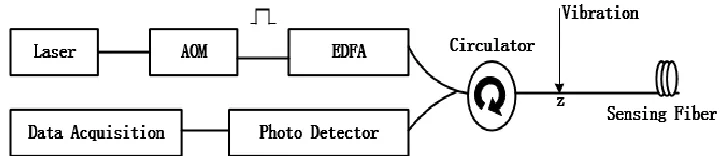
− 𝐎𝐓𝐃𝐑 Principle [image:2.612.181.449.201.283.2]Distributed Optical Fiber sensor (DOFS) technology based on OTDR has been very mature and widely used in optical fiber sensing system. OTDR was first introduced to monitor fiber attenuation for fault detection in telecommunication cables, later such systems have been used for a number of other applications[2]. Ф − 𝑂𝑇𝐷𝑅 is a kind of distributed type which is developed by the OTDR, The structure diagram of the traditional OTDR system is shown in figure 1, the light emitted by the light source enters the sensing fiber through the coupler, and the backward Rayleigh scattered light generated during the fiber transmission is reversely transmitted back to the optical input end, and then received by the photo-detector through the coupler and processed with the data acquisition, Traditional OTDR has the advantage of simple structure, low price and convenient test, etc. However, the light source used in the system is a broadband light source with low sensitivity and short sensing distance which is not suitable for long-distance disturbance sensing system.
Figure 1: Schematic diagram of Traditional OTDR vibration sensor
A distributed optical fiber based on Ф − 𝑂𝑇𝐷𝑅 has emerged, Ф − 𝑂𝑇𝐷𝑅 is developed on the basis of Traditional OTDR. The working principle of the two is similar, compared with the broadband light source used by conventional OTDR system, Ф − 𝑂𝑇𝐷𝑅 system using ultra-narrow linewidth lasers as light source. It uses the interference effect between the backward Rayleigh light in the wide pulse, injects the high coherent light into the sensing fiber, and the detector detects the reflected coherent Rayleigh scattered light. In addition, compared to the polarization sensitive OTDR, Ф − OTDR has the unique advantage of achieving multi-point disturbance simultaneous positioning. Ф − 𝑂𝑇𝐷𝑅 system block diagram shown in figure 2, the continuous light generated by the narrow linewidth laser enters the acousto-optic modulator (AOM), and the signal generated is connected to the acousto-optic modulator to modulate the input continuous light into a series of pulsed light, and it amplified by erbium doped fiber amplifier (EDFA), and enters the sensing fiber through the circulator. In the process of optical fiber transmission, backward Rayleigh light generated by pulse light enters the Circulator again after reverse transmission, which is received by the photodetector and processed with data acquisition to obtain the disturbance information. When the sensing fiber is disturbed at a certain point along the line, the internal refractive index and length of the fiber at that location will change, resulting in a change in the optical phase of the optical interference and then lead to the backward Rayleigh scattering light intensity, that is, backward optical power changes, there will be disturbed when the scattering power curve minus the power curve without disturbance, the disturbance information, according to the light in the fiber speed and disturbance signal transmission time of the corresponding relationship, the distance of the disturbance signal can be accurately positioned.
[image:2.612.125.487.508.586.2]ISSN 2250-3153
3.
RESEARCH STATUSTaylor First introduced the concept of Ф − OTDR in 1993, it is pointed out that the coherent fading effect between the backward Rayleigh scattered light generated in the OTDR sensing fiber is applied to the intrusion detection scheme. The last 20 years the researchers have made constant efforts to improve the Ф-OTDR system structure in order to improve the Ф-OTDR sensing distance and spatial resolution, mainly including the traditional OTDR, Raman, brillouin and cascading Ф − OTDR system.
3.1.
Traditional
Ф − 𝐎𝐓𝐃𝐑
In order to verify the feasibility of the Ф − OTDR system, in 1993, Park [3]proposed a Ф − OTDR sensing technique that not only detects fiber loss and location breakpoints, but also perceives weak disturbances, compared to traditional OTDR techniques. The biggest difference is that the light injected into the fiber by the Ф − OTDR system is highly coherent and requires a very small linewidth and minimal frequency drift of the source(laser).
In 1994, Juškaitis[4] proposed the use of Ф − OTDR technology for intrusion (vibration) detection, with the development of optical amplification technology and fiber lasers, Erbium-doped fiber amplifier (EDFA) is increasingly used.
In 2003, Choi [5] used a full-light ER+ fiber amplifier combined with a F-P interferometer to achieve laser emission with a linewidth of less than 3 KHz, and then pulsed modulation by an electro-optic modulator (EOM) and a good effect is obtained, In experiment, the output power of the laser is 50𝜇𝑠, and the linewidth is less than 3kHz and the frequency drift rate was less than 1MHz/min. the monitoring range of the system reached 12Km, Positioning accuracy 1km , and signal-to-noise (SNR) ratio is about 5.6 dB, at this point the φ − OTDR technology can be used in perimeter alarm monitoring system.
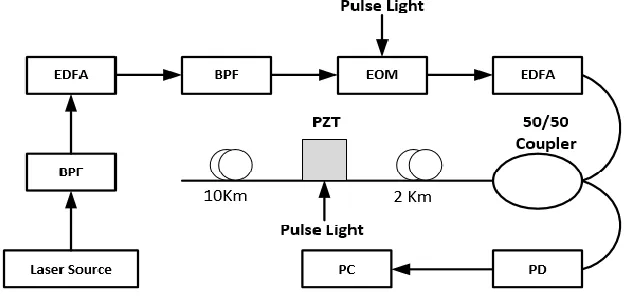
[image:3.612.153.466.418.568.2]Afterwards, Juarez designed an F-P cavity laser consisting of an erbium-doped fiber amplifier (EDFA) and a pair of band-pass filters (BPF)in 2005[6], the experiment diagram is shown in figure 3. The laser output from the laser satisfies the requirements of low drift and narrow linewidth (3kHz), after being modulated by an electro-optic modulator (EOM) it becomes a pulse light injection sensing fiber with a width of 10𝜇𝑠, the piezoelectric simulates the intrusion signal, and the direct detection combined with the erbium-doped fiber amplification enables the sensing distance to reach 12km and spatial resolution to reach 1km. later they improved the structure by adding a light polarization splitter in front of the detector to detect the two polarized beam of reflected light at the same time, which extended the sensing distance of 19km and the spatial resolution to 200m[7]. The traditional OTDR system has been developed so far, the system became very mature, mainly using EDFA for amplification. The typical structural block diagram of the system is shown in figure 2, including light source, modulator, EDFA, Circulator, Photodetector and data processing, etc.
Figure 3 EDFA technology combined with Direct detection of Ф − 𝑂𝑇𝐷𝑅 system
ISSN 2250-3153
3.2.
Raman
Ф − 𝐎𝐓𝐃𝐑
In order to improve the sensing distance and positioning accuracy, Rao Yunjiang proposed a Ф − OTDR sensing system based on high-power, ultra-narrow linewidth single-mode fiber laser in 2008[8]. The sensing distance is 14km, the spatial resolution is 50m, and the signal-to-noise ratio is about 12dB and high sensitivity. In order to overcome some of the shortcomings of centralized amplification, restrain non-linearity effect, on this basis they applied the bi-directional Raman amplification technology to the Ф − OTDR system, and the sensing distance was extended to 62km, reaching the longest distance at the time[9].
[image:4.612.136.487.219.357.2]By further optimizing the system parameters, the method was successfully implemented again and achieves an ultra-long detection distance of 74km and a spatial resolution of 20m. the experiment diagram is shown in figure 4, the ultra-narrow linewidth laser used in the experiment has a linewidth of 2 kHz, a wavelength f 1550nm, and a light pulse width of 200ns, the Raman fiber laser has a center wavelength of 1455nm and a maximum power output of 5W. The scheme improves the uniformity of signal light distribution across the sensing fiber, therefore, the sensing distance of the system is further extended and the spatial resolution is improved.
Figure 4: Experiment Diagram of Ф − 𝑂𝑇𝐷𝑅 system based on two way Raman amplification
Peng zhengpu proposed a forward Raman amplification combined with heterodyne detection method in 2014[10], which brought the sensing distance of the system up to 103km with a spatial resolution of 15.7m, the signal-to-noise ratio reaches 7.89dB, the experiment implemented diagram is shown in figure 5, this method not only enhances the sensing distance but also has high spatial resolution and signal-to-noise ratio, heterodyne detection is used to improve the conversion gain and SNR of backscatter light, at the same time, Raman amplification is used to compensate the propagation loss of Rayleigh backscattering light and pulse light, and the input pulse light power and Raman pump power are adjusted to optimize the system.
Figure 5: Ф − 𝑂𝑇𝐷𝑅 System experiment scheme for forward Raman amplification combined with heterodyne detection
[image:4.612.130.490.476.648.2]ISSN 2250-3153
in sensing distance, spatial resolution and signal-to-noise ratio. Moreover, the complexity and cost of the system have been increased, and experiments and improvements need to be continued in practical applications.
3.4.
Brillouin
Ф − 𝐎𝐓𝐃𝐑
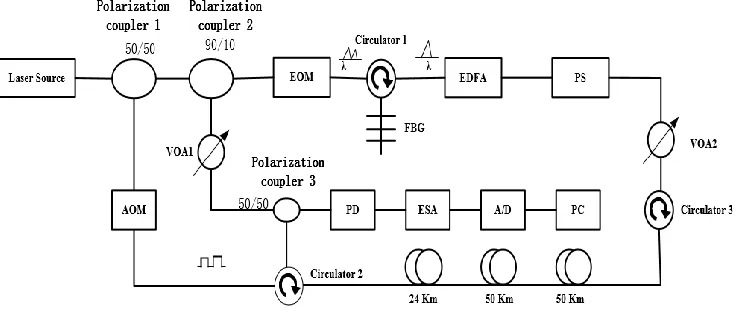
Due to the limitation of Raman amplification pump efficiency, some researchers start looking for new technologies. In 2004, Wan Nan successfully built a Ф − OTDR system based on Brillouin amplification[12], for the first time, brillouin amplification is applied to distributed optical fiber disturbance sensing system and combined with heterodyne detection technology, the milliwatts brillouin pump light makes the sensing distance of the system reach 124km, and the spatial resolution is 20m, the experiment diagram is shown in figure 6. The system structure is mainly composed of laser, polarization-maintaining coupler, EOM, circulator, FBG, EDFA, PS, variable optical attenuator (VOA), AOM, PD, Spectrum analyzer (ASE), and A/D Acquisition data, etc. the backward Brillouin pump power is only 9.5dBm, it is obviously superior to the backward Raman pump power of 26.9dBm, at this point the great potential of Brillouin amplification technology for distributed fiber optic sensing is confirmed.
[image:5.612.124.492.240.398.2]Figure 6: Experiment Diagram of Ф − 𝑂𝑇𝐷𝑅 system based on Brillouin amplification
Subsequently, Zeng jiajia[13] proposed a new type of partitioned distributed amplification (HDA) scheme, the system schematic is shown in Figure 7. Combination of three different pumping methods has been used, including backward brillouin pumping, second order Raman pumping based on random fiber lasers, since each pumping mode provides amplification for the signal light in each section of optical fiber, in turn distributed amplification of the entire sensing fiber is realized which effectively increases the sensing distance. Using HDA technology combined with heterodyne detection technology, the monitoring distance of the Ф − OTDR sensing system is extended to 175km and the spatial resolution is 25m. the experiment verifies the effectiveness of HDA technology. [image:5.612.142.484.538.705.2]
Fiber Brillouin amplification technology is a new amplification technology applied to distributed disturbance sensing system, it’s limitations lies in two points: first, the gain spectrum is narrow (about 30MHz); second, the external temperature is easy to affect the amplification effect, which has an impact on system monitoring.
ISSN 2250-3153
Therefore, the schematic needs further improvement. Utilizing fiber brillouin amplification technology combined with Raman amplification technology and heterodyne detection technology, the sensing distance of the system has been extended, but the spatial resolution still needs to be improved, and the system structure need a further optimization. This method provides a reference for the follow-up research, and fully combines a variety of theories and techniques to achieve a longer sensing distance of the system and improvement of positioning accuracy. In addition, compared to the Raman gain, Brillouin’s gain is much greater than the Raman gain, up to three orders of magnitude. In addition, at the same time the introduction of distributed amplification technology, the use of heterodyne detection and other methods also with the system’s sensing distance has a positive effect.
3.4.
Cascading
Ф
− 𝐎𝐓𝐃𝐑
[image:6.612.157.458.272.365.2]In 2013, Chen Xueyi [14]introduced a two-stage cascaded EDFA amplification structure in Ф − OTDR, a distributed optical fiber sensing intrusion detection system based on coherent backward Rayleigh scattering is constructed. Due to the erbium-doped fiber (EDF) amplification process, ASE emission consumes pump light, reduce pump efficiency, and noise interference. Therefore, an improved EDFA structure is proposed, the diagram is shown in figure 8, consists of three wavelength division multiplexers (WDM). WDM1 and WDM3 couple the signal light and pump light to EDF to interact with, WDM2 is used as channel for pumping light. After the signal light and pump light pass through WDM2 and WDM3, to a great extent suppresses the spontaneous emission noise (ASE), thereby reducing the pump light consumed by the ASE to improve the pump efficiency. The system extends the sensing distance about 35km and the spatial resolution was increased to 15m.
Figure 8: Schematic diagram of two-stage EDFA structure
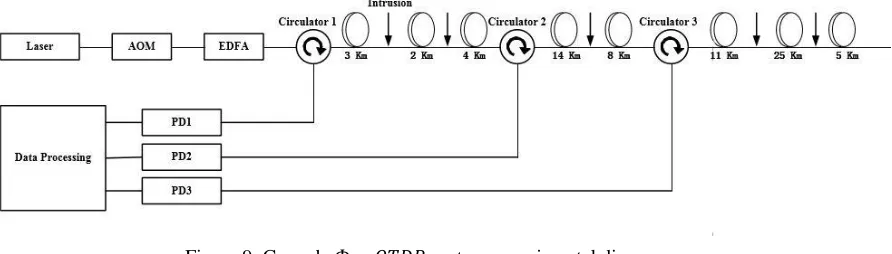
Because the traditional EDFA technology is still limited to SBS, in order to overcome this shortcoming, Lu Qiying [15]proposed another cascaded fiber Ф − OTDR distributed fiber perturbation sensing in 2014, the experimental setup is shown figure 9. Multiple optical circulators are used in the scheme, the First one is to play the role of light isolation, the backscattered light generated will only be received and processed by the photodetector through the first circulator at the front end, and will not enter the previous sensitive fiber. Second, the sensing optical fiber is divided into many segments from short to long, which interrupts the growth mechanism of the stokes wave and reduces the SBS threshold of each level of optical fiber, as to improve the monitoring distance. The system can detect multi-point disturbance positioning at the same time, and the monitoring distance reaches 72km in the laboratory, and later carried out the experiment in the field and the feasibility of cascade scheme in practical application is verified.
Figure 9: Cascade Ф − 𝑂𝑇𝐷𝑅 system experimental diagram
The cascading Ф − OTDR has a simple optical path structure and low cost, in practical applications the cascading optical path can be expanded to a further sensing distance, however, it needs to occupy multiple optical fibers, when calculating the length of each sensing optical fiber the process is tedious and the actual laying of optical fiber is easy to be affected by bending loss and other factors resulting in large deviation.
4.
CONCLUSION [image:6.612.93.539.491.618.2]ISSN 2250-3153
sensing distance, anti-electromagnetic interference, insulation and corrosion resistance, is capable of real-time monitoring and multi-point disturbance simultaneous positioning, and has unique advantages in long-distance perimeter security, oil and gas pipeline safety monitoring, smart grid and railway safety monitoring applications. Although the experimental system based on Ф − OTDR principle has been in pretty good stage but it can’t be denied that the system indicators still need to be improved, including increasing the sensing distance of the system, the spatial resolution, frequency response range, and the signal-to-noise ratio. And the problems existing in the actual application need further exploration and improvements[16].
With development of laser technology and optical fiber sensing technology, as well as the introduction of new technologies and new principles such as EDFA technology, Raman amplification technology, Brillouin amplification, cascade. The sensing distance of Ф − OTDR system is constantly changing, increasing, positioning accuracy continuous to improve, system performance also continuous to improve, in the field of border security, oil pipeline, building structure health monitoring, communication line monitoring and have broader application prospects.
REFERENCES
[1] Z. Wang, X. Jia, H. Wu, F. Peng, Y. Fu, and Y. Rao, “Towards ultra-long-distance distributed fiber optic sensing,” in 25th International Conference on Optical Fiber Sensors, 2017.
[2] V. Kumar and D. Rajouria, Fault Detection Technique by using OTDR: Limitations and drawbacks on practical approach of measurement, vol. 2. 2012.
[3] J. Park, W. Lee, and H. F. Taylor, “<title>Fiber optic intrusion sensor with the configuration of an optical time-domain reflectometer using coherent interference of Rayleigh backscattering</title>,” in Optical and Fiber Optic Sensor Systems, 2003.
[4] R. Juškaitis, A. M. Mamedov, V. T. Potapov, and S. V Shatalin, “Interferometry with Rayleigh backscattering in a single-mode optical fiber,” Opt. Lett., vol. 19, no. 3, pp. 225–227, Feb. 1994.
[5] K. N. Choi and H. F. Taylor, “Spectrally stable Er-fiber laser for application in phase-sensitive optical time-domain reflectometry,” IEEE Photonics Technol. Lett., 2003.
[6] J. C. Juarez, E. W. Maier, K. N. Choi, and H. F. Taylor, “Distributed fiber-optic intrusion sensor system,” J. Light. Technol., 2005.
[7] J. C. Juarez and H. F. Taylor, “Polarization discrimination in a phase-sensitive optical time-domain reflectometer intrusion-sensor system,” Opt. Lett., 2006.
[8] 谢孔利 Xie Kongli, 饶云江 Rao Yunjiang, and 冉曾令 Ran Zengling, Distributed Optical Fiber Sensing System Based of Rayleigh Scattering Light φ-OTDR Using Single-Mode Fiber Laser with High Power and Narrow Linewidth, vol. 28. 2008. [9] Y.-J. Rao, J. Luo, Z.-L. Ran, J.-F. Yue, X.-D. Luo, and Z. Zhou, “Long-distance fiber-optic Φ-OTDR intrusion sensing
system,” in 20th International Conference on Optical Fibre Sensors, 2009.
[10] Z.-P. Peng, Y.-J. Rao, F. Peng, H.-J. Wu, X.-H. Jia, and X.-Y. Li, Long distance phase-sensitive optical time-domain reflectometer based on heterodyne detection and forward Raman amplification, vol. 25. 2014.
[11] Y. Lu, T. Zhu, L. Chen, and X. Bao, “Distributed vibration sensor based on coherent detection of phase-OTDR,” J. Light. Technol., 2010.
[12] J. Li et al., “124km phase-sensitive OTDR with Brillouin amplification,” in 23rd International Conference on Optical Fibre Sensors, 2014.
[13] Z. Jiajia, “Long distance OTDR based on partitioned distributed amplification technology,” Opt. Fiber Opt. Sens. Syst., pp. 24–34, 2015.
[14] Z. X. Chen Xueyi, Dong Fengzhong, “Distributed optical fiber system based on coherent Rayleigh backscattering,” J. Photoelectron laser, vol. 24(9), pp. 1779–1783, 2013.
[15] L. Qiying, “Research on cascade optical phase OTDR long distance sensing technology,” Beijing Univ. Aeronaut. Astronaut., pp. 38–57, 2015.
[16] Y. Qing, P. Zhengming, and W. Zhaoyang, “Research and application of phase sensitive optical time domain reflectometry,”