Linear Distinguishers in the Key-less Setting:
Application to PRESENT
Martin M. Lauridsen and Christian Rechberger
DTU Compute, Technical University of Denmark, Denmark {mmeh,crec}@dtu.dk
Abstract. The application of the concept of linear cryptanalysis to the domain of key-less primitives is largely an open problem. In this paper we, for the first time, propose a model in which its application is meaningful for distinguishing block ciphers.
Combining our model with ideas from message modification and rebound-like approaches, we initiate a study of cryptographic primitives with re-spect to this new attack vector and choose the lightweight block cipher PRESENT as an example target. This leads to known-key distinguishers over up to 27 rounds, whereas the best previous result is up to 18 rounds in the chosen-key model.
Keywords: hash function, block cipher, linear cryptanalysis, distin-guisher, PRESENT
1
Introduction
We start off with a simple, clearly undesirable property of a block cipher and generalize it; suppose there is ann-bit block cipher which allows, for a particular known or chosen key, to determine a plaintext, such that the plaintext is the same as the ciphertext. For a good block cipher, accomplishing this should be very unlikely with much less than 2ntrials. It would, for example, allow preimage attacks in fully preimage-secure compression function constructions that use this block cipher.
Now, consider an n-bit block cipher where the key is known or chosen by the attacker and let us focus on a single bit at positioniof the plaintext pi and ciphertext ci in this setting. We would expect that the equation pi = ci holds in exactly half the cases. In fact, any statistically significant deviation from this expectation can be interpreted as a sign of non-randomness in the cipher.
Such an attack would be in the so-calledkey-less model, which covers both theknown-keyandchosen-key models, and is hence of relevance if the cipher is used as part of a hash function construction. More generally, it allows to make meaningful statements and differentiate between ciphers beyond what is possible
in other models. Should we consider such a cipher as a good building block for a compression function? Not if there would be an alternative cipher with similar implementation characteristics that does not allow for such a distinguisher!
1.1 Contributions
We discuss the two types of contributions in this paper. One is of a more con-ceptual/modeling nature, while the other is a concrete cryptanalytic application of the former.
A New Way of Formulating Key-less Distinguishers. The property
described in the beginning resembles properties used in linear cryptanalysis to recover secret keys. The problem with the above line of reasoning was that so far there did not exist a meaningful model to properly express the setting. By this, we mean a model which has a proper characterization of the power of generic attackers and a clear distinction as to when a dedicated attack in fact can be considered a valid distinguisher, i.e. outperforms generic attackers. In this paper, after starting off by giving notation and preliminary notions of block ciphers and linear cryptanalysis in Section 2, we put in Section 3 the above very informal description of a possible demonstration of non-randomness on more rigorous grounds.
The usual requirement for a distinguisher to be valid is, that one must com-pare the cost of satisfying a specific property, which varies from case to case, for a concrete permutationπ, with achieving the same property for an ideal permu-tation. In our model, we expand on this by posing the problem of determining for a concrete permutation π: i) a linear relation over π in the form of an in-put/output mask and ii) a set of inputs to π, such that the number of inputs satisfying the linear relation is expected to deviate from what one expects of an ideal permutation, by a significant amount. A property which should not be attainable for an ideal primitive.
Our proposed key-less linear distinguisher model captures the possibility of distinguishing a cipher using any previous linear cryptanalysis, in the sense that the attacker needs only a linear hull and the probability distribution on the absolute correlation, to perform his analysis. To amplify the distinguisher to either cover more rounds or to need less computation, approaches inspired by message modification [43] and rebound attacks [36,28] are used.
Application to PRESENT. We can find concrete results in the new model
in round-reduced versions of the leading lightweight-cipher PRESENT [10] (used in compression function designs advocated e.g. in [11]). In Section 4 we describe the relevant aspects of the PRESENT block cipher and give results on linear hulls and keys pertaining to it. Section 5 details the application of the key-less linear distinguisher to PRESENT. We fix a bit positioni, devise an algorithm for determining up to 261.97key-dependent plaintexts in a very efficient manner,
What we claim to be able to find is a deviation from the expectation that the equation pi = ci is fulfilled with probability 12. Depending on the size of the allowable key-set, this will work for up to 27 rounds of PRESENT. Detailed results are summarized in Table 4, before our conclusions and a discussion of open problems in Section 6. We confirm the results with experimental verifications (see Appendix C and [29]).
1.2 Related Work
Linear cryptanalysis, a technique to recover keys in ciphers, was pioneered by Matsui from 1992 on [33,35], with extensions or variants such as multiple lin-ear approximations [5,20], linlin-ear hulls [39], multidimensional variants [16], zero-correlations [12] and considerations of a general statistical framework [3,31,38].
The application of linear cryptanalysis to key-less constructions, i.e. in mod-els where the key is either known or chosen by the attacker, is largely an open problem. Sometimes, designs are evaluated with respect to standard linear crypt-analysis [2,32]. Some designers of SHA-3 candidates state properties with respect to this class of attacks (such as linear probability) without ever mentioning spe-cific models. The reason is that there simply was no model, a situation that we address in this paper.
In all cases of linear cryptanalysis applied in a key-less setting, the analysis done is exactly the same as in a setting with a secret key: a linear approximation with a non-zero correlation is presented. The only known exception to us is a linear analysis of Cubehash by Ashur and Dunkelman [2]. There, an 11-round linear approximation with bias 2−235is used to describe a standard distinguisher
with 2470 queries. Then, inspired by a chosen-plaintext variant of linear
crypt-analysis of DES by Knudsen and Mathiassen [23], the authors fix 80 bits of the plaintext input of modular additions, thereby gaining the first round for free, arriving at a 12-round result with a complexity below 2512. This can be seen as a predecessor to our deterministic technique of Section 5.2.
The only analysis of PRESENT in a setting without secret keys we know of is by Koyama, Sasaki, and Kunihiro [25]. In their work, differential chosen-key distinguishers (a setting that gives the attacker more freedom than in our known-key model) for up to 18 rounds are obtained.
At its core is a differential rebound attack with an inbound phase of 5 rounds that needs 100 degrees of freedom1. In the method we propose, we allow the key
to be fixed arbitrarily, and out of the remaining 64 degrees of freedom from the plaintext input more than 61 degrees of freedom remain. Hence our results, that cover more rounds, and use our deterministic phase over 3 rounds that needs only 3 degrees of freedom, compare favorably to this result.
1
2
Preliminaries
In this section we introduce our notation, give basic definitions and recall known properties related to our analysis throughout the paper.
Notation. For ann-bit block cipher with key space K, let E :Fn2 × K →Fn2
andD:Fn2× K →Fn2 denote encryption and decryption functions, respectively.
For convenience, we also use the notation thatEK(x) :=E(x, K) andDK(c) :=
D(c, K). We use ]X to denote the size of a set X. For a real number w, |w| denotes the absolute value ofw. We letPerm(n) denote the set of all permutations onn-bit inputs and we letx←−$ X denote the assignment ofxby an element ofX
chosen uniformly at random. We useN(µ, σ2) andB(n, p) to denote the normal-and binomial distributions respectively. For a distribution D we useΦ(D, x) to denote the cumulative distribution function ofDat pointx. We use the notation that ei is a binary string with a 1 in position iand zeroes elsewhere.
In this paper, when we talk about the key-less setting, we implicitly mean adversarial assumptions where the keyK∈ Kis either known or chosen by the attacker.
Trails and Hulls. In the following, letF :Fn
2 →Fn2 be an iterated function
of the formF =FR◦ · · · ◦F1. We borrow to a large extent the notation from
Leander’s treatment on linear cryptanalysis [31]. We define a mask as a vector
α∈Fn2. For two masks α, β, we denote by hα, βi the inner product of the two
masks:
h(α0, . . . , αn−1),(β0, . . . , βn−1)i:=
n−1
M
i=0
αiβi.
We define anR-roundtrail as an element (δ, α1, . . . , αR−1, γ)∈(Fn2)R+1, where
δ and γ are the input and output masks, respectively. The αi are called the
intermediate masks. For a randomly chosenx∈Fn2, and fori= 1, . . . , R(letting
α0=δ andαR=γ), we have
Pr [hx, αi−1i=hFi(x), αii] = 1 2 +
CFi(αi−1, αi)
2 ,
where CFi(αi−1, αi) is the correlation over Fi. The trail correlation over F is defined in terms of theCFi as
CF(δ, α1, . . . , αR−1, γ) =CF1(δ, α1) R−1
Y
i=2
CFi(αi−1, αi)
!
CFR(αR−1, γ). (1)
We say that a trail is valid if and only if each constituent correlation of (1) is non-zero.
t∈LHR(δ, γ) for anR-round trailt. Note that a linear hull LHR(δ, γ) defines an
R-roundlinear relation betweenxand F(x), which we denoteRF δ,γ :F
n
2 →F2,
where
RF δ,γ(x) =
(
1 ,hx, δi=hF(x), γi 0 ,hx, δi 6=hF(x), γi.
WhenRF
δ,γ(x) = 1 we say the relation issatisfied for inputxand otherwise it is not. The linear hull correlation [17, Theorem 7.8.1] is given by
CF(LHR(δ, γ)) =
X
t∈LHR(δ,γ)
CF(t)
= X
t∈LHR(δ,γ)
(−1)sgn(t)· |CF(t)|, sgn(t) =
(
0 ,CF(t)≥0 1 ,CF(t)<0
.
When the trail or hull is understood, we write CF for simplicity to mean the correlation of the trail or hull over F. For a block cipher, the value of sgn(t) for t ∈ LHR(δ, γ) depends on the secret key K ∈ K, and hence the value of |CF(LHR(δ, γ))| depends on the difference between the number of trails with sgn(t) = 1 and those with sgn(t) = 0. In this paper, we use the following as-sumption.
Assumption 1 For any fixed key K ∈ K, we assume that for any two trails
t, t0 ∈ LHR(δ, γ), where t 6= t0, the signs sgn(t) and sgn(t0) are independent
Bernoulli random variables withp=12.
We note that Assumption 1 has been experimentally verified for PRESENT, see e.g. [13,31].
For readers familiar with differential-type attacks in the known-key setting, we offer the following loose analogy. We say that x∈ Fn2 follows an R-round
trail over F if and only if
hx, δi=hF1(x), α1i=· · ·=h(FR−1◦ · · · ◦F1)(x), αR−1i=hF(x), γi.
This notion will be used in Section 5, when we describe how to use a technique similar to message modification, to extend a presented distinguisher in the key-less setting.
3
Key-Less Linear Distinguishers for Block Ciphers
Mendel, Schl¨affer, Rechberger and Rijmen [27] proposed open- or chosen-key models to evaluate the security of block ciphers.
Even though these models often exhibit a rather contrived looking property, and evade a formally rigorous definition2 (a property they share with collision
attacks), cryptanalysts largely agree that these distinguishers are useful and interesting. Indeed, techniques developed to improve the original known-key dis-tinguishers from [24], such as the rebound attack later led to collision attacks on various hash functions [21,37,27]. Also, the findings in the open-key model from [8] were later used to find the first related-key key-recovery attacks on AES-256 and AES-192 [6,7].
3.1 Motivation for our Distinguisher
Sometimes distinguisher descriptions are merely motivated by the fact that they
canbe formulated, as e.g. the 7-round known-key distinguisher on AES from [24], where byte-level zero-sums are used as a distinguishing property. Another ex-ample is the rotational rebound attack on reduced Skein [22], where the exis-tence ofrotational collisions with errors is defined as a distinguishing property. Sometimes, however, they are better motivated, e.g. by the construction of near-collisions, or the subspace- and limited-birthday distinguishers [19,27,28] that resemble some generalization of the concept of near-collisions.
The distinguisher we propose below comes with a new motivation that stems from preimage attacks on hash functions or compression functions3. As an
exam-ple, consider the compression function construction using a single call to a block cipher in Matyas-Meyer-Oseas mode. The ith message blockmi is compressed by using it as the plaintext input when computing the next chaining valueHi+1
using Hi as the cipher key, i.e. Hi+1 = EHi(mi)⊕mi. If an attacker can de-termine a relation stating that the jth bit ofmi equals thejth bit of EHi(mi) with a high probability, then it is likely that thejth bit of Hi+1 equals zero. In
a preimage attack, if the target preimage is zero at positionj, this then leads to an advantage over brute-force search.
Motivated by this example, we proceed with our new key-less linear distin-guisher model for block ciphers that we will use throughout the paper.
3.2 The Key-less Linear Distinguisher Model
In the following, we give our definition of a model for key-less linear distinguish-ers. Essentially, the model captures the possibility of distinguishing any block cipher in the key-less setting, given that a linear relation (in the form of a linear hull) of sufficiently high absolute correlation for a reasonable fraction of the key spaceK, is available. The notions of Definitions 1 and 2 are largely inspired by the recent work of Gilbert on pushing known-key attacks further on the AES [18].
2 One exception being [1] 3
The following definition of α-separability formalizes how a linear relation, combined with a set of inputs for a permutation π : Fn
2 → Fn2, can exhibit a
significant deviation from the behavior of a random permutation.
Definition 1 (α-separability). LetP be a set of permutations fromFn2 toFn2
and let π∈ P denote a particular, fixed permutation from P. Let S ⊆Fn2 with
sizeMand letδ, γ∈Fn2\{(0, . . . ,0)}.
Without checking each input, eachxi∈ S has an (a priori) associated
proba-bilitypi= Pr
h Rπ
δ,γ(xi) = 1
i
that the linear relation is satisfied for that particular
input. Let X =]{x∈ S | Rπ
δ,γ(x) = 1}, thenE[X] =
PM
i=1pi. We say that the
tuple (P, π,S,Rπ
δ,γ) is α-separable if and only
Pr
E
[X]−M 2
≥√M
≥α,
where the probability is taken overπ∈ P.
Definition 2 ((T,M, α)-intractability).LetP be a set of permutations from
Fn2 toF
n
2 and letπ∈ Pdenote a particular, fixed permutation fromP. LetS ⊆F
n
2
of sizeMand let δ, γ∈Fn2\{(0, . . . ,0)}. We say that the tuple(P, π,S,Rπδ,γ)is (T,M, α)-intractableif and only if it is impossible, for any algorithm Ato
1. Commit to a choice ofδ0, γ0 ∈Fn2\{(0, . . . ,0)} and
2. When given access to a fixed pairΠ, Π−1withΠ←−$ Perm(n), construct a set
S0 of sizeMin timeT, s.t. the tuple(Perm(n), Π,S0,RΠ
δ0,γ0)isα-separable.
Note 1. For our distinguisher model, the notion ofone time unit corresponds to a single evaluation of the respective permutation.
With the definition ofα-separability and (T,M, α)-intractability in hand, we are ready to formulate our proposed key-less linear distinguisher.
Definition 3 (Key-less linear distinguisher). Let E : Fn
2 × K → Fn2 be a
block cipher and letE to denote the set of permutations due to choices of the key K∈ K. LetEK denote some fixed permutation from E.
Fix δ, γ∈Fn
2\{(0, . . . ,0)} and let A be an algorithm producing in time T a
set S ⊆ Fn
2 of size M. Then the tuple (A,E, EK,S, T,REδ,γK, α) is said to be a key-less linear distinguisher if and only if (E, EK,S,REδ,γK) is both α-separable
and(T,M, α)-intractable.
Note 2. In all of the definitions above, the fixed linear masksδ, γ∈Fn2\{(0, . . . ,0)}
arechosenby the algorithmA, but the choicemust be made beforethe produc-tion of the input setS commences.
In the context of distinguishing a block cipher, the adversary commits toδ
and γ and then obtains access toEK upon which the production of S in time
Analysis. In the following, we analyze and argue that the key-less linear dis-tinguisher is meaningful. First, informally, the notion ofα-separability expresses that for a concrete permutationπ:Fn
2 →Fn2, one can provide a linear relation
which captures, for some constructed set of inputs, a significant non-random behavior in a permutation which is supposed to behave randomly. The signifi-cant part is captured by the requirement that the number of inputs satisfying the relation Rπ
δ,γ should deviate from what is expected in the ideal case by at least √M. This reflects the usual requirement in linear cryptanalysis, that the data complexity is inversely proportional to the squared correlation. Second, on top of that, Definition 2 captures the notion that for a random permutation
Π ←−$ Perm(n), it should not be possible, in the same amount of time, to pro-vide such a relation with a set of inputs which exhibits the same significant non-random behavior.
With respect to Definition 2, one of the components to analyzing our pro-posed key-less linear distinguisher is to answer the following question: what is theupper bound on the probabilityα0 that an algorithm A, when given access to the fixed pairΠ andΠ−1, can produce in timeT a setS0⊆
Fn2 of sizeM,
to-gether with a pre-determined relationRΠ
δ,γ, such that (Perm(n), Π,S0,RΠδ,γ) isα0 -separable? Our analysis answers this question in the following, and it implicitly provides alower bound onαfor when a concrete permutationπ:Fn2 →Fn2 ∈ P
(in the notation of Definitions 1 and 2) can be shown to be (T,M, α)-intractable, for fixedT andM. We begin our analysis with Lemma 1.
Lemma 1. In the notation of Definition 2, letδ0, γ0 ∈
Fn2\{(0, . . . ,0)} be fixed
non-zero linear masks, and let then an algorithm Abe given access to Π, Π−1,
whereΠ ←−$ Perm(n). The optimal way forA to constructS0⊆
Fn2 of sizeMin
timeT is the following:
1. Construct an arbitrarily chosen setQ ⊆Fn2 of size T.
2. Partition Q into Q1 = {x ∈ Q | RΠδ0,γ0(x) = 1} and Q0 = {x ∈
Q | RΠ
δ0,γ0(x) = 0} by querying Π(x) for all x ∈ Q (this has time
complexity T).
3. SetS0 equal to the larger of the sets Q
0 andQ1.
4. Fill up S0 with arbitrarily chosen inputs from
Fn2\Quntil]S0 =M.
Proof. As Π ←−$ Perm(n), the particular choice of δ0, γ0 ∈ Fn2\{(0, . . . ,0)} does
not affect the analysis. The most informationAcan learn aboutΠ in timeT is to obtainT pairs (x, Π(x)), as is done when determiningQand its image under
Π. In order to optimally shift the balance of the expected number of inputs of S0 satisfyingRΠ
δ0,γ0 away fromM/2,Ashould take the larger ofQ1andQ0and
pool it with randomly chosen inputs xfor which the value of RΠ
δ0,γ0(x) is not
known. ut
Continuing our analysis, assuming an algorithmAconstructsS0as in Lemma 1, we determine an upper bound on the value α0 as a function ofMand T, such that the resulting tuple (Perm(n), Π,S0,RΠ
Theorem 1 (Generic success probability). Let A, Π, δ0, γ0,S0 andT be as
in Lemma 1, whereT ≤4√M, and letX :=]{x∈ S0| RΠ
δ,γ(x) = 1}. Then
Pr
E
[X]−M 2
≥√M
= 2−T ·
T−2√M
X k=0 T k + T X
k=2√M
T
k
.
Proof. First, note that ]Q1 ∼ B(T,12). We want to determine the probability
that we have E[X]−M2 ≥
√
M. The consideration is split into two cases depending on whether or not]Q1≥T /2.
Case ]Q1 ≥ T /2. In this case, we know that at least ]Q1 of the M inputs
satisfy the relation. Thus, E[X] = E[Z] +]Q1 where Z ∼ B M −]Q1,12
. Thus, E[X] = M+2]Q1, and the requirement E[X]−M2
≥
√
M is equivalent to either]Q1≥2
√
Mor]Q1≤ −2
√
M, the latter not being possible as]Q1 is
non-negative.
Case ]Q1 < T /2. In this case, we know that there are at least T −]Q1 of
theM inputs thatdo not satisfy the relation. Thus, E[X] =E[Z] where Z ∼ B M −T+]Q1,12. Thus,E[X] = M−T2+]Q1, and the requirement
E[X]−M2 ≥ √
Mis equivalent to either ]Q1 ≥T+ 2
√
M or ]Q1 ≤T −2
√
M, the former not being possible as ]Q1≤T.
In both cases considered, there is one event which makes the inequality
E[X]−M2 ≥
√
Mtrue. The combined probability of those two events is
Prh]Q1≥2
√
Mi+ Prh]Q1≤T−2
√ Mi
= 2−T ·
T−2√M
X k=0 T k + T X
k=2√M
T
k
.
From this, the result follows. ut
Note 3. The requirementT ≤4√M in the statement of Theorem 1 arises be-cause otherwise the two sums would overlap and add the same terms twice. The probability which is derived as a function of M and T provides a lower bound on α for when, in the notation of Definition 2, a tuple (P, π,S,Rπ
δ,γ) can be (T,M, α)-intractable. By using the normal approximation of ]Q1, i.e.
]Q1 ∼ N T2,T4
, one obtains a very precise and easily-computable approxima-tion of the probability as
1−Φ N T 2, T 4 ,2√M
+Φ N T 2, T 4
, T −2√M
.
Corollary 1. LetAbe an algorithm which, after a choice ofδ, γ∈Fn
2\{(0, . . . ,0)}
WhenT <2√MandP =Perm(n), it is impossible forAto produce in time T a set S ⊆Fn
2 of size M s.t. the tuple (P, π,S,Rπδ,γ) is α-separable for any
α >0.
On the other hand, when T ≥4√M andP =E (in the notation of Defini-tion 3), then it is impossible for A to produce in time T a set S ⊆ Fn
2 of size
Ms.t. the tuple(A,P, π,S, T,Rπ
δ,γ, α)is a key-less linear distinguisher for any
α >0.
Proof. The first result follows directly from Theorem 1 when observing that the both sums are zero whenT <2√M. The second result follows from Theorem 1 when observing that the sums equal one whenT = 4√M. This makes (T,M, α
)-intractability impossible. ut
Note 4. The key-less linear distinguisher specified in Definition 3 does not ask to provide outputs. Thus, it is not ruled out to give a valid key-less linear distin-guisher without pre-computation, i.e. to haveT = 0. Indeed, one of the concrete applications we show to the block cipher PRESENT does not need any compu-tations.
From Corollary 1 it follows that when no pre-computation is allowed, i.e. when T = 0, any algorithm A producing a set S ⊆ Fn
2 together with any
re-lation δ, γ∈Fn
2\{(0, . . . ,0)} for a permutationEK ∈ E, yields a key-less linear distinguisher (A,E, EK,S, T,REδ,γK, α) for some α >0. Note, however, that the parameterαmeasures how likely such a distinguisher is to succeed for a specific key. For example, when α is very low, one might have a valid key-less linear distinguisher for many rounds, but for a tiny fraction of the key space. As such, when T = 0, such a key-less linear distinguisher is to be taken with a grain of salt, depending on the value α. In the following dicussions, we always provide together with our distinguishers the parameterα, to make clear the lower bound on the fraction of the key space for which it is valid.
Having analyzed the generic case, we move on to stating in Theorem 2 a necessary condition for when, for a particular fixed π ∈ P and non-zero linear masksδ, γ ∈Fn2\{(0, . . . ,0)}, an algorithm A can constructS ⊆Fn2 of size M
in time T, s.t. the tuple (P, π,S,Rπ
δ,γ) is aα-separable.
Theorem 2. Let π ∈ P and fix non-zero linear masks δ, γ ∈ Fn2\{(0, . . . ,0)}.
Let S ⊆Fn2 have sizeM. Then the tuple (P, π,S,Rπδ,γ)can be α-separable for
α >0if and only if the absolute correction|Cπ|ofRπδ,γ satisfies|Cπ| ≥2/ √
M. Furthermore, the largest αfor whichα-separability is obtained, is given by α= Prh|Cπ| ≥2/
√ Mi.
Proof. LetX :={x∈ S | Rπ
δ,γ(x) = 1}. ThenX ∼ B M,
1 2+
Cπ
2
. We haveα
-separability if and only if PrhE[X]−M2 ≥
√
Mi≥α. Thus, we require either
E[X]≥M2 +
√
MorE[X]≤M2 −
√
M. SinceE[X] = M2 +M·
Cπ
2 , this happens
exactly when|Cπ| ≥2/ √
4
The Block Cipher PRESENT, Keys and Linear Hulls
PRESENT is a 64-bit iterated block cipher [10] for use in lightweight applications such as RFID tags and wireless sensor networks. Its use in compression function designs is e.g. studied and advocated for in [11]. The key space isK =Fκ
2 with
κeither 80 or 128 bits. The respective block ciphers are denoted PRESENT-80 and PRESENT-128. Both ciphers have 31 rounds. The PRESENT key-schedule (see Appendix A for details) produces 32κ-bit round keys, but only the 64 most significant bits are used in the key addition of each round. We refer to these 64-bit round keys asKi withi= 0, . . . ,31.
The structure of PRESENT is a substitution-permutation network, repeating the round function
Ri(x) =P◦S(x⊕Ki),
where x is the 64-bit state input to round i, S is the parallel application of sixteen identical 4-bit S-boxes and P is a fixed bitwise permutation4. The full
cipher is composed of 31 applications of the round function followed by addition of a post-whitening key, i.e.
EK= (R30◦ · · · ◦R0)(x)⊕K31.
An illustration of a single round of PRESENT is given in Figure 1. For the specification of the PRESENT S-box and permutationP, see Appendix A.
S S S S S S S S S S S S S S S S
Fig. 1: Top-to-bottom illustration of a single round of PRESENT
4.1 Keys and Linear Hulls in PRESENT
One of the first thorough treatments of linear cryptanalysis on PRESENT is by Ohkuma [40]. This work defines optimal linear trails using solely masks of Hamming weight one. Furthermore, 64 optimal hulls using these trails are de-termined, along with the number of trails in each hull.
The absolute correlation for one of Ohkuma’s R-round optimal trails t is |CEK(t)|= 2
−2R. Considering a particularR-round optimal hull LH
R(δ, γ), let
TR+(respectivelyTR−) denote the number of trailstin the hull for which sgn(t) = 0 (respectively sgn(t) = 1). We also letTR :=]LHR(δ, γ), i.e.TR =TR++T
− R.
4
By Assumption 1, for a fixed key K ∈ K, we have TR+ ∼ B TR,12
, which for sufficiently large TR is well approximated by TR+ ∼ N
TR
2 ,
TR
4
. Let Z =
TR+−TR−= 2TR+−TR. Thus,Zis normally distributed withµ= 2·T2R−TR= 0 and σ2 = 22· TR
4 =TR, so Z ∼ N(0, TR). When |Z| ≥ N, for some N, where
0≤N≤TR, the absolute linear hull correlation is
|CEK| ≥N·2 −2R.
Thus, there is a clear trade-off between the lower bound on |CEK| and the probability that a randomly chosenK∈ Kyields such a lower bound.
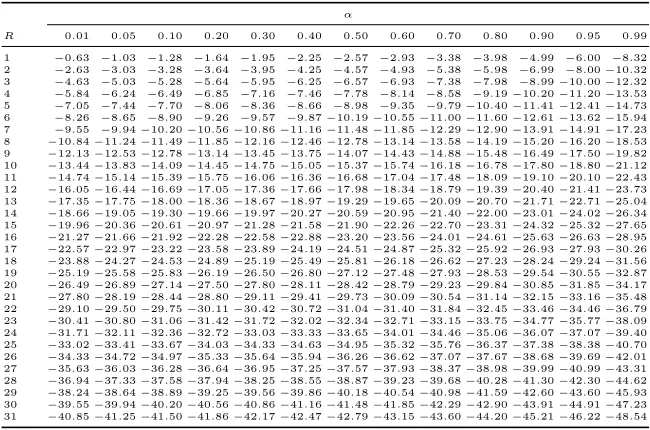
For theTRvalues, we refer to [40] or Table 6 in Appendix B. For a fixed num-ber of roundsR, using the analysis above,TRcan be used directly to determine i) a lower bound on |CEK| and ii) the probability that for a random K ∈ K, this bound is obtained. Table 1 gives, for various probabilities α and number of roundsR the valueβ such thatα= Pr [|CEK| ≥β]. Table 7 in Appendix B gives the same data points forR∈ {1, . . . ,31}.
Table 1: Values log2β s.t.α= Pr [|CEK| ≥β] forR-round PRESENT
α
R 0.01 0.05 0.10 0.30 0.50 0.70 0.90 0.95 0.99
7 −9.55 −9.94 −10.20 −10.86 −11.48 −12.29 −13.91 −14.91 −17.23 11 −14.74 −15.14 −15.39 −16.06 −16.68 −17.48 −19.10 −20.10 −22.43 16 −21.27 −21.66 −21.92 −22.58 −23.20 −24.01 −25.63 −26.63 −28.95 24 −31.71 −32.11 −32.36 −33.03 −33.65 −34.46 −36.07 −37.07 −39.40 26 −34.33 −34.72 −34.97 −35.64 −36.26 −37.07 −38.68 −39.69 −42.01 28 −36.94 −37.33 −37.58 −38.25 −38.87 −39.68 −41.30 −42.30 −44.62 31 −40.85 −41.25 −41.50 −42.17 −42.79 −43.60 −45.21 −46.22 −48.54
Example 1. For R = 28, we have T28 = 45170283840. Thus, with probability
α= 0.30, a randomly chosenK∈ Kyields that one of Ohkuma’s optimal hulls has|CEK| ≥2
−38.25.
5
Application to PRESENT
5.1 Probabilistic Phase
In this section we present key-less linear distinguishers on PRESENT using the model introduced in Section 3. We refer to approach described here as the prob-abilistic phase, which in Section 5.2 is combined with a deterministic phase to extend the distinguishers for three more rounds. The distinguishers we present here do not use any pre-computation, i.e. in the notation of the model, we have
T = 0. Corollary 1 implies in this case that when |CEK| > 0, the tuple pro-duced by any algorithm Ais always (T,M, α)-intractable for someα >0, and hence a valid distinguisher. The results match those of distinguishers used in key-recovery attacks and are as such of limited interest. We hope the discussion below makes it easier to follow (and appreciate) the real use of the model intro-duced, namely the case described in Section 5.2 when we do some, albeit very little, pre-computation.
In the following, let REK
δ,γ be the linear relation used, where δ = γ = e21, which is one of the optimal linear hulls for PRESENT identified by Ohkuma. Also, letAbe an algorithm constructingS ⊆Fn2 by pickingMarbitraryx∈Fn2.
In Table 2 we give, for variousMand number of roundsR, lower boundsαon the fraction of the key space, s.t. (A,E, EK,S, T = 0,REδ,γK, α) are key-less linear distinguishers.
Table 2: Lower boundsαon the fraction of the key spaceK susceptible to key-less linear distinguishers usingT = 0, and the specifiedMand number of rounds
R. A dash indicates thatα <0.00.
RoundsR
M 10 11 12 13 14 15 16 17 18 19 20 21 22 23
240 0.96 0.89 0.74 0.41 0.04 − − − − − − − − −
244 0.99 0.97 0.93 0.84 0.61 0.21 − − − − − − − − 246 0.99 0.99 0.97 0.92 0.80 0.53 0.12 − − − − − − −
252 1.00 1.00 1.00 0.99 0.97 0.94 0.85 0.63 0.24 − − − − − 254 1.00 1.00 1.00 0.99 0.99 0.97 0.92 0.81 0.55 0.14 − − − − 256 1.00 1.00 1.00 1.00 0.99 0.98 0.96 0.90 0.77 0.46 0.07 − − − 262 1.00 1.00 1.00 1.00 1.00 1.00 1.00 0.99 0.97 0.93 0.82 0.58 0.17 − 263 1.00 1.00 1.00 1.00 1.00 1.00 1.00 0.99 0.98 0.95 0.87 0.69 0.33 0.02
264 1.00 1.00 1.00 1.00 1.00 1.00 1.00 0.99 0.99 0.96 0.91 0.78 0.49 0.09
Note, that theαparameter from Table 2 gives immediately the probability that such anR-round key-less linear distinguisher without pre-computation for PRESENT is valid in practice, for a fixed chosen- or known key K ∈ K. As examples, we see that with M= 240, the probability of having a valid key-less
5.2 Extension by Deterministic Phase
Next, we describe how one can use pre-computation to extend the key-less linear distinguishers from Section 5.1 to cover three more rounds with no degradation to the valid key space fraction α. In the notation of the model, we now have
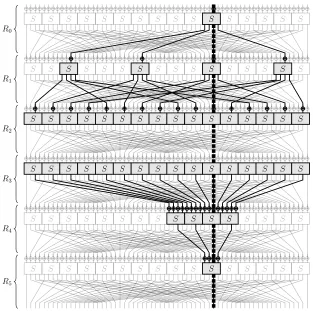
T > 0, which in turn means that (T,M, α)-intractability is no longer granted for free by Corollary 1, unless belowT < 2√M. In Appendix D we outline an approach for a deterministic phase over 6 rounds, reminiscent of the rebound approach [36,28], which however has a computational complexity too high to fit into our model.
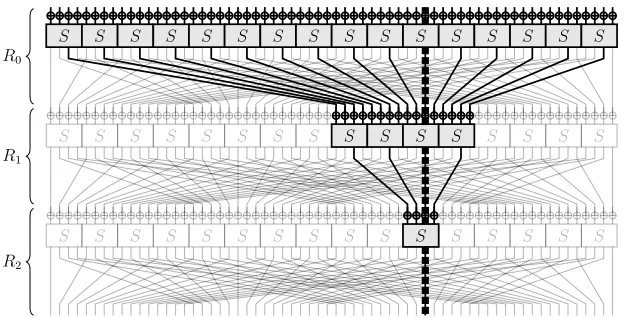
We describe in the following the algorithm A which will construct the set of inputs S. The algorithm we give will construct S such that each x ∈ S is guaranteed to follow the linear trail T = (e21,e21,e21,e21) over the first three rounds. We remark that this choice of trail is not unique; several others choices are possible, this is but one example. We refer to the approach we describe as thedeterministic phase.
R0
S S S S S S S S S S S S S S S S
S S S S S S S S S S S S S S S S
R1
S S S S S S S S SS SS SS SS S S S S
R2
S S S S S S S S S S SS S S S S S
Fig. 2: Construction of S for 3-round PRESENT using the trail T = (e21,e21,e21,e21). The highlighted parts show the S-boxes and key bits involved in the construction. The trail is indicated by the thick dotted line.
For notation, in roundr ∈ {0,1,2}, letSr,j denote thejth S-box of round
Rr (counting from right to left) and let Kr,j denote the jth least significant bit of the round key Kr, where all indices start from zero. Consider then S2,5
which is highlighted in Figure 2. By inspection, the PRESENT S-box has 10 inputs x which satisfyhx,(0,0,1,0)i= hS(x),(0,0,1,0)i and hence follow the trail (e21,e21) over the round R2, no matter what the inputs on the other
S-boxes are. By adding the key bits (K2,23k · · · kK2,20) to each x, we can trace
those back through the permutation layer of the round R1. For each value of
of the S-boxes S1,7, . . . , S1,4, as indicated in Figure 2. By the bijectivity of the
S-box, it holds that for each of these S-boxes, half the inputs will give the desired output bit. However, for the S-boxS1,5 we have the extra requirement that the
input bit on position 1 should equal the output bit on position 1, and only 5 inputs satisfy both properties simultaneously. As such, we can trace each of the ten values forxback throughR1and also adding the key bits (K1,31k · · · kK1,16)
to obtain 10·83·5 = 25600 inputs toR
2◦R1which follow the trail (e21,e21,e21)
by construction. By tracing each of these values back throughR0the same way,
and adding the full round key K0, algorithmAhas a construction of the set S
which consists of inputs which follow T over three rounds with probability 1. Using this approach to constructing S, the size of the set can be up to M = 25600·815·5 = 4503599627370496000≈261.97. As such, if one should wish to use a smallerMfor the key-less linear distinguisher, this is also possible, simply by leaving out elements in the construction ofS.
Table 3: Tight values αsuch that (E, EK,S,REδ,γK) is α-separable, where EK is
R-round PRESENT for a fixed, knownK∈ K(and thusEK ∈ E)
RoundsR 18 19 20 21 22 23 24 25 26
α 0.998 0.995 0.988 0.970 0.926 0.819 0.571 0.162 0.001
Consider EK being R-round PRESENT for a particular fixed K ∈ K, and thus EK ∈ E. Let A be an algorithm for constructing S using the 3-round deterministic phase described, with M ≈ 261.97 for one of Ohkuma’s optimal
linear hull relations REK
δ,γ. Table 3 gives, for various number of rounds R, the highest possible α s.t. (E, EK,S,REδ,γK) is α-separable as per Definition 1. Of course, in order for the key-less linear distinguisher (A,E, EK,S, T,REδ,γK, α) to be valid, it also has to hold that the tuple (E, EK,S,REδ,γK) is (T,M, α)-intractable as per Definition 2, whereT is the time required byAto construct the setS.
In Section 5.3, we show that the timeTrequired to constructSbyAis equiv-alent to T = 40964116R calls to anR-round PRESENT encryption oracle. As such, we have that T <2√M, and from Corollary 1, it follows that (E, EK,S,REδ,γK) is (T,M, α)-intractable.
In Appendix C, we give examples of experimental verification of the key-less linear distinguishers presented on 9-round PRESENT. The code for this experimental verification is available as [29].
5.3 Computational Complexity
performed byAand then compare this to the number of S-box applications for a full call to the encryption oracle.
Let us consider all S-boxes as being different for generality, as the complexity in this case will certainly upper bound the case where they are all equal. In particular, since the key is known, this allows us to consider the key addition as part of the S-boxes. The analysis follows the construction of S by A itself, starting from round R2 and working its way up (referring again to Figure 2).
To determine the 10 inputs toS2,5,Aperforms one lookup into this S-box. For
each of these 10 values, one bit is traced back to an S-box of R1, so this adds
10·4 S-box lookups. Finally,Ahas 25600 inputs to roundR1 for which it traces
one bit back to each of the 16 S-boxes of round R0, contributing by 25600·16
S-box lookups.
In total, the number of lookups is 1+10·4+25600·16 = 409641. Now, compar-ing to the number of S-box lookups involved with a call to anR-round PRESENT oracle, the number of lookups would be 16R, not counting key scheduling. As such, we find that the timeT spent byAfor constructingS isT = 409641
16R .
Memory Complexity. The memory complexity, though not a formal part of
the key-less linear distinguisher model, is at a practical level. The storage of the setS can be encoded efficiently as follows. We define three sets
Q={X |X1=S(X)1},
S0={X |S(X)1= 0}, and
S1={X |S(X)1= 1}.
(2)
In a setLwe store the 25600 inputs which follow the trail (e21,e21) overR2◦R1.
LetX =X15k · · · kX0 denote one such 16-bit fromL. The corresponding set of
inputs toR0is now determined as the Cartesian product
SX15× · · · ×SX6×Q∩SX5×SX4× · · · ×SX0. (3) The storage ofQ,S0 andS1 take up 5 bytes, 4 bytes and 4 bytes, respectively.
The storage ofL takes up 50 KB.
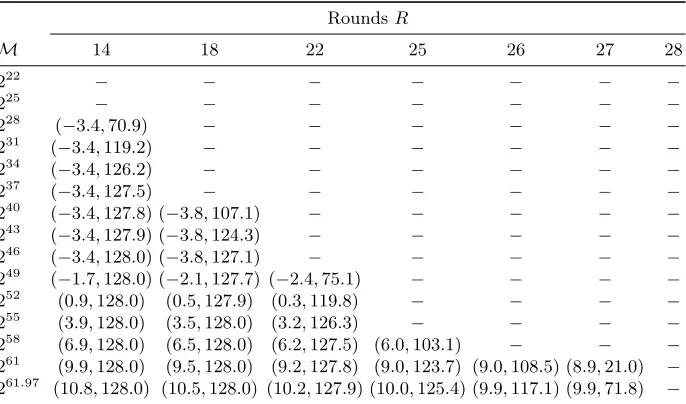
Using these simple observations, we give in Table 4 an overview of selected results for key-less linear distinguishers on R-round PRESENT. We give the size M of S ⊆ Fn2 constructed by A, the time T required to do so, and the
parameterα(implicitly, as we giveα·2128) for the distinguisher, i.e. the lower bound on the fraction of the key space for which the distinguisher is valid. As such, the table is representative for PRESENT-128. Numbers for PRESENT-80 can be directly determined with the sameT andα·280. Note, however, that for
27-round PRESENT-80 usingM= 261.97,α·280<0, so one can distinguish at
most 26 rounds of PRESENT-80.
Table 4: Overview of parameters for key-less linear distinguishers on PRESENT. The entries give, for each M and each total number of rounds R a pair (log2T,log2(α·2128)) s.t. algorithm A can construct S in time T and result
in a distinguisher forat least a fractionαof the key space. Here, we indicate for PRESENT-128 the number of keys supporting the distinguisher. The equivalent number for PRESENT-80 is obtained asα·280. A dash indicates thatα·2128<0.
RoundsR
M 14 18 22 25 26 27 28
222 − − − − − − −
225 − − − − − − −
228 (−3.4,70.9) − − − − − −
231 (−3.4,119.2) − − − − − −
234 (−3.4,126.2) − − − − − −
237 (−3.4,127.5) − − − − − −
240 (−3.4,127.8) (−3.8,107.1) − − − − − 243 (−3.4,127.9) (−3.8,124.3) − − − − −
246 (−3.4,128.0) (−3.8,127.1) − − − − − 249 (−1.7,128.0) (−2.1,127.7) (−2.4,75.1) − − − − 252 (0.9,128.0) (0.5,127.9) (0.3,119.8) − − − −
255 (3.9,128.0) (3.5,128.0) (3.2,126.3) − − − − 258 (6.9,128.0) (6.5,128.0) (6.2,127.5) (6.0,103.1) − − −
betweenR andR+ 1 rounds. For example, withM= 261, we see a drop from
2108.5 keys supporting the distinguisher for 26 rounds to just 221 for 27 rounds.
What is also apparent is that in all cases,T 2√M, indeed sometimesT <1, so by Corollary 1, (T,M, α)-intractability is for granted.
One thing worth discussion is the time complexityT. This is the time, con-verted to equivalent calls to anR-round encryption oracle, required by the key-less linear distinguisher algorithmAto construct the set S. In a scenario where one would verify the distinguisher for a concrete block cipherEK, i.e. for a par-ticular value ofK, one would need to determine the value of the random variable X of Definition 1. What we denote as the verifying complexity in this case is dominated byM, because this is the number of inputs to the permutation that needs to be evaluated in order to determineX.
6
Conclusion and Open Problems
In this paper we have formalized the notion of distinguishers for block ciphers using linear cryptanalysis in the key-less setting, i.e. where the block cipher is instantiated with a single known or chosen key.
The introduced key-less statistical distinguisher based on linear cryptanalysis led to a wide variety of results on PRESENT, for example a linear distinguisher of up to 26 and 27 rounds of PRESENT-80 and PRESENT-128, with respec-tive computational complexities of about 29 and 210, and verifying complexities of about 261 and 261.97, for both PRESENT variants. The very low computa-tional complexity made a practical verification possible for a reduced number of rounds, but also leaves room for improvements. For example, it is an open question whether it is possible to extend the deterministic phase to cover more rounds, while still keeping the work factor in the order of 230to allow for a valid
distinguisher c.f. Corollary 1.
While PRESENT was chosen because it is a relatively high profile cryptan-alytic target and the fact that relatively long useful linear hulls exist, we point out that the new distinguisher model is not specifically tailored for it. KATAN, a cipher with a very different round transformation and design philosophy, ex-hibits linear effects as described in [14] that makes it another interesting target for an application of the techniques introduced in this paper.
More research is needed on the relations between the use of degrees of free-dom and the number of rounds that can be sidestepped, e.g. in our deterministic phase. Even though there is no good theoretical understanding of this yet, the literature already contains many data points for differential properties. The lin-ear counterpart seems different and interesting enough to warrant a separate study, see also Appendix D.
important primitive in their own right, also due to the popularization of the Sponge [4] construction.
Acknowledgments
We would like to thank Mohamed Ahmed Abdelraheem, Dmitry Khovratovich, Gregor Leander, and Tyge Tiessen for helpful discussions on the paper.
References
1. Elena Andreeva, Andrey Bogdanov, and Bart Mennink. Towards Understanding the Known-Key Security of Block Ciphers. In Shiho Moriai, editor,Fast Software Encryption - 20th International Workshop, FSE 2013, Singapore, March 11-13, 2013. Revised Selected Papers, volume 8424 ofLecture Notes in Computer Science, pages 348–366. Springer, 2013.
2. Tomer Ashur and Orr Dunkelman. Linear Analysis of Reduced-Round CubeHash. In Javier Lopez and Gene Tsudik, editors, Applied Cryptography and Network Security - 9th International Conference, ACNS 2011, Nerja, Spain, June 7-10, 2011. Proceedings, volume 6715 ofLecture Notes in Computer Science, pages 462– 478, 2011.
3. Thomas Baign`eres, Pascal Junod, and Serge Vaudenay. How Far Can We Go Beyond Linear Cryptanalysis? In Pil Joong Lee, editor,Advances in Cryptology -ASIACRYPT 2004, 10th International Conference on the Theory and Application of Cryptology and Information Security, Jeju Island, Korea, December 5-9, 2004, Proceedings, volume 3329 of Lecture Notes in Computer Science, pages 432–450. Springer, 2004.
4. Guido Bertoni, Joan Daemen, Michael Peeters, and Gilles Van Assche. On the Indifferentiability of the Sponge Construction. In Nigel P. Smart, editor,Advances in Cryptology - EUROCRYPT 2008, 27th Annual International Conference on the Theory and Applications of Cryptographic Techniques, Istanbul, Turkey, April 13-17, 2008. Proceedings, volume 4965 ofLecture Notes in Computer Science, pages 181–197. Springer, 2008.
5. Alex Biryukov, Christophe De Canni`ere, and Micha¨el Quisquater. On Multiple Linear Approximations. In Matthew K. Franklin, editor,Advances in Cryptology -CRYPTO 2004, 24th Annual International CryptologyConference, Santa Barbara, California, USA, August 15-19, 2004, Proceedings, volume 3152 ofLecture Notes in Computer Science, pages 1–22. Springer, 2004.
6. Alex Biryukov, Orr Dunkelman, Nathan Keller, Dmitry Khovratovich, and Adi Shamir. Key Recovery Attacks of Practical Complexity on AES-256 Variants with up to 10 Rounds. In Henri Gilbert, editor,Advances in Cryptology - EUROCRYPT 2010, 29th Annual International Conference on the Theory and Applications of Cryptographic Techniques, French Riviera, May 30 - June 3, 2010. Proceedings, volume 6110 ofLecture Notes in Computer Science, pages 299–319. Springer, 2010. 7. Alex Biryukov and Dmitry Khovratovich. Related-Key Cryptanalysis of the Full
AES-192 and AES-256. In Matsui [34], pages 1–18.
- CRYPTO 2009, 29th Annual International Cryptology Conference, Santa Bar-bara, CA, USA, August 16-20, 2009. Proceedings, volume 5677 ofLecture Notes in Computer Science, pages 231–249. Springer, 2009.
9. Andrey Bogdanov, Dmitry Khovratovich, and Christian Rechberger. Biclique Cryptanalysis of the Full AES. In Dong Hoon Lee and Xiaoyun Wang, editors, Ad-vances in Cryptology - ASIACRYPT 2011 - 17th International Conference on the Theory and Application of Cryptology and Information Security, Seoul, South Ko-rea, December 4-8, 2011. Proceedings, volume 7073 ofLecture Notes in Computer Science, pages 344–371. Springer, 2011.
10. Andrey Bogdanov, Lars R. Knudsen, Gregor Leander, Christof Paar, Axel Poschmann, Matthew J. B. Robshaw, Yannick Seurin, and C. Vikkelsoe. PRESENT: An Ultra-Lightweight Block Cipher. In Pascal Paillier and Ingrid Ver-bauwhede, editors,Cryptographic Hardware and Embedded Systems - CHES 2007, 9th International Workshop, Vienna, Austria, September 10-13, 2007, Proceedings, volume 4727 ofLecture Notes in Computer Science, pages 450–466. Springer, 2007. 11. Andrey Bogdanov, Gregor Leander, Christof Paar, Axel Poschmann, Matthew J. B. Robshaw, and Yannick Seurin. Hash Functions and RFID Tags: Mind the Gap. In Elisabeth Oswald and Pankaj Rohatgi, editors, Cryptographic Hardware and Embedded Systems - CHES 2008, 10th International Workshop, Washington, D.C., USA, August 10-13, 2008. Proceedings, volume 5154 ofLecture Notes in Computer Science, pages 283–299. Springer, 2008.
12. Andrey Bogdanov and Vincent Rijmen. Linear hulls with correlation zero and linear cryptanalysis of block ciphers. Des. Codes Cryptography, 70(3):369–383, 2014.
13. Stanislav Bulygin. More on linear hulls of PRESENT-like ciphers and a cryptanal-ysis of full-round EPCBC-96. IACR Cryptology ePrint Archive, 2013:28, 2013. 14. Christophe De Canni`ere, Orr Dunkelman, and Miroslav Knezevic. KATAN and
KTANTAN - A Family of Small and Efficient Hardware-Oriented Block Ciphers. In Christophe Clavier and Kris Gaj, editors,Cryptographic Hardware and Embed-ded Systems - CHES 2009, 11th International Workshop, Lausanne, Switzerland, September 6-9, 2009, Proceedings, volume 5747 ofLecture Notes in Computer Sci-ence, pages 272–288. Springer, 2009.
15. Joo Yeon Cho. Linear Cryptanalysis of Reduced-Round PRESENT. In Pieprzyk [41], pages 302–317.
16. Joo Yeon Cho, Miia Hermelin, and Kaisa Nyberg. A New Technique for Multidi-mensional Linear Cryptanalysis with Applications on Reduced Round Serpent. In Pil Joong Lee and Jung Hee Cheon, editors,Information Security and Cryptology - ICISC 2008, 11th International Conference, Seoul, Korea, December 3-5, 2008, Revised Selected Papers, volume 5461 ofLecture Notes in Computer Science, pages 383–398. Springer, 2008.
17. Joan Daemen and Vincent Rijmen. The Design of Rijndael: AES - The Advanced Encryption Standard. Information Security and Cryptography. Springer, 2002. 18. Henri Gilbert. A Simplified Representation of AES. In Palash Sarkar and Tetsu
Iwata, editors,Advances in Cryptology - ASIACRYPT 2014 - 20th International Conference on the Theory and Application of Cryptology and Information Security, Kaoshiung, Taiwan, R.O.C., December 7-11, 2014. Proceedings, Part I, volume 8873 ofLecture Notes in Computer Science, pages 200–222. Springer, 2014. 19. Henri Gilbert and Thomas Peyrin. Super-Sbox Cryptanalysis: Improved Attacks
7-10, 2010, Revised Selected Papers, volume 6147 ofLecture Notes in Computer Science, pages 365–383. Springer, 2010.
20. Burton S. Kaliski Jr. and Matthew J. B. Robshaw. Linear Cryptanalysis Us-ing Multiple Approximations. In Yvo Desmedt, editor,Advances in Cryptology -CRYPTO ’94, 14th Annual International Cryptology Conference, Santa Barbara, California, USA, August 21-25, 1994, Proceedings, volume 839 ofLecture Notes in Computer Science, pages 26–39. Springer, 1994.
21. Dmitry Khovratovich, Mar´ıa Naya-Plasencia, Andrea R¨ock, and Martin Schl¨affer. Cryptanalysis of Luffa v2 Components. In Alex Biryukov, Guang Gong, and Douglas R. Stinson, editors, Selected Areas in Cryptography - 17th International Workshop, SAC 2010, Waterloo, Ontario, Canada, August 12-13, 2010, Revised Selected Papers, volume 6544 ofLecture Notes in Computer Science, pages 388–409. Springer, 2010.
22. Dmitry Khovratovich, Ivica Nikolic, and Christian Rechberger. Rotational Re-bound Attacks on Reduced Skein. In Masayuki Abe, editor,Advances in Cryptology - ASIACRYPT 2010 - 16th International Conference on the Theory and Applica-tion of Cryptology and InformaApplica-tion Security, Singapore, December 5-9, 2010. Pro-ceedings, volume 6477 ofLecture Notes in Computer Science, pages 1–19. Springer, 2010.
23. Lars R. Knudsen and John Erik Mathiassen. A Chosen-Plaintext Linear Attack on DES. In Bruce Schneier, editor, Fast Software Encryption, 7th International Workshop, FSE 2000, New York, NY, USA, April 10-12, 2000, Proceedings, volume 1978 ofLecture Notes in Computer Science, pages 262–272. Springer, 2000. 24. Lars R. Knudsen and Vincent Rijmen. Known-Key Distinguishers for Some Block
Ciphers. In Kaoru Kurosawa, editor,Advances in Cryptology - ASIACRYPT 2007, 13th International Conference on the Theory and Application of Cryptology and Information Security, Kuching, Malaysia, December 2-6, 2007, Proceedings, volume 4833 ofLecture Notes in Computer Science, pages 315–324. Springer, 2007. 25. Takuma Koyama, Yu Sasaki, and Noboru Kunihiro. Multi-differential
Cryptanal-ysis on Reduced DM-PRESENT-80: Collisions and Other Differential Properties. In Kwon et al. [26], pages 352–367.
26. Taekyoung Kwon, Mun-Kyu Lee, and Daesung Kwon, editors. Information Secu-rity and Cryptology - ICISC 2012 - 15th International Conference, Seoul, Korea, November 28-30, 2012, Revised Selected Papers, volume 7839 ofLecture Notes in Computer Science. Springer, 2013.
27. Mario Lamberger, Florian Mendel, Christian Rechberger, Vincent Rijmen, and Martin Schl¨affer. Rebound Distinguishers: Results on the Full Whirlpool Com-pression Function. In Matsui [34], pages 126–143.
28. Mario Lamberger, Florian Mendel, Martin Schl¨affer, Christian Rechberger, and Vincent Rijmen. The Rebound Attack and Subspace Distinguishers: Application to Whirlpool. J. Cryptology, 28(2):257–296, 2015.
29. Martin M. Lauridsen and Christian Rechberger. Source code for experimental validation. https://github.com/mmeh/present-keyless.
30. Martin M. Lauridsen and Christian Rechberger. Linear Distinguishers in the Key-less Setting: Application to PRESENT. In Gregor Leander, editor,Fast Software Encryption - 22nd International Workshop, FSE 2015, Istanbul, Turkey, March 8-11, 2015, Revised Selected Papers, volume 9054 ofLecture Notes in Computer Science, pages 217–240. Springer, 2015.
and Applications of Cryptographic Techniques, Tallinn, Estonia, May 15-19, 2011. Proceedings, volume 6632 of Lecture Notes in Computer Science, pages 303–322. Springer, 2011.
32. Yunqiang Li and Wang Ailan. Linear Cryptanalysis for the Compression Func-tion of Hamsi-256. In Proceedings of the 2011 International Conference on Net-work Computing and Information Security - Volume 01, NCIS ’11, pages 302–306, Washington, DC, USA, 2011. IEEE Computer Society.
33. Mitsuru Matsui. Linear Cryptoanalysis Method for DES Cipher. In Tor Helleseth, editor,Advances in Cryptology - EUROCRYPT ’93, Workshop on the Theory and Application of of Cryptographic Techniques, Lofthus, Norway, May 23-27, 1993, Proceedings, volume 765 of Lecture Notes in Computer Science, pages 386–397. Springer, 1993.
34. Mitsuru Matsui, editor. Advances in Cryptology - ASIACRYPT 2009, 15th Inter-national Conference on the Theory and Application of Cryptology and Information Security, Tokyo, Japan, December 6-10, 2009. Proceedings, volume 5912 ofLecture Notes in Computer Science. Springer, 2009.
35. Mitsuru Matsui and Atsuhiro Yamagishi. A New Method for Known Plaintext Attack of FEAL Cipher. In Rainer A. Rueppel, editor, Advances in Cryptology -EUROCRYPT ’92, Workshop on the Theory and Application of of Cryptographic Techniques, Balatonf¨ured, Hungary, May 24-28, 1992, Proceedings, volume 658 of
Lecture Notes in Computer Science, pages 81–91. Springer, 1992.
36. Florian Mendel, Christian Rechberger, Martin Schl¨affer, and Søren S. Thomsen. The Rebound Attack: Cryptanalysis of Reduced Whirlpool and Grøstl. In Orr Dunkelman, editor,Fast Software Encryption, 16th International Workshop, FSE 2009, Leuven, Belgium, February 22-25, 2009, Revised Selected Papers, volume 5665 ofLecture Notes in Computer Science, pages 260–276. Springer, 2009. 37. Florian Mendel, Christian Rechberger, Martin Schl¨affer, and Søren S. Thomsen.
Rebound Attacks on the Reduced Grøstl Hash Function. In Pieprzyk [41], pages 350–365.
38. Sean Murphy. The effectiveness of the linear hull effect. J. Mathematical Cryptol-ogy, 6(2):137–147, 2012.
39. Kaisa Nyberg. Linear Approximation of Block Ciphers. In Alfredo De Santis, editor,Advances in Cryptology - EUROCRYPT ’94, Workshop on the Theory and Application of Cryptographic Techniques, Perugia, Italy, May 9-12, 1994, Proceed-ings, volume 950 ofLecture Notes in Computer Science, pages 439–444. Springer, 1994.
40. Kenji Ohkuma. Weak Keys of Reduced-Round PRESENT for Linear Cryptanaly-sis. In Michael J. Jacobson Jr., Vincent Rijmen, and Reihaneh Safavi-Naini, editors,
Selected Areas in Cryptography, 16th Annual International Workshop, SAC 2009, Calgary, Alberta, Canada, August 13-14, 2009, Revised Selected Papers, volume 5867 ofLecture Notes in Computer Science, pages 249–265. Springer, 2009. 41. Josef Pieprzyk, editor.Topics in Cryptology - CT-RSA 2010, The Cryptographers’
Track at the RSA Conference 2010, San Francisco, CA, USA, March 1-5, 2010. Proceedings, volume 5985 ofLecture Notes in Computer Science. Springer, 2010. 42. Christian Rechberger. On Bruteforce-Like Cryptanalysis: New Meet-in-the-Middle
Attacks in Symmetric Cryptanalysis. In Kwon et al. [26], pages 33–36.
A
PRESENT Components
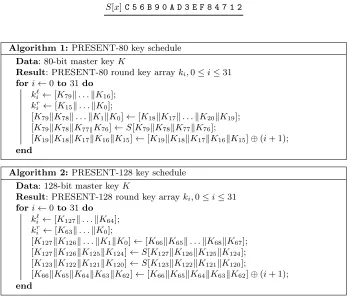
Table 5 gives the 4-bit S-box used in PRESENT. The bit-permutation P is defined s.t. bitiis moved to bitP(i) where
P(i) = 16·(imod 4) + 4· i
16
+
imod 16
4
.
Algorithms 1 and 2 give pseudo-code for the key-scheduling algorithms for PRESENT-80 and PRESENT-128, respectively.
Table 5: The 4-bit PRESENT S-box in hexadecimal notation
x 0 1 2 3 4 5 6 7 8 9 A B C D E F
S[x]C 5 6 B 9 0 A D 3 E F 8 4 7 1 2
Algorithm 1:PRESENT-80 key schedule Data: 80-bit master keyK
Result: PRESENT-80 round key arrayki,0≤i≤31
fori←0to31do k`i←[K79k. . .kK16];
kri ←[K15k. . .kK0];
[K79kK78k. . .kK1kK0]←[K18kK17k. . .kK20kK19];
[K79kK78kK77kK76]←S[K79kK78kK77kK76];
[K19kK18kK17kK16kK15]←[K19kK18kK17kK16kK15]⊕(i+ 1);
end
Algorithm 2:PRESENT-128 key schedule Data: 128-bit master keyK
Result: PRESENT-128 round key arrayki,0≤i≤31
fori←0to31do k`
i←[K127k. . .kK64];
kri ←[K63k. . .kK0];
[K127kK126k. . .kK1kK0]←[K66kK65k. . .kK68kK67];
[K127kK126kK125kK124]←S[K127kK126kK125kK124];
[K123kK122kK121kK120]←S[K123kK122kK121kK120];
[K66kK65kK64kK63kK62]←[K66kK65kK64kK63kK62]⊕(i+ 1);
end
B
Data Pertaining to Correlation Bounding
Table 6: Number of trails TR in optimal hull for R-round PRESENT, R ∈ {1, . . . ,31}
R TR R TR R TR R TR
1 1 9 512 17 1140480 25 2517252696
2 1 10 1344 18 2985984 26 6590254272
3 1 11 3528 19 7817472 27 17253512704
4 3 12 9261 20 20466576 28 45170283840
5 9 13 24255 21 53582633 29 118257341400 6 27 14 63525 22 140281323 30 309601747125 7 72 15 166375 23 367261713 31 810547899975 8 192 16 435600 24 961504803
Table 7: Values log2β s.t.α= Pr [|CEK| ≥β] forR-round of PRESENT
α
R 0.01 0.05 0.10 0.20 0.30 0.40 0.50 0.60 0.70 0.80 0.90 0.95 0.99 1 −0.63 −1.03 −1.28 −1.64 −1.95 −2.25 −2.57 −2.93 −3.38 −3.98 −4.99 −6.00 −8.32 2 −2.63 −3.03 −3.28 −3.64 −3.95 −4.25 −4.57 −4.93 −5.38 −5.98 −6.99 −8.00−10.32 3 −4.63 −5.03 −5.28 −5.64 −5.95 −6.25 −6.57 −6.93 −7.38 −7.98 −8.99−10.00−12.32 4 −5.84 −6.24 −6.49 −6.85 −7.16 −7.46 −7.78 −8.14 −8.58 −9.19−10.20−11.20−13.53 5 −7.05 −7.44 −7.70 −8.06 −8.36 −8.66 −8.98 −9.35 −9.79−10.40−11.41−12.41−14.73 6 −8.26 −8.65 −8.90 −9.26 −9.57 −9.87−10.19−10.55−11.00−11.60−12.61−13.62−15.94 7 −9.55 −9.94−10.20−10.56−10.86−11.16−11.48−11.85−12.29−12.90−13.91−14.91−17.23 8 −10.84−11.24−11.49−11.85−12.16−12.46−12.78−13.14−13.58−14.19−15.20−16.20−18.53 9 −12.13−12.53−12.78−13.14−13.45−13.75−14.07−14.43−14.88−15.48−16.49−17.50−19.82 10 −13.44−13.83−14.09−14.45−14.75−15.05−15.37−15.74−16.18−16.78−17.80−18.80−21.12 11 −14.74−15.14−15.39−15.75−16.06−16.36−16.68−17.04−17.48−18.09−19.10−20.10−22.43 12 −16.05−16.44−16.69−17.05−17.36−17.66−17.98−18.34−18.79−19.39−20.40−21.41−23.73 13 −17.35−17.75−18.00−18.36−18.67−18.97−19.29−19.65−20.09−20.70−21.71−22.71−25.04 14 −18.66−19.05−19.30−19.66−19.97−20.27−20.59−20.95−21.40−22.00−23.01−24.02−26.34 15 −19.96−20.36−20.61−20.97−21.28−21.58−21.90−22.26−22.70−23.31−24.32−25.32−27.65 16 −21.27−21.66−21.92−22.28−22.58−22.88−23.20−23.56−24.01−24.61−25.63−26.63−28.95 17 −22.57−22.97−23.22−23.58−23.89−24.19−24.51−24.87−25.32−25.92−26.93−27.93−30.26 18 −23.88−24.27−24.53−24.89−25.19−25.49−25.81−26.18−26.62−27.23−28.24−29.24−31.56 19 −25.19−25.58−25.83−26.19−26.50−26.80−27.12−27.48−27.93−28.53−29.54−30.55−32.87 20 −26.49−26.89−27.14−27.50−27.80−28.11−28.42−28.79−29.23−29.84−30.85−31.85−34.17 21 −27.80−28.19−28.44−28.80−29.11−29.41−29.73−30.09−30.54−31.14−32.15−33.16−35.48 22 −29.10−29.50−29.75−30.11−30.42−30.72−31.04−31.40−31.84−32.45−33.46−34.46−36.79 23 −30.41−30.80−31.06−31.42−31.72−32.02−32.34−32.71−33.15−33.75−34.77−35.77−38.09 24 −31.71−32.11−32.36−32.72−33.03−33.33−33.65−34.01−34.46−35.06−36.07−37.07−39.40 25 −33.02−33.41−33.67−34.03−34.33−34.63−34.95−35.32−35.76−36.37−37.38−38.38−40.70 26 −34.33−34.72−34.97−35.33−35.64−35.94−36.26−36.62−37.07−37.67−38.68−39.69−42.01 27 −35.63−36.03−36.28−36.64−36.95−37.25−37.57−37.93−38.37−38.98−39.99−40.99−43.31 28 −36.94−37.33−37.58−37.94−38.25−38.55−38.87−39.23−39.68−40.28−41.30−42.30−44.62 29 −38.24−38.64−38.89−39.25−39.56−39.86−40.18−40.54−40.98−41.59−42.60−43.60−45.93 30 −39.55−39.94−40.20−40.56−40.86−41.16−41.48−41.85−42.29−42.90−43.91−44.91−47.23 31 −40.85−41.25−41.50−41.86−42.17−42.47−42.79−43.15−43.60−44.20−45.21−46.22−48.54
C
Experimental Verification
In this section we describe experiments performed to verify the validity of the proposed key-less linear distinguishers. Concretely, we describe a key-less linear distinguisherAtrying to distinguish 9-round PRESENT (regardless of key size). We letREK
δ,γ be the linear relation used in Section 5.
For the first example, we haveα= 0.33. From Theorem 2, we know that to have 0.33-separability, we require that the event|CEK| ≥2/
√
Mhappens with probability (at least) α= 0.33. From the analysis of Section 4.1, we find that for 6-round PRESENT we have Pr [|CEK| ≥β] =αforβ = 2
−9.66. When using
the inequality|CEK| ≥2/ √
M, we find this bound is tight whenM= 2619369. As such, A is an algorithm for constructing an S of this size in the 3-round deterministic phase described in Section 5.2. For this key-less linear distinguisher A, we now have 0.33-separability, because we expect thatE[X]−M2
≥
√ M, whereX is the number of inputs satisfying the linear relation.
The experimental part comes now from actually encrypting eachx∈ S un-der a fixed, known key K ∈ K using 9-round PRESENT. We then check each REK
δ,γ(x) = 1 by checking the relation on the input/output pair. For our ex-periment, we repeated 1000 times the experiment of computing X for a ran-dom key K and the corresponding set S. We found that 389 keys satisfied
E[X]−M2 ≥
√
M, and as such we see that this fits with 389
1000≥α= 0.33.
We repeated the same experiment again withα= 0.75. In this case, we found that we requireM= 24480331. In the same way, we did 1000 experiments with random keys K and found that 764 keys satisfiedE[X]−M2
≥
√
M. Again, this fits with 1000764 ≥α= 0.75.
D
6-round Deterministic Phase
By combining the 3-round deterministic phase of Section 5.2 with another 3 rounds appearing before, it is possible to construct a 6-round deterministic phase, reminiscent of the rebound approach [36,28] (see Figure 3). The idea is, that for rounds 3 to 5, the same approach as in Section 5.2 is used. Also, the same approach is used, but going in the other direction, for rounds 0 to 2.
This describes a construction toindependentlyobtain (i) a set ofoutputs from roundR2, for which the inputs follow the trail over thefirstthree rounds and (ii)
a set ofinputstoR3which follow the trail over thelast three rounds. These two
sets meet at the same point: Right around the addition of the round key of round
R3. Thus, one can use said round key to determine a matching between the two
sets, to obtain a set which has the desirable property of following the trail over both the top and bottom part. However, as the approaches are independent, there are constraints put on the round key of roundR3 due to both parts, and
this loss in degrees of freedom must be taken into account.
R0
S S S S S S S S S S SS S S S S S
R1
S S SS S S S SS S S S SS S S S SS S
R2
S S S S S S S S S S S S S S S S
S S S S S S S S S S S S S S S S
R3
S S S S S S S S S S S S S S S S
S S S S S S S S S S S S S S S S
R4
S S S S S S S S SS SS SS SS S S S S
R5
S S S S S S S S S S SS S S S S S
![Table 1: Values log β2s.t. α = Pr [|CEK| ≥ β ] for R-round PRESENT](https://thumb-us.123doks.com/thumbv2/123dok_us/7925160.1315900/12.612.164.453.365.453/table-values-log-b-pr-cek-round-present.webp)