International Journal of Emerging Technology and Advanced Engineering
Website: www.ijetae.com (ISSN 2250-2459, ISO 9001:2008 Certified Journal, Volume 7, Issue 9, September 2017)
595
VANET Implementation and Ratings: on Roads in Dehradun
Rajeev Tiwari
1, Soumil Agarwal
2, Rohan Srivastava
3, Shuchi Upadhyay
41Assitant Professor & UPES, Dehradun 2Associate IT Consultant & ITC Infotech 3Software Engineer & Cisco Systems India 4
Assistant Professor, Uttranchal University
Abstract—Vehicular Ad-hoc Network (VANET), is a sub-set of Mobile Ad-hoc network (MANET) but with speed in agents(vehicles). With infrastructural support with VANET communication, traveling on road can be safer and smarter. VANET routing also follows IEEE 802.11p standards. In this paper, a VANET network scenario is generated for real life geographical region of Dehradun city with 50 vehicles, simulated such traffic topological modeling using SUMO. Then to check quality of com-munication among smart vehicles, network traffic is generated using realistic network simulator NS2 on roads of Dehradun, Uttrakhand, India. We have analyzed the performance of VANET earlier also in IVANET environment by using cache techniques [1]. But in this paper, we have compared performance of protocols at upper(application) and middle (transport) layers, to propose the ratings of network parameters required for VANET deployment in Dehradun. The extensive simulation is performed and protocols behavior is observed and recorded on the basis of performance metrics like: packets generated, packets received, packet dropped, Average Throughput and Packet delivery ratio using 10 vehicles. Our work shows that DSR has performed better than other two protocols. So it is more promising for future technology in VANET and accordingly parameters rating is given as per executed simulated environment.
Keywords—VANET, MANET, Routing Protocols,
Performance, NS2.
I. INTRODUCTION
Wireless Ad hoc network is a decentralized wireless net-work that does not depend upon pre-existing infrastructures like routers or access points. Ad hoc networks are dynamic in nature where any node can enter or leave the network any time. One of the most prominent utilization of wires Adhoc network is made by mobile Adhoc network (MANET). In the recent times with increasing number of vehicles on roads have given birth to many problems like traffic jams, overcrowding, accidents etc. which is a grave cause of concern affecting human lives.
One solution to this problem is to introduce a network of vehicles to disseminate appropriate prior information, so vehicle to vehicle communication is used where information gets flooded to nearby vehicles regarding road blocks, accidents etc. and suggest the alternate paths for shading the problems quickly.. In order to increase safety on road, inter vehicular communication will be very useful. This concept of using vehicles as nodes which can communicate with each other is called VANET where communication oc-curs between vehicle to Infrastructure (V2I) and vehicle to vehicle (V2V). So such communications are supported and can facilitate with following advantages at a glance.
Traffic Management Safety
Management
Provisioning of Internet services
Due to moving vehicles VANET becomes very special case of MANET with high mobility of Nodes, so some of characteristics of VANET can be listed as below:
High Dynamic Topology Frequent Network
reconfiguration
Interaction with On-Board Sensors
Dependence on surroundings ie different characteris-tics for urban and rural mobility
International Journal of Emerging Technology and Advanced Engineering
Website: www.ijetae.com (ISSN 2250-2459, ISO 9001:2008 Certified Journal, Volume 7, Issue 9, September 2017)
596
To perform these tests we simulate a mobility scenario using SUMO and analyses trace files using NS2 and provide animation using NAM.This paper is organized into different five technical sec-tions. The literature review of earlier work done by researchers in section II and also discusses problem formulation of the work. Section III discusses about the system design used be-hind VANET deployment explaining about system and network model. Section IV tells about implementation and last section covers results and conclusions.
II. LITERATURE REVIEW
Before we start discussing the various literature proposed by researchers in this context, a brief introduction is given for understanding of roting protocols for ad-hoc networks.
A. Ad Hoc Routing Protocols
Broadly Ad Hoc routing protocols are categorized into two different categories based on their voluntarily actions. These are proactive and reactive (On-demand) categories [4]. DSDV is picked from first category and DSR and AODV from second category of proactive type of protocols. Proactive protocols action is to update route information after a fixed interval of time, while reactive type of protocols setup routes as per needed.
1)Adhoc on Demand Distance Routing Protocol (AODV):
AODV protocol which stands for Adhoc on Demand Distance Routing Protocol is one of the few reacting protocols which are used for implementing MANET. This protocol establishes a path whenever a demand is created and are never restored. AODV possesses the advantage of saving the memory as it never requires pre maintaining of routes thus resulting in low battery loss. It also eliminates lagging in quick reaction for network restructure and node failure. This feature of not pre maintaining routes often becomes a concern generating high latency time in route finding and sometimes network clogging due to excessive flooding. In Adhoc protocol, every node has a client and a server and every inter route request between nodes contains the IP address and sequence number of the source and the destination. The source and the destination are called broadcasting ID and sequence number is the age of request which consists of threshold life span of the request. Upon broadcasting of a request from a particular node to other nodes around it, if the nodes have a route to destination node then they will reply to corresponding nodes and if dont then they will broadcast request to surrounding nodes to get to the destination.
Upon reaching the destination, a reply request is formed conveying that route has been formed.
2)Destination Sequenced Distance Vector protocol (DSDV):
DSDV protocol stands for Destination Sequenced Distance Vector protocol which is used as a proactive protocol for implementation of MANET. In DSDV protocol, in process of routing requests, exchange of messages take place between the neighboring nodes who are in range of each other. It eliminates flooding of requests by disabling re broadcasting of routes. Routing updates are sometimes routine wise and sometimes they are triggered when there is an instance of change of routing table by routing information from one of neighboring forces. DSDV also enables caching, in which packet are cached for which the route to its destination is not known. Upon reaching the max buffer size for caching the packets which are looking for their routing information, packets are released. Each routing requesting in DSDV contains three data i.e. destination address, metric and the sequence number. Packets that are destined to reach a mobile node are routed directly using a dmux operation on the address to its dmux port. Destination agents receive the packets from port dmux. In the instances when target is not obtained for the destination, the packets are handed to the routing agent which is the default target. The next hop for the packet is assigned by the routing agent which sends it down to the link layer.
3)Dynamic Source Routing protocol is a reactive protocol (DSR):
International Journal of Emerging Technology and Advanced Engineering
Website: www.ijetae.com (ISSN 2250-2459, ISO 9001:2008 Certified Journal, Volume 7, Issue 9, September 2017)
597
The DSR routing protocol makes use of load balancing feature which enables more than one paths to a destination and enables every sender to have the full control of the routes that were used for routing its packets. DSR also gives the added benefit of loop-free routing, assistance for implementation of networks that possess unidirectional links and instant recovery when paths of the network modify. The DSR protocol is equipped with the facility to handle ad hoc mobile networks with maximum limit of about two hundred nodes and works accurately with even faster rates of mobility.After providing details of routing algorithms, we are dis-cussing some important and significant works done which are more aligned towards our concerned topic. So in coming paragraphs research review of authors is given:
Rakesh Kumar and Mayank Dave in [2] have presented a correlative study by comparing different routing protocols which are employed in vehicular ad-hoc network (VANET) which is a subset of mobile ad-hoc network (MANET). VANET caters to different avenues and provide unique ways regarding smart transportation system. In this paper the ad-vantages and disadvantages of multiple routing protocols for VANET have been discussed. It also presents a relational con-trast between multiple protocols used for routing in VANET.
Komal sharma in [3] conducted a comprehensive survey of multiple protocols used for routing in vehicular ad-hoc network (VANET). In this paper the importance of VANET has been emphasized given the increase in automotive industry, traffic accidents etc. and how transmission between Nodes or vehicles can be utilized for providing comfort, recreation and comfort also. In order to use VANET efficiently there should be proper routing for which there are multiple protocols whose performance has to be measured. In this paper different routing protocols have been analyzed so as to identify the perfect ad-hoc routing protocol in a highly mobile environment of VANET. It was also observed that there was no universal routing protocol that works for diverse vehicular environments.
Samanpreet Singh and Gaganjeet Singh Aujla in [4] discuss the importance of vehicular ad-hoc network which helps to ensure traffic safety by providing applications like driver assistance, passenger comfort and vehicle safety. This paper also addresses the concern of breakage of communication linkage among vehicles in VANET because of dynamic nature of road environment and traffic patterns.
Moreover there are certain differences between VANET and mobile ad-hoc network and there is a requirement to modify MANET protocols to use in VANET. This paper proposes an advanced version of existing MANET routing protocol which increase efficiency of VANET environment. This protocol is able to remove the problem of huge number of error messages that existed using AODV protocol and delivers better results than latter.
Ghanishtha Narang and Yogesh Juneja in [5]have presented vehicular ad-hoc network (VANET) which is a notable subset of mobile ad-hoc network (MANET) having high mobility and frequent topology changes. VANET is a highly dynamic wireless network that can improve transportation system using sensor, wireless networks, gps etc. Routing in VANET is challenging given the high mobility of nodes. VANET serves a wide range of applications for different scenarios and require different protocol for each scenario. VANET helps to build a robust network between vehicles that act as nodes and com-municate with each other. This paper also classifies different ad-hoc routing protocols and techniques.
Uma Nagaraj and Poonam P. Dhamal in [6]present the various applications and challenges faced by vehicular ad-hoc network. Different protocols need to be adopted for multiple topography and situations. In this paper a comprehensive review of ad-hoc routing protocols is conducted so as to develop a sturdy network between motile vehicles communicating with each other. Different routing protocols were used to test VANET implementation and comparisons were drawn between four protocols AODV, DSDV, DSR and OLSR utilizing performance based metrics like average end to end delay, packet delivery ratio, and routing overhead. Network simulator tool NS2 and network animator (NAM) were used for comparisons and preparing graphs from trace files.
International Journal of Emerging Technology and Advanced Engineering
Website: www.ijetae.com (ISSN 2250-2459, ISO 9001:2008 Certified Journal, Volume 7, Issue 9, September 2017)
598
Some of the major challenges faced for VANET setup are as follows:High speed of vehicles resulting in limited interaction only
Hands off on different sinks, as vehicles are in random motion which requires change of sink.
Higher network traffic generated which is difficult to administer properly
Message transportation between vehicles which must be error free as there will be negligible time for retransmitting it in case of emergency situations like accident.
[image:4.612.41.294.332.479.2]So keeping these challenges in mind we have analyzed the performance of MANET routing protocols for setup of VANET in Dehradun city, we have also investigated the range of parameters required for city traffic.
Fig. 1. Dehradun Map fetched for Road Network for SUMO.
III. SYSTEM DESIGN
VANET provides a means to enable a wide spectrum of applications with the help of mobile network that does not require a stationary or dedicated infrastructure. However due to a prohibitive cost required for the deployment and implementation of a system to real world restricts us to first test VANET using simulations. Multiple tools are available to simulate VANET. For this simulation we require a vehicular mobility model and a network simulator. In coming sections we have given system model which has elaborated about mobility and topological scenarios. While Network Model subsection has details related to network configurations and network simulator and its setup.
A. System Model
To simulate the traffic scenario a traffic simulator is needed that keeps track of every automotive on the road at a given time frame and also adheres to road conditions.
This is visualized with the help of graphical user interface which uses realistic modelling to describe vehicles moving. Here the vehicles move in a synchronized order which avoids collision between them.
For this SUMO(Simulation Of Urban Mobility) an open source simulator is appropriate which follows all above features. In order to use Sumo to simulate mobility model a route file and road network files are needed for it. A network file known as road network file is formulated using a section of open street map (.OSM file) and then using the netconvert module. The fetched map is shown below in Figure 1.
Route file contains information about all vehicles specified in simulation and the corresponding path taken by each of them. This file is generated with the aid of a module called duarouter that needs to have a trip definition. Trip definitions have information about starting, ending paths and time of departure. Finally Sumo simulates vehicles on the basis of their respective positions at fixed time intervals at fixed time intervals. The vehicle positions are noted in a separate trace file which is used as an input by network simulators. We are making use of NS2 to analyze network trace.
B. Network Model
[image:4.612.327.562.459.668.2]In this model there is a sink and have 50 mobile vehicles (nodes). In this network vehicles are communicating with each other.
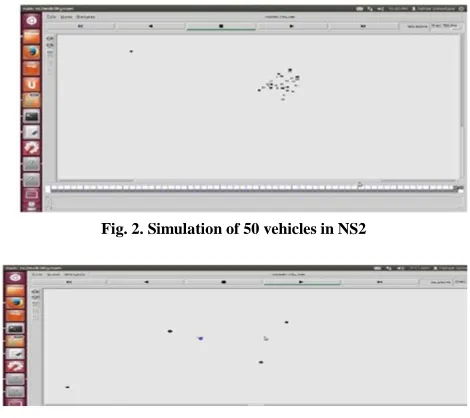
Fig. 2. Simulation of 50 vehicles in NS2
International Journal of Emerging Technology and Advanced Engineering
Website: www.ijetae.com (ISSN 2250-2459, ISO 9001:2008 Certified Journal, Volume 7, Issue 9, September 2017)
599
Vehicles have IEEE 802.11 based Dedicated Short Range Communication (DSRC) transceiver which leads to vehicles communicating with other vehicles or fixed sink communicating node.We have deployed 50 vehicles on fetched map and converted into similar topography. Vehicles can exhibit speed of upto 90 km/hr. This scenario setup is shown in Figure 2.
IV. IMPLEMENTATION
For our experiment purpose we have used some parameters and they are listed in Table I, with their corresponding values. These are the parameters that we have taken for the simulation of 50 vehicles.
A. Simulation Setup and Parameters
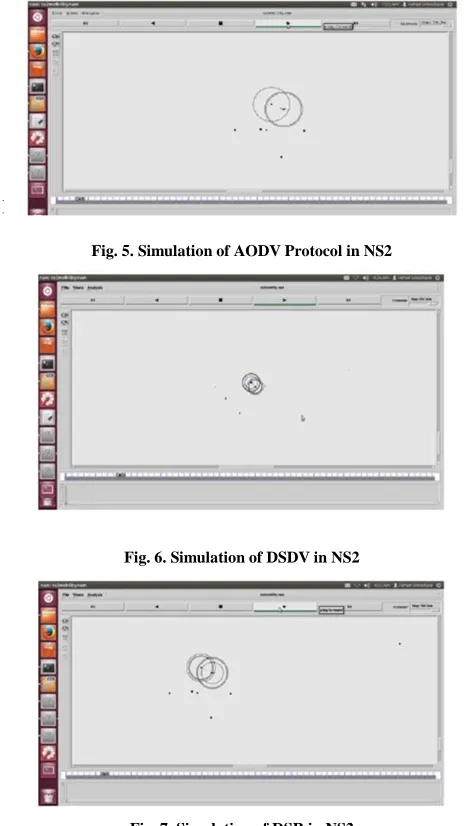
Then for network and scenario setup, the mobility and communication of vehicles is made with access point as shown in Figures 3 and 4. Mobility is maintained at speed of 90km/hr.
All the nodes are approaching towards access point which is statically fixed for vehicles.
Simulation of AODV, DSDV and DSR protocols is shown in Figure 5, 6 and 7 in our environment
[image:5.612.323.556.140.553.2]Fig. 4. Simulation of Communication between Vehicles and Access Point
Fig. 5. Simulation of AODV Protocol in NS2
[image:5.612.77.259.307.417.2]Fig. 5. Simulation of AODV Protocol in NS2
[image:5.612.59.273.537.630.2]Fig. 6. Simulation of DSDV in NS2
Fig. 7. Simulation of DSR in NS2
V. RESULTS
International Journal of Emerging Technology and Advanced Engineering
Website: www.ijetae.com (ISSN 2250-2459, ISO 9001:2008 Certified Journal, Volume 7, Issue 9, September 2017)
600
The VANET network simulation is done and its performance is noted by observing protocol behavior like AODV, DSDV and DSR on the basis of various performance metrics: packets sent, packets received, packet dropped, Average Throughput and Packet delivery ratio. All protocols are compared on the outcome of all these parameters and listed in Table II.VI. CONCLUSION AND FUTURE WORK
In this research work, a network topology of 50 mobile nodes/ vehicles and an AP is setup using SUMO, where vehicles can travel at speed of 90km/hr towards AP. Network traffic is generated and simulated using NS2 simulator. Routing protocols are tested and evaluated in NS2 and parameters are recorded like generated, received packets, packet delivery ratio etc. Our simulation setup shows that DSR has performed better than other two protocols in terms of sent and received packets and still maintains a decent packet delivery fraction and throughput. So using it for deployment of VANET will increase the life of devices used in deployment in city.
In near future we will try to simulate and setup topology for higher number of vehicles with variety of speed limits with traffic lights mechanism. Its analytical justification can also be done in near future.
REFERENCES
[1] Rajeev Tiwari and Neeraj Kumar, ”Minimizing Query Delay using
Cooperation in IVANET”, In proceeding of Third International conference on Recent Trends in Computing, Delhi, Procedia Computer Science, Elsevier, vol. 57, pp. 84-90,2015.
[2] Rakesh Kumar and Mayank Dave, A Comparative Study Of Various
Routing Protocols In Vanet, International Journal Of Computer Science Issues, Vol. 8, Issue 4, No. 1, July 2011.
[3] Komal Sharma, A Comprehensive Survey On Various Routing
Protocols In Vanet, International Journal Of Scientific and Technology Research, Volume 3, Issue 8, August 2014.
[4] Samanpreet Singh and Gaganjeet Singh Aujla, A Noble Routing
Protocol For Vehicular Ad-Hoc Network (Vanets) With Less Routing Overheads, International Journal of Future Generation Communication And Networking, Vol. 7, No. 5(2014),pp 23-24.
[5] Ghanishtha Narang and Yogesh Juneja, Review On Classification of
Different Vanet Protocols Based On Routing Information, International Journal Of Advanced Research In Computer And Communication Engineering, Vol. 4, Issue 5, May 2015.
[6] Uma Nagaraj and Poonam P. Dhamal, Performance evaluation of
Proactive And Reactive Protocols In Vanet, International Journal of Information And Education Technology, Vol. 2, No. 5, October 2012.
[7] Kashif Naseer Qureshi and Abdul Hanan Abdullah, Topology Based
Routing Protocols For Vanet And Their Comparison With Manet, Journal of Theoretical And Applied Information Technology, Vol.