International Journal of Emerging Technology and Advanced Engineering
Website: www.ijetae.com (ISSN 2250-2459,ISO 9001:2008 Certified Journal, Volume 3, Issue 10, October 2013)
Image Enhancement Using Spatial Domain Techniques and
Fuzzy Intensification Factor
V. N. Ghodke
1, S. R. Ganorkar
21AISSMS Institute of Information Technology Pune-411001 2
Sinhgad college of engineering, Pune-411041
Abstract - In this paper, to study the different methods of
the image processing, implement and carry out the investigations in the image enhancement techniques. We have considered image enhancement techniques to modify the images obtained under improper exposure and illumination as well as the images having some distortion due to recording system limitations and corrupted by some uniform noise. The approaches applied to modify the images may be grouped into two categories one is spatial domain approach and another is fuzzy domain approach.
In the spatial domain approach, the gray values of pels are directly manipulated to obtain the enhanced image. We have considered, following methods for the direct manipulation of pixel. a)Intensity transformations by different methods, b) Histogram equalization technique and c) Spatial filtering.
In the fuzzy domain approach, an image can be considered as an array of fuzzy singletons, each with a value of membership function devoting the degree of having some brightness level. We have c o n s i d e r e d c ontrast e nhancement for fuzzy based enhancement algorithm for comparison with conventional image processing techniques. In this paper implementation of various spatial domain techniques are carried o u t i n t h e C e n v i r o n m e n t .
Keywords-- Image enhancement, spatial domain techniques
and fuzzy image enhancement.
I. INTRODUCTION
Image enhancement is the processing images to increase their usefulness. Methods and objectives vary with the application. When images are enhanced for human viewers, as in television, the objective may be to improve perceptual aspects: image quality, intelligibility, or visual appearance. In other applications, such as object identification by machine, an image may be preprocessed to aid Machine performance. Because the objective of image enhancement is dependent on the applicationcontext, and the criteria for enhancement are often subjective or too complex to be easily converted to useful objective measures, image enhancement algorithms tend to be simple, qualitative and ad hoc. In addition, in any given application, an image enhancement algorithm that performs well for one class of images may not perform as well for other classes.
Image Enhancement is closely related to image restoration. When an image is degraded, restoration of the original image often results in enhancement. In image restoration, an ideal image has been degraded, and the objective is to make the processed image resemble the original as much as possible. In other words image enhancement is the improvement of digital image quality, without knowledge about the source of degradation. If the source of degradation is known, one calls the process image restoration.
Many different, often elementary and heuristic methods are used to improve images in some sense. The problem is, of course, not well defined, as there is no objective measure for image quality. Here, we discuss a few recipes that have shown to be useful both for the human observer and/or for machine recognition. These methods are very problem-oriented: a method that works fine in one case may be completely inadequate for another problem. Some preliminary gray level conventional image processing techniques using transformations such as contrast stretching, spatial filtering etc.
Another new approach based fuzzy technique is use for image enhancement. In this paper theory of fuzzy set has been used to deal with image enhancement problems of some degraded images in which uncertainties and inaccuracies. For such images good enhancement effect can be obtained using fuzzy set based image enhancement approach instead of conventional image enhancement approach. Image enhancement using generalized fuzzy intensification factor is shown and is simulated to show its effectiveness.
II. SPATIAL DOMAIN ANALYSIS
2.1) Spatial domain image enhancement
The term spatial domain refers to the aggregate of pixels composing an image. Spatial domain methods are procedures that operate directly spatial domain process will be denoted by the expression
International Journal of Emerging Technology and Advanced Engineering
Website: www.ijetae.com (ISSN 2250-2459,ISO 9001:2008 Certified Journal, Volume 3, Issue 10, October 2013)
431
Where f(x, y) is the input image and g (x, y) is the processed image, and T is an operator on f, defined over some neighborhood of (x, y ).
2.2) Image transformation
In spatial domain analysis following methods of image enhancement viz. negative of image, contrast stretching, thresholding, histogram, histogram equalization and conventional filters are observed.1. Negative operation can be utilized to highlight the blur (dark) part of the image.2. Contrast stretching can be used to improve the contrast of the image linearly it is independent of image intensity variation.3. Thresholding can be used to produce binary images.4. Histogram is basically contrast stretching operation 5. Spatial domain filtering. a. Max filter can be used for intensity improvement with smoothing. b. Min filter can be used for, darkening of image with smoothing. c. Median filter is best for pepper salt noise removal.
III. ENHANCEMENT USING FUZZY OPERATOR
3.1) Introduction
This section presents a study on digital image enhancement based on fuzzy set theory in image processing. There are many reasons to do this. The most important of them are as follows:
1. Fuzzy techniques are powerful tools for knowledge representation and processing.
2. Fuzzy techniques can manage the vagueness and ambiguity efficiently.
3.2) Fuzzy image enhancement
Fuzzy image enhancement is based on gray level mapping into a fuzzy plane, using a membership transformation function [7]. The aim is to generate an image of higher contrast than the original image by giving a larger weight to the gray levels that are closer to the mean gray level of the image than to those that are farther from the mean. In recent years, many researchers have applied the fuzzy set theory to develop new techniques for contrast improvement. An image I of size M x N and L gray levels can be considered as an array of fuzzy singletons, each having a value of membership denoting its degree of brightness relative to some brightness levels. For an image I, we can write in the notation of fuzzy set
I=U
m 1,2,3,...,M and n 1,2,3,..., N
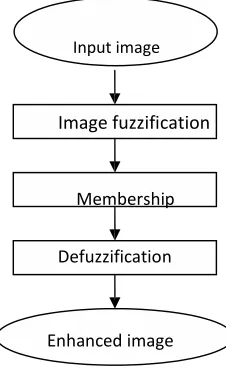
[image:2.612.363.476.255.439.2]Where is the intensity of (m, n)th pixel and its membership value. The membership function characterizes a suitable property of image (e.g. edginess, darkness, textural property) and can be defined globally for the whole image or locally for its segments. In recent years, some researchers have applied the concept of fuzziness to develop new algorithms for image enhancement. The principle of fuzzy enhancement scheme is illustrated in fig.1. Input image Image fuzzification Membership Defuzzification Enhanced image
Fig. 1 The basic principles of fuzzy enhancement
International Journal of Emerging Technology and Advanced Engineering
Website: www.ijetae.com (ISSN 2250-2459,ISO 9001:2008 Certified Journal, Volume 3, Issue 10, October 2013)
In many cases, the global adaptive implementation is necessary to achieve better results. Fuzzy-based local contrast is very fast compared to global and classical image enhancement algorithms.
3.4) Algorithm
We have implemented algorithm [5] to compare the conventional filters. The index of fuzziness was defined by Kaufmann [9], and fuzzy entropy by De Luca and Termini [10]. The index of fuzziness, for instance, reflects the ambiguity in an image by measuring the distance between its fuzzy property plane and the nearest ordinary plane. Both index of fuzziness and fuzzy entropy are the measures for global grayness ambiguity (fuzziness) of an image.
IV. EXPERIMENTAL RESULTS AND DISCUSSSION
Table1 and 2 shows Grayness ambiguity between original image & enhanced image Advantage of fuzzy base image enhancement is much better than histogram equalization a s i t i s c o m p u t a t i o n a l l y s i m p l e . As F e i n c r e a s e s g r a y n e s s ambiguity decreases. Resultant image of fuzzy intensification is more sharp and clear as compared to result obtained from conventional filters.
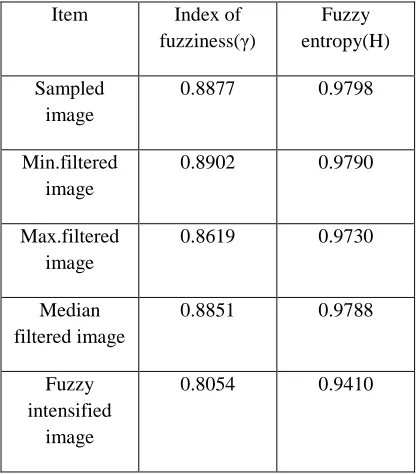
[image:3.612.374.514.157.411.2]Table 3 shows how result of fuzzy intensified image is sharper and good for visual perception as compared to conventional filters.
[image:3.612.376.512.158.410.2]Fig.1 to 10 shows experimental results of original image and enhanced image
TABLE I
Grayness ambiguity of original image
Fe gmn γ H1
1 40 0.7879 0.9596
80 0.9055 0.9855
120 0.8833 0.9884
2 40 0.7603 0.9489
80 0.8924 0.9814
120 0.8622 0.9838
3 40 0.7504 0.9449
80 0.8877 0.9798
120 0.8539 0.9818
TABLE II
Grayness ambiguity of enhanced image
Fe gmn γ H2
[image:3.612.340.549.427.664.2]1 40 0.6332 0.8817 80 0.8336 0.9560 120 0.7824 0.9598 2 40 0.5927 0.8551 80 0.8131 0.9452 120 0.7463 0.9402 3 40 0.5785 0.8455 80 0.8054 0.9410 120 0.7325 0.9390
TABLE III
Comparison between conventional filter and fuzzy intensification.
Item Index of fuzziness(γ)
Fuzzy entropy(H) Sampled
image
0.8877 0.9798
Min.filtered image
0.8902 0.9790
Max.filtered image
0.8619 0.9730
Median filtered image
0.8851 0.9788
Fuzzy intensified
image
[image:3.612.101.235.500.726.2]International Journal of Emerging Technology and Advanced Engineering
Website: www.ijetae.com (ISSN 2250-2459,ISO 9001:2008 Certified Journal, Volume 3, Issue 10, October 2013)
433
Fig.1 Original Image
Fig.2 Image with Fe= 1 gmn=40
Fig.3 Image with Fe= 1 gmn = 80
Fig.4 Image with Fe= 1 gmn = 120
Fig.5 Image with Fe= 2 gmn = 40
International Journal of Emerging Technology and Advanced Engineering
Website: www.ijetae.com (ISSN 2250-2459,ISO 9001:2008 Certified Journal, Volume 3, Issue 10, October 2013)
Fig.10 Image with Fe= 3 gmn = 120
Fig.7 Image with Fe= 2 gmn = 120
Fig.8 Image with Fe= 3 gmn =40
Fig.9 Image with Fe= 3 gmn = 80
V. CONCLUSION
This paper presents comparison between conventional image processing techniques and image enhancement using fuzzy intensification factor. It is observed that sharper image is obtained using fuzzy intensification techniques. It is also observed that entropy and index of fuzziness of fuzzy intensified image is much less than that obtained using conventional filters. So, fuzzy intensification is more effective than conventional filters for image enhancement.
REFERENCES
[1] R. C. Gonzalez and R. E. Woods, “Digital Image Processing”, Second Edition, Pearson Education, 2003.
[2] B. B. Chaudhari and D. Datta Majumdar, “Two Tone Image Processing and Recognition”, Wiley Eastern Limited, 1993. [3] A. Rosenfeld and A. C. Kak, “Digital Picture Processing”, Second
Edition, Volume 1, Academic Press, 1982.
[4] William K. Pratt, “Digital Image Processing”, Third Edition, a Wiley – Interscience Publication, 2006.
[5] Hassanien A. E., Badr A., “A Comparative Study On Digital Mammography Enhancement algorithms Based on Fuzzy Theory”, Studies in Informatics and Control, Vol. 12, pp. 21-32, No. 1, March 2003.
[6] S.L. Kok, “Computer Interpretation of X-ray Mammography”, Department of Engineering Science, University of Oxford, pp. 68, July 1993.
[7] Gordon R, Rangayan R. M, “Feature enhancement Of Film mammograms using fixed and adaptive Neighborhoods”, Applied Optics 23, pp.560-564,1984.
International Journal of Emerging Technology and Advanced Engineering
Website: www.ijetae.com (ISSN 2250-2459,ISO 9001:2008 Certified Journal, Volume 3, Issue 10, October 2013)
435 [9] Kaufmann A., “Introduction to the Theory of Fuzzy
Subsets-Fundamental Theoretical Elements”, vol. 1, Pp.455-459, Academic Press, New York, 1975.
[10] De Luca, A., Termini, S., “A definition of no Probabilistic entropy in the setting of fuzzy set Theory”, Information and Control, vol. 20, pp. 301- 312, 1972.
[11] J.Mantas., “Methodologies in pattern recognition and Image analysis- a brief survey”, Pattern recognition, Vol 20, No. 1, pp. 1-6, 1987.
[12] David C. C. Wang, Anthony H. V., Li C. C., “Digital Image Enhancement: A Survey.” Computer vision, Graphics and Image processing, 24, pp.363-381, 1983.
[13] K.Preston, “Computer processing of Biomedical Images”, Computer, 9, pp.54- 58,1976.
[14] M. J. McDonnell, “Restoration of Voyager I images”, Computer Graphics Image Processing 15, pp. 79, 1981.
[15] J. M. Prewitt, “Object enhancement and extraction, in Picture Processing and Psychopictorics”, (B. S.Lipkin and A. Rosenfeld, Eds.), pp. 70, Academic Press, New York, 1970.
[16] L. S. Davis, A. Rosenfeld, and J. Weszka, Region Extraction by averaging and thresholding, IEEETrans. Syst. Man Cybem. SMC-5, pp. 383, 1975.
[17] W. Frei, “Image enhancement by histogram hyperbolization”, Computer Graphics Image Processing, Vol. 6. pp. 286,1977. [18] H. C. Andrews, “Digital image restoration: A Survey”, Computer
7 (5), pp. 36,1974.
[19] Zadeh, L. A., “A Fuzzy-Set-Theoretic Interpretation of Linguistic Hedges”, J. Cybern., vol. 2 pp. 4-34, 1972.