R E S E A R C H
Open Access
Dynamic lactate indices as predictors of outcome
in critically ill patients
Alistair Nichol
1,3, Michael Bailey
1, Moritoki Egi
2, Ville Pettila
1, Craig French
5,4, Edward Stachowski
6,
Michael C Reade
4, David James Cooper
1,3and Rinaldo Bellomo
1,4,7*Abstract
Introduction:Dynamic changes in lactate concentrations in the critically ill may predict patient outcome more accurately than static indices. We aimed to compare the predictive value of dynamic indices of lactatemia in the first 24 hours of intensive care unit (ICU) admission with the value of more commonly used static indices.
Methods:This was a retrospective observational study of a prospectively obtained intensive care database of 5,041 consecutive critically ill patients from four Australian university hospitals. We assessed the relationship between dynamic lactate values collected in the first 24 hours of ICU admission and both ICU and hospital mortality. Results:We obtained 36,673 lactate measurements in 5,041 patients in the first 24 hours of ICU admission. Both the time weighted average lactate (LACTW24) and the change in lactate (LACΔ24) over the first 24 hours were independently predictive of hospital mortality with both relationships appearing to be linear in nature. For every one unit increase in LACTW24and LACΔ24the risk of hospital death increased by 37% (OR 1.37, 1.29 to 1.45;P< 0.0001) and by 15% (OR 1.15, 1.10 to 1.20;P< 0.0001) respectively. Such dynamic indices, when combined with Acute Physiology and Chronic Health Evaluation II (APACHE II) scores, improved overall outcome prediction (P< 0.0001) achieving almost 90% accuracy. When all lactate measures in the first 24 hours were considered, the combination of LACTW24and LACΔ24significantly outperformed (P < 0.0001) static indices of lactate concentration, such as admission lactate, maximum lactate and minimum lactate.
Conclusions:In the first 24 hours following ICU admission, dynamic indices of hyperlactatemia have significant independent predictive value, improve the performance of illness severity score-based outcome predictions and are superior to simple static indices of lactate concentration.
Keywords:lactate, hyperlactaemia, dynamic, intensive care unit, critical illness, mortality
Introduction
In the critically ill, a higher admission blood lactate con-centration is associated with a higher risk of death [1-8]. We recently reported that even within the current‘ nor-mal range’ (< 2.00 mmol.L-1) a higher admission blood lactate concentration is associated with significantly increased hospital mortality [4], a finding which suggests that even the subtle perturbations of lactate homeostasis may be important.
An elevated blood lactate concentration (a ‘static’ index) at any time point must be due to an increase in its production, a decrease in its clearance, or both. Like-wise, an increasing blood lactate concentration (a
‘dynamic’index) must be due to increasing production, decreasing clearance, or both simultaneously [9-11]. Sta-tic derangements in lactate homeostasis during ICU stay have become established as clinically useful markers of increased risk of hospital and ICU mortality [1,3,4,12]. However, dynamic indices of lactate homeostasis, which describe not only magnitude but also duration and trend over time, may be even more useful in predicting outcome. In support of this hypothesis, a number of small single centre observational studies, principally in patients with severe sepsis and septic shock, have
* Correspondence: [email protected]
1Australian and New Zealand Intensive Care - Research Centre, School of
Public Health and Preventive Medicine, Monash University, Commercial Road, Melbourne, VIC, Australia
Full list of author information is available at the end of the article
suggested that early changes in blood lactate concentra-tion may be useful in identifying those at high risk of death [5,6,13-16]. Furthermore, one interventional study (n= 348) has suggested that interventions aimed at tar-geting a dynamic reduction in lactate (20% per two hours for the first eight hours) in the critically ill with an abnormal admission lactate level may be associated with reduced organ failure and increased survival [17]. However, the association between dynamic changes in blood lactate concentration during the first 24 hours of ICU admission and mortality has not yet been investi-gated in a very large heterogeneous cohort of critically ill patients. Furthermore, to our knowledge no study has compared the ability of dynamic compared to static indices of lactate homeostasis to predict mortality in the critically ill.
To study this association, we examined the relation-ship between six indices of lactate homeostasis in the first 24 hours of ICU admission and both hospital and ICU mortality. Three indices were static: i) admission lactate (LACADM), ii) maximum lactate (LACMAX24), iii) minimum lactate (LACMIN24), and three were dynamic: iv) time weighted lactate (LACTW24), v) absolute change in (delta) lactate (LACΔ24) and vi) percentage change in lactate (LAC%Δ24).
Materials and methods
The data collection and data analysis for this study are part of ongoing de-identified data auditing processes across the participating hospitals, which have all waived the need for informed consent. The Austin Hospital Ethics Committee approved studies related to this database.
Study population and data sources
The study population and data sources used in this study are similar to those previously reported by us, in a previous manuscript describing lactate homeostasis in the critically ill [4]. In brief, this four-centre retrospec-tive investigation of a prospecretrospec-tively gathered intensive care database enrolled patients from January 2000 to October 2004. However, in this study a minimum of two lactate values collected over the first 24 hours were necessary for inclusion into the study, with the latter criteria needed to produce both a time weighted lactate (LACTW24) and a change in lactate (LACΔ24) over the first 24 hours.
The blood lactate concentration data used for this study were stored and retrieved electronically. We obtained age, sex, use of mechanical ventilation, reason for ICU admission (surgical and non-surgical, further classified as trauma, cardiac/vascular, gastrointestinal tract, neurological and thoracic/respiratory), and Acute Physiology and Chronic Health Evaluation (APACHE) II
score [18] from the electronic data repositories of each ICU, using data prospectively collected as part of the Australian and New Zealand Intensive Care Society-Centre for Outcome and Resources Evaluation (ANZICS-CORE) quality assurance program [19].
The timing of lactate measurement (Rapilab, Bayer Australia, Sydney, NSW, Australia) was at the discretion of the managing critical care team. Laboratories in the participating hospitals comply with standards of the National Association of Testing Authorities [20] and the Royal College of Pathologists of Australia [21].
Statistical analysis
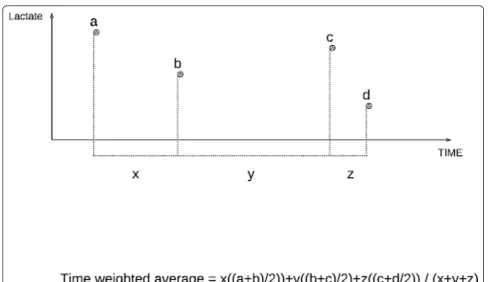
To avoid the potential effect of surveillance bias due to the increased blood lactate monitoring in more severely ill patients, we calculated the time-weighted lactate con-centration (LACTW24). In brief, time weighted average lactate (LacTW) is an index of lactate homeostasis that is proportional to the amount of time spent at each con-centration in relation to the total period of time observed. It is determined by summing the mean value between consecutive time points multiplied by the per-iod of time between consecutive time points and then dividing by the total time (see Figure 1). This method was modified from and used in accordance with an approach previously used by Finney et al. to describe hyperglycaemia [22].
The change in lactate over 24 hours (LACΔ24) was cal-culated by regressing lactate against time for each indi-vidual patient, with the regression slope representing the projected change over a 24-hour period. To avoid undue influence from extreme outliers, the maximal and mini-mal slope values were capped in accordance with Tukey [23]. Values that were found to be more than three times the interquartile range to the left of the 25th per-centile or to the right of the 75th percentile were consid-ered to be extreme outliers. This resulted in a maximum increase or decrease in slope over the first 24 hours of 5 mmol.L-1. LAC%Δ24 describes the change in lactate over a 24-hour period as the percentage change from the admission blood lactate concentration.
measurements collected over the first 24 hours was also included. After forcing all of the previous described vari-ables into the multivariate model, both stepwise and backwards elimination procedures were used to deter-mine which lactate indices could independently aid in the prediction of mortality. Six lactate indices specifically relating to the first 24 hours of ICU admission were con-sidered: Three indices were static: i) admission lactate (LACADM), ii) maximum lactate (LACMAX24), iii) mini-mum lactate (LACMIN24), and three were dynamic: iv) time weighted lactate (LACTW24), v) absolute change in (delta) lactate (LACΔ24) and vi) percentage change in lac-tate (LAC%Δ24).
To determine if the relationship between lactate and mortality was consistent across patient subgroups and study hospitals, we examined interactions between mea-sures of lactate and other variables in the model. To confirm that the potential relationships between lactate and mortality were linear in nature, measures of lactate were divided into quintiles and analysed as categorical variables, with quintiles chosen to provide a minimum of 1,000 patients per category. Goodness of fit was determined using the Hosmer and Lemeshow statistic. All analyses were performed using SAS version 9.2 (SAS Institute Inc., Cary, NC, USA). A two-sidedP-value of 0.05 was considered to be statistically significant.
Having established which lactate variables had the strongest relationships with mortality, to then determine the true predictive capacity of these lactate variables, the data were randomly divided into two groups, with 50% of the data used as a derivation sample and the remain-ing 50% of the data used as a validation sample. Univari-ate models and multivariUnivari-ate models (with and without the inclusion of lactate) were constructed from the deri-vation sample for both hospital and ICU mortality. The prediction equations were then applied to the holdout sample and the improvement in the Area under the Receiver Operating Characteristic Curve (AUC-ROC) was recorded.
Results
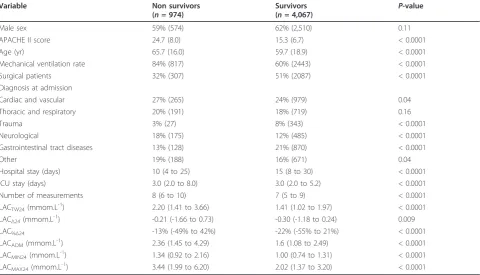
[image:3.595.54.544.84.366.2]We studied a heterogeneous cohort of 7,155 critically ill patients of whom 5,041 had at least two measurements over the first 24 hours (median 7; range 2 to 34) and were included in the analysis. All indices of blood lac-tate concentration over the first 24 hours (LACADM, LACTW24, LACMAX24, LACMIN24), were significantly higher in hospital non-survivors compared to survivors (Table 1). The median decline in lactate over the first 24 hours (LACΔ24) and the median percentage decline in lactate (LAC%Δ24) were significantly lower in non-sur-vivors compared to surnon-sur-vivors (Table 1).
Univariate analysis
We assessed the ability of both static (LACMAX24 and
LACMIN24) and dynamic (LACTW, LACΔ24 and
LACΔ24%) indices of lactate homeostasis in the first 24 hours to predict hospital and ICU mortality bench-marked against LACADM, the most commonly used sta-tic measure (Table 2). The combination of LACTWand LACΔ24, which assesses duration, magnitude and trend of lactate derangement, resulted in the most significant increase in ability to predict hospital death (Table 2).
Multivariate analysis
After adjusting for established predictors of mortality, the lactate variables that were independently the most
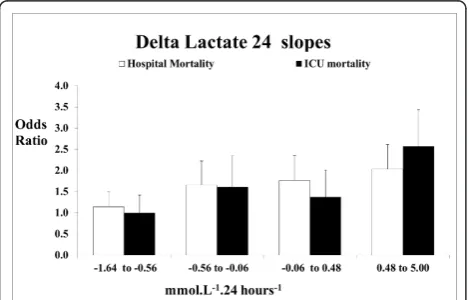
[image:4.595.58.539.101.376.2]predictive of hospital and ICU mortality were LACTW24 and LACΔ24 (Table 3). For every one unit increase in LACΔ24 the risk of death increased by 15% (OR 1.15 (1.10 to 1.20)P< 0.0001) for hospital mortality and 18% for ICU mortality (OR 1.18 (1.13 to 1.24) P< 0.0001). When LACΔ24 was divided into quintiles the relation-ship between LACΔ24and mortality also appeared to be well approximated by linearity (Figure 2). When the risk of death was calculated based on the slope of the LACΔ24, an increasing blood lactate concentration (slope greater than 0 mmom.L-1.24 hours-1) was associated with a greater increase in risk of hospital and ICU death (OR 1.46 (1.23 to 1.74)P < 0.0001 and OR 1.71 (1.37 to 2.13)P< 0.0001, respectively). Furthermore, the risk of
Table 1 Comparison of hospital survivors vs.nonsurvivors
Variable Non survivors
(n= 974)
Survivors
(n= 4,067) P
-value
Male sex 59% (574) 62% (2,510) 0.11
APACHE II score 24.7 (8.0) 15.3 (6.7) < 0.0001
Age (yr) 65.7 (16.0) 59.7 (18.9) < 0.0001
Mechanical ventilation rate 84% (817) 60% (2443) < 0.0001
Surgical patients 32% (307) 51% (2087) < 0.0001
Diagnosis at admission
Cardiac and vascular 27% (265) 24% (979) 0.04
Thoracic and respiratory 20% (191) 18% (719) 0.16
Trauma 3% (27) 8% (343) < 0.0001
Neurological 18% (175) 12% (485) < 0.0001
Gastrointestinal tract diseases 13% (128) 21% (870) < 0.0001
Other 19% (188) 16% (671) 0.04
Hospital stay (days) 10 (4 to 25) 15 (8 to 30) < 0.0001
ICU stay (days) 3.0 (2.0 to 8.0) 3.0 (2.0 to 5.2) < 0.0001
Number of measurements 8 (6 to 10) 7 (5 to 9) < 0.0001
LACTW24(mmom.L -1
) 2.20 (1.41 to 3.66) 1.41 (1.02 to 1.97) < 0.0001
LACΔ24(mmom.L -1
) -0.21 (-1.66 to 0.73) -0.30 (-1.18 to 0.24) 0.009
LAC%Δ24 -13% (-49% to 42%) -22% (-55% to 21%) < 0.0001
LACADM(mmom.L-1) 2.36 (1.45 to 4.29) 1.6 (1.08 to 2.49) < 0.0001
LACMIN24(mmom.L-1) 1.34 (0.92 to 2.16) 1.00 (0.74 to 1.31) < 0.0001
LACMAX24(mmom.L-1) 3.44 (1.99 to 6.20) 2.02 (1.37 to 3.20) < 0.0001
APACHE II, Acute Physiology and Chronic Health Evaluation II; LACADM, admission lactate; LACTW24, time weighted lactate; LACMAX24, maximum lactate; LACMIN24, minimum lactate; LACΔ24, delta lactate; LAC%Δ24, percentage change in lactatein the first 24 hours
Table 2 Change in RAW (AUC-ROC) for indices of lactate homoeostasis in the first 24 hours and mortality
_NAME_ Hosp AUC-RAW P-value* ICU AUC-RAW P-value*
LACADM 0.648 ± 0.014 0.700 ± 0.017
LACΔ24% 0.558 ± 0.016 0.0002 0.572 ± 0.022 < 0.0001
LACΔ24 0.534 ± 0.016 < 0.0001 0.542 ± 0.022 < 0.0001
LACMAX24 0.694 ± 0.014 < 0.0001 0.769 ± 0.016 < 0.0001
LACTW24 0.705 ± 0.014 < 0.0001 0.769 ± 0.016 < 0.0001
LACMIN24 0.682 ± 0.014 0.002 0.723 ± 0.018 0.15
LACTWand LACΔ24 0.710 ± 0.01 < 0.0001 0.763 ± 0.01 < 0.0001
*compared to LACADM
[image:4.595.55.539.611.711.2]hospital death based on the slope of the LACΔ24was greater in the increasing blood lactate concentration group (n= 1,879) and the mildly decreasing blood lac-tate concentration group (slope 0 to -1 mmom.L-1.24 hours-1, n = 1,680) when compared to a significantly decreasing blood lactate concentration (less than -1 mmom.L-1.24 hours-1, n = 1,482) (OR 1.66 (1.35 to 2.04), OR 1.29 (1.02 to 1.62) respectively).
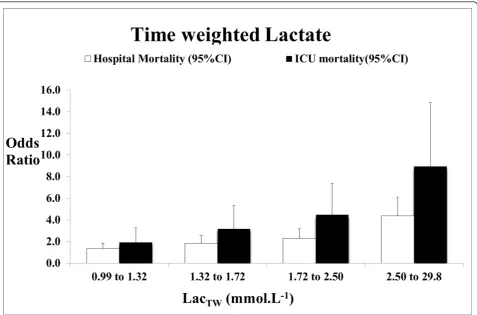
For every one unit increase in LACTW24 the risk of hospital death increased by 37% (OR 1.37 (1.29 to 1.45) P < 0.0001) and the risk of ICU mortality increased by 43% (OR 1.43 (1.35 to 1.52) P < 0.0001). When LACTW24 was divided into quintiles and analysed as a categorical variable, each quintile progressively showed an increased risk in comparison to the lowest quintile for both hospital and ICU mortality (Figure 3).
When prediction equations excluding measurements of lactate were derived from 50% of the data and then applied to the remaining holdout sample, the AUC for hospital and ICU mortality was 0.820 ± 0.01 and 0.873 ± 0.01 respectively. The inclusion of static and dynamic measures of lactate homeostasis within the first 24 hours improved the prediction of hospital and ICU mor-tality (Table 4). When LACTW24 and LACΔ24 were added to the models of hospital mortality, the AUC-ROC was found to increase to 0.831 ± 0.01 and 0.825 ± 0.009 respectively (Table 4). In both cases, this repre-sented a statistical (P< 0.0001) improvement in the pre-diction of mortality.
Interestingly, when LACMIN (a static measure) was added to the models of hospital mortality, the AUC was found to increase to 0.832 ± 0.01 (Table 4). However, when we combined LACTW24 and LACΔ24 we found that this resulted in the greatest improvement in the prediction of both hospital and ICU mortality (Table 4), compared to any other combination.
Discussion
Statement of key findings
[image:5.595.57.540.100.260.2]In a large multi-centre, heterogeneous cohort of criti-cally ill patients, we examined whether dynamic indices of blood lactate concentration over the first 24 hours of ICU admission were independently associated with increased risk of hospital mortality. We found that LACTW24 and the LACΔ24were the indices of lactate homeostasis within the first 24 hours that were indepen-dently the most predictive of hospital mortality. A rising, compared to a falling, blood lactate concentration over the first 24 hours was associated with a significantly increased risk of mortality. Furthermore, for every one mmol L-1increase in LACTW24 and in LACΔ24 the risk of hospital death increased by 37% and 15%, respec-tively. When LACTW24 and LACΔ24 were separately
Table 3 Multivariate models for the prediction of hospital and ICU mortality
Effect Hospital mortality P-value ICU mortality p-value
Odds ratio (95% CI) Odds ratio (95% CI)
APACHE II score 1.13 (1.11 to 1.14) < 0.0001 1.13 (1.11 to 1.15) < 0.0001
Age (yr) 1.02 (1.02 to 1.03) < 0.0001 1.01 (1.00 to 1.02) 0.004
LACTW24(mmom.L-1) 1.37 (1.29 to 1.45) < 0.0001 1.43 (1.35 to 1.52) < 0.0001
LACΔ24(mmom.L-1) 1.15 (1.10 to 1.20) < 0.0001 1.18 (1.13 to 1.24) < 0.0001
Diagnosis* < 0.0001 < 0.0001
Mechanical ventilation 1.93 (1.52 to 2.45) < 0.0001 2.81 (1.95 to 4.05) < 0.0001
Hospital* 0.0001 0.006
Admission date (decreased risk per year) 0.91 (0.83 to 0.99) 0.04 0.88 (0.78 to 1.00) 0.05 Surgical patients 0.67 (0.53 to 0.84) 0.0007 0.80 (0.59 to 1.08) 0.15 Number of measurements 0.98 (0.95 to 1.01) 0.23 1.01 (0.97 to 1.04) 0.76
Female v male 0.96 (0.81 to 1.14) 0.66 0.99 (0.79 to 1.23) 0.90
*categorical variable, odds ratios excluded
APACHE II, Acute Physiology and Chronic Health Evaluation; LACTW24, time weighted lactate; LACΔ24, delta lactate-change in lactate in the first 24 hours
Figure 2Adjusted* odds ratios for LacΔ24referenced against
the lowest quintile. * adjusted for APACHE II, diagnosis, age, gender, ventilation, surgery, admission date, hospital number of measurements. 95% CI, 95% confidence interval; APACHE II, Acute Physiology and Chronic Health Evaluation II; LACΔ24, delta lactate,
change in lactate in the first 24 hours;LacΔ24change in lactate over
[image:5.595.57.292.500.650.2]added to outcome prediction models, the AUC-ROC was found to increase significantly achieving close to 90% discrimination for ICU mortality. Furthermore, the maximal increase in AUC-ROC was achieved by the combination of both these dynamic indices (LACTW24 and LACΔ24) achieving close to 90% discrimination for
ICU mortality and close to 85% discrimination for hos-pital mortality
[image:6.595.60.538.88.403.2]Comparison with previous studies-static versus dynamic While quite a number of studies, including our previous study [4], have demonstrated that higher“static”indices
Figure 3Adjusted* odds ratios for LacTWreferenced against the lowest quintile. * adjusted for APACHE II, diagnosis, age, gender,
ventilation, surgery, admission date, hospital number of measurements. 95% CI, 95% confidence interval; APACHE II, Acute Physiology and Chronic Health Evaluation II; LacTW, time weighted lactate over the first 24 hours.
Table 4 Change in adjusted Area under the Receiver Operating Characteristic Curve
NAME Hospital AUCADJ P-value* ICU AUCADJ P-value*
(1) Established risk factors 0.820 ± 0.01 0.873 ± 0.01
(1) + LACADM 0.822 ± 0.01 0.16 0.875 ± 0.01 0.24
(1) + LACΔ24% 0.824 ± 0.01 0.006 0.879 ± 0.01 0.009
(1) + LACΔ24 0.825 ± 0.01 0.005 0.879 ± 0.01 0.03
(1) + LACMAX24 0.827 ± 0.01 0.007 0.883 ± 0.01 0.015
(1) + LACTW24 0.831 ± 0.01 0.0001 0.887 ± 0.01 0.0005
(1) + LACMIN24 0.832 ± 0.01 < 0.0001 0.886 ± 0.01 < 0.0001
(1) + LACTW& LACΔ24 0.838 ± 0.01** < 0.0001 0.895 ± 0.01** < 0.0001
*compared to model (1) with established risk factors (APACHE II, diagnosis, age, gender, ventilation, surgery, date of admission and hospital) **P< 0.01 compared to all individual measure of lactate
[image:6.595.57.538.565.676.2]of lactate derangement during ICU stay (LACTW24, LACMAX24 and LACMIN24) are associated with higher ICU and hospital mortality [1,3,4,8,12] only a few stu-dies have reported dynamic indices of lactate homeosta-sis. In these studies, sustained hyperlactataemia (generally regarded as more than six hours) was asso-ciated with higher mortality and, as the duration of this hyperlactaemia increased, the mortality rate also increased [2,5,12,13,16,17]. However, it must be noted that the majority of these studies were small, single cen-tre, conducted in a single/specific diagnostic grouping (that is, severe sepsis), commonly examined for only short time periods after admission to ICU (under 24 hours) and were assessed in patients who had only a small number of lactate samples taken in the first 24 hours. These methodological deficiencies have con-founded previous attempts to investigate the indepen-dent predictive value of dynamic indices of lactate in a heterogeneous population of critically ill patients. Our findings, however, for the first time demonstrate that early dynamic indices of lactate hoemeostasis (LACTW24 and the LACΔ24) are independently associated with hos-pital mortality in a large heterogeneous cohort of patients. Our study expands this association between decreasing blood lactate concentrations and mortality to
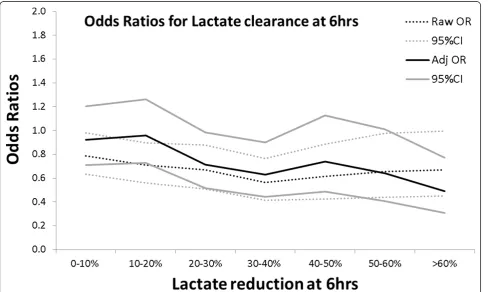
[image:7.595.57.546.402.694.2]all patient groups and up to the first 24 hours in the cri-tically ill. Thus, not only the magnitude and the dura-tion of lactate derangement (LACTW24) but also the rate of derangement in blood lactate concentration over the first 24 hours (LACΔ24) help identify patients at higher risk of death. In this regard, our findings significantly expand previous work which suggested that dynamic changes in lactate concentration could be clinically use-ful markers of patients at high risk of death [1,2,5,6,24]. However, to facilitate comparison with these previous studies we conducted a separate analysis over the first six hours after ICU admission and demonstrated that lactate clearance was inversely associated with increased risk of death at both univariate (P= 0.0001) and multi-variate levels (P= 0.007) (Figure 4). These findings sug-gest for the first time that LACΔ24 may be a clinically useful index of lactate homeostasis in the critically ill. While univariate results suggest a threshold value of 30 to 40% clearance over the first six hours, there is no clear indication from the multivariate model as the risk of death continues to decrease as the lactate clearance increases. Furthermore, these findings are consistent with previous studies suggesting that targeted reduction of lactate may be a beneficial strategy in the critically ill [14,17]. We also examined lactate clearance at 6 to 12
Figure 4Raw and adjusted* odds ratios (95% CI) for death with LacΔ6referenced against zero change. * adjusted for APACHE II,
hours, 12 to 18 hours and 18 to 24 hours, but it was not found to be statistically significant at either a univariate or multivariate level (data not shown). In addition, while the majority of the previous studies examined patients with sepsis/septic shock, our cohort was heterogeneous. While we determined those with sepsis had an increased risk of mortality OR 1.60 (1.06 to 2.41)P = 0.02, there was no significant interaction between sepsis and LACTW24(P = 0.92) or sepsis and LACΔ24 (P = 0.10). This indicates that there was no evidence in this cohort to suggest that the relationship between lactate and mortality differed significantly between those with and without sepsis.
To our knowledge this is the first demonstration that dynamic measures of lactate can be used to significantly improve the prediction of mortality in a heterogeneous cohort of critically ill patients. Moreover, both LACTW24 and LACΔ24 were positively associated with length of stay in survivors suggesting that these indices are robust and identify patients not only at high risk of mortality but also those who are at high risk of significant mor-bidity (data not shown). While individual dynamic mea-sures do not outperform all the currently used static measures, the combined measure of lactate dynamics (LACTW24and LACΔ24) could be the optimal early lac-tate variable to predict mortality as it can out-perform currently used static measures. This improved predictive ability may rest in the ability of this dynamic composite to assess the absolute magnitude, duration and rate of reduction of lactate derangement. Further studies are now required to confirm the clinical utility of this com-posite dynamic measure.
Implications for clinicians
There is much interest in finding biomarkers that can assist in the early identification of patients who are, or continue to be, at high risk of death [25]. Our findings suggest that dynamic changes in blood lactate concen-tration over the first 24 hours may prove useful as a widely available biomarker of increased risk of death. Interestingly, in support of this hypothesis, goal directed resuscitation in critically ill patients with septic shock improves blood lactate concentrations over its six hours of therapy [26]. Furthermore, a prospective study which targeted reductions in blood lactate concentration goals was equally effective as a strategy targeting central venous oxygen saturation [25,27]. While our findings are in broad agreement with this association between
‘physiological’ normalisation of lactate and improved survival in the critically ill, further study is required before our findings should be used as a therapeutic tar-get in mixed cohorts of patients and over varying time periods. However, clinicians confronted with a
persistently abnormal blood lactate should also be aware of the fact that the absolute degree of derangement (duration and magnitude) and the rate increase of this derangement are associated with risk of death and should continue to maintain a high index of suspicion until these parameters have completely normalised.
Limitations of the study
Our study is retrospective in design and thus potentially subject to systematic error and bias. However, all the clinical and electronic data utilised were collected pro-spectively in a large number of consecutive critically ill patients in four ICUs, are numerical in nature and were measured independently; thus, they were not amenable to selection bias or unintended manipulation. Further-more, 71% of all ICU patients admitted during the study period (n = 7,155) had at least two blood lactate mea-surements (n= 5,041) and were included in our analysis, suggesting that our findings are generalisable and can be applied to the majority of ICU patients. A number of common therapeutic interventions, such as epinephrine [28], metformin [29], nucleoside analogues in HIV [30], high-volume hemofiltration (HVHF) with lactate-buf-fered replacement fluids [31], can all affect lactate levels and we did not have information on their use. However, the influence of these potential confounding factors is likely to be negligible given the small numbers of patients in which these factors would have been present, in relation to the size of the cohort; although presence of these factors might alter the applicability of these results to individual patients.
While our calculation of LACΔ24 assumes that the kinetics of lactate is linear in nature, it is possible that it may follow an alternative decay profile, that is, exponen-tial. However, we feel this pragmatic assumption does not positively bias the strength of the associations demonstrated. Furthermore, we believe that more com-plex modelling of lactate kinetics would obscure the take-home message for clinicians at the bedside of the association between rate of change of lactate concentra-tion and mortality
LACTW24 and LacΔ24, however, should be considered a useful indicator pointing to the severity of illness and to superimposed complications.
Future research
These dynamic lactate findings are novel and need to be confirmed by similar studies in other countries and large heterogeneous patient populations before they can be considered to reflect a general biological principle. Ideally, these studies should be conducted prospectively with simultaneous collection of information on interven-tions which may affect lactate. Furthermore, given the lactate indices assessed in this study are not necessarily the first in hospital lactate measurements and may not, therefore, consider the effects of early resuscitative inter-ventions, future prospective studies should collect all lactate measurements (that is, including the emergency department) to determine if the demonstrated relation-ships are also observed during this earlier period.
In addition, if these studies confirm the value of LACΔ24, then future studies could potentially focus on this marker as a surrogate endpoint to assess the success of early interventions in critically ill patients in the resuscitative period.
Future studies developing new or refining current severity of illness models in the critically ill should con-sider the inclusion of measures of lactate homeostasis in the first 24 hours. Our results suggest that the use of dynamic measures may result in the greatest improve-ment in predictive ability. In addition, it is worth noting that our study was potentially limited by having to add lactate measurements to the composite APACHE II score, rather than its component parts, and that a com-pletely re-derived risk prediction equation that includes one or more index of lactate may further increase the predictive ability over that shown in this study.
Conclusions
In conclusion, higher LACTW24and LACΔ24 blood lac-tate concentrations are associated with greater hospital mortality. In the first 24 hours following ICU admission, they have significant independent predictive value, improve the performance of illness severity score-based outcome predictions and are superior to simple static measures of lactate concentration. Future studies should be conducted to determine the clinical utility of the composite measure of lactate derangement (magnitude, duration and rate of correction) to predict mortality and to determine potential the utility of LACΔ24 as a future therapeutic target/trigger. While these dynamic mea-sures do not have a routine role in daily clinical prac-tice, clinicians should be especially alert to all patients with a persistently deranged or rapidly rising blood lac-tate concentration.
Key messages
•Static derangements in lactate homeostasis during ICU stay have become established as clinically useful markers of increased risk of mortality.
• Dynamic indices of lactate homeostasis, which describe not only magnitude but also duration and trend over time, may be even more useful in predict-ing outcome.
•We demonstrated that higher lactate averaged over 24 hours (LACTW24) and an increasing trend in lac-tate concentration over 24 hours (LACΔ24) is asso-ciated with greater hospital mortality.
•Furthermore, the combination of these markers out-performed all individual‘static’indices of lactate homeostasis in predicting outcome in the critically ill.
•Clinicians should be especially alert in all patients with a persistently deranged or rapidly rising blood lactate concentration
Abbreviations
APACHE II: Acute Physiology and Chronic Health Evaluation II; ANZICS-CORE: Australian and New Zealand Intensive Care Society-Centre for Outcome and Resources Evaluation; AUC-ROC: Area under the Receiver Operating Characteristic Curve; HVHF: high-volume hemofiltration; LACADM: admission
lactate; LACTW24: time weighted lactate; LACMAX24: maximum lactate;
LACMIN24: minimum lactate; LACΔ24: delta lactate; LAC%Δ24: percentage
change in lactatein the first 24 hours.
Acknowledgements
No financial support was received for the collation of this article. However, AN receives a Victorian Neurotruama Initiative (VNI) Early Career Practitioner Fellowship and RB receives a National Health and Medical Research Council (NHMRC) Practitioner Fellowship.
Author details
1Australian and New Zealand Intensive Care - Research Centre, School of
Public Health and Preventive Medicine, Monash University, Commercial Road, Melbourne, VIC, Australia.2Department of Anaesthesiology and
Resuscitology, Okayama University Hospital, 2-5-1 Shikata-cho, Okayama, Japan.3Department of Intensive Care, The Alfred Hospital, Commercial Road,
Melbourne, VIC, Australia.4Department of Intensive Care, The Austin Hospital, Heidelberg Road, Melbourne, VIC, Australia.5Department of Intensive Care,
The Western Hospital, Gordon Street, Melbourne, VIC, Australia.6Department of Intensive Care, Westmead Hospital, Darcy Road, Sydney, NSW, Australia.
7
Faculty of Medicine, University of Melbourne, Swanston Street, Melbourne, VIC, Australia.
Authors’contributions
AN, MB, ME and RB carried out the database searches, participated in the data collation and drafted the manuscript with CF, ES, MR, GH and DJC. AN, RB, VP, DJC and MB conceived of the study, and participated in its design and coordination and helped to draft the manuscript. All authors read and approved the final manuscript.
Competing interests
The authors declare that they have no competing interests.
Received: 9 May 2011 Revised: 13 September 2011 Accepted: 20 October 2011 Published: 20 October 2011
References
2. Suistomaa M, Ruokonen E, Kari A, Takala J:Time-pattern of lactate and lactate to pyruvate ratio in the first 24 hours of intensive care emergency admissions.Shock2000,14:8-12.
3. Khosravani H, Shahpori R, Stelfox HT, Kirkpatrick AW, Laupland KB: Occurrence and adverse effect on outcome of hyperlactatemia in the critically ill.Crit Care2009,13:R90.
4. Nichol AD, Egi M, Pettila V, Bellomo R, French C, Hart G, Davies A, Stachowski E, Reade MC, Bailey M, Cooper DJ:Relative hyperlactatemia and hospital mortality in critically ill patients: a retrospective multi-centre study.Crit Care2010,14:R25.
5. Meregalli A, Oliveira RP, Friedman G:Occult hypoperfusion is associated with increased mortality in hemodynamically stable, high-risk, surgical patients.Crit Care2004,8:R60-65.
6. Bakker J, Gris P, Coffernils M, Kahn RJ, Vincent JL:Serial blood lactate levels can predict the development of multiple organ failure following septic shock.Am J Surg1996,171:221-226.
7. Weil MH, Afifi AA:Experimental and clinical studies on lactate and pyruvate as indicators of the severity of acute circulatory failure (shock).
Circulation1970,41:989-1001.
8. Mikkelsen ME, Miltiades AN, Gaieski DF, Goyal M, Fuchs BD, Shah CV, Bellamy SL, Christie JD:Serum lactate is associated with mortality in severe sepsis independent of organ failure and shock.Crit Care Med
2009,37:1670-1677.
9. De Backer D:Lactic acidosis.Intensive Care Med2003,29:699-702. 10. Manikis P, Jankowski S, Zhang H, Kahn RJ, Vincent JL:Correlation of serial
blood lactate levels to organ failure and mortality after trauma.Am J Emerg Med1995,13:619-622.
11. Fall PJ, Szerlip HM:Lactic acidosis: from sour milk to septic shock.J Intensive Care Med2005,20:255-271.
12. Kaplan LJ, Kellum JA:Initial pH, base deficit, lactate, anion gap, strong ion difference, and strong ion gap predict outcome from major vascular injury.Crit Care Med2004,32:1120-1124.
13. McNelis J, Marini CP, Jurkiewicz A, Szomstein S, Simms HH, Ritter G, Nathan IM:Prolonged lactate clearance is associated with increased mortality in the surgical intensive care unit.Am J Surg2001,182:481-485. 14. Nguyen HB, Rivers EP, Knoblich BP, Jacobsen G, Muzzin A, Ressler JA,
Tomlanovich MC:Early lactate clearance is associated with improved outcome in severe sepsis and septic shock.Crit Care Med2004, 32:1637-1642.
15. Noritomi DT, Soriano FG, Kellum JA, Cappi SB, Biselli PJ, Libório AB, Park M: Metabolic acidosis in patients with severe sepsis and septic shock: a longitudinal quantitative study.Crit Care Med2009,37:2733-2739. 16. Friedman G, Berlot G, Kahn RJ, Vincent JL:Combined measurements of
blood lactate concentrations and gastric intramucosal pH in patients with severe sepsis.Crit Care Med1995,23:1184-1193.
17. Jansen TC, van Bommel J, Schoonderbeek FJ, Sleeswijk Visser SJ, van der Klooster JM, Lima AP, Willemsen SP, Bakker J, LACTATE study group:Early lactate-guided therapy in intensive care unit patients: a multicenter, open-label, randomized controlled trial.Am J Respir Crit Care Med2010, 182:752-761.
18. Knaus WA, Draper EA, Wagner DP, Zimmerman JE:APACHE II: a severity of disease classification system.Crit Care Med1985,13:818-829.
19. ANZICS: Modified APACHE III Admission Diagnosis.[http://www.anzics. com.au].
20. National Association of Testing Authorities.[http://www.nata.asn.au]. 21. RCPA manual. The Royal College of Pathologists of Australasia.Fifth edition.
Sydney: The Royal College of Pathologists of Australasia; 2009. 22. Finney SJ, Zekveld C, Elia A, Evans TW:Glucose control and mortality in
critically ill patients.JAMA2003,290:2041-2047.
23. Tukey J:Exploratory Data AnalysisReading, MA: Addison-Wesley; 1977. 24. Levy B, Sadoune LO, Gelot AM, Bollaert PE, Nabet P, Larcan A:Evolution of
lactate/pyruvate and arterial ketone body ratios in the early course of catecholamine-treated septic shock.Crit Care Med2000,28:114-119. 25. Rivers E, Nguyen B, Havstad S, Ressler J, Muzzin A, Knoblich B, Peterson E,
Tomlanovich M, Early Goal-Directed Therapy Collaborative Group:Early goal-directed therapy in the treatment of severe sepsis and septic shock.N Engl J Med2001,345:1368-1377.
26. Yang CS, Qiu HB, Huang YZ, Xie JF, Mo M, Liu SQ, Yang Y:[Prospective research on the prognosis of septic shock based on the change of lactate concentration in arterial blood].Zhonghua Wai Ke Za Zhi2009, 47:685-688.
27. Jones AE, Shapiro NI, Trzeciak S, Arnold RC, Claremont HA, Kline JA:Lactate clearance vs central venous oxygen saturation as goals of early sepsis therapy: a randomized clinical trial.JAMA2010,303:739-746. 28. Myburgh JA, Higgins A, Jovanovska A, Lipman J, Ramakrishnan N,
Santamaria J, CAT Study investigators:A comparison of epinephrine and norepinephrine in critically ill patients.Intensive Care Med2008, 34:2226-2234.
29. Chang CT, Chen YC, Fang JT, Huang CC:Metformin-associated lactic acidosis: case reports and literature review.J Nephrol2002,15:398-402. 30. Falco V, Crespo M, Ribera E:Lactic acidosis related to nucleoside therapy
in HIV-infected patients.Expert Opin Pharmacother2003,4:1321-1329. 31. Cole L, Bellomo R, Baldwin I, Hayhoe M, Ronco C:The impact of
lactate-buffered high-volume hemofiltration on acid-base balance.Intensive Care Med2003,29:1113-1120.
doi:10.1186/cc10497
Cite this article as:Nicholet al.:Dynamic lactate indices as predictors of outcome in critically ill patients.Critical Care201115:R242.
Submit your next manuscript to BioMed Central and take full advantage of:
• Convenient online submission
• Thorough peer review
• No space constraints or color figure charges
• Immediate publication on acceptance
• Inclusion in PubMed, CAS, Scopus and Google Scholar
• Research which is freely available for redistribution