Knowledge management challenges
within traditional procurement system
Takhtravanchi, M and Pathirage, C
Title
Knowledge management challenges within traditional procurement system
Authors
Takhtravanchi, M and Pathirage, C
Type
Article
URL
This version is available at: http://usir.salford.ac.uk/id/eprint/41177/
Published Date
2016
USIR is a digital collection of the research output of the University of Salford. Where copyright
permits, full text material held in the repository is made freely available online and can be read,
downloaded and copied for noncommercial private study or research purposes. Please check the
manuscript for any further copyright restrictions.
Abstract— In the construction industry, project knowledge mostly resides in the minds of project members and is, often, not managed properly so it can be used in future projects. As construction projects are temporary and unique, project members leave a project for another one once a project is completed. Therefore, poor management of knowledge across construction projects will lead to a considerable amount of knowledge loss; the ignoring of which would be detrimental to project performance. This issue is more prominent in projects undertaken through the traditional procurement system, as this system encourages fragmentation rather than integration. Thus disputes exist between the design and construction phases based on the poor management of knowledge between those two phases. This paper aims to highlight the challenges of the knowledge management that exists within construction projects undertaken through the traditional procurement system. Expert interviews were conducted and challenges were identified and analysed by the Interpretive Structural Modelling (ISM) approach in order to summarise the relationships among them. Two identified key challenges are the Culture of an Organisation and Knowledge Management Policies. A knowledge of the challenges and their relationships will help project manager and stakeholders to have a better understanding of the importance of knowledge management
Keywords— Challenges, Construction Industry, Knowledge Management, Traditional Procurement System.
I. INTRODUCTION
here are different philosophical views about knowledge. It is categorised either as tacit or explicit. Explicit knowledge can be codified, stored and distributed in certain media, whilst tacit knowledge is hard to capture and distribute because it is associated with the experiences and skills of individuals. Many studies have written about the difference between tacit and explicit knowledge in KM [Knowledge Management], but fewer studies have considered the importance of ‘Implicit Knowledge’ as a potential bridge between them. Implicit knowledge is another dimension of tacit knowledge. It is about knowing 'how' (the process of doing something), which has not been put together either by assumptions or perceptions that leads to principles, or through an analysis of theory [1], [2]. Therefore, in this research the ‘implicit’ component of tacit knowledge is considered.
Knowledge is a valuable asset that can create added wealth.
M. Takhtravanchi is the Postgraduate Researcher in the School of the built Environment at the University of Salford. (email: [email protected])
C. Pathirage is the Director of Postgraduate Research Studies in the School of the Built Environment, University of Salford. (e-mail:
Therefore, the competitive advantage of an organisation and the successful completion of projects lie in the ability of effectively managing knowledge. KM plays a significant role in the survival and performance of organisations, specifically in based industries like construction. Most project-based organisations tend to embark on rework thereby often repeating the same mistakes again, which is known as ‘reinventing the wheel’ [3]. In fact, a lack of effective knowledge transfer will lead the captured knowledge from previous projects not being efficiently reused in future projects. Therefore, effective KM can be the main source of the competitive advantage of an organisation by reducing project time and cost, and improving its quality and performance. KM is a wide concept that consists of various processes such as creating, securing, capturing, coordinating, combining, retrieving, and distributing knowledge [4]. The three main processes are: capturing, sharing and transferring.
II. KNOWLEDGE MANAGEMENT IN CONSTRUCTION INDUSTRY
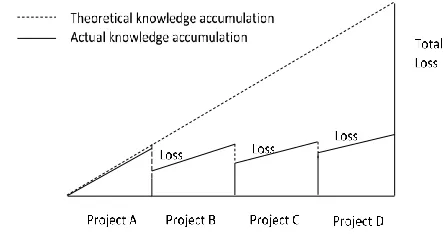
In the construction industry, project knowledge mostly resides in minds of project members and is, frequently, not captured and transferred across projects in order to be used in future [5]. This means that knowledge is not managed properly between projects and the team members in those projects. The nature of construction projects is temporary which means project members leave a project for another one once a project is completed. Therefore, much knowledge that is gained by project members will be lost and dispersed if it is not properly captured and shared at the end of a project (Fig. 1).
[image:2.612.326.550.541.658.2]Fig. 1 Knowledge Accumulation and Loss across Projects
Furthermore, researchers believe that the construction industry will lose its skilled and knowledgeable workforce because there is no efficient strategy to manage knowledge across projects and between team members [6]. In other
Knowledge Management Challenges within
Traditional Procurement System
M. Takhtravanchi, C. Pathirage
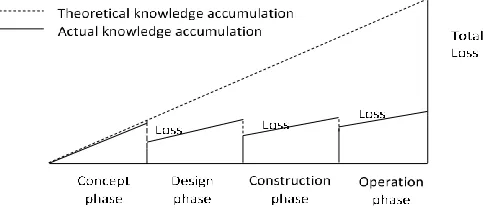
words, the construction industry suffers from a lack of KM between its phases [7], [8], especially in the traditional procurement system [9] because this system encourages fragmentation rather than integration. There is no ethos of sharing knowledge between the design and construction phases in a traditional procurement system [7], [10]. Reference [11] stated that literature about the way in which designers share their knowledge in the project environment is limited and more research is required. Furthermore, Reference [12] highlighted that different techniques are used to capture knowledge and for sharing important information and knowledge that assists in solving some intractable problems in the different phases of a construction project; the amount of knowledge loss in later phases is great and ignoring it would be detrimental to project performance (Fig. 2).
Fig. 2 Knowledge accumulation and loss between project phase
Regarding KM, Reference [13] identified two challenges within traditional construction projects. Firstly, the traditional procurement system suffers from a lack of management expertise. Due to the nature of the system, the period of the design and construction phases are lengthy. Therefore, good communication needs to exist between all members of a project. Secondly, the traditional procurement system suffers from a lack of buildability during the design and construction phases. Designers are not motivated and well experienced enough to manage the construction work and the cost and time of a project effectively. Additionally, the people involved in the construction phase are unable to contribute to the design of a project until it is too late. Therefore, there is a need to motivate project members in both the design and construction phases to use and share their experiences in order to improve project performance.
According to a CIOB report (2010) [9], the traditional procurement method is the most efficient and suitable method only for projects up to £5m, and it is primarily used in projects that overrun in terms of costs and time. Furthermore, the report indicated that alterations to clients’ requirements, communication, and design team problems are the most significant challenges that arise during the procurement process. Therefore, the importance of tacit knowledge is more significant in a knowledge-based industry such as construction where common disputes exist between the design and construction phases, specifically in projects undertaken by utilising the traditional procurement system. Within this context, failure to manage knowledge in terms of capturing, sharing and transferring, will result in spending more time, in
incurring greater costs and in increasing the possibility of “reinventing the wheel”. Therefore, there is a need to identify the challenges to KM in a traditional procurement system in order to enable project managers to have a better understanding of KM and to implement an appropriate strategy.
III. METHODOLOGY
The research aims to explore and identify the challenges to KM, in terms of capturing, sharing and transferring knowledge within construction projects based on the traditional procurement system. The first stage of this research included a thorough study of the relevant literature which aimed to understand the concept of KM and its challenges in traditional construction projects. The main part of the research, the second stage, involved an experts’ survey by conducting 4 interviews with experts from both academia and industry.
The main research tool was understanding semi-structured interviews where a number of open-ended questions were used in order to identify to key challenges to, and barriers sets against, KM. The questions allowed respondents to give their views based on their own experiences concerning the challenges within traditional construction projects and the factors that affect KM within this type of procurement. The answers produced considerable information about the respondents’ views on the current challenges within the traditional procurement system in terms of KM. The interviewees were selected from both academia and industry in order to have a better understanding of this research phenomenon and to bridge the gap that exists between academia and industry. However, it was necessary to interview academics to get their expert view and they also had industry experience. The selected interviewees, 2 from academia and 2 from industry, were experts and had had years of experience of working in the construction field and had been involved in various KM and traditionally-based construction projects. They were selected based on their understanding and knowledge of these concepts: Tacit Knowledge, KM, Knowledge Capturing, Knowledge Sharing, Knowledge Transferring, and Construction Projects undertaken through the Traditional Procurement System. The experts' profile is illustrated in Table I.
The interviews lasted one hour and some were extended as the interviewees were very open and eager to talk about and discuss their experiences. Furthermore, all interviews were audio-recorded – with interviewees’ permission – then transcribed and entered into NVivo software. Thematic analysis was undertaken of the transcripts with a particular focus on the challenges of KM in terms of capturing, sharing and transferring knowledge. The analysis of both the academia and industry perspectives were synthesised and compared with findings from the literature review in order to identify challenges. Furthermore, an ISM approach was used to summarise and identify the relationships between the identified challenges.
Respondents Profile Total Experience
R1 Professor of Construction
Management/Procurement, with experience of the industry including organising, managing and procuring construction project
20 years
R2 Lecturer in Construction Management,
with experience and understanding of BIM implementation, knowledge management and design-construction integration
10 years
R3 Construction engineer involved in
Knowledge Transfer Partnerships, and having experience of BIM
implementation
8 years
R4 Architect with a thorough experience of
being a project manager and site manager
25 years
IV. KNOWLEDGE MANAGEMENT CHALLENGES – CRITICAL REVIEW
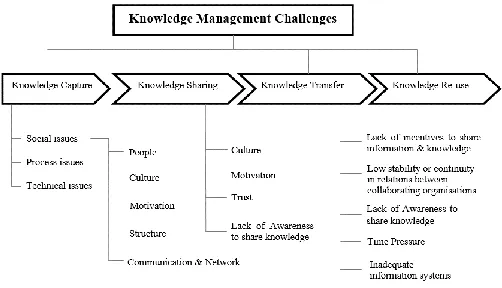
[image:4.612.40.297.51.223.2]The unique characteristic of the traditional procurement system, also known as the separated method, is the separation of responsibility within the design phase and the construction phase in the procurement process of the project. Researchers have conducted a critical literature survey in order to identify the challenges of KM in terms of capturing, sharing and transferring tacit knowledge in a traditional construction project [4]. These challenges are shown in Fig 3.
Fig. 3 Knowledge Management Challenges
V. KNOWLEDGE MANAGEMENT CHALLENGES – EXPERTS’ SURVEY
The responses from the interviews were analysed with the aid of computer software. The process started with a qualitative content analysis of the interviews’ transcripts with the aid of NVivo software which generates codes according to the identified concepts within the transcripts. These codes and concepts were further used to create cognitive maps highlighting the outcomes from the experts’ survey interviews. “I think it is particularly difficult and problematic in the design phase to manage tacit knowledge as all of the expertise and the skills in design are all linked to tacit knowledge” The findings establish that tacit knowledge in the design phase is more problematic and harder to manage due to the
complexity of the design phase. This tacit knowledge refers mostly to personal, and the company’s, experience.
A. A Synthesis of Academia and Industry Perspectives
Fig. 4 presents a synthesis of the challenges of tacit KM within the traditional procurement system as elicited from experts’ survey interviews. Concepts 11-21 and 21-38 are those identified by interviewees from academia and industry respectively. Comparing the identified challenges from the academia and industry perspectives reveals that not only are there some challenges (concepts 11 and 21, 12 and 22, 13 and 23) in common, but also that there are some relationships between them.
Respondents highlighted that the traditional procurement system by definition encourages project members to walk away at the end of a project; therefore, no sufficient time for project members to capture the lessons they have learned through project and to share them with each other (managing knowledge). Moreover, the awareness of project members concerning the importance of tacit knowledge and its management is low within this type of procurement system (which is highly dependent on the organisational culture and on the approaches that managers take in order to manage knowledge).
Concepts 11-21 provide a summary of challenges to tacit KM as elicited from R1 and R2. They highlight the main challenges to tacit KM within traditional construction projects from an academia point of view. R1 and R2 stated that the traditional procurement system, by its definition, is a challenge to the managing of tacit knowledge as it does not facilitate project members to keep the knowledge and experiences that they have achieved during project's process (concept 21). As described by R2, project members are not encouraged to share their information and knowledge in a traditional procurement system. Both R1 and R2 stated that this will lead to an improper flow of information and knowledge between project members (concept 12). Furthermore, they mentioned that the system itself tries to ignore the importance of KM by not incentivising project members and by encouraging them to walk away at the end of a project (concept 17). However, R1 stated that this is due to the contractual barriers (concept 18) that exist in this type of procurement for both the design and construction teams. Additionally, R1 explained that contractual barriers affect the flow of knowledge and information within/between the design team and the construction team (concept 12).
[image:4.612.48.299.382.526.2]concerning the importance of tacit KM and implementing proper KM mechanisms. R1 and R2 highlighted that the culture of an organisation is the major challenge and forms the root of other challenges to tacit KM in traditional construction projects. However, R1 stated that the awareness of the importance of tacit knowledge and its management depends on individual concerns and on companies (concept 19) and how they view the benefits of such management and using any lessons learned; some would be aware of this importance and some would not (concept 14). In this regard, R1 and R2 suggested that organisations and project managers should increase their awareness of the importance of tacit KM and should also put rewards in place and incentivise project members to participate in the tacit KM process and improve their performance (concept 20). They also stated that the traditional procurement system does not usually provide incentives and give rewards to project members for capturing and sharing knowledge through lessons learned (concept 13).
Fig.4 Synthesis of Challenges to KM within the Traditional Procurement System
Concepts 21-38 are a summary of the challenges to tacit KM as elicited from R3 and R4. They highlight the main challenges to tacit KM within a traditional construction project from an industry viewpoint. R3 and R4 stated that the level of trust between designers and engineers is low (concept 25) in the traditional procurement system and this is related to its
nature which is based on the separation of the design and construction teams (concept 26). R4 stated that the value and benefits of tacit KM are not well explained within organisations (concept 27) and is related to the attitudes of project managers and whether they feel it is necessary to prioritise and explain the importance of KM (concept 21). R3 stated that collaboration between the design and construction teams in terms of information and knowledge is low (concept 22) and this is because organisations are not incentivised to act on lessons learned or to undertake Post Project Reviews [PPR] after finishing a project (concept 28). They are also not incentivised to share their experiences (concept 23). R4 argued that capturing lessons learned should be simple and easy (concept 29); it merely means that individuals need to make an effort and to spend time to capture and share their experiences (concept 34), and undertake cost analysis (concept 35). If they are not motivated and incentivised, there is no reason for them to make effort and to spend time in capturing and sharing their experiences (concept 30). R3 argued that a lack of incentives and motivation from manager level will make it difficult to
members are usually afraid of adopting new technology not only because they have little information about it, but also because they afraid of being liable for the problems that might occur by implementing the new technology. Therefore, they are resistant to change (concept 37). Both R3 and R4 highlighted that work overload (concept 33) and having less time for capturing experiences and collaboration with other project members (concept 24) are other challenges that lead to less participation in the KM process in terms of capturing, and sharing, lessons learned and experiences.
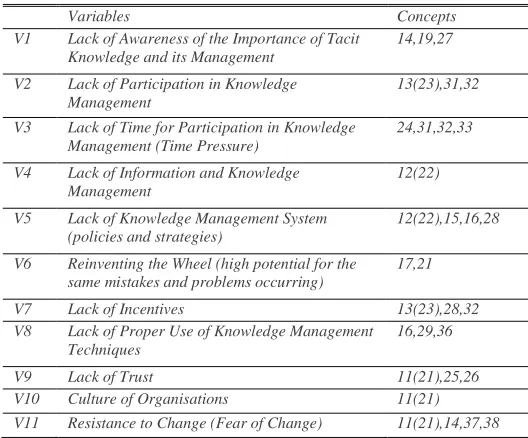
Fig. 4 illustrates a summary of all the challenges and barriers to KM within construction projects undertaken within the traditional procurement system as elicited from the experts’ interviews. The identified challenges are given in detail and most of them are related to each other. In order to have a categorised and summarised list of challenges and barriers, these findings are compared with the findings from the critical literature review (Fig. 3) and the result is presented in Table II.
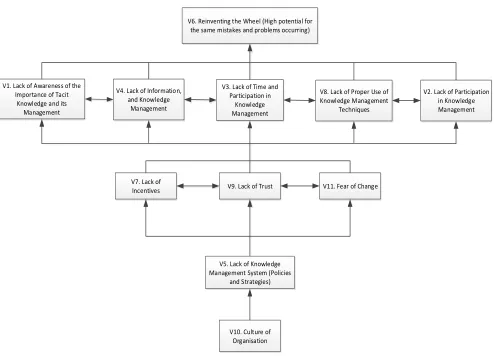
[image:6.612.40.304.360.579.2]This table shows how these summarised challenges are in line with the concepts in Fig 2. Furthermore, these challenges and barriers, were used by ISM approach to identify their relationships (see Fig. 3).
TABLE II
KM CHALLENGES AND BARRIERS IN THE TRADITIONAL PROCUREMENT SYSTEM
Variables Concepts
V1 Lack of Awareness of the Importance of Tacit Knowledge and its Management
14,19,27
V2 Lack of Participation in Knowledge Management
13(23),31,32
V3 Lack of Time for Participation in Knowledge Management (Time Pressure)
24,31,32,33
V4 Lack of Information and Knowledge Management
12(22)
V5 Lack of Knowledge Management System (policies and strategies)
12(22),15,16,28
V6 Reinventing the Wheel (high potential for the same mistakes and problems occurring)
17,21
V7 Lack of Incentives 13(23),28,32
V8 Lack of Proper Use of Knowledge Management Techniques
16,29,36
V9 Lack of Trust 11(21),25,26
V10 Culture of Organisations 11(21)
V11 Resistance to Change (Fear of Change) 11(21),14,37,38
VI. ISM APPROACH
The ISM-based approach can use practical experience and knowledge of experts based on various management techniques like brain storming, nominal group technique, etc. to decompose a complicated system into several elements and construct a multilevel structural model [14]. In other words, it can be used to identify and summarise relationships among specific variables, which define an issue or a problem. The various steps involved in the ISM approach, which are as follows [15]:
Step 1: Identify and select the relevant variables. In this research the challenges of knowledge integration in traditional procurement system have been identified. Step 2: Structural self-interaction matrix (SSIM) is developed. This matrix is used to indicate pair wise relationship among variables of the system under consideration
Step 3: Determine the reachability matrix. The SSIM matrix is used to develop the reachability matrix. However, the transitivity of the contextual relationships is a basic assumption made in ISM. This means if variable A is related to variable B and variable B is related to variable C, then variable A is necessarily is related to variable C. Step 4: Decompose the reachability matrix into different levels. The developed reachability matrix from step 3 is partitioned into different levels in order to create structural model, a directed graph (diagraph), and the transitive links are removed.
A.Structural Self-Interaction Matrix (SSIM)
The SSIM is a contextual relationship among the variables and is developed based on opinions of experts. For this purpose, the experts from academia (2 experts) and industry (2 experts) were consulted in identifying the nature of contextual relationship among the variables. In order to analyse the variables, a contextual relationship of ‘leads to’ and ’facilitates’ type must be chosen. This means that one variable leads to another or one variable facilitates another variable. Therefore, contextual relationship between the identified variables is developed.
Considering in mind the contextual relationship for each variable and the existence of a relationship between any two variables (i and j), the associated direction of the relationship is questioned in a pair wise manner. Four symbols are used to denote the direction of relationship among variables [2]:
1. V is used when variable i will facilitates or influences variable j (the relation from variable i to variable j)
2. A is used when variable i will be facilitated or influenced by variable j (the relation from variable j to variable i)
3. X is used when variable i and j will facilitate and influence each other (both direction relations)
4. O is used when variables i and j are unrelated (no relation between the variables)
Based on the contextual relationships, the SSIM is developed which is shown in Table III (Appendix).
B. Reachability Matrix
The next step in ISM approach is to transform the SSIM into a binary matrix, called the initial reachability matrix by substituting four symbols V, A, X and O to 1 or 0. The rules for this substitution are as follows:
A. If the (i, j) entry in the SSIM is V, then the (i, j) entry in the reachability matrix becomes 1 and the (j, i) entry becomes 0.
B. If the (i, j) entry in the SSIM is A, then the (i, j) entry in the reachability matrix becomes 0 and the (j, i) entry becomes 1.
D. If the (i, j) entry in the SSIM is O, then the (i, j) entry in the reachability matrix becomes 0 and the (j, i) entry becomes 0.
Following these rules, the initial reachability matrix is illustrated in Table IV (Appendix). The final reachability matrix is developed by considering the concept of transitivity, which was described in step 3 of SSIM approach. The 1* entries indicate the incorporate transitivity. The final reachability matrix along with the dependence and driving power is shown in Table V (Appendix).
C. Level Partitions
According to Reference [14], the reachability and antecedent set are derived from final reachability matrix. The reachability set for each variable consists of the variable itself and the other variables that it may impact, whereas the antecedent set for each variable consists of the variable itself and the other variables that may impact it. Following that the intersection of these sets is obtained for all variables. Subsequently, the variables for which the reachability and intersection sets are the same occupy the level in the ISM hierarchy. The top-level variables are those that will not lead the other variables above their own level. After identifying the top-level variable, it is removed from the other remaining variables. Then the same process is continued until levels of all variables are identified. These levels help in building the diagram and the final model of ISM.
The reachability set, antecedent set, intersection and the participation level of variables are shown in Table VI (Appendix), where variable 6 (Reinventing a wheel) is found to be at level I. Therefore, variable 6 should be positioned at the top of the ISM model.
D. Formation of ISM-based Model
It can be seen in Fig. 5 that the ‘Culture of Organisation’ is a very significant challenge when managing knowledge in the traditional procurement system, as it comes at the bottom of ISM hierarchy. The ISM model highlights the major challenges and barriers to KM, and provides a means for analysing the interaction between these challenges. These challenges need to be tackled in order to ensure the success of KM in the traditional procurement system.
VII. DISCUSSION
KM is critical in construction projects that are undertaken via the traditional procurement route due to the nature of this system which basically encourages fragmentation rather than integration. In other words, the traditional procurement system confronted by challenges and barriers in terms of managing tacit knowledge. For instance, this system encourages project members to walk away at the end of a project. Therefore, project members do not have the opportunity to capture and share the knowledge that they have gained through the project lifecycle with each other. The findings obtained from the experts’ interviews' analysis establish that tacit knowledge at the design phase is more problematic and harder to manage because of the complexity of the design phase. This tacit knowledge mainly consists of personal experience and the company’s experience. Furthermore, the construction team is not involved in the designing process until it is too late.
However, it should be mentioned that good communication and the motivation to share knowledge do not usually exist between project members across and among, project phases. Considering these challenges it can be deduced that there is a lack of management expertise to effectively manage knowledge in projects undertaken by the traditional procurement system.
KM is critical in construction projects that are undertaken via the traditional procurement route due to the nature of this system which basically encourages fragmentation rather than integration. In other words, the traditional procurement system confronted by challenges and barriers in terms of managing tacit knowledge. For instance, this system encourages project members to walk away at the end of a project. Therefore, project members do not have the opportunity to capture and share the knowledge that they have gained through the project lifecycle with each other. The findings obtained from the experts’ interviews' analysis establish that tacit knowledge at the design phase is more problematic and harder to manage because of the complexity of the design phase. This tacit knowledge mainly consists of personal experience and the company’s experience. Furthermore, the construction team is not involved in the designing process until it is too late. However, it should be mentioned that good communication and the motivation to share knowledge do not usually exist between project members across and among, project phases. Considering these challenges it can be deduced that there is a lack of management expertise to effectively manage knowledge in projects undertaken by the traditional procurement system.
The experts’ survey interviews identified 11 challenges and barriers to KM in terms of capturing, sharing and transferring knowledge in traditional construction projects. These are: Lack of Awareness of the Importance of Tacit Knowledge and its Management, Lack of Participation in KM, Lack of Time for Participation in KM (Time Pressure), Lack of Information and KM, Lack of a KM System (Policies and Strategies), Reinventing the Wheel (a high potential for the same mistakes and problems to occurre), Lack of Incentives, Lack of Proper Use of KM Techniques, Lack of Trust, The Culture of an Organisation, and Resistance to Change (Fear of Change).
An ISM-based model (Fig. 5) was developed to identify the relationships and hierarchy among the identified challenges and barriers gained from the experts’ interviews. This model presents the interaction between the identified challenges and presents strategic information for project managers and will support their decisions relating to KM processes.
process. Proper KM strategies will enable project members to have sufficient time to participate in the KM process and will decrease the potential for the same mistakes to occur again.
Fig. 5 ISM-based model of Knowledge Management Challenges in the Traditional Procurement System
VIII. CONCLUSION
The aim of this study was to investigate the challenges to KM within construction projects undertaken via the traditional procurement system. The 'implicit' aspect of tacit knowledge is considered in this research. The study investigated this issue by analysing relevant literature in order to understand the concept of KM and its challenges in traditional construction projects and by comparing this analysis with interview responses from experts (in both academia and industry) in order to have a better understanding of this research phenomenon and to bridge the gap that exists between academia and industry. Comparing the findings indicated that the identified challenges gained from the interviews' analysis are applicable to the main sub-processes of KM such as capturing, sharing and transferring knowledge. This critical analysis research not only extends the previous research on KM but it also enables project managers to have a better understanding of the challenges and barriers to KM in the traditional procurement system.
[image:8.612.52.546.89.450.2]APPENDIX
TABLE III
SELF-STRUCTURAL INTERACTION MATRIX
V1 V2 V3 V4 V5 V6 V7 V8 V9 V10 V11 V1 V V V A V O V O A V V2 A V A V A A X A A V3 V A V A A X A A V4 A V A A A A A V5 V V V V A V V6 O A O A O V7 V X O V V8 X A A V9 A X V10 V V11
V6. Reinventing the Wheel (High potential for the same mistakes and problems occurring)
V4. Lack of Information, and Knowledge
Management
V3. Lack of Time and Participation in
Knowledge Management
V10. Culture of Organisation V5. Lack of Knowledge Management System (Policies
and Strategies) V1. Lack of Awareness of the
Importance of Tacit Knowledge and its
Management
V9. Lack of Trust
V8. Lack of Proper Use of Knowledge Management
Techniques
V7. Lack of
Incentives V11. Fear of Change
TABLE VI
PARTITIONING OF VARIABLES
Reachability Set Antecedent Set Intersection Level V1 1,2,3,4,6,8,9,11 1,2,3,4,5,7,8,9,10,11 1,2,3,4,8,9,11 II V2 1,2,3,4,6,7,8,9 1,2,3,4,5,7,8,9,10,11 1,2,3,4,7,8,9 II V3 1,2,3,4,6,7,8,9 1,2,3,4,5,7,8,9,10,11 1,2,3,4,7,8,9 II V4 1,2,3,4,6,8,11 1,2,3,4,5,7,8,9,10,11 1,2,3,4,7,8,11 II V5 1,2,3,4,5,6,7,8,9,11 5,10 5 IV V6 6 1,2,3,4,5,6,7,8,9,10,
11 6 I
V7 1,2,3,4,6,7,8,9,11 2,3,5,7,8,9,10,11 2,3,7,8,9,11 III V8 1,2,3,4,6,7,8,9,11 1,2,3,4,5,7,8,9,10,11 1,2,3,4,7,8,9,1
1 II V9 1,2,3,4,6,7,8,9,11 1,2,3,5,7,8,9,10,11 1,2,3,7,8,9,11 III V10 1,2,3,4,5,6,7,8,9,10
,11 10 10 V
V11 1,2,3,4,6,7,8,9,11 1,4,5,7,8,9,10,11 1,4,7,8,9,11 III
REFERENCES
[1] S. Mohanty, B. Panda, H. Karelia, and R. Issar, “Knowledge Management in Disaster Risk Reduction: The Indian Approach,” 2006. [2] C. P. Pathirage, R. D. G. Amaratunga, and R. P .Haigh, “Tacit
knowledge generation and utilisation in the construction industry”, in:
Cobra, 2008, Dublin Institute of Technology, Republic of Ireland.
[3] R. E. Landaeta, “Evaluating Benefits and Challenges of Knowledge Transfer Across Projects,” Engineering Management Journal, vol. 20, no. 1, pp. 29-39, 2008.
[4] M. Takhtravanchi, and C. Pathirage, “The importance of tacit knowledge integration within traditional project environment: A critical review,” in: 12th International Postgraduate Research Conference (IPGRC 2015),
Salford Quays, June, 2015.
[5] M. Shokri-Ghasabeh, and N. Chileshe, “Knowledge management: Barriers to capturing lessons learned from Australian construction contractors' perspective,” Construction Innovation, vol. 14, no. 1, pp. 108 – 134, 2014.
[6] L. Kanapeckiene, A. Kaklauskas, E. K. Zavadskas, and E. K. Seniut, “Integrated knowledge management model and system for construction projects,” Engineering Applications of Artificial Intelligence, vol. 23, pp. 1200-1215, 2010.
[7] P. E. D. Love, R. Lopez, and D. J. Edwards, “Reviewing the past to learn in the future: Making sense of design errors and failures in construction,” Struct. Infrastruct. Eng., vol. 9, no. 7, pp. 675–688, 2013. [8] F. Zhu, X. Sun, X. Xu, and Z. Haider, “A Knowledge Integration
Framework of EPC Project Based on KBS and Stakeholder Networks,” International Journal of Innovative Computing, Information and Control, vol. 10, no. 2, pp. 703-715, 2014.
[9] Department for Business, Innovation and Skill (2013). Construction
2025. Available
at:https://www.gov.uk/government/uploads/system/uploads/attachment_ data/file/210099/bis-13-955-construction-2025-industrial-strategy.pdf (accessed: 4 February 2016)
[10] N. Aziz, D. Gleeson, and M. Kashif,, “Barriers and enablers of knowledge sharing: a qualitative study of ABB, Bombardier,” Ericsson and Siemens, School of Sustainable Development of Society and Technology, Bachelor Thesis in Business Administration, 2012 [11] Z. Ding, and F. Ng, “Knowledge sharing in architectural design
institutes: a multiple-case study,” Construction Innovation: Information, Process, Management, vol. 10, no. 3, pp. 267-285, 2010.
[12] M. Cheng, “Research on the Knowledge Transfer in Construction Projects,” Industrial Engineering and Engineering Management, IE&EM'09, 16th International Conference, 2009.
[13] J. W. E. Masterman, An introduction to Building Procurement Systems, 2nd ed, London: E & FN Spon, 2002.
[14] J. Warfield, Societal Systems: Planning, Policy and Complexity, New York, NY: John Wiley & Sons, Inc, 1976.
[15] P. Charan, R. Shankar, and R. K. Baisya, “Analysis of interactions among the variables of supply chain performance measurement system implementation,” Business Process Management Journal, vol. 14, no. 4, pp. 512-529, 2008.
TABLE IV
INITIAL REACHABILITY MATRIX
V1 V2 V3 V4 V5 V6 V7 V8 V9 V10 V11 V1 1 1 1 1 0 1 0 1 0 0 1 V2 0 1 0 1 0 1 0 0 1 0 0 V3 0 1 1 1 0 1 0 0 1 0 0 V4 1 0 0 1 0 1 0 0 0 0 0 V5 1 1 1 1 1 1 1 1 1 0 1 V6 0 0 0 0 0 1 0 0 0 0 0 V7 0 1 1 1 0 0 1 1 1 0 1 V8 0 1 1 1 0 1 0 1 1 0 0 V9 0 1 1 1 0 0 1 1 1 0 1 V10 1 1 1 1 1 1 0 1 1 1 1 V11 0 1 1 1 0 0 0 1 1 0 1
TABLE V
FINAL REACHABILITY MATRIX