International Journal of Emerging Technology and Advanced Engineering
Website: www.ijetae.com (ISSN 2250-2459,ISO 9001:2008 Certified Journal, Volume 4, Issue 7, July 2014)
348
Implementation and Performance Evaluation of Data
Offloading Approaches for Mobile Social Networks
Dr. Annapurna P. Patil
1, Kirti Kumari
2 1Associate Professor, 2Student, Department of CSE, M.S. Ramaiah Institute of Technology, Bangalore, India.
Abstract— Cellular networks are facing severe traffic
overloads due to the proliferation of smart handheld devices and traffic hungry applications. This paper tries to offload the cellular network traffic through Opportunistic Communications and Social Participation formed by the short-range communication technologies in the smart phones (e.g., Wi-Fi, Bluetooth). We design an Enhanced Greedy algorithm for target set selection Problem. Our design enables to select the most active, fixed located and having more energy mobile nodes into the Target- set, which affect the more number of infected users.
Our simulation results show that number of node covered by Enhanced Greedy algorithm is 89% and Greedy algorithm is 76%. We are able to achieve the rate of success information delivery over the networks in Enhanced Greedy and Greedy algorithms are 71% and 53% respectively.
Keywords— Mobile data offloading, target-set selection, opportunistic communications, mobile social networks, cellular traffic offloading, Non-target set, Cellular networks
I. INTRODUCTION
Mobile Social Networks (MoSoNets) is a mobile communications system which involves the social relationship of the users. MoSoNets provides data delivery services exploring the social relationship among mobile users. Mobile Social Networks is a means of transmitting information (communicating) using a combination of voice and data devices over networks including cellular technology and elements of private and public IP infrastructure (such as the Internet).
Presently Mobile Social Networks extensively used in online social networking applications, healthcare services, location based services, wearable services and in personal area networks. Mobile Social Networks became very popular in different applications considering the following factors: ease of use, reliability, cost, bandwidth, total required power, security and performance of network.
3G cellular networks are currently overloaded with data traffic generated by various bandwidth-hungry Smartphone applications (e.g., mobile TV), especially in metropolitan areas [1]. Nowadays, the popularity of data guzzling applications, social networking, video and online gaming will further drive data consumption creating tremendous burden on the networks.
Cisco to provides an analysis that global mobile data traffic grew 2.3-fold in 2011, more than doubling for the four consecutive years, which supports its previous annual forecast since 2008 [9]. It was also forecast there that the total global mobile data traffic will increase 18- fold between 2011 and 2016, where the average Smartphone is projected to produce 1.3 GB per month in 2015 [9]. The rapid growth in popularity of social networks has enabled large numbers of users to create, communicate, and share content, give and receive recommendations, and, at the same time, it gives new challenging problems. Mobile data offloading solution is a comprehensive solution addressing the scalability, reliability and security needs of operators.
Due to the increase of the mobile services and user demands, cellular networks will, very likely, be overloaded and congested in the near future. Especially during peak time and in urban area, users face extreme performance hits in terms of low network bandwidth, missed voice calls, and unreliable coverage. In the next three years alone, data traffic is expected to grow tenfold creating a tremendous capacity crunch for one operator. While data revenues are expected to only double during this period creating a large monetization gap.
Therefore, service providers need to constantly review their data traffic patterns and implement traffic offloading mechanisms that can help them manage their network load and capacity more efficiently. Mobile network service providers have a wide variety of different approach at their disposal to solve the problem of rapid data consumption. There are two types of offloading methods: on-the-spot and delayed [4]. On-the-spot offloading is to use spontaneous connectivity to Wi-Fi and transfer data on the spot. Most of the current Smartphone’s support on-the-spot offloading by default. In delayed offloading, each data transfer is associated with a deadline, and the data transfer is resumed whenever getting in the coverage of Wi-Fi until the transfer is complete. If the transfer does not finish within its deadline, cellular networks finally complete the transfer.
A. Data traffic offload options
International Journal of Emerging Technology and Advanced Engineering
Website: www.ijetae.com (ISSN 2250-2459,ISO 9001:2008 Certified Journal, Volume 4, Issue 7, July 2014)
349
Each of these options can co-exist and the operator will have to determine the best option based on multiple factors like current infrastructure, customer usage patterns, associated costs, deployment and maintenance complexities and user density in a particular location.
The six different mobile data offload options are
1. Wi-Fi Hotspot
2. LTE Small Cells / Relay nodes 3. Integrated Femto / Wi-Fi 4. Direct Tunnel
5. Internet offloads Gateway (IOGW) 6. M2M Gateway
Operators can chose and deploy one or more of the data offload options on the basis of data traffic growth, subscriber base and the time frame of deployment. The traditional networking protocols can be modified by exploiting the mobility pattern and social relationship to enhance the performance of data delivery services in MoSoNets. The mobility of users generates challenges to the design of appropriate architectures, protocols and efficient algorithm [10].
Our contributions are summarized as follows:
1. We formulate the optimal mobile data offloading with the consideration of the heterogeneity of traffic, users, and limited storage as a problem of Sub modular Function Maximization under multiple linear constraints. 2. We prove the problem of target set selection, give two algorithms to the offloading problem with different scenarios, and obtain the optimal solution for the system. 3. Through extensive real trace-driven simulations, we show that our designed algorithms achieve good system performance in both static and dynamic networking environments.
The advantages of opportunistic communications are potentially high capacity, low cost, localized communications, fully decentralized operation and independence of any infrastructure. These benefits are directly related to the different capabilities of the available networking technologies. Cellular data today is often slow, costly (especially when roaming) and not even always available (rural areas, underground transportation, popular mass events, disaster situations to name a few examples). Bluetooth or Wi-Fi can both offer always available, essentially free, local connectivity. In addition, Wi-Fi offers higher bandwidths compared to the available cellular networks.
II. RELATED WORK
A. Cellular Traffic Offloading
Traditional network expansion methods by acquiring more spectrum licenses, deploying new macro cells, and upgrading technologies are expensive and time-consuming. Clearly, network operators must find novel methods to resolve the mismatch between demand and supply growth, and mobile data offloading appears as one of the most attractive solutions. Mobile data offloading is the use of complementary network technologies, such as Wi-Fi and femtocell, for delivering data traffic originally targeted for cellular networks [1], [2].
There are two types of existing solutions to reduce traffic load on cellular networks:
(i) Femtocell for Indore Environment
Femtocells are low power, mostly unmanaged small cells that are deployed in homes and offices to provide better coverage and capacity. It is also known as Home NodeBs. In this technology subscribers may use them as an alternative to the macro radio network because the signal is stronger at their point of use. It does not require any device configuration to enable their use.
(ii) Cellular Traffic Offloading to Wi-Fi Networks
Wi-Fi technology offers the most potential because of its ubiquitous nature and availability in most residential and business units. The access network may also be provided by cellular network operator in some most congested indoor areas where otherwise signal strength is poor. It is works on the unlicensed frequency bands.
Both Femto Cells (small micro sites of cellular coverage) and Wi-Fi access can mitigate the traffic problem, but Wi-Fi data offload solutions are proving both easier and more economical for carriers to deploy and maintain. Reliable enterprise-grade equipment and robust, redundant networks make Wi-Fi data offload a viable strategy not only to address today’s immediate 3G offload needs, but support 4G traffic as well [1], [2].
B. Information Diffusion or Dissemination
International Journal of Emerging Technology and Advanced Engineering
Website: www.ijetae.com (ISSN 2250-2459,ISO 9001:2008 Certified Journal, Volume 4, Issue 7, July 2014)
350
Social networks can be thought of as the carrier of information flows in communities. Various wireless communication technologies can effectively help the propagation of information among mobile users. As a result, information diffusion/dissemination has been widely studied in traditional social networks and wireless networks [1].
(i) Traditional Social Networks
The traditional networking protocols can be modified by exploiting the mobility pattern and social relationship to improve the performance of data delivery services in MoSoNets. In recent years Social Networks have undergone a dramatic growth. Such networks are giving an extremely suitable space to instantly share multimedia information between individuals and their neighbors in the social graph [1], [2].
(ii) Opportunistic Networks
Due to the heterogeneity of access methods and the spatial locality of information, when mobile devices fail to access Internet through their own connections, they can try to query data from peers in their proximity, who either have the data cached, or have Internet access and thus can download and forward the data to them. However, aiming to minimize the spectrum usage in cellular networks, they simply select p percent of the subscribers with the strongest propagation channels as target users which may include inactive users. Compared to the above works, we focus on the target-set selection problem to reduce mobile data traffic [1], [2], [13].
(iii) Other Wireless Networks
In wireless sensor networks and cellular networks diffusion has also been widely studied. Directed diffusion [1], [2] is a data-centric dissemination approach for sensor networks, such that the communication is for named data (attribute-value pairs). It achieves energy efficiency by choosing empirically good paths, and by caching data and processing it in-network.
C. Mobile Social Networks
A recent trend for online social networking services, such as Facebook has replaced Loopt. Loopt was one of the first applications to socialize location sharing from mobile devices. Foursquare is also one of the applications which give foursquare tips that gives the user location awareness as a tip, PeopleNet [13] is application designed as a wireless virtual social network that mimics how people seek information in real life.
In People Net, queries of a specific type are first propagated through infrastructure networks to bazaars these queries are further disseminated through peer-to-peer communications to find the possible answers. WhozThat [12] is a system that combines online social networks and mobile smart phones to build a local wireless networking infrastructure. Micro-Blog [11] is a social participatory sensing application that can enable the sharing and querying of content through mobile phones. All these application Motivates the fact that people are usually good resources for location, community, and time-specific information which helps in information dissemination.
Multiple cores that uses multicasting, this approach provides better message delivery and message latency as compared to protocol that uses only single core to establish multicast connectivity in a group [14].
III. LITERATURE SURVEY
A significant amount of work has been done in the field of mobile data offloading for last 10 years.
Bo Han, Pan Hui, V.S. Anil Kumar, Madhav V. Marathe, Jianhua Shao, and Aravind Srinivasan proposed three algorithms for the Target-set selection problem, called Greedy, Heuristic, and Random [1]. Their simulation results show that Greedy performs the best in each case, followed by Heuristic. Although the Greedy algorithm is not practical, it is the basis of the Heuristic algorithm which exploits the regularity of human mobility.
International Journal of Emerging Technology and Advanced Engineering
Website: www.ijetae.com (ISSN 2250-2459,ISO 9001:2008 Certified Journal, Volume 4, Issue 7, July 2014)
351
They found that more than 80% of news can be pre-fetched within 700 seconds, with only 50 Wi-Fi APs per km2 (1.2% spatial coverage) on a random mobility model. Therefore, Wi-Fi networks are proven to offload large fraction of cellular data for various mobility conditions and low AP density, whenever data can tolerate some amount of delay. Some recent works [7], [8] devised incentive frameworks for users to delay their data traffic. Ha et al. [7] proposed a time dependent pricing scheme for mobile data, which incentivizes users to delay their traffic from the higher- to lower-price time zone. They conducted surveys which revealed that users are indeed willing to wait 5 minutes (for YouTube videos) to 48 hours (for software updates). They addressed that the time dependent pricing flattens temporal fluctuation of traffic usage and benefits wireless operators. In [8], Zhuo et al. proposed an incentive framework for downlink mobile traffic offloading based on an auction mechanism, where users send bids, which include the delay it can tolerate and the discount the user wants to obtain for that delay, and the provider buys the delay tolerance from the users. However, previous studies did not provide how much economic gain the provider and users can obtain.
IV. SYSTEM MODEL AND PROBLEM STATEMENT
This section describes the system model of MoSoNets and the target-set selection problem which is proposed to solve.
A. Model of MoSoNets
Nowadays Social networks give a powerful reflection of the structure and dynamics of the society between the interaction of the Internet generation with both technology and other people. Indeed, the dramatic growth of social multimedia and user generated content is revolutionizing all phases of the content value chain including production, processing, distribution and consumption. Social Networking Internet services are changing the way we communicate with others, entertain and actually live. Social Networking is one of the primary reasons that many people have become avid Internet users; people who until the emergence of social networks could not find interests in the web. There are two kinds of typical connections in MoSoNets, similar to the small-world networks [1], [3]:
Local connection
Remote connection
(i) Local connection
Local connection is nothing but short range communication, communicated through Bluetooth or Wi-Fi. When two mobile phones are within the transmission range of each other, then their vendors may start to exchange information, even though they aren't familiar with each other. For Local connection, a contact graph can be created for disseminated data [1].
(ii) Remote connection
Remote connection is nothing but long-range communications, communicated through EDGE, EVDO, or HSPA. This communication happens only between friends in real life. It may be used periodically, compared to the short-range communication. Here we can construct social graph for remote connection [1] since MoSoNets can be viewed as a ―The Marriage of traditional social networks over novel approach called opportunistic communication method‖, we can make use of both types of connection to facilitate information dissemination in MoSoNets.
Firstly, friends can actively forward (push) information whenever they want.
Secondly, mobile users that are in contact can also pull the information from each other locally.
B. Problem Statement
We focus on how to select the initial set with only k users (target users), such that we can maximize the expected number of client users. We can translate this objective to reduce the cellular data traffic. If there are totally n subscribed users and m users finally get the information before the deadline, the amount of reduced cellular data traffic will be:
n− (k+ (n−m)) = m−k
For a given mobile user, the delivery delay is defined as time between when the service provider delivers the information to the k users until a copy of it is received by that user. If he or she fails to get the information before their delivery deadline, the service provider will send the information to a user directly through cellular networks [1], [2].
International Journal of Emerging Technology and Advanced Engineering
Website: www.ijetae.com (ISSN 2250-2459,ISO 9001:2008 Certified Journal, Volume 4, Issue 7, July 2014)
352
V. PROPOSED WORK
A. Target-Set Selection
Service providers may deliver the information to only a small fraction of selected users to reduce mobile data traffic and their operation cost, this selection process is known as Target-set selection. Target-set selection is the first step toward bootstrapping mobile data offloading for information delivery in MoSoNets.
B. Sub modularity of the Information Dissemination Function
The well-known greedy algorithm is applied to identify the target set and evaluate that the information dissemination function is sub modular, the greedy algorithm proposed to identify the target set. For any subset S of the users, the information dissemination function(S) gives the final number of infected users .when S is the initial target set. The function G {(.)} is sub modular if it satisfies the diminishing returns rule.
𝑔( 𝑆∪{ 𝑢}) – 𝑔( 𝑠) ≥ 𝑔 (𝑆1 ∪{ 𝑢 })− 𝑔(𝑠1)
For all users ―u‖ and all pairs of sets S⊆ 𝑆1 it’s been mentioned and compared in information diffusion in traditional social networks, the contact graph of MoSoNets changes dynamically and mobile users can pull information from their peers at every contact .Note that the delay tolerance threshold (i.e., the delivery deadline) determines the information dissemination duration [1], [2].
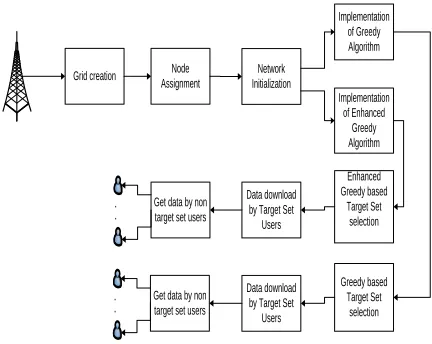
C. Block Diagram of the proposed System
The Grid or Server is static in position, provides services to all mobile clients. All other nodes are mobile users they wants data from the server. We initialize the all properties of Mobile Social Networks (MoSoNets) like bandwidth, queue-length, initial energy, location in terms of x-y co-ordinates of each node.
Server is sending information to selectively chosen users called target users by implementing Greedy and Enhanced greedy algorithms.
Target users download data from the server and disseminate to all other mobile users which are in their communication range.
Node Assignment Grid creation
Implementation of Greedy Algorithm
Implementation of Enhanced
Greedy Algorithm Network
Initialization
Get data by non target set users
Enhanced Greedy based
Target Set selection
Greedy based Target Set
selection Data download
by Target Set Users
Data download by Target Set
Users .
.
Get data by non target set users .
[image:5.612.332.548.134.306.2].
Figure 1: Block Diagram of the proposed system D. Greedy and Enhanced greedy algorithms
We implemented two algorithms Greedy and Enhanced greedy algorithms for the selection of target-set. For Greedy algorithm, initially the target set is empty so, this work evaluates the information dissemination function for every user, and selects the most active user (i.e., the one that can infect the largest number of uninfected users) into the target set. Then repeat this process, in each round selecting the next user from the rest of the mobile users with the maximum increase solution into the target set, until the k Target-set user selected in a NP-hard problem for both the independent cascade model and the linear threshold model.
Disadvantage of greedy algorithm:
It is not suitable in dynamic environment of the MoSoNets.
It requires user’s mobility during the dissemination process, which may not available at the very beginning.
Enhanced greedy algorithm is based on Greedy algorithm but it select only those users which are frequently using the network and staying at the same place for a long time (i.e., .one that can infect the largest number of uninfected users) into the target set.
Which node is static in position having more probability of selecting into the target set?
International Journal of Emerging Technology and Advanced Engineering
Website: www.ijetae.com (ISSN 2250-2459,ISO 9001:2008 Certified Journal, Volume 4, Issue 7, July 2014)
353
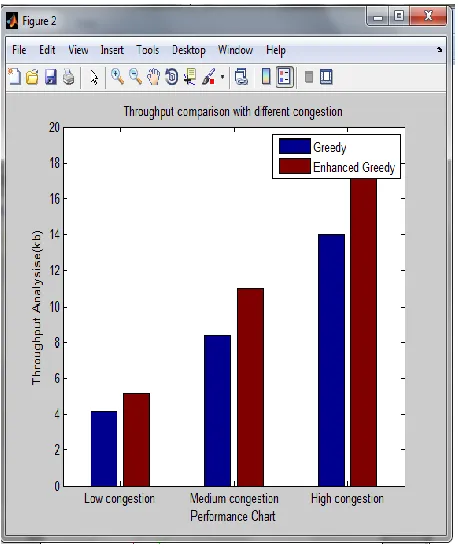
So, this algorithm is applicable in both static as well as dynamic environment and by using this algorithm we achieve high throughput and more number of users covered in the range of target-set.
E. Activity Diagram of the Proposed System
The Figure 2 of activity diagram shows the details of the process and data flow in the system and how our mobile data offloading system is working.
Data distribution among mobile users Configuration of nodes in MoSoNets
Network Initialization
Nodes and Grid Asignment
Static-dynamic, Active-inactive Nodes Generation
Greedy based Target-set Selection
Enhanced Greedy based Target-set Selection
Target-set Data Download from Server
Non-Target-set Data Download from Target-set
Simulation Results Comparision between Enhanced Greedy and Greedy Algorithms
Yes
No
[image:6.612.327.541.152.469.2]Is Greedy algorithm?
Figure 2: Activity Diagram of proposed system
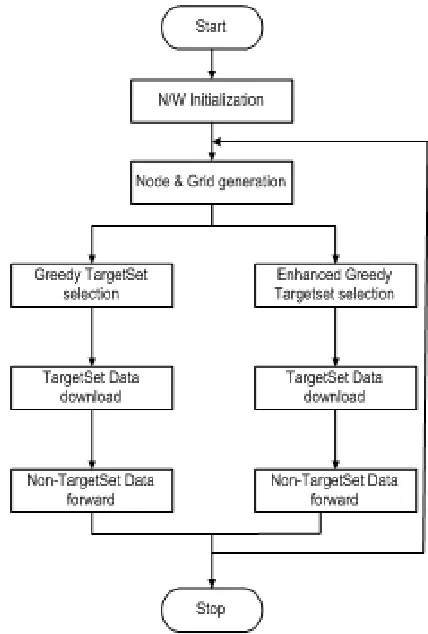
F. Flow Chart of the System
Figure 3: Flowchart showing behavior of the Data Offloading system
VI. EXPERIMENTAL SETUP
We now introduce the simulation environment that we use for performance evaluation, and then present the results from this simulator. We measured the number of nodes covered and average throughput with respect to data transferred for moving smartphones.
A. Simulation Environment
In this work we used MATLAB simulator. MATLAB stands for MATrix LABoratory. It is high level language for technical computing. In MATLAB everything is a matrix and easy to do with linear algebra.
Strengths of MATLAB:
Flexibility to solve large number of problems.
Good tools for visualization.
[image:6.612.54.280.243.695.2]International Journal of Emerging Technology and Advanced Engineering
Website: www.ijetae.com (ISSN 2250-2459,ISO 9001:2008 Certified Journal, Volume 4, Issue 7, July 2014)
354 The graphical output is optimized for interaction. We
can plot our data very easily, and then change colors, sizes, scales, etc, by using the grap.
MATLAB allows matrix manipulations, plotting of functions and data, implementation of algorithms, creation of user interfaces, and interfacing with programs written in other languages, including C, C++, and FORTRAN. Hical interactive tools.
B. Simulation Results:
(i) Configuration of nodes
[image:7.612.325.563.240.487.2]The simulator first creates one node which is called as Grid or Server which is providing the services to all other nodes and then it creates sixty nodes, initially all nodes are dynamic and active nodes. Out of sixty nodes five nodes are stationary nodes and five are inactive nodes.
Figure 4: Configuration of mobile nodes
(ii) Greedy selection of target-set
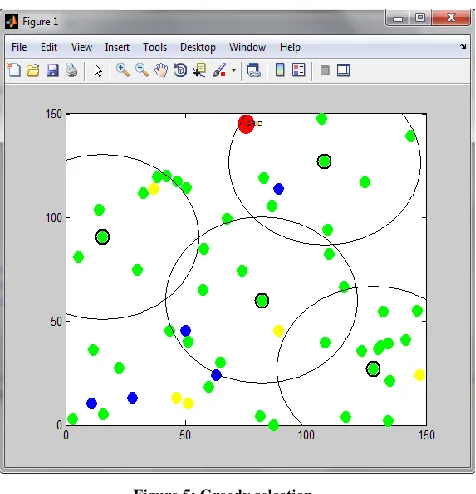
In the Figure 5 shows the snapshot sixty mobile nodes are created. The five nodes which are in blue color are static node and another five nodes which is in yellow color are inactive nodes. All other nodes are active and dynamic nodes; they are moving and using the networks frequently.
Server selected four nodes as target-set based on Greedy algorithm, which are marked black colored circle and their circular area is Bluetooth or Wi-Fi range. Server is sending data to target-set users and target-set users forward to all other mobile users which are in their range. In this snapshot we can observe that many mobile users are not coming in the communication range of any target-set users, this is the main disadvantage of Greedy algorithm and it is only suitable in static environment of MoSoNets.
Figure 5: Greedy selection
(iii) Enhanced Greedy selection of Target-Set
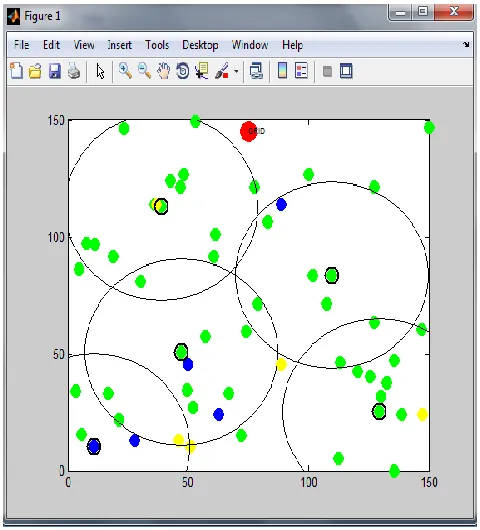
The observation from the Figure 6 shows that Enhanced greedy selection of the target-set covering the more number of mobile users in their communication range in compare to Greedy algorithms of the previous Snapsot. This algorithm selected the stationary node as a target-set which have several benefits:
Very useful to offload data in high density and high traffic areas.
Less chances of data loss.
Uses of optimum energy.
Less time consumption for delivery the information.
More number of users are covered.
Throughput of this system is high and
International Journal of Emerging Technology and Advanced Engineering
Website: www.ijetae.com (ISSN 2250-2459,ISO 9001:2008 Certified Journal, Volume 4, Issue 7, July 2014)
[image:8.612.321.565.131.405.2]355
Figure 6: Enhanced Greedy selection
(iv) Performance Analysis
a. Number of node covered in Greedy and Enhanced Greedy algorithms
Figure 8 shows the plotted graph for number of covered nodes verses number of nodes in two cases: Enhanced Greedy and Greedy algorithms. Number of node covered in Enhanced Greedy algorithm is 89% and Greedy algorithm is 76%.
Figure 7: Comparison of the area coverage of two algorithms
b. Throughput Analysis
[image:8.612.48.288.133.398.2]International Journal of Emerging Technology and Advanced Engineering
Website: www.ijetae.com (ISSN 2250-2459,ISO 9001:2008 Certified Journal, Volume 4, Issue 7, July 2014)
[image:9.612.54.283.133.407.2]356
Figure 8: Graph indicating throughput comparison for two algorithms
VII. CONCLUSION AND FUTURE WORKS
In this paper we propose the Enhanced Greedy algorithm for mobile data offloading through opportunistic communications that leverages Wi-Fi networks and Bluetooth technology to migrate mobile traffic from cellular networks. We explore the target-set selection problem for information delivery in MoSoNets. We present two algorithms for this problem, Greedy, and Enhanced greedy. We evaluate their performance using MATLAB simulator. The simulation results show that Enhanced greedy performs the better than Greedy algorithms in every case. Offloading is a solution to augment these mobile system’s capabilities by migrating computation to more resourceful computers (i.e., servers).
In this work we used one level of target set selection. For future enhancement we can use multi level of target-set selection with advantages of reduction of the load on core networks. Also we can try the evaluation of the implemented algorithms on real time application instead of simulation.
REFERENCES
[1] Bo Han, Pan Hui, V.S.Anil kumar, Madhav V. Marathe and
Aravind Srinivasan ―Mobile Data Offloading through Opportunistic Communications and Social Participation‖ , IEEE Transaction 2012.
[2] Padmini C., Harish G., and Smitha Shekar B. ―Data Offloading
through Target Selection in Mobile Social Network‖ IJERT vol. 2, issue 8, August 2013.
[3] Usha R., and Annapurna P Patil ―CAPACITY CRUNCH: can
MoSoNets offload data solve this‖ IJCSE, VOL. 10, NO. 2, ISSUE 3, May 2013.
[4] K. Lee, I. Rhee, J. Lee, Y. Yi, and S. Chong, ―Mobile data
offloading: How much can WiFi deliver?‖ in Proc. ACM CoNEXT, 2010, pp. 425-426.
[5] A. Balasubramanian subramanian, R. Mahajan, and A.
Venkataramani, ―Augmenting mobile 3g using Wi-Fi,‖ in Proc. of ACM MobiSys, 2010.
[6] J. Hultell, P. Lungaro, and J. Zander, ―Service provisioning with
ad-hocdeployed high-speed access points in urban environments,‖ in Proc. Of IEEE PIMRC, 2005.
[7] S. Ha, S. Sen, C. Joe-Wong, Y. Im, and M. Chiang, ―Tube:
Timedependent pricing for mobile data,‖ in Proc. of ACM SIGCOMM, 2012.
[8] X. Zhuo, W. Gao, G. Cao, and Y. Dai, ―Win-coupon: An incentive
framework for 3g traffic offloading,‖ in Proc. of IEEE ICNP, 2011.
[9] Cisco Systems Inc., ―Cisco visual networking index: Global mobile
data traffic forecast update, 2011-2016,‖ 2012.
[10] ―Data offload approaches for mobile
operators‖.http://www.wipro.com/Documents/resourcecenter/Data_ Offload_Approaches_for_Mobile_Operators.pdf.
[11] S. Gaonkar, J. Li, R.R. Choudhury, L. Cox, and A. Schmidt,
―Micro-Blog: Sharing and Querying Content through Mobile Phones and Social Participation,‖ Proc. ACM MobiSys, pp. 174-186, June 2008.
[12] B. Ray, S. Razgulin, K. Sundaresan, B. Surendar, M. Terada, and R.
Han, ―WhozThat? Evolving an Ecosystem for Context-AwareMobile Social Networks,‖ IEEE Network, vol. 22, no. 4, pp. 50-55, July/Aug. 2008.
[13] M. Motani, V. Srinivasan, an.d P.S. Nuggehalli, ―PeopleNet:
Engineering A Wireless Virtual Social Network,‖ Proc. ACM MobiCom, pp. 243-257, Aug. /Sept. 2005.
[14] E. Miluzzo, N.D. Lane, K. Fodor, R. Peterson, H. Lu, M. Musolesi,