arXiv:1312.5438v3 [cs.SY] 16 Dec 2014
Asynchronous Adaptation and Learning over
Networks — Part II: Performance Analysis
Xiaochuan Zhao, Student Member, IEEE, and Ali H. Sayed, Fellow, IEEE
Abstract
In Part I [2], we introduced a fairly general model for asynchronous events over adaptive networks including random topologies, random link failures, random data arrival times, and agents turning on and off randomly. We performed a stability analysis and established the notable fact that the network is still able to converge in the mean-square-error sense to the desired solution. Once stable behavior is guaranteed, it becomes important to evaluate how fast the iterates converge and how close they get to the optimal solution. This is a demanding task due to the various asynchronous events and due to the fact that agents influence each other. In this Part II, we carry out a detailed analysis of the mean-square-error performance of asynchronous strategies for solving distributed optimization and adaptation problems over networks. We derive analytical expressions for the mean-square convergence rate and the steady-state mean-square-deviation. The expressions reveal how the various parameters of the asynchronous behavior influence network performance. In the process, we establish the interesting conclusion that even under the influence of asynchronous events, all agents in the adaptive network can still reach an O(ν1+γ′
o) near-agreement with someγ′
o>0while approaching the desired solution withinO(ν) accuracy, where
ν is proportional to the small step-size parameter for adaptation.
Index Terms
Distributed learning, distributed optimization, diffusion adaptation, asynchronous behavior, adaptive networks, dynamic topology, link failures.
The authors are with Department of Electrical Engineering, University of California, Los Angeles, CA 90095 Email:
{xzhao, sayed}@ee.ucla.edu.
This work was supported by NSF grants CCF-1011918 and ECCS-1407712. A short and limited early version of this work appeared in the conference proceeding [1]. The first part of this work is presented in [2].
I. INTRODUCTION
In Part I [2], we introduced a fairly general model for asynchronous distributed adaptation and learning over networks. The model allows the step-size for any agent to be randomly chosen within a range of values including zero, meaning an off-status; it also allows the communication links between any two agents to be randomly turned on and off; it further allows the topology to vary and the combination weights on the links between agents to vary randomly. The model also captures the situation in which agents randomly select a subset of their neighbors to share information with, as happens in gossip implementations. Based on this asynchronous model, we carried out a detailed stability analysis in Part I [2] and arrived at Theorem 1 in that Part, which provides an explicit condition on the first and second-order moments of the distribution of the step-sizes to ensure mean-square stability of the adaptive network. When the condition holds, it was further shown that the asymptotic mean-square-deviation (MSD) for every agent in the network remains bounded. Interestingly, it was shown that these conclusions hold irrespective of the randomness in the network topology.
In this Part II, we conduct a detailed mean-square-error (MSE) analysis in order to characterize the learning behavior of the asynchronous network in terms of the network parameters. In particular, we answer the following three questions:
• How is the convergence rate of the algorithm affected by the occurrence of asynchronous events in comparison to a synchronous network?
• Are agents still able to reach some sort of agreement in steady-state despite the various sources of randomness influencing their interactions?
• How close do the iterates of the various agents get to each other and to the desired optimal solution? One of the main conclusions that will follow from the analysis is that, under certain reasonable conditions, the asynchronous network will continue to be able to deliver performance that is comparable to the synchronous case where no failures occur. In particular, we will be able to establish that for a sufficiently small step-size parameterν it holds that
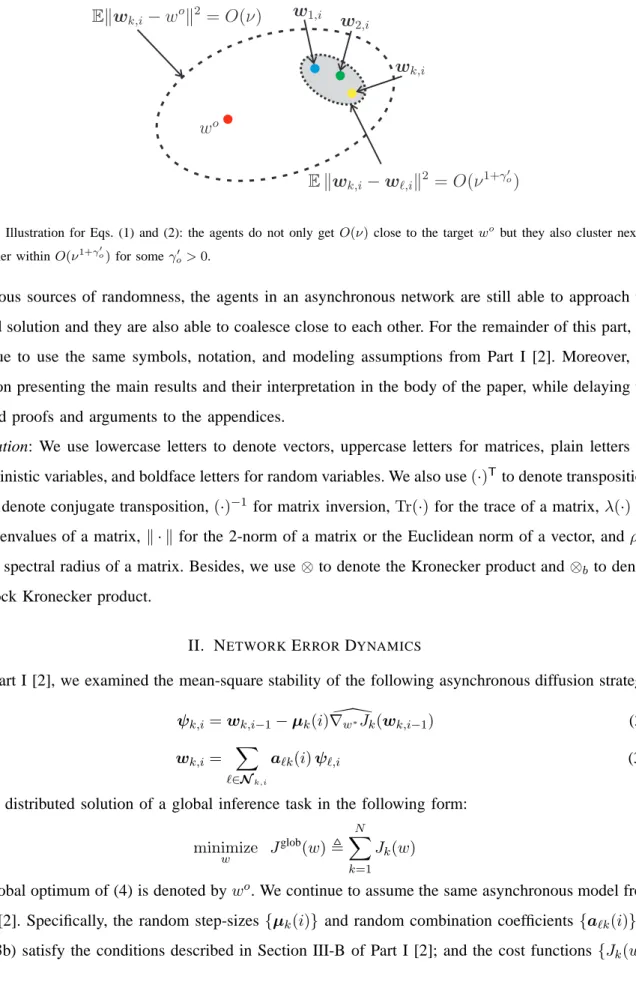
lim i→∞ Ekwo−w k,ik2 =O(ν) (1) lim i→∞ Ekwk,i−wℓ,ik2 =O(ν1+γ′ o) (2)
for someγo′ >0 that is given by (92) further ahead. These results imply that all agents reach a level of
O(ν1+γ′
o) agreement with each other and getO(ν) close to the desired optimal solution,wo, in
Fig. 1. Illustration for Eqs. (1) and (2): the agents do not only get O(ν)close to the targetwo
but they also cluster next to each other withinO(ν1+γ′
o)for someγo′ >0.
to various sources of randomness, the agents in an asynchronous network are still able to approach the desired solution and they are also able to coalesce close to each other. For the remainder of this part, we continue to use the same symbols, notation, and modeling assumptions from Part I [2]. Moreover, we focus on presenting the main results and their interpretation in the body of the paper, while delaying the detailed proofs and arguments to the appendices.
Notation: We use lowercase letters to denote vectors, uppercase letters for matrices, plain letters for
deterministic variables, and boldface letters for random variables. We also use(·)Tto denote transposition,
(·)∗ to denote conjugate transposition,(·)−1 for matrix inversion,Tr(·) for the trace of a matrix,λ(·) for the eigenvalues of a matrix, k · k for the 2-norm of a matrix or the Euclidean norm of a vector, andρ(·)
for the spectral radius of a matrix. Besides, we use⊗to denote the Kronecker product and⊗b to denote
the block Kronecker product.
II. NETWORKERRORDYNAMICS
In Part I [2], we examined the mean-square stability of the following asynchronous diffusion strategy:
ψk,i=wk,i−1−µk(i)∇\w∗Jk(wk,i−1) (3a)
wk,i=
X
ℓ∈Nk,i
aℓk(i)ψℓ,i (3b)
for the distributed solution of a global inference task in the following form:
minimize w J glob(w), N X k=1 Jk(w) (4)
The global optimum of (4) is denoted bywo. We continue to assume the same asynchronous model from Part I [2]. Specifically, the random step-sizes {µk(i)} and random combination coefficients{aℓk(i)} in
satisfy Assumptions 1 and 2 in Section II of Part I [2]. However, in order to study the mean-square-error performance in steady-state, it is necessary to strengthen the assumption on the stochastic gradient vectors
{∇\w∗Jk(wk,i−1)}. We replace the gradient noise model described in Assumption 3 in Section III-A of
Part I [2] by the following one.
Assumption 1 (Gradient noise model):
1) The gradient noise vk,i(wk,i−1), conditioned on Fi−1, is assumed to be independent of any other
random sources including topology, links, combination coefficients, and step-sizes. The conditional moments ofvk,i(wk,i−1) satisfy:
E[vk,i(wk,i−1)|Fi−1] = 0 (5) E[kvk,i(wk,i−1)k4|Fi−1]≤α2kwo−wk,i−1k4+σ4
v (6)
for someα≥0 andσv2 ≥0.
2) The individual gradient noises {vk,i(wk,i−1)} are uncorrelated and circular across all agents such
that
Ri(wi−1) = diag{R1,i(w1,i−1), . . . , RN,i(wN,i−1)} (7)
where Ri(wi−1) and {Rk,i(wk,i−1)} are from (23) and (19) both in Part I [2].
3) The conditional covariance of
¯
vi(wi−1) satisfies the Lipschitz condition
kRi(1N ⊗wo)− Ri(wi−1)k ≤κvk1N ⊗wo−wi−1kγv (8)
for some constantsκv ≥0 and0< γv ≤4.
4) The covariance of
¯
vi(1N⊗wo) converges to a constant matrix: R, lim i→∞Ri(1N⊗w o),diag {R1, . . . , RN} (9) where Rk , lim i→∞Rk,i(w o) (10)
From Assumption 1, the conditional moments of
¯
vk,i(wk,i−1) satisfy E[ ¯vk,i(wk,i−1)|Fi−1] = 0 (11) E[k ¯ vk,i(wk,i−1)k4|Fi−1]≤α2k ¯ wo− ¯ wk,i−1k4+ 4σ4v (12)
where a factor of 4 appeared due to the transform
¯
A. Long Term Error Dynamics
We showed in (87) from Part I [2] that the error recursion for the asynchronous network (3a)–(3b) evolves according to the following dynamics:
¯e wi =ATi (I2M N −MiHi−1) ¯e wi−1+ATi Mi ¯ vi(wi−1) (13)
where Hi−1 = diag{H1,i−1,H2,i−1, . . . ,HN,i−1} and
Hk,i−1, Z 1 0 ∇ 2 ¯ w ¯ w∗Jk( ¯ wo−t ¯e wk,i−1)dt (14)
The dependency of Hi−1 on the previous iterate wi−1 complicates the mean-square analysis. Recall
though from Lemma 1 in Part I [2] that the Hessian matrices of the costs{Jk( ¯
w)} are globally Lipschitz around ¯ wo. Let Hk,∇2 ¯ w ¯ w∗Jk( ¯ wo), H,diag{H1, . . . , HN} (15)
Recursion (13) can then be rewritten as
¯e wi =ATi (I2M N −MiH) ¯e wi−1+ATiMi ¯ vi(wi−1) +ATidi (16)
where the perturbation factor di is given by
di,Mi(H −Hi−1) ¯e wi−1 ,col{d1,i, . . . ,dN,i} (17) dk,i,µk(i)(Hk−Hk,i−1) ¯e wk,i−1 (18)
Let µ¯(kn) , E[µk(i)]n denote the n-th moment of the random step-size parameter µ
k(i); we also use ¯
µk ≡µ¯(1)k from (34) of Part I [2] for the mean and cµ,k,ℓ =E[(µk(i)−µ¯k)(µℓ(i)−µ¯ℓ)] from (37) of
Part I [2] for the cross-covariance.
Lemma 1 (Size of perturbation): If condition (103) in Part I [2], namely, q ¯ µ(4)k ¯ µ(1)k < λk,min 3λ2 k,max+ 4α (19) holds for all k, then
lim sup i→∞ EkAT idik2 ≤O(ν4) (20) where ν,max k q ¯ µ(4)k ¯ µ(1)k (21)
Assumption 2 (Small step-sizes): The parameterν from (21) is sufficiently small such that ν <min k λk,min 3λ2 k,max+ 4α <1 (22)
Under Assumption 2, condition (19) holds. It was shown in (200) and (201) from Part I [2] that condition (19) in this Part implies condition (93) from Part I [2], i.e.,
¯ µ(2)k ¯ µ(1)k < λk,min α+λ2k,max (23) for all k.
Since we are interested in examining the asymptotic performance of the asynchronous network, result (20) indicates that the network error recursion (13) can be expressed for large enough i by using the following long-term model:
¯e wi′ =ATi(I2M N−MiH) ¯e wi′−1+ATiMi ¯ vi(wi−1) (24)
where we ignore the O(ν2) term AT
idi according to (20), and we use w′i−1 to denote the estimate
obtained from this long-term model. It is worth noting that the gradient noise
¯
vi(wi−1) in (24) is an
extraneous noise that is imported from the original model (13); it only depends on the original estimate wi−1 but not on w′i−1. We will now use recursion (24) to determine expressions (rather than bounds)
for the steady-state individual MSD and for the average network MSD. One advantage of model (24) is that the random matrix Hi−1 from (13) has been replaced by the constant matrix H. More formally, under Assumption 1 on the fourth-order moment of the gradient noise, and by extending the arguments of Appendices D and E from Part I [2] and the arguments of [3], we will establish later in (76) that the MSD expression resulting from (24) is withinO(ν3/2) of the MSD expression for the original recursion (13); this conclusion will rely on the following useful result.
Theorem 1 (Bounded mean-square gap): Under Assumptions 1 and 2, the mean-square gap from the
original error recursion (13) to the long-term model (24) is then asymptotically bounded by
lim sup i→∞ max k Ek ¯e wk,i− ¯e w′k,ik2 ≤O(ν2) (25) for anyk.
Proof: See Appendix B.
To proceed with the mean-square-error performance analysis, we introduce the following auxiliary variables:
Di ,I2M N−MiH= diag{Dk,i} (27) Bi ,ATiDi (28) ¯si ,A T iMi ¯ vi(wi−1) (29)
Based on the gradient noise model in Assumption 1 and the asynchronous network model described in Section III-B of Part I [2], it is easy to verify that the (conditional) means of{Ai,Mi,Dk,i,Di,Bi,
¯
si} are given by:
¯ A,E(Ai) = ¯A⊗I2M (30) ¯ M,E(Mi) = ¯M⊗I2M (31) ¯ Dk,E(Dk,i) =I2M −µ¯kHk (32) ¯ D,E(Di) =I2M N−MH¯ = diag{D¯k} (33) ¯ B,E(Bi) = ¯ATD¯ (34) ¯ s,E( ¯si|Fi−1) = 0 (35)
It can be verified that the block-Kronecker-covariance matrices of several random quantities are given by:
CA,E[(Ai−A¯)⊗b(Ai−A¯)] =CA⊗I4M2 (36) CM ,E[(Mi−M¯)⊗b(Mi−M¯)] =CM ⊗I4M2 (37) CD ,E[(D∗i −D¯∗)T⊗b(Di−D¯)] =CM(HT⊗bH) (38) CB,E[(B∗i −B¯∗)T⊗b(Bi−B¯)] = ( ¯AT⊗bA¯T)CD+CAT( ¯DT⊗bD¯+CD) (39)
where the symbol⊗b denotes the block-Kronecker operation of block size2M×2M (see Appendix C).
Moreover, it can be verified by using property (133) from Appendix C that
E[(X∗−X¯∗)T⊗
b(X −X¯)] =E[(X∗)T⊗bX]−( ¯X∗)T⊗bX¯ (40)
for any random block matrix X with appropriate block size and with mean X¯ , EX. The {CA, CM}
that appear in (36)–(39) relate to the second-order moments of {aℓk(i)} and {µk(i)}. Using (28) and
(29), the long-term model (24) can be rewritten as
¯e
wi′ =Bi·
¯e
wi′−1+
B. Mean Error Recursion
Taking the expectation of both sides of (41), we end up with the mean error recursion for large i:
E
¯e
wi′ = ¯B ·E
¯e
w′i−1 (42)
The stability of recursion (42) requires the stability of B¯. A condition on the step-sizes to ensure the stability of B¯ can be derived as follows. Using the fact that A¯is block left-stochastic and D¯ is block diagonal and Hermitian, and following the same argument in [4, App. A] [5], we obtain
ρ( ¯B)≤ρ( ¯D) (43) whereρ(·)denotes the spectral radius of its matrix argument. It follows from (33) and (43) that asymptotic mean stability is guaranteed if the mean step-size µ¯k satisfies
¯
µk≡µ¯(1)k < 2
ρ(Hk)
(44) for all k. Since Hk is a positive semi-definite matrix, its spectral radius coincides with its largest
eigenvalue. Using (8) from Part I [2], we have ρ(Hk) ≤ λk,max. If condition (19) holds, then from
(196) of Part I [2], we have ¯ µ(1)k ≤ q ¯ µ(4)k ¯ µ(1)k < λk,min 3λ2k,max+ 4α ≤ λk,min 3λ2k,max ≤ 2 ρ(Hk) (45) since α >0. Therefore, condition (44) holds if condition (19) does so. With Assumption 2, we have
lim i→∞
Ewe′
k,i= 0 (46)
for allk. From (46), we conclude that the long-term model (24) or, equivalently, (41), is the asymptotically centered version of the original error recursion (13).
C. Error Covariance Recursion
We proceed to examine the evolution of the covariance matrix of the network error vector
¯e
wi′ in the long-term model (41). Let
ri(wi−1),bvec(Ri(wi−1)) =E[( ¯ v∗i(wi−1))T⊗b ¯ vi(wi−1)|Fi−1] (47) yi ,( ¯AT⊗bA¯T+CAT)( ¯M ⊗bM¯ +CM)E[ri(wi−1)] (48) zi ,bvec(E( ¯e wi′ ¯e wi′∗)) =E[( ¯e w′∗i )T⊗b ¯e w′i] (49) G,E[(D∗i)T⊗ bDi] = ¯DT⊗bD¯+CD (50)
F ,E[(B∗i)T⊗bBi]∗= ¯BT⊗bB¯∗+C∗B=G( ¯A ⊗bA¯+CA) (51)
where the notationsbvec(·)and⊗bdenote block vectorization and block Kronecker products, respectively,
both of size2M×2M (see Appendix C). We note that the second equalities in (47) and (49) are due to property (130) and the second equalities in (50) and (51) are by using (33), (34), and (38)–(40). Using (47)–(51), we obtain the following recursion for the block-vectorized covariance matrix of the network error vector
¯e
w′i.
Theorem 2 (Network error covariance recursion): The vector zi evolves according to the following
recursion:
zi =F∗zi−1+yi (52)
Recursion (52) converges if condition (19) holds, and its convergence rate is determined byρ(F).
Proof: See Appendix D.
The vectorzi can be used to compute useful error metrics. For example, we can examine any weighted
MSE measure for
¯e
w′i by evaluating quantities of the form:
Ek ¯e w′ik2Σ =E[Tr( ¯e wi′ ¯e w′∗i Σ)] =zi∗·bvec(Σ) (53) where Σ is an arbitrary positive semi-definite weight matrix. To guarantee the convergence ofEk
¯e
w′ik2Σ for any weighting matrixΣ, it is sufficient and necessary to guarantee the convergence of zi. It follows
from Theorem 2 that under Assumption 2, the spectral radius of the matrix F in (52) determines the mean-square stability and convergence rate of the asynchronous diffusion strategy (3a)–(3b).
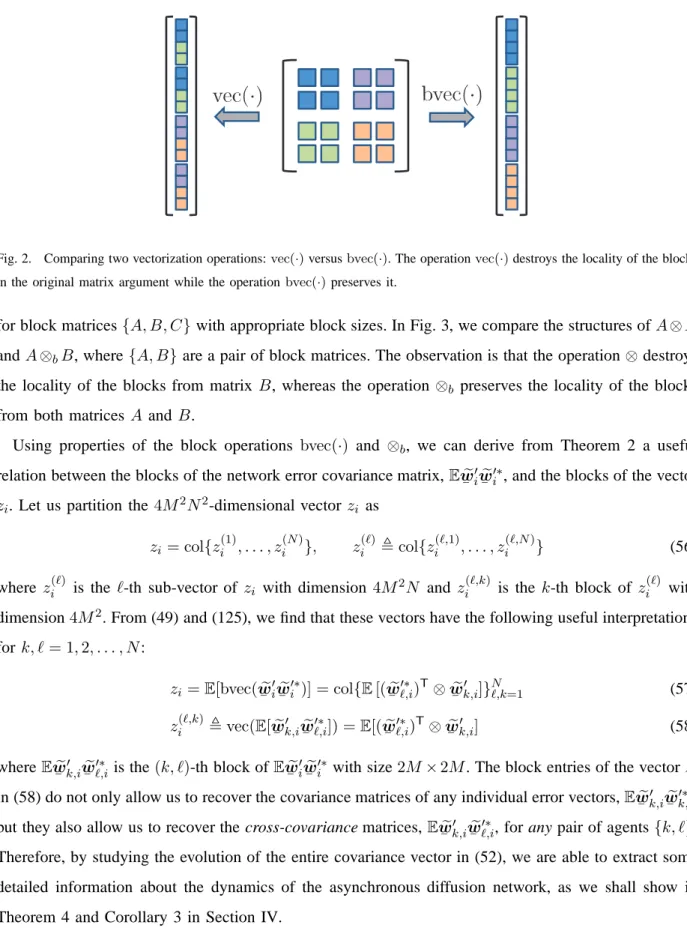
Before proceeding we comment on the reason why we choose to use the block vectorization operation
bvec(·) in (49) instead of the traditional vectorization operationvec(·). This is becausebvec(·) allows us to track each block of its matrix argument after vectorization. By the definition in (125) and the illustration in Fig. 2, operationbvec(·) preserves the locality of every block in the original matrix argument whereas operation vec(·) blends different blocks together. Therefore, whenever we need to vectorize a network matrix whose blocks relate to individual agents, it is more natural to use the block vectorization operation
bvec(·); on the other hand, whenever we need to vectorize a matrix that only relates to a single agent, we can use the conventional vectorization operationvec(·). A useful property of the conventional vectorization operation vec(·) is
vec(ABC) = (CT⊗A)·vec(B) (54) for matrices{A, B, C} of compatible sizes. A similar property holds for the bvec(·) operation:
Fig. 2. Comparing two vectorization operations:vec(·)versusbvec(·). The operationvec(·)destroys the locality of the blocks in the original matrix argument while the operationbvec(·)preserves it.
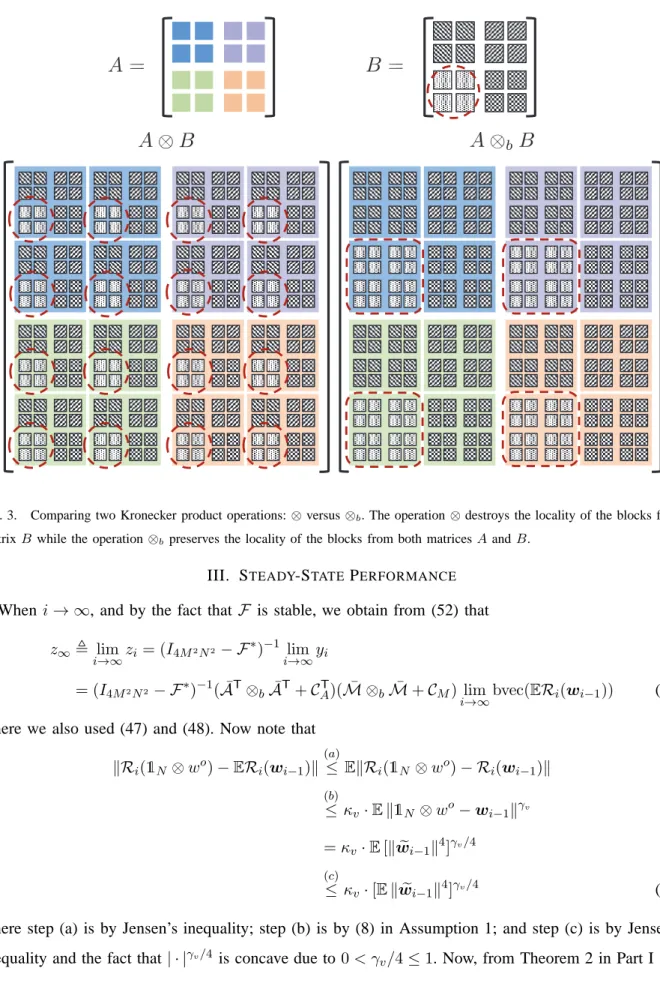
for block matrices{A, B, C}with appropriate block sizes. In Fig. 3, we compare the structures ofA⊗B
andA⊗bB, where{A, B}are a pair of block matrices. The observation is that the operation ⊗destroys
the locality of the blocks from matrix B, whereas the operation ⊗b preserves the locality of the blocks
from both matrices A and B.
Using properties of the block operations bvec(·) and ⊗b, we can derive from Theorem 2 a useful
relation between the blocks of the network error covariance matrix,E
¯e
w′i
¯e
w′∗i , and the blocks of the vector
zi. Let us partition the4M2N2-dimensional vectorzi as
zi = col{z(1)i , . . . , z (N) i }, z (ℓ) i ,col{z (ℓ,1) i , . . . , z (ℓ,N) i } (56)
where zi(ℓ) is the ℓ-th sub-vector of zi with dimension 4M2N and z(iℓ,k) is the k-th block of z
(ℓ)
i with
dimension4M2. From (49) and (125), we find that these vectors have the following useful interpretations
for k, ℓ= 1,2, . . . , N: zi =E[bvec( ¯e wi′ ¯e w′∗i )] = col{E[( ¯e w′∗ℓ,i)T⊗ ¯e wk,i′ ]}Nℓ,k=1 (57) zi(ℓ,k),vec(E[ ¯e w′k,i ¯e w′∗ℓ,i]) =E[( ¯e w′∗ℓ,i)T⊗ ¯e w′k,i] (58) whereE ¯e w′k,i ¯e
w′∗ℓ,i is the(k, ℓ)-th block ofE
¯e
wi′
¯e
w′∗i with size2M×2M. The block entries of the vectorzi
in (58) do not only allow us to recover the covariance matrices of any individual error vectors,E
¯e
wk,i′
¯e
wk,i′∗, but they also allow us to recover the cross-covariance matrices,E
¯e
wk,i′
¯e
wℓ,i′∗, for any pair of agents{k, ℓ}. Therefore, by studying the evolution of the entire covariance vector in (52), we are able to extract some detailed information about the dynamics of the asynchronous diffusion network, as we shall show in Theorem 4 and Corollary 3 in Section IV.
Fig. 3. Comparing two Kronecker product operations:⊗versus⊗b. The operation⊗destroys the locality of the blocks from matrixB while the operation⊗bpreserves the locality of the blocks from both matricesAandB.
III. STEADY-STATE PERFORMANCE
When i→ ∞, and by the fact that F is stable, we obtain from (52) that
z∞, lim i→∞zi= (I4M2N2− F ∗)−1 lim i→∞yi = (I4M2N2− F∗)−1( ¯AT⊗bA¯T+CAT)( ¯M ⊗bM¯ +CM) lim i→∞bvec( ERi(wi−1)) (59)
where we also used (47) and (48). Now note that
kRi(1N ⊗wo)−ERi(wi−1)k (a) ≤ EkRi(1N ⊗wo)− Ri(wi−1)k (b) ≤ κv·Ek1N ⊗wo−wi−1kγv =κv·E[kwei−1k4]γv/4 (c) ≤ κv·[Ekwei−1k4]γv/4 (60)
where step (a) is by Jensen’s inequality; step (b) is by (8) in Assumption 1; and step (c) is by Jensen’s inequality and the fact that| · |γv/4 is concave due to0< γ
we know thatlim supi→∞Ekwei−1k4 ≤O(ν2)under Assumption 2. Therefore, we obtain from (60) that
lim sup i→∞ kRi
(1N ⊗wo)−ERi(wi−1)k ≤O(νγv/2) (61)
According to (61), we can replace ERi(wi−1) in (59) by Ri(1N ⊗wo) with an error in the order of
νγv/2. Let
z,(I4M2N2− F∗)−1( ¯AT⊗bA¯T+CAT)( ¯M ⊗bM¯ +CM)bvec(R) (62)
From (198) in Part I [2], we know that the second-order moments of {µk(i)} are in the order of ν2.
Hence, by (84) from Part I [2], (31), and (37), it is easy to verify that
kM ⊗¯ bM¯ +CMk=O(ν2) (63)
Using (62), (63), and the fact that k(I4M2N2 − F∗)−1k = O(ν−1) from Lemma 5 further ahead, we
conclude that
kzk=O(ν) (64)
Then, by using (9) and (61)–(64), we obtain from (59) that
z∞=z+O(ν1+γv/2), kz∞k=O(ν) (65)
Define the steady-state average network MSD by MSDnet , lim i→∞ 1 N N X k=1 Ekwek,ik2 (66)
and the steady-state individual MSD for agentk by
MSDk, lim
i→∞
Ekwek,ik2 (67)
Theorem 3 (Steady-state MSD): It holds that
MSDnet = 1 2Nz ∗bvec(I 2M N) +O(ν1+γo) (68) MSDk= 1 2z ∗bvec(E kk⊗I2M) +O(ν1+γo) (69) where z is given by (62), γo , 1 2min{1, γv} (70)
and Ekk is the N ×N basis matrix that only has one non-zero element, which is equal to 1, at the (k, k)-th entry.
Proof: From (53) by selecting Σ =I2M N, and also using (59) and (65), we get lim i→∞ Ek ¯e wi′k2=z∞∗ bvec(I2M N) =z∗bvec(I2M N) +O(ν1+γv/2) =O(ν) (71)
Likewise, by selecting Σ =Ekk⊗I2M, we get lim i→∞ Ek ¯e wi′k2Ekk⊗I 2M =z ∗ ∞bvec(Ekk⊗I2M) =z∗bvec(Ekk⊗I2M) +O(ν1+γv/2) =O(ν) (72)
Note further that
Ek ¯e wik2 =Ek ¯e wi′k2+Ek ¯e wi− ¯e wi′k2+ 2ReE[ ¯e w′∗i ( ¯e wi− ¯e w′i)] (73)
Using the Cauchy-Schwartz inequality, it can be verified that
ReE[ ¯e wi′∗( ¯e wi− ¯e wi′)]≤ q Ek ¯e wi′k2·Ek ¯e wi− ¯e wi′k2 (74)
From Theorem 1, we have
lim i→∞ Ek ¯e wi− ¯e w′ik2 ≤O(ν2) (75)
Substituting (71) and (75) into (73), and using (74), we get
lim i→∞ Ek ¯e wik2 = lim i→∞ Ek ¯e w′ik2+O(ν2) + 2pO(ν)·O(ν2) = lim i→∞ Ek ¯e w′ik2+O(ν3/2) (76)
Results (68) and (69) follow from (71), (72), and (76).
Result (68) generalizes its counterpart (276) from [5] for the synchronous diffusion strategy. Since expressions (71) and (72) are both related to the vector z in (62), let us examine z more closely to reveal the implications of asynchronous adaptation and learning on performance. Theorem 4 in the following section will lead to powerful alternative expressions for (71) and (72). The new expressions will highlight some important properties about the behavior of the asynchronous network in steady-state, such as the behavior that was illustrated earlier in Fig. 1. The subsequent analysis relies on a useful low-rank factorization result.
IV. LOW-RANKFACTORIZATION
From (59) we see that the structure ofz depends on the structure of the matrix (I4M2N2− F∗)−1. In
the following, we show that by retaining the dominant eigen-space of (I4M2N2 − F∗)−1, we can obtain
a more revealing MSD expression than (68) that is still accurate to the order of O(ν1+γo). A. Perron Eigenvectors
To proceed, we introduce the following condition on the matrix A¯⊗A¯+CA.
Assumption 3 (Primitiveness of A¯⊗A¯+CA): The matrixA¯⊗A¯+CAis assumed to be primitive [6,
p. 45], namely, that there exists a finite positive integer j such that all entries of ( ¯A⊗A¯+CA)j are
positive.
Lemma 2 (Primitiveness of A¯): The matrix A¯ is primitive if A¯⊗A¯+CA is primitive.
Proof: See Appendix F.
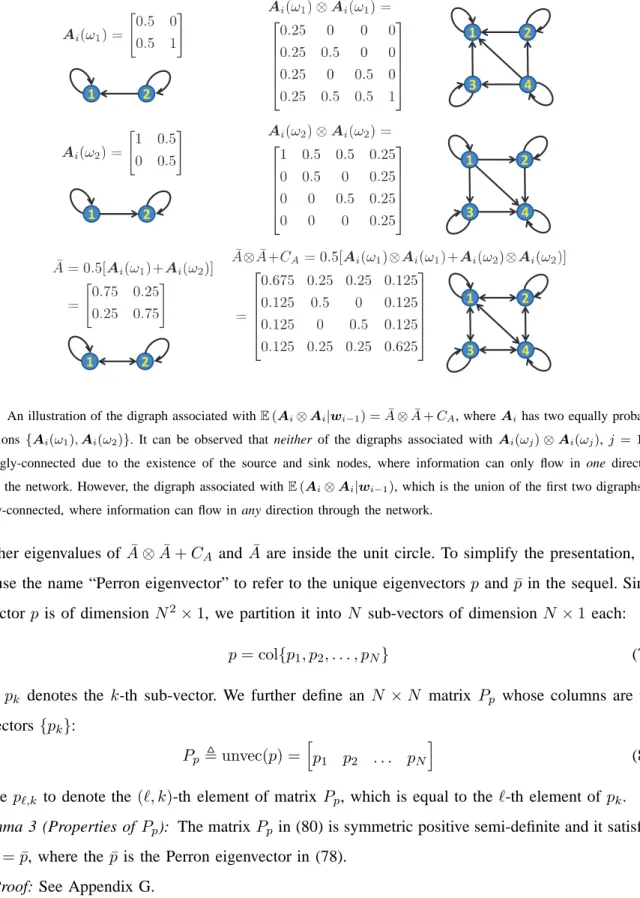
Assumption 3 is guaranteed if the directed graph (digraph) associated with the matrix A¯⊗A¯+CA is
strongly-connected with as least one self-loop [6, pp. 30,34]. The digraph associated with A¯⊗A¯+CA
is the union of all possible digraphs associated with the realizations ofAi⊗Ai [7, p. 29]. Each possible
digraph associated with Ai ⊗Ai is a Kronecker graph of order 2 generated by the initiator Ai [8].
Therefore, Assumption 3 amounts to an assumption that the union of all possible digraphs associated with the realizations of Ai ⊗Ai is strongly-connected with at least one self-loop. As illustrated in
Fig. 4, this condition still allows the digraphs associated withAi to be weakly-connected with or without
self-loops or even to be disconnected. Important cases such as random gossip [9]–[13] or probabilistic diffusion [14], [15] are therefore not ruled out by this condition. It can be verified that the converse of Lemma 2 is generally not true: when the digraph associated with A¯is primitive, the digraph associated with A¯⊗A¯+CA does not even need to be connected.
By Lemma 3 from Part I [2] and the above Assumption 3, the matrixA¯⊗A¯+CA is left-stochastic and
primitive. It follows from the Perron-Frobenius theorem [6] [16] that this matrix has a unique eigenvalue at one and a pair of eigenvectors{1N2, p} with positive entries satisfying:
( ¯A⊗A¯+CA)·p=p, pT·1N2 = 1 (77)
Likewise, the matrixA¯is also left-stochastic and primitive. It has a unique eigenvalue at one and a pair of eigenvectors{1N,p¯} with positive entries satisfying:
¯
A·p¯= ¯p, p¯T·1
2 1 2 1 4 3 2 1 2 1 4 3 2 1 2 1 4 3
Fig. 4. An illustration of the digraph associated withE(Ai⊗Ai|wi−1) = ¯A⊗A¯+CA, whereAihas two equally probable realizations {Ai(ω1),Ai(ω2)}. It can be observed that neither of the digraphs associated withAi(ωj)⊗Ai(ωj), j = 1,2, is strongly-connected due to the existence of the source and sink nodes, where information can only flow in one direction through the network. However, the digraph associated withE(Ai⊗Ai|wi−1), which is the union of the first two digraphs, is
strongly-connected, where information can flow in any direction through the network.
All other eigenvalues ofA¯⊗A¯+CA andA¯ are inside the unit circle. To simplify the presentation, we
shall use the name “Perron eigenvector” to refer to the unique eigenvectorsp andp¯in the sequel. Since the vectorp is of dimension N2×1, we partition it into N sub-vectors of dimension N ×1 each:
p= col{p1, p2, . . . , pN} (79)
where pk denotes the k-th sub-vector. We further define an N ×N matrix Pp whose columns are the
sub-vectors{pk}: Pp ,unvec(p) = h p1 p2 . . . pN i (80) We use pℓ,k to denote the (ℓ, k)-th element of matrix Pp, which is equal to theℓ-th element ofpk.
Lemma 3 (Properties of Pp): The matrixPp in (80) is symmetric positive semi-definite and it satisfies
Pp1N = ¯p, where thep¯is the Perron eigenvector in (78).
From Lemma 3, we get the following useful relations: pℓ,k =pk,ℓ, N X k=1 pℓ,k = ¯pℓ, N X ℓ=1 pℓ,k = ¯pk (81) B. Low-Rank Approximation
We return to our earlier objective of seeking a low-rank factorization for the matrix(I4M2N2− F∗)−1.
For this purpose, we first introduce the 4M2×4M2 Hermitian matrix:
F , N X k=1 N X ℓ=1 pℓ,k[ ¯DTℓ ⊗D¯k+cµ,ℓ,k(HℓT⊗Hk)] (82) where D¯k is given by (32).
Lemma 4 (Spectral radius of F): The matrixFin (82) is stable if condition (23) is satisfied. Moreover,
ρ(F) = [1−λmin(H)]2+O(ν2) = 1−O(ν) (83) where H, N X k=1 ¯ pkµ¯kHk (84)
It can be verified that kHk=O(ν) and the O(ν2) term in (83) is negligible by Assumption 2. Proof: See Appendix H.
Lemma 5 (Low-rank approximation): Under Assumptions 2 and 3, it holds that
(I4N2M2 − F)−1 = (p1TN2)⊗(I4M2−F)−1+O(1) (85) (p1TN2)⊗(I4M2−F)−1=O(ν−1) (86)
Under Assumption 2 where ν ≪1, the term in (86) dominates theO(1) term in (85). Moreover,
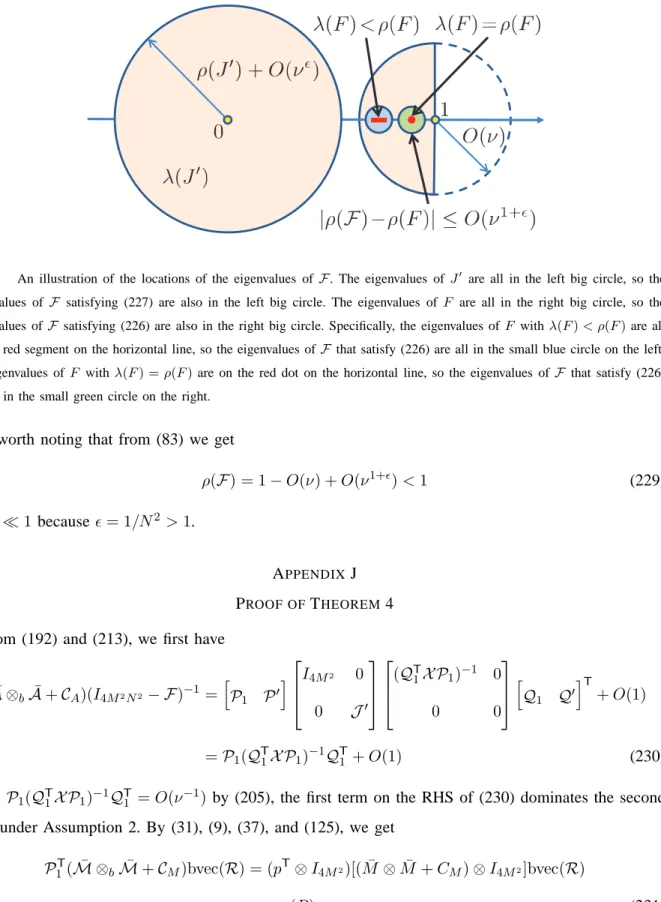
ρ(F) =ρ(F) +O(ν1+1/N2) (87) where the ρ(F) from (83) dominates the O(ν) term in (87).
Proof: See Appendix I.
In expression (82) we observe that the matrix F is dependent on the first and second-order moments of the random step-sizes, i.e., {µ¯k} and {cµ,ℓ,k}, and is also dependent on the first and second order
moments of the random combination coefficient matrix, i.e., A¯ andCA, through the dependence on the
Perron eigenvectorp. Let us introduce two 4M2×4M2 matrices:
R,
N
X
k=1
Z ,unvec (I4M2−F)−1vec(R)
(89) where Rk is given by (10). Using (186)–(188) and (214) in Appendix I, we can verify that
kRk=O(ν2), kZk=O(ν) (90) Then, using Lemma 5, we can establish the following useful result about the structure of the steady-state network error covariance matrix.
Theorem 4 (Network error covariance matrix): In steady-state, the covariance matrix of the network
error
¯e
wi′ from the long-term model (24) can be approximated by
lim i→∞ E ¯e w′i ¯e w′∗i = (1N1TN)⊗Z+O(ν1+γ ′ o) (91) where Z is from (89), γo′ , 1 2min{2, γv} (92)
and the first term on the RHS is dominant.
Proof: See Appendix J.
According to Theorem 4, the (cross-) covariance matrices of{
¯e
wk,i′ }, which are uniformly expressed by
E
¯e
w′k,i
¯e
w′∗ℓ,i= unvec(zi(ℓ,k)) for all k andℓ according to (58), can be approximated byZ in steady-state. However, this result is useful only if Z is a valid complex-Hessian-type matrix.
Definition 1 (Complex-Hessian-type matrices): Let X be an M×M positive semi-definite Hermitian matrix and let Y be an M ×M symmetric matrix. Then, a positive semi-definite block matrix of the form H, X Y Y∗ XT ≥0 (93)
will be referred to as a complex-Hessian-type matrix.
The following result explains the reason for introducing this definition.
Lemma 6 (Complex-Hessian-type covariance matrices): Let x denote an M ×1 zero-mean complex random vector and let Rx,Exx∗ andR′x,ExxT. Then, the covariance matrix of ¯x=T¯(x) is given
by E ¯ x ¯ x∗= Exx∗ ExxT E(x∗)Tx∗ E(x∗)TxT = Rx Rx′ Rx′∗ RT x (94)
and this matrix is a complex-Hessian-type matrix.
By Lemma 6, for any zero-mean complex random vector x, the covariance matrix of
¯
x=
¯
T(x) must
be a complex-Hessian-type matrix. Therefore, in order to approximate {unvec(zi(ℓ,k))} by Z according to (91), we establish the following useful result for the matrix Z.
Lemma 7 (Properties of Z): The matrix Z in (89) is a positive semi-definite complex-Hessian-type matrix.
Proof: See Appendix K.
Using (91) and Lemmas 6 and 7, we arrive at the following result for the covariance and cross-covariance matrices of the steady-state error vectors {
¯e
w′k,i} from the long-term model (24).
Corollary 1 (Covariance and cross-covariance matrices): The steady-state (cross-) covariance
matri-ces of individual errors{
¯e
wk,i′ }from the long-term model (24) can be approximated by
lim i→∞ E ¯e wk,i′ ¯e w′∗ℓ,i=Z+O(ν1+γo′) (95)
for all k andℓ, where Z is given by (89) and is dominant due to (90), and γo′ is given by (92).
Proof: By Lemma 7, the Z is a complex-Hessian-type matrix. According to Lemma 6, it is a valid covariance matrix for complex random vectors obtained via the transform
¯
T(·). The approximation (95)
then follows from Theorem 4.
C. Steady-State MSD
Using Corollary 1, we obtain two useful results about the steady-state MSD for asynchronous diffusion solutions.
Corollary 2 (Steady-state MSD): Based on the same assumptions as Theorem 4, the steady-state MSD
(either the network MSD in (66) or the individual MSD in (67)) can be approximated by MSDnet= 1 4Tr(H −1R) +O(ν1+γo) (96) MSDk= 1 4Tr(H −1R) +O(ν1+γo) (97)
where {H, R} are given by (84) and (88), respectively, γo is from (70), and Tr(H−1R) is of the order
ofν.
Proof: See Appendix L.
Corollary 3 (Clustered solutions): The steady-state relative MSD between any two agents k and ℓ, i.e.,Ekwk,i−wℓ,ik2, is negligible compared to their steady-state absolute MSD with respect towo, i.e.,
lim i→∞
Ekwk,i−wℓ,ik2 =O(ν1+γ′
o)≪max
where γo′ is given by (92).
Proof: First, from Corollary 1, we have lim i→∞ Eke ¯ w′k,i− e ¯ w′ℓ,ik2 = lim i→∞ E[ke ¯ w′k,ik2+ke ¯ w′ℓ,ik2− e ¯ w′∗k,ie ¯ w′ℓ,i−e ¯ w′∗ℓ,ie ¯ w′k,i] = Tr(Z) + Tr(Z)−Tr(Z)−Tr(Z) +O(ν1+γo′) =O(ν1+γo′) (99)
From Theorem 1 and using (99), we get
lim i→∞ Eke ¯ wk,i− e ¯ wℓ,ik2= lim i→∞ Eke ¯ wk,i− e ¯ w′k,i+ e ¯ w′k,i−e ¯ w′ℓ,i+ e ¯ w′ℓ,i− e ¯ wℓ,ik2 ≤ lim i→∞3 E ke ¯ wk,i− e ¯ w′k,ik2+ke ¯ w′k,i−e ¯ w′ℓ,ik2+ke ¯ w′ℓ,i− e ¯ wℓ,ik2 ≤O(ν2) +O(ν1+γ′o) +O(ν2) ≤O(ν1+γ′o) (100)
Using (6) from Part I [2], (100), and Corollary 2 completes the proof.
We illustrated Corollaries 2 and 3 earlier in Fig. 1. We note that if the cost functions, {Jk(w)}, are
deterministic with known gradient vectors, then performance results in Corollaries 2 and 3 can still be deduced from our expressions by setting the gradient noise to zero.
V. CONCLUSION
We studied in some detail the MSE performance of asynchronous networks with random step-sizes, links, topologies, and combination coefficients. Assuming sufficiently small step-sizes, we showed that at steady-state, the error vector for every individual agent tends to cluster withinO(ν1+γo)from each other,
which means that the MSD performance is essentially uniform across the entire network. The result in Corollary 2 shows explicitly how the MSD performance of the network is affected by the asynchronous behavior. Quantities that relate to the first and second-order moments of the distribution of the random step-sizes and combination coefficients appear in these expressions. These results can be used to guide strategies for adjusting the combination weights and the rate at which the agents update their solutions and to ensure that the performance (in terms of MSD and rate of convergence) does not degrade below desirable levels.
APPENDIXA PROOF OFLEMMA 1 Using Lemma 1 in Part I [2], we get from (14)–(15) that
kHk−Hk,i−1k= Z 1 0 [∇2 ¯ w ¯ w∗Jk( ¯ wo)− ∇2 ¯ w ¯ w∗Jk( ¯ wo−t ¯e wk,i−1)]dt ≤ Z 1 0 k∇ 2 ¯ w ¯ w∗Jk( ¯ wo)− ∇2 ¯ w ¯ w∗Jk( ¯ wo−t ¯e wk,i−1)kdt ≤ Z 1 0 τk′ ·t· k ¯e wk,i−1kdt= τk′ 2 · kw¯ek,i−1k (101)
Using (101), we get from (18) that
kdk,ik2 ≤[µk(i)]2· kHk−Hk,i−1k2· k ¯e wk,i−1k2 ≤[µk(i)]2· τk′2 4 · kw¯ek,i−1k 4 (102)
Taking the expectation of both sides of (102) yields
Ekdk,ik2 ≤µ¯(2) k τ′2 k 4 ·Ekw¯ek,i−1k 4 (103)
From Theorem 2 of Part I [2], it holds for large enough ithat
Ekwek,ik4 ≤2b2
4·ν2 (104)
Using the fact from (198) of Part I [2] that µ¯(2)k ≤ν2 for anyk, and letting
τ′ ,max k τ
′
k (105)
we obtain from (103) and (104) that
Ekdk,ik2 ≤2τ′2b2
4·ν4 =O(ν4) (106)
where a factor of 4 appeared due to the conversion
¯
T(·) from (4) of Part I [2]. Then,
EkAT idik2 = N X k=1 E X ℓ∈Nk,i aℓk(i)dℓ,i 2 (a) ≤ N X k=1 E X ℓ∈Nk,i aℓk(i)kdℓ,ik2 = N X k=1 X ℓ∈Nk ¯ aℓkEkdℓ,ik2 ≤N ·max ℓ Ekdℓ,ik2
(b)
≤ 2N τ′2b24·ν4 (107)
where step (a) is by using Jensen’s inequality; and step (b) is by using (106).
APPENDIXB PROOF OFTHEOREM 1
We rewrite the original error recursion (16) and the long-term model (24) respectively as follows:
¯e
ψk,i= [I2M −µk(i)Hk] ¯e
wk,i−1+µk(i) ¯
vk,i(wk,i−1) +dk,i (108)
¯e wk,i= X ℓ∈Nk,i aℓk(i) ¯e ψℓ,i (109) and ¯e ψk,i′ = [I2M −µk(i)Hk] ¯e w′k,i−1+µk(i) ¯ vk,i(wk,i−1) (110) ¯e wk,i′ = X ℓ∈Nk,i aℓk(i) ¯ e ψℓ,i′ (111)
with the prime notation for quantities associated with the long-term model (24). From (109) and (111), and using Jensen’s inequality, the squared 2-norm of the difference between the two models is given by
kw¯ek,i− ¯e wk,i′ k2≤ X ℓ∈Nk,i aℓk(i)k ¯e ψℓ,i− ¯e ψ′ℓ,ik2 (112)
Taking the expectation of both sides yields
Ek ¯e wk,i− ¯e wk,i′ k2 ≤ X ℓ∈Nk ¯ aℓkEk ¯e ψℓ,i− ¯e ψℓ,i′ k2 ≤max ℓ Ek ¯ e ψℓ,i− ¯ e ψ′ℓ,ik2 (113)
for all k. Then,
max k Ek ¯e wk,i− ¯e wk,i′ k2 ≤max k Ek ¯ e ψk,i− ¯ e ψk,i′ k2 (114)
From (108) and (110), we have
¯e ψk,i− ¯e ψk,i′ = [I2M −µk(i)Hk]( ¯e wk,i−1− ¯e w′k,i−1) +dk,i (115)
Taking the expected squared 2-norm of both sides, we have
Ek ¯e ψk,i− ¯e ψk,i′ k2 ≤Ek[I2M −µk(i)Hk]( ¯e wk,i−1− ¯e wk,i′ −1) +dk,ik2 =E (1−t) I2M −µk(i)Hk 1−t (w¯ek,i−1−w¯e ′ k,i−1) +t dk,i t 2
≤(1−t)−1EkI2M −µk(i)Hkk2·Ek
¯e
wk,i−1−
¯e
w′k,i−1k2+t−1Ekdk,ik2 (116)
for any 0< t <1, where we used Jensen’s inequality in the second inequality. By condition (19), it can be verified that EkI2M −µk(i)Hkk2 ≤1−2¯µ(1) k λk,min+ ¯µ (2) k λ2k,max (a) ≤ 1−µ¯(1)k λk,min ≤ 1−1 2µ¯ (1) k λk,min 2 <1 (117)
where step (a) is from (192) of Part I [2]. Substituting t= 12µ¯(1)k λk,min<1 and (117) into (116) yields Ek ¯e ψk,i− ¯e ψk,i′ k2≤ 1−1 2µ¯ (1) k λk,min Ek ¯e wk,i−1− ¯e w′k,i−1k2+ 2 λk,minµ¯(1)k Ekdk,ik2 (118)
Using (103), the second term on the RHS of (118) can be bounded for large enough iby
2 λk,minµ¯(1)k ·Ekdk,ik2 ≤ 2 λk,minµ¯(1)k ·µ¯(2)k τ ′2 k 4 ·Ekw¯ek,i−1k 4 = τ ′2 k 2λk,min · ¯ µ(2)k ¯ µ(1)k · Ek ¯e wk,i−1k4 ≤ τ ′2 kν 2λk,min · Ek ¯e wk,i−1k4 (119)
where we used the fact from (200) of Part I [2] that ν≥µ¯(2)k /µ¯(1)k . Substituting (119) into (118) yields
Ek ¯e ψk,i− ¯e ψk,i′ k2 ≤ 1−1 2µ¯ (1) k λk,min Ek ¯e wk,i−1− ¯e wk,i′ −1k2+ τ ′2 kν 2λk,min Ek ¯e wk,i−1k4 (120) Therefore, max k Ek ¯e ψk,i− ¯e ψk,i′ k2 ≤max k 1−1 2µ¯ (1) k λk,min max k Ek ¯e wk,i−1− ¯e wk,i′ −1k2 + max k τk′2ν 2λk,min · Ek ¯e wk,i−1k4 (121) Substituting (121) into (114) yields
max k Ek ¯e wk,i− ¯e wk,i′ k2 ≤γ·max k Ek ¯e wk,i−1− ¯e wk,i′ −1k2+ τ ′2ν 2 minkλk,min · max k Ek ¯e wk,i−1k4 (122) where γ ,max k 1−1 2µ¯ (1) k λk,min = 1−1 2mink {µ¯ (1) k ·λk,min} (123)
When condition (19) holds, it can be verified by using (191) from Part I [2] that|γ|<1. Then, we get from (122) that lim sup i→∞ max k Ek ¯e wk,i− ¯e w′k,ik2 ≤ τ ′2ν (1−γ)·2 minkλk,min · lim sup i→∞ max k Ek ¯e wk,i−1k4
≤ 4τ ′2b2
4ν3
minkµ¯(1)k ·minkλ2k,min
≤O(ν2) (124)
where we used Theorem 2 from Part I [2] and the fact from (198) of Part I [2] thatµ¯(1)k =O(ν). APPENDIXC
BLOCKOPERATIONS
Consider a block matrix X of sizeN M×N M and partition it intoN×N blocks whereXkℓ denotes
its (k, ℓ)-th sub-matrix of sizeM×M. The block vectorization ofX with block size M×M is defined as follows [17]:
bvec(X),col{vec(X11),vec(X21), . . . ,vec(XN1), . . . ,vec(X1N),vec(X2N), . . . ,vec(XN N)} (125)
LetY denote another block matrix of size N M×N M and letYkℓ denote its(k, ℓ)-th sub-matrix of size
M×M. Then, the block Kronecker product of X and Y with block sizeM ×M is defined by [17]:
X ⊗bY , Z11 Z12 . . . Z1N Z21 Z22 . . . Z2N .. . ... . .. ... ZN1 ZN2 . . . ZN N (126) where Zkℓ , Xkℓ⊗Y11 Xkℓ⊗Y12 . . . Xkℓ⊗Y1N Xkℓ⊗Y21 Xkℓ⊗Y22 . . . Xkℓ⊗Y2N .. . ... . .. ... Xkℓ⊗YN1 Xkℓ⊗YN2 . . . Xkℓ⊗YN N (127)
For any matrices {X, Y, A, B} of compatible dimensions and with blocks of size M×M, it holds that
(X⊗A)⊗b(Y ⊗B) = (X⊗Y)⊗(A⊗B) (128)
where⊗denotes the traditional Kronecker product operation. Other useful properties for the⊗b operation
can be found in [17, pp. 176-179] and are listed here for ease of reference:
bvec(ABC) = (CT⊗bA)·bvec(B) (129) bvec(xyT) =y⊗
bx (130)
(AC)⊗b(BD) = (A ⊗bB)(C ⊗bD) (132)
(A+B)⊗b(C+D) =A ⊗bC+B ⊗bC+A ⊗bD+B ⊗bD (133)
(A ⊗bB)∗=A∗⊗bB∗ (134)
(A ⊗bB)T=AT⊗bBT (135)
for any block matrices {A,B,C,D} and any block vectors {x, y} with appropriate sizes. APPENDIXD
PROOF OFTHEOREM 2 From the long-term model (41), we obtain that
E( ¯e w′i ¯e wi′∗|Fi−1) =E(Bi ¯e wi′−1 ¯e w′∗i−1B∗i|Fi−1) +E( ¯si¯s ∗ i|Fi−1) (136)
where the cross terms that involve
¯ si disappear because E(Bi ¯e wi−1 ¯ s∗i|Fi−1) = 0 by (29) and (35).
Performing the block vectorization of block size 2M for both sides of (136), and using (129) and (130) yield E[( ¯e wi′∗)T⊗b ¯e wi′|Fi−1] =E[(B∗i)T⊗bBi][( ¯e wi′∗−1)T⊗b ¯e wi′−1] +E[( ¯ s∗i)T⊗b ¯si|Fi−1] (137)
Using (29), (132), and (135), the second term on the RHS of (137) can be expressed as
E[( ¯s ∗ i)T⊗b ¯si|Fi−1] = ( ¯A ⊗bA¯+CA) T( ¯M ⊗ bM¯ +CM)ri(wi−1) (138)
Substituting (51) and (138) into (137), taking the expectation with respect to Fi−1, and then using (48),
we arrive at the desired recursion (52), namely,
E[( ¯e w′∗i )T⊗ b ¯e w′i] =F∗E[( ¯e w′∗i−1)T⊗ b ¯e w′i−1] +yi (139)
From (51), we know that G in (50) is a factor of F. Hence, we use the following result to examine the stability of F.
Lemma 8 (Properties of G): The matrix G in (50) satisfies the following properties: 1) Block diagonal and Hermitian matrix: it holds that
G= diag{G1, G2, . . . , GN} (140)
where Gℓ denotes the ℓ-th block on the diagonal of G with block size4M2N ×4M2N and Gℓ,k
denotes the k-th block on the diagonal of Gℓ with block size 4M2 ×4M2. The block Gℓ,k is
Hermitian and is given by
Gℓ,k ,D¯ℓT⊗D¯k+cµ,ℓ,k(HℓT⊗Hk) (142)
where D¯k is given by (32).
2) Norms and spectral radius: it can be verified that
ρ(G) = max
k,m{(1−µ¯kλk,m)
2+c
µ,k,kλ2k,m} (143)
where λk,m denotes them-th eigenvalue ofHk,m= 1,2, . . . ,2M.
3) Stability: if condition (23) holds, then
ρ(G) <1 (144)
Proof: See Appendix E.
Using the fact that G is block diagonal and Hermitian, and that A¯⊗A¯+CA is block left-stochastic,
result (153) from [4, App. A] implies that
ρ(F)≤ρ(G) (145)
By (144) and (145), we conclude that F is stable if condition (23) holds.
APPENDIX E PROOF OFLEMMA 8
The first property relating to the block diagonal and Hermitian structure of (140)–(142) is established by using the definition of⊗band (50). Because the matrixDiis block diagonal with block size2M×2M,
the block Kronecker product:
Gi ,DTi ⊗bDi (146)
is block diagonal with block size 4M2N ×4M2N and each block is itself block diagonal with block size4M2×4M2. Let us denote the ℓ-th block on the diagonal ofGi with block size 4M2N ×4M2N
by
Gℓ,i,DTℓ,i⊗Di (147)
and thek-th block on the diagonal ofGℓ,i with block size 4M2×4M2 by
where we used the fact that Dℓ,i is Hermitian. Then, we have
Gi= diag{G1,i,G2,i, . . . ,GN,i} (149) Gℓ,i= diag{Gℓ,1,i,Gℓ,2,i, . . . ,Gℓ,N,i} (150)
Using (50) and taking the expectation of both sides of (149) and (150), we get (140) and (141) by identifying:
Gℓ =E[Gℓ,i], Gℓ,k =E[Gℓ,k,i] (151)
Equation (142) follows from (151), (148), (26), and (32). Since the matrices {Gℓ,k} are all Hermitian,
by (140) and (141), the matrix G is also Hermitian.
The second property in (143) is established by using the block diagonal and Hermitian properties of
G to readily conclude that ρ(G) = maxℓ,kρ(Gℓ,k). Furthermore, by (142), the eigenvalues of Gℓ,k are
given by
λm,n(Gℓ,k) = (1−µ¯ℓλℓ,n)(1−µ¯kλk,m) +cµ,ℓ,kλℓ,nλk,m (152)
for any ℓ, k= 1,2, . . . , N, where λk,m denotes the m-th eigenvalue ofHk and m, n = 1,2, . . . ,2M. It
is straightforward to verify that
λm,n(Gℓ,k) =E[(1−µℓ(i)λℓ,n)(1−µk(i)λk,m)] (153)
Using Cauchy-Schwarz inequality, we get
|E[(1−µℓ(i)λℓ,n)(1−µk(i)λk,m)]| ≤qE[(1−µℓ(i)λℓ,n)2]·E[(1−µk(i)λk,m)2] ≤max k,m{ E[(1−µk(i)λk,m)2]} = max k,m{(1−µ¯kλk,m) 2+c µ,k,kλ2k,m} (154)
where the first inequality becomes equality when ℓ=kand n=m. From (152)–(154) we get
|λm,n(Gℓ,k)| ≤max
k,m{(1−µ¯kλk,m)
2+c
µ,k,kλ2k,m} (155)
for any ℓ, k, m, and n. Since the above inequality applies to all eigenvalues of Gℓ,k, and since Gℓ,k is
Hermitian, we get
ρ(Gℓ,k)≤max
k,m{(1−µ¯kλk,m)
2+c
µ,k,kλ2k,m} (156)
Furthermore, from (152) we know that
so that equality in (156) is achievable for some kand m.
For the third property in (144), we introduce the quadratic function
f(x),(1−µ¯kx)2+cµ,k,kx2 (158)
with x∈[λk,min, λk,max]. It is easy to verify that f(x) achieves its maximum value at either one of its
boundaries:
f(x)≤max{f(λk,min), f(λk,max)}
≤1−2¯µkλk,min+ (¯µ2k+cµ,k,k)λ2k,max (159)
From Assumption 2 in Part I [2] we have λk,min ≤λk,m ≤λk,max for any k and m. We then deduce
from (159) that
f(λk,m)≤1−2¯µkλk,min+ (¯µ2k+cµ,k,k)λ2k,max (160)
for anyk andm. Using (143), (158), and (160), we get
ρ(G) = max k,m{f(λk,m)} ≤max k {f(λk,min), f(λk,max)} <max k {f(λk,min), f(λk,max)}+α(¯µ 2 k+cµ,k,k) (161)
where α >0 by Assumption 1. When condition (23) holds, using (144) from Part I [2], we have
max
k {1−2¯µkλk,min+ (¯µ
2
k+cµ,k,k)(λ2k,max+α)}<1 (162)
Therefore, by (161) and (162), if condition (23) holds, then ρ(G)<1, which completes the proof. APPENDIXF
PROOF OFLEMMA 2
From Lemma 3 in Part I [2] we know that the matrices A¯⊗A¯+CA and A¯ are both left-stochastic.
To establish the desired result, we only need to show that the matrix A¯⊗A¯is primitive if A¯⊗A¯+CA
is primitive. This is because if A¯⊗A¯is primitive, then for some finite positive integerj >0, the matrix
( ¯A⊗A¯)j has strictly positive entries. Since ( ¯A⊗A¯)j = ¯Aj ⊗A¯j and A¯ has nonnegative entries, A¯j
must have strictly positive entries. Therefore, A¯ is primitive.
In order to prove that the matrix A¯⊗A¯is primitive if A¯⊗A¯+CA is primitive, we first introduce the
Definition 2 (Comparing sparsity): For any two matrices {A, B} with nonnegative entries and of the same size, the matrix A is called sparser than B, or, equivalently, B is called denser than A, if, and only if, [B]ℓk >0 whenever[A]ℓk >0 for anyk andℓ.
It is straightforward to verify the following three useful properties related to Definition 2.
Lemma 9 (Denser product): For any M ×N matrices {A, B} and any N ×P matrices {C, D} all with nonnegative entries, ifB is denser thanA andD is denser thanC, thenBD is denser than AC.
Lemma 10 (Denser Kronecker product): For any M ×N matrices {A, B} and any P ×Q matrices
{C, D} all with nonnegative entries, ifB is denser thanAandDis denser thanC, thenB⊗Dis denser than A⊗C.
Lemma 11 (Sum is not denser): For any set of M×N matrices{Ai}with nonnegative entries, where
i ∈ I and I is an index set (which can be uncountable), if there exists an M ×N matrix B with nonnegative entries such thatB is denser than everyAi,i∈ I, and assuming that the sumS ,Pi∈IAi
exists, then B is also denser than S.
Now, from Lemma 2 in Part I [2], we know that A¯ is denser than any realization of Ai, say, Ai(ω)
where ω ∈ Ω and Ω is the sample space of Ai. Using Lemma 10, we get that A¯⊗A¯ is denser than anyAi(ω)⊗Ai(ω). Using Lemma 11 and the fact that the probability measures only take nonnegative values, we get thatA¯⊗A¯ is denser thanA¯⊗A¯+CA=E[Ai⊗Ai]. IfA¯⊗A¯+CA is primitive, then
there exists a finite positive integer j >0 such that ( ¯A⊗A¯+CA)j has strictly positive entries. Using
Lemma 9, we know that( ¯A⊗A¯)j must be denser than( ¯A⊗A¯+CA)j. Therefore,( ¯A⊗A¯)j must also
have strictly positive entries, which means that A¯⊗A¯ must be primitive. APPENDIXG
PROOF OFLEMMA 3 We first show that Pp =PpT, or equivalently,
p= vec(PT
p) (163)
Lemma 12 (Vec-permutation matrix): The N2 × N2 vec-permutation matrix Π is a matrix whose
columns are formed from the basis vectors in RN2
and it satisfies:
vec(A) = Π·vec(AT) (164)
for anyN ×N matrixA. Then, for anyN ×N matrices{A, B},
In addition,Π = ΠT= Π∗ = Π−1.
Proof: See [18, Tabs. I and II] [19, Eqs. (5) and (6)].
Let Π be the permutation matrix that satisfies
vec(PpT) = Π·vec(Pp) (166)
From (80) and (166), proving (163) is equivalent to proving
p= Π·p (167)
To establish (167), we only need to show that Π·p is the Perron eigenvector of A¯⊗A¯+CA. In that
case, we can obtain (167) directly from the uniqueness of the Perron eigenvector, which is p. Thus, note that
Π( ¯A⊗A¯+CA)Π = Π[E(Ai⊗Ai]Π
(a)
= E(Ai⊗Ai)
= ¯A⊗A¯+CA (168)
where step (a) is by (165). Then, we deduce from (77) that
Π·p= Π( ¯A⊗A¯+CA)p= ( ¯A⊗A¯+CA)(Π·p) (169)
1TN2·Π·p=1TN2 ·p= 1 (170)
where we used the fact that Π2 = I
N2 by Lemma 12 and Π·1N2 = 1N2. Results (169) and (170)
establish that Π·p is the Perron eigenvector of A¯⊗A¯+CA and proves (167).
We next establish that Pp is positive semi-definite. Note that for any vectorx∈RN:
xTPpx= vec(xTPpx) = 1
N2(xT⊗xT)p·1TN21N2 (171)
by using (80) and the fact that 1TN21N2 = N2. Since A¯⊗A¯+CA = E(Aj ⊗Aj), we can introduce
a series of fictitious random combination matrices {A′j;j ≥1} such that they are mutually-independent and satisfy E(A′
j⊗A′j) = ¯A⊗A¯+CA for anyj≥1. Let Φi,
Qi
j=1A′j for anyi≥1. Then, lim
i→∞
E(Φi⊗Φi)(= lima)
i→∞ i Y j=1 E(A′ j⊗A′j) = lim i→∞( ¯A⊗ ¯ A+CA)i (b) = p·1T N2 (172)
where step (a) is by using the fact that the{A′j} are mutually-independent, and step (b) is by using the Perron-Frobenius Theorem [6]. Substituting (172) into (171) and using the fact that 1N2 = 1N ⊗1N,
we get xTPpx= 1 N2 ilim→∞E[(xTΦi1N) 2] ≥0 (173)
which shows that Pp is positive semi-definite.
Now we show that Pp1N = ¯p. Note from (80) and (77) that
Pp =E[Ai·Pp·ATi ] (174)
by switching the order of unvec(·) and E(·) and applyingunvec(·) to the identity vec(ABC) = (CT⊗
A)·vec(B). Furthermore, we get from (174) that
Pp·1N =E(AiPpAiT)·1N = ¯A(Pp·1N) (175)
which implies that the vector Pp·1N is the Perron eigenvector of A¯, which is p¯. Because the Perron
eigenvector is unique, by (78), equation Pp·1N = ¯p must hold.
APPENDIXH PROOF OFLEMMA 4
We first establish that F is stable if condition (23) is satisfied. From (142) and (82), we get
F = N X ℓ=1 N X k=1 pℓ,kGℓ,k (176)
By (77) and (80), the elements {pℓ,k} ofPp satisfy: N X ℓ=1 N X k=1 pℓ,k = 1, and pℓ,k >0 (177)
Then, in terms of the 2-induced norm, we have
kFk(≤a) N X k=1 N X ℓ=1 pℓ,kkGℓ,kk (b) ≤ max k,ℓ kGℓ,kk (c) = ρ(G) (178)
where step (a) is from the triangle inequality of norms; step (b) is by using (177); and step (c) is by (143). Using (144), (178), and the fact that ρ(F) =kFk for the Hermitian matrix F, we conclude that matrix F is stable if condition (23) holds.
We now establish expression (83). Introduce the Hermitian matrix
F′ , N X k=1 N X ℓ=1 ¯ pℓp¯k( ¯DℓT⊗D¯k) (179)
From (32), we can rewriteF′ asF′ = (I2M−H)T⊗(I2M−H), where we used (78) and (84). Therefore,
the eigenvalues of F′ are equal to the products of any two of the eigenvalues of I2M −H, which are
given by1−λ(H). Since {p¯k}and{µ¯k} are all positive and{Hk} are all positive definite, it is easy to
verify that H in (84) is also positive definite. Then, from (84), (78), and (15), and using (8) from Part I [2] as well as Jensen’s inequality [20], we get
0< λ(H)≤ kHk ≤max
k {µ¯kλk,max} (180)
for all eigenvalues of H. When condition (23) holds, we get from (195) of Part I [2] that
¯ µk≤ ¯ µ(2)k ¯ µk < λk,min λ2 k,max+α < 1 λk,max (181) for any k. This implies that maxk{µ¯kλk,max} <1 and therefore, 0 < λ(H) <1 for all eigenvalues of
H. From (84) and (186), we obtain
0< λ(H) =O(ν)<1 (182) for any eigenvalue of H. Therefore, we get
λ(I2M −H) = 1−O(ν), ρ(I2M −H) = 1−λmin(H) (183)
where λmin(·) denotes the smallest eigenvalue of its Hermitian matrix argument. We further get from
(183) that
λ(F′) = 1−O(ν), ρ(F′) = [1−λmin(H)]2 (184)
Using Lemma 3, (77), (78), and (32), the difference between F in (82) andF′ in (179) is given by
F −F′= N X k=1 N X ℓ=1 {[(pℓ,k−p¯ℓp¯k)¯µℓµ¯k+pℓ,kcµ,ℓ,k](HℓT⊗Hk)} (185)
which is also Hermitian. From (198) in Part I [2], we get
¯
µk≡µ¯(1)k ≤ν (186)
cµ,k,k ≤µ¯(2)k ≤ν2 (187)
|cµ,ℓ,k| ≤√cµ,ℓ,ℓ·cµ,k,k ≤ν2 (188)
where (188) is by using the Cauchy-Schwartz inequality. By (186)–(188), we get kF −F′k = O(ν2). Using a corollary of the Wielandt-Hoffman theorem [21, Corollary 8.1.6, p. 396], we then conclude that
whereλm(·)denotes them-th eigenvalue of its Hermitian matrix argument; the eigenvalues are assumed
to be ordered from largest to smallest in each case. Result (189) implies that for every eigenvalue ofF′
there is an eigenvalue of F that is O(ν2) close to it. From (189) and (184) we immediately deduce that
λm(F) = 1−O(ν), ρ(F) =ρ(F′) +O(ν2) (190)
where ρ(F′) from (184) dominates theO(ν2) term. APPENDIXI PROOF OFLEMMA 5 We first establish (85). Introduce the Jordan decomposition:
¯ A⊗A¯+CA,P JQT= h p P′ i 1 0 0 J′ h 1N2 Q′ iT (191)
where J is the Jordan canonical form of A¯⊗A¯+CA andJ′ is a sub-matrix of J containing its stable
eigenvalues, P′ and Q′ are sub-matrices of P and Q, and P−1 =QT. Then, the Jordan decomposition
ofA ⊗¯ bA¯+CA is given by ¯ A ⊗bA¯+CA=PJ QT= h P1 P′ i I4M2 0 0 J′ h Q1 Q′ iT (192) where P ,P ⊗I4M2, P′ ,P′⊗I4M2 (193) J ,J⊗I4M2, J′ ,J′⊗I4M2 (194) Q,Q⊗I4M2, Q′ ,Q′⊗I4M2 (195) P1 ,p⊗I4M2, Q1,1N2⊗I4M2 (196) Let X ,I4M2N2 − G (197)
where G is given by (50). Then, by (51),
QTFP=QT[G ·( ¯A ⊗bA¯+CA)]P =QT(I
4M2N2− X)(PJ QT)P =J − QTX PJ
= I4M2 − QT1X P1 −QT1X P′J′ −Q′TX P 1 J′− Q′TX P′J′ (198)
From (198), we further get
(I4M2N2 − QTFP)−1 = QT 1X P1 QT1X P′J′ Q′TX P 1 I− J′+Q′TX P′J′ −1 (199)
where the I denotes the 4M2(N2−1)×4M2(N2−1) identity matrix. The quantity QT1X P1 in (198)
can be expressed as QT1X P1 (a) = QT1 · P1− QT1GP1 (b) = (1TN2p)⊗I4M2−(1TN2⊗I4M2)(diag{Gℓ,k})(p⊗I4M2) (c) = I4M2−F (200)
where step (a) is by (197); step (b) is by (140)–(141); and step (c) is by (176). We already know that the matricesF andF are stable for sufficiently small step-sizes. Thus, the matricesI4M2N2−F andI4M2−F
are invertible. It follows that the quantity QT1X P1 is invertible. Moreover, the Schur complement with
respect to QT1X P1 in (199) is also invertible. Let us denote the inverse of this Schur complement by
∆,[I− J′+Q′TX P′
J′− Q′TX P
1(QT1X P1)−1QT1X P′J′]−1 (201)
Then, by using a formula for the inversion of block matrices [22, Eq. (7), p. 48], equality (199) can be expressed as (I4M2N2− QTFP)−1 = (QT 1X P1)−1+ ∆′ −(QT1X P1)−1QT1X P′J′∆ −∆Q′TX P 1(QT1X P1)−1 ∆ (202) where ∆′,(QT1X P1)−1QT1X P′J′∆Q′TX P1(QT1X P1)−1 (203)
Now, from (200), (82), (32), (81), and (84), we can also write
QT1X P1=H⊗I2M +I2M ⊗H− N
X
ℓ,k=1
pℓ,k(¯µℓµ¯k+cµ,ℓ,k)(HℓT⊗Hk) (204)
It follows from (204) and (186)–(188) that QT1X P1 is Hermitian and
kQT