WEB TRANSCRIPT VERIFICATION USING DUAL CHECK DIGIT AS SECURE NUMBER
MUHAMAD RAIS BIN ABD HALIM
UNIVERSITI TUN HUSSEIN ONN MALAYSIA
STATUS CONFIRMATION FOR MASTER’S DISSERTATION WEB TRANSCRIPT VERIFICATION USING DUAL CHECK DIGIT
AS SECURE NUMBER ACADEMIC SESSION: 2015/2016
I, MUHAMAD RAIS BIN ABD HALIM, agree to allow this Master’s Dissertation to be kept at the Library under the following terms:
1. This Master’s Dissertation is the property of the Universiti Tun Hussein Onn Malaysia. 2. The library has the right to make copies for educational purposes only.
3. The library is allowed to make copies of this report for educational exchange between higher educational institutions.
4. ** Please Mark ()
CONFIDENTIAL (Contains information of high security or of great importance to Malaysia as STIPULATED under the OFFICIAL SECRET ACT 1972)
RESTRICTED (Contains restricted information as determined by the Organization/institution where research was conducted)
FREE ACCESS
Approved by,
(MUHAMAD RAIS BIN ABD HALIM) (DR HAIRULNIZAM BIN MAHDIN)
Permanent Address:
NO. 5, TAMAN KENANGAN INDAH, 86400 PARIT RAJA, JOHOR
Date : ___________________________ Date: _____________________________ NOTE:** If this Master’s Dissertation is classified as CONFIDENTIAL or RESTRICTED,
please attach the letter from the relevant authority/organization stating reasons and duration for such classifications.
This dissertation has been examined on date 16 JUNE 2015
and is sufficient in fulfilling the scope and quality for the purpose of awarding the Degree of Master of Computer Science (Web Technology).
Chairperson:
MADAM ROZANAWATI BINTI DARMAN
Faculty of Computer Science and Information Technology Tun Hussein Onn University of Malaysia
Examiners:
ASSOC. PROF. DR. RATHIAH BINTI HASHIM
Faculty of Computer Science and Information Technology Tun Hussein Onn University of Malaysia
MADAM HANAYANTI BINTI HAFIT
WEB TRANSCRIPT VERIFICATION USING DUAL CHECK DIGIT AS SECURE NUMBER
MUHAMAD RAIS BIN ABD HALIM
A dissertation submitted in
fulfillment of the requirements for the award of the Degree of Master of Computer Science (Web Technology)
Faculty of Computer Science and Information Technology Universiti Tun Hussein Onn Malaysia
ii
I hereby declare that the work in this dissertation is my own except for quotations and summaries which have been duly acknowledged.
Student :………..……
MUHAMAD RAIS BIN ABD HALIM
Date :………...………
Supervisor :………
iii
I dedicate this work to my mother Radiah Bte Ujang, my father Abd Halim Bin Dolah, my beloved wife Rozie Bte Md Yusof also to all my children Raidah Maisarah,
iv
ABSTRACT
v
CONTENTS
TITLE i
DECLARATION ii
DEDICATION iii
ABSTRACT iv
CONTENTS v
LIST OF FIGURES x
LIST OF TABLES xii
LIST OF APPENDICES xiii
CHAPTER 1 INTRODUCTION 1
1.1 Background of Study 1
1.2 Problem Statement 2
1.3 Objectives 3
1.4 Scope 3
1.4 Thesis Organization 3
CHAPTER 2 LITERATURE REVIEW 5
2.1 Introduction 5
vi
2.3.1 Watermarking 6
2.3.2 Digital Signatures 7
2.4 Check Digit 8
2.5 Common Errors 8
2.5.1 Single Digit Error 9
2.5.2 Single Transposition Error 9
2.5.3 Twin Error 10
2.5.4 Jump Transposition Error 10
2.5.5 Jump Twin Error 11
2.5.6 Phonetic Error 11
2.6 Error Detections 11
2.6.1 Luhn 10 Method 11
2.6.2 The UPC Modulus 10 Method 12
2.6.3 ISBN Modulus 11 Method 13
2.7 Analysis 14
2.8 Summary 15
CHAPTER 3 METHODOLOGY 17
3.1 Introduction 17
3.2 Student Academic Transcript 17
3.2.1 Transcript Attributes 18
3.2.2 Define Attributes 19
3.3 Secure Number Generation 19
vii
3.3.1.1 Generating First Secure Number 21 3.3.1.1.1 Mathematical Terminology for
First Secure Number 24
3.3.1.2 Generating Second Secure Number 25
3.3.1.2.1 Mathematical Terminology for
Second Secure Number 27
3.3.1.2.2 Conversion Two Digit Secure Number To
One Digit 28
3.4 Proposed UTHM Student Transcript Design 31
3.5 Summary 32
CHAPTER 4 IMPLEMENTATION 33
4.1 Introduction 33
4.2 Administrative Section 33
4.2.1 System Requirement 36
4.2.2 Administrative Interface 36
4.3 End User Section 38
4.4 Interface Design 38
4.5 Source Code 40
4.6 Summary 49
CHAPTER 5 PERFORMANCE ANALYSIS 50
5.1 Introduction 50
5.2 Experiments 51
viii
5.2.2 Single Transposition Error 53
5.2.3 Jump Transposition Error 55
5.2.4 Twin Error 56
5.2.5 Jump Twin Error 57
5.2.6 Phonetic Error 58
5.2.7 Overall Test Result 59
5.3 Summary 60
CHAPTER 6 CONCLUSION 62
6.1 Introduction 62
6.2 Contributions 63
6.3 Future Work 63
REFERENCES 65
ix
LIST OF TABLES
Table 2.1 Common errors occurrence 9
Table 2.2 Check digit methods success rates 14
x
LIST OF FIGURES
Figure 2.1 Check digit methods success rates 15
Figure 3.1 Generating UTHM Student transcripts with secure number 20 Figure 3.2 The process of generating Secure Number 21 Figure 3.3 Secure numbers created using UPC Modulus 10 22 Figure 3.4 Diagrammatical Representation of 1st Secure Number
Generating 23
Figure 3.5 Legend for Diagrammatical Representation of
first secure numbers 24
Figure 3.6 Secure numbers created using ISBN Modulus 11 25 Figure 3.7 Diagrammatical Representation of Second Secure Number
Generating 26
Figure 3.8 Legend for Diagrammatical Representation of
second secure numbers 27
Figure 3.9 Academic transcript with secure number 31 Figure 4.1 Function for creating 1st secure number 35 Figure 4.2 Function for creating a second secure number
xi
Figure 4.3 Administrative Interface for Generating Secure Number 37
Figure 4.4 Result of Generating Secure Number 38
Figure 4.5 Interface verification system 39
Figure 4.6 Academic transcript is valid 39
Figure 4.7 Academic transcript is not valid 39
Figure 4.8 Source code of welcome.php as main controller part 1 40 Figure 4.9 Source code of welcome.php as main controller part 2 41 Figure 4.10 Source code of formula.php as model part 1 42 Figure 4.11 Source code of formula.php as model part 2 43 Figure 4.12 Source code of formula.php as model part 3 44
Figure 4.13 Source code of admin.php as view 45
Figure 4.14 Source code of admingen.php as view 46
Figure 4.15 Source code of check.php as view 47
Figure 4.16 Source code of validate.php as view 48
Figure 4.17 Source code of webtransindex.php as view 48
Figure 5.1 Test result for single error 53
Figure 5.2 Test result for single transposition error 1 54 Figure 5.3 Test result for single transposition error 2 55 Figure 5.4 Test result for jump transposition error 56
Figure 5.5 Test result for twin error 58
xii
Figure 5.7 Test result for phonetic error 59
xiii
LIST OF APPENDICES
APPENDIX TITLE PAGE
A Result For Single Digit Error
(15 Samples Data From 10,000 Data) 68 B Result For Single Transposition Error 1
(15 Samples Data From 10,000 Data) 72 C Result For Single Transposition Error 2
(15 Samples Data From 10,000 Data) 76 D Result For Jump Transposition Error
(15 Samples Data From 10,000 Data) 80
E Result For Twin Error
(15 Samples Data From 10,000 Data) 84 F Result For Jump Twin Error
(15 Samples Data From 10,000 Data) 88 G Result For Phonetic Error
(15 Samples Data From 10,000 Data) 92
H Function Generating
xiv
I Function Generating
1
CHAPTER 1
INTRODUCTION
1.1 Background of Study
Most information including important documents has begun to use web services as a medium. There is an increasing number of web services available on the Internet. Examples of available web services include university review articles, weather alert and reports, stock quotations, student subject’s registration, or lecture hall booking processes. Web services can be a component of a system and different Web services would provide different services. However, supplying information using web services as a medium can expose the information to various threats. An example of this threat includes data manipulation. There is a risk of manipulation of data against information in hard copy or downloaded information. Irresponsible parties can do counterfeit printing.
Fraud on the student's academic transcript is the issue that universities should take seriously. This can affect educational institutions in terms of integrity of recognition. Academic transcripts fraud has spread to Malaysia references. This scam has tarnished the name of a famous university. According to The Star Online "Fake USM ‘degrees’ on sale online" (2012), The matter was viewed seriously as it could jeopardize the good reputation of Universiti Sains Malaysia (USM) and put its credibility at stake. There are parties who are responsible for issuing transcripts illegally. The advancement of computer hardware and software has made the production of fake transcripts easier and can be produced at a high quality that is at par with the original document.
2
document. Both of these approaches have to consider the documents available online or printed. These data modifications focus on intrusion system and also printed illegally or modify data while a copy of the document was done.
This research focused on detection mechanism to determine the authenticity of a document. One of the methods that can be used is Check Digit, which is a numeric Value that is generated mathematically and added to data to ensure that original data has not been altered. The first notable checks digit algorithm was developed by an IBM scientist named Hans Peter Luhn. It is specified in ISO/IEC 7812-1(Luhn, 1960). Check digit algorithm has been widely used in various applications such as bank account numbers standards "International Bank Account Number" (IBAN) numbers and standards publication, "International Standard Book Number" (ISBN) numbers of books.
1.2 Problem Statement
An academic transcript is a detailed verification of students’ academic performance after graduation. Academic transcripts show all subjects taken together with the grade that have been obtained. This makes student academic transcript be the main reference to the organization when an individual want to continue their studies or applying for a job. Organizations faced constraints in order to verify student academic transcript.
Advances in IT devices such as printers and scanners cause academic transcripts to be duplicated in high quality. There are universities in Malaysia that have received threats transcript academic fraud. This has cause direct defamation to the university. While criminals have been arrested, the likelihood of fraud can happen again.
3
To facilitate the verification, an application developed using the approach as a check digit verification method. By using this application, verification can be done at any time. Therefore, there is a proposal to put a reference number for verification of academic transcripts for each semester. A numeric value that has been calculated mathematically is added to original data to ensure that data has not been altered or an incorrect but submitted a valid value. The reference number can be verified with each subject taken for that semester.
1.3 Objectives
The objective of this thesis is to achieve the following goals:
a) To design verification method-using dual check digit, namely TransV for student academic transcript.
b) To develop a prototype for the designed verification method mentioned in (a).
c) To test the robustness the verification method against 3 other methods – UPC Modulus 10, ISBN Modulus 11 and Luhn 10.
1.4 Scope
This research focuses on developing a secure number of student academic transcripts. Semester, session, student matric number and GPA are four attributes that will be used on 10,000 student data. This data will be tested on four methods which is UPC, ISBN, Luhn 10 and proposed method.
1.5 Thesis Organization
Fraud student transcript must be taken seriously. This issue will be discussed in detail in this thesis. The design and development of the secure number will also be discussed in this thesis. Below are the outlines of this thesis.
4
digit with examples. Check digit comparative success rate using the method "Luhn 10", "UPC Modulus 10" and "ISBN Modulus 11" is described. Comparisons were made with six common errors namely single error, adjacent transposition error, twin error, jump transposition error, jump twin error and phonetic error also described.
Chapter 3 describes UTHM student academic transcript and the elements contained. Some of the elements used in generating secure number. In this chapter are also described in detail the process of generating secure number. The proposed locations of the placement secure number into the student academic transcript also described.
Chapter 4 describes the development and implementation of the proposed method. A prototype was also developed to illustrate the procedure for generation and validation a secure number. The proposed interface for system administrators and users described. Program code used in the generation of secure number and the verification of student academic transcript also described in detail.
Chapter 5 discusses the result of analysis and test of data using proposed method and prominent method. Ten thousand test data were used in the comparative testing which the test data was generated randomly on GPA. All method compared to determine the efficiency and accuracy when apply to student transcript as a number secure.
5
CHAPTER 2
LITERATURE REVIEW
2.1 Introduction
In this chapter all related works and current practices are presented. The three check digit methods are described and discussed in terms of their strengths and weaknesses.
Each university students will have student academic transcript for each semester. Performance of each semester shows in student academic transcript. Most organizations use a student academic transcript as a reference to the performance of students either continue their studies or job application. Transcript is vulnerable to fraud and manipulation of information.
To avoid fraudulent student academic transcript, various methods can be used such as watermarking and digital signature and a check digit. This method can be applied in the printing of student academic transcript.
Check digit comparative success rate using the method "Luhn 10", "UPC Modulus 10" and "ISBN Modulus 11" is described. Comparisons were made with six common errors namely single error, adjacent transposition error, twin error, jump transposition error, jump twin error and phonetic error also described.
2.2 University Student Academic Transcript
6
and year. The student transcript also display information on subject taken such as subject code, subject name, grade, CPA and CGPA.
Student transcript is an important reference document of student achievement for employment, education and other related purposes.
Verification method will involve the important information in student academic transcript. The method depends on information in transcript. This is to make sure that there is no data modification made in student academic transcript.
2.3 Verification Methods of Certification
Albrecht (2013) outlined that the increase in document forgery by fraudulent individuals has brought about a dire need to develop methods that protects the integrity of documents, both hardcopy and softcopy documents. To provide security to the information contained in a document, mechanisms and tools for prevention and detection need to be used.
These sections will only cover most prominent integrity mechanisms, which include digital signatures and watermarking, which are used in preventing and detecting forged documents.
2.3.1 Watermarking
Watermarking is a mechanism of embedding an imperceptible signal or signature, which is visible or invisible to protect the integrity intellectual property rights of digital media such as text, audio, video and images. Watermarking algorithm is made up of embedding algorithm; embeds the signature on the document and an extraction algorithm; decodes its content and detects the signature.
7
An example of watermarking is on photos or images by placing a mark in the form of words or logo. This is to ensure that the image was not taken illegally. In addition the use of watermarking as copyright protection, watermarking also uses as a promotional company or service by placing company logo on attractive photos. In the present time have a lot of watermarking applications have been developed. These include mobile application to facilitate users placing watermarking to photographs or images before uploading to the Internet.
2.3.2 Digital Signatures
Diffie, W. and Hellman, M. E. (1990) introduced digital signature in the mid-seventies. Digital signature is an asymmetric cryptographic mechanism used for demonstrating the authenticity of a document. In other word, digital signature is a mathematical technique used to validate the authenticity and integrity of a message, software or digital document.
Digital Signature is used to sign intellectual properties such as information transactions and also software distribution purposes. Sender can attach a unique code that acts as a signature to message. The encryption of message with the sender’s private key and the hash of the message are taken to form the signature. The recipient unpack received message, and use the same hashing function to the signed and encrypted message then compared to the decrypted signature.
8
2.4 Check Digit
Humans often make mistakes during entry input. Khaled (1998) mentioned errors that occur in machine communication are caused by human operations. Check digit is used to detect data errors by adding data with certain digits as revised. Check digit has been used in various applications such as the European Article Number (EAN) Code, Universal Product Code (UPC), bank account numbers standards "International Bank Account Number" (IBAN) numbers and standards publication, "International Standard Book Number" (ISBN) numbers of books.
Check digit method is able to check data modification by detecting common errors. To make sure no data modification is made, check digit is used for verification method by generating secure number for student academic transcript. Next, most common error will be discussed.
2.5 Common Errors
When humans use numbers, whether dialing them on phone, keying them into computer, or reading and telling them to others mistake.
9
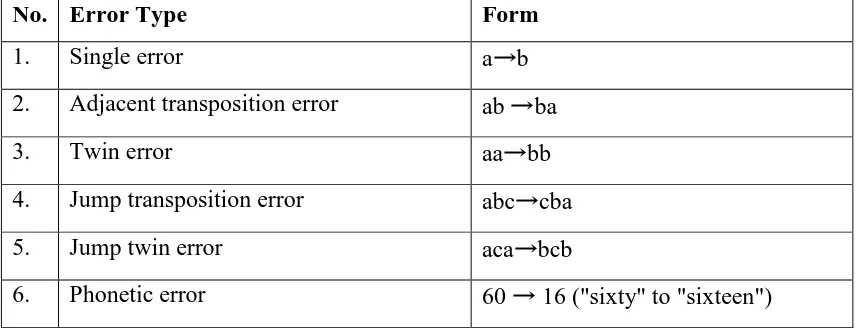
Table 2.1 Common errors occurrence
No. Error Type Form
1. Single error a→b
2. Adjacent transposition error ab →ba
3. Twin error aa→bb
4. Jump transposition error abc→cba
5. Jump twin error aca→bcb
6. Phonetic error 60 → 16 ("sixty" to "sixteen")
a) Single Digit Error
Single digit error occurs when only a single digit in the whole string of numbers or alphabets is typed wrongly.
Example 2.1
An example of single-digit error is when University is typed wrongly as Univrrsity. The alphabet e at fifth position is wrongly typed as r. Only a single digit in the whole
b) Single Transposition Error
Single transposition error occurs when the nth and the (n + 1 )th digits are replaced by the (n + 1)th and the nth respectively.
Example 2.2
10
c) Twin Error
Twin error occurs when two consecutive identical digits are incorrectly typed as two other identical digits.
Example 2.3
An example of twin error is when 63309857 typed as 64409857. Here the digits 33 at second and third position are incorrectly typed as 44.
d) Jump Transposition Error
Jump transposition error occurs when the nth and the (n + 2)th digits are replaced by the (n + 2)th and the nth respectively.
Example 2.4
An example of jump transposition error is when University typed as Univsreity. Here the alphabet e at seventh position and s at fifth position are jump transposed.
e) Jump Twin Error
Jump twin error occurs when the nth and (n + 2)th digits are identical and are mistyped as two other identical digits or alphabets.
Example 2.5
11
f) Phonetic Error
Phonetic Error occurs when there are two have similar pronunciations in some languages. An example of such errors is pronunciation number 16 (sixteen) and 60 (sixty) in English.
2.6 Error Detections
Several error detection methods are needed to detect common errors. Error detection method that is most convenient and efficient is the check digit.
Error detection involves adding a check digit to the digit or alphanumeric and verification. Check digits generated and usually placed behind the digit or alphanumeric. To confirm 'digit or alphanumeric' are error-free, check digit verification performed. This section will discuss some of the check digit generation method such as Luhn 10 method, UPC Modulus 10 method and ISBN Modulus 11 method.
2.6.1 Luhn 10 Method
Luhn 10 method, also known as the "modulus 10" or "mod 10" algorithm, is a simple checksum formula used to validate a variety of identification numbers, such as credit card numbers, IMEI numbers, National Provider Identifier numbers in the US, and Canadian Social Insurance Numbers (https://en.wikipedia.org/wiki/Luhn_algorithm). Luhn 10 is used by IBM scientist Peter Luhn (Gallian, 1996). It had no weighing numbers applied to Luhn 10 method.
Definition 2.1
The check digit α7 for the IBM number is; α1α2α3α4α5α6α7 - α8
12
Example 2.6
For example, a number such as 435-3748
(α7+ α6+ α5+ α4+ α3+ α2 + α1) ≡ 0 (mod 10)
4+3+5+3+7+4+8= 34, 10 - (34 % 10) Therefore,6 is the check digit.
Numbers with check digit is 435-3748-6.
2.6.2 UPC Modulus 10 Method
Universal Product Code (UPC) contains thirteen digits. The first twelve digits represent the product code and last digit is check digit. The modulus 10 method is used to detect errors in UPC. The first digit identifies a broad category of product type, the next five digits identify the manufacturer, the next five the product, and the last is the check digit. UPC required weighting number in creating check digit. Figure 2.1 below illustrates an abstract view of UPC check digit method.
Definition 2.2
The check digit α13 for the UPC number α1, α2... α12 is chosen to satisfy the condition. Where Weight W1, W2, W3.... W12 is denoted by weighing factor (3, 1, 3, 1, 3, 1, 3, 1, 3, 1, 3, 1).
X = ((α1*W1) + (α2*W2) + ... + (α12*W12)) (2.1)
X =∑𝑛=12𝑖=1 (α1 ∗ W1) (2.2)
UPC Check Digit : 10 - (X % 10) (2.3)
Example 2.7
Example for UPC is7384 9920 9388. Get the check digit.
7*3+3*1+8*3+4*1+9*3+9*1+2*3+0*1+9*3+3*1+8*3+8*1= 156,10 - (156 % 10). Therefore 4 is the check digit.
13
2.6.3 ISBN Modulus 11 Method
Books published also must have a unique identification number. International Standard Book Number system (ISBN), was introduced by Gordon Foster and WH Smith in 1966. ISBN later published by the international organization for standardization in 1970 as ISO 2108.
Definition 2.3
The check digit α10 for the ISBN number α1, α2... α9 is chosen to satisfy the condition. Where Weight W1, W2, W3.... W9 is denoted by weighing factor (10,9,8,7,6,5,4,3,2).
X = ((α1*W1) + (α2*W2) + ... + (α12*W12)) (2.4)
X =∑𝑛=9𝑖=1(α1 ∗ W1) (2.5)
ISBN Check Digit : 11 - (X % 11) (2.6)
Example 2.8
Example for ISBN is 73849 9238. Get the check digit.
7*10+3*9+8*8+4*7+9*6+9*5+2*4+3*3+8*2= 321,11 - (321% 11) Therefore 9 is the check digit.
After check-digit number is obtained, it will be combined with the original number. Final numbers with check digit is 73849 9238 9.
2.7 Analysis
14
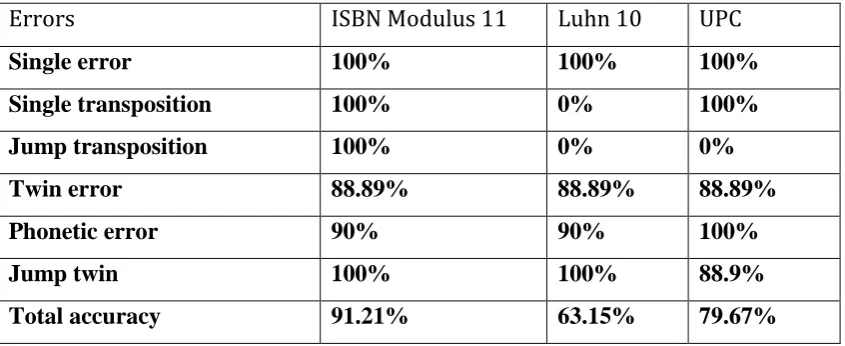
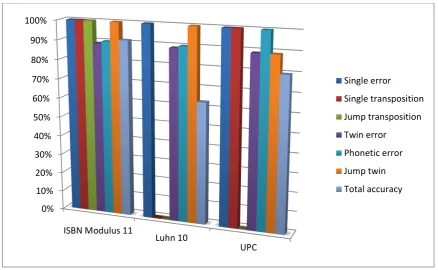
[image:31.595.88.511.200.373.2]followed by UPC with 79.67% and Luhn 10 with 63.15%. Table 2.2 below gives a summary of the success rates of three modern conventional check digit methods.
Table 2.2 Check digit methods success rates.
Errors ISBN Modulus 11 Luhn 10 UPC
Single error 100% 100% 100%
Single transposition 100% 0% 100%
Jump transposition 100% 0% 0%
Twin error 88.89% 88.89% 88.89%
Phonetic error 90% 90% 100%
Jump twin 100% 100% 88.9%
Total accuracy 91.21% 63.15% 79.67%
15
Figure 2.1: Check digit methods success rates
2.8 Summary
This chapter discussed the modern mechanisms and tools used in protecting the genuine of a document such as watermarking and digital signatures. This chapter also discussed the relevant check digit methods and common errors. An analysis have made to error detection success rate.
Student academic transcript discussed that is each university students will have student academic transcript for each semester. Performance of each semester shows in student academic transcript. Student academic transcript is main references to the performance of students either continue their studies or applying a job. Transcript is vulnerable to fraud and manipulation of information, therefor various methods discussed to be used for fraud detection such as watermarking and digital signature and a check digit.
Example fraud detection is watermarking which is placing a mark in the form of words or logo on photos or images. Other than that, Digital Signature is used to sign intellectual properties such as information transactions and also software distribution purposes. This is to ensure that the image was not taken illegally.
0% 10% 20% 30% 40% 50% 60% 70% 80% 90% 100%
ISBN Modulus 11
16
17
CHAPTER 3
METHODOLOGY
3.1 Introduction
The proposed check digit algorithm, namely TransV will be used to generate a secure serial number for UTHM students’ transcript. A detailed implementation of check digit system to UTHM students’ transcript will be explained. The algorithm will compute elements such as session, semester, GPA and matric number to produce the double check digit. All the processes and detail design of check digit including computing, generating and verification
will be discussed in this chapter.
10,000 data are tested to analyze the robustness of the method in generating the secure numbers. Appendix A shows 15 sample data from a total of 10,000 data tested.
3.2 Student’s Academic Transcript
18
3.2.1 Transcript Attributes
Attributes in the student's transcript are listed and some of these attributes be identified to used as inputs in generating the secure number. The following are the 20 attributes contained in the UTHM academic transcript:
1) NAME
2) PROGRAMME OF STUDY
3) FACULTY
4) STUDENT MATRIC NUMBER
5) SESSION OF ADMISSION
6) YEAR OF GRADUATION
7) I/C NUMBER
8) CREDITS TRANSFERRED
9) FINAL CPA
10) SEMESTER
11) SESSION
12) CPA
13) GPA
14) COURSE CODE
15) COURSE NAME
16) CREDIT HOURS 17) GRADE POINT
18) GRADE
19) SEMESTER CREDITS
20) TOTAL ACCUMULATED CREDITS
19
3.2.2 Define Attributes
In the TransV, each transcript for each semester will have its own secure number. To create a secure number, four attributes are selected. They are Semester, Session, Student Matric Number and GPA. These four attributes were chosen because the combination values for these attributes are unique for each semester or session. Therefore, the secure number obtained from these attributes will be used for UTHM students’ transcript verification.
3.3 Secure Number Generation
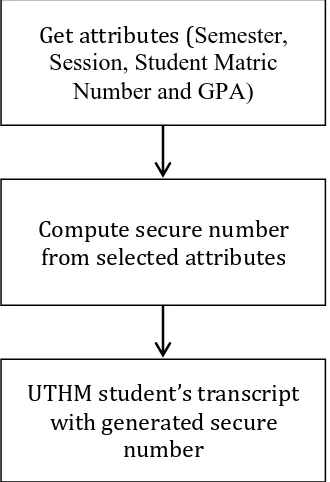
This section will discuss the process of generating secure number. Attributes that are required in generating a secure number are Semester, Session, Student Matric Number and GPA. Figure 3.1 gives an illustration of the process in generating a secure number.
20
Figure 3.1 Generating UTHM Student transcripts with secure number
3.3.1 Secure Number Design
The process of securing a number will use two approaches that have been described in the previous chapter. The approaches used are the check digit UPC Modulus 10 and ISBN Modulus 11. The combination of two check digit approaches produced a secure number, which is more efficient, named as TransV (the newly combined method). This combination of the two check digits will complement each other in overcoming each algorithm’s shortcomings. This will be discussed further in Chapter 5.
Get attributes (Semester, Session, Student Matric
Number and GPA)
Compute secure number from selected attributes
UTHM student’s transcript with generated secure
21
Figure 3.2 : The process of generating Secure Number using TransV
3.3.1.1Generating First Secure Number
The first secure number is produced using UPC Modulus 10 approach. The system will retrieve information such as Semester, Session, Student Matric Number and GPA data and apply the algorithm of UPC Modulus 10 for generating the first secure number. Here is the creation of the first secure number using UPC Modulus 10 algorithm.
Examples of generating first secure number using algorithm of UPC Modulus 10 Start
End
Get Semester, Session, Student Matric Number And GPA
Generate First Secure Number
Combining Secure Numbers
Generate UTHM Student’s Transcript Generate Second Secure
22
Figure 3.3 Secure numbers created using UPC Modulus 10.
Figure 3.3 illustrates how the system gets the attributes to generate a secure number using UPC Modulus 10 algorithm. The number 8 (eight) is generated and will use it as the first secure number.
The UPC system uses mod 10 method to generate check digit number. This system uses a weighting factor of 3 for the digits in the even positions i.e., even-positioned will be multiplied by three, while the odd-positioned digits will be multiplied by one. Counting the digit is from right to left.
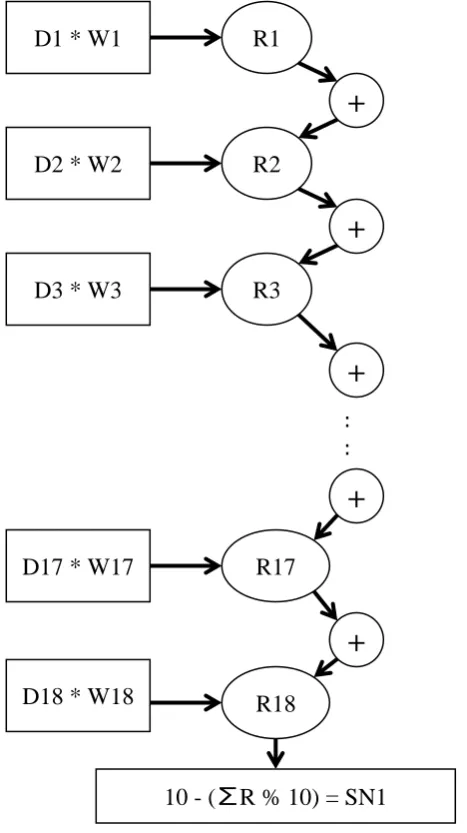
The first digit "D1" is multiplied by weights "W1", where the results is denoted as (D1 * W1) and produce immediate result "R1". The second digit "D2" is also multiplied with its weight "W2" and produce immediate result "R2". This process is continuing until the 18th digit "D18" and multiplied by its weight "W18" and produce immediate result "R18". As mentioned earlier, the odd-positioned digits will be multiplied by one and even-positioned will be multiplied by three. This means W1 is one, W2 is three, W3 is one, and W4 is three and so on. The intermediate results (R1, R2, R3, ..., R18) are summed up and modulo with 10 (ten), and then 10 (ten) is subtracted from the result. This would produce the first secure number. It is denoted as 10 - (∑R % 10) = SN1. Figure 3.4 below represents a diagrammatical representation of the method described above.
Session, Semester, GPA and Student Matric
Number
(120132014173120002)
8 UPC Modulus
23
Figure 3.4 Diagrammatical Representation of 1st Secure Number Generating.
D17 * W17 R17
+
D18 * W18 R18
10 - (∑R % 10) = SN1
+
D1 * W1 R1
+
D2 * W2 R2
+
D3 * W3 R3
+
24
[image:41.595.123.476.84.268.2]Below are the legends for the above diagram.
Figure 3.5 : Legend for Diagrammatical Representation of the first secure number.
3.3.1.1.1 Mathematical Terminology for the First Secure Number
Following mathematical formula denotes the first secure number algorithm using UPC Modulus 10 :
𝐼𝑚𝑚𝑒𝑑𝑖𝑎𝑡𝑒 𝑅𝑒𝑠𝑢𝑙𝑡
= (𝐷1 ∗ 𝑊1) + (𝐷2 ∗ 𝑊2) + (𝐷3 ∗ 𝑊3)
+ (𝐷4 ∗ 𝑊4) … . + (𝐷16 ∗ 𝑊16) + (𝐷17 ∗ 𝑊17) + (𝐷18 ∗ 𝑊18)
𝑆𝑒𝑐𝑢𝑟𝑒 𝑁𝑢𝑚𝑏𝑒𝑟 = 10 − (∑𝑅 % 10)
The above mathematical formula can be further deduced into the equation below to get the first secure number (SN1):
𝑅 = ∑𝑛=18𝑖=1 (D1 ∗ W1) (3.1)
𝑆𝑁1 = 10 − (𝑅 % 10) (3.2)
Legends:
D1-D18 : Series digit from information of UTHM Transcript Number
W1-W18 : Weight * : Multiplication
R1 - R18 : Immediate result + : Additional