Journal of Chemical and Pharmaceutical Research, 2016, 8(12):159-166
Research Article
CODEN(USA) : JCPRC5
ISSN : 0975-7384
159
Characterization of Cellulose Ether Films Containing Tween 20 and Tween
40
Lais C Machado
1, Diana M da Costa
1, Gustavo F Perotti
2, Ruan R Henriques
1and
Ricardo A de Couto
3, Jorge Amim Jr.
1and Ana L Shiguihara
1*1
Federal University of Rio de Janeiro-Campus Macaé, Macaé-RJ, Brazil 2
Federal University of Amazonas-Campus Itacoatiara-ICET, Itacoatiara-AM, Brazil 3University of São Paulo, Institute of Chemistry, São Paulo, Brazil
___________________________________________________________________________________
ABSTRACT
In the present study, cellulose ether films containing two kinds of sorbitan based surfactants, namely, polyoxyethylenesorbitan monolaurate (Tween 20) and polyoxyethylenesorbitan monopalmitate (Tween 40) were prepared by casting from aqueous solutions. Three cellulose ethers were used hydroxyethylcellulose (HEC), hydroxypropylcellulose (HPC), and carboxymethylcellulose (CMC). The obtained films were characterized by means of attenuated total reflectance-Fourier transform infrared spectroscopy (ATR-FTIR), optical properties,
thermogravimetric analysis (TGA) and differential scanning calorimetry (DSC). ATR-FTIR spectra of cellulose ether/tween films showed that OH band shifted towards higher wavenumber values when compared to pristidine cellulose ethers. The transparency of cellulose ether films was reduced after the addition of Tween 20 and 40. The thermal stability of CMC and HPC films increased in the presence of Tween 20 and 40. For HEC film, the thermal stability depends on the Tween used. DSC measurements indicated that Tween 20 and 40 act as plasticizers for CMC, HEC and HPC.
Keywords: CMC; HPC; HEC; Tween; Miscibility
___________________________________________________________________________________
INTRODUCTION
Non-ionic cellulose ethers such as hydroxyethylcellulose (HEC), hydroxypropylcellulose (HPC), and carboxymethylcellulose (CMC) are water-soluble derivatives of cellulose that have been widely used as food additive, coatings, pharmaceutical excipients, encapsulations, plastics, and food packaging [1-3]. Among the various additives incorporated in the polymer films, plasticizers are widely used to improve processability, flexibility, and durability [4]. In general, plasticizers are small, non- volatile molecules which promote a higher separation among polymer chains leading to lower glass transition and melting temperatures [4]. Moreover, their use can also bring health risks, especially when used in its composition, plasticizers such as di(2-ethylhexyl) phthalate (DEHP) [5-7].
Non- toxic surfactants based on sugar, such as sorbitan derivatives, like polyoxyethylenesorbitan monolaurate (Tween 20) and polyoxyethylenesorbitan monopalmitate (Tween 40) appear as an alternative to the replacement of DEHP and other plasticizers sparingly toxic and traditionally used such as polyethylene glycol (PEG), glycerin and propylene glycol [8].
160
For this present study, carboxymethylcellulose, CMC, (Mw=90,000 g.mol, DScm=0.9), hydroxypropylcellulose,
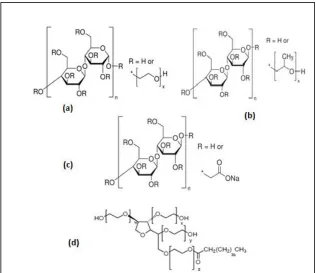
[image:2.596.141.457.186.459.2]HPC, ( Mw=80,000 g.mol ), 2-hydroxyethylcellulose (HEC) with viscosity average molar mass of 90,000, and the surfactants: polyoxyethylenesorbitan monolaurate (Tween 20) and polyoxyethylenesorbitan monopalmitate (Tween 40) were purchased from Sigma- Aldrich. Both polymers and surfactants were used as received. The chemical structures of polymers and surfactants are schematically represented in Figure 1.
Figure 1: Schematic representation of chemical structures of (a) 2-hydroxyethylcellulose (HEC), (b) hydroxypropylcellulose (HPC), (c) carboxymethylcellulose (CMC), and (d) surfactants: Tween 20 and Tween 40. These surfactants possess 12 and 16 carbons in
alkyl chain, respectively [9]. Where: x + y + z + w = 20.
METHOD
Sample preparation
Films of CMC, HPC and HEC with Tween 20 and 40 were obtained by casting method from aqueous solutions at 60ºC. The samples were dried until constant mass. The content of surfactants (as weight fraction, W) in the dried mixture with the polymers ranged from 0.1 to 0.30.
Attenuated Total Reflectance-Fourier Transform Infrared Spectroscopy (ATR-FTIR)
ATR-FTIR spectra of Tween 20 and 40, cellulose ethers and cellulose ether/Tween films were obtained using a Shimadzu IRAffinity-1 spectrometer equipped with a single-reflection attenuated total reflectance (ATR) accessory. A ZnSe crystal mounted in tungsten carbide was used. The analysis was carried out in the frequency range between 700-4000 cm-1.
Optical properties of the films
Transmittance spectra of cellulose ethers and their films with the surfactants (Tween 20 and 40) were obtained on quartz substrate using UV-Visible spectrophotometer (Shimadzu, UV2600).
Thermogravimetric Analysis (TGA)
161
Differential Scanning Calorimetry (DSC)
Differential Scanning Calorimetry (DSC) curves were obtained in a TA-DSC Q10V9.0 equipment. Closed Al crucibles loaded with 3 mg of each sample under a dynamic N2 atmosphere (50 mL/min) were heated and cooled down at rates of 10°C/min, in the temperature range from -80°C to 200°C. Empty pans were used as reference. The second heating was considered for the determination of the glass transition temperature (Tg), melting temperature (Tm) and ΔfusH of the samples. The DSC cell was calibrated with In (Tm = 157°C; fus
= 28.54 J g-1) and Zn (Tm = 420°C). One should notice that typically the standard deviation determined for triplicates was 1OC.
RESULTS AND DISCUSSION
Attenuated Total Reflectance-Fourier Transform Infrared Spectroscopy
162
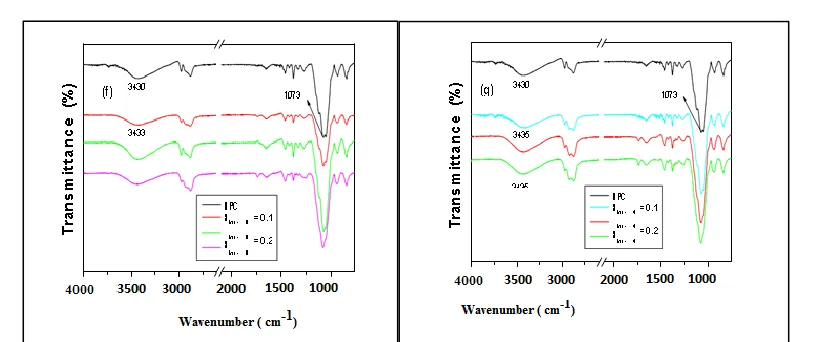
Figure 2: ATR-FTIR spectra of (a) Tween 20 and 40, (b-g) cellulose ethers and cellulose ether/Tween films as a function of surfactant content (Tween 20 (b,d and f) or Tween 40 (c,e and g) ).
The ATR-FTIR spectra for pure Tween 20 and 40 (Figure 2a) showed characteristic bands. The strong broad band in the range of 3200-3700 cm-1was assigned to OH stretching. Bands at 2915, 2862, 1728, and 1090 cm-1 were assigned as CH3 stretching, CH2 stretching, C=O, and C-O-C stretching, respectively [10, 11]. ATR-FTIR
spectrum of CMC (Figure 2 b and c) exhibited bands at 3340, 1586, 1056 cm-1that can be attributed to the stretching of the hydroxyl group (OH), COO-group, and C-O-C stretching, respectively [12,13]. From Figure 2 d and e, ATR-FTIR spectrum of HEC showed bands at 3388, 2923, and 1053 cm-1 that are assigned to OH stretching, CH stretching, and stretching vibration of C-O group [14]. In the case of HPC, ATR-FTIR spectrum (Figure 2 f and g) presented typical bands at 3430 and 1073 cm-1that are attributed to the stretching of the OH and C-O-C groups [15].
The ATR-FTIR spectra of cellulose ether films containing various surfactant proportions are depicted in Figure 2 b-g. As can be observed in Figure 2 b-g, for all the composition of cellulose ether/Tween studied, the OH band shifted to higher wavenumber when compared with the pure cellulose ethers, suggesting the formation of the inter and intra-molecular hydrogen bonding between surfactants (Tween 20 and 40) and cellulose ethers.
Optical properties of the films
163
Fig.3 Transmittance spectra of cellulose ethers and cellulose ether/Tween films as a function of surfactant content (Tween 20 or Tween 40).
Thermogravimetric Analysis (TGA)
[image:5.596.214.383.574.700.2]164
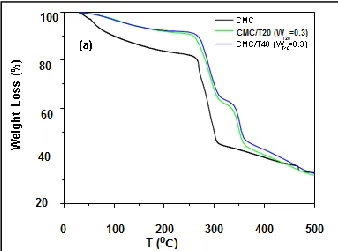
Figure 4: TG curves for pure cellulose ethers and cellulose ether/Tween films.
Table 1: Tonset values obtained from TGA for pristidine cellulose ether films and cellulose ether/Tween films (WTween = 0.3)
Cellulose Ethers
Tonset (°C)
Pritidine Cellulose Ether Cellulose Ether/ Tween 20 Cellulose Ether/ Tween 40
CMC 262 264 269
HEC 300 280 304
HPC 318 352 352
Differential Scanning Calorimetry (DSC)
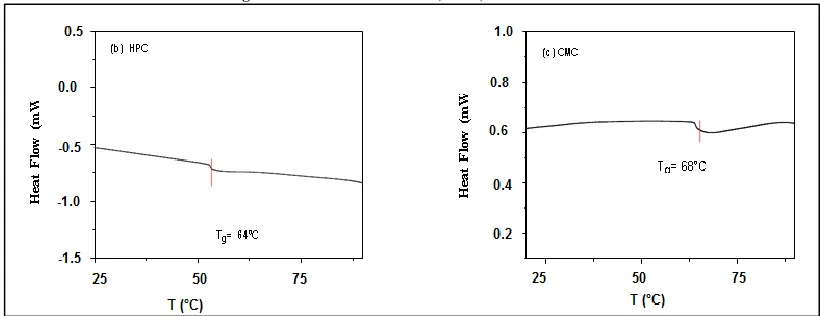
To properly understand the miscibility between cellulose esters and the Tween 20 and 40, DSC measurements were performed for pristine polymers and for the formed films. DSC curves
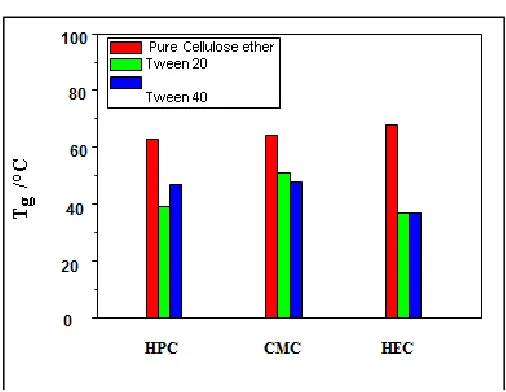
Recorded for pristine cellulose ethers are shown in Figure 5. The Tg values for HEC, HPC and CMC were determined as 63ºC, 64ºC and 68ºC, respectively. Tween 20 and Tween 40 possess Tg at -61oC [17].
Figure 5: DSC curves for HEC, HPC, and CMC films
[image:6.596.93.503.457.615.2]165
Figure 6: Tg values for pure cellulose ethers and cellulose ether/Tween films obtained with WTween = 0.3.
Figure 6 shows that Tg values of pure cellulose esters decreased upon addition of Tween 20 and 40. This effect can be associated to an increase in polymer chain mobility and flexibility when the surfactants were incorporated in the free volume of polymer. Similar behavior was observed for mixtures of Tween 20, 40 and 60 with cellulose esters [17]. Furthermore, the effect of alkyl chain length of surfactants on the Tg values of HEC, HPC, and CMC can be analyzed through Figure 6. Tween 20 and 40 possess 12 and 16 carbon atoms in the alkyl chains, respectively [9]. Figure 6 shows that the surfactants alkyl chain length has practically no effect on the Tg values of CMC. However, for mixtures of HEC with Tween 20 and 40, Tg values enhanced with the increasing surfactant alkyl chain length. In the case of HPC, higher reduction of Tg value occurred in the presence of the surfactant of longest alkyl chain, Tween 40.
CONCLUSIONS
In this work, cast films of CMC, HEC, and HPC were obtained in the presence of two types of non-ionic surfactants, Tween 20 and 40. ATR-FTIR spectra of cellulose ether films showed that the hydrogen bonds of these polymers were altered upon addition of Tween 20 and 40. The experimental results suggest that these surfactants have significant influence on the thermal and optical properties of cellulose ether films. The DSC results demonstrated that Tween 20 and 40 can be used as plasticizers for CMC, HEC and HPC at WTween = 0.3.
ACKNOWLEDGEMENTS
The authors acknowledge FAPERJ for financial support and Lais C. Machado thanks FUNEMAC for scholarship.
REFERENCES
[1] D Hu; H Wang; L Wang. LWT - Food Sci. Technol., 2016, 65, 398-405.
[2] K Luo; J Yin; OV Khutoryanskaya; VV Khutoryanskiy. Macromol. Biosci., 2008, 8, 184–192.
[3] KS Reddy, MN Prabhakar, PK Babu, G Venkatesulu, USK Rao, KC Rao, MCS Subha. Int. J. Carbohydr. Chem., 2012, 2012,1-9.
[4] T Mekonnen; P Mussone; H Khalil; D Bressler.. J. Mater Chem. A, 2013, 1, 13379–13398. [5] U Heudorf; V Mersh-Sudermann; J Angerer; Int. J. Hyg. Environ Health, 2007, 210(5), 623- 634.
[6] ML Marin; J López; A Sánchez; J Vilaplana; A Jiménez. Bull Environ Cont Toxicol, 1998, 60(1), 68-73. [7] G Lattini; C De Felice; A Verrotti. Reprod Toxicol, 2004, 19, 27-33.
[8] AN Ghebremeskel; C Vemavarapu; M Lodaya; Int. J Pharm, 2007, 328(2), 119-128.
[9] M Graca; JHH Bongaerts; JR Stokes; S Granick; J Colloid Interface Sci, 2007, 315(2), 662- 670. [10] B Balakrishnan; NR James; A Jayakrishnan. Polym Int, 2005, 54; 1304-1309.
[11] Y Khan; SK Durrani; M. Siddique; M Mehmood. Mater Lett, 2011, 65, 2224–2227. [12] DR Biswall; RP Singh. Carbohyd Polym, 2004, 57, 379–387.
166
[15] G Şengül; S Demirci; T Caykara; J Appl Polym Sci, 2009, 114, 2751-2754.
[16] KL Yam; DS Lee. Emerging Food Packaging Technologies, Principles and Practice, 1st edition,
WoodHead Publishing, Cambridge, 2012, 303-319.