THE EFFECT OF AMORPHOUS RICE HUSK SILICA TO THE
POLYSULFONE MEMBRANE SEPARATION PROCESS
Zawati Harun
1,2,a, Mohd Riduan Jamalludin
3,b, Muhamad Zaini Yunos
4,cMuhamad Fikri Shohur
4,d, Ahmad Fauzi Ismail
5,e1,3,4
Department of Materials and Design Engineering, Faculty of Mechanical and Manufacturing Engineering, Universiti Tun Hussein Onn Malaysia, 86400 Parit Raja, Johor, Malaysia
2
Advanced Materials and Manufacturing Centre (AMMC), Faculty of Mechanical and Manufacturing Engineering, Universiti Tun Hussein Onn Malaysia, 86400 Parit Raja, Batu
Pahat, Johor Darul Takzim, Malaysia.
5Advanced Membrane Technology Research Centre (AMTEC), Universiti Teknologi Malaysia, Skudai, 81310 Johor Bahru, Johor, Malaysia
a [email protected], b [email protected] , c [email protected], d [email protected], e [email protected]
Keywords: polysulfone (Psf), Polyethelene glycol (PEG), Rice husk silica
Abstract.
This study investigates the effect of additive rice husk silica and Polyethylene glycol (PEG) on the performance of polysulfone (PSf) membrane. The membrane was prepared by phase inversion method using PSf, N-methyl-2-pyrrolidone (NMP) and rice husk silica was added as an additive. The performance of the membrane was analyzed by using distilled water for permeation test and humic acid for rejection test. The result showed that the hydrophilic of PSf/PEG membrane has significantly improved permeation and rejection with addition of rice husk silica. The results showed that the addition of 3% rice husk silica give highest rejection flux at 196.63 L/m²hr with the rejection value 98%.
Introduction
as pore size, pore distribution, physical properties and mechanical characteristic. These changes will improve the antifouling mechanism of the membrane that important to increase the performance, productivity and decrease the costs for water treatment process.
In this work, the incorporation of potential organic fibers from natural sources (non-hazardous element) i.e. rice husk was considered as contain high silica compound. Besides that it also has biodegradable properties and offers green technology. As documented in many papers [9, 10, 11, 12], additive of silica able to suppress the formation of amphiphilic component, macrovoids, enhance pore formation and improve pore interconnectivity and hydrophilicity for the membrane.
Membrane preparation
Polysulfone (PSf) membranes were prepared by using the phase inversion process via casting method. Casting solution were prepared by dissolving Polysulfone (PSf) in N-methyl-2-pyrrolidone (NMP) and stirred for 4 h. Then, PEG and rice husk silica additive at differences concentration (0%, 0.5%, 1.0%, 1.5%, and 2%) was subsequently added with continuous stirring and heating at 60°C until the solution was completely dissolved and homogeneous. Meanwhile, rice husk silicaadditive was prepared by burning the rice husk in the furnace at temperature range up to 600˚C and maintain for 1 h. Subsequently, the casting solution is poured into bottle and ultrasonicated for 1 h to release the bubbles. After the bubbles completely released, the solution were cast by using flat sheet membrane casting system, and then immersed in a coagulation bath of distilled water. Finally, the flat sheet membranes were dried for 24 h.
Membrane performance
The filtration experiment was conducted by using the water permeability testing unit [13]. This experiment were measured the volume of water flow rate that can penetrate the membrane layer at the time period specified. Tested membranes were prepared with diameter size 5.5cm. The permeation test was carried out by using distilled water and for rejection was carried out by using humic acid. Each membrane samples were fixed with pressure up to 2 bars.
Pure water flux calculation
The permeation fluxes of the membrane were measured by an Ultrafiltration cross flow filtration experimental setup feed with distilled water at a transmembrane pressure of 2 bars. The membrane performance of permeation water flux (PWF) for the PSf/PEG/silica membrane was calculated from the equation (Eq. 1) below [12]:
(1)
Where PWF is the pure water flux
Lm-2h-1
, Q is the permeate volume (L), A is the membrane area (m2), and Δt is the time (h). The feed and permeate solution will be tested using UV rejection test. The equation solute separation of the membrane is following below (Eq. 2):. 100%
C C -1
f p
(2)
Results and Discussion
a. Water Permeability Test
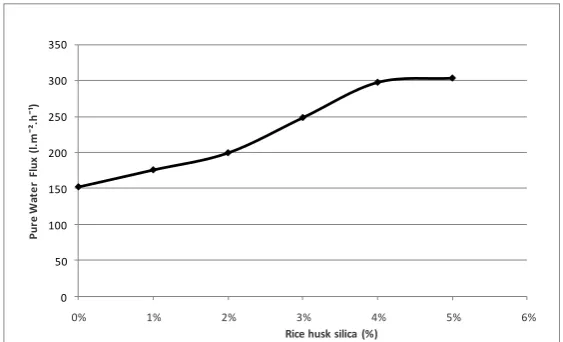
Figure 1 shows the performance and capability of membrane to resist their permeability by water permeation flux testing unit. As shown in graph below, the flux has significantly improved by addition of rice husk silica with weight percentage in range of 1% until 5%. From the plot 1, the flux of pure water is increased up to 303.03 L/m2h. This condition might be due to addition of rice husk silica can enhance the hydrophilic properties of the membrane surface [9] and tends to create larger pore formation at drain out layer system [14]. Thus, this will assist the permeation mechanism especially in the fouling stage.
Figure 1: The pure water flux permeation rice husk silica
[image:3.595.144.426.250.421.2]b. Humic acid rejection
Figure 2 shows the rejection graph of humic acid concentration. From the plot, the rejection is increased with addition the rice husk silica from 1% until 3% and slightly reduced when approach to 4% rice husk silica. Based on the rejection plot, it is noticed that the addition of 3% rice husk silica give the highest rejection with 98%. Thus, 3% membrane can be considered as an optimum membrane. As reported by others researcher that the addition of silica can reduce the pore size formation at the separation layer and this caused the better rejection mechanism [14].
[image:3.595.143.430.586.757.2]
Figure 2: Rejection of rice husk silica 0
50 100 150 200 250 300 350
0% 1% 2% 3% 4% 5% 6%
P
ur
e
W
at
e
r
F
lux
(l
.m
¯²
.h¯¹
)
c. Flux rate rejection
Figure 3 shows that the flux rate rejection of humic acid for results five different concentration of silica percentage. Based on the flux rate rejection plot, it was observed that the flux increased with addition of the rice husk silica from 1% until 3%. However, the plot slightly decreased with the addition of 4% rice husk silica and above. According to the plot, the highest flux rates rejection is achieved at the addition of 3% rice husk silica with permeation value at 196.63 L/m²hr. It was noticed that, the addition of silica with hydrophilic propertise also can prevent fouling mechanism in membrane filtration and this was agree with the previous study [3].
Figure 3: Flux rate rejection of rice husk silica
Conclusion
In this work, flat sheet membrane was prepared from casting solutions containing 18% of PSf and 82% of N-methyl-2-pyrrolidone (NMP), by using diffusion induced phase separation process with addition of different additive. The addition of different weight percentage (0%, 1%, 2 %, 3%, and 4%, 5%) of rice husk silica in casting solution improved the performance of membrane in term pure water permeation rate and rejection. The result of experiment demonstrated that with addition of 1% to 3% increase the flow rate and rejection but slightly reduced as rice husk increase from 4% to 5%. As a conclusion, the experimental results show that the addition of amorphous rice husk increased the permeation and rejection (with the highest was given by 3%) of PSf membrane by increasing the hydrophilic properties antifouling process.
References
[1] Haijun Yua,b, Yiming Caoa, Guodong Kanga, Jianhui Liua, Meng Li , Quan Yuana, Journal of Membrane Science 342 (2009), p. 6–13.
[2] Yan, L., Y. Li, C. Xiang, and S. Xianda, Journal of Membrane Science, 276(1-2) (2006), p. 162-167.
[3] Mansourizadeh, Ismail A.F., Journal of Membrane Science, 348 (2010), p. 260–267.
[4] B.Torrestinana-Sancheza, RI. Ortiz-Basurtoa, E. Brito-De La Fuente, Journal of Membrane Science, 146 (1998), p.179-184.
[5] Basri H., Ismail A.F., Aziz, M., Desalination, 273(1) (2010), p.72-80
[7] Idris, A., Mat Zain, N., and Noordin, M.Y., Desalination, 207 (2011), p. 324-339. [8] Yoo, S.H., et al., Journal of Membrane Science. 236(1-2) (2004), p. 203-207 [9] Suryani and Y.-L. Liu, Journal of Membrane Science, 332(1-2) (2009).p. 121-128. [10] He, Z., Pinnau, I., and Morisato, A., Desalination,146(1-3) (2002), p. 11-15.
[11] Arthanareeswaran, G., D. Mohan, and M. Raajenthiren, Applied Surface Science, 253(21) (2007), p. 8705-8712.
[12] Vatanpour, V., S.S. Madaeni, R. Moradian, S. Zinadini, and B. Astinchap, Journal of Membrane Science, 375(1-2) (2011), p. 284-294.
[13] Yunos, M. Z., Harun Z, Basri, H., Ismail A. F., Advance Material Research, 488-489 (2012), p. 46–50.