Information technology as boundary
object for transformational learning
Forgues, D, Koskela, LJ and Lejeune, A
Title
Information technology as boundary object for transformational learning
Authors
Forgues, D, Koskela, LJ and Lejeune, A
Type
Article
URL
This version is available at: http://usir.salford.ac.uk/9357/
Published Date
2009
USIR is a digital collection of the research output of the University of Salford. Where copyright
permits, full text material held in the repository is made freely available online and can be read,
downloaded and copied for noncommercial private study or research purposes. Please check the
manuscript for any further copyright restrictions.
www.itcon.org - Journal of Information Technology in Construction - ISSN 1874-4753
INFORMATION TECHNOLOGY AS BOUNDARY OBJECT FOR
TRANSFORMATIONAL LEARNING
PUBLISHED: March 2009 at http://www.itcon.org/2009/06 EDITORS: K. Ruikar & S. Emmitt
Daniel Forgues, Professor
Department of Construction Engineering, École de Technologie Supérieure Montreal, Canada
Lauri Koskela, Professor
School of the Built Environment, University of Salford, UK [email protected]
Albert Lejeune, Professor
Department of management & technology, Université du Québec à Montréal Montreal, Canada
SUMMARY: Collaborative work is considered as a way to improve productivity and value generation in construction. However, recent research demonstrates that socio-cognitive factors related to fragmentation of specialized knowledge may hinder team performance. New methods based on theories of practice are emerging in Computer Supported Collaborative Work and organisational learning to break these knowledge boundaries, facilitating knowledge sharing and the generation of new knowledge through transformational learning. According to these theories, objects used in professional practice play a key role in mediating interactions. Rules and methods related to these practices are also embedded in these objects. Therefore changing collaborative patterns demand reconfiguring objects that are at the boundary between specialized practices, namely boundary objects. This research is unique in presenting an IT strategy in which technology is used as a boundary object to facilitate transformational learning in collaborative design work.
KEYWORDS: information technology, integrated design, boundary objects, innovation, social learning
COPYRIGHT: © 2009 The authors. This is an open access article distributed under the terms of the Creative Commons Attribution 3.0 unported (http://creativecommons.org/licenses/by/3.0/), which
permits unrestricted use, distribution, and reproduction in any medium, provided the original work is properly cited.
1.
INTRODUCTION
Problems related to the industry fragmentation are well documented. Dupagne (1991) identifies among those the lack of iterations in the design process, the lack of consideration of constraints within subsequent phases or the unnecessary constraints set in design for these phases; and the lack of leadership and accountability, leading to suboptimal solutions, poor constructability and operability, rework in design and construction and lack of innovation . A proposed solution is encouraging collaborative work through integrated practices (Eastman et al., 2008), integrated teams (Egan, 1998) or integrated design process (Larsson, 2002, Löhnert et al., 2002).
collaborative work is therefore a matter of evolving existing practices (Blackler et al., 1999, Engeström, 2004) and of creating new objects to facilitate boundary-crossing between specialized knowledge (Carlisle, 2004, Star and Griesemer, 1989). While there is a growing interest in other industries to adopt methods related to theories of practice such as situated action and activity theory for computer supported collaborative work, little research has been realized in this field in construction. It is limited to ethnographic research focused on recording intensity or flow of interactions around one or more specific objects used to coordinate the design of the building (Tory et al., 2008, Koskinen, 2009).
This paper proposes to analyse the role of information technology (IT) in collaborative work from the perspective of a tool to enable evolution of practices to higher level of maturity for collaborative work. It focuses on the project definition process, during which the most important design decisions are made. It is argued that IT could be used as boundary objects first to facilitate knowledge sharing between practices to facilitate collaborative work, second to break the epistemic barriers that hinder the successful transition of practices from fragmented to integrated design.
2.
IT INITIATIVES TO TRANSFORM CONSTRUCTION PRACTICES
Technology can be used in two ways: as a boundary object that help break knowledge barriers between practices and facilitate mutual learning in a polycontextual environment (Carlisle, 2002); or to trigger transformational learning for the creation of new practice knowledge (Engeström, 2004).
2.1
IT artefacts to cross boundaries
The concept of boundary objects to bridge knowledge gaps between practices stems from the empirical work of situated action theorists (Lave and Wenger, 1991, Suchman, 1987). They have demonstrated that it is the situation that drives people’s learning and behaviour, rather than goals. Learning is situated within an arena – a community. Organisations are defined as sets of communities of practice. Boundary objects are tools to facilitate exchanges between these communities.
Carlisle (2002) identifies three levels of boundary-crossing: first an information processing level, which is about knowledge and things to store and retrieve; second an interpretive level, which focuses on common learning; and third, at the upper level, a pragmatic (political) level, which is concerned with how different interests impede knowledge sharing. Innovation requires incrementally breaking boundaries at these three levels, starting by the achievement of a syntactic level in which a common language is agreed upon for knowledge sharing; then at a semantic level, by the development of common meanings through mutual learning; and lastly by reaching a pragmatic level in which a convergence of interests among actors in settings where innovations across different specialties is the required outcome.
IT initiatives can be devised as boundary objects at the syntactic and the semantic levels: repositories (i.e. cost databases, CAD/CAM databases, parts libraries) supply a common reference point of data, measures, or labels across functions that provide shared definitions and values for solving problems; standardised forms and methods provide a shared format for solving problems across different functional settings; objects or models (i.e. sketches, assembly drawings, parts, prototype assemblies, mock-ups, and computer simulations) are simple or complex representations that can be observed and then used across different functional settings; maps of boundaries (i.e. Gantt charts, process maps, workflow matrices, and computer simulations) represent the dependencies and boundaries that exist between different groups or functions at a more systemic level. IT for interoperability such as BIM could be considered as boundary objects that aim to address the barriers at the semantic and syntactic level in a distributed environment.
2.2
IT artefacts to support transformational learning
Activity theory differs from situated action in three ways: first in recognizing the essential roles of things – tools or artefacts – in the creation of knowledge, second in the role of the researcher to intervene in the context of a situation in order to induce what Engeström (2001) qualifies as transformational learning, a incremental or radical transformation of existing practices ; third by recognizing the asymmetry of agency between people and things (mediating artefacts or boundary objects).
Activity theory adopts a systemic view of client and supply chain organisations as complex interactions of sets of communities of practice that strive to achieve a common outcome. An integrated design team is from this view a sophisticated activity system, i.e. an object-oriented, collective, and culturally mediated activity (Engeström, 1987). The team is characterized by a community of multiple points of view, traditions and interests representative of their organisational culture or practices. The participants carry their own diverse histories and the activity of design itself carries multiple layers and strands of history engraved in its artefacts, rules, and conventions. Tensions and conflicts will arise when these different views collide.
Transformational learning, i.e. the evolution of an activity system to a higher maturity in their organisation of work, will occur if the team succeeds to resolve their conflicts and contradictions and achieves a shared mental model. The cycle of transformational learning is represented by an ascending spiral. First, tensions increase within or between activity systems. Second, there is recognition of problems that are growing with established practices or activities. Third, there is a period of conversations, sense making and improvisation in which models emerge leading to the creation of new knowledge of practice or revised patterns of practices and activities. Fourth tensions arise within the new patterns triggering a new cycle upward (Blackler et al., 2000).
Contradictions are the sources of change and development in practices. Contradictions historically accumulate structural tensions. As the contradictions of an activity system are aggravated, some individual participants begin to ask questions and to deviate from its established norms. External interventions may be necessary to break barriers that impede the successful resolution of these contradictions. These interventions are realized by introducing new mediating artifacts or boundary objects.
Engeström (2001) suggests strategies to induce transformational learning that are leveraged by technology
Incremental exploration is construction of new knowledge by experimentation within the given activity. This type of learning could be related to the implementation of complex configurational technologies, such as Building Information Modeling. “Each configuration demands substantial user input and effort to get the overall system to work, i.e., a process of ‘learning by trying’: improvements and modifications have to be made to the constituent components before the configuration can work as an integrated entity” (Fleck, 1994). Radical exploration, or expansive learning, begins when experimentation is no longer aimed solely at making a well-bounded new technology work in the framework of a given, pre-existing activity. “Radical exploration is learning what is not yet there. It is creation of new knowledge and new practices for a newly emerging activity, that is, learning embedded in and constitutive of qualitative transformation of the entire activity system” (Engeström, 2004).
It is proposed to derive principles from situated action and activity theory to analyse the role that technology can play as boundary objects to facilitate collaborative work.
3.
RESEARCH STRATEGY AND METHODS
The research adopts a socio-constructivist perspective (Vygotsky, 1978) which considers learning not as an individual but a social process that occurs within group activities. It follows Engeström (1987) principles of activity theory which looks at this process within an activity system, which constitutes the unit of analysis, and the developmental work methodology, in which the researcher plays a participative role of in intervening on the phenomenon with the aim of resolving conflicts and contradictions that hinder team performance. The intervention consists of introducing new boundary objects, - events or technologies - to trigger transformational learning through incremental or radical exploration.
opportunities during data collection. A strong sampling can be obtained by maximising similarities in one dimension and maximising difference in another dimension (Eisenhardt, 1989). All the cases selected share a high level of intensity and homogeneity because they represent successful and unsuccessful attempts to change practices. Maximum variation was achieved using examples in two countries (UK and Canada) and in two industries (aerospace and construction) with a strong contrast in their maturity in using integrated teams. These cases are used as comparative cases to better articulate the concept or to stimulate the development of boundary objects.
Case 1 is a demonstration project in sustainable construction undertaken by a coalition of non-profit organisations devoted to sustainability development. It is a longitudinal case in which a project team was committed to follow an integrated design process. New technology as boundary objects were introduced on two occasions, computer-assisted collaborative tools, at the outset of the definition process, and a requirement management process and tool during the stage of preliminary design. Case 1 included experimentation with technology as boundary objects in a laboratory for collaborative work. IT research on technology to support collaborative work can be divided in three strands:
• design tools that can exchange data through protocols such as Industry Foundation Classes (IFC); • 4D visualisation space such as the Computer-Assisted Virtual Environment (CAVE) (McKinney
and Fischer 1998) and the Virtual Reality–Experimental Virtual Environment (VR – EVE) (Kam et al. 2003) to facilitate resolution of space-time conflicts.
• laboratories for collaborative work (design labs) such as iLand (Streitz et al. 1999) and the iRoom of the University of Stanford (Liston et al. 2001; Schreyer et al. 2005).
The laboratory belongs to the third category. It offers tools such as intelligent boards, 3D screen, and WiFi collaboration software for the sharing and viewing of documents.
Case 2 is a complex aerospace programme acclaimed by the defence industry for its innovative approach and exceptional performance in planning, delivering, and managing the lifecycle of a multi-purpose helicopter designed to fulfil many roles, from naval anti-submarine warfare to on-shore transport. The core to this approach was the introduction of an integrated requirement and project management platform around which processes and practices were reconfigured. As asserted by Hobday (1998), the construction and military aerospace industries share the same characteristic of developing complex products.
Case 3 represents a new procurement route, Procure-21, established by the British Department of Health to improve their performance in delivering better buildings. It is recognized by the National Audit Office as one of the most representative of UK initiatives in transforming existing procurement practices in construction. Procure 21 could be described as a re-contextualization of contract as a new boundary object that breaks traditional power structure, based on a lean approach to value generation. The aim of the project was to transform the way patients with mental illness could be treated and integrated back into society. To realize this, a low security two-storey mental health rehabilitation unit accommodating 18 patients was to be built.
A client perspective was adopted for the research, focusing on the dynamics of the integrated team. Grounded research approach was adopted to facilitate the identification and analysis of patterns during the inquiry Strauss and Corbin (1998) suggest connecting causal conditions, the phenomenon, the context, the intervening conditions, the actions and interactions, and the consequences as a process structure to analyse patterns. Data were collected through review of documents (programme framework, project files, and organisations web sites), focus groups or semi-structured interviews. Focus groups and questionnaires were also utilized in the longitudinal case to validate findings with the project team.
were held in the researcher’s laboratory for collaborative work. All data was managed in Nvivo 7 database, a software for qualitative analysis.
4.
TECHNOLOGY AS BOUNDARY OBJECT FOR TRANSFORMATIONAL
LEARNING
The impact of technology as boundary objects to facilitate the transition from fragmented to integrated design is analysed at two levels: first as tools to facilitate incremental changes in design practices; second as frameworks that command a radical transformation of these practices. Case 2 provided insights on how a technology could be used as a boundary object to trigger incremental exploration, whereas in case 3 the aim was to provoke radical exploration. Case 1 offered both an observation setting to analyse interactions through objects of practices and an experimental setting to investigate the impact of the introduction of new boundary objects first to facilitate collaboration second to break barriers hindering the development of a shared mental model. This section presents the findings.
4.1
Boundary objects for incremental exploration
It is expected in the context of incremental exploration that participants, by adopting technology in their design process, will discover opportunities to improve exchanges of information between specialized practices. In Case 1 the design team was placed in the context of a design laboratory in which they were provided access to computer assisted collaborative tools. In case 2, technology was central as a boundary object to integrate the network of interactions between the client and the supply chain.
4.1.1 Case 1
The longitudinal case was conducted during a period of two years, the duration for the project definition phase (planning, concept and preliminary design). One of the client objectives was to stimulate the development of better practices for the design of sustainable construction. Part of the design team contract was to conduct a series of integrated design workshops in which computer-assisted collaborative tools were going to be tested to facilitate collaboration and innovation. Design team, client representatives, and subject matter experts in energy efficiency or specific building technologies participated in the workshop. The design team included architects, engineers and a general contractor hired as an adviser. An executive and two employees specialized in sustainable development represented the client. The client also hired a consultant that acted as an adviser for defining the integrated design roadmap and establishing sustainability criteria.
Computer assisted collaborative tools were introduced as boundary objects to facilitate the development of a shared lexicon among the various specialists, and between users and experts. However, experts of different disciplines adopted two typical behaviors that hinder the proper use of these objects for knowledge sharing: “Groupthink”, a mode of thinking that people engage in when they are deeply involved in a cohesive in-group - “groupthink” typically leading to an overestimation of the in-group, closed-mindedness and stereotypes of out-groups (Janis, 1982); and paradoxically, “compartmentalization”, a fragmentation of viewpoints and lack of shared mental models (Mathieu et al., 2000). Such fragmentation may make it impossible for experts from different contexts to “speak the same language” and exchange ideas about a problem (Engeström, 2000). The design team (architects, engineers and builder representatives) formed an in-group, restricting interventions from the out-group (the client, its staff, and other experts on the design process). The in-group replicated the vertical hierarchy of the traditional design decision-making process– the engineers or builders intervening only in their area of expertise, and not challenging the decision made by the architect. The architect kept the upper hand in the use collaborative tools, maintaining a tight control on the type and format of information to be presented to the rest of the team. As asserted by the client executive, the interactions for decision-making were polarized between the architect and the client executive, the former requesting validation of design solutions to the latter, with little regard for the opinion of users or other experts.
“The architect was coming to the workshops with predefined design concept. My understanding is the way they usually work, but I have a problem with that, because we (the client) were not able to build ownership of the concept.”
performance in meeting criteria for sustainable construction. The design tools proved to be quite inefficient for developing a conversation between the client and users. The traditional briefing process was ill-adapted to capturing the stakeholders’ values in sustainable development. The users could not make sense of the relationships between their business needs or aspirations and the descriptions presented in the functional brief. The client stakeholders and executive also could not make sense of the 3D representations used by the architect during the workshops to present his concept:
“The building plans and 3D drawings were presented simultaneously. We could not watch and make sense of both in the same time. We would have required much more time with the 3D. However, without the depiction of texture, it does not tell me anything. I cannot figure out the volumea.”
The collaborative and visualisation tools, instead of facilitating exchange of information, reinforced patterns of interactions found in a traditional design process.
4.1.2 Case 2
Problems observed in case 1 are typical of project coalitions of representatives from various organizations with different cultures and organization of work that are brought in together for the first time and are assigned to the project on a temporary basis.. Coalitions suffer from the lack of self-regulation of typical collaborations. Because they are coming from different organizations or practices, participants duplicate each other’s efforts, and many problems often fail to be resolved either quickly or to anyone’s satisfaction (Zager, 2002). Zager suggests the introduction of a technology that will play the role a pseudo-collective object around which the coalition can build common knowledge through incremental exploration. Case 2 is an example of a pseudo-collective object – an integrated requirement and project management platform - that was used for resolving contradictions within a coalition.
The case study was part of a research that looked at the feasibility to integrate best practices and tools from the aerospace industry to solve requirement and project management problems in the delivery of a large construction programme (Begin and Forgues, 2003). The problem that was addressed in this case was the difficulty to align military requirements with industry capacity to deliver a complex weapon and rescue artefact within a sequential lowest bid procurement process. Military requirements are well known to be over designed, generating higher costs and delays. Military specifications increases costs by 42% to 49% compared to a commercial component with similar configuration and performance (Fowler, 1994). RAND Corporation (Lorell et al., 1999), in research conducted for the US Navy, also relates cost and schedule overruns to problems with over-specifications.The answer was to reconfigure the interactions within the client organisation and with the supply chain by introducing an integrated requirement and project management platform as a pseudo-collective object.
This platform presented characteristics that address the syntactic, semantic and pragmatic dimensions for boundary-crossing. First, it gave as a repository a complete story of the evolution of the requirements. It also links the requirements to sets of configurations representing stakeholders’ agreements on the characteristics of the expected outcomes at different levels of granularity. Second, as posited by the programme manager, the software provided a virtual arena for exchanging, mediating and routinizing knowledge generated through the process of defining and developing the helicopter artefact:
“As an example of the process set out to review documents, a list of internal and external reviewers is pre-established within a responsibility matrix, and reviewers enter their comments into DOORS using pre-arranged columns; the Team Leader consolidates as needed and through a chain of command finds his way to the Change Control Board for endorsement and furtherance to the contractor”
Third, the story is mapped, showing through traceability the hierarchical relationships between the different layers of requirements from the configuration items to the systems, components, and elements of the product. The platform created bridges across the horizontal boundary between the client and supplier, and the vertical boundaries between actors at each level of the client organisation. A rare achievement in defence projects, the bid came much lower than the initial budget.
4.2
Boundary objects for radical exploration
The core issue is how to address pragmatic barriers that hinder integrated teams’ performance in construction. Case 3 provides some insights on how boundary objects could be used specifically to break pragmatic barriers. It provided insights for intervening on case 1 to break the pragmatic barriers identified in the early stages of the design and facilitate knowledge sharing.
4.2.1 Case 3
Influential British reports on construction (Egan, 1998, Latham, 1994) suggested that one of the causes of the construction industry poor performance was the adversarial climate created by transactional contracts. Procure- 21 is itself a boundary object that provoke a radical exploration of new forms of collaborative work, by recontextualizing the construction contract. Koskela et al. (2006) contend that the incapacity of the industry to move from sequential to integrated design resides in the adversarial business context created by transactional contracting methods. In a transaction, the seller is bounded to deliver to the buyer a specified outcome for an agreed price. Risk and responsibility of results are on the shoulder of the seller, who has no incentive for collaboration with other contract parties in defining the solution that will best meet expected results. Relational contracting is based on recognition of and striving for mutual benefits between the parties. This type of contract is usually long-term, develops and changes over time, and involves substantial relations between the parties.
Procure -21 is a relational procurement framework that redefines the rules and division of work, introducing new roles, the project director and the design champion, to lead the design process. Agency is central to activity theory. Things such as boundary objects do not have agency. It is the subject of the activity system, in this case the project director, who orchestrates interactions between the multiple communities of practice involved in the project (doctors, nurses, patients, planners, managers, operators, members of the supply chain) by his selective use of various types of boundary objects. As asserted by the project director:
“Two of the most important aspects (to be a project director) are firstly having good technical competence… Second, and almost as equally important is the chemistry you create, the team that you build, and the chemistry, where it’s a, um… a can-do culture, to create a can-do culture rather than having forever arguments and… a can-do culture isn’t a soft option. It isn’t abdication of responsibility. It is how people interact, how you get disparate people developing a common purpose, a common agenda, and how you drive that agenda and gain ownership from the people so that they feel that they’re part of the process, and they’re not being instructed, but they are being enabled… that enabling… a good project director should be a facilitator, should be a band leader, a conductor, so he knows when to bring in the string instruments, he knows when to bring in the drums and so on, and know how the balance the thing, that’s the essence… whether it is the P-21 process or whatever, but the P-21, because it has all these other instruments, it forms a better basis of enabling the conductor to organize the orchestra”
The Procure-21 procurement framework provides the project director with authority and tools to break the pragmatic barriers, first for destabilizing traditional design practices by shifting the structure of power and influence from the architect to the user representative and the project manager, second for eliminating vertical barriers in decision-making within the client organisation by empowering the project director in a role of governance of the project. Part of the framework are boundary objects (events or technology), that are selectively introduced to build shared ownership, to facilitate knowledge sharing. Technology in the form of knowledge portals is used to capture, mediate and disseminate knowledge and practice generated in the process.
4.2.2 Case 1
Lessons learned from case 2 and 3 provided insights regarding the resolution of problems observed in the longitudinal case. First, there was a lack of shared ownership, mainly caused by the resistance from the design professionals to share knowledge and to change their practices to allow active participation of the rest of the group in the design process. Second, there was an unresolved fragmentation of views regarding the project expected outcome. Third, as asserted by the project architect, technology proved to be sometimes more a nuisance than a benefit to collaborative work:
“Technologies that we saw, as an example, everyone was reading their mail on their laptop. It is normal that the workshop was lasting four hours, people were not listening. The executive sponsor was coming back at the end and said “we haven’ talked about that,” Maybe you were not listening…”
The proposed solution to address these problems was to derive from case 3 a gating approach combined with the introduction of a requirement management technology derived from case 2 to manage sustainability requirement in the preliminary design process. Engeström (2004) suggests introducing a technology that is alien to the domain for stimulating radical exploration. Systematic management of requirements, a common practice in the aerospace industry, is unusual in construction, especially when it is client-driven. In the traditional design process, the architect drives the process of defining requirements and translating them into a design solution. Clients, users and builders do not have much say in the choice of design solutions. Client-driven management of requirements breaks this paradigm. The power of decision over the quality of the design is shifted to the client and users, breaking the traditional hegemony of the design professionals over the design process. At each step the professionals have to justify how design propositions fit with client requirements and to accept an active participation of the builder in the design process.
Gating was used as a formal, phased, auditing approach in which each project’s intermediate deliverables have to meet specific criteria for the team to be authorized to proceed from one gate to the next. It first, as a boundary object, shifted the structure of power and influence, providing to the sustainability adviser some authority on the integrated design process. Second, it gave an opportunity to build a common lexicon in the mediation process to agree on the requirements and criteria for measuring team performance; third it provided a means to define a common purpose for the project by agreeing on the criteria to measure the alignment of the design scheme with the client expectations.
The result was a sustainability framework aimed at enhancing client governance capabilities through a flexible but formal gating process. It was the client (with the help of his sustainability adviser) who establishes the sustainability targets and establishes the gating process. The framework was articulated around three components: the adviser’s auditor role and profile - someone who is independent from the client and the design team; the gating process, which defined the purpose and requirements for each gate and how they were distributed in the project lifecycle; and the requirement management system, which was the backbone for documenting the audit process and establishing the audit trail.
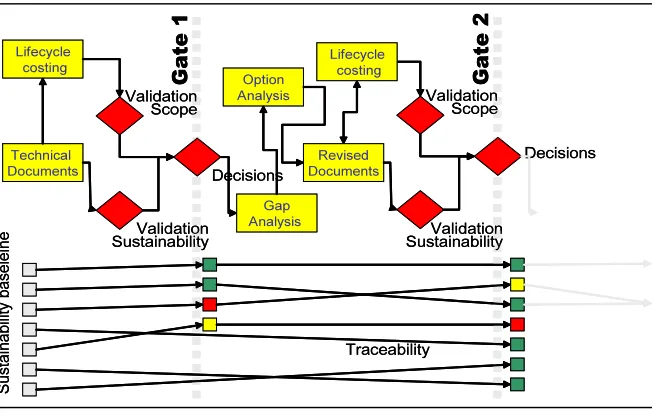
[image:9.595.73.399.477.685.2]Gating the sustainable design process provided a step-wise and rigorous feedback system that helped the integrated team to focus on the client’s requirements regarding the project or the sustainability targets. It also gave the client a reference to measure the performance of the team. The probability of meeting the sustainability objectives could be assessed at each review. Hence, these reviews were part of the client learning process, and helped to improve management of the process or practices during the project. The core principle within this gating process was to systematize feedback loops through a series of interactive learning/acting cycles (Figure 1).
FIG. 1: Requirement-based integrated design framework
criteria and its owner (architect, engineer or client) within the integrated design roadmap. During the gating review, the level of conformity is established using a colour code.
of the creation of a proof of concept (Institute of Electrical and Electronics Engineers, 1990) by introducing two gates in the preliminary design process. Sustainability requirements were mapped into the software and data for verification and validation captured at each gate through documents sent by the design professionals through e-mails. The gating review was conducted during the workshops within the laboratory for collaborative work.
In this validation process, a shift in the pattern of interactions was observed, with much less polarization in the discussion. The technology offered an easy way to access documents pertaining to the discussion and provided traceability to connect proposed solutions to specific requirements, facilitating sense making. The response to the process was positive. The client representatives felt they had a much better understanding of the value of the proposed solutions and were much more confident about the expected results. The sustainability adviser adapted the process to his other projects, but chose to use a spreadsheet instead of the requirement management system, which was not well adapted to the construction context. However, Case 1 design team, while finding the new approach useful, did not see a value to open up the design process itself.
5.
CONCLUSION
The paper presents the results of an ethnographic research regarding the use of technology as boundary objects to induce transformational learning in practices related to integrated design. Unique aspects of this study are: first proposing an alternative to process reengineering for enabling or driving processes related to collaborative work; second combining two social learning methods for diagnosing and intervening on the design process using technology as a boundary object; third by introducing the concept of boundary objects as means to induce transformational learning in an integrated design process.
The efficiency of collaborative teamwork depends on the team ability to exchange knowledge for continual learning and to develop shared mental models. Integrated design teams in construction are coalitions of firms with mental models firmly bounded within their specialized practices. The taxonomy of knowledge boundaries between practices derived from situated action theory is a powerful tool that helped identify and define socio-cognitive barriers hindering collaborative work within an integrated team. In turn, activity theory offered a framework to analyse the relationships between actors and boundary objects to achieve a specific outcome, and a method to intervene on activity systems to induce transformational learning.
Two approaches to transformational learning were analysed in the case studies. The first one looked at incremental exploration of new forms of interactions between practices using a pseudo-collective object, a technology that provided virtual arenas for knowledge-sharing and generation of new knowledge. The second one focused at radical exploration by breaking barriers created by power structure and asymmetry of knowledge. The cases also illustrated, by the comparison between the aerospace and the construction industry, the importance of context in the adoption of technology. Practices in the aerospace industry are much more process oriented, and have many loosely bounded bodies of knowledge. For example, software engineering has adopted and evolved methods and tools from system engineering and project management which later were used to evolve bodies of knowledge in these two disciplines (Blanchard, 2004). Approaches derived from social learning theories to change practices and not processes may therefore be more appropriate in the context of improving the performance in collaborative design work in construction. Also, technology has not to be at the centre of the transformational learning process, but can be one of the instruments to induce this process.
Finally, activity theory implies that technology has no agency and transformational learning cannot be achieved without governance. Both the healthcare and the aerospace project had a strong governance model built around an executive sponsor, someone that master and use events, tools and technology as instruments to better accomplish the project purpose.
6.
REFERENCES
Ancona, D. G., Kochan, T. A., Scully, M. & J.V., M. (2004) Managing for the future: organizational behavior & processes, Cincinnati, Ohio, South-Western College Publishing.
Begin, B. & Forgues, D. (2003) Concept of Operations - Streamlining Data Tracking and Control Processes in RPS-Type Construction Projects. Ottawa, PWGSC.
Blackler, F., Crump, N. & McDonald, S. (1999) Managing experts and competing through innovation: an activity theoretical analysis. Organization, 6, 5-31.
Blackler, F., Crump, N. & McDonald, S. (2000) Organizing Processes in Complex Activity Networks.
Organization, 7, 277-300.
Blanchard, B. S. (2004) System engineering management, Hoboken, N.J., John Wiley.
Brown, J. S. & Duguid, P. (2001) Knowledge and Organization: A Social-Practice Perspective. Organization Science, 12, 198-213.
Carlisle, P. (2004) Transferring, Translating, and Transforming: an Integrative Framework for Managing Knowledge Across Boundaries. Organization Science, 15, 555-568.
Carlisle, P. R. (2002) A Pragmatic View of Knowledge and Boundaries: Boundary Objects in New Product Development. Organization Science, 13, 442-455.
Dupagne, A. (1991) Computer Integrated Building. Strategic final Report. Exploratory action NO 5604. ESPRIT II.
Eastman, C., Teicholtz, P., Sacks, R. & Liston, K. (2008) BIM Handbook: A Guide to Building Information Modeling for Owners, Managers, Designers, Engineers and Contractors, Hoboken, NJ, Wiley & Sons. Egan, J. (1998) Rethinking Construction: The Report of the Construction Task Force. London, HMSO. Eisenhardt, K. M. (1989) Building Theories From Case Study Research. Academy of Management Review, 14,
532-550.
Engeström, Y. (1987) Learning by expanding: An activity-theoretical approach to developmental research, Helsinki, Orienta-Konsultit.
Engeström, Y. (2000) Activity theory as a framework for analyzing and redesigning work. Ergonomics, 43, 960-974.
Engeström, Y. (2001) Expansive Learning at Work: toward an activity theoretical reconceptualization. Journal of Education and Work, 14, 133-156.
Engeström, Y. (2004) New forms of learning in co-configuration work. Journal of Workplace Learning, 16, 2-10.
Fernie, S., Green, S. D. & Weller, S. J. (2003) Dilettantes, discipline and discourse: requirements management for construction. Engineering, Construction and Architectural Management, 10, 354-367.
Fleck, J. (1994) Learning by trying: the implementation of configurational technology. Research Policy, 23, 637-652.
Fowler, C. A. (1994) The defense acquisition system too late for the scalpel; bring out the meat axe! Aerospace and Electronic Systems Magazine, 9, 3-6.
Hobday, M. (1998) Product complexity, innovation and industrial organisation. Research Policy, 26, 689-710.
Institute of electrical and electronics engineers (1990) IEEE standard for software configuration management plans, New York, Institute of Electrical and Electronics Engineers.
Janis, I. L. (1982) Groupthink, Boston, MA, Houghton-Mifflin
Koskela, L., Howell, G. & Lichtig, W. (2006) Contracts and production. Symposium on Sustainability and Value through Construction Procurement. Salford , UK, CIBW92 Procurement Systems.
Koskinen, K., Makinen S. (2009) Role of boundary objects in negotiations of project contracts. International Journal of Project Management 27,31-38.
Lave, J. & Wenger, E. (1991) Situated Learning: Legitimate Peripheral Participation, Cambridge Cambridge University Press.
Lorell, M., Drezner, J. A. & Lowell, J. (1999) Completing U.S. Navy Military Specifications & Standards Reform (MSSR): Issues and Problems. Santa Monica, CA RAND Corporation.
Mathieu, J. E., Heffner, T. S., Goodwin, G. F., Salas, E. & Cannon-Bowers, J. A. (2000) The Influence of Shared Mental Models on Team Process and Performance. Journal of Applied Psychology, 85, 273-283.
Patton, M. Q. (2002) Qualitative Research and Evaluation Methods, Thousand Oaks, Sage Publications. Star, S. L. & Griesemer, J. R. (1989) Institutional Ecology,Translations' and Boundary Objects: Amateurs and
Professionals in Berkeley's Museum of Vertebrate Zoology, 1907-39. Social Studies of Science, 19, 387-420.v
Strauss, A. & Corbin, J. (1998) Basics of Qualitative Research, International Educational and Professional Publisher.
Suchman, L. A. (1987) Plans and Situated Actions: The Problem of Human-Machine Communication, Cambridge University Press.
Tory, M., Staub-French, S., PO, B. A. & WU, F. (2008) Physical and Digital Artifact-Mediated Coordination in Building Design. 17, 311-351.
Vygotsky, L. S. (1978) Mind in society: The development of higher psychological processes, Cambridge, Harvard University Press.