Journal of Chemical and Pharmaceutical Research, 2016, 8(4):1350-1354
Research Article
ISSN : 0975-7384
CODEN(USA) : JCPRC5
Phytochemical profiling, standardization and quality control of Indian red
chilli
Archana Chaturvedi
1*and Ashok Kumar Tiwari
21
Amity Institute of Biotechnology, AUUP, Noida, Uttar Pradesh, India
2Ayurveda Sadan, Arogyadham, JRD Tata Foundation for Research in Ayurveda and Yoga Sciences, Deendayal
Research Institute, Chitrakoot, Satna, Madhya Pradesh, India
_____________________________________________________________________________________________
ABSTRACT
Red chilli is a commercial crop which is used in a wide range of food products in India as well as across the world. The varieties of red chilli available in different geographical zones of India show remarkable variation in their pungency. There is absolutely no information available on its standardization and quality control which of course is essential for establishing authenticity, quality and efficacy of herbal products. In the present study an attempt has been made to standardize red chilli samples collected from different geographical locations. The method developed for standardization employed qualitative evaluation of physicochemical characters and HPTLC profiles.
Keywords: Red chilli, Geographical location, Standardization, Quality control, HPTLC profile
_____________________________________________________________________________________________
INTRODUCTION
India is the largest producer, consumer and exporter of red chilli. The countries to which chilli is exported are Malaysia, Bangladesh, Sri Lanka, USA and UAE [1]. It is famous for its unique flavor. The flavor of chilli is because of seven closely related compounds of capsaicinoids – primarily capsaicin which are present in the placenta of the fruit. It is widely used in Indian, Cajun and Maxican cuisine. The usefulness of chili has also been described in spiritual and ethnobotanical practices [2-3]. In Ayurveda red pepper has been recommended for digestive problems4. There are reports showing chilli as an inhibitor of H. pylori [5]. Bactericidal property of capsaicin has been demonstrated to be more pronounced at lower pH [6]. Red chili because of its lachrymatory effect on eyes is used in pepper sprays for defense purposes [7].
______________________________________________________________________________
standardization and quality control is of utmost importance. Literature survey reveals that pharmacopeial standards for Indian red chili have not been developed so far. Keeping this in view efforts have been made through this study to standardize four different varieties of red chilli.
EXPERIMENTAL SECTION
Collection and authentication of raw materials
The samples for this study were collected from three different geographical locations namely - Bangalore, Chennai, Meerut and Chitrakoot.
Physico-chemical tests
Organoleptic characters and physico-chemical analysis of all the samples were studied. Quantitative analysis for loss on drying at 105oC, alcohol soluble extractive, water soluble extractive, total ash, acid insoluble ash [17-18]was also carried out.
Preliminary phytochemical screening
Preliminary phytochemical evaluation was carried out by using standard procedure [19-21].
HPTLC profile
For HPTLC, 2gm of each sample was extracted with 25 ml of acetone on boiling water bath for 25 minute consecutively of 3 times using fresh portion of 25 ml acetone, filtrate and concentrated. TLC of extracts of all the samples was carried out on Silica Gel 60 F254 precoated plates (0.2 mm thickness; from Merck India Limited Mumbai). A TLC applicator from Camag Linomat-5 (Camag Switzerland 140443) was used for band application. For documentation of chromatographic fingerprints a photo documentation unit (Camag Reprostar-3: 140604) was used. The mobile phase selected for the study was Toluene: Ethyl acetate: Acetic acid (5:4.5.:0.5). The plate was developed over a distance of 9 cm in a saturated development chamber (Twin trough chamber (10 x 10 cm with SS lid), and visualized under visible light, 254nm and 366nm. The plates were also visualized after spraying with Anisaldehyde - sulphuric acid reagent followed by heating at 1100C for 5-10 minutes [22-24].
RESULTS AND DISCUSSION
A coarse powder, red in color with odor tikshan and tastetikht. All the particles passed through 710 µm IS Sieve
(old sieve number 22) and not more than 10 percent passed through 355 µm IS Sieve (old sieve number 22).
Physico-chemical parameters
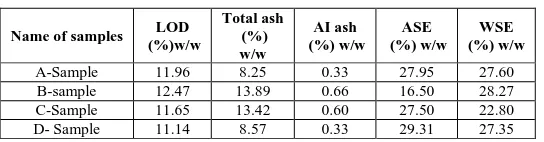
[image:2.595.164.436.534.605.2]Physico-chemical tests were carried out on all the samples and results have been given in Table -1.
Table 1: Physico-chemical contents of chilli samples
Name of samples LOD (%)w/w
Total ash (%)
w/w
AI ash (%) w/w
ASE (%) w/w
WSE (%) w/w
A-Sample 11.96 8.25 0.33 27.95 27.60
B-sample 12.47 13.89 0.66 16.50 28.27
C-Sample 11.65 13.42 0.60 27.50 22.80
D- Sample 11.14 8.57 0.33 29.31 27.35
Note- LOD-Loss on drying, ASE- Alcohol soluble extractive, WSE -Water soluble extractive, AI -Acid insoluble
Sample details - A-Bangalore market, B-Chennai market, C-Chitrakoot market, D- Meerut market
Preliminary phytochemical screening
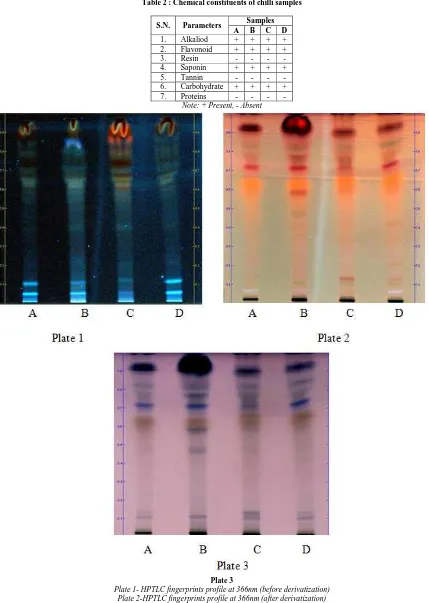
Table 2 : Chemical constituents of chilli samples
S.N. Parameters Samples A B C D
1. Alkaliod + + + +
2. Flavonoid + + + +
3. Resin - - - -
4. Saponin + + + +
5. Tannin - - - -
6. Carbohydrate + + + +
7. Proteins - - - -
Note: + Present, - Absent
Plate 3
Plate 1- HPTLC fingerprints profile at 366nm (before derivatization) Plate 2-HPTLC fingerprints profile at 366nm (after derivatization) Plate 3- HPTLC fingerprints profile at visible light (after derivatization)
______________________________________________________________________________
HPTLC finger print profile
HPTLC fingerprint profiles of the different samples of red chilli have been depicted in (Plate 1-3).Plate 1 reveals that TLC profiles of sample A, B, C, and D. The major bands observed in this case were at Rf 0.97 ( all spots red), 0.94 (all spots yellow), 0.94 (all spots orange). In addition to this bands were also noticed at Rf 0.10 (all spots grey), 0.06 (all grey), However, sample A, C and D also showed some extra bands at Rf 0.59, 0.74 (both spots red), 0.87 (orange) but these bands were totally absent in sample B. The intensity of all the bands was more pronounced in sample C followed by sample B and then sample D.
The TLC plate was also examined under visible light, after derivatization and the results have been presented as Plate 2. The analysis of the results show that the band pattern observed for sample A, B, C and D showed major spots under visible light at Rf 0.92 (all dark blue), 0.82 (all spots grey), 0.72 (all spots blue), 0.62 (all spots brown). A dark grey band at Rf. 0.77 also appeared in sample B. Sample B in track 2 also showed additional bands at Rf. 0.57 (grey) and 0.44(grey). Also in the case of sample A, C and D a blue colour doublet was present between Rf 0.11-0.13 but sample B showed only a single band (blue) at Rf 0.10
The TLC profile developed for all the four samples at 366nm after derivatization (Plate 3) showed major bands at Rf 0.12 (green all), 0.64 (all orange), 0.82 (all green) 0.97 (all brown). In addition to this sample B also showed a very prominent band at Rf 0.47 (green), 0.58 (red). Interestingly, a band at Rf 0.77 was also noticed in sample B and C. A red colour band at Rf. 0.13 was seen in sample C and D. Also a white colour band was present at Rf 0.04 in all the samples but absent in sample C.
CONCLUSION
The pharmacognostical features of chilli studied in the present study have been utilized in developing standards of different varieties of chilli plant growing in different geographical locations. From the results presented above it is clear that all the four varieties exhibit variation in their band patterns which could be linked with their phytochemical constituents. This information will be useful in establishing its identity and authenticity of the plant material. It can also be utilized for monitoring the quality maintaining batch to batch consistency of the raw material and finished products.
Acknowledgement
Authors express their gratitude to Dr. Ashok K. Chauhan, Founder President AIHBPD for his constant motivation and encouragement. Authors are also thankful to the Organising Secretary, Deendayal Research Institute, Chitrakoot (Satna) for this collaborative work.
REFERENCES
[1]MK Reddy, A Srivastava, S Kumar, R Kumar , N Chawda, AW Ebert and M Vishwakarma. Sabrao J Breeding
and Genetics, 2014, 46 (2), 160-173.
[2]S Kumar, R Kumar and J Singh. Cayenne/American pepper. In: Peter KV ed., Handbook of Herbs and Spices, Woodhead Publishing, Cambridge, UK, 2006.
[3]MK Meghvansi, S Siddiqui, H Khan, VK Gupta, MG Vairale, HK Gogo and L Singh. J. Ethnopharmacol, 2010, 132, 1-14.
[4]PV Sharma. Dravyaguna Vijnana, Caukhambha Bharati Academy, Varanasi, India, Vol.II, 2009.
[5]R O Mahony, H Al-Khtheeri, D Weerasekera, N Fernando, D Vaira, J Holton and C Basset. World J
Gastroenterology, 2005, 11(47), 7499–7507.
[6] HW Steer and DG Colin-Jones. Gut, 1975, 16(8), 59-70.
[7] R Krishnamurthy, MK Male and BM Shinde. J Scientific Industrial Res, 1999, 58, 629-630.
[8]KM Crosby. Handbook of Plant Breeding, Vegetables II: Fabaceae, Liliaceae, Solanaceae and Umbelliferae, In Pepper, J Prohens F, Nuez and Carena M.J. (Eds), Springer Science Business Media LLC, New York, 2008. [9]C Stewart Jr, M Mazourek, GM Stellari, M O Connel and M Jahn. J. Exp. Botany, 2007, 58(5), 979 – 991, [10] VL Huffman , ER Schadle , B Villalon and EE Burns. J. Food Sci, 1978, 43, 1809–1811.
[11] M Monforte-Gonsalez , A Guzman-Antonio, F Uuh-Chim and F Vazquez-Flota. J. Sci Food Agric, 2010, 90, 764 – 768.
[14] A Tiwari, MP Kaushik, KS Pandey and RS Dangi. Curr. Sci., 2005, 88, 1545-1546. [15] JJ Lee, KM Crosby, LM Pike, KS Yoo and DI Leskovar. Sci. Hort, 2005, 106, 341-352. [16] DI Leskovar, K Crosby and JL Jifon. Acta Hort, 2009, 841, 317-322.
[17] DR Lohar. Protocol for testing Ayurvedic, Siddha and Unani medicines, Government of India, Ministry of Health & Family Welfare, Pharmacopoeial Laboratory for Indian Medicines, Ghazibad, UP, 2007.
[18]Anonymous. The Ayurvedic Pharmacopoeia of India, 1st Edn, Ministry of Health & Family Welfare, Government of India, The Controller of Publications, New Delhi Vol. III, Part I, 2001.
[19] KR Brain and TD Turner. The Practical Evaluation of Phytopharmaceuticals, Bristol: Wright-Scientechnica,
1975.
[20] CK Kokate. Practical Pharmacognosy, Vallabh Prakashan, New Delhi, India, 1994.
[21] JB Harborne. Methods of Extraction and isolation, In: Phytochemical Methods, London: Chapman and Hall,
1998.