Journal of Chemical and Pharmaceutical Research, 2014, 6(6):1658-1662
Research Article
ISSN : 0975-7384
CODEN(USA) : JCPRC5
First-principles study of structural and electronic properties of CdO
Fu Chun Zhang, Hong Wei Cui, Xing Xiang Ruan and Wei Hu Zhang
College of Physics and Electronic Information, Yan an University, Yan an, China
_____________________________________________________________________________________________
ABSTRACT
Structure and electronic properties of rocksalt CdO are studied by using density functional theory (DFT), in which the exchange correlation functions are described with generalized gradient approximation (GGA), local density approximation (LDA), B3LYP, HSE06 and HSE03. The ground state properties of the rocksalt CdO have been subjected to investigate by the calculated band structure and density of state. The results reveal that CdO is an indirect wide band gap semiconductor, and a very similar dispersion of calculated energy levels is also found around Fermi level. In addition, it is obvious that the hybrid-exchange functions are more accurate than the GGA and LDA functional for the band gap of the rocksalt CdO. Particularly to the Burstein–Moss effect and the calculated effective mass conform to existing experimental results, which have offered theoretical reference for design and large scale application of the rocksalt CdO materials.
Keywords: Rocksalt CdO, First-principles, electronic structure, properties.
_____________________________________________________________________________________________
INTRODUCTION
Transparent conductive oxides (TCOs) has become one of the electronic materials with excellent photo-electric property due to its low specific resistance and high transmittance and has wide applications in solar cell [1], liquid crystal display [2] and gas sensor [3]. Cadmium oxide (CdO), as a type of wide band-gap compound semiconductor, has been highlighted in terms of being used as new type of transparent conductive films due to its excellent performance in terms of conduction and transparent conduction and considered as a promising photoelectric material and is applicable to solar cell, electrochromic device, liquid crystal display, heat reflector, flat panel display, antistatic coating, and photoelectron device [4-10]. In particular, compared with other transparent conductive films (SnO2、ITO), CdO has many advantages such as low growth temperature, material with high migration rate and
better crystal orientation can be obtained at room temperature, under undoped condition, since there is a great number of interstices in CdO, Cd atom and oxygen vacancy are able to serve as shallow donor, enabling CdO to have higher carrier concentration and making CdO have higher electron concentration and favorable electrical property under undoped condition. In addition, CdO is 2.26 eV in band gap width, with corresponding absorption wave length 550nm within visible light range. So it is used as window material for solar cell. Therefore, research on physicochemical properties of CdO shall be of far reaching importance to development of electronic industry and solar cell.
At present, although there are a great number of theoretical and experimental researches on CdO in terms of electronic structure, defect state and doping, there are many subjects such as electronic and optical properties to be researched; furthermore, equal importance should be attached to theoretical research and experimental research on CdO. Theoretically, the electronic structure and phase change of CdO have been subjected to research based on density functional theory (DFT) [11-15],since a majority of researches have been made adopting generalized
electronic structures of CdO by hybrid functional of HSE03, HSE06 and B3LYP based on DFT and also makes a study of its geometrical and electronic structure under various conditions and brings them into comparison with other results.
EXPERIMENTAL SECTION
Theoretical model and calculation method
The stable crystalline state of CdO at room temperature is cubic NaCl structure, with space group being Fm-3m,cell
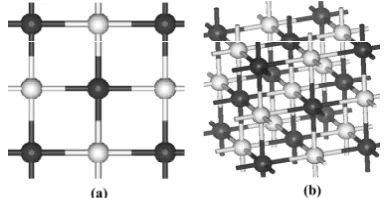
parameter a=4.674Å. In addition, CdO also shows three types of meta-stable states namely sphalerite, cesium chloride and wurtzite structures. Existing research findings show that CdO crystal with cubic NaCl structure changes into CsCl structure under the pressure of about 89 Gpa, with cell volume reduced by about 6%. We adopt NaCl type CdO structure for calculation this time in our paper, the crystal structure is as shown in Fig. 1.
Calculations were carried out the Vienna Ab initio Simulation Package [16]. First, rock-salt CdO were subjected to full-geometry optimization to obtain stable CdO structure. Second, the basic energy and properties of optimized CdO were calculated. The exchange and correlation potentials were calculated by using GGA for PW91 form [17]. The projector augmented wave (PAW) potentials [18] were used for Cd and O atoms to describe the interaction potential between the ion core and valence electron, and select the Cd and O valence electron configuration is Cd 4d105s2 and O 2s22p4, respectively. Energy cutoff was set at 600 eV and the convergence in energy and force was set at1× 10–6 eV and 10–3 eV/Å, respectively. The internal stress was no more than 0.1 Gpa and the Brillouin zone parameters for the k-point set were 8×8×8 Monkhorst-Pack sampling mesh.
Fig. 1 (a) Top view of CdO (b) perspective of CdO (black ball is Cd, grey ball is O)
[image:2.595.209.404.330.429.2]RESULTS AND DISCUSSION
Table 1 Lattice parameter, gap, effective mass and total energy
Method a (Å) Length bond Indirect gap Direct gap (eV) Effective mass Total energy (eV) Experiment 4.770 [19] 2.354 1.20[20] 2.28[21] 0.21me [22]
LDA 4.656 2.328 0.15 1.17 0.20 me -1175.7 GGA 4.776 2.388 0.16 1.48 0.20 me -1179.9 HSE03 4.695 2.347 0.962 2.39 0.22 me -1168.8 HSE06 4.489 2.245 1.275 3.32 0.22 me -1175.7 B3LYP 4.794 2.397 1.331 2.40 0.22 me -1158.4
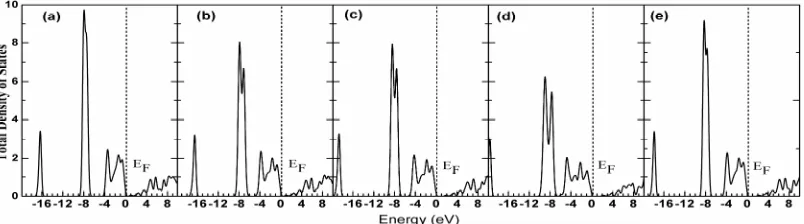
[image:2.595.130.483.499.567.2]Fig. 2 band structure of CdO, (a) GGA, (b) LDA, (c) HSE03, (e) HSE06, (f) B3LYP
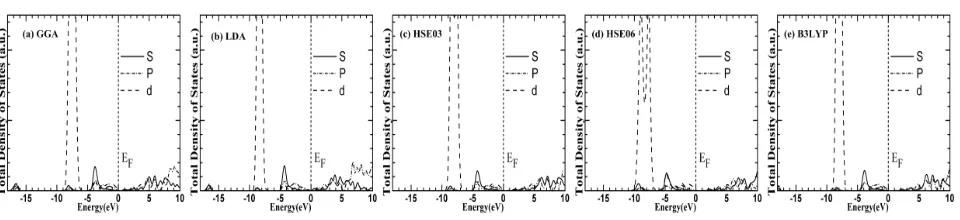
In order to investigate electronic properties we calculated energy structure, total density of states (DOS) and partial DOS adopting GGA ,LDA and hybrid-DFT approach, the calculation results are shown in Fig. 2, Fig. 3, Fig. 4 and Fig. 5, respectively. It is observed from the Fig. 2 that rock-salt CdO is an indirect band gap semiconductor by
theoretical prediction. The conduction band minimum is at Γ point and the valence band maximum is at L point in
brillouin zone dut to a repulsion of O 2p states in the valence band with Cd 4d sates lying at -7.0 eV~-9.0 eV. it is
observed from Fig. 3, Fig. 4 and Fig. 5 that valence band of CdO is divided into two areas by and large, namely low energy from -8.0 eV to -6.5 eV and high energy from -4.0 eV to 0.0 eV. The contribution to high energy made by valence band of CdO is mainly from O 2p state electrons together with a few of Cd 4d electrons, the contribution to low energy tail made by valence band is primarily from 4d electrons of Cd. There is state density peak appearing from -16.1 eV to -22.0 eV due to O 2s state and that the state density peak contributed by O 2s state in case of hybrid density functional migrates to low energy by 2.5 eV, with weak interaction with other two valance bands. For conduction band, the hybrid conduction band at Cd 5s and 5p state appears at conduction band bottom ranging from 0.6 to 6.0 eV,the high energy p-state of Cd and O is found to be in high energy area within the range of above 6.3
eV. In addition, in case of hybrid density functional, the entire valence band migrates to high energy and widens band gap. For band gap value by theoretical calculation, being 0.12 eV by GGA and LDA, the reason for which is
that there is common problem namely calculated value of Eg by LDA and GGA is on the low side. For CdO crystal,
the increase of interaction between Cd 4d and O 2p due to overestimation of the energy of Cd 4d in calculation, resulting in increase of valence band width and band gap on the low side, but this will not influence theoretical analysis of electronic structure of CdO, especially, the band structures at conduction band bottom and valence band top conform to previous theoretical value and experimental value [12]. It is observed from band gap by theoretical calculation based on hybrid density functional theory that the band gap of CdO has improved obviously, the band gaps calculated by B3LYP and HSE06 are 1.831 eV and 1.775 eV, being up to 79% and 77% of experimental values. It is observed from the calculated energy band pattern shown from Fig. 2 (a) to Fig. (e) that the dispersions of the calculated band structure around Fermi level are similar and that the Cd 4d state adopting hybrid density functional migrates to low energy by about 0.4 eV, being around 9.0 eV, which conform to the experimental values namely Cd 4d is in 9.1 eV, and it is also observed from the fig that the dispersion of conduction band is consistent with experimental value. In addition, we also calculate the electron effective mass along Γ-X direction, and that the electron effective mass calculated by LDA and GGA is 0.20 me, and that the electron effective mass calculated by
hybrid density functional is 0.22 me, which conform to the experimental value of 0.21 me [22]. The above results
[image:3.595.108.510.595.707.2]show that the results of calculation based on hybrid density functional theory we adopted are credible.
Fig. 4 The partial density of state of Cd atoms, (a) GGA, (b) LDA, (c) HSE03, (d) HSE06, (e) B3LYP
Fig. 5 The partial density of state of O atoms, (a) GGA, (b) LDA, (c) HSE03, (d) HSE06, (e) B3LYP
CONCLUSION
The paper presents the research on geometrical structure and electronic attribute of CdO adopting first principle calculation method based on density functional theory together with GGA, LDA and hybrid density function. The results of theoretical calculation show that Cd is an indirect wide band gap semiconductor, with valence band top at the point L in brillouin zone and conduction band bottom at the point Γ in brillouin zone, and that the dispersions of the calculated energy level around Fermi level, it is observed from calculation results that hybrid density significantly improves band gap value of CdO, in addition, the calculated electron effective mass conforms to experimental value and that Cd 4d energy level calculated adopting hybrid density functional is around 9.0 eV, which also conforms to experimental value, the above mentioned results are favorable for us to make an exact analysis of electronic structure and attribute of CdO and also offer theoretical reference to prepare CdO in experiment.
Acknowledgements
This work was supported by the Scientific Research Program of the Educational Committee of Shanxi Province, China (No.2013JK0917), the Scientific Research Program of Yan'an, China (No.2013-KG03), and industry study research of YuLin city.
REFERENCES
[1]T J Coutts; T O Mason; J D Perkins; et al. Proc.Electro. Chem. Soc, 1999, 11(2): 274. [2]H J Kim; H N Lee; J C Park; et al. Thin Solid Films, 2002, 2(6): 451.
[3]B L Zhu; C S Xie; D W Zeng; et al. Marer.Chem.Phy., 2005, 89:148.
[4]N Takeuch. Phys. Rev. B, 2002, 65: 045204.
[5]Y Dou; R G Egdell; D S Law; et al. J. Phys.:Condens.Mater.,1998, 10: 8447.
[6]V V Sobolev; D O Mordas; V V Sobolev. J. Appl. Spectrosc., 2003, 70: 317.
[7]T Makino; Y Segawa; M Kawasaki; et al. Appl. Phys. Lett., 2001, 78: 1237.
[8]R L Gunshor; A V Nurmiko. Semiconductors and Semimetals, 1997, 44: 731
[9]F Wang; Z Ye; D Ma; et al. J. Crystal Growth, 2005, 283: 373.
[10]G Torres-Delgado; C I Zuniga-Romero; O Jimenez-Sandoval;et al. Adv. Funct. Mater., 2002, 12: 129.
[11]P D C King; T D Veal; A Schleife; et al. Phys. Rev. B, 2009, 79: 205205.
[12]R J Guerrero-Moreno; N Takeuchi. Phys. Rev. B, 2002, 66: 205205.
[17]Y Wang; J P Perdew. Phys. Rev. B, 1991, 44: 013298. [18]G Kresse; J Joubert. Phys. Rev. B, 1999, 59: 1758.
[19]H Liu; H Mao, M Somayazulu. Phys. Rev. B, 2004, 70: 094114.
[20]M Altwein; H Finkenrath, C Konak; et al. Phys. Status Solid 1968, 29: 203.
[21]O Madelung. Numerical Data and Functional Relationships in Science and Technology, Group III, Springer,
2006, 21a-28a.