OPTIMISATION OF PROCESSING CONDITION USING TAGUCHI
METHOD ON WARPAGE FOR HDPE- CLAY COMPOSITE
M.H.I. Ibrahim
1, a *, M.H.A. Manaff
1,b, M.H. Othman
1,c, N. Mustafa
1,d,
S. R. Masrol
1,e, N.H. Rafai
1,f1 Faculty of Mechanical & Manufacturing Engineering, Universiti Tun Hussein Onn Malaysia (UTHM), Batu Pahat, Malaysia
a*[email protected], b[email protected], c[email protected], d[email protected], e[email protected], f[email protected]
Keywords: Taguchi Method, processing condition, warpage, HDPE Clay.
Abstract. Injection molding is one of the most important processes in manufacturing nowadays. Thus, attention must be given towards the optimization of the product defects. Parameters have been chosen by screening tests to improve the process quality. The main purpose of this study is to optimize the processing condition using Taguchi Method on shrinkage for HDPE-Clay specimen. The experiment starts by preparing the mixture between HDPE and clay. Then, screening test is conducted to obtain the parameters. The parameters are melt temperature, injection speed, injection pressure and cooling time. By using the array orthogonal L9 (34), signal to noise ratio and ANOVA were conducted. Based on the S / N ratio analysis, best combination can be produced for warpage (melt temperature: 190oC, injection speed: 40%, injection pressure: 30% and cooling time: 3 seconds). While for ANOVA, melt temperature is most significant with 60.28% for warpage.
Introduction
These days, injection moulding is gaining popularity due to the combination of near net shape processing of wide range of material[1]. It has been well established as it inherit many features compared to powder compaction such as low production cost at large quantity, good tolerance & mechanical properties, applicable to many materials and ability to sub-micrometer regime[2,3,4]. However there is some limitation in the process such as feedstock preparation, debinding and sintering[3,5]. For this project, High-density Polyethylene will be mixed with nano clay. Due to the problem of nano powders, optimisation technique has to be implemented in order to reduce defects and give higher shape retention[3]. Here, taguchi method will be implement to estimate the best parameter injection that suites warpage characteristics. Design of experiment(DOE) using taguchi method was used in this study to optimize the injection parameters and the experimental results are then transformed into a signal to noise ratio(SN Ratio)[6]. Analysis of variance(ANOVA) also been used to determine the contribution factors which influence the quality characteristics.
Experiment
Figure 1: Injection moulding machine Nissei NP7-1F type
Material Selection
[image:2.595.174.424.311.454.2]The material used in this research was High Density Polyethylene (HDPE). The second material is clay. HDPE and Clay will be mix together. Table 1 shows the general properties of HDPE.
Table 1 : Properties of HDPE
Properties
Hardness, Shore D
Tensile Strength, Ultimate Tensile Strength, Yield
Elongation at Break Melting Point
Vicat Softening Point
Brittleness Temperature Density
62 30 MPa 21.9 MPa 840 130°C 120°C -86.2°C 0.948 g/cc
Selection of Cavity Shape
The shape chosen for the mould cavity in this research was dumbbell shape. Figure 2 shows the dumbbell shape and its dimension based on International Organization for Standardization, ISO R527-2.
Figure 2: Cavity of dumbbell (dimension in mm)
Selection of Factors and Levels. [image:2.595.179.418.546.650.2]
Table 2 : Factor and level selection
Factors Level 1 Level 2 Level 3
Melt Temperature (˚C) 135 163 190
Injection Speed (%) 20 40 60
Injection Pressure (%) 30 50 70
Cooling Time (s) 3 5 7
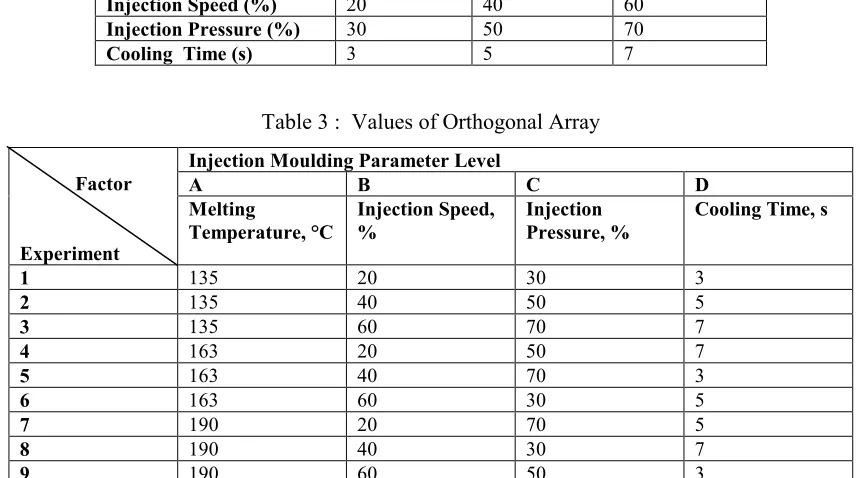
Table 3 : Values of Orthogonal Array
Factor
Experiment
Injection Moulding Parameter Level
A B C D
Melting
Temperature, °C Injection Speed, % Injection Pressure, % Cooling Time, s
1 135 20 30 3
2 135 40 50 5
3 135 60 70 7
4 163 20 50 7
5 163 40 70 3
6 163 60 30 5
7 190 20 70 5
8 190 40 30 7
9 190 60 50 3
MeasuringWarpage
The warpage of specimens was measured by using digital dial gauge. The procedure is needle need to touch the base and the specimen.
Result and Discussion
The result is focusing in the specimen warpage for each parameter and formulation. Using S/N ratio and ANOVA value, the quality of the specimen can be determined [1,2]. In this result also the correlation of the parameter and the S/N ratio value was plotted in a Figure 3. For the ANOVA analysis, the most contribution parameter can be determined [7]. The contribution of the parameter was base on the higher percentage of contribution. This percentage contribution was calculated for all formulation.
Analysis of Warpage
They have four combinations of matrix and clay which is 1% and 5%. Table 4 and 5 shows all
combinations with their S/N ratio value and the example manual calculation of S/N ratio.
Table 4: Warpage Value and S/N Ratio for 1% Clay
No.
Trial Melt temperature (°C) speed (%) Injection Injection pressure (%)
Cooling time
(s)
Hardness
value S/N Ratio (dB)
1 135 20 30 3 0.009 40.9151
2 135 40 50 5 0.014 37.0774
3 135 60 70 7 0.015 36.4781
4 165 20 50 7 0.017 35.3910
5 165 40 70 3 0.011 39.1721
6 165 60 30 5 0.02 33.9794
7 190 20 70 5 0.014 37.0774
8 190 40 30 7 0.015 36.4781
[image:3.595.63.533.625.781.2]Table 5: Warpage Value and S/N Ratio for 5% Clay
No.Trial Melt
temperature (°C) speed (%) Injection Injection pressure (%)
Cooling time
(s)
Hardness
value S/N Ratio (dB)
1 135 20 30 3 0.013 37.7211
2 135 40 50 5 0.013 37.7211
3 135 60 70 7 0.019 34.4249
4 165 20 50 7 0.01 40.0000
5 165 40 70 3 0.008 41.9382
6 165 60 30 5 0.008 41.9382
7 190 20 70 5 0.006 44.4369
8 190 40 30 7 0.007 43.0980
9 190 60 50 3 0.006 44.4369
Based from Table 4 and 5, it shows that the range of S/N ratio are wider for 5% clay compare with 1% clay. It may happened because of the feedstock homogeneity and particle distribution during mixing where 5% clay provide better compact retention. The higher percentage of clay will give minimal amount of warpage as it contains bimodal powder packing. The difference between 1% clay and 5% clay was illustrated in a Figure 3 for average S/N ratio versus the level of parameter for four different parameters.
[image:4.595.66.536.366.525.2]
Figure 3: Graph Average S/N Ratio vs Parameter Level for Warpage for 1%(a) & 5%(b) of Clay
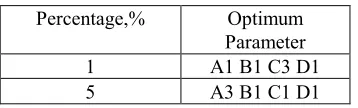
The S/N ratio of each interaction in Figure 3 is come from Table 4 and 5 where it clearly shows that A1B1C3D1 and A3B1 C1D1 were the highest mean S/N ratio. Hence, the optimum performance parameter can be achieved as it comes from the highest mean S/N ratio[8,9]. .From Figure 3, the optimum parameter for each formulation can be determined based from the highest mean S/N ratio. Table 6 shows the optimum parameter for warpage for each formulation.
Table 6 : Optimum Parameter for Warpage
Percentage,% Optimum
Parameter
1 A1 B1 C3 D1
5 A3 B1 C1 D1
Conclusion
Taguchi’s orthogonal array is designed to improve the quality of products and processes where the performance depends on many factors. From screening experiment analysis, six parameters were
[image:4.595.210.389.676.730.2]tested. However injection time and cycle time parameter were eliminated since it is not significant to the analysis. As a results melt temperature, injection speed, injection pressure and cooling time were taken into considerations. In the injection molding, visible ejector marks will give significant effect to the experimental samples and warpage. Hence, it can be reduced by eject the sample in a cooling down temperature. Overall, optimum parameter for warpage has been achieved where the best combination is melt temperature 135oC, injection speed 20%, injection pressure 70% and cooling time 3 second with 1% clay. For 5% clay, the best combination is melt temperature 190oC, injection speed 20%, injection pressure 30% and cooling time 3 second.
References
[1] M.R. Harun, N. Muhamad, A.B. Sulong, N.H.M. Nor, M.H.I. Ibrahim. “Rheological investigation of Zk60 magnesium alloy feedstock for metal injection moulding using palm stearin based binder system”. Applied Mechanics & Material 44-47(2011),pp4126-4130
[2] M.H.I. Ibrahim, N. Muhamad,A.B. Sulong . “Rheological characterization of water atomised stainless steel SS316L for micro MIM”. Advanced Materials Research (2011)264-265,pp129-134 [3] M.H.I. Ibrahim, N. Muhamad,A.B. Sulong,N.H.M. Nor. “Optimization of micro metal injection molding with multiple performance characteristics using grey relational grade” Chiang Mai Journal of Science(2011) 38(2), pp231.
[4] R.M. German & A. Bose. “Injection molding of metals and ceramics”. MPIF, Princeton, NJ.(1997)
[5] M.H.I. Ibrahim,N. Muhamad,A.B. Sulong,N.H.M. Nor,M.R. Harun. “Parameter optimization towards highest micro MIM density by using Taguchi Method” Key Engineering Materials 443(2010), pp705-710.
[6] N.H.M. Nor,N. Muhamad, M.H.I. Ibrahim, M.R. Harun. “Optimization of injection molding parameter of Ti-6Al-4V powder mix with palm stearin and polyethylene for the highest green strength by using Taguchi method”. International Journal of Mechanical & Materials Engineering(2011) 6(1), pp126.
[7] M.C. Huang,C.C. Tai, “The effective factors in The Warpage Problem of an injection-molded part with a thin shell feature”. J Mater Process Tech(2001);110;1-9