Finite Element Modelling of Fixed-Fixed End Plate Attached
with Passive Vibration Absorber
Muhammad Mohamed Salleh
1, Izzuddin Zaman
1,2,a1 Faculty of Mechanical and Manufacturing Engineering, 2Structural Integrity and Monitoring
Research Group, Universiti Tun Hussein Onn Malaysia, 86400 Batu Pahat, Johor, Malaysia
Keywords: Finite element analysis, vibration absorber, vibration control, fixed plate
Abstract. Every vibration structure has a certain resonance which tends to oscillate with larger amplitude at certain frequencies. These frequencies are known as resonance frequencies or natural frequencies of the structure. At these resonance frequencies, even a small periodic force can result the structure to vibrate excessively. Thus, in this study, the free and forced vibrations of fixed-fixed ends plate were simulated using a commercial Finite Element Analysis software, such as ANSYS to investigate the natural frequencies, mode shape and the response of the plate. Later, the vibration absorber is attached to the plate in order to decrease the vibration amplitude produced by a shaker. The preliminary result shows that the plate vibration reduced significantly with attached a single absorber.
Introduction
The Finite Element Method (FEM) is a numerical method for finding approximate solutions of partial differential equations (PDE) as well as of integral equations. It is consider a cheaper, quicker and a good choice for solving many solid and fluid mechanics problems [1–5]. In this research, the finite element analysis of the thin plate and the passive vibration absorber are performed using ANSYS software to obtain their natural frequencies and mode shape.
Previous researches have shown that adding discrete masses such as passive vibration absorber attached to a vibrating structure can reduce a considerable amount of vibration level [6–8]. This is due to vibration absorber does not contribute significant additional vibration energy to the structure. Unfortunately, it produces drawback such as the obvious weight increase, and the most critical is improperly placement and tuning of passive vibration absorber may result in large increase of vibration level.
The vibration has been a major concern in most engineering fields. It has turned to be a hazard that reduces the fatigue life of the structure. Excessive vibration can lead structural failure and induce uncomfortable noise which ultimately can cause catastrophic and hearing damage [9]. This is the reason why a proper vibration control method is required to address the structural vibration problems. Over the past 20 years, there are numerous research works concerning on excessive vibration through the thin-walled structures such as plate [10–12]. This problem commonly found in automobiles, aircraft and the fairings of rocket launch vehicles. Many studies have been devoted in the past to develop a method to reduce vibration that generated by machines [13–17].
This paper aims to analyze the natural frequencies, mode shape and the vibration response of fixed-fixed end plate by carried out the free vibration and force vibration analyses using FEA software. An in-depth study on the vibration absorber is also performed, such as the correlation of stiffness with absorber’s fundamental frequency and the location of absorber on plate structure in order to ensure that the whole plate vibration can be reduced significantly.
Finite Element Models
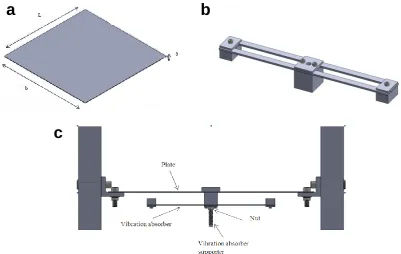
employed for both systems are plain carbon steel, in which subsequently identify the mass of plate to be 3.159 kg and vibration absorber 0.0741 kg. Both models were meshed using solid hexagonal element. Fig. 1 shows the models of plate and vibration absorber.
a
b
[image:2.595.106.508.113.367.2]c
Fig. 1. Isometric view of (a) plate, (b) vibration absorber, and (c) front view of plate attached with vibration absorber
Results and Discussion
Plate with constraint. In the finite element modelling of plate, the analysis was performed plate with boundary condition of fixed-fixed end to observe the effect on the vibration characteristic of plate. Table 1 tabulates the natural frequencies of plate with constraint obtained from the modal analysis of ANSYS. The natural frequencies were observed until the first four modes. Obviously, it can be seen that the frequencies for the mode shape are between 86.97 to 317.92 Hz.
Table 1. Natural frequencies of plate in unit Hz
Mode (nth) Fixed-fixed end plate
1 86.97
2 177.36
3 261.47
4 317.92
Mode Shape for plate fixed-fixed end. Table 2 shows the results for the mode shape of plate with fixed-fixed end. These simulation were conducted to find out the location of vibration for the first four modes. This process can determine accurate location to place vibration absorber to ensure it can absorb surplus vibration more effectively.
Table 2. Mode shape of plate with and without the constraint
Mode (nth) 1 2 3 4
[image:2.595.75.526.687.798.2]Vibration absorber. Table 3 shows the results for the first two natural frequencies and mode shape of vibration absorber with fixed support at the centre base. The concept of vibration absorber is to match the fundamental frequency of absorber with the first natural frequency of plate. In Table 3, the first mode indicates that the absorber experiences the bending mode, while second mode displays the torsional vibration. Although there are two frequencies presented in the analysis, only the first fundamental frequency will be chosen for matching with the plate natural frequency.
Table 3. Mode shape and frequencies of vibration absorber
Mode (nth) Vibration Absorber
1
63.233 Hz
2
331.86 Hz
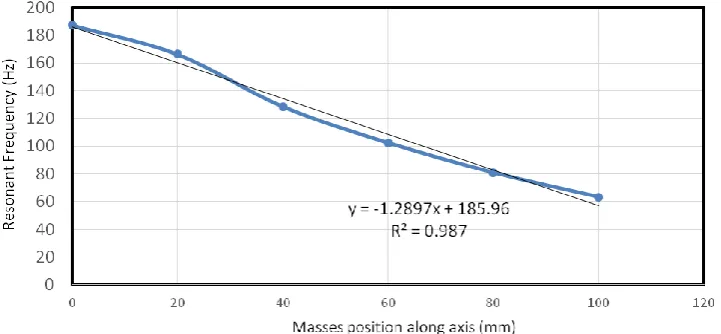
In the next analysis, the masses mounted on absorber’s flyers were shifted at intervals to observe the changes in the frequency. This is due to the stiffness effect when the mass was moving along the flyers. The result found that the fundamental frequency of vibration absorber decreases when both masses moving away (along the axis) from centre of neutralizer as shown in Fig. 2.
Fig. 2: Resonant Frequencies versus masses position along axis
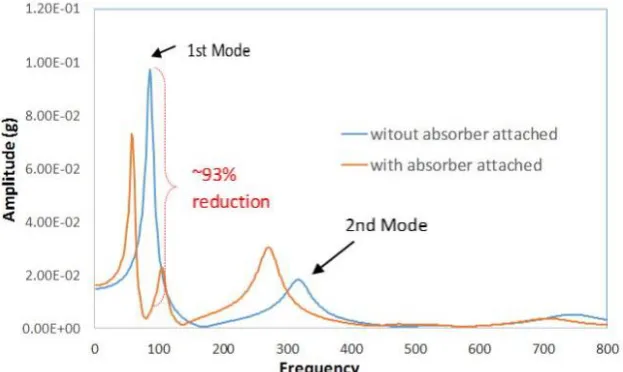
[image:3.595.118.479.446.613.2]plate, while the response was measured at the same point of attachment. Based on this result, it was found that the amplitude at the first frequency mode of plate was reduced significantly.
Fig. 3. Comparison between frequency response before and after attachment with absorber
[image:4.595.142.454.115.301.2]Table 4 tabulates the effect of before and after adding neutralizers on the amplitude response value of a plate. Obviously by attached a single absorber, the response of a plate structure was decreased at the first mode about 93.4%.
Table 4. Vibration amplitude of plate before and after attached with absorber
Mode Amplitude (g)
before
Amplitude (g) after
Percentage reduction %
1 0.0974 0.00642 93.4
Conclusion
The finite element simulation approaches have been implemented successfully to investigate the vibration attenuation of fixed-fixed ends plate by employing single passive vibration absorber. The result for adding the passive vibration absorber was found highly influence on the structure as different dynamic characteristic of plate was obtained. The amplitude percentage of the first resonance frequency of plate was found reduce to 93.4%. It is clearly showed the significant effect of addition of passive vibration absorber.
Acknowledgement
Author thanks Universiti Tun Hussein Onn Malaysia and Office of Research, Innovation, Commercialisation and Consultancy (ORICC) for the support under Short Term Grant, vote 1332 and Postgraduate Incentive Research Grant, vote U040.
References
[1] R.D. Cook, D.S. Malkus, M.E. Plesha, R.J. Witt, Concepts and applications of finite element analysis, fourth edition, John Wiley & Sons Inc., New York, 2002.
[2] I. Zaman, R.A. Rahman, H. Khalid, Dynamic analysis on off-road vechicle chassis using 3-d finite element model, Journal of Science and Technology 4 (2007) 1-16.
[4] B. Manshoor, I. Zaman, Z. Ngali, A. Khalid, Simulation of laminar mixing in fractal perforated plate static mixers, Advanced Materials Research 845 (2014) 31-35.
[5] B. Manshoor, I. Zaman, M. Jaat, A. Khalid, CFD analysis of circle grid fractal plate thickness on turbulent swirling flow, Applied Mechanics and Materials 465-466 (2014) 109-113.
[6] I. Zaman, M.M. Salleh, B. Manshoor, A. Khalid, S. Araby, The application of multiple vibration neutralizers for vibration control in aircraft, Applied Mechanics and Materials 629 (2014) 191-196.
[7] I. Zaman, M.M. Salleh, M. Ismon, B. Manshoor, A. Khalid, M.S.M. Sani, S. Araby, Vibration attenuation of plate using multiple vibration absorbers, MATEC Web of Conferences 13 (2014) 03003.
[8] I. Zaman, M.M. Salleh, M. Ismon, B. Manshoor, A. Khalid, M.S.M. Sani, S. Araby, Study of passive vibration absorbers attached on beam structure, Applied Mechanics and Materials 660 (2014) 511-515.
[9] C.R. Fuller, J.P. Maillard, M. Mercadal, H. Von Flotow, Control of aircraft interior noise using globally detuned vibration absorber, Journal of Sound and Vibration 203 (1997) 745-761.
[10] J.P. Carneal, F. Charette, C.R. Fuller, Minimization of sound radiation from plates using adaptive tuned vibration absorbers, Journal of Sound and Vibration 270 (2004) 781-792.
[11] I.Z. Bujang, M.K. Awang, A.E. Ismail. Study on the dynamic characteristic of coconut fibre reinforced composites. in Regional Conference on Engineering Mathematics, Mechanics, Manufacturing & Architecture (EM3ARC), 2007, Putrajaya, Malaysia.
[12] I. Zaman, A.E. Ismail, M.K. Awang, Influence of fiber volume fraction on the tensile properties and dynamic characteristics of coconut fiber reinforced composite, Journal of Science and Technology 1 (2009) 55-71.
[13] P. Bonello, M.J. Brennan, S.J. Elliott, Vibration control using an adaptive tuned vibration absorber with a variable curvature stiffness element, Smart Materials and Structures 14 (2005) 1055-1065.
[14] I.Z. Bujang, R.A. Rahman. Dynamic analysis, updating and modification of truck chassis. in Regional Conference on Engineering Mathematics, Mechanics, Manufacturing & Architecture (EM3ARC), 2007, Putrajaya, Malaysia.
[15] I. Zaman, B. Manshoor, A. Khalid, S. Araby, M.I. Ghazali, Vibration characteristics of composite plate embedded with shape memory alloy at elevated temperature, Applied Mechanics and Materials 393 (2013) 655-660.
[16] I. Zaman, A. Khalid, B. Manshoor, S. Araby, M.I. Ghazali, The effects of bolted joints on dynamic response of structures, IOP Conference Series: Materials Science and Engineering 50 (2013) 012018.
[17] M.J. Brennan, Some recent developments in adaptive tuned vibration absorbers/neutraliser, Shock and Vibration 13 (2006) 531543.