2016, Volume 3, e3052 ISSN Online: 2333-9721 ISSN Print: 2333-9705
The Effect Level of Expertise on the Didactic
Functionalities for the Teaching Gestuality of
Athletic Activities: The Shot Put
Houda Dammak1,2*, Liwa Masmoudi2, Salma Abedelmalek3, Khouloud Aloui1, Nizar Souissi2
1Research Laboratory “Sports Performance Optimization”, National Center of Medicine and Science in Sports (CNMSS), Tunis, Tunisia 2High Institute of Sport and Physical Education KsarSaiid, University of Manouba, Tunis, Tunisia
3Department of Physiology and Functional Explorations, Sousse Faculty of Medicine, Sousse, Tunisia
Abstract
The aim of this study is to investigate the effect of expertise on didactic functionality of the teaching gesture of two teachers with different expertise and similar expe-rience. The audio-visual method was used with interviews. Our results showed that the teaching gestures in the teaching of shot put depend on the teacher’s expertise (chi-square = 18.25 2; p = 0.01). Indeed, the expert teacher uses more representa-tional gestures in comparison with the polyvalent that uses the manipulations in fa-vour of other actions. Regarding learning structures used (chi-2 = 22.56; p = 0.001), both teachers define first, then they regulate, then they evolve and finally they insti-tutionalize. Moreover, the mobilized didactic technique by both teachers is topoge-nesis (chi-square = 31.82 2; p = 0.001). In conclusion, the teaching gestures in the teaching of shot put depend on the teacher’s expertise. However, more work expe-rience widens; the differences are related to the expertise decrease.
Subject Areas
EducationKeywords
Teacher Gestures, Expertise, Didactic Functionality, Shot Put
1. Introduction
It is well established that motility has a potent role especially on physical education whose gesture presents a fundamental position in the didactic interactions [1]. Accord-How to cite this paper: Dammak, H.,
Masmoudi, L., Abedelmalek, S., Aloui, K. and Souissi, N. (2016) The Effect Level of Expertise on the Didactic Functionalities for the Teaching Gestuality of Athletic Activities: The Shot Put. Open Access Library Journal, 3: e3052.
http://dx.doi.org/10.4236/oalib.1103052
Received: September 29, 2016 Accepted: November 13, 2016 Published: November 16, 2016
Copyright © 2016 by authors and Open Access Library Inc.
This work is licensed under the Creative Commons Attribution International License (CC BY 4.0).
ing to [2] and [3], non-verbal communication accounts for over 50% of the transmitted messages. That is why communicative gestures of the teacher are in a privileged posi-tion in the process of teaching and especially in the transmission of knowledge.
Previous studies showed that verbal statements are accompanied by many gestures
[3]-[8]. Thus, the gesture is a very functional way of intervention of the teacher of sport and physical education in order for the knowledge transfer taking place optimally. On the other hand, the professional experience and expertise are central in didactic interac-tions. Several studies showed that knowledge of teaching content in EPS is essentially contextualized knowledge related to the professional experience and the importance of their use in situations of apprenticeship [9][10][11] and [12]. Other research in educa-tional sciences has pointed inter-individual variability between expert teachers and less experts. In this context, [13] showed that the expert teacher is easier in his gestures and clear in its definitions.
According to the literature, the expertise and the teaching gestures were studied in several APS as boxing [14], gymnastics [8][15], judo [16], swimming [4]; however no study was interested in studying the effect of expertise on the actions of athletics activi-ties particularly the shot put.
Hence our present research is a comparative study of the teaching gesture of two teachers of similar experience and different expertise. Thus the aim of this study was to make a specific gestural repertoire for each teacher's expertise, and deduct the differ-ences and similarities of the categories of actions and their functionality in both didac-tic teachers.
2. Methodology
2.1. Characteristics of the Observed Participants
We have selected two different profiles of teachers. They are a teacher in the same pub-lic secondary school in Sfax. Both teachers have more than twenty years of experience, both have had the same university track and graduated from “sciences and technology of physical activities and sports”, one specialist in athletics and the second is a gymnas-tics specialist (SANA and SARA).
“SANA” is the pseudonym chosen to keep the confidentiality of “athletic expert”. She had practiced athletic for twelve years, including seven years a member of the Tunisian national athletics team (specialty shot put). She had a federal diploma of second degree coach.
“SARA” is the pseudonym chosen to keep the confidentiality of “gymnastic expert”. She had practiced gymnastic for twelve years. She had a federal diploma of second de-gree coach. The observations took place in two senior classes that belong to two differ-ent specialties.
Students observed in this study are the same skill levels.
2.2. Experimental Design
recording and we have recorded different interviews with the two teachers.
2.2.1. Audio-Visual Recording
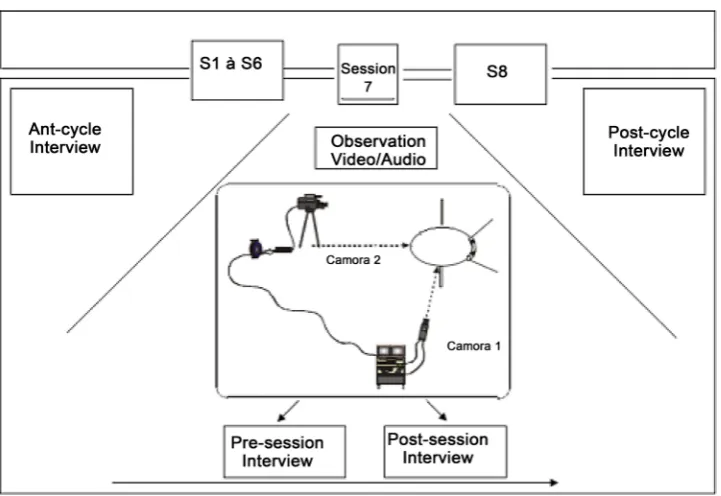
To investigate the effect level of expertise on gestural functionality, we used the me-thodology of observations [18]. Two calibrated cameras were presented: one placed at wide angle, allowed to film the entire Wide field. And the second was teacher-centered, followed all his movements. Concerning the video-recorded and observed class ses-sions, we have taken note of the session planning done by the two teachers in order to know the items taught. We have also taken some notes so as to have a better idea about the tasks proposed to the students, about teacher’s action in work presentation, and also in her guidelines during the action [17]. We have also taken note of students’ motor ac-tion and their progress over the class session [19]. Likewise, all interviews with both teachers were recorded using a Dictaphone (Figure 1).
2.2.2. Interviews
Each interview was conducted in a room where there was the teacher and researcher. These interviews are intended to update projects and assessments of teachers in the minutes before or after the observation. They consisted of the teacher let speak from a question that the target object of inquiry. These interviews allow one hand, access to experiential knowledge from the teacher through the ant-cycle, and his teaching activity through interviews, pre and post session according to [20].
2.3. Data Transcription and Condensation
[image:3.595.195.556.441.689.2]Concerning the qualitative analysis principles [21], the first step consists in copying down the data collected during the interviews (pre and post class session and pre and
Table 1. Categories of coding for each observed gestural unit (Kamoun and Amade Escot, 2007).
Gestural categories Didactic functionality - Spatial index gestures
- Illustrative and substitutionnal gestures - Representational gestures
- Manipulations gestures - Symbolic gestures
Definite Devolve Regulate Institutionalize
Topogenesis Mesogenesis Chronogenesis
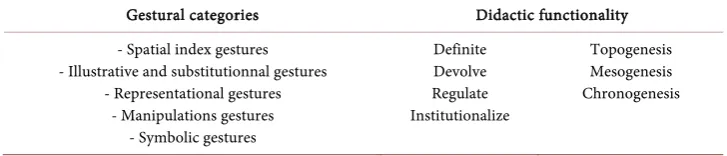
post cycle). It consists in producing the observation data of the different class sessions in simplified forms of analysis. We have summarized the video recorded data of each class in a synopsis [17]. Concerning the classification of gestural categories, we will ca-tegorize gestural units used by both teachers. To this, since our study focuses on the comparison of two teachers with similar experiences and different expertise; we repro-duce exactly the same method of data collection and processing of information [8]
(Table 1).
• The spatial-index gestures: Spatiographics gestures that represent a spatial relationship which refers to an object and index gestures; Gestures of scores and designation [4]. • Illustrative and substitutional gestures: The teacher uses her body or any part of his
body to demonstrate, reproduce or replace a hardware device or human.
• The representational gestures: The teacher uses part of his body to represent or evoke the action of another body part.
• The manipulations gestures: The task of the teacher to help a student to move or execute an action
• The symbolic gestures: The gestures able of providing communication without the use of a word [22].
2.4. The Classification of a Modeling of Teachers
The Didactic Model chosen in our study is described in first time by [23]; and [24] cov-er many levels of description, going from fundamental structures of teachcov-er action (de-fining, regulating, devolving, institutionalizing) borrowed from [25] theory of didactic situations, to descriptors of joint action borrowed from [26]: mesogenesis, topogenesis, and chronogenesis: Define: Identify and nominate the constituent objects of the situa-tion during the lesson in order to optimize [27], devolve: The process by which the teacher ensures that students assume their responsibility in achieving the task [28], re-gulate: Refers to the teacher’s interventions when students realized an activity and in-stitutionalize: Refers to everything the teacher did for that knowledge, knowledge, teaching and learning issue, is legitimate in the class institution [28].
For technical teaching, we will refer to the model done by [24] and reproduced by
time (chronogenesis: defines what is related to the production of knowledge in the course of didactic temporality) and production environments situations production and objects. Organization reports to these items (mesogenetic: defines the evolution of a complex system of objects). Thus, for each gesture coded to correspond to a structure and a technical learning. For each coded gesture match a structure and a technical teaching from the teacher [29][30][31].
2.5. Didactic Analysis of Shot Put
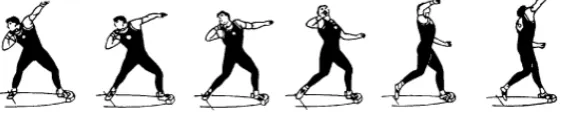
In our study, we are interested to study the effect of expertise on the actions of teachers in school. Therefore, our protocol requires the analysis of the translation technique in shot put (according to official instructions of Tunisia, 2012). Shot-putting requires great explosive strength, together with the ability to perform precisely timed move-ments in a conned space. The athlete’s objective is to project the shot as far as possible, but competition regulations restrict the technique that may be used. The shot must be thrown from the shoulder using one hand and it must be held near to the chin throughout any preliminary movements. The most widely used throwing technique is the translation technique (Figure 2).
Figure 2. Sequence of movements by a shot-putter using the translation.
2.6. Statistical Technique Analysis
The statistical analysis was performed using Statistica (Stat Soft, France). Values are expressed as percentages. Data analysis was performed by the chi-square (X2). It is used to investigate whether distributions of categorical variables differ from one another. Basically categorical variable yield data in the categories and numerical variables yield data in numerical form. The level of statistical significance was set at (p < 0.05).
3. Results
3.1. Distribution of the Gestures of Two Teachers
The distribution of the gestures observed for both the two teachers (expert and polyva-lent) is presented in (Table 2). Our results showed a significant difference in the dis-tribution of the gestures used by teachers (chi-square = 18.252; p = 0.01). Indeed, the expert uses more gestural sequences in learning shot put in comparison with the poly-valent. Thus, for a total time of 71 min and 11 s, 570 gestural sequences as follows: 336 for the expert during 36 minutes and 17 seconds. However, only 234 gestural were ob-served during 34 minutes and 54 seconds for the polyvalent.
3.2. Distribution of Gestural Categories Depending on the Expertise of Teachers
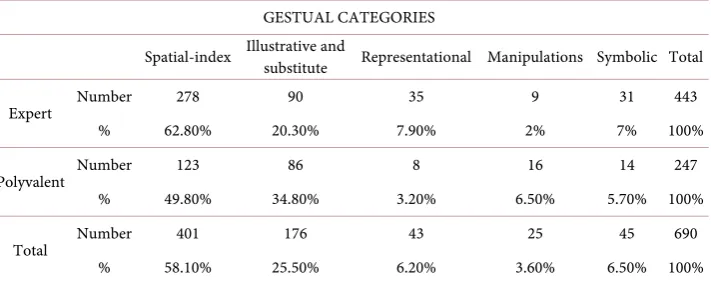
The analysis of variance showed a significant gestural categories effect (chi-square = 31.52; p = 0.01) between two teachers according to their level of expertise. Indeed, the gestures category of spatial-index is the most used for both teachers (expert and poly-valent) with 278 gestures for the expert and only 123 for the polyvalent (Table 3).
In general, we note the following findings:
• The substitutional and the illustrative are in the second place with 20.3% for the ex-pert and 34.8% for the polyvalent.
• The representational are positioned in last place and represent 3.2% for the polyva-lent and they are greater in the expert with 7.9%.
• Concerning the manipulation, they are rarely in expert 2% and they present 6.5% for the polyvalent.
• The symbolic gestures present a percentage of 7% for the expert teacher, and 5.7% for the polyvalent.
3.3. Classification Gestural Categories According to the Structures of the Educational Action
Table 2. Distribution of the gestures observed in expert and polyvalent teachers.
Teacher observation Time of Number of unit gestuality
Number of gestual categories
Number of gestual categories/min
Expert 36'17" 336 443 12.24
Polyvalent 34'54" 234 247 7.15
Total 71'11" 570 690 9.70
Table 3. Distribution of gestural categories of teachers.
GESTUAL CATEGORIES
Spatial-index Illustrative and substitute Representational Manipulations Symbolic Total
Expert Number 278 90 35 9 31 443
% 62.80% 20.30% 7.90% 2% 7% 100%
Polyvalent Number 123 86 8 16 14 247
% 49.80% 34.80% 3.20% 6.50% 5.70% 100%
Total Number 401 176 43 25 45 690
% 58.10% 25.50% 6.20% 3.60% 6.50% 100%
structures of the action used by both teachers (chi-square = 21.11 2; p = 0.001). Like-wise, the primary function of the teaching gesture is defining the didactic environment independently of the level of expertise with 64% for the expert and 82.1% for the poly-valent. Regarding the regulatory function, the highest percentage is observed on the expert with 30.4% in comparison with 15.7% for the polyvalent. On However, the de-volution function has only 1.7% in polyvalent teacher in comparison with 4.8% for the expert. Furthermore, the function of institutionalization keeps the same rank for both teachers independently of the level of expertise (0.6% to 0.4% for expert and polyvalent respectively).
Regarding the cross between gestural categories and didactic structures (Table 4), the chi-square showed no significant differences was observed (chi-2 = 22.56; p = 0.001), except at the level crossing structures with spatial-index movements.
Indeed, our results showed that:
- To define the category “spatial-index” is the most used in both teachers’ relatively high percentages 74% for the expert and 59% for the polyvalent.
- To devolve, expert appeals to symbolic gestures, with a percentage of 50% and re-presentational gestures with a percentage at 31.3%. The polyvalent uses only symbolic gestures to devolve with 66.7%.
- To regulate, expert teacher use spatial-index gestures with 52.1%, while the polyva-lent uses illustrative gestures with a percentage of 48.6%.
[image:7.595.198.554.215.357.2]3.4. Classification Gestural Categories Based Didactic Techniques Used by Teachers
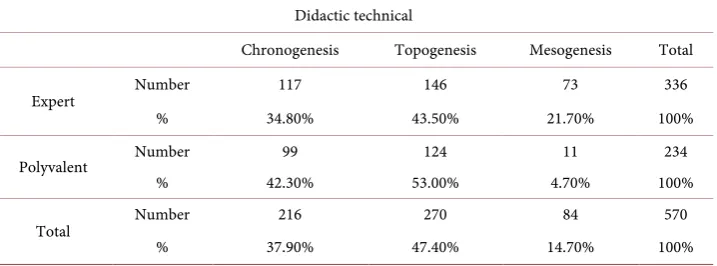
The chi-square test shows a significant difference (chi-square = 31.82 2; p = 0.001) in the use of didactic technical in both two teachers (Table 5). Indeed, both two teachers used the topogenesis technique in the first with 43.5% for the expert and 53% for the polyvalent. Similarly, the expert teacher uses more mesogenic technique with 21.72% and only 4.7% for the polyvalent. Regarding the chronogenesis gesture appear to be classified in second place independently of the expertise of the teacher with a high per-centage observed for the polyvalent 42.3% and 34.8% for the expert.
4. Discussion
The aim of this study was to investigate the effect of expertise on didactic gesture func-tionality in the teaching of the shot put. Our results showed similarities and differences in the distribution of the teachers’ gesturing for the expert and polyvalent.
Concerning categories spatial-index gestures are the most frequently used by both teachers. The spatial-index gesture of shot put are often indicated the locations (i.e., the tempo or time to start and stop the action, to designate an object, to clarify the meaning and direction, height or distance, speed ....).
[image:8.595.197.554.404.542.2]Furthermore, we observed that the expert “SANA” uses on average (12 categories gestural/min) during the observed session, while the polyvalent teacher “SARA” uses (7
Table 4. Frequency distribution of gestural units according to their educational structures.
Structure of didactic action
Definition Regulation Devolution Institutionalization Total
Expert Number 216 102 16 2 336
% 64.30% 30.40% 4.80% 0,6% 100%
Polyvalent Number 188 36 4 1 229
% 82.10% 15.70% 1.70% 0.40% 100%
Total Number 404 138 20 3 565
% 71.50% 24.40% 3.50% 0.50% 100%
Table 5. The use of gestuality and teaching techniques according to the level of expertise.
Didactic technical
Chronogenesis Topogenesis Mesogenesis Total
Expert Number 117 146 73 336
% 34.80% 43.50% 21.70% 100%
Polyvalent Number 99 124 11 234
% 42.30% 53.00% 4.70% 100%
Total Number 216 270 84 570
[image:8.595.196.555.574.707.2]categories/min). Thus the teacher “SARA” uses less gesture based on a verbal language to convey the knowledge skilled. This could be explained by the effect of expertise in EPS. These results are in accordance with those observed by [14] who indicate the cru-cial role of expertise in the teaching of physical activity.
Our results showed that gestures “spatial-index” ranked first. These results confirm those of [8] who found that the “spatial-index” gestures are the most used by the teach-ers independently of the expertise level.
In this context, [6] called their “intention” to designate, to indicate (category spe-cial-index gestures), present, reproduce or substitute (category illustrative gestures and substitutional) to raise (representational gesture category), manipulate and finally to symbolize (category of symbolic gestures). These actions are to prevent accidents and achieve the objectives of technical learning. According to [32] gestures can be used to fill a void or silence, which can be an additional function of nonverbal modality when verbal modality is not accessible. “SARA” said: “We must always be vigilant towards this discipline”. Here arguments it seeks to hide his weaknesses to the taught material.
Regarding the use of illustrative gestures, it was observed that both our teachers use most illustrative and substitutional gestures that occupies second place in “SANA” and “SARA” respectively. This confirms the influence of expertise on the use of illustrative gestures. In this context, [15] highlighted the importance of this type of gesture in the transmission of knowledge. Thus, expert uses the illustrative type “partial demonstra-tion” more than the novices. The partial demonstration is only one stage of construc-tion needed in the establishment of an internal model in the subject and this with ref-erence to the teacher’s words “SANA”: As a former athlete specialist “I demonstrate all the gesture to shot put step by step to a better understanding and memorizing”.
[4] showed that the ability of the student to interpret the gesture does not depend only on the quality of gestures produced by the teacher, but other variables such as the level of skill in the activity, its theoretical and practical knowledge of the activity. Thus, with a higher level of skill, pupils interpret with pertinence and competence the teach-er’s gestures.
Our results showed a frequent use of this category by the expert. Indeed, the expert uses its in practical memories (athletics specialty for twelve years), to extract an action and schematically virtual in order to help the student to make the representation of a complete action or element of this action in his mind. In this context, [34] found that experienced teachers with a high level of expertise specialty in sports have a basic knowledge extended and articulated.
However, the polyvalent use rarely representational gestures in comparison with the expert. A possible explanation is that polyvalent has little practical experience (specialty is gymnastic).
Moreover, gestures of manipulation (correction) are most frequently used by the po-lyvalent in order to correct and help. She says after the post session interview “students are not too motivated for the specificity of the subject taught”. One can imagine that a non-specialist teacher teaches without much difficulty to make gestures but nothing says that he will use them appropriately to promote its learning. For an expert this type of action and less frequent and occupies last place. In this sense, [35] indicates that the manipulation provides the desired posture without however being asked the question of what to do to get there.
Another possible explanation relates to the specificity of the subject taught. Indeed, the expert mastery teaching of shot put which explains the choice of representational gestures rather than others. [1] believe his side that the subject constructs a representa-tion of the observed pattern in the encoding visual informarepresenta-tion, an image or words and for the gain of working time. It exposes us his approach: “I produce a mental pattern in students concerning the action to execute and stores it in its memory to retrieve it if necessary”. Hence the potent place of this category in the act of transmitting content. Moreover, it makes use of partial demonstration to prevent tampering and to motivate students about the specificity of the discipline.
Concerning didactic functionality, definition in teaching ranks first in both teachers (expert and polyvalent). Concerning the regulation, it is higher in the expert in com-parison with the polyvalent. In this sense, the nature of the discipline requires human and material organization to ensure both the safety of students and their apprentice-ship. In fact, the teaching style used by the two teachers may partly explain the high percentage of using (start time, tempo, indicating place ...). According to SANA said “I prefer the style of command, I give orders and follows and implements learning; peda-gogy command for the simple reason that it makes my job as a teacher to manage my classroom and again to ensure the safety, style requires a lot of correction to the level of execution.”
Moreover, [37] showed that students are struggling to remember, to memorize vo-cabulary and properties. Hence, the importance of regulation according to SANA “All teaching proposing to fight against school failure must offer students learning situa-tions taking into account the difficulty of discipline”. Regarding the devolution func-tion is higher in the expert. These results are in accordance with those of [14]. Moreo-ver, [13] showed that, devolution is the commitment of students, guided by the teacher. This is to give meaning to knowledge, build relationships between knowledge.
However, the institutionalization function keeps the same rank independently on the teachers’ expertise. Different teaching techniques are at work, some have the function of ensuring the progression of instructional time (chronogenesis technical), others play on the division of tasks and responsibilities (topogenesis technical) Finally, other (me-sogenesis technical) fall within “the progressive development of an environment in which certain dimensions were set in the early moments of the lesson”.
Our results showed that both teachers use Topogenesis gestures. Likewise, both teachers use in chronogenesis gestuality in the second place. [8] and [35] showed that “chronogenesis” in the most used in apprenticeship situations. However, the use of mesogenesis gestures is in last place. These results disagree with those of [8] that showed a superiority of this technique in the teaching of gymnastics.
5. Conclusion
The teaching gestures in the teaching of shot put depend on the teacher’s expertise. However, more professional experience the teacher expands, more differences diminish due to the expertise.
Limit of the Study
This study has some limits. First, this is a case study; we regret not to work on a larger sample. Second, to investigate the effect level of expertise on the didactic functionality of the teaching gestures in the teaching who teach different physical activities and with different sex.
References
[1] Durand, M. and Rief, J. (1993) Planning and Decision among Teachers. Results from Stu-dies in Physical Education, Analysis and Perspectives. French Revue of Pedagogy, 103, 81-07.
[2] Hall, E.T. (1978) Hidden Dimension. Seuil, Paris.
[3] Pieron, M. (1992) Pedagogy of Physical and Sport Activities. Review EPS, Paris. (In French) [4] Mahut, B. (2003) Semiotic Approach Didactic Interactions; Gesture and Verb in a Situation
of Physical Education and Sports. PhD Thesis, University of Franche Conte.
[5] Marsenach, J. and Mérand, R. (1987) Formative Assessment in PE in Colleges. Research Report, NPRI, Paris.
[7] Vigarello, G. and Vivés, J. (1989) Gestures of the Coach and Technical Body. EPS Review, 216, 12-18.
[8] Kammoun, M. and Amade-Escot, C. (2007) Didactic Features of the Gestures of the Teach-er of EPS: Comparative Analysis According Gymnastics ExpTeach-ertise. In: CarliTeach-er, G., BouthiTeach-er, D. and Bui-Xuân (Dir), Intervention in Physical Education and Sport, UCL, University Press of Louvain.
[9] Amade-Escot, C. (2000) The Use of Teaching Theories, Issues Raised by the Study of Di-dactic Contract. Physical Education. In: The Didactic Engineering, Uses and Misuses of Theories of Teaching, De Boeck, Brussels.
[10] Cizeron, M. and Gal-Petitfaux, N. (2003) Knowledge of Action and Justification of Know-ledge in Teaching Situation: The Case of Gymnastics. French Review of Pedagogy, 143, 91-100. https:/doi.org/10.3406/rfp.2003.2956
[11] Cizeron, M. and Gal-Petitfaux, N. (2005) Knowing Gymnastics and Teach Namely PTA: The Nature of Pedagogical Content Knowledge and Its Relationship to Classroom Instruc-tion. Science and Traction, 55, 9-38.
[12] Rovegno, I., Chen, W. and Todorovich, J. (2003) Accomplished Teachers’ Pedagogical Content Knowledge of Teaching Dribbling to Third Grade Children. Journal of Teaching in Physical Education, 22, 426-449.https:/doi.org/10.1123/jtpe.22.4.426
[13] Assude, T., Mercier, A. and Sensevy, G. (2007) The Didactic Action of the Teacher in Dy-namic Environments. Research in Mathematics Education, 27, 221-252.
[14] Touboul, A., Carnus, A. and Terrisse, A. (2008) The Weight of the Expertise and Expe-rience in Teaching Practices in Physical Education and Sport Contrasts Case Study Savate French Boxing. Science in Freedom. http://www.sciencelib.fr/index.php
[15] Kohler, M. (1998) The Partial Demonstration of EPS Teachers in Gymnastics: A Body Technique for Better Representation of Gesture. Dossier EPS, No. 39.
[16] Brossais, E. and Terrisse, A. (2009) The Weight of the Sports Institution in the Analysis of a Beginner-Expert in Judo Teacher. In: Carnus, M.-F. and Terrisse, A., Eds., Clinical Teach-ing of EPS: The Challenges of Knowledge? Oxford University Press, Brussels, 115-133. [17] Leutenegger, F. (2003) Study of Educational Interactions in Math Class: A Methodological
Prototype. Psychology Bulletin, 56, 559-571.
[18] Brousseau, G. (1978) Observation of Educational Activities. French Review of Education, 130-139.
[19] Amade-Escot, C. and Marsenach, J. (1995) Didactics of Physical Education and Sports. Theoretical Issues and Methodologies, INRP.
[20] Schubauer-Leoni, M.L. and Leutenegger, F. (2002) Explain and Understand in a Clinical Approach/Experimental Ordinary Teaching. In: Leutenegger, F. and Saada-Robert, M., Eds., Explain and Understand the Educational Sciences, De Boeck, Educational Reasons, Brussels, 227-251.
[21] Huberman, M. and Miles, M.B. (1991) Qualitative Data Analysis: Story Collection Methods. Oxford University Press, Brussels.
[22] Cosinier, J. (1982) Communications and Sign Languages. The Ways of the Language, Ver-bal, Gestural and Animal. Dunod, Paris, 255-304.
[23] Sensevy, G. (2001) Action Theory and Teacher Action. In: Baudouin, J.M. and Friedrich, J., Eds., Theories of Action and Education, De Boeck, Bruxelles, 203-224.
Savage Mind, Grenoble.
[25] Brousseau, G., Balacheff, N., Cooper, M. and Sutherlan, R. (1998) Theory of Didactic Situa-tions: Teaching Mathematics, 1970-1990.
[26] Chevallard, Y. (1991) Basic Concepts of Didactics: Perspectives Provided by an Anthropo-logical Approach.In: Douady, R. and Mercier, A., Eds., Research in Didactique of Mathe-matics, Mathematical and Computer Publications, Rennes, 160-163.
[27] Schubauer-Leoni, M.L. (2008) The Construction of the Reference in the Joint Action Teacher-Student. In: Wallian, N., Poggi, M.P. and Musard, M., Eds., Co-Construct Know-ledge: The Art of Intervention by APSA, PUFC, Besançon, 67-86.
[28] Brousseau, G. (1986) Foundation and Method of the Mathematics Education Research in Mathematics Education.
[29] Schubauer-Leoni, M.L. (1996) Research Didactic Contract for Struggling Students in Math. Beyond Teaching, Teaching. De Boeck University, Brussels, 159-189.
[30] Verscheure, I. (2005) Dynamic Differential Didactic Interaction and Co-Construction of Gender Difference in Physical Education and Sportive: The Case of the Attack in Volleyball in Agricultural Schools. Doctoral Dissertation, III Paul Sabatier University, Toulouse, 3. [31] Verscheure, I. and Amade-Escot, C. (2007) The Gendered Construction of Physical
Educa-tion Content as the Result of the Differentiated Didactic Contract. Physical EducaEduca-tion and Sport Pedagogy, 12, 245-272.https:/doi.org/10.1080/17408980701610185
[32] Baider, F., Roman, A. and Embleton, S. (1998) Verbal Metaphors and Nonverbal Meta-phorics: What Can They Teach Us? The Linguistic Association of Canada and the Unit-ed-States (LACUS) Forum, No. 24, 437-444.
[33] Cadopi, M. (1990) Memorisation and Reproduction Chaining in Women’s Artistic Gym-nastics. Laboratory Sport, Action, Optimization, Monpilier, 1.
[34] Durand, M. (1999) Efficiency, Expertise and Teaching Experience: Methodological and Theoretical Reflection.
[35] Garnier, A. (2003) The Report to Know the Teacher: Between Coercion and Autonomy. A Case Study at a College Gymnastics Teaching Cycle. PhD Thesis Teaching of Scientific and Technological Disciplines, III Paul Sabatier University, Toulouse.
[36] Tardif, M. and Lessard, C. (1999) The Teacher Daily Work. Experience, Human Interaction and Professional Dilemmas. Laval University Press, Brussels, De Boeck, Québec.
Submit or recommend next manuscript to OALib Journal and we will provide best service for you:
Publication frequency: Monthly
9 subject areas of science, technology and medicine Fair and rigorous peer-review system
Fast publication process
Article promotion in various social networking sites (LinkedIn, Facebook, Twitter, etc.)
Maximum dissemination of your research work