Munich Personal RePEc Archive
What Caused the Decline in the US
Saving Ratio?
Paradiso, Antonio and Rao, B. Bhaskara
5 January 2011
1998 words
What Caused the Decline in the US Saving Ratio?
Antonio Paradiso
Department of Economics
University of Rome La Sapienza, Rome (Italy)
B. Bhaskara Rao
School of Economics and Finance
University of Western Sydney, Sydney (Australia)
Abstract
We investigate whether the mortgage equity withdrawal (MEW) mechanism is useful
for explaining the large declines in the US personal saving ratio in the last two decades.
MEW depends on house price inflation and mortgage rates. In addition stock prices
may affect saving ratio. Therefore, we estimate a VEC model with these four variables.
The impulse response analysis shows that saving ratio decreases with positive shocks to
asset prices and increases with positive shocks to mortgage rates.
Keywords: Saving ratio, MEW, VEC, asset prices, interest rates
1. Introduction
The average US personal saving rate during 1960-1985 was about 9% but it has declined to 2.5% by
2007. Different explanations are offered for this large reduction; see Guidolin and La Jeunesse
(2007). A theory advanced by some practitioners is the mortgage equity withdrawal (MEW)
hypothesis of Hatzius (2006). MEW argues that equity extracted from existing houses, via cash-out
refinancing, is the main cause for the declining saving pattern. MEW acts as an additional channel,
beyond the wealth effect, through which increases in house prices can boost consumer spending.
We show that theratio of MEW toincome depends positively on the change in house prices and
negatively on mortgage rate.
To examine the role of MEW in the personal saving rate, a VEC model is estimated with the
saving rate, the two variables explaining MEW and the stock price index and the results confirm the
presence of a significant long-run relationship. Next, we identify the effects of shocks on the saving
rate by imposing plausible long-run restrictions on the estimated VEC. The impulse response
functions (IRFs) show that saving rate reacts negatively to asset price shocks and positively to
mortgage rate shocks.
2. The empirical VEC model
The variable of the empirical VEC analysis are: the house price index inflation (expressed in the
year-on-year growth rate) 4 h,
p the Standard and Poor’s 500 index (expressed in log)sp500,the
mortgage rate imtg,and the personal saving ratiosav. For the house price index the source was
Standard and Poor’s/Case–Shiller, whereas for others the FRED (Federal Reserve Economic Data). We use observations from 1988Q1 to 2010Q1.
The choice of house price inflation and mortgage rate is not ad hoc. MEW depends mainly
on these two variables. Home equity can be extracted if either of the two following events occur: 1)
the value of the house increases; 2) the current mortgage rate goes below the historically contracted
one. In such cases the mortgage can be renegotiated, increasing the loan amount or decreasing the
service of debt, and then freeing resources.1 Our view of the MEW mechanism is confirmed by
1
DOLS (dynamic OLS) estimation in Table 1. MEW, expressed as a share of disposable income, can
be explained with 4 h and mtg.
p i
(Table 1 here)
2.1 Reduced-form model
First, ADF unit roots tests are conducted for the variables before proceeding with the reduced form
model specifications. AIC criteria is used in determining the lag orders. The results (available upon
request) show that at the 5% level,the unit root null for the variables in levels is not rejected, while
the null is rejected for their first differences. Therefore, cointegration between these variables
( , 500, 4 h
sav sp p and mtg
i ) is possible. The next step is the specification of an unrestricted VAR
model for the cointegration tests:
0 1
1
p
t t t
i
y v y u (1)
where yt imtg, 4ph,sp500,sav '. All the information criteria (AIC, SIC, HQ) suggest that 2,
and a series of diagnostic tests are in Table 2.
(Table 2 here)
We test against autocorrelation, non-normality, and ARCH effects in the VAR(2) residuals.
The results are satisfactory, except for some traces of non-normality. To examine whether lack of
normality is associated with specific variables, univariate tests are used in Table 3. Normality is
rejected because of non-normality in the stock prices and this is due to an excess of kurtosis. An
absolute value of unity or less for skewness is acceptable according to Juselius (2006). Since
Johansen’s maximum likelihood (ML) approach appears robust to excess kurtosis, non-normality is not a serious problem; see Juselius (2001).
(Table 3 here)
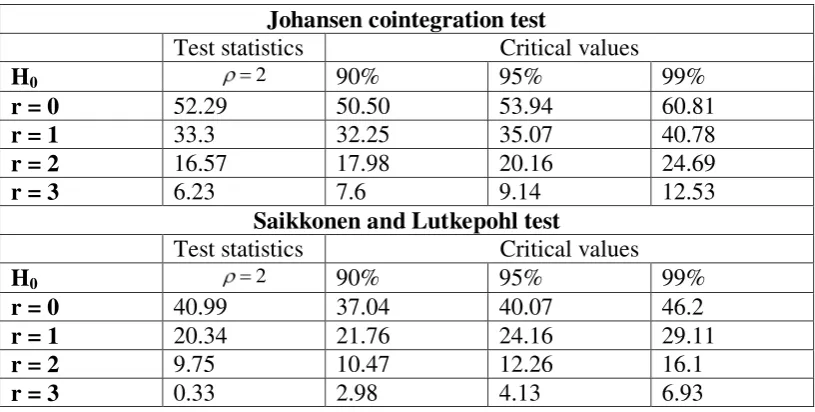
We test for cointegration of the VAR(2) specification with the Johansen (1995) trace and
the Saikkonen and Lutkepohl (2000) tests, with only a constant as the deterministic term. Results in
Table 4 show that both the multivariate cointegrating tests reject zero cointegrating relations, while
the existence of one cointegrating vector is not rejected.
(Table 4 here)
The VECM based on the VAR(2), under the rank restriction r = 1, can be specified as:
1 '
1 0 1
p
t t i t i t
i
y y y u (2)
Table 5 shows the Johansen ML estimate of the cointegrating relation, where the exclusion
of the insignificant parameters is based on the top-down algorithm ( AIC criteria) and it is
normalized on the saving ratio. This cointegrating vector is the long run equilibrium relationship
between the saving rate stock price, house price inflation, and the nominal interest rate. All the
coefficients are statistically significant and have the expected signs. Also, the estimates of the
adjustment coefficients ( )has the correct negative sign and significant at the 1% level.2 This is an
important evidence that the variables explaining MEW viz., house price inflation and mortgage
rate, play an important role in explaining the saving ratio in our sample.
(Table 5)
2.2 Structural identification and impulse response analysis
2
Having specified the reduced-form model, we now examine the structural analysis. In the VEC
framework the following restrictions are needed to analyze the effects of structural shocks with the
moving average representation of the model:3
*
1
( )
t
t t t
i
L
x (3)
where the matrix CB represents the permanent component of the model, and the matrix
polynomial *( )L C*( )L Bthe transitory or cyclical component. The vector of the structural shocks
is given by
' 500
, h, ,
i p sp sav
t . We proceed to identify the shocks by imposing restrictions on
the long-run impact matrix CB:
* 0 0 0 * * 0 0 * * * 0 * * * 0
CB
We need 1 ( 1) 6
2K K linearly independent restrictions. Cointegration analysis suggests that
the saving ratio is stationary. Accordingly, saving shocks have no long-run impact on the other
variables, which correspond to four zeros in the last column of the matrix CB. This reduces the
rank of CB, and implies K* 3 linearly independent restrictions. To identify the K* 3 permanent
shocks, K*(K* 1)/ 2 3 additional restrictions are necessary. We assume that the long-term interest
rate influences asset prices in the long run, but not the opposite. This is because long-term interest
rates commove mainly with fed funds in the long period (Mehra, 1996) and the Fed does not target
asset prices directly (Bernanke and Gertler 1999). The last assumption is that house prices are more
exogenous than stock prices, that is, stock prices respond to house price shocks, but the opposite is
not true. This assumption comes from the fact that in the last 20 years the housing market seems to
have had a more independent dynamics (Leamer 2008).4
3
For a derivation see Lutkepohl and Kratzick (2004).
4
However, we have proved that the position can be changed between sp500 and 4ph and the results do not change.
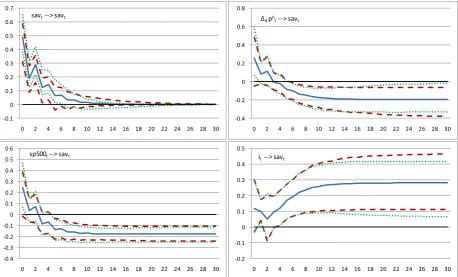
Figure 1 shows the responses of the saving ratio to a stock price, house price inflation, and
mortgage rate shock together with 95% bootstrap confidence intervals based on 2000 replications
over a simulation period of 30 quarters. The signs of the dynamic responses are as expected. A
positive saving ratio shock has a significant positive impact on itself for about two years. In the long
run there is no significant effect, which is in line with the restriction in the long-run matrix. A
positive stock price shock, instead, causes an initial positive response of the saving rate, but it is
insignificant. The effect on the saving ratio becomes negative and significant only after about four
quarters. In the long run this effect remains significant. Similar observations apply to a positive
shock to house price inflation. Finally, the saving ratio increases after a shock to the mortgage rate
and is significant after about 4 quarters.
(Figure 1 here)
Overall, IRF analysis suggests that: (a) asset prices and mortgage rate shocks have an impact
on saving with some delay; (b) MEW shocks have played an important role in saving during the last
20 years.
3. Conclusions
In this paper we have investigated the dynamics of the personal saving ratio in the US economy for
the last two decades, a period of huge declines in the saving ratio. We found that the variables
explaining the MEW, viz., house price inflation and mortgage rate, and stock prices enter the
long-run relationship of the saving ratio. We have estimated with VEC this long long-run relationship and a
structural form with restrictions on the long-run impact matrix. Impulse responses showed that the
saving ratio responds negatively to asset price shocks and positively to mortgage rate shocks and
these are consistent with the underlying theories and empirical results.
References
Bernanke, B. S., and Gertler, M. 1999. Monetary policy and asset price volatility. Federal Reserve Bank of Kansas City Economic Review 4: 17–53.
Greenspan, A., and Kennedy, J. 2008. Sources and uses of equity extracted from homes. Oxford Review of Economic Policy 24: 120–144.
Guidolin, M., and La Jeunesse 2007. The decline of the U.S. personal saving rate: Is it real and is it a puzzle? Federal Reserve Bank of St. LouisReview 89: 491–514.
Hatzius, J. 2006. Housing holds the key to Fed policy. Global Economics Paper No. 37, Goldman Sachs.
Johansen, S. 1995. Likelihood-based inference in cointegrated vector autoregressive models. Oxford: Oxford University Press.
Juselius, K. 2001. Big shocks, outliers and interventions. A cointegration and common trends analysis of daily bond rates. Mimeo, European University Institute, Florence.
Juselius, K. 2006. The cointegrated VAR model: Methodology and applications. Oxford: Oxford University Press.
Leamer, E. E. 2008. Housing is the business cycle. Proceedings, Federal Reserve Bank of Kansas City: 359–413.
Mehra, Y. P. 1996. Monetary policy and long-term interest rates. Federal Reserve Bank of Richmond Economic Quarterly 82: 27–49.
Lutkepohl, L., and Kratzick, M. 2004. Applied time series econometrics. Cambridge: Cambridge University Press.
Appendix: Tables and figures
Table 1: DOLS estimates of active MEW
Model t / t t 0 1tmtg 2 4 th k 1,j t jmtg k 2,j ( 4 t jh ) t
j k j k
amew yd MEWRAT i p i p
Long-run relation MEWRATt 0 1itmtg 2 4pth ut
Sample Period 0 1 2
1991q1–2008q2 -3.744* -0.298*** 0.099***
Phillips–Ouliaris test -4.23***
Note: *, **, *** represent, respectively, the significance levels of 10%, 5%, and 1%. amew and yd
are expressed in natural logarithm. Leads and lags of DOLS estimations are selected according to HQ criteria. The sample period denotes the range of data before the data points for leads and lags are removed. Newey–West corrected t-statistics are applied in regression.
Table 2: Diagnostic tests for VAR(2) specifications
16
Q *
16
Q LM5 LJB4L MARCHLM(5)
2 210.7
[0.73] 234.38 [0.30] 95.96 [0.11] 19.82 [0.01] 549.0 [0.06]
Note: p-values in brackets. Qp = multivariate Ljiung–Box portmentau test tested up to the th lag;
LM = LM (Breusch–Godfrey) test for autocorrelation up to the th lag; L p
LJB = multivariate Lomnicki–Jarque–Bera test for non-normality from Lutkepohl (2004) with pvariables in the
[image:9.595.73.524.559.648.2]system; MARCHLM( ) = multivariate LM test for ARCH up to the th lag.
Table 3: Specification tests for VAR(2) model
Univariate normality test for
sav sp500
4ph imtg
Norm(2) 0.512
[0.774] 12.919 [0.00] 5.36 [0.069] 4.262 [0.119]
Skewness 0.151 -0.404 -0.215 0.51
Table 4: Multivariate cointegration tests
Johansen cointegration test
Test statistics Critical values
H0 2 90% 95% 99%
r = 0 52.29 50.50 53.94 60.81
r = 1 33.3 32.25 35.07 40.78
r = 2 16.57 17.98 20.16 24.69
r = 3 6.23 7.6 9.14 12.53
Saikkonen and Lutkepohl test
Test statistics Critical values
H0 2 90% 95% 99%
r = 0 40.99 37.04 40.07 46.2
r = 1 20.34 21.76 24.16 29.11
r = 2 9.75 10.47 12.26 16.1
r = 3 0.33 2.98 4.13 6.93 Notes: Deterministic term: constant in the cointegrating relationship.
Table 5: Cointegration vector and loading parameters for VECM with two lagged differences and cointegrating rank r =1
500 sp
4ph imtg sav constant
-1.6 (3.6)
-0.042 (2.1)
0.469 (2.9)
1 11.48
(2.87) -0.014
(1.78)
-0.276 (1.86)
- -0.404
(5.25)
[image:10.595.51.542.410.488.2]Figure 1: Impulse response analysis
-0.1 0 0.1 0.2 0.3 0.4 0.5 0.6 0.7
0 2 4 6 8 10 12 14 16 18 20 22 24 26 28 30
savt--> savt
-0.4 -0.2 0 0.2 0.4 0.6 0.8
0 2 4 6 8 10 12 14 16 18 20 22 24 26 28 30 Δ4 pht--> savt
-0.4 -0.3 -0.2 -0.1 0 0.1 0.2 0.3 0.4 0.5 0.6
0 2 4 6 8 10 12 14 16 18 20 22 24 26 28 30
sp500t--> savt
-0.2 -0.1 0 0.1 0.2 0.3 0.4 0.5
0 2 4 6 8 10 12 14 16 18 20 22 24 26 28 30