Negru, C. and Mocanu, M. and Cristea, V. and Sotiriadis, Stelios and Bessis,
N. (2017) Analysis of power consumption in heterogeneous virtual machine
environments. Soft Computing 21 (16), pp. 4531-4542. ISSN 1432-7643.
Downloaded from:
Usage Guidelines:
(will be inserted by the editor)
Analysis of Power Consumption in Heterogeneous Virtual
Machine Environments
Catalin Negru · Mariana Mocanu · Valentin Cristea · Stelios Sotiriadis ·
Nik Bessis
Received: date / Accepted: date
Abstract Reduction of energy consumption in Cloud computing datacenters today is a hot a research topic, as these consume large amounts of energy. Further-more, most of the energy is used ineciently because of the improper usage of computational resources such as CPU, storage, and network. A good balance be-tween the computing resources and performed workload is mandatory. In the context of data-intensive applica-tions, a signicant portion of energy is consumed just to keep alive virtual machines or to move data around without performing useful computation. Moreover, het-erogeneity of resources increases the degree of diculty, when try to achieve energy eciency. Power consump-tion optimizaconsump-tion requires identicaconsump-tion of those inef-ciencies in the underlying system and applications. Based on the relation between server load and energy consumption, we study the eciency of data-intensive applications, and the penalties, in terms of power con-sumption, that are introduced by dierent degrees of
Catalin Negru - Principal Author,
Computer Science and Engineering Department, University Po-litehnica of Bucharest,Romania E-mail: [email protected] Mariana Mocanu
Computer Science and Engineering Department, Univer-sity Politehnica of Bucharest, Romania E-mail: [email protected]
Valentin Cristea
Computer Science and Engineering Department, Uni-versity Politehnica of Bucharest, Romania E-mail: [email protected]
Stelios Sotiriadis - Corresponding Author,
The Edward Rogers Sr. Department of Electrical and Com-puter Engineering, University of Toronto, Canada E-mail: [email protected]
Nik Bessis
Department of Computing, Edge Hill University, UK E-mail: [email protected]
heterogeneity of the virtual machines characteristics in a cluster.
Keywords Cloud computing · Energy-Eciency ·
Virtualization·Data Intensive-Applications
1 Introduction
Nowadays, Cloud computing datacenters consume large amounts of energy. By 2020 these will use approxi-mately 140 kilowatt-hours. The usage on large scale of the services provided by Cloud led to this situation. So, there is an urgent need to reduce the consume of energy. A possible way to reduce the energy consumption is to improve resource utilization. Virtualization tech-nology, permits the independence of servers and oers a new way to improve the data center energy eciency by assignment of multiple virtual machines (VMs) to a sin-gle physical server. The problem is represented by the low utilization of virtual machines. Resources, such as CPU, memory, storage, and network, consume energy even when they are in idle state [2].
Resource provisioning problem is very challenging as we encounter a great diversity of workloads (e.g. computationally-intensive, data-intensive, and hybrid), dierent usage patterns (e.g. static, periodic, once-in-a-lifetime, unpredictable, and continuously changing), and virtual machine heterogeneity. For instance in the case of data-intensive applications a signicant portion of energy is used just to keep virtual machines alive or move data around without performing a useful com-putation. Furthermore, reducing power consumption at the data center level has serious implications over the usage cost.
patterns. What happens when we have to deal with workloads that are computational intensive or data-intensive?How is better regarding the energy consump-tion, to use virtual machine instances, with low re-sources (e.g. CPU, RAM, Disk and bandwidth) and to process tasks in a longer time, or to use virtual machine instances with high resources and to process tasks in a shorter time? Also, what are the implications of virtual machine heterogeneity over the energy consumption? So, in order to study the optimization of power con-sumption, we need in the rst place, to identify the ineciencies in the underlying system. So, heterogene-ity of virtual machines has a great deal of importance in power consumption.
Applications for smart-cities and cyber-infrastructures are data intensive and are I/O bounded. These dedicate a signicant part of execution time to the data move-ment process, and in consequence need a high band-width data access rate. If the available bandband-width is less than required, the CPU is held idle until data sets are available. So, a virtual machine that is idle for a certain amount of time, will consume much more en-ergy. Additionally, a heterogeneous environment con-tribute to the waste of energy especially in the case of data-intensive applications. This happens because of the resource characteristics diversity such as CPU, bandwidth and RAM memory in virtual machines.
Also, Big Data applications can help to uncover the ne interactions between data. In this way we are al-lowed to manipulate hidden, often-counterintuitive, lev-els that directly impact dierent domains and activities. Moreover, these applications can bring up new opportu-nities for business and consumer through modern mar-keting and networking technologies using an inclusive social and technological environment [35], [37]. Also, there are tools that supports managers in identifying forthcoming disruptive technologies and provide them with tailored strategic options [28].
Fields such as environmental research, disaster man-agement and information in relief operations, decision support systems, crowd-sourcing, citizen sensing and sensor web technologies, need to make use of new and innovative tools and methods for Big Data, in order to be more ecient. So, we must be able to analyze all data in order to get the promoted benets. For instance, a decision support system can give better and accurate indications in a crisis situation.
As shown by the authors of [53] the measurement of energy consumption in a virtual machine can be made by measuring the usage of the machine. So, there is a direct relation between server load and consumption of energy. Based on this relation we try to evaluate what
are the penalties in terms of power consumption intro-duced by the heterogeneity of virtual machines.
This paper extends the work presented in [39]. The main contributions can be summarized as follows:
we analyze the methods for power metering at vir-tual machine level;
we identify ineciencies of big-data applications; based on the relation between virtual machine load
and power consumption, we present an approach for evaluating the impact of virtual machine het-erogeneity on power consumption in a datacenter; The paper is structured as the following: In Section 1, is presented the importance of power consumption optimization in Cloud computing data centers. Also, here are presented the questions and implications that arise when performing power consumption optimiza-tion. In Section 2, are presented previous related work for the power consumption optimization of virtual ma-chines. Section 3 presents our approach for the impact evaluation of the virtual machine heterogeneity over the power consumption in a Cloud computing datacenter. Section 4 presents the Big Data applications and key issues regarding the energy consumption. In Sect. 5, the experimental setup, use case scenarios, results and analysis of the obtained results are presented. Finally in Sect. 6, the conclusions and future work are presented.
2 Related work
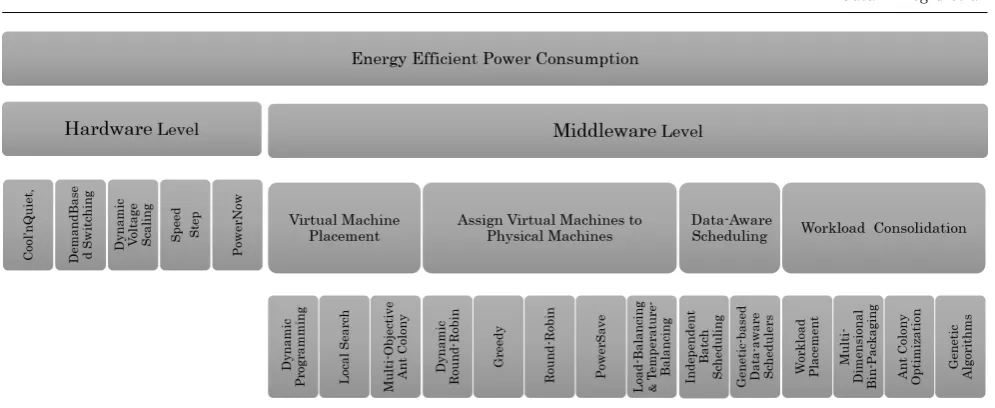
The problem of virtual machines ecient power con-sumption in Cloud computing infrastructures is very intense studied. Given the heterogeneous nature of re-sources, workloads and, usage patterns this is still a challenging problem. Surveying the literature we can distinguish few important research directions for power ecient Cloud computing.
Another research direction that we have identied in the scientic literature refers to virtual machine place-ment problem. Also, dierent methods and algorithms has being proposed. For instance, in [19] the authors propose an algorithm that use methods like dynamic programming and local search in order to place in an energy-ecient way, previous created copies of virtual machines in order to meet the QoS, on the physical servers. An algorithm for virtual machine placement, designed to increase environmental sustainability in the context of distributed data centers with dierent carbon footprint and power utilization eciency is presented in [23]. The results obtained from the simulation shows a reduction of CO2 and power consumption,
maintain-ing the same level of quality of service. Furthermore, a multi-objective ant colony system algorithm for mini-mization of total resource wastage and power consump-tion is proposed in [17]. The authors compare the al-gorithm with existing multi-objective genetic alal-gorithm and two single-objective algorithms. In [21] is proposed a decentralized strategy for genetic scheduling in het-erogeneous environments that uses a combination of ge-netic algorithms and lookup services for obtaining a scalable and highly reliable optimization tool.
Energy-ecient scheduling algorithms that assign virtual machines to physical machines represent an-other research direction that we have identied. For ex-ample, an algorithm, that aim to minimize total power consumption of physical machines in the datacenter, by assigning eciently virtual machines is presented in [47]. The results obtained show 24.9% power saving and nearly 1.2% performance degradation. Also, an al-gorithm called Dynamic Round-Robin for energy-aware virtual machine scheduling and consolidation is pro-posed in [31]. Compared with other strategies such as Greedy, Round-Robin and PowerSave implemented in Eucalyptus, this reduces a signicant amount of power. In [33] the authors propose and implement a virtual machine scheduling heuristics that take into consider-ation load-balancing and temperature-balancing with the aim of reducing the energy consumption in a Cloud data center.
Energy ecient, data-aware scheduling is also a ma-jor research direction. In Cloud computing, it pose ad-ditionally challenges, as data is stored and accessed on a large scale from distributed servers. In this situation the energy consumption reduction represents the prin-cipal scheduling objective. In [26], the authors deal with the problem of independent batch scheduling in grid en-vironment as a bi-objective minimization problem with makespan and energy consumption as the scheduling criteria. Also in [27],are presented two implementations of classical genetic-based data-aware schedulers of
in-dependent tasks submitted to the grid environment. In [5] is optimized the energy eciency of message ex-changing for service distribution in interoperable infras-tructures. The authors consider two use cases. First, a requester sends messages to all interconnected nodes and gets messages only from resources available to ex-ecute it and second, the requester sends one message for all of the jobs of its local pool and gets a respond from available nodes, and then obtainable resources are ranked and hierarchically categorized based on the per-formance criterion e.g. latency competency. Also in [6] the authors propose a novel message-exchanging opti-mization model to reduce energy consumption in dis-tributed systems. They aim to achieve the optimiza-tion of the energy consumpoptimiza-tion for communicaoptimiza-tion and to improve the overall system performance. The inter-cloud concept [49] encompasses the interconnectivity of node and authors of [5], [6] developed the inter-cloud meta-scheduling simulation framework [48] to evaluate the energy eciency of message exchanging.
Workload consolidation represents also an impor-tant research direction, as it permits to place the work-load on fewer physical machines, taking into considera-tion as a principal parameter the machine load. In this way is achieved the reduction of the power consump-tion. Usually, the workload placement problem is mod-eled as a multi-dimensional bin-packaging problem, as expressed in [45], [42], [29]. Moreover, meta-heuristics such as Ant Colony Optimization [14], [15], [17], Ge-netic Algorithms [25], [46], [44], [24] are used for power consumption optimization.
More recent research directions are in the domain of security. One example is prevention of some energy oriented distributed denial of service (e-DDoS) attacks. These attacks are characterized by the fact that do not produce direct damage or block the activity of the tar-geted infrastructure, but instead generate an anoma-lous and sustained power consumption on the target side. In this way, IT equipment and facilities such as air conditioning, heating and ventilation are aected, their lifetime is reduced signicantly. Also, this type of attacks increases energy bills, drastically [16].
Fig. 1 Energy ecient power consumption taxonomy
3 Virtual machine power metering
Server virtualization represents one step further in power consumption optimization in Cloud computing data-centers, permitting eective, ecient energy manage-ment. In order to optimize power consumption, we have to measure the power consumption on per-virtual ma-chine basis in an accurate and ecient way. In [36] the authors provide a comprehensive survey of proposed approaches for estimating the power consumption of single-core as well as multi-core processors, virtual ma-chines, and an entire server.
The virtual machine power models for power con-sumption metering proposed in literature can be classi-ed in two categories: utilization-basclassi-ed models [32],[8], [3] and performance-monitor-counter models [30], [7], [4]. The rst category of models assume that a server resources (e.g. CPU, memory, disk) consume of energy is linear with his utilization [36]:
Pserver=Pstatic+
X
j∈J
(kj·Uj), (1)
where:
Pstatic - xed power consumption when there is no
workload;
Uj - utilization of physical component;
kj - the dynamic power coecient;
J =CP U, RAM, Disk, I/O - set of power
consum-ing components.
Starting from equation 1, can be obtained the most used virtual machine power model:
Pivm=Pstatic
M ·
X
j∈J
(kj·Uj), (2)
where:
Wi- the processor utilization of the virtual machine;
M - the number of active VMs on a server.
Performance monitor counter models are based on software components called counters, that monitor the performance of the physical server oering a real-time method for power consumption monitoring. These coun-ters are supported by all modern processor architec-tures. The power model for a virtual machine using performance monitor counter models can be expressed as follows:
Pivm(t1, t2) =
X
j∈J
Pijvm(t1, t2), (3)
where:
Pijvm(t1, t2) - the power consumption consumed by
physical component j in time interval[t1, t2].
The authors of [1], in order to formulate the prob-lem of power consumption minimization, propose the following objective function:
P(π) = X i∈[1,m]:Ai6=
(µ X
dj∈Ai
(l(dj)α+b), (4)
where:
π={A1, . . . Am}- set of virtual machines;
l(dj)- load of a virtual machine;
µ- dynamic power coecient;
b - static power consumption.
Then the power consumption function for a set of virtual machines can be express as following:
P(π) = m
X
i=1
Further in our paper we used Equation( 4) to quan-tify the power consumption for our considered set of virtual machines.
4 Big Data Applications
Big Data represents a paradigm for the advancing trends in technology that propose a new approach in the pro-cess of decision-making. Moreover, it means to deal with huge amounts of heterogeneous data, and ask for a pipeline of processing operations. The aim is to oer support in the decision-making process. An important challenge, besides the large volumes and high-speed pro-duction rates (e.g. velocity), is raised by the data het-erogeneity (e.g. variety). The most important Big Data characteristics are volume, variety, velocity, value, ve-racity, volatility and vicissitude.
Data volume is the main challenge, because tradi-tional storage systems(e.g. relatradi-tional databases) did not succeed to handle volumes of data in terms of terabyte and petabyte levels. Developments in dierent areas such as Cyber-infrastructures, Smart Cities, e-Health, Social Media, Web 3.0, etc., has led to large amounts of data, and these data are often unstructured or semi-structured, with a high level of heterogeneity.
Variety characteristic refers to dierent data for-mats and sources such as data from sensors, documents, emails, social media texts, mobile devices etc. Veloc-ity refers to the data acquisition rate, as data can be acquired at dierent speeds. The value property illus-trates the potential gain of data, obtained after some processing operations.
Veracity characteristic describes how accurate is data collected from dierent sources. For example, data gath-ered from a social media website have a specic degree of accuracy, in other words represents the uncertainty in data. Veracity ensure that used data are trusted, au-thentic and protected for unauthorized access and mod-ication. Furthermore, the data must be secured during the whole their lifecycle from collection to storage [13]. Vicissitude property refers to the challenge of scal-ing Big Data complex workows. This property signies a combination between the large volume of data and the complexity of processing workow, which prevent to gather useful insights in data [18].
4.1 Real-Time Data Access and Processing
The batch data processing has the following workow of operations: data collection, send to the processing system, process, and extract the results. This is an ef-cient way to process high volumes of data. This type
of processing requires separate applications for input, process and output.
In contrast with batch data processing, real time data processing implies a input, process and output of data in a continuous mode. This means that data need to be processed in a small time. Moreover, there are two categories of data:
predicted data - that has value at the given moment in time);
measured data - value remains forever (e.g. sensor data) which represents historical data.
Mining the instantaneously valued data requires a real time platform. Also, a method of dynamic pattern identication for logically clustering log data is needed. The method must be a real time and generalized solu-tion to the process of log le management and analy-sis. For instance, a monitoring platform for water data management needs to access distributed data sources (e. g. sensor networks, mobile systems, data repository, social web, and so on). Next, this data has to be pro-cessed for preventing natural disasters such as water pollution and to alert the possible aected people [38]. Frameworks such as MapReduce [12], Dryad [22] are used for large-scale data processing. Users write parallel computations with the aid of high-level opera-tors, without paying attention to data distribution or fault tolerance. These systems are batch-processing sys-tems and are not designed for real-time processing and this is an important disadvantage. A possible solution for real-time data streaming processing is provided by Storm [51] and Spark [50]. Storm is used at Twitter for real-time distributed processing of stream data.
In the context of Big Data traditional technologies for the data processing and analysis are not ecient. There is an imperative need to discover valuable knowl-edge in data in order to gain help in decision mak-ing process. Dierent challenges are encountered when dealing with big data handling, from data capture to visualization. Moreover, sources of data are heteroge-neous, geographically distributed, and unreliable, being susceptible to errors. As a consequence we face with databases that are populated with inconsistent, incom-plete and noisy data. Therefore, several data prepro-cessing techniques, such as data reduction, cleaning, integration, data transformation, must be applied to re-move noise and correct inconsistencies in order to help in decision-making process.
key-value storage), focus on the scalability and high-performance, while the management part, is built on low-level access mechanisms, meaning that related tasks to data management can be implemented in the appli-cation layer. For instance, three operators are dened for data cleaning tasks:
fuzzy lookup - used to perform record matching; fuzzy grouping - used for deduplication;
column segmentation - uses regular expressions to segment input strings.
In this way, NoSQL databases provide exible mecha-nisms for data handling and application developments. Moreover, deployments can be easily updated.
Many elds(e.g. scientic, business, etc.) can bene-ts from Big Data with the condition to solve the chal-lenges, which arise in data storage, capture, cleaning, analysis and visualization.
4.2 Energy Ecient Processing in Big Data Platforms
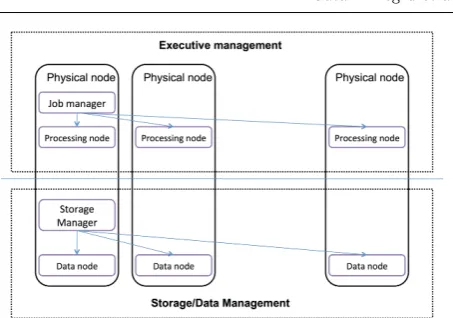
A Big Data processing platform is composed by two parts, a job manager and a storage manager. First one coordinates the processing nodes, and the second one coordinate the storage nodes. An examples is Apache Hadoop [10] composed by a set of open source applica-tions that are used together to provide a Big Data pro-cessing solution. HDFS and YARN are the main com-ponent of Hadoop. YARN coordinates the processing nodes and HDFS the storage nodes. Fig. 2 presents the general architecture of Big Data platforms.
Hadoop distributed le system (HDFS) is organized in clusters where each cluster consists of a name node and several storage nodes. A large le is split into blocks and name node takes care of the persisting parts on data nodes. The name node maintains metadata about the les and commits updates to a le from a temporary cache to the permanent data node. The data node does not have knowledge about the full logical HDFS le; it handles locally each block as a separate le. Fault tol-erance is achieved through replication; optimizing the communication by considering the location of the data nodes (the ones located on the same rack are preferred). A high degree of reliability is realized using "heartbeat" technique (for monitoring), snapshots, metadata repli-cation, checksums (for data integrity), and re-balancing (for per-formance) [9].
[image:7.595.305.532.74.233.2]YARN, the version 2.0 of MapReduce, implements a master/slave execution of processes with a JobTracker master node and a pool of Task-Trackers that do the work. JobTracker has two main responsibilities, man-agement of resources and job scheduling/monitoring.
Fig. 2 Organization of resources in a big-data platform
Also, there is a global resource manager (RM) per appli-cation, and an Application Master (AM). The slave has a node entity named Node Manager (NM) which is do-ing the computations. The AM negotiates with the RM for resources and monitors task progress. Other com-ponents are added on top of Hadoop in order to create a Big Data ecosystem capable of conguration man-agement (Zookeeper), columnar organization (HBase), data warehouse querying (Hive), easier development of MapReduce programs (Pig), and machine learning al-gorithms (Mahout).
In Big Data platforms each layer (e.g. operating systems, databases and environments, computing solu-tions, data operations and analytics and data sources) of the processing stack impose power issues, as can see in the Fig. 3. First, the usage of virtual machine com-ponents (e.g. CPU, storage, RAM and network) have a direct inuence on power consumption of the hardware components. Operating systems, databases and envi-ronments have direct impact on the hardware usage and thus on power consumption. Computing solutions produce the system behavior power consumption fac-tor. Data operations and analytics have eect on data movement and processing. Finally, data sources pro-duce eects in memory and storage components.
So, in order to optimize the energy consumption of the underling hardware, every processing step should be optimized. For instance, this could mean optimized reads and writes from memory and storage, ecient data movement and processing, improved system be-havior.
5 Impact Evaluation on Power Consumption of Virtual Machines Heterogeneity
Fig. 3 Energy eciency issues Big Data processing
with dierent degrees of heterogeneity. To achieve our goal, we used multiple sets of virtual machines having dierent heterogeneity degrees. Each set is composed by four instances. Further, we increase gradually the degree of heterogeneity and calculated the power con-sumption for dierent degrees of heterogeneity. Regard-ing the workload type, we chose to perform a data-intensive job, all machines sending and receiving simul-taneously a le of 200M B. At every 15 seconds we get
the server load on every machines until the job is done. In the rst experiment we start four identical ma-chines and performed the data transfer job. In the sec-ond experiment we used three identical instances and the forth instance was dierent. For the third exper-iment we used two machines of one type and two of other type. In the fourth experiment we used three dif-ferent sets of virtual machines. In the last experiment, all machines were dierent, having the highest degree of heterogeneity.
In the second place, we want to evaluate the ence in terms of power consumption between two dier-ent Hadoop clusters with same computing power when running the same workload. Regarding the workload type we run three benchmarks, TeraGen, TeraSort and TeraValidate. TeraGen was used to generate 10GB of random distributed data, TeraSort was used to sort the data and TeraValidate was used to validate the sorted data. These benchmarks are commonly used to measure MapReduce performance of an Apache Hadoop cluster. We used the following formula in order to calculate the power consumption and it is based on Equation 5:
P(4) = 4
X
i=1
(l(i)3+ 0.1), (6)
where:
i represents a virtual machine instance; α= 3;
Fig. 4 Full mesh logical topology
b= 0.1;
µ= 1.
5.1 Experimental Setup
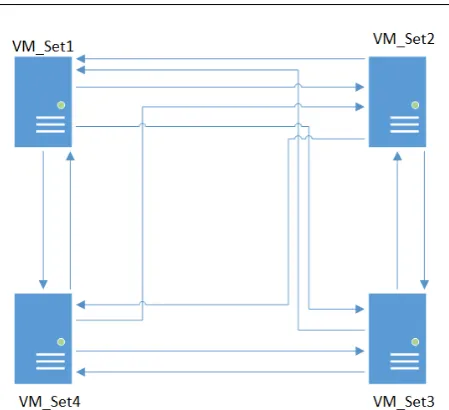
We create two dierent experimental setups. First, in order to perform a data-intensive job, we interconnected all machines together in a full mesh logical topology as shown in Fig. 4. Further, each virtual machine sends and receive data. We used four types of virtual ma-chines from Microsoft Azure Cloud [34] with dierent CPU and RAM memory characteristics presented in Table 5.1: Basic A0, Basic A1, Basic A2 and Basic A3 instance types.
Secondly, in order to evaluate power consumption in a Hadoop MapReduce cluster, we used two dierent Hadoop clusters with same computing power. Cluster 1 has six worker nodes (with the following characteris-tics:1 virtual CPU and 3.75 GB RAM memory) and one master node (with 2 virtual CPUs and 7GB RAM mem-ory). Cluster 2 has three worker nodes and one master node. All virtual machines has the same conguration, 2 virtual CPUs and 7GB RAM memory.
[image:8.595.46.277.83.234.2]VM type Cores RAM (GB) Disk (GB) Basic A0 0.25 0.75 30
Basic A1 1 1,75 30 Basic A2 2 3,00 30 Basic A3 4 7,00 30
[image:9.595.43.535.87.485.2]Table 1 Azure instances types that have been used in experi-ments
Fig. 5 Experiment 1: Homogeneous environment
5.2 Results
5.2.1 Evolution of server load
In order to understand the eect of heterogeneity on power consumption of the machines, we present the evolution of server load in a for dierent degrees of heterogeneity. In the rst experiment, we considered a homogeneous environment. In this setup the type of virtual machines is "Basic A0". The evolution of server load is presented in the Fig. 5. As can we see the load has same evolution pattern on all machines.Moreover, al machines nish the data transfer in the same time.
In the second experiment, we considered an hetero-geneous environment with three identical sets of virtual machines formed from "Basic A0" instance types and one dierent with "Basic A1" instance type. The evolu-tion of server load is presented in Fig. 6. We can observe a more random evolution pattern with large uctua-tions of the load. "Basic A1" instance types nish rst the transfer and have to wait for the rest of instances to nish the data transfer.
In the third experiment we increased the degree of heterogeneity. We interconnected two sets of virtual machines with dierent characteristics. First set has "Basic A0" instance types and the second one has "Ba-sic A1". In the Fig 7 is presented the evolution of server load. As can we observe the sets with identical machines has the same evolution pattern. Moreover, the virtual machines with higher performance characteristics (e.g. Basic A1) nish the transfer before the other instance
Fig. 6 Experiment 2: Heterogeneous environment
[image:9.595.303.530.415.544.2]Fig. 7 Experiment 3: Heterogeneous environment
Fig. 8 Experiment 4: Heterogeneous environment
types. These have to wait for the slower machines to nish the transfer.
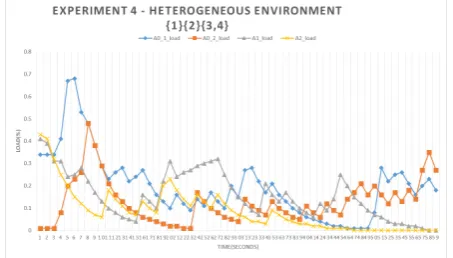
For the fourth experiment we have increased the de-gree of heterogeneity. We've interconnected three dier-ent sets of instances (e.g. Basic A0, A1 and A2). The evolution of server load is presented in Fig. 8. As can we see an irregular pattern of the load evolution and the range of load values increased. Also, "Basic A2" instance type nish rst the transfer followed by the "Basic A1" and "Basic A0".
Fig. 9 Experiment 5: Heterogeneous environment
Fig. 10 Hadoop cluster 1 load evolution
load in this type of environment. The powerful instances A2, and A3 nish the job much faster, approximatively after 100 second and have to wait for the other less powerful virtual machines.
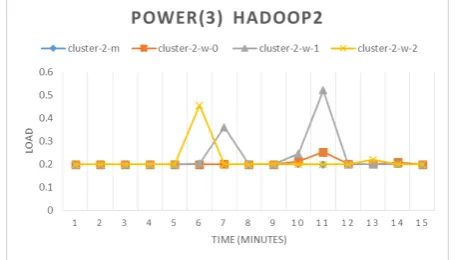
In the second part of our experiment we measured the evolution of load on two dierent Hadoop clusters, while performing a MapReduce benchmark(e.g. Tera-Gen, TeraSort and TeraValidate.) The load evolution for the rst cluster is presented in Fig. 10 and for the second cluster is presented in Fig. 11.
Comparing the load evolution of the two clusters we can observe that the rst cluster need more time to generate (approximately ve minutes more), sort and validate the data than the second cluster. We can also observe that the cluster nodes are not equally balanced.
5.2.2 Power Consumption
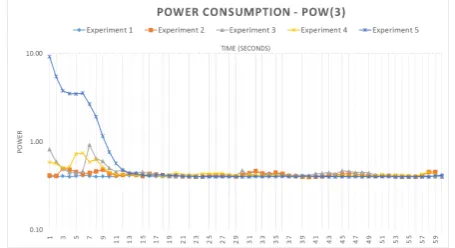
In the Fig. 12 is presented in an aggregated way the evolution of energy consumption over the execution of job. As can we see the environment with highest de-gree of heterogeneity (Experiment 5) consume more power than the homogeneous environment (Experiment 1). Furthermore, we observe that for the Experiment 5 in the rst 15 seconds, which is the time that is needed for the powerful machines to nish the transfer, is con-sumed an important quantity of energy. In the
remain-Fig. 11 Hadoop cluster 2 load evolution
Fig. 12 Power consumption for each experiment
ing time these stay in an idle state while have to wait for the slower machines to nish the transfer and thus consume energy while do not make any useful work.
So, we can conclude that the heterogeneous envi-ronments consume more power because the virtual ma-chines with higher resource characteristics nish the transfer much faster than slower machines and have to wait in an idle for the other virtual machines to n-ish the transfer, consuming power without performing useful computation. The key issue is to reduce the idle time of the virtual machines.
In the Fig. 13 is presented the power consumption for the each experiment performed. As can we see a fully heterogeneous environment consume approximately twice the power of a homogeneous environment.
[image:10.595.46.275.249.381.2] [image:10.595.302.530.257.381.2]Fig. 13 Power consumption for each experiment
Fig. 14 Hadoop cluster 1 power consumption
Fig. 15 Hadoop cluster 2 power consumption
nd the best combination between the conguration of computing resources and workload type.
6 Conclusions and Future Work
In this paper we presented an approach for evaluation of the heterogeneity degree impact on power consump-tion for a set of virtual machines in a Cloud computing environment in the case of data-intensive jobs in virtual machines.
A good balance between workloads, usage patterns and virtual machine computing power is mandatory in order to achieve power eciency. If the virtual machine
utilization is low, and is still running, more power is consumed. As a consequence virtual machines should be dynamically adjusted to match the characteristics of the other virtual machines that performs the job. In this way the degree of heterogeneity decrease and the virtual machines can nish the data transfer in simulta-neously, reducing the energy consumed. The key issue is to reduce the idle time for the used resources.
Results show that the power consumption is pro-portional with heterogeneity degree. This happens be-cause of the fact that powerful virtual machines nish the transfer much more quickly that the less powerful ones, and wait just to receive the data.
As we showed through the paper heterogeneity de-gree has a big impact on power consumption for a set of virtual machines that perform data-intensive tasks. This has also impact on cost, because the cost of en-ergy represent an important component of the cost for services and resources.
For future work more type of workloads can be used in order to quantify more accurate the impact on power consumption. Furthermore, based on these results we can build a job scheduling algorithm that take into consideration the heterogeneity degree for the set of instances that must execute scheduled job, in order to optimize the power consumption at data center level.
Acknowledgements
The work has been funded by the projects: DataWay: Real-time Data Processing Platform for Smart Cities: Making sense of Big Data, PN-II-RU-TE-2014-4-2731; CyberWater grant of the Romanian National Author-ity for Scientic Research, CNDI-UEFISCDI, project number 47/2012;
Compliance with Ethical Standards
The authors of this paper Catalin Negru, Mariana Mo-canu, Valentin Cristea, Stelios Sotiriadis and Nik Bessis declare that they have no conict of interest.
This article does not contain any studies with hu-man participants or animals performed by any of the authors.
References
[image:11.595.47.278.413.543.2]2. Luiz André Barroso, Jimmy Clidaras, and Urs Hölzle. The datacenter as a computer: An introduction to the design of warehouse-scale machines. Synthesis lectures on computer architecture, 8(3):1154, 2013.
3. Andreas Berl and Hermann De Meer. An energy consump-tion model for virtualized oce environments. Future Gen-eration Computer Systems, 27(8):10471055, 2011.
4. Ramon Bertran, Yolanda Becerra, David Carrera, Vicenç Beltran, Marc Gonzàlez, Xavier Martorell, Nacho Navarro, Jordi Torres, and Eduard Ayguadé. Energy accounting for shared virtualized environments under dvfs using pmc-based power models. Future Generation Computer Systems, 28(2):457468, 2012.
5. Nik Bessis, Stelios Sotiriadis, Florin Pop, and Valentin Cristea. Optimizing the energy eciency of message ex-changing for service distribution in interoperable infrastruc-tures. In Intelligent Networking and Collaborative Systems (INCoS), 2012 4th International Conference on, pages 105 112. IEEE, 2012.
6. Nik Bessis, Stelios Sotiriadis, Florin Pop, and Valentin Cristea. Using a novel message-exchanging optimization (meo) model to reduce energy consumption in distributed systems. Simulation Modelling Practice and Theory, 39:104 120, 2013.
7. W Lloyd Bircher and Lizy K John. Complete system power estimation using processor performance events. Computers, IEEE Transactions on, 61(4):563577, 2012.
8. Ata E Husain Bohra and Vipin Chaudhary. Vmeter: Power modelling for virtualized clouds. In Parallel & Distributed Processing, Workshops and Phd Forum (IPDPSW), 2010 IEEE International Symposium on, pages 18. Ieee, 2010. 9. Dhruba Borthakur. Hdfs architecture guide.
HADOOP APACHE PROJECT http://hadoop. apache. org/common/docs/current/hdfs design. pdf, 2008.
10. Dhruba Borthakur, Jonathan Gray, Joydeep Sen Sarma, Kannan Muthukkaruppan, Nicolas Spiegelberg, Hairong Kuang, Karthik Ranganathan, Dmytro Molkov, Aravind Menon, Samuel Rash, et al. Apache hadoop goes realtime at facebook. In Proceedings of the 2011 ACM SIGMOD In-ternational Conference on Management of data, pages 1071 1080. ACM, 2011.
11. Natural Resources Defense Council. America's data centers consuming and wasting growing amounts of energy. 12. Jerey Dean and Sanjay Ghemawat. Mapreduce: simplied
data processing on large clusters. Communications of the ACM, 51(1):107113, 2008.
13. Yuri Demchenko, Paola Grosso, Cees De Laat, and Peter Membrey. Addressing big data issues in scientic data infras-tructure. In Collaboration Technologies and Systems (CTS), 2013 International Conference on, pages 4855. IEEE, 2013. 14. Marco Dorigo and Mauro Birattari. Ant colony optimization. In Encyclopedia of machine learning, pages 3639. Springer, 2010.
15. Eugen Feller, Louis Rilling, and Christine Morin. Energy-aware ant colony based workload placement in clouds. In Proceedings of the 2011 IEEE/ACM 12th International Con-ference on Grid Computing, pages 2633. IEEE Computer Society, 2011.
16. M. Ficco and F. Palmieri. Introducing fraudulent energy consumption in cloud infrastructures: A new generation of denial-of-service attacks. Systems Journal, IEEE, PP(99):1 11, 2015.
17. Yongqiang Gao, Haibing Guan, Zhengwei Qi, Yang Hou, and Liang Liu. A multi-objective ant colony system algorithm for virtual machine placement in cloud computing. Journal of Computer and System Sciences, 79(8):12301242, 2013.
18. Bogdan Ghit, Mihai Capota, Tim Hegeman, Jan Hidders, Dick Epema, and Alexandru Iosup. V for vicissitude: The challenge of scaling complex big data workows. In Cluster, Cloud and Grid Computing (CCGrid), 2014 14th IEEE/ACM International Symposium on, pages 927932. IEEE, 2014.
19. Hadi Goudarzi and Massoud Pedram. Energy-ecient vir-tual machine replication and placement in a cloud computing system. In Cloud Computing (CLOUD), 2012 IEEE 5th In-ternational Conference on, pages 750757. IEEE, 2012. 20. Enhanced Intel. SpeedstepR technology for the intelR
pentiumR m processor, 2004.
21. George V Iordache, Marcela S Boboila, Florin Pop, Corina Stratan, and Valentin Cristea. A decentralized strategy for genetic scheduling in heterogeneous environments. In On the Move to Meaningful Internet Systems 2006: CoopIS, DOA, GADA, and ODBASE, pages 12341251. Springer, 2006. 22. Michael Isard, Mihai Budiu, Yuan Yu, Andrew Birrell, and
Dennis Fetterly. Dryad: distributed data-parallel programs from sequential building blocks. In ACM SIGOPS Operating Systems Review, volume 41, pages 5972. ACM, 2007. 23. Atefeh Khosravi, Saurabh Kumar Garg, and Rajkumar
Buyya. Energy and carbon-ecient placement of virtual ma-chines in distributed cloud data centers. In Euro-Par 2013 Parallel Processing, pages 317328. Springer, 2013.
24. Joanna KoªOdziej and Samee Ullah Khan. Multi-level hier-archic genetic-based scheduling of independent jobs in dy-namic heterogeneous grid environment. Information Sci-ences, 214:119, 2012.
25. Joanna Koªodziej, Samee Ullah Khan, and Fatos Xhafa. Ge-netic algorithms for energy-aware scheduling in computa-tional grids. In P2P, Parallel, Grid, Cloud and Internet Computing (3PGCIC), 2011 International Conference on, pages 1724. IEEE, 2011.
26. Joanna Kolodziej, Magdalena Szmajduch, Tahir Maqsood, Sajjad Ahmad Madani, Nasro Min-Allah, and Samee U Khan. Energy-aware grid scheduling of independent tasks and highly distributed data. In Frontiers of Information Technology (FIT), 2013 11th International Conference on, pages 211216. IEEE, 2013.
27. Joanna Koodziej, Samee U Khan, Magdalena Szmajduch, Lizhe Wang, Dan Chen, et al. Genetic-based solutions for independent batch scheduling in data grids. 2013.
28. Roman Kopetzky, Markus Günther, Natalia Kryvinska, An-dreas Mladenow, Christine Strauss, and Christian Stummer. Strategic management of disruptive technologies: a practical framework in the context of voice services and of computing towards the cloud. International Journal of Grid and Utility Computing, 4(1):4759, 2013.
29. Lawrence T. Kou and George Markowsky. Multidimensional bin packing algorithms. IBM Journal of Research and de-velopment, 21(5):443448, 1977.
30. Min Yeol Lim, Allan Portereld, and Robert Fowler. Soft-power: ne-grain power estimations using performance coun-ters. In Proceedings of the 19th ACM International Sym-posium on High Performance Distributed Computing, pages 308311. ACM, 2010.
31. Ching-Chi Lin, Pangfeng Liu, and Jan-Jan Wu. Energy-aware virtual machine dynamic provision and scheduling for cloud computing. In Cloud Computing (CLOUD), 2011 IEEE International Conference on, pages 736737. IEEE, 2011.
33. Yousri Mhedheb, Foued Jrad, Jie Tao, Jiaqi Zhao, Joanna Koªodziej, and Achim Streit. Load and thermal-aware vm scheduling on the cloud. In Algorithms and Architectures for Parallel Processing, pages 101114. Springer, 2013. 34. Microsoft. Microsoft azure cloud computing platform, 2015. 35. Andreas Mladenow, Natalia Kryvinska, and Christine Strauss. Towards cloud-centric service environments. Jour-nal of Service Science Research, 4(2):213234, 2012. 36. Christoph Mobius, Waltenegus Dargie, and Alexander Schill.
Power consumption estimation models for processors, virtual machines, and servers. Parallel and Distributed Systems, IEEE Transactions on, 25(6):16001614, 2014.
37. Eugen Molnar, Natalia Kryvinska, and M Gregu±. Customer driven big-data analytics for the companies servitization. 38. Catalin Negru, Mariana Mocanu, Costin Chiru, Aurelian
Draghia, and Radu Drobot. Cost ecient cloud-based service oriented architecture for water pollution prediction. In In-telligent Computer Communication and Processing (ICCP), 2015 IEEE International Conference on, pages 417423. IEEE, 2015.
39. Catalin Negru, Mariana Mocanu, and Valentin Cristea. Im-pact of virtual machines heterogeneity on data center power consumption in data-intensive applications. In Adaptive Re-source Management and Scheduling for Cloud Computing. Springer, 2015.
40. Ewa Niewiadomska-Szynkiewicz, Andrzej Sikora, Piotr Arabas, Mariusz Kamola, Marcin Mincer, and Joanna Koªodziej. Dynamic power management in energy-aware computer networks and data intensive computing systems. Future Generation Computer Systems, 37:284296, 2014. 41. Venkatesh Pallipadi. Enhanced intel speedstep technology
and demand-based switching on linux. Intel Developer Ser-vice, 2009.
42. Rina Panigrahy, Kunal Talwar, Lincoln Uyeda, and Udi Wieder. Heuristics for vector bin packing. research. mi-crosoft. com, 2011.
43. Padmanabhan Pillai and Kang G Shin. Real-time dynamic voltage scaling for low-power embedded operating systems. In ACM SIGOPS Operating Systems Review, volume 35, pages 89102. ACM, 2001.
44. Florin Pop, Ciprian Dobre, Valentin Cristea, Nik Bessis, Fatos Xhafa, and Leonard Barolli. Deadline scheduling for aperiodic tasks in inter-cloud environments: a new approach to resource management. The Journal of Supercomputing, 71(5):17541765, 2015.
45. George Prekas, Mia Primorac, Adam Belay, Christos Kozyrakis, and Edouard Bugnion. Energy proportionality and workload consolidation for latency-critical applications. In Proceedings of the Sixth ACM Symposium on Cloud Com-puting, pages 342355. ACM, 2015.
46. Andrei Sfrent and Florin Pop. Asymptotic scheduling for many task computing in big data platforms. Information Sciences, 2015.
47. Mohsen Shari, Hadi Salimi, and Mahsa Najafzadeh. Power-ecient distributed scheduling of virtual machines using workload-aware consolidation techniques. The Journal of Su-percomputing, 61(1):4666, 2012.
48. S. Sotiriadis, N. Bessis, A. Anjum, and R. Buyya. An inter-cloud meta-scheduling (icms) simulation framework: Archi-tecture and evaluation. IEEE Transactions on Services Computing, PP(99):11, 2015.
49. Stelios Sotiriadis, Nik Bessis, and Nick Antonopoulos. To-wards inter-cloud schedulers: A survey of meta-scheduling approaches. In P2P, Parallel, Grid, Cloud and Internet Computing (3PGCIC), 2011 International Conference on, pages 5966. IEEE, 2011.
50. Apache Spark. Lightning-fast cluster computing, apache spark, 2015.
51. Apache Storm. Storm, distributed and fault-tolerant real-time computation. 2014.
52. Mark W Welker and One AMD Place. Amd processor per-formance evaluation guide, 2003.