N A N O R E V I E W
Open Access
Effect of particle size on the thermal conductivity
of nanofluids containing metallic nanoparticles
Pramod Warrier, Amyn Teja
*Abstract
A one-parameter model is presented for the thermal conductivity of nanofluids containing dispersed metallic nanoparticles. The model takes into account the decrease in thermal conductivity of metal nanoparticles with decreasing size. Although literature data could be correlated well using the model, the effect of the size of the particles on the effective thermal conductivity of the nanofluid could not be elucidated from these data. Therefore, new thermal conductivity measurements are reported for six nanofluids containing silver nanoparticles of different sizes and volume fractions. The results provide strong evidence that the decrease in the thermal conductivity of the solid with particle size must be considered when developing models for the thermal conductivity of nanofluids.
Introduction
Recent interest in nanofluids stems from the work of Choi et al. [1] and Eastman et al. [2], who reported large enhancements in the thermal conductivity of com-mon heat transfer fluids when small amounts of metallic and other nanoparticles were dispersed in these fluids. Others [3-9] have also reported large thermal conductiv-ity enhancements in nanofluids containing metal nano-particles, although the effect of particle size, in particular, was not studied explicitly in these experi-ments. In our previous work [10-15], we have reported data for the thermal conductivity of nanofluids contain-ing metal oxide nanoparticles, and critically reviewed [15] these and other data to determine the effect of tem-perature, base fluid properties, and particle size on the thermal conductivity of the nanofluids. These studies have led us to the conclusion that the temperature dependence of the nanofluid thermal conductivity arises predominantly from the temperature-thermal conductiv-ity behavior of the base fluid, and that the effective ther-mal conductivity of nanofluids decreases with decreasing size of dispersed particles below a critical particle size. We have also presented a model [15] based on the geo-metric mean of the thermal conductivity of the two phases to predict the thermal conductivity of the hetero-geneous nanofluid. The model incorporated the size
dependence of the thermal conductivity of semiconduc-tor and insulasemiconduc-tor particles using the phenomenological relationship proposed by Liang and Li [16]. The result-ing‘modified geometric mean model’was able to predict the thermal conductivity of nanofluids containing semi-conductor and insulator particles dispersed in a variety of base fluids over an extended temperature range. In the present work, we propose a similar geometric mean model that incorporates the size dependence of the thermal conductivity of metallic particles.
Previous experimental studies of nanofluids containing metallic particles employed very low volume fractions (<1%) of these particles. As a result, any size depen-dence of the thermal conductivity of the nanofluid was not apparent from these measurements and the data could be correlated using the bulk thermal conductiv-ities of the solid and base fluid. We have now measured the thermal conductivity of nanofluids containing sev-eral volume fractions of silver nanoparticles of three sizes, and fitted the data with a model that incorporates the size dependence of the thermal conductivity of the solid phase. We show that such a model provides a bet-ter representation of the data than models that assume a constant (bulk) thermal conductivity for metallic parti-cles of different sizes.
* Correspondence: [email protected]
School of Chemical & Biomolecular Engineering, Georgia Institute of Technology, Atlanta, GA 30332-0100, USA
The thermal conductivity of metallic nanoparticles
The kinetic theory expression [17] for the thermal con-ductivitykbof bulk metals is given by
kb[T]= (1/3)ρCv,evFλe,b (1)
whereris the mass of electrons per unit volume,Cv,e the volumetric specific heat of electrons, vFthe Fermi velocity, andle,bis the mean free path of electrons in the bulk material. Substituting for electronic specific heat and Fermi velocity in Equation 1 leads to the rela-tionship:
kb(T) =
k2
Bπ2neTλe,b
3mevF
(2)
whereneandmeare the number of free electrons per atom and the mass of an electron, respectively. These values are presented in Table 1 for a number of metals [17]. Equation 2 can be used to calculate the mean free path of electrons in the solid le,b if the bulk thermal conductivity and Fermi energy are known.
Boundary or interface scattering will lead to a decrease in the electron mean free path and will become
signifi-cant when the characteristic sizeL (= diameter of the
particles) is of the same order as the electron mean free path. In this case, Equation 2 implies that the thermal conductivity of the particle will decrease with decreasing size. When L <<le,b, the thermal conductivity of the particlekPcan be expressed as [17]:
kP
kb
= λe,P
λe,b
= 1
Kn (3)
whereKn=le,b/Lis the Knudsen number. WhenLis of the same order asle,b, the effective mean free path of the electron in the particle can be calculated using Mat-thiessen’s rule:
1 λe,P
= 1
λe,b
+1
L. (4)
This leads to the following relationship for the ther-mal conductivity of the particle [17]:
kP
kb
= λe,P
λe,b
= 1
1 +Kn. (5)
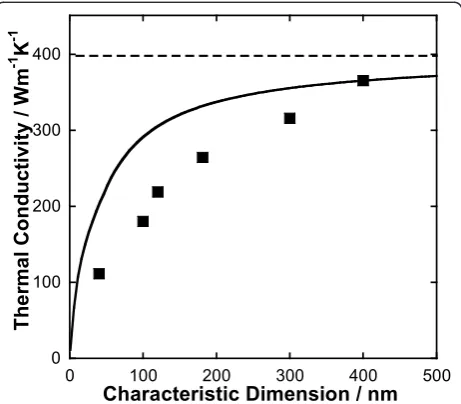
Equations 3 and 5 relate the thermal conductivity of metallic nanoparticles to their characteristic size, and is illustrated in Figure 1 for copper nanoparticles. The solid line in Figure 1 was obtained using Equation 3 to calcu-late the thermal conductivity whenKn > 5, and Eq. 5 whenKn< 1. In the intermediate region (1 <Kn< 5), the thermal conductivity was obtained by interpolation. Although no data are available to validate these calcula-tions, the measurements of Nath and Chopra [18] for the thermal conductivity of thin films of copper (also plotted in Figure 1) clearly show a decrease in the thermal con-ductivity as the thickness of the film decreases. We expect metallic nanoparticles to exhibit similar trends with size. The dashed line in Figure 1 shows the bulk value of the thermal conductivity of copper, which is sig-nificantly higher than the measured values for thin films.
Geometric mean model for the thermal conductivity of nanofluids
In our earlier work [13], we have shown that the ther-mal conductivity of nanofluids can be modeled using the Landau and Lifshitz [19] relation for the thermal conductivity of heterogeneous materials [20,21]:
(keff)n=
kp
n
ϕ+(kl)n(1−ϕ) −1<n<1 (6)
where keff, kp, and klare the thermal conductivities of the nanofluid, particles, and liquid, respectively, andis
the volume fraction of the particles. For n = 1, this
[image:2.595.307.538.466.668.2]equation reduces to the arithmetic mean of the thermal conductivities of the two phases, which provides a good
Table 1 Properties of metals at 298.15 K [17]
kb/W m-1K-1 μF/eV ne1028/m-3 le,b/nm
Silver 424 5.51 5.85 49.10
Copper 398 7 8.45 35.97
Gold 315 5.5 5.9 36.14
0 100 200 300 400
0 100 200 300 400 500
Th
er
m
a
l C
ond
uct
iv
it
y /
Wm
-1 K
-1
Characteristic Dimension / nm
Figure 1Size dependent thermal conductivity of copper. The solid linerepresents the thermal conductivity of copper
[image:2.595.57.292.673.725.2]representation for conduction in materials arranged in parallel. Similarly, when n= -1, Equation 6 reduces to the harmonic mean of the two thermal conductivities, which provides a good representation for conduction in materials arranged in series. Finally, for napproaching zero, Equation 6 reduces to the geometric mean of the thermal conductivity of the two materials as follows:
keff
kl
=
kp
kl
ϕ
(7)
Turian et al. [20] have shown that Equation 7 works well for heterogeneous suspensions in whichkP/kl> 4, whereas the Maxwell model [22] provides a lower bound for the thermal conductivity for dilute suspensions or whenkP/kl ~ 1. We have shown [15] that Equation 7 works well for thermal conductivity enhancement in nanofluids contain-ing semiconductor and insulator particles if we account for the temperature dependence ofkl, as well as the parti-cle size and temperature dependence ofkP. The modified geometric mean model may be expressed as:
keff(L,T,ϕ)
kl(T) =
kp(L,T)
kl(T)
ϕ
(8)
wherekeff(L,T,) is the effective thermal conductivity of the nanofluid as a function of particle size (L), tem-perature (T), and particle volume fraction (), kl(T) is the thermal conductivity of the base fluid as a function of temperature, and kP(L,T) is the thermal conductivity of the particle as a function of particle size and tem-perature. In this work, we calculate kP(L,T) using Equa-tions 3 and 5 as discussed in“The thermal conductivity of metallic nanoparticles” section. Equation 6 is used to fit measurements of the thermal conductivity of nano-fluids withnas the adjustable parameter.
Thermal conductivity of nanofluids
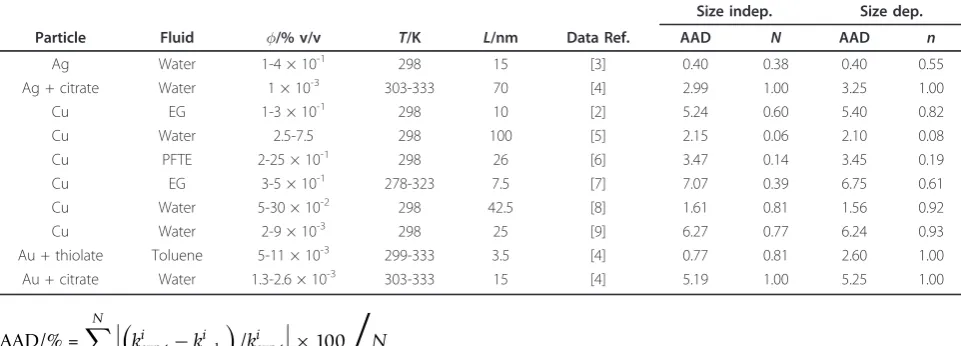
Literature data for nanofluids containing metallic nano-particles were compiled and fitted using Equation 6 with and without considering the size dependence of the thermal conductivity of the particles. Table 2 lists our results for the two cases. Equation 6 is able to fit the lit-erature data for nanofluids containing metallic particles reasonably well. However, values ofnrequired to fit the data are higher than expected, and increase when the
size dependence is considered. High values ofnappear
[image:3.595.57.538.539.712.2]to be related to unusually large thermal conductivity enhancements. For example, enhancements of 80% were reported for 0.3% (v/v) copper nanoparticles [8] in water, and 10% enhancements were reported for as little as 0.005% (v/v) gold nanoparticles in water [4]. By con-trast, Zhong and coworkers [8] report 35% enhancement in the thermal conductivity of nanofluids containing 0.8% (v/v) carbon nanotubes (CNT). As the thermal conductivity of CNT is about an order of magnitude higher than that of copper or gold, we would expect nanofluids containing copper or gold particles to exhibit lower enhancements than nanofluids containing CNTs, or for nanofluids containing CNTs to exhibit much lar-ger enhancements than nanofluids containing copper or gold. Clearly, there are inconsistencies in the literature data. This is also apparent in the results of Li and cow-orkers [7] for 0.5% (v/v) copper particles in ethylene gly-col (EG). Their work reports an increase in the thermal conductivity enhancement from about 10 to about 45% when the temperature increases from 10 to 50°C, but shows no increase in the thermal conductivity of EG with temperature. Finally, we note that many of these experiments employed very low volume fractions of nanoparticles. As a result, it is often difficult to separate size effects in these studies. Therefore, we have
Table 2 Evaluation of the modified geometric mean thermal conductivity model
Size indep. Size dep.
Particle Fluid /% v/v T/K L/nm Data Ref. AAD N AAD n
Ag Water 1-4 × 10⁻¹ 298 15 [3] 0.40 0.38 0.40 0.55
Ag + citrate Water 1 × 10⁻³ 303-333 70 [4] 2.99 1.00 3.25 1.00
Cu EG 1-3 × 10⁻¹ 298 10 [2] 5.24 0.60 5.40 0.82
Cu Water 2.5-7.5 298 100 [5] 2.15 0.06 2.10 0.08
Cu PFTE 2-25 × 10-1 298 26 [6] 3.47 0.14 3.45 0.19
Cu EG 3-5 × 10⁻¹ 278-323 7.5 [7] 7.07 0.39 6.75 0.61
Cu Water 5-30 × 10-2 298 42.5 [8] 1.61 0.81 1.56 0.92
Cu Water 2-9 × 10⁻³ 298 25 [9] 6.27 0.77 6.24 0.93
Au + thiolate Toluene 5-11 × 10-3 299-333 3.5 [4] 0.77 0.81 2.60 1.00 Au + citrate Water 1.3-2.6 × 10⁻³ 303-333 15 [4] 5.19 1.00 5.25 1.00
AAD/%=
N
i=1
kiexpt−kicalc/kiexpt ×100
N
measured the thermal conductivity of nanofluids con-taining several volume fractions of metallic nanoparticles and report these results in the present work.
Experimental
Silver nanoparticles of sizes 20, 30 to 50, and 80 nm, loaded with 0.3 wt% polyvinylpyrrolidone (PVP), were purchased from Nanostructured and Amorphous
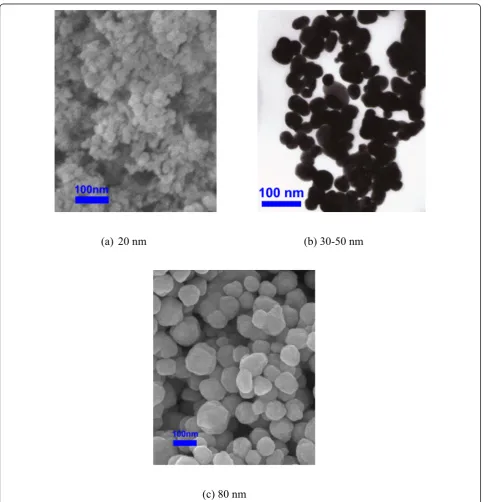
Materials, Inc. (Los Alamos, NM, USA) and dispersed in EG to make nanofluids. The particle sizes were chosen to span sizes below and above the mean free path of electrons in silver. Scanning Electron Microscope (SEM) and Transmission Electron Microscope (TEM) images of the particles provided by the vendor are shown in Figure 2 and appear to show significant aggregation of the 20 nm particles. Nanofluids were prepared by
(a) 20 nm
(b) 30-50 nm
[image:4.595.57.549.201.704.2]
(c) 80 nm
dispersing pre-weighed quantities of nanoparticles into EG. The samples were subjected to ultrasonic processing to obtain dispersions. The nanofluid dispersions remained stable without any noticeable settling for over 2 h after processing.
The thermal conductivity of each nanofluid was mea-sured using a liquid metal transient hot-wire device. The transient hot-wire method has been used success-fully in our laboratory to measure the thermal conduc-tivity of electrically conducting liquids [23] and nanofluids [10-14] over a broad range of temperatures. Our transient hot-wire device consists of a glass capil-lary, filled with mercury, and suspended vertically in the nanoparticle dispersion in a cylindrical glass cell. The glass capillary insulates the mercury ‘wire’ from the electrically conducting dispersion, and prevents current leakage when a voltage is applied to the‘wire’. The‘wire’is heated by application of a voltage and its resistance is measured using a Wheatstone bridge
cir-cuit with the ‘wire’ forming one arm of the circuit.
The temperature change of the wire is computed from the resistance change of the mercury‘wire’ with time. The data are used to calculate the effective thermal conductivity of the nanofluid via an analytical solution of Fourier’s equation for a linear heat source of infinite length in an infinite medium. This solution predicts a linear relationship between the temperature change of the wire and the natural log of time, and this is used to confirm that the primary mode of heat transfer dur-ing the measurement is conduction. Corrections to the temperature are included for the insulating layer around the wire, the finite dimensions of the wire, the finite volume of the fluid, and heat loss due to radia-tion. The thermal conductivity is obtained from the slope of the corrected temperature-time line using the
length of the mercury ‘wire’ in the calculation. An
effective length of the wire that corrects for non-uni-form capillary thickness and end effects is obtained by calibration with two reference fluids. In the present study, water and dimethyl phthalate were used as the reference fluids [24] and their properties were obtained from the literature [25]. Additional details of the appa-ratus and method are available elsewhere [23]. The
experiment was performed five times for each sample and condition, and a data point reported in this work thus represents an average of five measurements with an estimated error of ±2%.
Results
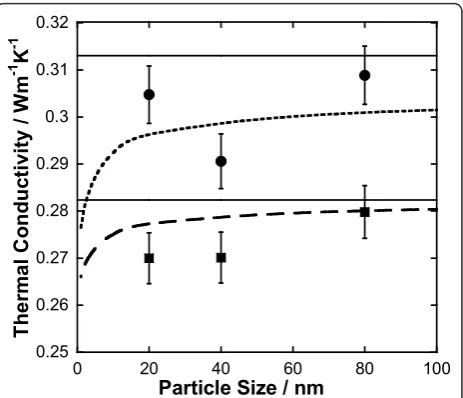
Table 3 gives our measured values of the thermal con-ductivity enhancement for silver nanofluids. As noted previously, each data point represents the average of five measurements at a specific concentration and room temperature. The experimental data along with calcula-tions using Equation 6 with and without considering the size dependence are presented in Figure 3. First, the size dependent model (Equations 3, 5, and 6 was used to correlate the data and a value ofn= 0.088 was found to give the best fit with an AAD = 2.01%. Then, the same
value of n was used in the size independent model
(Equation 6) and resulted in an AAD = 3.64%. Figure 3 appears to confirm that the thermal conductivity of the nanofluid decreases with decreasing particle size, although the results are not conclusive. This could be due to the higher than expected thermal conductivity of nanofluids containing 20 nm silver particles resulting from aggregation (Figure 2a). Since the dry 20 nm parti-cles were highly aggregated when purchased, we consider it likely that they are aggregated in the dispersion despite being subjected to sonication. In an aggregated structure, a fraction of the particles form a conductive pathway, which could result in enhanced conduction [26]. This is supported by numerical simulations and molecular dynamics studies [27-29]. On the other hand, the value ofn= 0.088 obtained by fitting our data implies that the extent of aggregation was probably small and most
parti-cles were randomly dispersed in the fluid. Values ofn
close to ±1 in Table 2, obtained by fitting literature data, do not appear to be physically reasonable because they imply series or parallel alignment of particles.
Conclusions
[image:5.595.57.538.632.721.2]A phenomenological model is presented for the thermal conductivity of metallic nanofluids that takes account of the size dependence of the thermal conductivity of metallic particles. The model was able to fit literature
Table 3 Thermal conductivity of nanofluids consisting of silver nanoparticles dispersed in ethylene glycol
T/K /% v/v d/nm kEG/W m
-1
K-1[25] kP/W m -1
K-1 keff/W m -1
K-1 Standard deviation inkeff
299.3 1 20 0.2544 123.49 0.2700 0.0052
299.9 1 30-50 0.2544 191.32 0.2701 0.0025
298.4 1 80 0.2544 263.50 0.2798 0.0023
300.8 2 20 0.2544 123.49 0.3048 0.0029
300.9 2 30-50 0.2544 191.32 0.2907 0.0023
data for nanofluids using one adjustable parameter, although values of the fitted parameter were higher than expected. The thermal conductivity of nanofluids con-taining three sizes of silver nanoparticles dispersed in EG was measured and the data were fitted using our model. The results are in agreement with our previous work on nanofluids containing semiconductor or insula-tor particles, and appear to confirm that the thermal conductivity of silver nanofluids decreases with decreas-ing particle size.
Abbreviations
CNT: carbon nanotubes; EG: ethylene glycol; PVP: polyvinylpyrrolidone.
Authors’contributions
PW compiled the literature data, carried out experiments, proposed the thermal conductivity model, and participated in the writing of the manuscript. AST provided theoretical and experimental guidance, and participated in the writing of the manuscript. Both authors read and approved the final manuscript.
Competing interests
The authors declare that they have no competing interests.
Received: 19 October 2010 Accepted: 22 March 2011 Published: 22 March 2011
References
1. Choi SUS, Zhang ZG, Yu W, Lockwood FE, Grulke EA:Anomalous thermal conductivity enhancement in nanotube suspensions.Appl Phys Lett2001,
79:2252.
2. Eastman JA, Choi SUS, Li S, Yu W, Thompson W:Anomalously increased effective thermal conductivities of ethylene glycol-based nanofluids containing copper nanoparticles.Appl Phys Lett2001,78:718.
3. Kang HU, Kim SH, Oh JM:Estimation of thermal conductivity of nanofluid using experimental effective particle volume.Exp Heat Transfer2006,
19:181.
4. Patel HE, Das SK, Sundararajan T, Nair AS, George B, Pradeep T:Thermal conductivity of naked and monolayer protected metal nanoparticles based nanofluids: manifestation of anomalous enhancement and chemical effects.Appl Phys Lett2003,83:2931.
5. Xuan Y, Li Q:Heat transfer enhancement of nanofluids.Int J Heat Fluid Flow2000,21:58.
6. Li Q, Xuan Y:Enhanced heat transfer behaviors of new heat carrier for spacecraft thermal management.J Spacecraft Rockets2006,43:687. 7. Yu W, Xie H, Chen L, Li Y:Investigation on the thermal transport
properties of ethylene glycol-based nanofluids containing copper nanoparticles.Powder Technol2010,197:218.
8. Jana S, Salehi-Khojin A, Zhong WH:Enhancement of fluid thermal conductivity by the addition of single and hybrid nano-additives.
Thermochim Acta2007,462:45.
9. Li XF, Zhu DS, Wang XJ, Wang N, Gao JW, Li H:Thermal conductivity enhancement dependent pH and chemical surfactant for Cu-H2O nanofluids.Thermochim Acta2008,469:98.
10. Beck MP, Sun T, Teja AS:The thermal conductivity of alumina nanoparticles dispersed in ethylene glycol.Fluid Phase Equilibr2007,
260:275.
11. Beck MP, Yuan Y, Warrier P, Teja AS:The effect of particle size on the thermal conductivity of nanofluids.J Nanopart Res2009,11:1129. 12. Beck MP, Yuan Y, Warrier P, Teja AS:The thermal conductivity of alumina
nanofluids in water, ethylene glycol, and ethylene glycol + water mixtures.J Nanopart Res2009,12:1469.
13. Beck MP, Yuan Y, Warrier P, Teja AS:The thermal conductivity of aqueous nanofluids containing ceria nanoparticles.J Appl Phys2010,107:066101. 14. Beck MP, Yuan Y, Warrier P, Teja AS:The limiting behavior of the thermal conductivity of nanoparticles and nanofluids.J Appl Phys2010,107:114319. 15. Warrier P, Yuan Y, Beck MP, Teja AS:Heat Transfer in Nanoparticle
Suspensions: Modeling the Thermal Conductivity of Nanofluids.AICHE J 2010,56:3243.
16. Liang LH, Li B:Size-dependent thermal conductivity of nanoscale semiconducting systems.Phys Rev B2006,73:153303.
17. Zhang ZM:Nano/Microscale Heat TransferMcGraw Hill Nanoscience and Nanotechnology Series, New York; 2007.
18. Nath P, Chopra KL:Thermal conductivity of copper films.Thin Solid Films 1974,20:53.
19. Landau LD, Lifshitz EM:Electrodynamics of Continuous MediaOxford: Pergamon Press; 1960, Translated by J. B. Sykes and J. S. Bell.
20. Turian RM, Sung DJ, Hsu FL:Thermal conductivity of granular coals, coal-water mixtures and multi-solid/liquid suspensions.Fuel1991,70:1157. 21. Nan CW:Physics of inhomogeneous inorganic materials.Prog Mater Sci
1993,37:1.
22. Maxwell JC:A Treatise on Electricity and MagnetismLondon: Oxford University Press; 1892.
23. Bleazard JG, Teja AS:Thermal conductivity of electrically conducting liquids by the transient hot-wire method.J Chem Eng Data1995,40:732. 24. Marsh KN, (Ed):Recommended Reference Materials for the Realization of
Physicochemical PropertiesBoston: Blackwell Scientific Publications; 1987. 25. Rowley RL, Wilding WV, Oscarson JL, Yang Y, Giles NF:DIPPR®Data
Compilation of Pure Chemical PropertiesProvo, Utah: Brigham Young University; 2010 [http://dippr.byu.edu], Design Institute for Physical Properties. 26. Prasher R, Evans W, Meakin P, Fish J, Phelan P, Keblinski P:Effect of
aggregation on thermal conduction in colloidal nanofluids.Appl Phys Lett 2006,89:143119.
27. Kumar S, Murthy JY:A numerical technique for computing effective thermal conductivity of fluid-particle mixtures.Numer Heat Transf B Fundam2005,47:555.
28. Gao L, Zhou XF:Differential effective medium theory for thermal conductivity in nanofluids.Phys Lett A2006,348:355.
29. Eapen J, Li J, Yip S:Beyond the Maxwell limit: Thermal conduction in nanofluids with percolating fluid structures.Phys Rev E2007,76:062501.
doi:10.1186/1556-276X-6-247
Cite this article as:Warrier and Teja:Effect of particle size on the thermal conductivity of nanofluids containing metallic nanoparticles. Nanoscale Research Letters20116:247.
0.25 0.26 0.27 0.28 0.29 0.3 0.31 0.32
0 20 40 60 80 100
Th
er
m
a
l Co
nd
uc
tiv
it
y /
Wm
-1 K
-1
[image:6.595.59.291.88.287.2]Particle Size / nm