S P E C I A L I S S U E A R T I C L E
Open Access
Solution reaction design: electroaccepting and
electrodonating powers of ions in solution
Keyan Li
1, Min Li
1and Dongfeng Xue
1,2*Abstract
By considering a first-order variation in electroaccepting and electrodonating powers,ω±, induced by a change from gas to aqueous solution phase, the solvent effect onω±for charged ions is examined. The expression of electroaccepting and electrodonating powers in the solution phase,ω±s, is obtained through establishing the quantitative relationship between the change of theω±due to the solvation and the hydration free energy. It is shown that cations are poorer electron acceptors and anions are poorer electron donors in solution compared to those in gas phase. We have proven that the scaled aqueous electroaccepting power,ω+s, of cations can act as a good descriptor of the reduction reaction, which is expected to be applied in the design of solution reactions.
Keywords:electroaccepting, electrodonating, solution phase, solvent effect
Introduction
With the rapid development of functional materials, novel micro/nanostructures of the materials are highly demanded to obtain advanced properties, which can be achieved by the rational design of solution-phase chemi-cal reactions [1-6]. Therefore, it is of significance to thoroughly understand the reactivity of chemical species and the mechanism of chemical reactions to further rea-lize the solution reaction design. Among many chemical reactivity indices, one quantity of importance is the elec-trophilicity,ω, introduced by Parr and co-workers [7]. They definedω as
ω=μ22η (1)
whereμis the chemical potential andhis the chemical hardness of anN-electron system with total energy,E, defined asμ= (∂2 E/∂2N)v(r)andh= (∂2E/∂2N)v(r). This
index has been found to be helpful in analyzing the reac-tivity behaviors of a variety of compounds as well as the reaction mechanisms of diverse chemical processes [8,9]. As an important contribution to theω, Gazauez et al. [10] argued that from a chemical perspective, it would make sense to differentiate the response of a system to the elec-tron acceptance from the elecelec-tron donation grounded on
that the left and right derivatives of the total energy,EDFT
(N), of anN-electron system with respect to the integer electron number,N, are different. By introducing an elec-tron bath of nonzero chemical potential,μbath, with which
the chemical species can exchange electrons, they pro-posed electroaccepting [ω+] and electrodonating [ω
-] powers as the following equation:
ω±=
μ±2
−(μbath)2
2η± (2)
where the chemical potential,μ±, and the chemical hardness,h±, were defined as
μ+=−(I+ 3A)
4 η
+=η= I−A
2 (3a)
μ−=−(3I+A)
4 η
−=η= I−A
2 (3b)
where I andA are the ionization potential and the electron affinity, respectively. A larger value ofω+ corre-sponds to a larger capability of accepting charges, whereas a smaller value ofω-implies a larger capability of donating charges.
Although some chemical phenomena have been ratio-nalized by establishing the quantitative structure-reactiv-ity relationships using these reactivstructure-reactiv-ity indices in the gas phase [11], the presence of solvent is bound to affect
* Correspondence: [email protected]
1
State Key Laboratory of Fine Chemicals, School of Chemical Engineering, Dalian University of Technology, Dalian 116024, People’s Republic of China Full list of author information is available at the end of the article
the reactivity behaviors of chemical substances. There-fore, studies on the reactivity indices such asω andω± in solution are quite necessary to reveal the accurate reactivity of chemical species in solution and further predict and design the solution phase reactions [12]. While several theoretical calculations about the solvent effect on theω for various chemical species have been performed [12-14], the solvent effect on the ω± which are regarded as better descriptors of the donor-acceptor type interactions [10] has not received much attention to date. In this work, the solvent effect on theω±is esti-mated by establishing a linear relationship between the change of theω±due to the solvation and the hydration free energy,ΔGhyd. The values of aqueous
electroaccept-ing power,ω+s, of 39 metal cations are quantitatively
calculated, which are proven to be appropriate descrip-tors for the reduction reactions.
Method
In a previous study, Perez et al. [14] examined the solvent effect on the electrophilicity index,ω, by introducing a first-order finite variation in theωdue to the solvation
ωg→s= μ
g ηg
μg→s−
1 2 μ g ηg 2
ηg→s=ω1,g→s+ω2,g→s (4)
whereΔμg®sandΔhg®sare the variations inμandh
from the gas to solution phase, respectively. They rearranged the first contribution as
ω1,g→s=
μg
ηg
μg→s=
Eg
Ng
υ(r)
Ng
μg
μg→s∼=Eins= 2Gsolv (5)
whereΔEinsis the insertion energy of the solute going
into the solvent which is suggested as twice the solva-tion energy.
The second contribution in Equation 4 is rewritten as
ω2,g→s=−
1 2 μ g ηg 2
ηg→s=−
1 2 μ g ηg μg ηg μ N
=−1
2
μ g
ηgN
μg
ηgμ
.
=−1
2
μ g
ηgN
Eins= Ng,max
N Gsolv
(6)
Finally, they deduced the expression ofΔωg®s
ωg→s=ω1,g→s+ω2,g→s=
2 +Ng,max
N
Gsolv=γ Gsolv (7)
whereΔωg®sshowed a linear dependence on the
sol-vation energy,ΔGsolv, with a regression slope,g. They
used 18 well-known electrophilic ligands including hard electrophiles such as Li+and Na+to test this linear cor-relation and obtained good results (R = 0.9925, g = 1.00765 at B3LYP/6-311G**andR= 0.9918,g= 0.96843 at HF/6-311G**levels of theory).
Herein, we reconstruct the second contribution in Equation 4 which will directly lead to a quantitative expression forΔωg®swith a definite slope value,g.
ω2,g→s=−
1 2
μg
ηg
2 ηg→s=−
1 2
Ng,max
2 ηg→s
=−1
2
Ng,max
2 μs Ns,max − μg Ng,max
∼=−1
2
Ng,max
2μs−μg Ng,max
=−1
2
Ng,max
2(0−μs)−
0−μg Ng,max
=−1
2
Ng,max
2μg−μs Ng,max
=−1
2Ng,max
−μg→s
=−1
2
−μgηg −μg→s
=−1
2ω1,g→s=−Gsolv (8)
Substitution of Equations 5 and 8 into Equation 4 leads to the expression ofΔωg®s.
ωg→s=ω1,g→s+ω2,g→s= 2Gsolv−Gsolv=Gsolv (9)
Therefore, the global electrophilicity,ωs, in solution
can be calculated by
ωs=ωg+ωg→s=ωg+Gsolv. (10)
It should be noted that one key assumption in our approach isΔNs, max≈ ΔNg, maxwhich could be justified
by the data of Table 1 in Perez’s work [14]. Our result,
g= 1, has turned out to be fairly consistent with Perez’s regression value, i.e., g = 1.00765 and g = 0.96843, which thus approve the reasonableness of our approach to dealing withΔω2, g®s.
Further, we try to extend our approach to examine the solvent effect on theω±. For the charged ions, we sup-pose that the chemical potential,μ±bath, of the electron
bath equals that of the parent atoms of ions since the charged ions become neutral atoms after accepting or donating the maximum amount of electrons. In addi-tion, as the solvent only has little effect on the chemical potential,μ, of the neutral species [12,13,15], there exists a relationship as μ±bath = μs, atom ≈ μg, atom. The ion
exchanges electrons from the bath to the point that its chemical potential, μ±, equals the valueμ±bathwith the
maximum amount of electron flow:
N±max=
μ±
bath−μ±
η±. (11)
The first-order variation in theω± leads to the follow-ing equation:
ω±
g→s= μ
± g η± g μ±
g→s− 1 2
μ±
g
2−μ±
bath
2
η±
g
2 η±g→s=ω±1,g→s+ω±
2,g→s. (12)
The first part of Equation 12 in terms of the variation inμ±is given by
ω±
1,g→s=
μ± g η± g μ±
g→s= E
g
N±g
υ(r)
N±g μ±
g
μ±
g→s∼=Ghyd (13)
where the energy changeΔω±1,g®sdue to the variation
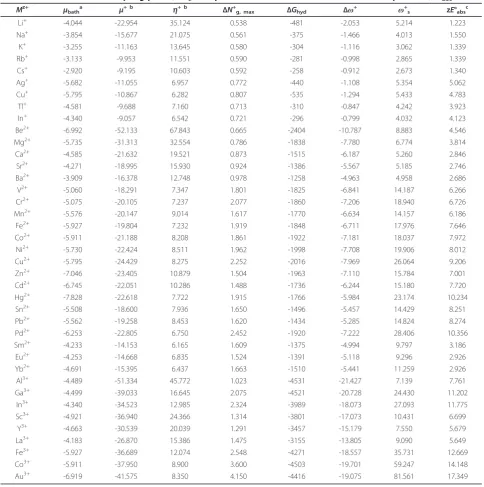
Table 1 Calculated electroaccepting power,ω+s, in aqueous solution and the absolute reduction potential,E°abs Mz+
μbatha μ+ b h+ b ΔN+g, max ΔGhyd Δω+ ω+s zE°absc Li+ -4.044 -22.954 35.124 0.538 -481 -2.053 5.214 1.223
Na+ -3.854 -15.677 21.075 0.561 -375 -1.466 4.013 1.550
K+ -3.255 -11.163 13.645 0.580 -304 -1.116 3.062 1.339
Rb+ -3.133 -9.953 11.551 0.590 -281 -0.998 2.865 1.339
Cs+ -2.920 -9.195 10.603 0.592 -258 -0.912 2.673 1.340
Ag+ -5.682 -11.055 6.957 0.772 -440 -1.108 5.354 5.062 Cu+ -5.795 -10.867 6.282 0.807 -535 -1.294 5.433 4.783 Tl+ -4.581 -9.688 7.160 0.713 -310 -0.847 4.242 3.923 In+ -4.340 -9.057 6.542 0.721 -296 -0.799 4.032 4.123 Be2+ -6.992 -52.133 67.843 0.665 -2404 -10.787 8.883 4.546 Mg2+ -5.735 -31.313 32.554 0.786 -1838 -7.780 6.774 3.814 Ca2+ -4.585 -21.632 19.521 0.873 -1515 -6.187 5.260 2.846 Sr2+ -4.271 -18.995 15.930 0.924 -1386 -5.567 5.185 2.746 Ba2+ -3.909 -16.378 12.748 0.978 -1258 -4.963 4.958 2.686
V2+ -5.060 -18.291 7.347 1.801 -1825 -6.841 14.187 6.266
Cr2+ -5.075 -20.105 7.237 2.077 -1860 -7.206 18.940 6.726
Mn2+ -5.576 -20.147 9.014 1.617 -1770 -6.634 14.157 6.186
Fe2+ -5.927 -19.804 7.232 1.919 -1848 -6.711 17.976 7.646
Co2+ -5.911 -21.188 8.208 1.861 -1922 -7.181 18.037 7.972
Ni2+ -5.730 -22.424 8.511 1.962 -1998 -7.708 19.906 8.012
Cu2+ -5.795 -24.429 8.275 2.252 -2016 -7.969 26.064 9.206
Zn2+ -7.046 -23.405 10.879 1.504 -1963 -7.110 15.784 7.001 Cd2+ -6.745 -22.051 10.286 1.488 -1736 -6.244 15.180 7.720 Hg2+ -7.828 -22.618 7.722 1.915 -1766 -5.984 23.174 10.234 Sn2+ -5.508 -18.600 7.936 1.650 -1496 -5.457 14.429 8.251 Pb2+ -5.562 -19.258 8.453 1.620 -1434 -5.285 14.824 8.274 Pd2+ -6.253 -22.805 6.750 2.452 -1920 -7.222 28.406 10.356 Sm2+ -4.233 -14.153 6.165 1.609 -1375 -4.994 9.797 3.186
Eu2+ -4.253 -14.668 6.835 1.524 -1391 -5.118 9.296 2.926
Yb2+ -4.691 -15.395 6.437 1.663 -1510 -5.441 11.259 2.926
Al3+ -4.489 -51.334 45.772 1.023 -4531 -21.427 7.139 7.761
Ga3+ -4.499 -39.033 16.645 2.075 -4521 -20.728 24.430 11.202
In3+ -4.340 -34.523 12.985 2.324 -3989 -18.073 27.093 11.775
Sc3+ -4.921 -36.940 24.366 1.314 -3801 -17.073 10.431 6.699
Y3+ -4.663 -30.539 20.039 1.291 -3457 -15.179 7.550 5.679
La3+ -4.183 -26.870 15.386 1.475 -3155 -13.805 9.090 5.649
Fe3+ -5.927 -36.689 12.074 2.548 -4271 -18.557 35.731 12.669 Co3+ -5.911 -37.950 8.900 3.600 -4503 -19.701 59.247 14.148 Au3+ -6.919 -41.575 8.350 4.150 -4416 -19.075 81.561 17.349
aμ+
bath=μ−atom=−(3IM+AM)
4∼= −3IM
4because of the neglectable values of electron affinities,AM, for atoms.bμ+andh+are obtained from Equation 3a.c
The second part of Equation 12 in terms of the varia-tion inh±is given by
ω±
2,g→s=−
1 2 μ± g 2
−μ±
bath 2
η±
g 2 η±
g→s=−
1 2 μ± g 2
−μ±
bath 2
η±
g
2 μ ±
N±
=−1
2
μ±
g 2
−μ±
bath 2 η± g 2 μ± s Ns,max
− μ±g
Ng,max
∼=−1
2
μ±
g 2
−μ±
bath 2
η±g2
μ±
bath−μ±s
−μ±
bath−μ±g Ng,max =1 2 μ± g 2
−μ±
bath 2
η±g2
η±
g
μ±gμ±g→s
=−1
2
μ±
bath+μ±g
η±
g
μ±
g→s=−
1 2
μ±
bath+μ±g
μ±g
μ±
g
η±
g
μ±
g→s
=−1
2
μ±
bath+μ±g
μ±g ω±1,g→s
(14)
Combining Equation 13 with Equation 14 yields
ω±
g→s=ω±1,g→s+ω±2,g→s= 1−1
2 μ±
bath+μ±g
μ±
g
ω±
1,g→s
= 1−1 2
μ±
bath+μ±g
μ±
g
Ghyd.
(15)
Therefore, the electroaccepting and electrodonating powers in solution,ω±s, can be calculated by
ω±
s=ω±g+ω±g→s=
μ±
g 2
−(μbath)2
2η±g + 1− 1 2
μ±
bath+μ±g
μ±g
Ghyd. (16)
Results and discussion
According to Pearson’s viewpoint that cations are elec-tron acceptors and anions are elecelec-tron donors [16], we pay attention to theω+sfor cations andω-sfor anions.
By using Equation 16, the ω+s values for 39 metal
cations with charges from +1e to +3e are calculated and summarized in Table 1. From Table 1, we find that the solvation weakens the capacity of cations to accept elec-trons due to the negative values of Δω+, in agreement with the previous conclusions [12-16]. Unfortunately, it is impossible to quantitatively calculate the ω-s values
for anions so far due to the absence of experimental electron affinities needed in Equation 3b. Herein, these values can be qualitatively estimated:
ω−
s=ω−g+ω−g→s=ω−g+ 1− 1 2
μ−
bath+μ−g μ−
g
Ghyd
> ω−
g+ 1− 1 2
μ−
g+μ−g μ−
g
Ghyd > ω−g.
(17)
Since a larger value ofω-s implies a smaller capability
of donating charges, we can conclude from Equation 17 that the solvation also weakens the capacity of anions to donate electrons, which agrees with the general view-points [12-16].
Many liquid-phase chemical reactions involve the elec-tron-transfer steps, and a key thermodynamic variable that describes the tendency of chemical species in solution to gain or lose electrons is the redox potential. The quan-tum-chemical computation approach to electrochemistry has become available very recently [18]. However, the esti-mation of redox potential by the quantum-chemical calcu-lations is a great challenge due to the complexity of the processes involved in a typical electrochemical reaction
0
2
4
6
8
10
12
14
16
0
10
20
30
40
50
60
70
Z
szE
o abs [image:4.595.57.539.463.711.2]y=0.325x21.451x+6.947 R=0.968
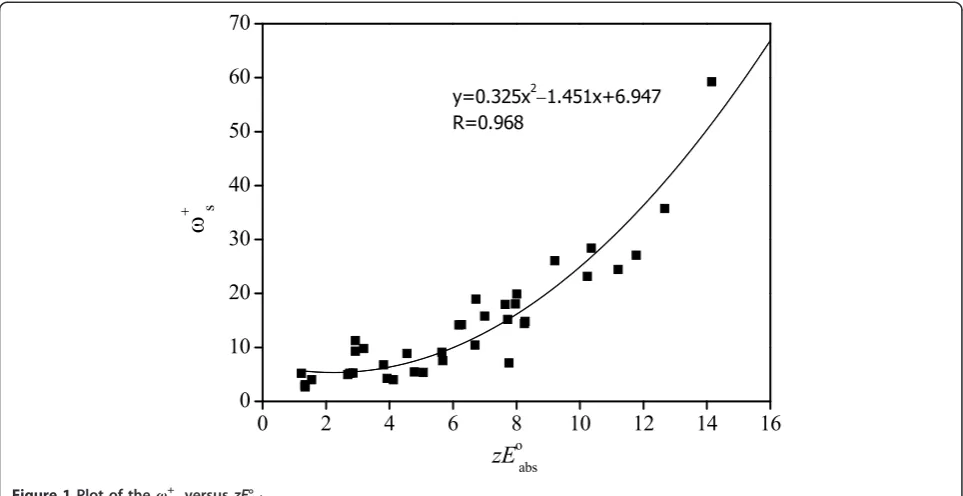
Figure 1Plot of theω+
[19]. For example, the complicated diffusion and adsorp-tion processes on the electrode surface which should be necessarily taken into account in the quantum-chemical modeling of the reduction-oxidation reaction lead to the considerable system size and thus require strong comput-ing power. Therefore, previous studies mainly focus on the one-electron reduction reactions between different oxida-tion states of transioxida-tion metals to avoid modeling of an electrode-solution boundary [18-20]. In this work, we try to use theω+sto describe the many-electron reduction
reaction including both main- and sub-group metal cations. According to the reaction formulaMZ+(aq) +z/ 2H2(g) =M(aq) +zH+(aq), the absolute reduction
poten-tial,E°abs, can be calculated by
E◦abs=E◦SHE=0+E◦abs(SHE) (18)
whereE°abs(SHE) is the conventional reduction
poten-tial and E°SHE = 0 is the absolute standard hydrogen
electrode potential. Note that theω+sis the energy
low-ing associated with a maximum amount of electron flow between two species; it is reasonable to establish a cor-relation between zE°abs and ω+s. A good relationship
shown in Figure 1 approves that ourω+s can act as an
appropriate descriptor of the many-electron energy change. Moreover, this method is more simple and con-venient compared to the quantum-chemical approach to the estimation of theE°abs.
Except for the reduction reaction, theω±scan also be
expected to qualitatively and quantitatively predict other properties of ions in connection with ligand binding, hydrolysis processes, and stability of coordination com-pounds, etc. In addition, compilation of experimental data on solvation energies in nonaqueous solutions will make it possible to evaluate the corresponding electroac-cepting and electrodonating powers, ω±, which will undoubtedly lead to the deeper understanding of the che-mical reactivity of ions in these media.
Conclusions
By reconstructing a first-order variation of theωdue to the solvation, the linear relationship between the change in theωand the solvation energy is reproduced, which suggests that our method is theoretically reasonable. The solvent effect on the electroaccepting and electrodonat-ing powers,ω±, for charged ions is examined, and a defi-nite quantitative expression for the aqueous ω±s is
established. It is found that the solvation weakens the capability of both electron-accepting power of cations and electron-donating power of anions. A good relation-ship between theω+sandE°absshows the validity of the
electroaccepting powers in determining the chemical reactivity of the ions in aqueous solution. It is expected that our ω±s will be helpful to achieve a better
understanding of chemical properties of ions in solution and further be used in many aspects of solution chemis-try such as the design of solution-phase reactions accord-ing to these indices.
Acknowledgements
The financial support of the National Natural Science Foundation of China (Grant Nos. 50872016, 51125009 and 20973033) is greatly acknowledged.
Author details
1State Key Laboratory of Fine Chemicals, School of Chemical Engineering,
Dalian University of Technology, Dalian 116024, People’s Republic of China
2State Key Laboratory of Rare Earth Resource Utilization, Changchun Institute
of Applied Chemistry, Chinese Academy of Sciences, Changchun 130022, People’s Republic of China
Authors’contributions
KL participated in the design and coordination of the study and corrected the manuscript. ML assisted in the calculation of the data and prepared the manuscript initially. DX conceived the study, supervised, and corrected the manuscript. All authors read and approved the final manuscript.
Competing interests
The authors declare that they have no competing interests.
Received: 6 September 2011 Accepted: 5 January 2012 Published: 5 January 2012
References
1. Liu J, Xue D:Cation-induced coiling of vanadium pentoxide nanobelts.
Nanoscale Res Lett2010,5:1619.
2. Wu D, Jiang Y, Liu J, Yuan Y, Wu J, Jiang K, Xue D:Template route to chemically engineering cavities at nanoscale: a case study of Zn(OH)2
template.Nanoscale Res Lett2010,5:1779.
3. Wu J, Xue D:In situ precursor-template route to semi-ordered NaNbO3
nanobelt arrays.Nanoscale Res Lett2011,6:14.
4. Liu J, Xue D, K Li:Single-crystalline nanoporous Nb2O5nanotubes. Nanoscale Res Lett2011,6:138.
5. Yan C, Liu J, Liu F, Wu J, Gao K, Xue D:Tube formation in nanoscale materials.Nanoscale Res Lett2008,3:473.
6. Liu J, Xue D:Hollow nanostructured anode materials for Li-ion batteries.
Nanoscale Res Lett2010,5:1525.
7. Parr R, Szentpaly L, Liu S:Electrophilicity index.J Am Chem Soc1999,
121:1922.
8. Roy D, Chattaraj P:Reactivity, selectivity, and aromaticity of Be32-and its
complexes.J Phys Chem A2008,112:1612.
9. Kostova I, Trendafilova N, Mihaylov T:Theoretical and spectroscopic studies of pyridyl substituted bis-coumarins and their new neodymium (III) complexes.Chem Phys2005,314:73.
10. Gazquez J, Cedillo A, Vela A:Electrodonating and electroaccepting powers.J Phys Chem A2007,111:1966.
11. Chattaraj P, Sarkar U, Roy D:Electrophilicity index.Chem Rev2006,
106:2065.
12. Jaramillo P, Perez P, Fuentealba P, Canuto S, Coutinho K:Solvent effects on global reactivity properties for neutral and charged systems using the sequential Monte Carlo quantum mechanics model.J Phys Chem B2009,
113:4314.
13. Safi B, Balawender R, Geerlings P:Solvent effect on electronegativity, hardness, condensed Fukui functions, and softness, in a large series of diatomic and small polyatomic molecules: use of the EFP model.Phys Chem A2001,105:11102.
14. Perez P, Toro-Labbe A, Contreras R:Solvent effects on electrophilicity.J Am Chem Soc2001,123:5527.
15. Valiev M, Yang J, Adams J, Taylor S, Weare J:Phosphorylation reaction in cAPK protein kinase-free energy quantum mechanical/molecular mechanics simulations.J Phys Chem B2007,111:13455. 16. Pearson R:Ionization potentials and electron affinities in aqueous
17. Contreras R, Andres J, Safont V, Campodonico P, Santos J:A theoretical study on the relationship between nucleophilicity and ionization potentials in solution phase.J Phys Chem A2003,107:5588.
18. Moens J, Roos G, Jaque P, Proft F, Geerlings P:Can electrophilicity act as a measure of the redox potential of first-row transition metal ions?Chem Eur J2007,13:9331.
19. Jaque P, Marenich A, Cramer C, Truhlar D:Computational
electrochemistry: the aqueous Ru3+/Ru2+ reduction potential.J Phys Chem C2007,111:5783.
20. Uudsemaa M, Tamm T:Density-functional theory calculations of aqueous redox potentials of fourth-period transition metals.J Phys Chem A2003,
107:9997.
21. Marcus Y:Thermodynamics of solvation of ions. Part 5.–Gibbs free energy of hydration at 298.15 K.J Chem Soc, Faraday Trans1991,87:2995.
doi:10.1186/1556-276X-7-6
Cite this article as:Liet al.:Solution reaction design: electroaccepting and electrodonating powers of ions in solution.Nanoscale Research Letters20127:6.
Submit your manuscript to a
journal and benefi t from:
7Convenient online submission 7Rigorous peer review
7Immediate publication on acceptance 7Open access: articles freely available online 7High visibility within the fi eld
7Retaining the copyright to your article