N A N O E X P R E S S
Interface Phonons and Polaron Effect in Quantum Wires
A. Yu. Maslov• O. V. Proshina
Received: 22 June 2010 / Accepted: 13 July 2010 / Published online: 11 August 2010 ÓThe Author(s) 2010. This article is published with open access at Springerlink.com
Abstract The theory of large radius polaron in the quantum wire is developed. The interaction of charge particles with interface optical phonons as well as with optical phonons localized in the quantum wire is taken into account. The interface phonon contribution is shown to be dominant for narrow quantum wires. The wave functions and polaron binding energy are found. It is determined that polaron binding energy depends on the electron mass inside the wire and on the polarization properties of the barrier material.
Keywords Quantum wireElectron–phonon interaction Interface phononsPolaron
Introduction
The electron–phonon interaction in semiconductor hetero-structures is of greater interest in comparison to bulk materials. This is due to the fact that the quasi-particle space localization leads to the modifications of the energy spectrum. The all-important factor is the rise of new vibration branches of optical spectrum, namely, the inter-face optical phonon [1]. In addition, the intensity of elec-tron–phonon interaction is changed. The interaction of charge particles with polar optical phonons should exhibit the most intensity. This interaction is of considerable importance in the understanding of the properties of het-erostructures based on material with high ionicity. It can
lead to self-consistent bond state of a charge particle and phonons, that is, the large radius polaron [2].
Currently, an investigation on the part played by inter-face phonons has attracted considerable interest in polaron state formation study. The heterostructures of different symmetry are under investigation. The contributions to polaron binding energy both of interface and of bulk optical phonons are the same value order in the quantum dots [3–5]. Taking into account, interface phonons are essential for quantitative analysis of the polaron states. It does not lead to new qualitative effects. Alternatively, the interface phonon role dominates in polaron binding energy for quantum well case [6,7]. In response to this fact, the strong electron–phonon interaction can be realized in the quantum wells based on non-polar material with high iconicity barrier material. In addition, from the results, it follows that profound polaron effects should be expected, e.g., in the Si/SiO2compounds. Although there are no polar optical phonons in the material of such quantum well, these may be produced at the heteroboundary. As a result, the strong interaction of charged particles with interface pho-nons becomes possible. Conversely, the essential depres-sion of electron–phonon interaction is possible when the quantum well is made of polar material and for the barriers is taken non-polar material.
In recent years, varied technologies of semiconductor quantum wire growth with assorted barriers are progressing rapidly. The most success has been achieved for the quan-tum wires based on III–V compounds [8–12]. Some advances have been made in the formation of II–VI semi-conductor wire structures [13,14]. It is in these structures that the polaron states can arise. At the same time, no extended theoretical study of the polaron states in such structures is available. Proper allowance must be made for the interaction of charge particles with interface optical
A. Yu. Maslov (&)O. V. Proshina
Ioffe Physical-Technical Institute of the Russian Academy of Sciences, Saint Petersburg, Russia
phonons for an understanding of this problem. In this paper, we develop a theory of polarons in the quantum wires, taking into account the interaction of charged particles with all branches of the optical phonon spectrum.
Interface Phonons in the Quantum Wire
The interface phonon spectrum is being examined in [15]. The general equations have been obtained to describe the phonon spectrum taking into account the interaction of polarization and deformation potentials. In materials with high ionicity degree, the charge particle interaction with polar optical phonons is of crucial importance in polaron state formation. This has led us to use the model which takes into account this phonon type in the quantum wire. The polar optical phonons we describe by the outline suggested in [16]. Optical-phonon modes in the quantum wire are determined using the classical electrostatics equations:
PðrÞ ¼viðxÞEðrÞ; ð1aÞ
EðrÞ ¼ ruðrÞ; ð1bÞ
r2uðrÞ ¼ 4pqðrÞ; ð1cÞ
qðrÞ ¼ rPðrÞ; ð1dÞ
together with conventional boundary conditions at heterointerfaces, where PðrÞ is the polarization field, EðrÞ the electric field,uðrÞthe scalar potential, qðrÞthe total charge density, and vðiÞðxÞ is the dielectric
susceptibility of the material i (i =1, 2). The dielectric functioneðiÞðxÞis given by:
eðiÞðxÞ ¼eð1iÞx
2x2ðiÞ
LO
x2x2ðiÞ
TO
; ð2Þ
where xðLOiÞ and xðTOiÞ are the frequencies of longitudinal-optical (LO) phonons and transverse-longitudinal-optical (TO) phonons, respectively, and eð1iÞ is the high-frequency dielectric
constant. The solution of system (Eq. 1) for the cylindrical quantum wire leads to the equation defining the dispersion law for interface optical phonons:
I0mðkq0Þ
Imðkq0Þ
eð1ÞðxÞ ¼K
0 mðkq0Þ
Kmðkq0Þ
eð2ÞðxÞ: ð3Þ
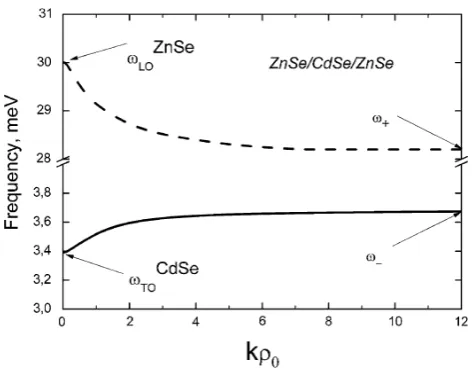
Here,Im is them-th order modified Bessel function of the first kind,Kmis them-th order modified Bessel function of the second kind,k is the wave vector,q0is the quantum wire radius. The spectrum of interface phonons is deter-mined by solution of Eq.3. In Fig.1is shown the wave-vector dependence of the interface phonon frequencies. This dependence is calculated for the quantum wire based onCdSesurrounded byZnSebarriers withm=0 in Eq.3. The material parameters are taken from [17].
The Hamiltonian operator for phonon subsystem is conveniently written in terms of the phonon creation and annihilation operators:
b
Hph ¼
X
k;n;m
hx0aþnmðkÞanmðkÞ þ
X
k;m
hxmðkÞaþmkamk; ð4Þ
where the operators aþnmðkÞ describe the creation of bulk phonons localized inside the quantum wire, aþmk are the interface phonon creation operators. The Hamiltonian of electron–phonon interaction for the cylindrical quantum wire can be represented by the method supposed in [16]:
b
Heph ¼
X
k;m;n
amnðk;qÞ anmðkÞ þaþnmðkÞ
þX
k;m
amðkÞ aþmkþamk
: ð5Þ
Here, the coefficients amnðk;qÞare defined as:
amnðk;qÞ ¼
2pe2hx
LO
L
1=2
1
eðopt1Þ
1=2
q0
exp½ikzJmðkqÞexp½imu
q2þ1
q2 0
l2
nðmÞ
1=2 ;qq0; ð6Þ
here,ln(m) isn-th order root of the equationJm(l)=0,Jm is the m-th order Bessel function of the first kind. The interaction parametersam(k) have the form:
amðkÞ ¼
2pxse2
L
1=2
bð11ÞðxsÞI1ðkq0Þ þb 1 ð2ÞðxsÞ
Imðkq0Þ
Kmðkq0Þ
I2ðkq0Þ
1=2
ImðkqÞ
Imðkq0Þ
exp½imuexp½ikz;qq0 ð7Þ
The expressions (6), (7) do not require in the regionqq0.
[image:2.595.307.544.55.239.2]The reason is that we suppose the total electron localization within the quantum wire. In Eq.7were used the following symbols:
bðxÞ ¼ 1
eopt
x2
LO
x2
x2x2
TO
x2
LOx2TO
2
; ð8Þ
I1ðkq0Þ ¼ Zkq0
0
Im2ðzÞ þ dImðzÞ dz
2
þm
2
z2I 2
mðzÞ
" #
zdz; ð9Þ
I2ðkq0Þ ¼ Z1
kq0
K2mðzÞ þ dKmðzÞ dz
2
þm
2
z2K 2
mðzÞ
" #
zdz: ð10Þ
The Polaron in the Quantum Wire
We consider a cylindrical quantum wire with the radiusq0. Let the quantum wire be surrounded with compositionally identical barriers. In order to separate the effect of exactly dielectric irregularities, we assume that the potential well for electrons is rather deep, so that the penetration of the wave functions under the barrier can be disregarded. In this case, the interaction of charged particles with barrier phonons is weak. We write the Hamiltonian of the system as
b
H ¼HbeþHbphþHbeph ð11Þ
Here, Hbe is the electron Hamiltonian for which the
interaction of the electron with phonons is disregarded. The Hamiltonian is given by
b
He¼
h2
2Mr
2þVðqÞ ð12Þ
where VðqÞ is the quantum wire potential and M is the electron effective mass. If the interaction of an electron with polar optical phonons is strong, the polaron binding energy can be determined with the use of adiabatic approximation. In so doing, the electron subsystem is fast and phonon subsystem is slow. The adiabatic parameter here is the ratio of the quantum wire radius q0 to the polaron radiusa0:
q0
a0
1: ð13Þ
The exact expression for polaron radius a0 is obtained below. The condition (Eq.13) implies that the main contribution to the polaron binding energy is given by small values of the wave vectorksuch that
kq0\1: ð14Þ
If condition (Eq.13) is satisfied, the wave function of an electron localized in the n-th size-quantization level can be represented as:
WeðrÞ ¼uðnðeÞ;mðeÞ;qÞexp imðeÞu
h i
vnðeÞ;mðeÞ;z; ð15Þ
where the wave functionuðnðeÞ;mðeÞ;qÞdescribes the two-dimensional electron motion not disturbed by electron– phonon interaction. This motion occurs inside the quantum wire. The wave function vnð Þe;mð Þe;z represents the electron localization in the self-consistent potential well created by phonons. The quantum numbersn(e),m(e)define not disturbed electron state in the quantum wire. In the case of total electron localization in the cylindrical quantum wire, the wave function uðnð Þe;mð Þe;qÞhas the form:
uðnð Þe;mð Þe;qÞ ¼Jmð Þe lnð Þe mð Þe
q
q0
: ð16Þ
HerelnðeÞðmðeÞÞisn(e)-th root ofm(e)-th order Bessel
func-tion. The wave functionvnð Þe;mð Þe;zis to be obtained by
solving self-consistent problem. In so doing, the total wave function from Eq.15is perceived to be normalized.
The procedure of polaron binding energy determination is similar to that used in [7]. We average the total Hamil-tonian of the system from expression (Eq.11) with yet unknown electron wave function from formula (Eq. 15). The HamiltonianHbefrom (Eq.12) takes the form after this
procedure:
b
He
D E
¼Eðn0ðeÞÞ;mðeÞþ
h2
2M
Z
dz dvðzÞ
dz
2
: ð17Þ
HereEðn0ðeÞÞ;mðeÞ is the energy of an electron on relevant
size-quantization level, M is the electron mass inside the quantum wire. The form of phonon Hamiltonian Hbph from
Eq. 11 remains unchanged. Averaged Hamiltonian of electron–phonon interaction Hbeph can be written as:
b
Heph
D E
¼X
k;m;n
e
amnðkÞanmðkÞ þaþnmðkÞ
þX
k;m
e
amðkÞ amkþaþmk
: ð18Þ
Here, eamnðkÞand eamðkÞare the coefficients amnðk;qÞ and
am(k) from Eq.5averaged with the electron wave function from formula (Eq. 15). We obtain average Hamiltonian
b
Hav:
b
Hav¼Hbphþ Hbeph
D E
: ð19Þ
It can be brought to the form diagonal in phonon variables by the unitary transformationeUHbaveU;where
U¼X
k;m;n
e
amnðkÞ anmðkÞ aþnmðkÞ
þX
k;m
e
amðkÞ amka
þ
mk
: ð20Þ
eUHbaveU¼HbphþDEe ð21Þ
From expression (Eq.21), we can see that, in the adiabatic approximation used here, the bulk phonon spectrum and the interface phonon spectrum remain unchanged. The last summand in expression (Eq.21) presents the energy of a large radius polaron. In the general case, the energyDEe
involved in (Eq.21) depends on the dielectric properties of the materials of both the quantum wire and the barriers. In the general case, the polaron binding energyDEedepends on electron size-quantization level number and on optical-phonon spectrum properties. These optical-phonons are localized in the quantum wire and at the heteroboundary. After the procedure of angle averaging which is expressible in explicit form, we obtain this energyDEeas:
DEe¼
X
n;k
ea2ð0;n;kÞ
hx0
X
k
e
a2ð0;kÞ
hxS
: ð22Þ
The energy (Eq.22) is defined by the electron interaction with phonon modes correspond to m=0 only. This equation (Eq.22) contains the contribution to polaron energy for all size-quantization levels. This contribution is caused by the interaction of localized electron with con-fined and interface phonons. It can be used for numerical analysis of electron–phonon interaction characteristic properties. However, the electron energy and wave func-tion can be obtained analytically on condifunc-tion the un-equality (Eq.14) is satisfied.
Results and Discussion
The most significant contribution to the polaron binding energy in the parameter (Eq.14) gives the interaction of an electron with interface phonon mode of the frequency close to barrier frequency xðLO2Þ: The largest contribution to the energy in the parameter (Eq.14) has the form:
DEe¼
e2
2eðopt2Þ X
k
Z
vð Þz
j j2exp½ikzdz
2
lnðkq0Þ: ð23Þ
The Eq.23 contains the optical dielectric function of the barriers eðopt2Þ: It is defined as eopt1 ¼e11e10:. This quantity
comes about from taking into account the interaction of an electron with interface optical phonons. It is seen from Eq. 23that the quantum wire material properties have no effect on the polaron state formation. The part of quantum wire material dielectric properties can be obtained in higher orders in the parameter (Eq.14). It is seen from Eq.23that the characteristic values of the phonon wave vectorkwhich describe the value of electron–phonon interaction is of the order reciprocal to polaron radius a0 k a01
: The logarithmic function changes weakly in this region.
Therefore, we can consider with the same accuracy in parameter (14) that the energy is equal to:
DEe¼
e2
2eðopt2Þ
ln q0
a0 X
k
Z
vðzÞ
j j2exp½ikzdz
2 ð24Þ
The substitution of the energy from Eq.24to the average Hamiltonian from Eq. 19 leads to the expression for polaron binding energy as the functional of unknown yet wave functionv(z). It can be written as:
Epol ¼
h2
2M
Z dvðzÞ
dz
2
dzþ e
2
2eðopt2Þ
ln q0
a0
X
k
Z
vðzÞ
j j2exp½ikzdz
2 : ð25Þ
The following equation is obtained by variational method using wave functionsv(z):
h
2
2M
d2vðzÞ dz
e2
eðopt2Þ
ln a0 q0
!
v3ðzÞ ¼EpolvðzÞ: ð26Þ
This nonlinear Eq. 26 has the solutions which can be written in the form with any energy valuesEpol:
vðzÞ ¼ ffiffiffiffiffiffiffi1
2a0
p 1
ch zð =a0Þ
: ð27Þ
The polaron binding energy is found by substitution of Eq. 27to26:
Epol ¼
Me4
h2 eðopt2Þ
2ln2 a0
q0
: ð28Þ
The polaron radius a0 is obtained by solving the transcendental equation. It has the form:
a0¼
h2eðopt2Þ
Me2ln a0 q0
: ð29Þ
It is this quantity from Eq.29which contains the adiabatic parameter (Eq.13). Substituting material parameters [17] into Eq. 29 for the quantum wire ZnSe/CdSe/ZnSe leads one to expect that the strong polaron effects for these structure should be observed when the quantum wire radius q0\40A˚.
between polar and non-polar materials. Among other things the significant electron–phonon interaction can result from the interface phonon influence in Si/SiO2heterostructures. The results obtained show that the intensity of electron– phonon interaction is determined significantly by interface optical phonons in narrow quantum wires corresponding to the condition (Eq.13). These interface phonons are local-ized basically in the heteroboundary vicinity. And its field penetrates also into the barriers region. By this is meant that the interface phonons can produce the effective canal of excitation transfer in the structures with several quantum wires. Related ways should be allowed for the transport theory development in quantum nanostructures.
This work was supported by Russian Foundation for Basic Research, grant 09-02-00902-a and the program of Presidium of RAS ‘‘The Fundamental Study of Nano-technologies and Nanomaterials’’ no. 27.
Open Access This article is distributed under the terms of the Creative Commons Attribution Noncommercial License which per-mits any noncommercial use, distribution, and reproduction in any medium, provided the original author(s) and source are credited.
References
1. P. Halevi, Electromagnetic surface modes (Wiley, New York, 1982)
2. I.P. Ipatova, A.Yu. Maslov, O.V. Proshina, Surf. Sci.507–510, 598 (2002)
3. D.V. Melnikov, W.B. Fowler, Phys. Rev. B64, 245320 (2001) 4. A.L. Vartanian, A.I. Asatryan, A.A. Kirakosyan, J. Phys. Cond.
Mater.14, 13357 (2002)
5. A.Yu. Maslov, O.V. Proshina, A.N. Rusina, Semiconductors41, 822 (2007)
6. A.Yu. Maslov, O.V. Proshina, Superlattices Microstruct.47, 369 (2010)
7. A.Yu. Maslov, O.V. Proshina, Semiconductors44, 189 (2010) 8. Zh.M. Wang, Sh Seydmohamadi, V.R. Yazdanpanah, G.J.
Sal-amo, Phys. Rev. B71, 165309 (2005)
9. X. Wang, Zh.M. Wang, B. Liang, G.J. Salamo, Ch.-K. Shih, Nano Letters6, 1847 (2006)
10. J. Lee, Zh. Wang, B. Liang, W. Black, V.P. Kunets, Y. Mazur, G.J. Salamo, Ieee Trans. Nanotechnol.6, 70 (2007)
11. J.B. Schlager, K.A. Bertness, P.T. Blanchard, L.H. Robins, A. Roshko, N.A. Sanford, J. Appl. Phys.103, 124309 (2008) 12. M. Jeppsson, K.A. Dick, J.B. Wagner, P. Caroff, K. Deppert, L.
Samuelson, L.-E. Wernersson, J. Crystal. Growth 310, 4115 (2008)
13. B. Zhang, W. Wang, T. Yasuda, Y. Li, Y. Segawa, H. Yaguchi, K. Onabe, K. Edamatsu, T. Itoh, Ipn. J. Appl. Phys.36, L1490 (1997)
14. L. Chen, P.J. Klar, W. Heimbrodt, F.J. Brieler, M. Fro¨ba, H.-A. Krug von Nidda, T. Kurz, A. Loidl, J. Appl. Phys. 93, 1326 (2003)
15. C. Trallero-Giner, Physica. Scripta.55, 50 (1994) 16. M. Mori, T. Ando, Phys. Rev. B40, 6175 (1989)