IJPSR (2019), Volume 10, Issue 9 (Research Article)
Received on 09 January 2019; received in revised form, 12 April 2019; accepted, 14 August 2019; published 01 September 2019
METHOD DEVELOPMENT, VALIDATION AND STABILITY INDICATING ASSAY ON GLIMEPIRIDE IN TABLET DOSAGE FORM BY RP-UFLC
R. Maruthi * and R. S. Chandan
Department of Pharmaceutical Chemistry, JSS College of Pharmacy, JSS Academy of Higher Education and Research, Mysuru - 570015, Karnataka, India.
ABSTRACT: The study aimed to develop a specific, exact, selective, precise and accurate Reversed-Phase Stability Indicating Ultra-fast Liquid Chromatography (RP-UFLC) strategy is created and validated for the determination of glimepiride in the tablet dosage form. The method showed an adequate separation for glimepiride from their degradation products. The optimum separation was achieved by using 250 mm × 4.6 mm C18 column (5 μm) with a mixture of potassium dihydrogen orthophosphate adjusted to pH 4.6 using (orthophosphoric acid) and acetonitrile in the ratio of 75:25 at a flow rate of 1 ml/min. The detection was carried out at 236 nm, and the retention time was found to be 5.9 min. Linearity was observed (correlation coefficient r2 0.9989). % R.S.D was found to be less than 2%. Accuracy of the method found to be in the range of 98.0 to 102.00 (% w/w). The above method was validated concerning system suitability, linearity, precision, the limit of detection (LOD) and limit of quantification (LOQ), accuracy (recovery) and robustness according to ICH guidelines. The linearity of the above methods was found to be 2-10 µg/ml for glimepiride and force degradation were carried out. Hence these methods can be used for routine analysis in quality control laboratories.
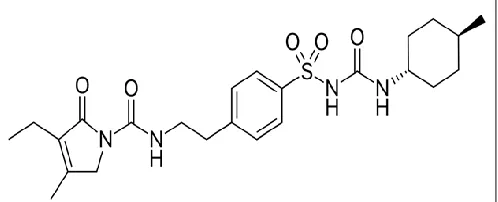
INTRODUCTION: Glimepiride, sold under the trade name amaryl among others, is medium-to-long-acting sulfonylurea anti-diabetic medication. It is taken by mouth. It is sometimes classified as either the first third-generation sulfonylurea or as second-generation. In 2016 it was the 61st most prescribed medication in the United States with more than 12 million prescriptions. Glimepiride is indicated to treat type 2 diabetes mellitus; its mode of action is to increase insulin secretion by the pancreas.
QUICK RESPONSE CODE
DOI:
10.13040/IJPSR.0975-8232.10(9).4345-53
This article can be accessed online on www.ijpsr.com
DOI link: http://dx.doi.org/10.13040/IJPSR.0975-8232.10(9).4345-53
However, it requires adequate insulin synthesis as a prerequisite to treating appropriately. It is not used for type 1 diabetes because in type 1 diabetes the pancreas is not able to produce insulin. Like all sulfonylureas, glimepiride acts as an insulin secretagogues. It lowers blood sugar by stimulating the release of insulin by pancreatic beta cells and by inducing the increased activity of intracellular insulin receptors. Not all secondary sulfonylureas have the same risk of hypoglycemia. Glibenclamide (glyburide) is associated with an incidence of hypoglycemia of up to 20-30%, compared to as low as 2% to 4% with glimepiride. Glibenclamide also interferes with the normal homeostatic suppression of insulin secretion in reaction to hypoglycemia, whereas glimepiride does not. Also, glibenclamide diminishes glucagon secretion in reaction to hypoglycemia, whereas glimepiride does not react to hypoglycemia 1, 2. Keywords:
Glimepiride, RP-UFLC, Acetonitrile, Validation, ICH
Guidelines, Degradation
Correspondence to Author: R. Maruthi
Ph.D. (Research Scholar), Department of Pharmaceutical Chemistry, JSS College of Pharmacy, JSS Academy of Higher Education and Research, Mysuru - 570015, Karnataka, India.
MATERIALS AND METHODS:
Preparation of Mobile Phase: To a 1000mL volumetric flask, add 1.36 gm of potassium dihydrogen orthophosphate was taken and diluted with millipore water and made up to the mark, and the pH was adjusted to 4.6 using orthophosphoric acid. The solution was then filtered through a 0.45µ membrane filter.
Preparation of Diluent: The diluent is a mixture of 100 parts of acetonitrile.
Preparation of Standard Stock Solution for Glimepiride: 100 mg of glimepiride was taken into 100 mL volumetric flask. To this add 50 mL of diluent and sonicate to dissolve and the volume was made up to the mark with diluent (1000 µg/ml). Pipette 1ml of the above solution into 10 mL volumetric flask and make up the volume using diluent (100 µg/ml).
Preparation of Solutions for Linearity: The solutions for linearity were prepared from the stock solution by diluting with diluent. The concentration ranging from 2, 4, 6, 8, 10 μg/mL were prepared for Glimepiride. Pipette 0.2, 0.4, 0.6, 0.8, 1.0 mL in 10 mL volumetric flasks and make up the volume using diluent to get the above concentrations.
[image:2.612.50.299.57.158.2]Chromatographic Conditions:
TABLE 1: CHROMATOGRAPHIC CONDITION
S. no. Chromatographic Conditions
1 Column Phenomenex Kinetex C18 (250 × 4.6 mm) 2 Flow Rate 1.0mL/min 3 Wavelength 236nm 4 Detector PDA detector 5 Injection
volume
10μl
6 Mobile phase Potassium Di-hydrogen orthophosphate and Acetonitrile(75:25) 7 pH 4.6 with Orthophosphoric acid
8 Run time 10 min
Method Validation: 3-10
Linearity and Range: The linearity of an analytical method is its ability to elicit test results that are directly, or by a well-defined mathematical transformation, proportional to the concentration of an analyte in samples within a given range.
Procedure: 2-10 ug/ml for glimepiride was prepared. The regression line obtained was linear. From the data obtained, co-relation coefficient, slope, and Y-intercept were calculated. Ideally co-relation coefficient should be not less than 0.99 and statistical Y-intercept should be not more than 2.0.
Accuracy: Accuracy is performed in three different levels for glimepiride using standard addition method at 50%, 100%, and 150%. A known quantity of sample was spiked to the standards. Samples are analyzed in triplicate for each level. From the results, % recovery was calculated. % recovery at each spike level shall be not less than 98.0% and not more than 102.0%, % RSD for the duplicate observations shall be not more than 2.0. Overall % RSD for the % Recovery shall be not more than 2.0.
% Recovery = (Amount of drug recovered) / (Amount of drug added) × 100
Procedure:
Accuracy at 50%: A known amount of standard drug solution of glimepiride (25 µg/mL) from the stock solution was added to the sample solution of a determined concentration (50 μg/mL) the solutions were taken in a 10 mL volumetric flask and the volume was made up with diluent and filtered through 0.2 μ syringe filter. The solutions were injected, analyzed and the recovery was calculated.
Accuracy at 100%: A known amount of standard drug solution of Glimepiride (50 μg/mL) from the stock solution was added to the sample solution of a determined concentration (50 μg/mL). The solutions were taken in a 10 mL volumetric flask and the volume was made up with diluent and filtered through 0.2 μ syringe filter. The solutions were injected, analyzed and the recovery was calculated.
stock solution were added to the sample solution of a determined concentration (50 μg/mL) the solutions were taken in a 10 mL volumetric flask and the volume was made up with diluent and filtered through 0.2 μ syringe filter. The solutions were injected, analyzed and the recovery was calculated.
Precision:
System Precision: The system precision is checked by injecting 6 sample injections and checking the reproducibility in the retention time and area. The % RSD calculated must be less than 2%.
Method Precision:
Intraday Precision: The intraday precision is checked by using standard glimepiride samples to ensure that the analytical system is precise. The retention time and area of three determinations was measured and RSD was calculated. % RSD of the assay value for three determinations shall not be more than 2.0%.
Interday Precision: The interday precision is checked by using the same standard glimepiride samples analyzed for intraday precision on an alternate day to ensure that the analytical system is precise. The retention time and area of three determinations was measured and RSD was calculated. % RSD of the assay value for three determinations shall not be more than 2.0%.
Limit of Detection (LOD) and Limit of Quantification (LOQ): LOD and LOQ were calculated using the mathematical equations.
LOD = 3.3 σ/S
Where, σ = the standard deviation of the response; S = the slope of the calibration curve
LOQ = 10 σ/S
Where, σ = the standard deviation of the response; S = the slope of the calibration curve
Robustness: The robustness of an analytical method is a measure of its capacity to remain unaffected by small but deliberate variations in method parameters and provides an indication of its reliability during normal usage.
Procedure: Robustness was done by changing the flow rate (± 0.1 mL), and the mobile phase ratio (±
2) and pH (± 0.1). All the system suitability parameters must meet as per the method. The flow rate of the mobile phase was increased to 1.1 mL/min and decreased to 0.9 mL/min from 1.0 mL/min. The final variation was done by changing the mobile phase (acetonitrile: potassium dihydrogen orthophosphate) ratio to 75:25 and 60:40 from 70:30. The pH was changed to 4.5 and 4.7 from 4.6.
System Suitability: Five replicate injections of standard solutions were injected, and the chromatograms were recorded. The system is suitable for analysis if
The theoretical plates in five replicate injections should be not less than in 2000.
USP tailing factor for glimepiride peaks should be not more than 2.0.
The % relative standard deviation for five replicate injections should not be more than 2%.
Procedure: The standard solution (10 μg/mL) was prepared and injected into the UFLC system six times. The tailing factor and theoretical plate count were recorded.
Method Validation:
System Suitability: System suitability tests are used to verify the reproducibility of the chromatographic system. To ascertain its effectiveness, system suitability tests were carried out on freshly prepared stock solutions.
TABLE 2: SYSTEM SUITABILITY RESULTS FOR
GLIMEPIRIDE
S. no. System suitability parameters
Glimepiride Acceptance
criteria
1 % RSD for six
replicate injections of analyte peak in standard solution
1.2511 <2
2 Tailing factor for analyte peak in standard solution
0.84 <2
3 USP plate count for analyte peak in standard solution
5428 >2000
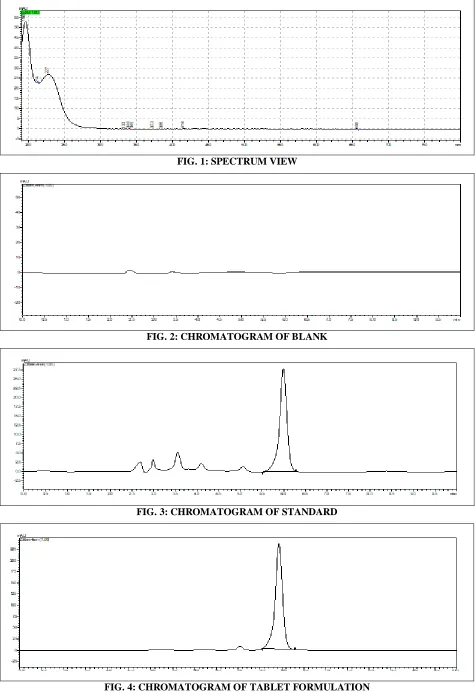
FIG. 1: SPECTRUM VIEW
FIG. 2: CHROMATOGRAM OF BLANK
FIG. 3: CHROMATOGRAM OF STANDARD
FIG. 5: PEAK PURITY
Linearity and Range:
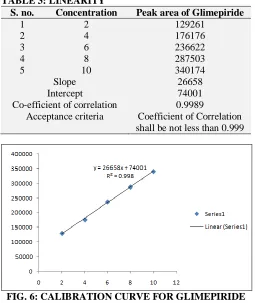
[image:5.612.47.302.346.649.2]Glimepiride: The linearity of an analytical method is its ability to elicit test results that are directly, or by a well-defined mathematical transformation, proportional to the concentration of an analyte in samples within a given range of 2-10 ug/ml as reported in Table 3.
TABLE 3: LINEARITY
S. no. Concentration Peak area of Glimepiride
1 2 129261
2 4 176176
3 6 236622
4 8 287503
5 10 340174
Slope 26658
Intercept 74001
Co-efficient of correlation 0.9989
Acceptance criteria Coefficient of Correlation shall be not less than 0.999
FIG. 6: CALIBRATION CURVE FOR GLIMEPIRIDE
Data Interpretation: The method for glimepiride was found to be linear in the concentration range of 2 µg/ml to 10 µg/ml and the correlation coefficient obtained is 0.9693.
Precision: The precision of an analytical method is the degree of agreement among individual test
results when the method is applied repeatedly to multiple sampling of a homogeneous sample.
System Precision: The system precision was carried out to ensure that the analytical system was working properly. The system precision is performed by 6 sample injections and checking the reproducibility in the peak area.
Data Interpretation: It is observed from the data tabulated above, that the area responses are consistent as evidenced by the values of relative standard deviation. Hence, it can be concluded that the system precision parameter meets the requirement of method validation.
[image:5.612.314.566.483.741.2]Method Precision: Intraday Precision:
TABLE 4: METHOD PRECISION FOR GLIMEPIRIDE
S. no. 2 μg 6 μg 10 μg
1 129261 236622 340174 2 128456 236652 342178 3 130641 238234 344161 4 131201 235896 348174 5 132001 241621 350110 6 133366 243612 352177 Avg. 130821 238772.8333 346162.3 St. dev 1636.716734 2864.149578 4311.757 % RSD 1.251111621 1.199529083 1.245588
TABLE 5: SYSTEM PRECISION FOR GLIMEPIRIDE
S. no. 2 μg 6 μg 10 μg
The precision express reliability of the method, where it defines the extent for the individual test results can agree to repeated test result on the same operating conditions at a short time period. Repeatability of the method is accepted.
Interday Precision: Repeatability method procedure was repeated on the next day. The method passed the test, as both retention time (<1%) and response peak areas (<2%), % RSD obtained were in the limits.
Data Interpretation: From the above Table 4 and
5 results, it was concluded that the method is precise.
Limit of Detection and Limit of Quantitation:
Limit of detection is the lowest amount of analyte in a sample that can be detected, but not necessarily
quantitated, under the stated experimental conditions.
Limit of Quantitation is the lowest amount of analyte in a sample that can be quantitated with acceptable accuracy and precision, under the stated experimental conditions.
[image:6.612.312.567.177.236.2]Limit of Detection (LOD) and Limit of Quantitation (LOQ) was calculated based on the residual standard deviation of response and slope.
TABLE 6: RESULTS OF LOD & LOQ OF GLIMEPIRIDE
Parameter Glimepiride
LOD (µg/ml) 3.3*sd/slope
2.95917628
LOQ (µg/ml) 10*sd/slope
8.95917628
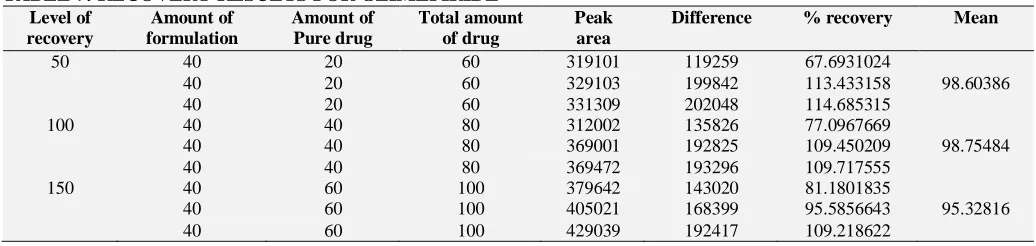
Accuracy: The accuracy of an analytical method is the closeness of test results obtained by that method to the true value (Standard value).
[image:6.612.47.565.323.446.2]% Recovery = Amount of drug × 100 / Amount of drug added
TABLE 7: RECOVERY RESULTS FOR GLIMEPIRIDE
Level of recovery
Amount of formulation
Amount of Pure drug
Total amount of drug
Peak area
Difference % recovery Mean
50 40 20 60 319101 119259 67.6931024
40 20 60 329103 199842 113.433158 98.60386
40 20 60 331309 202048 114.685315
100 40 40 80 312002 135826 77.0967669
40 40 80 369001 192825 109.450209 98.75484
40 40 80 369472 193296 109.717555
150 40 60 100 379642 143020 81.1801835
40 60 100 405021 168399 95.5856643 95.32816
40 60 100 429039 192417 109.218622
Robustness: The robustness of an analytical procedure is a measure of its capacity to remain unaffected by small, but deliberate variations in
method parameters and provides an indication of its reliability during normal usage.
TABLE 8: RESULTS FOR ROBUSTNESS OF GLIMEPIRIDE
WL C A WL C A
6 0.115 6 0.116
523 6 0.113 525 6 0.114
6 0.115 6 0.115
Average 0.114333333 Average 0.115
St. dev 0.001154701 ST DEV 0.001
%RSD 1.009942162 %RSD 0.86956522
Ruggedness:
TABLE 9: RESULTS FOR RUGGEDNESS OF GLIMEPIRIDE
C T1 T2 Mean SD %RSD
By changing the analyst
0 0 0 0 0 0
2 0.04 0.039 0.0395 0.000707107 1.79014375
4 0.073 0.074 0.0735 0.000707107 0.962050042
6 0.116 0.114 0.115 0.001414214 1.229750924
8 0.183 0.178 0.1805 0.003535534 1.958744546
10 0.204 0.209 0.2065 0.003535534 1.712122957
By changing the instrument
0 0 0 0 0 0
4 0.073 0.074 0.0735 0.000707107 0.962050042
6 0.115 0.112 0.1135 0.00212132 1.869004708
8 0.17 0.176 0.798 0.004242641 0.531659234
10 0.203 0.205 0.204 0.001414214 0.693241942
Assay of Marketed Formulation:
Sample Preparation: In case of marketed formulations, twenty tablets were taken, weighed, finely powdered and an accurate amount equivalent to 100 mg of drug powder was transferred into a 100 ml volumetric flask. The stock solution was further diluted with diluents and it was filtered through 0.45µ nylon filter to obtain a concentration of 100 µg/ml of glimepiride and then the resultant solution is analyzed.
Forced Degradation Studies: The stress studies were performed Glimepiride drug at 50 μg/ml concentration. Here the bulk drug is exposed to acidic stress by addition of 1.0 ml of 0.1M HCl to drug solution and counteracted with 1.0 ml of 0.1M NaOH, at 0 min, 30 min, 1 h, 2 h, 4 h, 8 h, 6 h, and 32 h respectively. Similarly, the basic stress studies were performed by adding 1.0 ml of 0.1 M NaOH and neutralized with 1ml of 0.1M HCl. Oxidation studies were achieved on the bulk drug by addition
of 1.0 mL of 3% H2O2. Thermal studies were
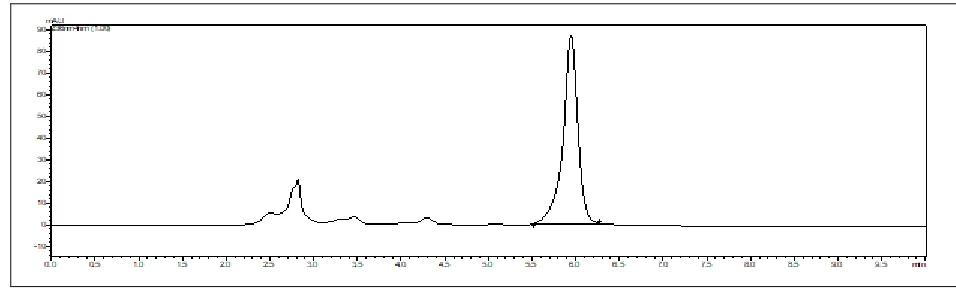
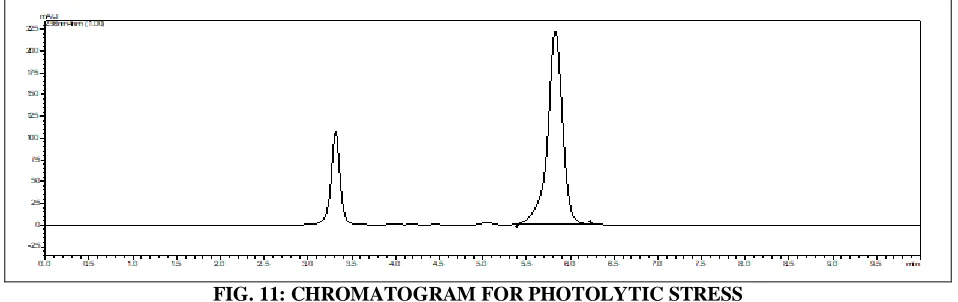
performed by heating the sample at 60 ºC and UV studies were also carried out by sample at UV- Lamp 45 ºC respectively. Entire samples were placed in a different volumetric flask (10 mL) and dissolved in HPLC grade acetonitrile. Final drug concentration for the assay was made up of Acetonitrile and injected in the chromatographic system. For all these stability studies, the development of degradable item was affirmed by contrasting and the chromatogram of the arrangement kept under ordinary unstressed conditions. Every stressed sample was analyzed by improved RP-UFLC method. The degradation of data for glimepiride was shown below 11-16.
[image:7.612.67.545.402.556.2]Acid Stress: For 2 ml sample add 2 ml 0.1N HCl keep aside for 5 min and then add 2 ml of 0.1N NaOH, then inject this sample for 36 h as intervals 30 min, 1 h, 1.30 min respectively.
FIG. 7: CHROMATOGRAM FOR ACID STRESS
Base Stress: For 2 ml sample add 2 ml of 0.1N NaOH keep aside for 5 min and then add 2 ml of 0.1N HCL, and inject the sample.
[image:7.612.64.542.599.743.2]Peroxide Stress: For 2 ml sample add 1 ml of 3% peroxide solution and inject this sample.
FIG. 9: CHROMATOGRAM FOR PEROXIDE STRESS
[image:8.612.68.543.261.412.2]Heat Stress: Take 2 ml sample and heat for 1 h at 8 ºC and inject the sample.
FIG. 10: CHROMATOGRAM FOR HEAT STRESS
[image:8.612.67.546.465.616.2]Photolytic Stress: Take 2 ml sample and place in a UV chamber for 1 h UV- Lamp 45 ºC respectively and then inject the sample.
FIG. 11: CHROMATOGRAM FOR PHOTOLYTIC STRESS
CONCLUSION: A novel, simple, rapid and cost-effective RP-UFLC method was successfully developed for method development, validation and stability-indicating assay on glimepiride in tablet dosage form by RP-UFLC form the proposed method was optimized and validated for the various experimental parameters. Influence of pH of the mobile phase, mobile phase ratio, and flow rate on the analysis of glimepiride was evaluated.
excellent accuracy, precision, selectivity, and reproducibility.
ACKNOWLEDGEMENT: The authors express their sincere thanks to the Principal, JSS College of Pharmacy, and Mysuru for providing the necessary facilities to carry out the research work.
CONFLICT OF INTEREST: None
REFERENCES:
1. Lestari ML and Indrayanto G: Glimepiride. in profiles of drug substances, excipients and related methodology Academic Press 2011; 36: 169-04.
2. Bonfilio R, Araújo MB and Salgado H: Development and validation of an UV-derivative spectrophotometric method for determination of glimepiride in tablets. Journal of the Brazilian Chemical Society 2011; 22(2): 292-9.
3. Karthik A, Subramanian G, Rao CM, Bhat K, Ranjithkumar A, Musmade P, Surulivelrajan M, Karthikeyan K and Udupa N: Simultaneous determination of pioglitazone and glimepiride in bulk drug and pharmaceutical dosage form by RP-HPLC method. Pakistan J of Pharmaceutical Sci 2008; 21(4): 421-25. 4. Lakshmi KS and Rajesh T: Development and validation of
RP-HPLC method for simultaneous determination of glipizide, rosiglitazone, pioglitazone, glibenclamide and glimepiride in pharmaceutical dosage forms and human plasma. Journal of the Iranian Chemical Society 2011; 8(1): 31-7.
5. Nirupa G and Tripathi UM: RP-HPLC analytical method development and validation for simultaneous estimation of three drugs: Glimepiride, pioglitazone, and metformin and its pharmaceutical dosage forms. Journal of Chemistry 2013; 1-8.
6. Singhvi I, Mehta K and Kapadiya N: Analytical method development and validation for the simultaneous estimation of pioglitazone and glimepiride in tablet dosage form by multiwavelength spectroscopy. Journal of Applied Pharmaceutical Science 2011; 1(6): 159.
7. Altinöz S and Tekeli D: Analysis of glimepiride by using derivative UV spectrophotometric method. J of Pharma-ceutical and Biomedical Analysis 2001; 24(3): 507-15.
8. Sane RT, Menon SN, Inamdar S, Mote M and Gundi G: Simultaneous determination of pioglitazone and glimepiride by high-performance liquid chromatography. Chromatographia 2004; 59(7-8): 451-3.
9. Kumar VK, Sudhakar M, Reddy PY, Swapna A and Sekhar RV: Method development and validation for simultaneous estimation of Pioglitazone and Glimepiride in tablet dosage form by RP-HPLC and UV-Spectro-photometric method. Current Pharma Research 2011; 2(1): 404.
10. Jain D, Jain S, Jain D and Amin M: Simultaneous estimation of metformin hydrochloride, pioglitazone hydrochloride, and glimepiride by RP-HPLC in tablet formulation. Journal of Chromatographic Science 2008; 46(6): 501-04.
11. Sharma R, Sharma G, Chopra D and Jain PK: Analytical method development and validation for the simultaneous estimation of pioglitazone and glimepiride in tablet dosage form by RP-HPLC. International Journal of Pharmaceutical Sciences and Research 2011; 2(3): 637. 12. Pandit V, Pai RS, Singh G, Devi K, Narayana S and
Suresh S: Development and validation of the liquid chromatographic method for simultaneous estimation of metformin, pioglitazone, and glimepiride in pharmaceutical dosage forms. Pharmaceutical Methods 2012; 3(1): 9-13.
13. Bonfilio R, Peres C, Salgado H, de Araújo MB and Tarley CR: Multivariate development and validation of a stability-indicating HPLC method for the determination of glimepiride in tablets. Journal of AOAC International 2013; 96(5): 960-7.
14. Hossain K, Rahman A, Sultan MZ, Islam F, Akteruzzaman M, Salam MA and Rashid MA: A validated RP-HPLC method for simultaneous estimation of antidiabetic drugs pioglitazone HCl and glimepiride. Bangladesh Pharmaceutical Journal 2013; 16(1): 69-75.
15. Navaneethan G, Karunakaran K and Elango KP: Simultaneous estimation of pioglitazone, glimepiride and glimepiride impurities in combination drug product by a validated stability-indicating RP-HPLC method. Journal of the Chilean Chemical Society 2011; 56(3): 815-8.
16. Patel KK, Karkhanis VV and Gajjar MS: Development and validation of stability-indicating HPTLC method for estimation of glimepiride and metformin hydrochloride. International Journal of Pharmaceutical Sciences & Research 2015; 6(3): 1222-29.
All © 2013 are reserved by International Journal of Pharmaceutical Sciences and Research. This Journal licensed under a Creative Commons Attribution-NonCommercial-ShareAlike 3.0 Unported License.
This article can be downloaded to Android OS based mobile. Scan QR Code using Code/Bar Scanner from your mobile. (Scanners are available on Google Play store)
How to cite this article: