Volume 2007, Article ID 45731,14pages doi:10.1155/2007/45731
Research Article
Efficient Zero-Knowledge Watermark Detection with
Improved Robustness to Sensitivity Attacks
Juan Ram ´on Troncoso-Pastoriza and Fernando P ´erez-Gonz ´alez
Signal Theory and Communications Department, University of Vigo, 36310 Vigo, Spain
Correspondence should be addressed to Juan Ram ´on Troncoso-Pastoriza,[email protected]
Received 28 February 2007; Revised 20 August 2007; Accepted 18 October 2007
Recommended by Stefan Katzenbeisser
Zero-knowledge watermark detectors presented to date are based on a linear correlation between the asset features and a given secret sequence. This detection function is susceptible of being attacked by sensitivity attacks, for which zero-knowledge does not provide protection. In this paper, an efficient zero-knowledge version of the generalized Gaussian maximum likelihood (ML) de-tector is introduced. This dede-tector has shown an improved resilience against sensitivity attacks, that is empirically corroborated in the present work. Two versions of the zero-knowledge detector are presented; the first one makes use of two new zero-knowledge proofs for absolute value and square root calculation; the second is an improved version applicable when the spreading sequence is binary, and it has minimum communication complexity. Completeness, soundness, and zero-knowledge properties of the de-veloped protocols are proved, and they are compared with previous zero-knowledge watermark detection protocols in terms of receiver operating characteristic, resistance to sensitivity attacks, and communication complexity.
Copyright © 2007 J. R. Troncoso-Pastoriza and F. P´erez-Gonz´alez. This is an open access article distributed under the Creative Commons Attribution License, which permits unrestricted use, distribution, and reproduction in any medium, provided the original work is properly cited.
1. INTRODUCTION
Watermarking technology has emerged as a solution for au-thorship proofs or dispute resolving. In these applications, there are several requirements that watermarking schemes must fulfill, like imperceptibility, robustness to attacks that try to erase a legally inserted watermark or to embed an ille-gal watermark in some asset, and they must also be secure to the disclosure of information that could allow the breakage of the whole system by unauthorized parties.
The schemes that have been used up to now are symmet-ric, as they employ the same key for watermark embedding and watermark detection; thus, such key must be given to the party that runs the detector, which in most cases is not trusted. In order to satisfy the security requirements, two ap-proaches have been proposed: the first one, called asymmet-ric watermarking, follows the paradigm of asymmetric cryp-tosystems, and employs different keys for embedding and de-tection; the second approach,zero-knowledge watermarking, makes use of zero-knowledge (ZK) protocols [1] in order to get a secure communication layer over a pre-existent sym-metric protocol. In zero-knowledge watermark detection [2],
a proverP tries to demonstrate to a verifierVthe presence of a watermark in a given asset. Commitment schemes [3] are used to conceal the secret information, so that detection is performed without providing toVany information addi-tional to the presence of the watermark.
Nevertheless, such minimum disclosure of information still allows for blind sensitivity attacks [4], that have arisen as very harmful attacks for methods that present simple de-tection boundaries. The ZK dede-tection protocols presented to date—Adelsbach and Sadeghi [2] and Piva et al. [5]—are based on correlation detectors, for which blind sensitivity at-tacks are especially efficient.
on additive spread-spectrum and Spread-Transform Dither Modulation (ST-DM), and rewritten in a form that greatly improves its communication and computation complexity.
The rest of the paper is organized as follows. InSection 2, some basics about zero-knowledge and watermark detec-tion are reviewed, and the three studied detectors are com-pared, pointing out the improved robustness of the GG de-tector against sensitivity attacks. InSection 3, the needed ZK subprotocols are enumerated, along with their communi-cation complexity and a detailed description of the devel-oped proofs. Sections4and5detail the complete detection protocol and the improved version for a binary antipodal spreading sequence. Section 6 presents the security analy-sis for these protocols; complexity and implementation con-cerns are discussed in Section 7. Finally, some conclusions are drawn inSection 8.
2. NOTATION AND PREVIOUS CONCEPTS
In this section, some of the concepts needed for the develop-ment of the studied protocols are briefly introduced. Bold-face lower-case letters will denote column vectors of length
L, whereas boldface capital letters are used for matrices, and scalar variables will be denoted by italicized letters. Upper-case calligraphic letters represent sets or parties participating in a protocol.
2.1. Cryptographic primitives
2.1.1. Commitment schemes
Commitment schemes [3] are cryptographic tools that, given a common public parameter parcom, allow that one party of a protocol choose a determined valuemfrom a finite setM
and commit to his choiceCm=Com(m,r, parcom), such that
he cannot modify it during the rest of the protocol; the com-mitted value is not disclosed to the other party, thanks to the randomization produced byr, which constitutes the secret information needed to open the commitment.
The required security properties that the commit func-tion must fulfill arebinding andhiding; the first one guar-antees that once produced a commitmentCm to a message
m, the committer cannot open it to a different messagem; the second one guarantees that the distributions of the com-mitments to different messages are indistinguishable, so one commitment does not reveal any information about the con-cealed message. Each of these properties can be achieved ei-ther computationally or in an information-theoretic sense, but the information-theoretic version cannot be obtained for both properties at the same time.
The commitment scheme used in the present work is Damg˚ard-Fujisaki’s scheme [7], that provides statistically-hiding and computationally-binding commitments, based on Abelian groups of hidden order. Given the security pa-rametersF,B,T, andk, the common parameters are a mod-ulusn(that can be obtained as an RSA modulus), such that the order ofZ∗
ncan be upper bounded by 2B, a generatorhof a multiplicative subgroup of high order (the order must be
F-rough) inZ∗
n, and a valueg=hα, such that the committer
knows neitherαnor the order of the subgroups. The com-mit function of a messagex∈[−T,T] with a random value
r∈[0, 2B+k] takes the formCx=gxhrmodn.
Additionally, this commitment scheme presents an ad-ditive homomorphism that allows computing the addition of two committed numbers (Cx+y = Cx·Cymodn) and the product of a committed number and a public integer (Cax=
Ca xmodn).
2.1.2. Interactive proof systems
Interactive proof systems were introduced by Goldwasser et al. [1]; they are two party protocols in which a proverP tries to prove a statementxto a verifierV, and both can make random choices. The two main properties that an interactive protocol must satisfy arecompletenessandsoundness; the first one guarantees that a correct proverP can prove all correct statements to a correct verifier V, and the second guaran-tees that a cheating proverP∗will only succeed in proving a wrong statement with negligible probability.
A special class of interactive protocols are proofs of knowledge [8], in which the proved statement is the knowl-edge of a witness that makes a given binary relation output a true value, such that a probabilistic algorithm called knowl-edge extractor exists, and it is able to output a witness for the common inputxusing any probabilistic polynomial time proverP∗as an oracle, in polynomial expected time (weak soundness).
2.1.3. Zero-knowledge protocols
In order for an interactive proof to be zero-knowledge [1], it must be such that the only knowledge disclosed to the verifier is the statement that is being proved. More formally, an in-teractive proof system (P,V) is statistically zero-knowledge if it exists a probabilistic polynomial algorithm (simulator)
SVsuch that the conversations produced by the real
interac-tion betweenPandVare statistically indistinguishable from the outputs ofSV.
2.2. Blind watermark detection
Given a host signal x, a watermark w, and a pair of keys
{Kemb,Kdet}for embedding and detection (they are the same
key in symmetric schemes), a digital blind watermark detec-tion scheme consists of anembedderthat outputs the water-marked signal y = Embed(x,w,Kemb) and a detector that
takes as parameters a possibly attacked signal z = y+n, wherenrepresents added noise, the watermark w, and the detection keyKdet, and it outputs a Boolean value
indicat-ing whether the signalzcontains the watermarkw, without using the original host datax.
x
s
Corr. rx QΛ(.)
QΛ(rx)−
+ ρ × +
1
L
w y
Figure1: Block diagram of the watermark embedding process for ST-DM.
i.i.d. with varianceσ2
X, the watermarked features are denoted byy=x+w, andzrepresents the input to the receiver, which may be corrupted with AWGN noisen, that is considered also i.i.d with varianceσ2
N. The binary hypothesis test that must be solved at the detector is
H0:z=x+n,
H1 : z=x+w+n.
(1)
Table 1 summarizes the probabilities of false alarm (Pf) and missed detection (Pm) for the three detectors [9–11].
2.2.1. Additive spread spectrum with
correlation-based detector
In SS, the watermark is generated as the product of a pseu-dorandom vectors, that we will consider a binary sequence with values{±1}(with norm s2 = L) and a perceptual
maskα(that is assumed to be constant to simplify the anal-ysis), that controls the tradeoffbetween imperceptibility and distortion (Dw=(1/L)
L
k=1E{w2k} =E{α2k} =α2).
The maximum-likelihood detector for Gaussian dis-tributed host features is a correlation-based detector:
H1
rz=1
L
L
k=1
zksk≷η, H0
(2)
whereηis a threshold that depends on the probabilities of false alarm (Pf) and missed detection (Pm), as indicated in Table 1.
2.2.2. Spread transform dither modulation
Given the host featuresxand the secret spreading sequence s, which will be considered here binary with values {±1}, the embedding of the watermark in ST-DM [12] (similar to quantized projection QP [9,10]) is done as indicated in Fig-ure1.
The host featuresxare correlated with the projection sig-nals, and the result (rx) is quantized with an Euclidean scalar quantizerQΛ(·) of stepΔ, that controls the distortion, and
with centroids defined by the shifted latticeΛ ΔZ+Δ/2.
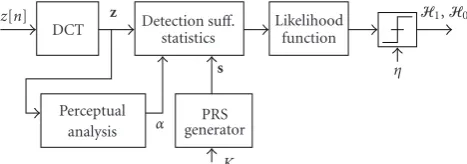
z[n] DCT
z Detection suff. statistics
Likelihood function
η
H1,H0
s
Perceptual analysis α
K
PRS generator
Figure2: Block diagram of the watermark detection process for the GG detector.
Letρ=(QΛ(rx)−rx); then the watermarked vector is given by
y=x+w=x+1
Lρs. (3)
In order to detect the watermark, the host features, pos-sibly degraded by AWGN noise n, are correlated with the spreading sequences, and the resulting valuerz =
L k=1zksk is quantized and compared to a threshold η to determine whether the watermark is present:
H1
QΛ
rz
−rz≶η. H0
(4)
Due to the Central Limit Theorem (CLT), the computed correlations can be accurately modeled by a Gaussian pdf.
2.2.3. Additive spread spectrum with generalized-Gaussian
features
Figure 2shows the detection scheme for this case. The host features are assumed to be the DCT coefficients of an image, what justifies the generalized Gaussian model with the fol-lowing pdf:
fX(x)=Ae−|βx| c ,
β= 1
σ
Γ(3/c)
Γ(1/c) 1/2
,
A= βc
2Γ(1/c).
(5)
The embedding procedure is the same as the one de-scribed for SS. For detection, a preliminary perceptual anal-ysis provides the estimation of the perceptual maskα that modulates the inserted secret sequences. The parametersc
andβare also estimated from the received features. The like-lihood function for detection is
H1
l(y)=
k
βc Y k
c
−Yk−αksk c
≷η, H0
(6)
Table1: Probabilities of false alarm (Pf) and missed detection (Pm) for the three studied detectors.
AddSS ST-DM GG
Pf Q(√Lη/
σ2
X+σN2)
∞
i=−∞[Q((Δ(i+ 1/2)−η)/
L(σ2
X+σN2))−Q((Δ(i+ 1/2) +η)/
L(σ2
X+σN2))] Q((η+m1)/σ1)
Pm Q(√L(α−η)/
σ2
X+σN2) 1− ∞
i=−∞[Q((iΔ−η)/ √
LσN)−Q((iΔ+η)/ √
LσN)] 1−Q((η−m1)/σ1)
As shown in [6], the pdfs ofl(Y) conditioned to hypothe-sesH0 andH1 are approximately Gaussian with the same
varianceσ2
1, and respective means−m1andm1, that can be
estimated from the watermarked image [6].
2.2.4. Comparison
The three detectors can be compared in terms of robustness through theirReceiver Operating Characteristic(ROC), taken from the formulas inTable 1. The correlation-based detec-tor is only optimum whenc=2, and whenc /=2, the gen-eralized Gaussian detector outperforms it; ST-DM can out-perform both for a sufficiently high DWR (Data to Water-mark Ratio, DWR=10log10(σ2
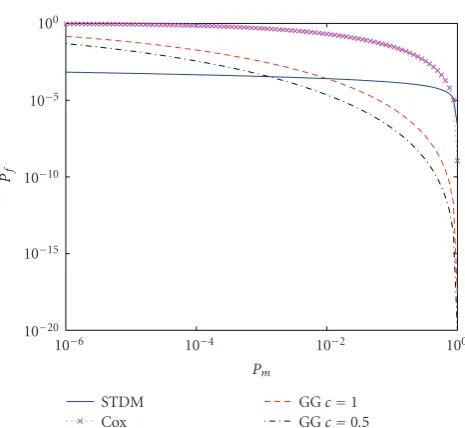
X/σW2)), due to its host rejec-tion capabilities. However, the performance of the general-ized Gaussian detector and the ST-DM one are not much far apart whencis near 1 and the DWR in the projected domain (DWRp = DWR−10 log10L) is low.Figure 3shows a plot
of the ROC for fixed DWR and WNR (Watermark to Noise Ratio, WNR = 10 log10(σ2
W/σN2)), with a features shape pa-rameter ofc = 0.8, that has been chosen as an example of a relatively common value for the distribution of AC DCT coefficients of most images. It is remarkable that even when the exactcis not used, and it is below 1, the performance of the GG detector withc=0.5 is much better than that of the correlation-based one, and its ROC remains near the ST-DM ROC.
Regarding the resilience against sensitivity attacks, it can be shown that the correlation-based detector and the ST-DM one make the watermarking scheme very easy to break when the attacker has access to the output of the detector, as the detection boundaries for both methods are just hyperplanes; Figure 4 shows the two-dimensional detection regions for each of the three methods. On the other hand, the detec-tion funcdetec-tion in the GG detector whenc < 1 (Figure 4(c)) presents the property that component-wise modifications produce bounded increments; that is, when modifying one component of the host signalY, the increment produced in the likelihood function (6) is bounded by|αksk|c indepen-dently of the component|Yk|ifc <1:
Ykc
−Yk−αksk c
≤αksk c
. (7)
This means that it is not possible to get a signal in the boundary by modifying a single component (or a numberN
of components such thatN|αksk|cis less than the gap toη), opposed to a correlation detector, in which just making one component big (or small) enough can get the signal out of the detection region. This property can make very difficult the task of finding a vector in the boundary given only one marked signal.
10−20
10−15
10−10
10−5
100
Pf
10−6 10−4 10−2 100
Pm STDM
Cox
GGc=1 GGc=0.5
Figure3: Theoretical ROC curves for the studied detectors under AWGN attacks, with DWR=20 dB, WNR=0 dB,L=1000, and generalized Gaussian distributed host features withc=0.8.
In order to quantitatively compare the resilience of the three detectors against sensitivity attacks, we will take as ro-bustness criterion the number of calls to the detector needed for reaching an attack distortion equal to that of the water-mark (NWR=0 dB). This choice is supported by the fact that for an initially nonmarked hostxin which a watermarkwhas been inserted, yieldingy, it is always possible to find a vector zin the boundary whose distortion with respect toyis less than the power of the watermark (e.g., taking the intersection between the detection boundary and the line that connectsx andy). Thus, a sensitivity attack can always reach a point with NWR=0 dB. In general, it is not guaranteed that an at-tack can reach a lower NWR. Furthermore, given that for a blind detection the original nonmarked host is not known, imposing a more restrictive fidelity criterion for the attacker than for the embedder makes no sense. In light of the previ-ous discussion, we can consider that a watermark has been effectively erased when a pointzis found, whose distortion with respect toyis equal to the power of the embedded wa-termarkw; the number of iterations that a sensitivity attack needs to reach this point can thus be used for determining the robustness of the detector against the attack.
(a) (b)
(c)
Figure4: Two-dimensional detection boundaries for ST-DM (a), correlation-based detector (b), and GG detector (c).
of times proportional to the number of dimensions of the involved signals. The results show that both ST-DM and the correlation detector are completely broken in just one iter-ation of the algorithm, independently of the dimensionality of the signals, so the attack needsO(L) calls to the detector in order to succeed (achieving not only a point with NWR<
0 dB, but also convergence to the nearest point in the bound-ary). This is due to their simple detection boundaries, that have a constant gradient.Figure 5shows the NWR of the at-tack as a function of the number of calls to the detector, for the three detectors, using DWR=16 dB andPf=10−4, as a result of averaging 100 random executions. The GG detector is used with two different shape factors,c=0.5 andc=1.5; the number of iterations needed to break the detector in both cases is bigger than for the correlation detectors, due to the more involved detection boundary, but this effect is more ev-ident whenc <1, case in which the detector has the afore-mentioned property of bounded increments for component-wise modifications at the input.
The involved detection boundary of the generalized Gaussian ML detector makes the number of iterations needed for achieving convergence grow also with the dimen-sionality of the host. This means that the number of calls to the detector needed to get a certain target distortion is not only higher for the GG detector, but it also grows faster than for the other detectors with the dimensionality of the host (Figure 6) for fixed WNR andPf. We have found empirically that the number of calls needed for reaching NWR=0 dB is approximatelyO(L1.5). Furthermore, if we took as
robust-ness criterion the absolute convergence of the algorithm (not only achieving NWR=0 dB), the advantage of the GG detec-tor is even better both in number of iterations and in number of calls to the detector; that is, while for the GG detector con-vergence is slowly achieved several iterations after reaching
−10 0 10 20 30 40 50 60 70 80
NWR
(dB)
0 0.5 1 1.5 2 2.5 3
×106
Calls to the detector STDM
Cox
GGc=1.5 GGc=0.5
Figure 5: NWR for a sensitivity attack (BNSA) as a function of number of calls to the detector for correlation detector (Cox), ST-DM, and generalized Gaussian (GG) withc=0.5, andc=1.5 for DWR=16 dB,Pf=10−4, andL=8192.
0 0.5 1 1.5 2 2.5 3 ×10⁶
N
u
mb
er
of
or
ac
le
cal
ls
for
NWR
=
0d
B
1000 2000 3000 4000 5000 6000 7000 8000
L
STDM Cox
GGc=1.5 GGc=0.5
Figure6: Number of calls to the detector for a sensitivity attack (BNSA) for reaching NWR=0 dB as a function of the dimensional-ity of the watermark for correlation detector (Cox), ST-DM, and generalized Gaussian (GG) withc = 0.5 andc = 1.5 for DWR
=16 dB andPf=10−4.
NWR=0 dB, for correlation detectors BNSA achieves both NWR<0 dB and convergence in just one iteration.
2.3. Zero-knowledge watermark detection
by Adelsbach et al. [2,15]. The formal definition of a zero-knowledge watermark detection scheme concreted for a blind detection mechanism can be stated as follows.
Definition 1(Zero-knowledge Watermark Detection). Given a secure commitment scheme with the operations Com() and Open(), and a blind watermarking scheme with the operations Embed() and Detect(), the watermarked host data z and the commitments on the watermark Cw and key CKw (for a keyed scheme), with their respective pub-lic parameters parcom =(parwcom, parKcomw ), a zero-knowledge
blind watermark detection protocol for this watermarking scheme is a zero-knowledge proof of knowledge between a prover P and a verifierV where on common inputx :=
(z,Cw,CKw, parcom), P proves knowledge of a tupleaux = (w,Kw,rcomw ,rcomKw ) such that
OpenCw,w,rcomw , parwcom
=true∧
OpenCKw,Kw,r Kw
com, parKcomw
=true∧
Detectz,w,Kw
=true.
(8)
Adelsbach and Sadeghi introduced in [2] a zero-knowledge watermark detection protocol for the Cox et al. [16] detection scheme, that consists in a normalized correlation-detector for spread spectrum. In [17], they have studied the communication complexity of the non-blind protocol, that is much less efficient than the blind one, due to the higher number of committed operations that must be undertaken. Later, Piva et al. also developed a ZK watermark detection protocol for ST-DM in [5].
3. ZERO-KNOWLEDGE SUBPROOFS
The proofs that are employed in the previous zero-knowledge detectors and in the generalized Gaussian one are shown in Table 2 with their respective communica-tion complexity, which has been calculated when applied to the Damg˚ard-Fujisaki commitment scheme [7] as a func-tion of the security parameters F,B,T and k, defined in Section 2.1.1.
The first five proofs are already existing zero-knowledge proofs for the opening of a commitment [7] (PKop), the
equality of two commitments [18] (PKeq), the square of a
commitment [18] (PKsq), a commitment is inside an
inter-val [18] (PKint) and nonnegativity of a commitment [19]
(PK≥0).
All these proofs are just simple operations, but the lack of some operations like the computation of the absolute value or the square root, both necessary for the first implementa-tion of the GG ML detector, led us to the development of the last two zero-knowledge proofs;PKsqrtrepresents a proof that
a committed integer is the rounded square root of another committed integer, and it is based on a mapping of quan-tized square roots into integers.PKabsallows the application
of the absolute value operator to a committed number, with-out disclosing the magnitude nor the sign of that number. Both proofs are described in the following.
3.1. Zero-knowledge proof that a committed integer is the rounded square root of another committed integer
Adelsbach et al. presented in [20] a proof for a generic func-tion approximafunc-tion whose inverse can be efficiently proven, covering, for example, divisions and square roots. Here, we present a specific protocol for proving a rounded square root that follows a similar philosophy, we study its commu-nication complexity and propose a mapping (presented in Appendix A) that makes possible this zero-knowledge proto-col to prove the correct calculation of square roots on com-mitted integers (not necessarily perfect square residues):
PKsqrt
y,r1,r2:Cy=gyhr1modn∧Cn√y=gn √y
hr2modn.
(9)
LetCy be the commitment to the integer whose square root must be calculated. The protocol that prover and verifier would follow is the next.
(1) First, the prover calculates the valuex =round(√y), its commitment Cx, and the commitment to its squared valueCx2, and sends both commitments and Cyto the verifier.
(2) The prover proves in zero-knowledge thatCx2contains
the squared value of the integer hidden inCx, through
PK{x,r1,r2 : Cx=gxhr1modn,Cx2=gx 2
hr2modn}.
(3) Then, the prover must prove thatx2 ∈[y−x,y+x],
using a modified version of Boudot’s proof [18] with hidden interval, that consists in considering also ran-domness in the commitments of the interval limits cal-culated by both parties at the first step of the proof. Using this interval instead of the one indicated in Appendix A, the zero values are also accepted with no ambiguity when the maximum allowable value foryis below the order of the group generated byg. The coun-terpart is that there are two possibilities for the square root of integers of the formk2+k, withkan integer,
namelykandk+ 1. The effect of this relaxation on the conditions imposed before is a small rise in the round-ing error, smaller ask grows; if we take into account that the numbers that are considered integers are actu-ally the quantization of real numbers using a step that is fixed by the precision of the system, the error is of the same order as this precision. Nevertheless, the need of working with null values without disclosing any infor-mation forces us to make this adaptation.
(4) At last, it is necessary to prove that x ∈ [0,√m], if
mis the order of the subgroup generated byg. If it is known—by the initialization of the commitment scheme—that log2(m) = l, then proving that x ∈
[0, 2l/2−1] is enough; if the working range for the com-mitted integers is [−T,T], withT < √m(as it will be if the bit length ofT is at mostl/2−1), then it suffices with the proof thatxis in the working range:
Table2: Zero-knowledge subproofs and their communication complexity.
Proof CompPK(bits)
PKop[m,r : Cm=gmhrmodn] 3|F|+|T|+ 2B+ 3k+ 2
PKeq[m,r1,r2 :C(1)m =g1mhr11modn∧Cm(2)=g2mhr22modn] 4|F|+|T|+ 2B+ 5k+ 3 PKsq[m,r1,r2 : Cm=g1mh
r1
1 modn∧gm 2 2 h
r2
2 modn] 4|F|+|T|+ 3B+ 5k+ 3
PKint[m,r : Cm=gmhrmodn∧m∈[a,b]] 25|F|+ 5|T|+ 10B+ 27k+ 2|n|+ 20
PK≥0[m,r : Cm=gmhrmodn∧m≥0] 11|F|+ 4|T|+ 12B+ 14k+ 9
PKsqrt[m,r1,r2 : Cm=gmhr1modn∧Cn√m=gn √
mhr2modn] 48|F|+ 9|T|+ 18B+ 53k+ 6|n|+ 39
PKabs[m,r1,r2 : Cm=gmhr1modn∧C|m|=g|m|hr2modn] 19|F|+ 6|T|+ 16B+ 24k+ 15
Claim 1. The presented interactive proof is computationally sound and statistically zero-knowledge in the random oracle model.
A sketch of the proof for this claim is given in Appen-dixC.
The communication complexity of this protocol is shown inTable 2.
3.2. Zero-knowledge proof that a committed integer is the absolute value of another committed integer
This proof is a zero-knowledge protocol that allows the appli-cation of the absolute value operator to a committed number, without disclosing the magnitude nor the sign of that num-ber
PKabs
x,r1,r2 : Cx=g1xhr11modn∧C|x|=g2|x|hr22modn
.
(10)
As in a residue groupZqthere is no notion of “sign,” we are using the commonly known mapping:
sign(x)=
⎧ ⎪ ⎪ ⎪ ⎨ ⎪ ⎪ ⎪ ⎩
1, x∈
0,
q
2
,
−1, x∈
q
2
+ 1,n−1
;
taking into account that−x≡q−xmodq, the mapping is consistent.
LetCx = g1xh
r1
1 modn be the commitment to a
num-ber x, whose sign is not known by the verifier, andC|x| =
g2|x|hr22modnthe commitment to a number which is claimed
to be the absolute value ofx. The scheme of the protocol is as follows:
(1) both prover and verifier calculate the commitment to the opposite ofx, with the help of the homomorphic properties of the commitment scheme:
C−x=C−x1; (11)
(2) next, the prover must demonstrate that the value hid-den in C|x| corresponds to the value hidden in one of the previous commitments Cx,C−x, using the ZK proof of knowledge described inAppendix B;
(3) at last, the prover demonstrates that the value hidden inC|x|is|x| ≥0, using the protocol proposed by Lip-maa [19].
Claim 2. The presented interactive proof is computationally sound and statistically zero-knowledge in the random oracle model.
A sketch of the proof for this claim can be found in Appendix C.
The communication complexity of this protocol is given inTable 2.
4. ZERO-KNOWLEDGE GG WATERMARK DETECTOR The zero-knowledge version of the generalized Gaussian de-tector conceals the secret pseudorandom signalsk using the Damg˚ard-Fujisaki scheme [7] Csk. The supposedly water-marked imageYkis publicly available, so the perceptual anal-ysis (αk) and the extraction of the parametersβkandckcan be done in the public domain, as well as the estimation of the thresholdηfor a given point in the ROC. In this first imple-mentation, only shape factorsc=1 orc =0.5 are allowed, so the employedckwill be the nearest to the estimated shape factor. The target is to perform the calculation of the likeli-hood function:
D=
k
βck k
⎛ ⎜ ⎜
⎝Ykck− Ak
Yk−αkskck
Bk ⎞ ⎟ ⎟
⎠, (12)
and the comparison with the thresholdη, without disclosing
sk.
The protocol executed by prover and verifier so as to prove that the given imageYk is watermarked with the se-quence hidden inCskis the following:
(1) prover and verifier calculate the commitment toAk =
Yk−αkskapplying the homomorphic property of the Damg˚ard-Fujisaki scheme:
CAk=
gYk
Cαk sk
; (13)
(2) next, the prover generates a commitmentC|Ak|to the absolute value ofAk, sends it to the verifier, and proves in zero-knowledge that it hides the absolute value of the commitment CAk, through the developed proof
PKabs(Section 3.2);
(3) if c = 1 (Laplacian features) then the operation
|Ak|c is not needed, so, just for the sake of notation
|Ak| must be calculated by the prover; then he gen-erates the commitmentCBk =C√|Ak|, sends it to the verifier and proves in zero-knowledge the validity of the square root calculation, through the proof PKsqrt
(Section 3.1);
(4) both prover and verifier can independently calculate the value βck
k and |Yk|ck, and complete the commit-ted calculation of the sumD = kβckk(|Yk|ck −Bk), thanks to the homomorphic property of the used com-mitment scheme
CD=
k g|Yk|ck
CBk βckk
; (14)
(5) finally, the prover must demonstrate in zero-knowledge thatD > η, or equivalently, thatD−η >0, which can be done by running the proof of knowledge by Lipmaa [19] onCth=CDg−η.
5. IMPROVED GG DETECTOR WITH BINARY ANTIPODAL SPREADING SEQUENCE (GGBA) When the spreading sequence sk is a binary antipodal se-quence, so it takes only values{±s}, we can apply a trivial transformation to the detection function of the GG detector (6):
D=
k
βck
kYkck−Yk−αkskck
=
k
βck
kYkck−Yk−αksck·1{s}sk
+Yk+αks ck·
1{−s}sk
=
k
βck k
Yk ck
−Yk−αks ck
·1
2s
s+sk
+Yk+αksck·1 2s
s−sk
(15)
=
k
βck k
Yk ck−1
2Yk−sαk ck
+Yk+sαk ck
G
−
k
βck k
2sYk−sαk
ck−
Yk+sαkck
Hk
sk.
(16)
In (15), we use the fact thatskcan only be given a values or−sin order to substitute the indicator function1{s}(sk)= (1/2s)(s+sk) and1{−s}(sk)=(1/2s)(s−sk).
The factors termed asGandHkin (16) can be computed in the clear-text domain, working with floating-point preci-sion arithmetic, and then have their commitments generated. This implies that all the nonlinear operations are transferred to the clear-text domain, greatly reducing the communica-tion overhead, as will be shown inSection 7; only additions and multiplications must be performed in the encrypted do-main, and they can be undertaken through the
homomor-phic properties of the commitment scheme. This transfer-ence also diminishes the computational load, as clear-text operations are much more efficient than modular operations in a large ring.
The zero-knowledge protocol can be reduced to the fol-lowing two steps.
(1) prover and verifier homomorphically compute th =
D−η
Cth= g
G−η !
kCHskk
. (17)
(2) The prover demonstrates the presence of the water-mark by running the zero-knowledge proof thatD− η >0.
The number of needed proofs during the protocol is reduced to only one, what propitiates the aforementioned reduction in computation and communication complexity, with the additional advantage that this scheme can be applied to any value of the shape parameterck, so it will be preferred to the previous one unlessskis not binary antipodal.
6. SECURITY ANALYSIS FOR THE GG DETECTION PROTOCOLS
After presenting the protocols for the zero-knowledge imple-mentation of the generalized Gaussian ML detector, we can state the following theorem.
Theorem 1. The developed detection protocols for the general-ized Gaussian detector are computationally sound and statisti-cally zero-knowledge.
A sketch of the proof for this theorem can be found in Appendix C.
The reformulation of the generalized Gaussian protocol deserves two comments concerning security. The first one in-volves the nonlinear operations that were performed under encryption in Section 4, which are now transferred to the public clear-text domain. Although this could seem at first sight a knowledge leakage, currently it is not; all those oper-ations can be performed with the same public parameters as inSection 4in a feasible time, so the parametersGandHk that are publicly calculated in this protocol could also be ob-tained in the previous version, and their disclosure gives no extraknowledge.
The second comment deals with the correlation form of the reformulation, and its resilience to blind sensitivity at-tacks. Even when the operation performed in the encrypted domain is a correlation, the additive term (G) is what pre-serves the bounded-increment property, by virtue of which component-wise modifications of the input signal only pro-duce bounded increments on the likelihood function:
−αc≤Y k
c
−Yk−αsk c
≤αc, c <1. (18)
no extra knowledge is learned fromG, and the difficulty for finding points in the detection boundary, that is a necessary step for sensitivity attacks, remains, as well as the shape of the detection regions, unaltered.
7. EFFICIENCY AND PRACTICAL IMPLEMENTATION
We will measure the efficiency of the developed protocols in terms of their communication complexity, as this parameter is what entails the bottleneck of the system, and it is easily quantifiable given the complexity measures calculated in the previous sections for each of the subprotocols.
Taking into account the plot of the raw protocol (Section 4), a total of 2Lcommitments (with a length|n|) are interchanged, namely theLcommitments that correspond to the secret pseudorandom sequencesand theLcommitments to|Ak|, while in the GGBA detector (Section 5) only theL commitments tosare sent; the rest of the commitments are either calculated using homomorphic computation or are al-ready included in the complexity of the subprotocols.
Thus, the total communication complexity for the detec-tor applied to Laplacian distributed features andc =0.5 in the first scheme, as well as the complexity for the improved
GGBAdetector can be expressed as
CompZKWDGG(c=1)
=2L|n|+L·CompPKabs+ CompPKop+ CompPK≥0, CompZKWDGG(c=0.5)
=2L|n|+L·CompPKabs+CompPKop+CompPKsqrt+CompPK≥0, CompZKWDGGBA
=(L+ 1)|n|+L·CompPKop+ CompPK≥0.
(19)
In every calculation,Lproofs of knowledge of the open-ing of the initial commitments have been added, as even when they are not explicitly mentioned in the sketch of the protocols, they are needed to protect the verifier.
In order to reduce the total time spent during the inter-action, it is possible to convert the whole protocol in a non-interactive one, following the procedure described in [21], keeping the condition that the parameters for the commit-ment scheme must not be chosen by the prover, or he would be able to fake all the proofs. In addition to the reduction in interaction time, the use of this technique also overcomes the necessity of a honest verifier that some subprotocols impose. The calculated complexity for Piva et al.’s ST-DM detec-tor and Adelsbach and Sadeghi’s blind correlation-based de-tector is the following:
CompZKWDSTDM
=(L+ 1)|n|+L·CompPKop+ CompPKint, CompZKWDSS
=(L+ 1)|n|+L·CompPKop+ 2CompPK≥0+ CompPKsq.
(20)
101
102
103
104
L
ength
of
the
p
ro
to
co
l
(kB)
100 200 300 400 500 600 700 800 900 1000 Number of watermark coefficients
STDM Cox
c=1
c=0.5 GGBA
Figure7: Communication complexity in kB for the studied proto-cols.
As a numeric example, inFigure 7the evolution of the communication complexity for every protocol is compared using|F| =80,|n| =1024,B=1024,T=2256andk=40, for growingL. All the protocols have complexityO(L). The two protocols for generalized Gaussian host features with
c = 1 andc = 0.5 have a higher complexity, due to the operations that cannot be computed by making use of the homomorphic property of the commitment scheme (abso-lute value and square root). Nevertheless, their complexity is comparable to that of the zero-knowledge non-blind detec-tion protocol developed by Adelsbach et al. [17].
On the other hand, the zero-knowledge GGBA detec-tor achieves the lowest communication complexity of all the studied protocols, even lower than the previous correlation-based protocols, with the increased protection against blind sensitivity attacks whenc <1 is used, being this the first ben-efit of the reformulated algorithm.
Furthermore, the communication complexity of the pro-tocol is constant if we discard the initial transmission of the commitments for the spreading sequence and their corre-sponding proofs of opening; once this step is performed, the protocol can be applied to several watermarked works for proving the presence of the same watermark with a (small) constant communication complexity.
The second benefit of the presented GGBA zero-knowledge protocol is that all the nonlinear operations are transferred from the encrypted domain (where they must be performed using proofs of knowledge) to the clear-text pub-lic domain; thus, all the operations that made the symmetric protocol more expensive than the correlation-based detec-tors can be neglected in comparison with the encrypted oper-ations, so the computation complexity of the zero-knowledge GGBA protocol will be roughly the same as the one for the correlation-based zero-knowledge detectors.
8. CONCLUSIONS
The presented zero-knowledge watermark detection pro-tocol based on generalized Gaussian ML detector outper-forms the previous correlation-based zero-knowledge de-tectors implemented to date in terms of robustness against blind sensitivity attacks, while improving on the ROC of the correlation-based spread-spectrum detector with a perfor-mance that is near that of ST-DM.
If the employed spreading sequence is a binary antipodal sequence, the protocol can be restated in a much more effi -cient way, reaching a communication complexity that is even lower than that of the previous correlation-based protocols, while keeping its robustness against sensitivity attacks.
Two zero-knowledge proofs for square root calculation and absolute value have been presented. They serve as build-ing blocks for the zero-knowledge implementation of the generalized Gaussian ML detector, and also allow for the en-crypted execution of these two nonlinear operations in other high level protocols.
Finally, the use of the technique shown in [21] makes the whole protocol noninteractive, so that it does not need a honest verifier to achieve the zero-knowledge property. In order to get protection against cheating provers, the proofs shown in [22] can be employed to prove some statistical properties of the inserted watermark, resulting in an increase in communication complexity.
APPENDICES
A. MAPPING FOR ROUNDED SQUARE ROOT
Current cryptosystems are based in modular operations in a group of high order. Although simple operations like addi-tion or multiplicaaddi-tion have a direct mapping from quantized real numbers to modular arithmetic (provided that the num-ber of elements inside the used group is big enough to avoid the effect of the modulus), when trying to cope with non-integer operations, like divisions or square roots, problems arise.
In the following, a mapping that represents quantized square roots inside integers in the range{1,. . .,n−1}is pre-sented, and existence and uniqueness of the solutions for this mapping are derived. The target is to find which conditions must be satisfied by the input and the output to keep this operation secure when the arguments are concealed.
The mapping must be such that ify∈Z+andx= √y∈ R, thenn√y := round(x). For this mapping to behave like
the conventional square root for positive reals, it is necessary to bound the domain where it can be applied. The formaliza-tion of the mapping would be as follows:
n√.:A
="y∈Z+|y < n#−→B="x∈Z+|x <round(√n)# y−→x=n$y=round($y).
(A.1)
In order for this definition to be valid, and given that the elements with which this mapping works are just the representatives of the residue classes of Zn in the interval
{1,. . .,n−1}, we can state the following lemma.
Lemma 1(Existence and uniqueness of a solution). A unique
x∈[1,xm]∩Z+exists, such that for ally∈ {1,. . ., min(xm2 +
xm,n−1)},xm≤ √n −1,
x2modn∈y−x,y+x
n, x≤y, (A.2)
where[, )nrepresents the modular reduction of the given inter-val.
Proof.
Existence. Giveny∈Z+, its real square root admits a unique
decomposition as an integer and a decimal in this way: $
y=x+d, x=round($y)∈Z+,d∈[−0.5, 0.5).
(A.3)
Squaring the previous expression, both sides of the equal-ity must be integers, so,
($y)2=x2+d2+ 2dx
x2=y−2dx−d2, (A.4)
and taking into account that yis integer, 2dx+d2 must be
also an integer, and it is bounded by
2dx+d2∈[−x+ 0.25,x+ 0.25)=⇒2dx+d2∈[−x+ 1,x].
(A.5)
Substituting this last equation in the previous one gives the desired result:
x2∈[y−x,y+x−1]. (A.6)
Thus, the modular reduction ofx2is inside the modular
reduction of the interval, andxexists.
Uniqueness. Here uniqueness is concerned with modular op-erations, and the possibility that the interval [y−x,y+x) in-clude integers out of the initial representing range{0,. . .,n−
1}, which would result in ambiguities after applying the mod operator. In the following, all the operations are modular, and thus, the mod operator is omitted. The intervals also rep-resent their modular reduction.
The proof is based on reductio ad absurdum. Let y ∈ {1,. . .,x2
integers such that both fulfillx=n√y,x=n√y. This means that
x2∈[y−x,y+x)∩Z,
x2∈[y−x,y+x)∩Z. (A.7)
Combining the previous relations,xandxmust be such that
x2−x2∈
(−x−x,x+x)∩Z. (A.8)
Let us suppose, without loss of generality, thatx > x. If bothx,x are less thanxm ≤ √n −1, then their squares are belown, and follow the same behavior as if no modular operation were applied. Squares inZcan be represented by the following recursive formula:
yk=k2=yk−1+k+k−1=⇒
yk−yi=k2−i2= ⎧ ⎪ ⎪ ⎨ ⎪ ⎪ ⎩
k−i−1
l=1
2(k−l) +k+i, k > i
0, k=i,
(A.9)
what means that in order forx2andx2to be spaced less that x+xthe next inequality must be satisfied:
x−x−1
l=1
2(x−l) +x+x< x+x=⇒
x−x−1
l=1
2(x−l)<0.
(A.10)
Thus, the only solution isx=x.
If, on the other hand,x = xm, and taking into account that
x2∈[y−x,y+x−1]⇐⇒y∈x2−x+ 1,x2+x,
(A.11)
there are two possibilities.
(1) y ∈ {x2 −x+ 1,. . .,n−1}: ifx /= x, then x < round(√n), so the range (x2−x,x2+x] cannot include
y, andxis the only admissible solution.
(2)y∈ {1,. . .,x2+x−n}: this is only possible ifx2
m+xm>
n; in such case, given the condition imposed onxm, then
y≤x2
m+xm−n≤
√
n2−1 +xm−n=xm−1. (A.12)
Asx =xm, this means thaty < x, which violates one of the conditions established at the beginning.
One issue in the previous exposition is that it is pos-sible that the mapping is not defined over the entire set
{1,. . .,n−1}. Instead, if the modulus is not public, the full working range is not known, and it becomes necessary to up-per bound the integers with which the system will work. In this case, the upper bound can be set toym =x2m+xm, and the mapping can be applied to the full working range; fur-thermore, the condition that x ≤ y can be eliminated, as
x∈ {1,. . .,xm}already guarantees that there is no ambiguity.
A similar reasoning can be applied when the working range includes negative numbers:
−
n
2
,. . ., 0,. . ., %
n
2 &
−1
. (A.13)
In this case, it is enough ifx∈ {1,. . ., round(√n/2)}, and
y∈ {1,. . .,n/2 −1}, asx2covers all the range of positive
numbers in whichyis included, and there are no ambiguities with the mod operation, as the overlap in intervals can only be produced with negative numbers, already discarded by the previous conditions.
Limiting the working range is the biggest issue of this method; with sequential modular additions and multiplica-tions inZn, it is only needed that the result of applying the same sequence of operations (without applying the modu-lus) inZbelongs to the interval{1,. . .,n−1}to reach the same value with modular operations. In the case of the de-fined square root, it is necessary that the operations made before applying a root also return a number inside the inter-val{1,. . .,n−1}, and it is not enough that the final result of all the computation is in this interval.
B. ZERO-KNOWLEDGE PROOF THAT A COMMITMENT HIDES THE SAME VALUE AS ONE OF TWO GIVEN COMMITMENTS
This proof constitutes a mixture of a variation of the proof of equality of two commitments [18] and the technique shown in [23] to produce an OR proof through the application of secret sharing schemes.
Given three commitmentsCx1=g
x1
1 hr11,Cx2=g
x2 2 hr22and Cx=gxhr, the prover states thatx=x1or thatx=x2. The
notation used for the security parameters (B,T,k,F=C(k)) is the same as inSection 2.1.1; the structure of the proof is the following.
(1) Let us suppose thatxi = x, andxj =/ x, withi,j ∈
{1, 2},i /=j. Then, forxj, the prover must generate the values
Wj1=g
uj j h
uj1
j C −ej xj ,
Wj2=gujhuj2C
−ej x ,
(B.1)
such that ej is a randomly chosen t-bit integer (ej ∈ [0,C(k))),ujis randomly chosen in [0,C(k)T2k) anduj1and uj2are randomly chosen in [0,C(k)2B+2k).
Forxi, the prover chooses at random yi ∈[1,C(k)T2k) andri3,ri4∈[0,C(k)2B+2k), and constructs
Wi1=giyih ri3
i ,
Wi2=gyihri4.
(B.2)
Then, the prover sends to the verifier the values W11, W12,W21,W22.
(2) The verifier generates a randomt-bit number s ∈
(3) The prover calculates the remaining challenge apply-ing an XORei = ej⊕s, and then generates the following values:
ui=yi+eix,
ui1=ri3+eiri,
ui2=ri4+eir,
(B.3)
and sends to the verifiere1,u1,u11,u12,e2,u2,u21,u22.
(4) The verifier checks that the challengese1,e2are
con-sistent with his random keys(s=e1⊕e2), and then checks,
fork= {1, 2}, the proofs
guk
1 hu1k1Cx−kek=Wk1,
gukhuk2C−ek x =Wk2.
(B.4)
The completeness of the proof follows from its definition, as if one of thexkis equal to x, then all the subproofs will succeed.
The soundness of the protocol resides in the keys, that is generated by the verifier. This protocol can be decomposed in two parts, each one consisting in the proof thatx=xifor eachxi. Both are based in a protocol that is demonstrated to be sound [18]. So, without access toeiat the first stage, the only way for the prover to generate the correct values with nonnegligible probability is thatxi = x; ifxi=/ x, he must generate eiin advance for making that the proof succeeds. With this premise, one of theeimust be fixed by the prover, and he indirectly commits to it in the first stage of the pro-tocol; but the other valueej is determined byeiand by the random choice of the verifiers, so for the prover it is as ran-dom ass, guaranteeing that the second proof will only suc-ceed with negligible probability whenxj=x.
The protocol is witness hiding, due to the followed proce-dure for developing it [23]; thanks to the statistically hiding property of the commitments, all the values generated for the false proof will be indistinguishable from those of the true proof. Furthermore, the protocol is also zero-knowledge, as a simulator can be built that given the random choices (s) of the verifier can construct both proofs applying the same trick as for the false proof, and the distribution of the re-sulting commitments will be statistically indistinguishable from that of the real interactions; in fact, the original proto-col was honest-verifier zero-knowledge, but adding the addi-tional XOR on the verifier’s random choice for the true proof makes that the resulting value is completely random, at least if one of the parties is honest (it is like a fair coin flip), so the zero-knowledge property is gained in this process.
Applying the technique shown in [21], the previous pro-tocol can be transformed in a noninteractive zero-knowledge proof of knowledge, by using a hash function H, so that
s=H(W11W12W21W22), and eliminating the
transmis-sion ofW11,W12,W21,W22. This way, the verifier checks that
e1⊕e2
=s=Hgu1 1 h
u11 1 Cx−1e1''g
u1hu12C−e1
x ''g u2 2 h
u21 2 C−x2e2''g
u2hu22C−e2
x
.
(B.5)
C. SECURITY PROOFS
In this appendix, we have included the sketches of the secu-rity proofs for the developed protocols.
C.1. Sketch of the proof forClaim 1
Completeness and soundness of the protocol inSection 3.1 are held upon the validity of the mapping ofAppendix A.
Proof.
Completeness. If both prover and verifier behave according to the protocol inSection 3.1, then the verifier will accept all the subproofs and all its tests will succeed. Ifxis generated as the rounded square root of y, the square proof and both range proofs will be accepted because of the validity of the mapping ofAppendix Aand the completeness of these subproofs. Soundness. Taking into account the consideration about inte-gers of the formk2+k, the binding property of the
commit-ment guarantees that the prover cannot open the generated
CxandCx2to incorrect values; thus, appealing to the
unique-ness property of the mapping ofAppendix A, the computa-tional soundness of the range and squaring subproofs guar-antees that a proof for a value that does not fulfill that map-ping will only succeed with negligible probability.
Zero-knowledge. We can construct a simulatorSV∗ for the verifier’s view of the interaction.SV∗must generate valuesC
x andCx2as commitments to random values, that will be
statis-tically indistinguishable from the true commitments, due to the statistically hiding property of the commitment scheme. Furthermore, the statistical zero-knowledge property of the squaring and range subproofs guarantees that simulators for these proofs exist and generate the correct views, and the gen-eration ofCxandCx2does not affect these views, due to their
indistinguishability with respect to the true commitments, and that the simulators do not need knowledge of the com-mitted values in order to succeed.
C.2. Sketch of the proof forClaim 2 Proof.
Completeness. If both parties adhere to the protocol, then whenC|x|hides the absolute value of the number concealed inCx, the protocol always succeeds due to the completeness of the OR proof and the nonnegativity proof.
Soundness. Due to the binding property of the commitments, the prover cannot openCxandC|x|to incorrect values. Fur-thermore, due to the soundness of the subproofs, ifC|x|hides a negative number, the proof in step (3) will fail, so the com-plete protocol will fail (except with negligible probability); on the other hand, ifC|x|does not hide a number with the same absolute value as the one hidden byCx, the proof in step (2) will also fail (except with negligible probability). Thus, the whole protocol will only succeed for a non-valid input with a negligible probability given by the soundness error of the proofs in steps (2) and (3).
Zero-knowledge. We can construct a simulatorSV∗
statistical zero-knowledge property of the OR and nonnega-tivity subproofs guarantees that simulators exist that can pro-duce sequences that are statistically indistinguishable from these protocols’ outputs, so the only quantity that the simu-latorSV∗
has to produce isC−x, whose true value can be gen-erated directly fromCxdue to the homomorphic property of the used commitment scheme. Thus, the whole protocol is statistically zero-knowledge.
C.3. Sketch of the proof forTheorem 1 Proof.
Completeness. Let us assume that both parties behave accord-ing to the protocol. The valuesCAk calculated by the correct prover and the correct verifier coincide. For correctly pro-ducedC|Ak|, the completeness of the absolute value subproof guarantees the acceptance of the verifier; equally, the com-pleteness of the rounded square root subproof guarantees the acceptance for a correctly calculatedCBk. Next, the values of
CD computed by both parties coincide, and, finally, due to the completeness of the nonnegativity proof, the verifier will accept the whole proof in case the signal{Yk}is inside the detection region. For the case of a binary antipodal spread-ing sequence (Section 5), if the valuesG,HkandCthare
cor-rectly calculated, the completeness of the nonnegativity proof guarantees the acceptance when{Yk}is inside the detection region. This concludes the completeness proof.
Soundness. The binding property of the commitments as-sures that the prover will not be able to open the commit-ments that he calculates (CAk,C|Ak|,CBk,CD,Cth) to wrong values. Furthermore, the statistical soundness of the used subproofs (absolute value, rounded square root, and non-negativity) guarantees that an incorrect input in any of them will only succeed with negligible probability. This fact, to-gether with the homomorphic properties of the commit-ments, that makes impossible for the prover to fake the arith-metic operations performed in parallel by the verifier, propi-tiates that the probability that a signal{Yk∗}that is not inside the detection region succeeds the proof be negligible. Zero-knowledge. We can construct a simulatorSV∗
such that the real interactions have a probability distribution indis-tinguishable from that of the outputs of the simulator. The statistical zero-knowledge property of the absolute value, rounded square root and nonnegativity subproofs guaran-tee the existence of simulators for their outputs; thus,SV∗ can generateCAk,CD, andCthas in a real execution of the protocol, thanks to the homomorphic properties of the com-mitment scheme. On the other hand, it must generateC|Ak| and CBk as commitments to random numbers; the statis-tical hiding property of the commitments guarantees that the distribution of these random commitments be indistin-guishable from the true commitments. Furthermore, these generated values will not affect the indistinguishability of the simulators for the subproofs, as these simulators do not need knowledge of the committed values in order to succeed. Thus, the output ofSV∗
is indistinguishable from true inter-actions of an accepting protocol, and the whole protocol is statistically zero-knowledge.
ACKNOWLEDGMENTS
This work was partially funded by Xunta de Galicia under projects PGIDT04 TIC322013PR and PGIDT04 PXIC32202PM, Competitive Research Units Program Ref. 150/2006, MEC project DIPSTICK, Ref. TEC2004-02551/TCM, MEC FPU grant, Ref. AP2006-02580, and European Commission through the IST Program under Contract IST-2002-507932 ECRYPT. ECRYPT disclaimer: the information in this paper is provided as is, and no guarantee or warranty is given or implied that the infor-mation is fit for any particular purpose. The user thereof uses the information at its sole risk and liability. This work was partially presented at ACM Multimedia and Security Workshop 2006 [24] and Electronic Imaging 2007 [25].
REFERENCES
[1] S. Goldwasser, S. Micali, and C. Rackoff, “The knowledge complexity of interactive proof systems,” SIAM Journal on Computing, vol. 18, no. 1, pp. 186–208, 1989.
[2] A. Adelsbach and A.-R. Sadeghi, “Zero-knowledge watermark detection and proof of ownership,” inProceedings of the 4th In-ternational Workshop on Information Hiding (IH ’01), vol. 2137 ofLecture Notes in Computer Science, pp. 273–288, Springer, Pittsburgh, Pa, USA, April 2001.
[3] I. Damg˚ard, “Commitment schemes and zero-knowledge pro-tocols,” inLectures on Data Security: Modern Cryptology in Theory and Practice, vol. 1561 ofLecture Notes in Computer Science, pp. 63–86, Springer, Aarhus, Denmark, July 1998. [4] P. Comesa˜na, L. P´erez-Freire, and F. P´erez-Gonz´alez, “Blind
newton sensitivity attack,”IEE Proceedings on Information Se-curity, vol. 153, no. 3, pp. 115–125, 2006.
[5] A. Piva, V. Cappellini, D. Corazzi, A. De Rosa, C. Orlandi, and M. Barni, “Zero-knowledge ST-DM watermarking,” in Secu-rity, Steganography, and Watermarking of Multimedia Contents VIII, E. J. Delp III and P. W. Wong, Eds., vol. 6072 of Proceed-ings of SPIE, pp. 1–11, San Jose, Calif, USA, January 2006. [6] J. R. Hern´andez, M. Amado, and F. P´erez-Gonz´alez,
“DCT-domain watermarking techniques for still images: detector performance analysis and a new structure,”IEEE Transactions on Image Processing, vol. 9, no. 1, pp. 55–68, 2000.
[7] I. Damg˚ard and E. Fujisaki, “A statistically-hiding integer com-mitment scheme based on groups with hidden order,” in Pro-ceedings of the 8th International Conference on the Theory and Application of Cryptology and Information Security: Advances in Cryptology (ASIACRYPT ’02), vol. 2501 ofLecture Notes In Computer Science, pp. 125–142, Springer, Queenstown, New Zealand, December 2002.
[8] M. Bellare and O. Goldreich, “On defining proofs of knowl-edge,” inProceedings of the 12th Annual International Cryp-tology Conference on Advances in CrypCryp-tology (CRYPTO ’92), vol. 740 ofLecture Notes in Computer Science, pp. 390–420, Springer, Santa Barbara, Calif, USA, August 1992.
[9] L. P´erez-Freire, P. Comesa˜na, and F. P´erez-Gonz´alez, “Detec-tion in quantiza“Detec-tion-based watermarking: performance and security issues,” inSecurity, Steganography, and Watermarking of Multimedia Contents VII, E. J. Delp III and P. W. Wong, Eds., vol. 5681 ofProceedings of SPIE, pp. 721–733, San Jose, Calif, USA, January 2005.