A Web-based Framework for User-centred Evaluation
of End-User Experience in Adaptive and Personalized
E-Learning Systems
Catherine Mulwa, Séamus Lawless, Mary Sharp, Vincent Wade
Centre for Next Generation Localisation
School of Computer Science and Statistics
Trinity College Dublin
[email protected], [email protected], [email protected], [email protected]
Abstract- The evaluation of interactive adaptive and personalised systems has long been acknowledged as a difficult, complicated and very demanding endeavour due to the complex nature of these systems. This paper describes a web-based framework for the evaluation of end-user experience in adaptive and personalised e-Learning systems. The benefits of the framework include: i) the provision of an interactive reference and recommendation tool to encourage the evaluation of systems that fulfil certain methodological requirements; ii) the collaborative nature of the framework facilitates the sharing of information among researchers from the information technology, adaptive hypermedia, information retrieval and e-Learning communities; iii) the identification of pitfalls in the evaluation planning process as well as in data analysis; and iv) the translation of presented information into users language of choice. This paper also presents a review of User-Centred Evaluation approaches, methodologies and techniques adopted by current systems and frameworks. The results of this review are analysed. From these results, an architectural design for the framework was specified.
Keywords-component; Personalised e-Learning; adaptive hypermedia; User-centred Evaluation; personalisation;
1.
I
NTRODUCTIONThe evaluation of interactive adaptive and personalised e-Learning systems has long been acknowledged as a difficult, complicated and very demanding endeavour due to the complex nature of these systems. Adaptive interfaces dynamically change their
layout and the content they present to each user’s individual needs
and preferences.
In this paper, the following definitions are used for user-centred evaluation, adaptive systems, adaptive hypermedia (AH) systems and personalised systems: i) “User-centred evaluation deals with the empirical evaluation of a system by gathering subjective user feedback on satisfaction and productivity and also quality of work and
support”[1-2]; ii) “An adaptive system refers to a system which tailors its output, using implicit inferences based on interaction with the user”; iii) A personalised system is “an information system in which
information is tailored towards the user in a given situation and context, allowing further optimization, which results in providing the user with an optimal individual experience and which targets the goal of the user”; and iv) AH refers to “any hypertext and hypermedia
system which reflects some features of the user in a user model and
applies this model to adapt various visible aspects of the system to the user” [3].
Evaluation is an important tool in software quality assurance. Evaluation of all systems is important, not only to evaluate but also to ensure that the evaluation uses the correct methods and metrics [4]. This is emphasized more from our earlier research on UCE of adaptive systems [5-6]. This paper describes a web-based framework for the evaluation of end-user experience in adaptive and personalised e-Learning systems (EFEx). This framework has been developed as part of the Centre for Next Generation Localisation (CNGL) which is involved in building interactive adaptive systems which combine Information Retrieval (IR), Adaptive Hypermedia (AH) and adaptive web techniques and technologies. This research is aimed at tackling
the question of “What are the techniques used, and benefits of, user-centred approaches to the evaluation of end-user experience in adaptive and personalised systems?How can these techniques be best combined and applied to evaluate end-user experience of adaptive and personalised e-Learning systems?
The rest of the paper is structured as follows: Section 2 introduces adaptive e-learning systems, more specifically focusing on adaptive personalised e-learning systems. Section 3 presents a review of evaluations of adaptive e-learning systems. Section 4 introduces current challenges in the evaluation of adaptive and personalised systems. Section 5 introduces an evaluation framework for end-user experience in adaptive systems (EFEx). This section also presents the proposed methodological approach, the architectural design and implementation of the EFEx framework and a brief description of potential educational benefits of the framework. Finally, Section 6 concludes the paper and introduces future work.
2.
ADAPTIVE
AND
PERSONALISED
E-LEARNING
SYSTEMS
Adaptive and personalised learning systems seek to make
e-learning content more attractive by tailoring it to individual users’
goals and interests. Currently various types of adaptive e-learning systems include (i.e. APeLS [7], AHA! [8], QuizPACK [9], ELM-ART II [10], JointZone [11], Language Trap [12], Adaptive Web-based educational systems constitute significant streams of research and development in the field of e-learning [13], Adaptive Hypermedia, ITS etc). This paper focuses on personalised e-learning systems. These systems build a model of the goals, knowledge and preferences of each individual person and use this model throughout the interaction
2011 IEEE/WIC/ACM International Conferences on Web Intelligence and Intelligent Agent Technology
with the user in order to propose content and link adaptations, which would best suit e-learners.
The end users of adaptive and personalised systems receive an experience that has been tailored towards their specific needs. Several adaptive and personalised systems have produced favourable results showing benefits to the end user [14].
2.1
Benefits of E-Learning Systems
Adaptive interfaces dynamically change their layout and the
content they present to each user’s individual needs and preferences.
Characterising and evaluating the quality of the user experience is important to promote the adoption and acceptance of adaptive systems. The adaptive interface plays an important role in the quality of this experience. Fischer [15] identifies the major strengths of adaptive interfaces to be that they required little or no effort on the part of the user and that the user is not required to have specialised knowledge about the system in order to adapt the interface. A survey by Harrigan et al. [16] identified examples of the potential benefits of adaptive learning systems (i.e. efficiency, user specificity, relevant learning material, personalisation, Re-usability, learner motivation , avoids information and cognitive overload, flexibility, monitoring, temporal and spatial relevance).
In many sectors, e-learning is often regarded as a ‘new’ form of
learning that uses the affordances of the Internet to deliver customized, often interactive, learning materials and programs to diverse local and distant communities of practice[17]. The commercial benefits to e-learning include[18] :
x Lowers costs: It is the most cost effective way to deliver instruction (training) or information (i.e. cuts travel expenses, reduces time it takes to train people).
x Enhances business responsiveness: It can reach an virtually unlimited number of people simultaneously.
x Messages are consistent or customized, depending on need: Everyone gets the same content, presented in the same way. Yet the programs can also be customized for different learning needs or different groups of people.
x Content is more timely and dependable: Because it is Web-enabled, e-learning can be updated instantaneously, making the information more accurate and useful for longer.
x Learning is 24/7: Users can access e-learning anywhere and
anytime “just in time-anytime”
x No user “ramp-up” time: With so many millions of users already on the Web and comfortable with browser technology, learning to access e-learning is quickly becoming a non-issue. x Universality: It is Web-enabled and takes advantage of the
universal Internet protocols and browsers.
x Builds community: The Web enables people to build communities of practice where they can come together to share knowledge and insight long after a training program.
x Scalability: e-learning solutions are highly scalable
x Leverages corporate investment in the Web: executives are increasingly looking for ways to leverage huge investments in corporate intranets. E-learning is one of those applications. x Provides increasingly valuable customer service.
Furthermore e-learning systems are based on a learners’ profile to
adapt personalised online courses. The personalised e-learning system tries to provide content that is tailored to the individual needs of each specific student.Dagger et al.[19] Acknowledge that the goal of personalised e-learning is to support e-learning content, activities and collaboration, adapted to the specific individual needs and mostly
influenced by specific preferences of the learner and built on sound pedagogical strategies.
Personalised learning has the potential to reduce delivery costs, to create more effective learning environments and experiences and also to accelerate study time and increase collaboration between learners.
3.
REVIEW
OF
EVALUATION
OF
ADAPTIVE
E
-LEARNING
SYSTEMSThe research field of adaptive systems has been growing rapidly during the past 15 years and this has resulted in terms, models, methodologies and a plethora of new systems.
3.1
The User-centred Evaluation of Adaptive Systems
The main goal of User-centred evaluation (UCE) include: i) verification of the quality of a product, ii) detection of problems and iii) supporting decisions. Previously the authors identified several evaluation approaches to evaluating adaptive systems [6]. Although these approaches have proved to be effective, still users are faced with a lot of usability issues. The UCE approach has proved to be effective in addressing these issues. UCE merits attention from researchers and practitioners in the Adaptive Hypermedia, information retrieval and e-Learning communities.
3.2
The Evaluations of Models in Adaptive Systems
Currently there is very limited research in area of evaluation of models in adaptive and personalised systems (i.e. user, task, domain, strategy, content, device, system, navigation, and presentation models). Recently, the authors conducted a review of evaluations of adaptive systems[20]. The results of the analysed studies show that most of the studies focus more on the evaluation of the adaptive system as a whole and do not take into consideration how each of the models are evaluated.
3.3
The Evaluations of Personalised e-Learning Systems
Most personalised systems consider learner interests, preferences and browsing behaviors in order to provide personalised learning experiences. Several researchers acknowledge that personalised e-learning employs an active e-learning strategy which empowers the learner to be in control of the context, pace and scope of their learning experience.
In order to provide best services to learners and teachers; evaluation of personalised e-learning systems is very important and it should be ensured that the correct evaluation methods and criteria are used. The evaluation of personalised e-learning systems aims to
evaluate learners’ performance by comparing it to the pre-determined objectives, then finding the gap, so that the system can adjust the
teaching strategies and establish the learner’s knowledge goal. These evaluations includes (i.e. i) an evaluation of learner knowledge level at the training session, ii) an evaluation of learner satisfaction; iii) completion date of training session, iv) faster results).
4.
A
REVIEW
OF
CHALLENGES
IN
EVALUATIONS
OF
ADAPTIVE
AND
PERSONALISED
E-LEARNING
SYSTEMS
Several researchers acknowledge there are well-known issues with adaptive interfaces (i.e. the lack of control the user has over the adaptive process, difficulty that users may have in predicting what the systems response will be to a user action and the problem of transparency and scrutability).
Several authors have emphasized and underlined the importance and the difficulties encountered by evaluators of adaptive systems [23, 25-26]. Some of the properties of adaptive and personalised systems can lead to usability problems that may outweigh the benefits of adaptation to the individual user; if these properties are not evaluated using the correct evaluation methods and measurement criteria. Jameson [27] presents an overview of existing usability
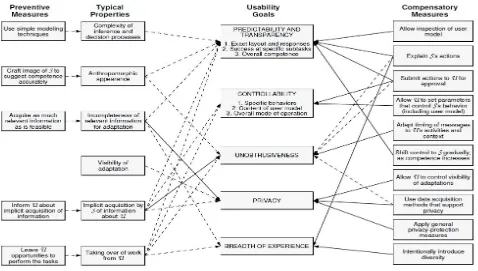
challenges for user-adaptive systems (i.e. i) usability goals correspond to several desirable properties of interactive systems, ii) predictability, transparency, controllability and unobtrusiveness correspond to general usability principles, iii) maintenance of privacy and breadth of experience are relevant to adaptive and personalised e-learning systems, iv) the column typical properties lists down existing examples of frequently encountered properties of these systems. Each has the potential of causing difficulties with respect to one or more of the usability goals, v) the preventive measures aim is to ensure that a property is not present in such a manner that it would cause problems and vi) compensatory measures goal is to ensure in some other way that the goals and objectives are achieved despite the threats created by the properties). Figure 1, presents an overview of these challenges
[image:3.612.69.547.248.519.2]The evaluation of adaptive systems is challenging due to the use of non-standardized methods and an increasing multi-professional approach to delivering instruction [28].
Figure 1: An Overview of Usability Challenges for Adaptive Systems (Solid and dashed arrows denote positive and negative causal influences, respectively) (s – Refers to an interactive computing system or device and µ - refers to its user)
5.
EVALUATION
FRAMEWORK
FOR
END-USER
EXPERIENCE
IN
EVALUATING
ADAPTIVE
SYSTEMS(EFE
X)
EFEx is a Web-based framework for the evaluation of end-user experience in adaptive and personalised e-Learning systems. According to Maiden et al [29] when working with requirements in frameworks and system development end users have to express their requirements and their creativity has to be stimulated during that
USER INTERFACE
UI Controls Presentation Metric
User Modelling
Registration & Authentication
Presentation Layer (Third Tier)
MySQL Java Persistent API (JPA)
Data Persistent Layer (First Tier) Map relational database tables to object oriented java class
Request Persistent Service for (Adaptive System, Model and UCE study)
Query Language Detector
Business Logic Layer (Second Tier)
Results Translation
Adaptive System
Shared Vocabulary
Systems and Model Repository
Fill & Submit Form
Studies on User-centred Evaluations of Adaptive
Systems
Studies on User-centred Evaluations of Models for Adaptive Systems
Component Controller
EFEX
(Web User Interface by Java Server Faces, Main
Controller) Recommendation (Main Controller)
Methodology Which Implements
UCE Techniques
UCE Techniques (Adaptive Systems & Models
Evaluation Phases
Preliminary Requirement
Final
User Model
Task Model
Domain Model
Content Model Strategy
Model
Navigation Model
Presentation Model System
Model
Device Model
Results
SourceQuery Ranked Result List Recommended
Techniques
1 3
4
5
7
Multiple Sets of Results
Results in Preferred Language Query
3
6 8
9
Request Controller
Retrieve Related Publications
2 10
12 View/Search
13
11
Attributes of Adaptive System
System Purpose
System Function
Application Area
Evaluation Method
Evaluation Criteria
Data Type Analysis Context & where used
System Name Attributes of Model
Model Purpose
Model Function
Application Area
Evaluation Method
Evaluation Criteria
Data-Type Analysis
Context & where used Model Name
Recommender Component
Query
USER INTERFACE CONTROLLER
[image:4.612.75.534.70.501.2]Main Controller
Figure 2: Proposed Architecture of the EFEx Framework
5.1 Proposed Methodogical Approach
The researchers propose a hybrid methodology for the evaluation of adaptive and personalised e-Learning systems. The hybrid approach combines: i) user-centred methods, which have proven particularly useful for evaluating adaptive systems [30-32]; ii) evaluation metrics that combine human computer interaction (HCI) and personalisation, adaptive hypermedia(AH) and information retrieval(IR) techniques; and finally iii) the use of task-based evaluations [33]. The proposed solution is different and new compared to existing approaches, since it adopts a hybrid approach comprised of AH and IR techniques and personalised e-learning. Personalised evaluation aims to evaluate learners’ performance by comparing the fact learners’ performance to the pre-determined objectives, then finding the gap so the system can adjust the teaching
strategies and establish the learner’s knowledge level. Potential benefits of the hybrid approach are reduced usability issues (Figure 1) which affect users of adaptive systems.
5.2 Proposed Architectural Design of EFEx
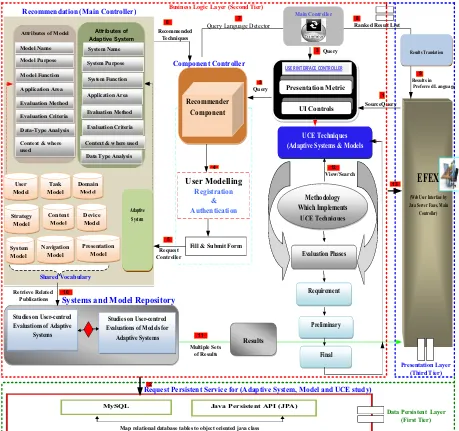
EFEx framework is designed as typical 3-tier architecture (Figure 2) which consists of: i) the presentation layer which is the topmost level of the application which displays information related to services such as browsing. It communicates with other tiers by outputting results to the browser/client tier and all other tiers in the network, ii) the business logic layer which is pulled out from the presentation tier
and, has its own layer, it controls an application’s functionality by
performing detailed processing and iii) the data persistence layer
or business logic. Giving data its own tier improves scalability and performance. The architecture consists of:
x A repository of current user-centred evaluation (UCE) techniques for adaptive systems. This interface allows users to search for: i) user-centered evaluations studies of adaptive systems from 2000 to date, ii) evaluations studies of models for adaptive systems (i.e. user, task, domain, strategy, content, device, system, navigation and strategy model) from 2000 to date.
x Provision of recommendations, to users, for the identification and application of the most appropriate methodologies and metrics: i) recommendations on how to evaluate adaptive systems (i.e. system name, system purpose, system functions, application area, evaluation methods, evaluation criteria, data type analysis and context and where it was used) and ii) recommendations on how to evaluate the models of adaptive systems (i.e. model name, model purpose, model functions, application area, evaluation methods, evaluation criteria and metrics).
x Amethodology which illustrates or explains how to apply the UCE techniques (i.e. results obtained after an investigation of the properties and capabilities that UCE techniques can discover or estimate)
x User modeling controller which handles the user registration process (i.e. user name, password, email address and organizations) and (authentication). User registration is required before users can access the recommender section of the framework.
x Translator component: User interface is translated into user’s
choice of language.
x User interface controller which consists of the presentation metrics and user interface controls.
The framework currently provides features such as:
x A search component which allows users to search and view a repository of all existing user-centred evaluation (UCE) techniques and studies for adaptive systems since 2000; x An implicit recommender algorithm which enables provision
of recommendations to users for the identification and application of the most appropriate methodologies and metrics x The specification of adaptive systems design and structure; x A set of components which enable the implementation of UCE
methodology.
5.3 Potential Educational and Industrial Benefits of EFEx
Framework
The potential educational and industrial benefits of the framework include:
x The provision of an interactive reference and recommendation tool to encourage the evaluation of systems that fulfil certain methodological requirements.
x The collaborative nature of the framework facilitates the sharing of information globally among researchers from the information technology, adaptive hypermedia, information retrieval and e-Learning communities;
x The identification of pitfalls in the evaluation planning process as well as in data analysis;
x The translation of presented information into user’s language of
choice.
5.4
Use case Scenario
Suppose a software developer has implemented an adaptive hypermedia system. The user comes along and wants to use the EFEx framework to: i) get recommendation on how to evaluate his or her adaptive system. First, the user is required to register (i.e., user name, institution or organization, email address, password). Then they are provided with a form and requested to fill it (i.e. their system name, function, application area, evaluation method, evaluation criteria used, data types, system purpose and content used) and then press the submit button. The EFEx framework reasons about the system and decides on suitable evaluation objectives. Based on the end user choice of evaluation objectives the framework suggests evaluation techniques appropriate for that user and provides explanations as to how to apply those techniques. The user is also able to view UCE studies of Adaptive systems and existing studies on evaluating adaptive models.
6.
CONCLUSIONS
AND
FUTURE
WORK
In order to produce effective results, evaluation should occur throughout the entire design cycle and provide feedback for design modification. The proposed solution is different and new compared to existing approaches, since it adopts a hybrid approach comprised of AH and IR techniques and personalised e-learning. The implemented framework will help to standardize current approaches and offer hints regarding the identification of failures and misconceptions of the adaptive mechanism. The framework will be applicable to all adaptive systems with no limitations of domain or inference mechanism. This research will support PhD students by encouraging new researchers from different domains to research in the area of the evaluation of systems which fulfill certain methodological requirements.
Evaluating adaptive and personalised e-learning systems is not easy. However, it is of significant importance to ensure scientific progress in this field and to provide convincing arguments that adaptation really does help. It is significant in any evaluation to: i) decide which criteria to use, ii) avoid confounding factors, iii) take into account domain effects, iv) consider if a metric really measures what the evaluators wants, v) build up the experiment gradually, and consider limited resources and also vi) take into account the effects of the material you select.
In future two experiments will be designed based on a problem scenario which will involve a developing a case study to capture the user experience after using the EFEx framework and a task based experiment to. Use of questionnaire and interview (i.e. users of the framework) and video; will provide qualitative feedback on user experience after using the system.
7.
ACKNOWLEDGEMENT
This research is based upon works supported by Science Foundation Ireland (Grant Number: 07/CE/I1142) as part of the Centre for Next Generation Localization (www.cngl.ie). The authors are grateful for the suggestions of the reviewers for this paper.
R
EFERENCES[2] "International Standard Organization: ISO 13407: Human-centred Design Processes
for Interactive Systems (1999)."
[3] P. Brusilovsky, "Methods and Techniques of Adaptive Hypermedia," User Modeling and User Adapted Interaction, vol. 6, pp. 87-129, 1996.
[4] P. Brusilovsky, Karagiannidis, P., and Sampson, C., "Layered Evaluations of Adaptive Learning Systems," vol. 14, pp. 402-421, 2004.
[5] Mulwa C., et al., "Adaptive Educational Hypermedia Systems in Technology Enhanced Learning: A Literature Review," presented at the Association for Computing Machinery's Special Interest Group for Information Technology Education, Central Michigan University at Midland MI USA 2010.
[6] S. Lawless, et al., "A Proposal for the Evaluation of Adaptive Personalised Information Retrieval," in
Proceedings of The 2nd International Workshop on Contextual Information Access, Seeking and Retrieval Evaluation, Milton Keynes, UK, 2010, p. 4.
[7] O. Conlan, et al., "Multi," in Second international conference on adaptive hypermedia and adaptive web-based systems
Malaga, Spain, 2002, pp. 100-111.
[8] P. De Bra and L. Calvi, "AHA! An open adaptive hypermedia architecture," New Review of Hypermedia and Multimedia, vol. 4, pp. 115-139, 1998.
[9] P. De Bra, "Adaptive educational hypermedia on the web,"
Communications of the ACM, vol. 45, p. 61, 2002.
[10] G. Weber and P. Brusilovsky, "ELM-ART: An adaptive versatile system for Web-based instruction," International Journal of Artificial Intelligence in Education, vol. 12, pp. 351-384, 2001.
[11] M. Ng, et al., "The application and evaluation of adaptive hypermedia techniques in web-based medical education,"
ALT-J, vol. 10, pp. 19-40, 2002.
[12] N. Peirce and V. Wade, "Personalised Learning for Casual Games: The'Language Trap'Online Language Learning Game."
[13] P. Brusilovsky, et al., "From Learning Objects to Adaptive Content Services for E-Learning," Hershey, Ed., ed New York: IGI Global, 2008, pp. 243-261.
[14] K. Koidl and O. Conlan, "Engineering information systems towards facilitating scrutable and configurable adaptation," 2008, pp. 405-409.
[15] G. Fischer, "User modeling in human–computer interaction," User modeling and user-adapted interaction,
vol. 11, pp. 65-86, 2001.
[16] M. Harrigan, et al., "What Do Academic Users Want from an Adaptive Learning System?," Technical Report, Trinity College Dublin2009.
[17] P. Nicholaon, "A History of E-Learning," in Computers and Education: E-Learning from Theory to Practice. vol. 1, B. Fernandez-Manjon, et al., Eds., ed: Springer, 2007, pp. 1-11.
[18] M. Rosenberg, "The E-Learning Revolution," in E-Learning. vol. 2, ed: R.R. Donnelley & Sons Company, 2001, pp. 19-38.
[19] D. Dagger, et al., "Personalisation for all: making adaptive course composition easy," 2005.
[20] S. L. Catherine Mulwa, Mary Sharp, Vincent Wade, "The Evaluation of Adaptive and Personalised Information Retrieval Systems: A Review," International Journal of Knowledge and Web Intelligence(IJKWI) p. 20, 2011 2011. [21] D. Chin, "Empirical evaluation of user models and user-adapted systems," User modeling and user-adapted interaction, vol. 11, pp. 181-194, 2001.
[22] C. Gena, "Methods and techniques for the evaluation of user-adaptive systems, The Knowledge Engineering Review," vol. 20, pp. 1-37, 2005.
[23] C. Gena and S. Weibelzahl, "Usability engineering for the adaptive web," The Adaptive Web, pp. 720-762, 2007. [24] L. Van Velsen, et al., "User-centered evaluation of adaptive
and adaptable systems: a literature review," The Knowledge Engineering Review, vol. 23, pp. 261-281, 2008.
[25] C. Mulwa, et al., "Adaptive Educational Hypermedia Systems in Technology Enhanced Learning: A Literature Review," presented at the Association for Computing Machinery's Special Interest Group for Information Technology Education, H Hotel 111 W Main St. Midland,MI 48640, 2010.
[26] N. Tintarev and J. Masthoff, "Evaluating Recommender Explanations: Problems Experienced and Lessons Learned for the Evaluation of Adaptive Systems," presented at the User Modeling, Adaptation and Personalization, Trento, Italy, 2009.
[27] A. Jameson, "Adaptive interfaces and agents," Human-Computer Interaction: Design Issues, Solutions, and Applications, p. 105, 2009.
[28] J. McDonald and J. Timonen, "How could pedagogy make a choice between personalized learning systems," 2009. [29] N. Maiden, et al., "Provoking creativity: Imagine what your
requirements could be like," IEEE software, vol. 21, pp. 68-75, 2004.
[30] C. Gena, "A USER-CENTERED APPROACH TO THE RETRIEVAL OF INFORMATION IN AN ADAPTIVE WEB SITE. ," in Cognitively Informed Systems: Utilizing Practical Approaches to Enrich Information Presentation and Transfer, E. Alkhalifa, Ed., ed, 2006.
[31] C. Gena, "Evaluation methodologies and user involvement in user modeling and adaptive systems," in User Modeling and User-Adapted Interaction, Torino, Italy, 2003, pp. pg. 74-78.
[32] A. Dix, et al., Human-computer interaction: Prentice hall, 1998.