Volume 43 | Issue 6
Article 5
1953
Old Age and Crime
David O. Moberg
Follow this and additional works at:
https://scholarlycommons.law.northwestern.edu/jclc
Part of the
Criminal Law Commons
,
Criminology Commons
, and the
Criminology and Criminal
Justice Commons
This Article is brought to you for free and open access by Northwestern University School of Law Scholarly Commons. It has been accepted for inclusion in Journal of Criminal Law and Criminology by an authorized editor of Northwestern University School of Law Scholarly Commons.
Recommended Citation
OLD AGE AND CRIME
David 0. Moberg
The author is Assistant Professor of Sociology and Chairman of the Social Science Department at Bethel College, St. Paul, Minnesota. He was previously engaged as Associate Instructor of Sociology at the University of Washington where he received his M.A. degree in 1949. In March, 1952, the Ph.D. degree was con-ferred upon him by the University of Minnesota. He is a member of the American Sociological Society and the Midwest Sociological Society, and he is the author of several forthcoming articles on various aspects of the relationship between the Christian religion and personal adjustment in old age.
In this article he summarizes much material on the subject of old age and crime that is not easily obtainable. He hopes that many of the suggestions made on this subject of increasing interest and importance in a nation with an increasing aged population will stimulate further research and study in the field.-EDITo0.
Very often the term "old age" is loosely used without being clearly defined. Only confusion and disagreement result from such a practice. A statement of how the term is used in this paper is therefore in order. Some definitions of old age are based upon physiological factors. For instance, Arthur T. Todd has said that
Old age is best regarded as the stage of life in which the signs of wearing out of the body appear; but this wearing out is not, as in the manner of machinery, by the attrition of so much work, but rather, as in the case of badly kept machinery, from neglect and ignorance.1
Todd divides life into three main periods: Infancy, when tissue increase is positive and storage is being made for the future, or the anabolic stage; middle life, when tissue increase is stationary and anabolism equals catabolism; and later life or old age, when increase is beginning to become negative and catabolism exceeds anabolism.2
The terms senility and senescence are also usually defined in terms of physiological criteria. Nolan Lewis, the Director of the New York State Psychiatric Institute and Hospital in New York City, has defined senility as follows:
Senility is a period of life, like infancy and adulthood. After middle maturity, a division of adulthood, we come to late maturity, a period called senility. Properly used, it is a biological term, an aging process, a chronological distinction and should never be used to describe a disease of the mind or abnormal people. Senile psychosis should be used to describe mental disorders occurring in senility. An individual has a senile psychosis if he becomes mentally ill for the first time after he is sixty years of age.3
Most medical writers disagree with Dr. Lewis as to the definition of
1. A. T. TODD, MEDICAL ASPECTS OF GROWING OLD (Bristol: John Wright and Sons, Ltd.,
1946), p. 6.
2. Ibid., p. 8.
3. N. D. C. LEWIS, Applying Mental Health Principles to Problems of the Aging, in GEORGE LAWTON, ED., NEW GOALS FOR OLD AGE (New York: Columbia University Press, 1944), p. 102.
senility and use the term senescence to refer to normal old age, a physi-ological condition, applying senility to abnormal mental conditions which sometimes supervene toward the close of life, a pathological con-dition.4 Unless otherwise indicated, the terms senility and senescence in this paper will bear the latter meanings.
Just when does senescence begin? In a diagram attributed to John W. Shuman, Thewlis indicates senescence to be the age period of 60 to 80 years, with ages 40 to 50 the "pause-age," 50 to 60 the period of "aging," and 80 to 90 the "dotage.'' 5 Others consider senescence to
begin at 65, at 70, or even as early as age 40 or 45. These disagree-ments reflect some of the difficulties in the use of physiological factors to define old age: There is no one age when all physical functions begin to show a decline; deterioration of the parts of the body proceeds at different rates of speed; the rate of change is slow and for that reason cannot be measured at weekly, monthly, and even annual intervals; not all indications of age appear with equal severity in a given individual; the age at which any given organ begins to deteriorate differs, and some of the less easily observable physical changes are very difficult or com-pletely impossible to measure.6
Psychological criteria of old age include changing mental abilities, as memory; attitudinal and emotional changes. Because of problems of measurement which are for the immediate present insurmountable, it is not practical to attempt to define old age in terms of psychological factors.7 In spite of these difficulties (or in ignorance of them I) L. Pearl Gardner has classified middle-aged and aged people into three cate-gories: The middle-aged, ages 40 to 59, whose problems emphasize escape from aging by keeping youthful; the pre-aged, ages 60 to 79, who are willing to acknowledge some encroachments of aging; and the aged, ages 80 and over, who are "the pioneers who must build the good land of the aged."' 8
Sociological criteria of old age are largely based upon the changes involved in relinquishing the social relationships and roles typical of adulthood and in accepting those typical of the later years of life.9 As
4. Editorial, Senescence, Senility and Crime, JOURNAL OF THE AMER. MED. Assoc., 127 (Feb. 24, 194-5), pp. 460 ff.
5. M. W. THEWLIS, THE CARE OF THE AGED (St. Louis: C. V. Mosby Co., 194-1), p. 46. 6. RuTH S. CAVAN, et al., PERSONAL ADJUSTMENT IN OLD AOE (Chicago: Science Research Associates, Inc., 1949), pp. 5f.
7. Ibid., pp. 4-6.
8. L. P. GARDNER, A4ttitudes and Acisities of the Middle-Aged and Aged, GERIATRICS, 4 (January-February, 1949), 33-50.
D1ID 0. MOBERG
yet these criteria have not been sufficiently studied to prove useful in precise definition of old age.
Because of the problems involved in the application of functional criteria of old age and the lack of application of them in published re-search projects, chronological measures will be used here. It is true that chronological age has a different significance for different individuals and that a purely chronological delimitation of the area of research in old age may tend to divert attention from significant phenomena. On the other hand, it is true also that in society age-typing of roles and statuses takes place chiefly on the basis of chronological age.'0
In every state of the United States the proportion of aged persons in the population has been constantly rising since 1870 or earlier. In the nation as a whole there has been a consistent increase in the median age of the population which reflects this trend. In 1870 the median age was 20.2 years, in 1900 22.9, and in 1940 29.0. In 1850 2.6 percent of the total population were aged 65 years and over; in 1900 4.1 percent, and in 1950 about 7.6 percent of the total population fall in that age category." The chief purposes of the study reported here were to dis-cover what types of crime are committed by senescents and what trends are taking place concomitantly with the changing age composition of our population. A knowledge of present trends might also indicate some possible or probable future trends that may be expected as our population continues to include an increasing proportion of elderly people.
PROBLEMS OF THE AGED
If one believes that frustrations and emotional tensions are an etio-logical factor in crime, a knowledge of the situation of old people in our society and of the trends that have taken place during the past century or so would lead one to judge that crime among old people must surely be on the increase. There appears to be a basic contradiction in our society in the ever-increasing age of our population and the values that are attached to youth and growth. With our actions as well as with our lips we as Americans tend to depreciate elderly people with but few exceptions, as in the fields of politics and jurisprudence. In our urbanized culture senescent and senile individuals are forced to become dependent at an earlier age than in an agricultural society, and they are forced much more often to seek assistance outside of the immediate
10. OTTO POLLAK, SOCIAL ADJUSTMENT IN OLD AGE (New York: Social Science Research Council, Bulletin 59, 1948), Chapters 1 and 2.
11. THE ELDERS AMONG Us, Metropolitan Life Insurance Company Statistical Bulletin, 30 (May, 1949), p. 5.
[Vol. 49
family to meet their economic needs. Many believe it is a stigma on themselves and on their families to receive such aid; hence emotional upsets result.
Havighurst has pointed out that
the coming of old age brings more new problerfis and strange experiences than the
ordinary person has faced since his early adulthood.... In reality old age is a period
of development and adjustment for most people, rather than a period of nirvana--of
blissful and unstriving ease leading to a quiet and peaceful passing out of this life.'2
With old age come five major adjustment problems according to Havighurst: Adjustment to the death of spouse, which is especially a woman's problem; adjustment to loss of employment and reduced in-come; affiliation with the age-group of elders, which involves in the
U. S. the tacit admission that one is old, the loss of status, and the
difficulty of learning to participate in new groups; adjustment to physi-cal infirmity; and the finding of satisfactory living arrangements.13 Is it any wonder that so many old people suffer from boredom and a sense of frustration?
• . . Plumb the depth of their feelings, if they will permit you to do so, and see there the unsatisfied yearning for affection and for gratitude. You will not have great difficulty in understanding why it is that so many old people wish to die. As they so often express it, they have lost their usefulness in the world, and there is no more reason why they should live. They are in the world but not of it. Their ideas, their patterns of conduct belong to an age which has vanished. They find themselves at variance with the accepted behavior of the younger generation. They are strangers to the ideas which have developed since they were young. They live in the past, isolated in the midst of a social world of which they are not a part, cut off from the social ties which made life worth while in their earlier years ...
No wonder these old people give up and pass down hopelessly toward the shades of death.14
In spite of all their problems, old people in our society have been so neglected that they have been called the "lost generation" of today.'5
They have been neglected even by ministers and the medical profession, and not merely by the public in general. The aged are not beautiful from an esthetic standpoint; because they are often disagreeable and repulsive, there seems to be a universal tendency to shift the respon-sibility and care of them upon others, especially upon the community at large.'6 Geriatrics, the care of the aged, is unpopular among physicians;
12. R. J. HAVIGHURST, Old Age-An American Problem, JOURNAL OF GERONTOLOGY, 4
(October, 1949), p. 300. 13. Ibid., pp. 298-304.
14. J. L. GILLiN, SOCIAL PATHOLOGY (New York: Appleton-Century-Crofts, Inc., 1946), p. 391.
15. P. B. MAys AND J. L. CEDARLEAF, OLDER PEOPLE AND THE CHURCH (New York: Abingdon-Cokesbury Press, 1949), p. 27.
D.4FID 0. MOBERG
it is relatively not remunerative; efforts in it ultimately end in failure; it is a relatively new field which requires much original observation and research work.17 The neglect of the aged by ministers is attributed by Maves and Cedarleaf to such factors as the glorification of youth and the new in our society; fears of their own later maturity, especially if they are worried and anxious about it; the emotional relations between generations which make people treat the aged as they treated their children; the attitude that time spent with them is wasted; mistaken notions, such as the one that all that the aged desire is financial security and freedom from responsibility; and the lack of awareness of con-temporary trends, which causes a lack of planning to meet such problems as the large numbers of aged persons we now find in our midst.'8
L. K. Frank has emphasized that through education the anxieties, guilt feelings, and worries of parents, teachers, ministers, and others concerned with the education of the young have been projected and imposed upon children, adolescents, and young adults. The burden be-comes ever greater as he meets life, with the individual's personal dif-ficulties becoming ever more acute with increasing age. Frank believes that
the whole emphasis of education in the home and family, in the church and school, has been to establish more or less rigid patterns of thinking and acting, and to demand a high degree of conformity which may operate to unfit the individual to meet changes in his later life. It is not unwarranted to say that, perhaps uncon-sciously but more or less effectively, the educational process through which the individual passes seems almost deliberately designed to create frustration and defeat; to prepare people for a life they can never find and to handicap them in every possible way in attempting to meet new situations in which their adult lives must be led.1 9
Thus the aged in our society are frustrated socially, economically,
and psychologically. What effect does this have upon their criminal record?
THE CRIMES OF OLD AGE
Actually increasing age is accompanied by decreasing or declining
crime rates. Among the aged criminals there is a high incidence of first
offenders, and certain types of crime tend to predominate, such as drunk-enness, sex offenses, embezzlement, fraud, etc., while crimes which in-volve physical violence or a quick decision are relatively infrequent. Table I, which is based on data for 1935-1937 in the U. S., shows the
17. Ibid., p. 26, and N. D. C. LEWIS, op. cit., pp. 96f. 18. MAVES AND CEDARLEAF, op. cit., pp 27-29.
19. L. K. FRANK, The Older Person in the Changing Social Scene, in GEORGE LAWTON, ED.,
NEW GOALS FOR OLD AGE (New York: Columbia University Press, 1944), p. 43.
incidence of arrest ratios per 100,000 males of corresponding age groups in 1930 for the age group with the highest incidence, the aged-fifty-and-over group, and the quotient of decrease between the highest crime incidence and the incidence of the fifty-plus group.
Similar relationships between age and crime have been noted in other nations as well.
Table 1.
ARREST RATES, 1935-37, PER 100,000 MALES OF CORRESPONDING AGE IN 1930 IN THE U. S.20
Highest Incidence Incidence Quotient of
Crime Age Rate of 50 + group decrease
Sex offenses (other than rape, prostitution,
com'l vice) ... 20-24 58.0 26.2 2.21 Narcotic drug laws ... 30-34 36.4 9.8 3.71 Embezzlement and fraud ... 25-29 138.3 36.0 3.84 Stolen property; receiving, etc ... 20-24 34.7 8.7 3.98 Criminal homicide ... 25-29 74.3 15.9 4.67 Assault ... 25-29 309.9 64.2 4.83 Forgery and counterfeiting ... 20-24 68.0 11.6 5.86 Prostitution and commercial vice ... 25-29 19.4 3.3 5.88 Weapons: Carrying, possessing, etc ... 20-24- 72.4 11.5 6.59 Rape ... 20-24 86.2 10.5 8.21 Larceny, theft ... 16-20 709.0 79.0 8.98 Burglary, breaking, entry ... 16-20 593.6 21.3 27.87 Robbery ... 20-24 238.1 4.8 49.60 Auto theft ... 16-20 282.2 2.3 122.60
From 1929 to 1938 the annual reports of the Prison Commissioners in England, for instance, show that 8 percent of all males convicted and imprisoned for indecent exposure were aged 60 years and over, and of all convictions and imprisonments for offenses against the Intoxicat-ing Liquor Laws (drunkenness) 16 percent were aged 60 or over. Yet people aged 60 and over accounted for only 2.03 percent of all acquisi-tive offenses, 8.04 percent of all sexual offenses, and 6.48 percent of all
aggressive offenses in England for the period.2'
An examination of prisoners committed to Illinois State Penitentiary during 1934 and 1935 indicated that only 10.2 percent of 1,083 serial admissions were above the age of 40, the oldest of whom was 64. The crimes which led to imprisonment of a larger proportion of prisoners above the age of 40 than of those of all ages were murder, fraud, and
sex.22
In a study made at the State Prison of Southern Michigan Fox
class-20. Compiled from tables 4 and 5 in 0. POLLAK, The Criminality of Old Age, JouR.
OF CRIM. PSYCHOPATHOL., 3 (October, 1941), pp. 213-235.
21. W. N. EAST, Crime, Senescence and Senility, JOUR. OF MENT. 5CL, 90 (October,
1944), pp. 835-850.
DAVID 0. MOBERG
ified crimes into those committed typically by younger men and those committed more frequently by older men by finding the mean age of the prisoners and comparing the mean age of those committed for speci-fic types of crimes. (One serious shortcoming of his report is that he does not clearly indicate whether the ages he gives were the ages of the prison population on July 13, 1943, or at the time of conviction or com-mitment, but internal evidence makes the former alternative appear more likely. If this is the case, the figures he gives are probably biased by differential lengths of incarceration.) The mean age of the prison population was 33.7 years. Crimes typical of prisoners significantly older than the mean age statistically were as follows :23
Mean age Crime
58.8 Violation of "Blue Sky" or State Securities Law 49.5 Conspiracy to obstruct justice or to commit crime 45.7 Drunken and disorderly
42.0 Marriage laws 41.8 Sex (other than rape)
41.4 Arson
37.8 Forgery
37.1 Drug laws
36.8 Aggravated assault 36.1 Embezzlement and fraud
35.8 Homicide 35.5 Rape
Crimes typical of prisoners who were statistically significantly younger than the mean age were these :24
26.8 Auto theft
28.4 Kidnapping
28.7 Robbery
30.5 Burglary
30.8 Escaping jail or prison or attempted escape
31.9 Weapons
Although the mean is a poor measure of central tendency for age, especially when there may be only a few individuals in some categories, the familiar pattern of criminality of old age is reflected in these statis-tics.
The manner in which the crimes of old age are committed has received some attention. Boas in Germany about forty years ago wrote that aged criminals are awkward, lack foresight of the consequences of their crimes, show indifference after the offense, and fail to efface the traces of their crimes.25 When they commit homicide, the victim is often the wife or some other near relative. The offender involved in murder
23. V. Fox, Intelligence, Race, and Age as Selective Factors in Crime, JOUR. OF CRIM. L.
AND CRIMINOL., 37 (July-August, 1946), pp. 150f.
24. Idem.
25. Cited in OTrO POLLAK, THE CRIMINALITY OF OLD AGE, op. cit.
usually appears to be motivated by mistrust, suspicion, and pathological fears and delusions, often with a sexual tinge. The criminal often locks himself in the home with the victim.2 6
The criminality of the older man resembles in many ways that of the woman. He is the instigator, or he commits crimes in which craftiness or the use of physical or chemical forces play a role. At the same time, feeling that the normal methods of defeating a competitor are not any longer at his disposal, the older man falls back on primitive means of violence. Even the weak can use force if he chooses a weaker object, a woman or a child, or if he turns to strength-saving devices, weapons, poison, and deceit. Arson is one of the crimes with a high old-age rate.2
When aged persons are involved in sex offenses, the victim or object of their attentions is usually a child, especially a girl. Very often the offenders show mental deterioration and symptoms of senility, and their behavior is awkward with a neglect of caution. When asked their mo-tives, they say that they did not know what they did, that they were under the influence of alcohol, or that they were seduced by the little girls. For this reason, some writers believe that there is a "children's prostitution," with little girls deliberately taking advantage of elderly men for money or favors of various kinds.28
In a study in Allegheny County, Pennsylvania, Henninger found that five percent of all types of male sex offenders exclusive of men charged with bastardy and fornication were senile men, and that 12 percent of all those accused of sex crimes against children were seniles. He indicates that there is seldom any evidence of previous delinquencies or miscon-duct among seniles who commit sex crimes and that such manifestations are almost always entirely unexpected by the family and friends of the offender.29 Ruskin found similarly that among the patients of Eloise Hospital in Michigan who were admitted from January, 1935, to Feb-ruary 15, 1940, 60 percent of the offenses committed by the seniles and arteriosclerotics were exhibitionism and pedophilia30
In their analysis of 1400 cases of rape, the Goldbergs say very little about elderly offenders. In one-fifth of the cases they studied the victims were under 13 years of age, and in only two of these instances were young boys involved. Even in these two exceptions, men 32 and 50 years of age subsequently assaulted the two girls. The ages of the men
im-26. POLLAK, ibid.
27. H. VON HENTIG, CRIME: CAUSES AND CONDITIONS (New York: McGraw-Hill Book Co., 1947), p. 152.
28. POLLAK, THE CRIMINALITY OF OLD AGE, op. Al.
DAID 0. MOBERG
plicated in these cases against young children ranged from 22 to
50
years, with most of them above the age of 40.31
There is very little evidence of crime among elderly women. It is possible that their criminalistic tendencies are channeled into other lines of activity, as Lewis seems to indicate:
In women, in addition to the possibility of an erotic flair in senility, the maternal instinct-or whatever it is that is usually known as the "maternal, instinct"-may be markedly in evidence. This is true even of aged virgins, and the tendency may survive even after the higher intellectual faculties have disappeared, as is amply demonstrated daily on the wards of large institutions for the mentally ill. A great need for affection is also revealed in the normal ones at home, where their need for love and their craving for attention create family difficulties, particularly in the grandchildren situation. The possible grandparent-child-parent relationships, hates, loves, jealousies, conflicts, and complications are too well known to elaborate here.32
One of the cases of rape studied by the Goldbergs involved a grand-mother who was paid for making it possible for an uncle of the victim
to rape her.33
Most writers dealing with the sexual crimes of old age indicate that underlying organic changes are related to them. Thus Thewlis speaks of sexual recrudescence, which in its paroxysmal form drives the elderly person, unrestrained by reason, to attempt rape, especially rape of chil-dren for they are usually readily available. "When the recrudescence is prolonged, the sexual stress is apparently not so great, and the person is more likely to become infatuated with one woman than to attempt in-discriminate or forcible intercourse."3 4 teckel explains the relatively
frequent occurrence of exhibitionism in old age in terms of organic changes in the brain which result in the abolition of certain inhibitions which permit the primitive man to appear. The exhibitionism of old age is to him an evidence of psychic regression after the cessation of previous inhibitions.3 5 Krafft-Ebing likewise indicates that sexual offenses in old
age are often a manifestation of senile dementia and other pathological
conditions.3 6
Henninger believes the increased libidinous drive of many seniles is a final expression of the aging organism in its unconscious
31. J. A. GOLDBERG AND R. W. GOLDBERG, GIRLS ON CITY STREETS (New York: Foundation
Books, 1940), pp. 163-165.
32. N. D. C. LEwIS, Mental Hygiene in Later Maturity, in 0. J. KAPLAN, ED., MENTAL DISORDERS IN LATER LIFE (Stanford University Press, 1945), p. 403.
33. Op. cit., pp. 119f.
34. THEWLIS, op. cit., p. 168.
-35. W. SaCKEL, A Contribution to the Study of Exhibitionism, in TWELVE ESSAYS ON SEX AND PSYCHOANALYSIS (New York: Cosmopolis Press, 1922), p. 261.
..- 36. R. VoN KRAFFT-EBING, PSYCHOPATHIA SEXUALIS (Philadelphia: F. A. Davis Co., 1898), pp. 39f., 404.
hope of leaving dependents on earth,7 and East says that sexual offenses in aged men are often due to the fact that fantasy and desire have out-lived potency.38 Thus at least three explanations have been offered for the sexual offenses of old age: (1) The continuation of "normal" sex drives but with weakened moral inhibitions. (2) The revival of the sex life. (3) "Instinctive" desires, such as the subconscious hope of leaving descendents.
REASONS FOR AGE DIFFERENTIALS IN CRIME
Many explanations have been offered for the variations in criminal behavior by age and especially for the decrease in crime rates for most crimes and for the specific types of crime committed in old age. They include the following, most of which have been taken from Sutherland, Reckless, and sources previously cited :39
1. Variations in physical strength and/or other characteristics of the physiological system. Older persons are not as active as young people, and their physical weakness and slower movements make them less capable of successfully undertaking certain types of crime.
2. Youth is a time of recklessness and disdain for caution. Older criminals are more careful in their crimes than young people and prob-ably, if they have lived a life of crime, are much more skilled so that they are better able to avoid detection.
3. Youth is the period of life when adventure, excitement, and danger are often deliberately sought. This makes the detection rate of their crimes high. Older people are much more stable and settled and tend in most instances to the forms of crime that are difficult to detect or to prove, especially if they have lived a life of crime and have become skilled in their careers.
4. If crime is inherited either socially or biologically (a few still claim the latter in spite of much contrary evidence), those who are pre-disposed to crime become criminals as soon as they have the oppor-tunity, hence at an early age.
37. HENNINGER, 10c. Cit. Cf. G. K. ZIPF, HUMAN BEHAVIOR AND THE PRINCIPLE OF LEAST EFFORT (Cambridge, Mass.: Addison-Wesley, 1949), p. 239.
38. EAST, op. cit., p. 838.
39. E. H. SUTHERLAND, PRINCIPLES OF CRIMINOLOGY (Chicago: J. B. Lippincott Co., Fourth Edition, 1947), pp. 98f.; W. C. RECKLESS, THE CRIME PROBLEM (N. Y.:
DAFID 0. MOBERG
5.
Differential association beginning early in life in delinquency areas leads to commission of crime early in life.6. Criminals live a hazardous life and do not grow old.
7. Successful treatment of offenders contributes to a decrease in crime with advancing years as more and more of them come into con-tact with our devices of correction. They have learned crime does not pay.
8. Adolescence is in some ways the time of greatest want, with many things to long for and few means except crime by which to attain them. Older persons are usually better established in the world, economically at least, and are hence more unlikely to undertake pecuniary crimes. (But are they? Large proportions of them are as dependent on others as a large part of the adolescents in our society.)
9. The action of the will is much more effective on the adult than on the adolescent in inhibiting criminalistic behavior, at least until the individual becomes senile, when an unexpected jolt to a tottering per-sonality may lead to criminal behavior.
10. Sympathy of police and of judges and juries makes it less likely that a child or a senescent will be arrested and convicted. Even when they are, their sentences are often suspended, the defendant is placed on parole, or the sentence is much lighter because of the age of the offender.
11. Differential accuracy-or lack of it-in reporting certain of-fenses (e.g., alcoholic recidivists often are senescents who are brought to jail at frequent intervals and in many places are not reported every time they are apprehended, whereas usually every apprehension of a recidivistic thief is reported) may tend to increase the crime rates of youths and decrease those of the aged.
12. White collar crime, which is probably more typical of older offenders if for no other reason than that positions of trust are more often given to older people, is much less apt to result in arrest than other types of crime.
13. Adolescents and youth are exposed more than senescents to cer-tain media of mass communications, such as comic books and movies, which some believe predispose to criminalistic behavior, or encourage it. 14. There is a growing body of empirical evidence that in senescence people show a renewed and increased interest in religion. The increased concern about the future life and the increased other-worldliness of many aged persons probably operates as a deterrent of crime.
Obviously there is some overlapping of the above points, and, de-pending upon the personal inclinations of the reader, some will have much more weight than others. It is very likely that all of them con-tribute, in varying degrees, to the differences in crime rates among youths, young adults, middle-age adults, and senescents.
TRENDS
It is extremely difficult to determine exactly what trends are taking place regarding the criminality of the aged because of the inadequate reporting of crime, the incomparability of criminal statistics in different parts of the U. S., the incomparability even of criminal statistics gathered at different times by the Bureau of the Census, and the lack of statistics which include age breakdowns before 1904. No valid conclu-sions can therefore be drawn as to trends that are taking place at present except that in the United States for the past fifty years the aged have consistently committed only a very small proportion of the total amount of crimes which resulted in apprehension and conviction. The situation is similar in England and Wales and in Sweden, which have a larger proportion of aged persons in the population than the United
States.
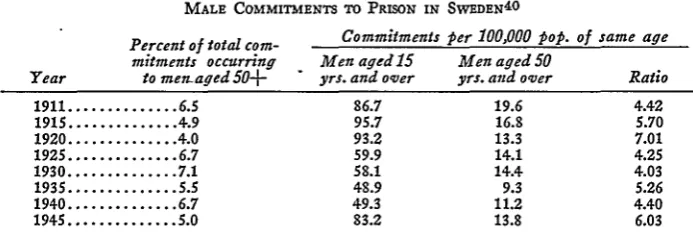
[image:13.454.51.398.463.580.2]Table II gives some figures for typical years in Sweden, the statistics of which are probably as comparable as any existing criminal statistics over a like period of time. Only the data for straffarbete (penal servi-tude) are included. (The other categories of criminals in Sweden are for offenses of a less serious nature.) Every year the crime rates are much lower for men over age 50 than they would be if criminal com-mitments were evenly distributed by age. No fluctuations which may be indicative of long-range trends appear.
Table II.
MALE COMMITMENTS TO PRISON IN SWEDEN4 0
Percent of total corn- Commitments per 100,000 PoP. of same age mitments occurring Men aged 15 Men aged 50
Year to men-aged 50+ yrs. and over yrs. and over Ratio
1911 ... 6.5 86.7 19.6 4.42
1915 ... 4.9 95.7 16.8 5.70
1920 ... 4.0 93.2 13.3 7.01
1925 ... 6.7 59.9 14.1 4.25
1930 ... 7.1 58.1 14.4 4.03
1935 ... 5.5 48.9 9.3 5.26
1940 ... 6.7 49.3 11.2 4.40
1945 ... 5.0 83.2 13.8 6.03
DAFID 0. MOBERG
What can we expect in the future? There is no indication that an increase in the proportion of the aged in the population will increase the amount of crime, but rather we may expect the opposite. As larger proportions of our population are included in the older age categories, we can expect the crime rates to decrease. On the other hand, other things being equal, certain types of crime will probably not decrease proportionately, among them being drunkenness, embezzlement and fraud, homicide, many sex offenses, etc.
One aspect of old age crime which has not been dealt with in this paper is that of suicide, which has a higher rate among elderly men than among any other segment of the population. Porterfield asks the ques-tion, which could be reworded as an hypothesis for further testing: "Could we expect suicide rates to go up and homicide rates to come down in an aging population?"4 1
Possibly other aspects of criminalistic behavior will also become more prevalent as increasing proportions of our still growing population go above the age of 60. Exploitation of the aged by self-seeking relatives and acquaintances may increase; euthanasia will probably become more and more common as physicians seek to relieve the misery of their elderly patients; political pressure groups catering to the aged will probably become more insistent and influential in their demands; white collar crime, both detected and undetected, will probably increase; in-stitutions catering to them will probably increase, and among them will undoubtedly be some that in reality are established only to "fleece" the aged. (Perhaps not the least of these will be new religious cults.) The investigation of present trends in regard to each of these and other related topics would be of interest and of value to our generation and to generations which will follow.
41. A. L. PORTERFIELD, Indices of Suicide and Homicide by States and Cities ... "
AMER. SOCIOL. REV., 14 (August, 1949), p. 490.