ARTICLE FOR RESCUE MAGAZINE BY BETSY DEGEORGE
1. Introduction
The picture of homeless migration may have been established in the American mind by the characters Joe Buck and “Ratso” Rizzo in the 1969 film classic Midnight Cowboy, whose homeless New York City dream was a winter flight to a warmer climate. Ratso’s abode in an abandoned tenement building is brightened only by a Florida tourism poster on the wall, and the threat of the impending winter is broken only by his hopes, expressed in an explanation of the conditions to Joe. “I got no heat, but by that time, you know, cold weather, hey, Ill be in Florida.”
Though there is some anecdotal corroboration of the perception that the homeless pop-ulation travels south for the winter, and no doubt there are some sunbelt cities whose resources are particularly stretched because of their attractive regional climates, the most significant of migration patterns that have been identified and studied in relation to the homeless population are not governed by the sun. Grace for the Homeless, the 10-Year Plan to End Homelessness in Alachua county, Florida underscores a reality that is part of the homeless demographic. “The people described in this planthose without shelter, who are vulnerable, suffering, and struggling to survivebelong to this community. The report continues, Many of our homeless were born in Alachua County or grew up here.”
Monroe County Floridas 10-Year Plan counters the myth of homeless migration to warmer climates saying that the motivations for moving are varied. “Homeless people who move to new areas do so because they are searching for work, have family or friends in the area, for the climate, or for other reasons not related to services. Homeless services in Key West and Monroe County have dramatically increased since 2002, [however], the number of homeless has decreased 55%!”
2. Verifiable Homeless Migration Patterns
According to the findings of the National Survey of Homeless Assistance Providers and Clients (NSHAPC) in 1999, 56 percent of homeless clients interviewed (N=2,938) reported
that they had remained in the same city, town, or rural community where they had previ-ously maintained a home. They had not moved to a different community after becoming homeless. Table 1 reveals the breakdown of migration experience for the rest of the inter-view population.
Table 1. Percentage of Transience by Family Status
Number of Locations* All Homeless Clients in Homeless Single Homeless
Clients Families Clients
(N=2938) (N=465) (N=2473) 1 56 71 54 2 22 6 23 3 8 10 8 4 3 2 3 5 to 10 6 1 6 11 or more 5 * 6
Note: *When homeless, number of towns/cities where stayed 2 or more days.
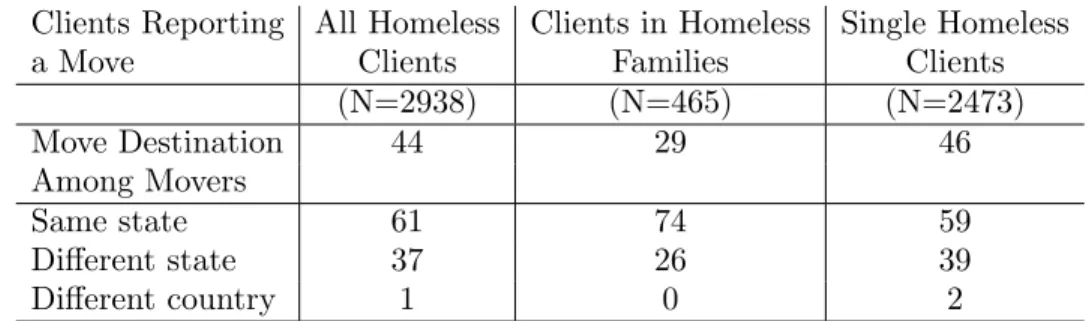
Family status contributes heavily to the likelihood of moving from one community to another while homeless. Seventy-one percent of clients in family groups remained in the community where they became homeless compared to 54 percent of single homeless clients. Among those individuals and families who did move from one community to another, 61 percent did so while remaining within their state of origin, with 74 percent of homeless families and 59 percent of single homeless clients who moved staying within the same state. Table 2 provides additional breakdowns related to moves and destinations.
Table 2. Percentage of Clients Reporting a Move from One Community
to Another While Homeless and Destination
Clients Reporting All Homeless Clients in Homeless Single Homeless
a Move Clients Families Clients
(N=2938) (N=465) (N=2473) Move Destination 44 29 46 Among Movers Same state 61 74 59 Different state 37 26 39 Different country 1 0 2
People who move always have a reason and homeless movers are no exception. One client who was normally living, homeless, in San Diego appeared in the Tennessee homeless circuit. When asked why he had traveled to Knoxville, TN., the man replied that he was
there on vacation to see the mountains. He planned to return to San Diego after his vacation. This incident may reflect the experience of some few homeless individuals.
However, data collected through NSHAPC provides a very different picture. Respon-dents to surveys identified the four most common reasons for mobility.
(1) No jobs available (2) Eviction from housing
(3) No affordable housing available (4) No services available
Additionally, those surveyed revealed strong common reasons for choosing the move destination.
(1) The presence of relatives or friends in the new community (2) Shelters or missions were present in the new community (3) Jobs were available in the new community
(4) Good services and programs for the homeless were available in the new community It is notable that homeless families have slightly different concerns than individuals. Forty-one percent of families who moved mentioned the availability of shelters or missions as a decisive factor in their decisions while only 18 percent of single individuals considered that important. Twenty-seven percent of families mentioned good services or programs as a reason for coming to their current location compared with only 17 percent of single individuals.
These factors are the ones that establish the patterns of migration typically seen in the homeless population. Patterns of movements are predominantly between community types rather than between regions within the United States. Homeless movers generally moved from smaller communities to larger ones. This would correlate with the expressed motivations of seeking more services and a wider employment market.
According to the Urban Institute analysis of weighted 1996 NSHAPC Client data, among people who changed the type of community in which they were living after becoming homeless, 28 percent started in a large central city, 14 percent in a medium-sized city, 31 percent in urban fringes of a large central city, 10 percent in urban fringes of a medium-sized city, 10 percent in large or small towns, and 5 percent in rural areas. For each category, the predominant destination was to a larger population center. Rural movers tended to move to medium-sized centers. Large and small towns people tended to move to medium-sized centers or the urban fringe of a large city. Those who lived in the urban fringes of medium-and large-sized cities tended to move to the central areas of those city types. People living
in medium cities tended to move to large cities. Those living in large cities predominantly moved within the same type of place.
3. History of Homeless Management
Extraordinary developments have come about in the national approach to homeless man-agement over the course of the past ten years. Initiated perhaps with the series of findings published in 1996 and 1999 of the National Survey of Homeless Assistance Providers and Clients, which have been referenced in this article, certain strategic directions were set in Washington. In January of 2003, before a conference of 100 mayors from across the nation, Philip Mangano, Executive Director of the Interagency Council on Homelessness, urged communities to commit to establishing plans for the next decade that would systemati-cally set in motion principles and actions designed to end chronic homelessness. At that time, fewer than five cities had such plans in place.
At a similar gathering in the national capital in February of 2008, it was reported that over 325 Mayors and county officials have already developed or have committed to developing such plans. Mangano stated, Our nonpartisan partnership with mayors across our nation has led to unprecedented results and resources in cities and most importantly to the reduction of street homelessness across our country. Keeping a good grip on the moral and spiritual imperative, we have seen the research that quantifies the economic impact and consequences of homelessness is driving an unprecedented political will to move beyond managing the crisis [of homelessness] to ending the disgrace.
“We have a new standard of expectation. We’re not going to be satisfied any longer moving homeless people from one side of town to the other, from one city to another. Our work together is to create that new standard of expectation: we want visible, measurable, quantifiable changeon our streets, in homeless programs, in the life of our neighborhoods, and most importantly, in the lives of homeless people.”
4. Homeless Management Information Systems
One initiative that has paralleled the nationwide development of 10-year plans is the congressional directive that all Continuums of Care (CoC) fully implement Homeless Man-agement Information Systems (HMIS) and conduct HMIS-based analysis on the numbers and characteristics of homeless people locally and report it to HUD as part of their annual applications for funding. Simply described, HMIS is a software application designed to
record and store client-level information on the characteristics and service needs of home-less persons allowing homehome-less assistance providers use to coordinate care, manage their operations, and better serve their clients.
These technological data collection implementations can encompass geographic areas ranging from a single county to an entire state and can potentially knit together homeless assistance providers within a community creating the opportunity for a more coordinated and effective housing and service delivery system. The effect of the implementation of these comprehensive plans will serve missions and shelters working on the ground in communities serving day by day to meet the needs of the homeless population. As well, the participation of community mission agencies in HMIS data collection will be critical to the longitudinal success of these initiatives and to discovering more about the patterns of homeless migration that have been discussed here.
The Knoxville and Knox County Ten-Year Plan to End Chronic Homelessness recog-nizes partnership with faith-based organizations as fundamental to the success of national strategic plans. It states, “Faith-based organizations have played a central role in providing help and support for the homeless as far back as history has been recorded. The calling to serve the least among us is the core reason many people strive to end homelessness, whether that calling is based on reading of scriptures or on other systems of values. This plan recognizes the importance of partnerships with faith-based organizations . . . and considers these organizations to be one of the critical components in the plan to develop permanent solutions to homelessness.”
References
Braddock, S. (2005). 10-Year plan to end chronic homelessness: Keys for housing the homeless. Monroe County, FL: Monroe County Homeless Continuum-of-Care.
City of Gainesville/Alachua County, Florida. (2005). Gainesville Region/Alachua County empowerment GRACE for the homeless. City of Gainesville/Alachua County10-Year Plan to End Homelessness.
Interagency Council on Homelessness. (2008, February 5). President’s FY 2009 budget pro-poses a record level of more than $5 billion in resources targeted to the lives of homeless people; Eighth consecutive year of record resources to end homelessness; Administra-tion proposes key expansions to intervenAdministra-tion and prevenAdministra-tion resources for veterans, housing, health care, treatment, and employment. Retrieved February 22, 2008, from http://www.ich.gov
Schlesinger, J. (Director) & Salt, W. (Screenplay). (1969). Midnight cowboy. [Motion picture]. United States: United Artists.
The Ten-Year Plan to End Chronic Homelessness Task Force. (2005). The Knoxville and Knox County ten-year plan to end chronic homelessness. Knoxville, TN: University of Tennessee College of Social Work, Office of Research and Public Service.
U.S. Department of Housing and Urban Development Office of Community Planning and Development. (2007). The annual homeless assessment report to congress. Washington D.C.