Journal of Criminal Law and Criminology
Volume 36 | Issue 6
Article 2
1946
Forensic Immunology
William C. Boyd
Follow this and additional works at:
https://scholarlycommons.law.northwestern.edu/jclc
Part of the
Criminal Law Commons
,
Criminology Commons
, and the
Criminology and Criminal
Justice Commons
This Article is brought to you for free and open access by Northwestern University School of Law Scholarly Commons. It has been accepted for inclusion in Journal of Criminal Law and Criminology by an authorized editor of Northwestern University School of Law Scholarly Commons.
Recommended Citation
FORENSIC IMMUNOLOGY
Willicam C. Boyd
Dr. William C. Boyd of Boston has long been one of the recognized leaders in research on blood groups and the techniques for determining them. His main interest, however, is Immunology, and he now turns to this field and shows how science may contribute mightily to the identification of biological substances and thereby aid the solution of perplexing medicolegal problems. Dr. Boyd is Associate Professor of Biochemistry, Boston University School of Medicine and Special Re-search Associate, Harvard University, Cambridge, Mass.-EDITOR.
Historical. Tests to identify material as blood, even when dried, have been known for a long time, but they generally depended on properties common to all mammalian blood. Therefore it was extremely difficult, prior to the introduction of immunological methods, to come to a decision in regard to what was often the most vital point of all, namely whether the suspected material was of human or animal origin, or, if of animal origin, which species it was derived from. This de-cision is now relatively easy, and since this is so, and since immunological methods have been used routinely for a good many years, we tend to forget how great a difference they have made. In the present chapter we shall be concerned precisely with the application of such methods to forensic medicine, and the conclusions which may be drawn.
General. The general principle is easy to state. Animals possess the power of producing protective substances, called antibodies, which may react in various ways with disease pro-ducing agents, or products derived from them. In 1897 Rudolf Kraus found that if animals were injected with certain bac-teria, one bodily response, particularly after repeated injec-tions, was the production, reaching a peak a week or so after the last injection, of antibodies which appeared in the animal's blood serum. If serum,' derived from a sample of these ani-mal's whole blood was mixed with an extract of the bacteria, the originally clear extract became cloudy and often a precipi-tate was produced. This was the discovery of the precipitin reaction.
It is not only agents of disease which can stimulate the for-mation of antibodies, however, for many other things, most proteins from a species foreign to the animal injected, particu-larly, may do so. Thus the injection of albumin from hen's egg (a substance in itself perfectly harmless) into rabbits causes them to produre anti-egg albumin antibodies.
WILLIAM C. BOYD
Antibodies are of various kinds; all of them, including the precipitins which will be of particular interest to us here, pos-sess one distinguishing characteristic which gives them their forensic usefulness, namely, their specificity. Antibodies pro-duced in an animal are directed particularly against the for-eign protein injected, thus antibodies produced to antigens2 derived from species A do not generally reacts positively with antigens of species B, and vice versa, unless A and B are more or less related. This provides us with a way of identifying the species origin of various materials which may come up for medicolegal examination, and is the basis of forensic immunol-ogy.
Antibodies have received various names depending on their mechanism of action. (1) If they dissolve the antigen in test suspensions, they are called lysins; (2) If they precipitate the antigen, they are called precipitins; (3) If they cause the parti-cles of antigen to agglutinate (clump or adhere), they are called agglutins, etc. Some of these may be different from the others but it is very likely that in some cases one and the same antibody is capable of acting in various ways, depending on circumstances.
In passing, we may mention that the compound formed when antibody and antigen react has an affinity for certain other com-ponents of the blood which are called collectively complement. Unless an excess of complement is present, the occurrence of an antibody-antigen reaction uses up all the complement. This is called complete fixation. By suitable test, it can be demon-strated that complement has been "fixed" from a mixture, and that an otherwise perhaps undetectable antibody-antigen reac-tion has taken place. If a certain antigen was known to be present in the mixture, the fact of its reacting and thus fixing complement indicates that the corresponding antibody was present. This principle is made use of in the Wassermann test for syphilis. Similarly, if a known antibody were present, the fact of complement fixation may indicate indirectly the presence in suspected material of specific antigen.
Applications. One of the earliest applications of the
pre-cipitin reaction was the differentiation of horse meat from the flesh of other species (Uhlenhuth and Jesz), and later the test was applied to differentiate the bloods of various species. The most complete treatise on precipitin reactions of blood is the classic book by Nuttall.4 The precipitin test may also be used
to detect the presence of bacterial antigens and thus in some
2 This is the name given to substances stimulating the animal to the production of antibodies.
3 By react we mean combine or .affect in a visible way, or a way which can be detected indirectly.
cases the presence of a certain disease. A good illustration of the forensic application of such tests is the use of the "thermo-precipitin test" of Ascoli5 to demonstrate the presence of a heat-stable6 antigen of the anthrax bacillus.7 Because of the public health aspect of anthrax (infections resulting from skins, hair, etc. of diseased animals), this procedure is of consider-able importance, especially abroad.
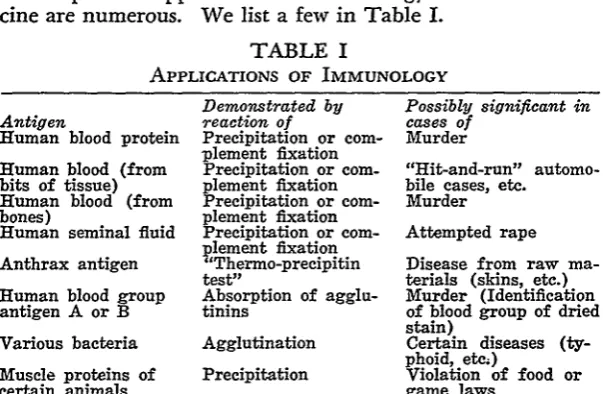
The possible applications of immunology to forensic medi-cine are numerous. We list a few in Table I.
TABLE I
APPLICATIONS OF IMMUNOLOGY
Demonstrated by Possibly significant in
Antigen reaction of cases of
Human blood protein Precipitation or com- Murder plement fixation
Human blood (from Precipitation or corn- "Hit-and-run" automo-bits of tissue) plement fixation bile cases, etc.
Human blood (from Precipitation or corn- Murder
bones) plement fixation
Human seminal fluid Precipitation or corn- Attempted rape plement fixation
Anthrax antigen "Thermo-precipitin Disease from raw ma-test" terials (skins, etc.) Human blood group Absorption of agglu- Murder (Identification antigen A or B tinins of blood group of dried
stain)
Various bacteria Agglutination Certain diseases (ty-phoid, etc;)
Muscle proteins of Precipitation Violation of food or
certain animals game laws
We may divide the material to be taken up in the present chapter into two parts. In the first part we shall consider the technic of the precipitin reaction, using this as a typical ex-ample of an immunological reaction which has forensic appli-cation. It will be wise to include also a study of the difficul-ties and pitfalls which the inexperienced may encounter. In the second part we shall take up the question of how the court may recognize the proficiency and competence of an expert who presents immunological data as evidence or who claims to be qualified to carry out such tests.
PART I: METHODS
The basic principle of good forensic immunological technic may be summarized by stating that the expert must in all cases assure himself of the specificity of all antisera8 he employs in a medicolegal case. The blood serum from a rabbit which has been injected several times with human blood will generally
5
Ascoli, A.: Die Thermoprizipitin reakticn, Wien und Leipzig, Josef Safar, 1922.
61n immunology, heat stable means resistant to heating to 55-60°C.
for 30-60 minutes.
7 An acute infectious disease. It is essentially a disease of the lower
animals, especially cattle and sheep, but may be transmitted to man by contact with the bodies of infected animals.
[image:4.454.74.376.153.350.2]WILLIAM C. BOYD
give a precipitate when mixed with human blood or an ex-tract of material which has been stained with human blood. However, any student of evolution will realize at once that such a serum might be expected to give a precipitate (less in amount, of course) also with blood from the anthropoid apes, and indeed, this is generally the case. To a still smaller extent, certain sera may cross-react also with blood of other mammals. Table 2, taken from Nuttall's book, will serve as an illustra-tion. Unless these facts are taken into account, an erroneous
TABLE II
Relative amounts of precipitate with 3 different anti-human blood rab-bit sera and equal amounts of blood serum of various species.4 Amount of precipitate obtained with human blood taken arbitrarily as 100.
SPECIES IMMUNE SERUM
1 2 3
Man ... 100 100 100
Chimpanzee ... .- - 130*
Gorilla ...- - 64
Orang-utan ... 47 80 42
Cynocephalus moron ... 30 50 42
Cercopithecus petaurista ... 30 50
-Ateles vellerosus ... 22 25
-Cat (Felis domesticus) ... 11 - 3
Dog (Canis familiaris) ... 11 - 3
* Loose precipitate.
diagnosis of human blood could be made when in fact the un-known blood sample came from an animal. The expert, how-ever, will avoid error through his knowledge of several facts:
(1) A good antiserum will practically always react with the homologous9 antigen, even when the latter is in a highly di-lute solution. Cross reactions, that is, reactions with material from other species, in general will occur only with more con-centrated solutions of the unknown antigen being tested. By including suitable controls0 in the tests, these differences may be made apparent.
(2) It is generally possible to remove from an antiserum the antibodies which are responsible for the cross reactions, leaving a reagent which is completely specific or nearly so. The technic of this is discussed below.
Preliminary. Naturally we shall not attempt to determine
the species origin of blood in suspected material unless pre-vious tests have established the presumption that some sort of blood is really there. The benzidene test is one of the most sensitive, but is not specific for blood; a positive benzidine
re-9
The antigen injected.
10 By controls we mean tests set up with known materials, so that
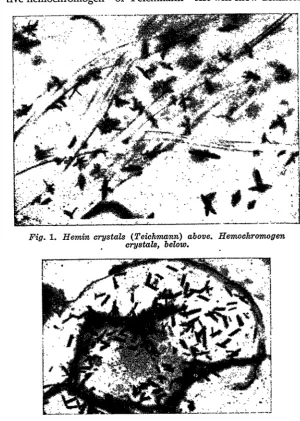
action" can only be considered presumptive evidence. A posi-tive hemochromogen 2or Teichmann'3test will show definitely
Fig. 1. Hemin crystals (Teichmann) above. Hemochromogen
crystals, below.
that blood is presefit. See Figure 1. Once this fact is confirmed, the qualified investigator is ready to perform precipitin tests IL The benzidine test is performed as follows: To 3 cc. of a satur-ated solution of benzidine in glacial acetic acid add 2 cc. of the solution to be tested and 1 cc. of 3 per cent hydrogen peroxide. A positive re-action is indicated by the development of a blue color.
12 Hemochromogen test. Probably the best results in obtaining these crystals are given by the Takayama method. Takayama's solution is as follows:
Sodium hydroxide (10 per cent) ... 3 cc. Pyridine ... .3 cc. Glucose (saturated solution) ... i ... 3 cc.
Distilled water ... 7 cc. This solution when kept in a yellow glass-stoppered bottle, will
[image:6.454.69.370.74.496.2]WILLIAM C. BOYD
to determine whether the blood be human or from an animal source, and if the question is material, from what animal.
Technic of the Precipitin Test. A precipitating serum, if
mixed with the homologous antigen in the proper proportions, will produce a clouding of the originally clear fluids, usually followed by the formation of a flocculent precipitate. The reaction is more easily seen, and takes place over a wider range of concentrations, if it is carried out by placing one fluid (the antigen) over the other (the antiserum) in a suitable test tube. By this interfacial technic the reaction is visible as the forma-tion of a white zone or plane at the juncforma-tion of the two clear fluids. This is often called the "ring" test. See footnotes 14. 15, 16, 17, 18, 19, 20, 21
Reagents. The reagents involved are two: antiserum and
antigen. Both should be crystal clear (though not necessarily colorless). If not clear, they should be filtered through a re-tentive filter paper, and if necessary centrifuged42 a long time at high speed.
Preparation of Antiserum Material for Injection.
Precipi-tins suitable for differentiating human from other blood may be produced by injecting rabbits with isotonic22 laked whole2 human blood, or by injecting defibrinated whole blood,24 main effective for a month or two. Two or three drops of the above solution are added to some of the -powdered material, from the stain, on a microscope slide which is later examined under low power. Gentle warming of the slide may hasten the reaction. If blood is present pink feathery crystals of hemochromogen or reduced alkaline haematin, usu-ally in sheaves, clusters, or in slightly varying formation, will be seen.
3 Teichmann's test. Place a very small drop of blood on a
micro-scopic slide, add a small drop of water and stir to lake the blood. Add a fraction of a drop of dilute (0.9 -per cent) sodium chloride solution and carefully evaporate to 'dryness over a low flame. Put a cover glass in place, run underneath it a drop of glacial acetic acid and warm gently until the formation of gas bubbles is noted. Add another drop of glacial acetic acid, cool the preparation, examine under the microscope. 14Boyd, W. C.: Fundamentals of Immunology, New York, Inter-science Publishers, Inc., 1943.
15 Glaister, J.: Medical Jurisprudence and Toxicology, Baltimore, Williams and Wilkins, 1942.
16 Hektoen, L.: The Precipitin Test for Blood, J.A.M.A., 70, 1273, 1918.
17 See footnote 5.
18 Schiff, F. and Boyd, W. C.: Blood Grouping Technic, New York, Interscience Publishers, Inc., 1942.
39 Smith, S. and Glaister, J.: Recent Advance8 in Forensic Medicine, Philadelphia, Blakiston's Son and Co., 1931.
20Uhlenhuth, P. and Steffenhagen, K.: Die biologische Eiweiss-Differenzierung mittels der Prazipitation unter besonderer Ber-icksich-tigung der Technik, Handbuch der Pathogenie Mikrooganismen, 3, 257,
1913.
21 Uhlenhuth, P. and Seiffert, W.: Die biologische Eiweisz-differen-zierung mittels der Pr~icipitation mit besonderer Beriicksichtigung der
Technik, Handbuch der Pathogenic Mikrooganismen, 3, 365, 1913.
22 Brought to the same osmotic pressure. If soduim chloride (com-mon salt) is used, this means bringing the concentration to 0.9 per cent. 23 Treated so as to dissolve the red cells and release the hemoglobin from them.
plasma,25 or serum.26 Serum is easiest to procure, and seems on the whole as satisfactory as anything else. Before injecting the serum it is sometimes diluted (with 0.9 per cent soduim chlor-ide solution) to an approximately 1 per cent protein content
(i.e., dilute 1:6 or 1:7). Several injections are necessary; the present writer injects each animal 3 times a week for 3 or 4 weeks before taking a bleeding.
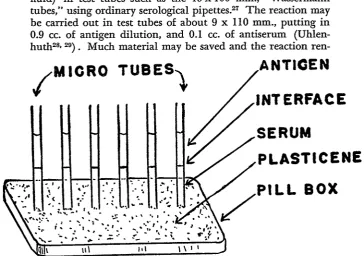
Apparatus. It is convenient to make the antigen dilutions (0.9 per cent sodium chloride solution is used for diluting fluid) in test tubes such as the 13 x 100 mm., "Wassermann tubes," using ordinary serological pipettes.27
The reaction may be carried out in test tubes of about 9 x 110 mm., putting in 0.9 cc. of antigen dilution, and 0.1 cc. of antiserum (Uhlen-huth28' 29). Much material may be saved and the reaction
ren-MICRO
TBSANTIGEN
PLASTICI
PILL
0)
Fig. 2. Diagrammatic representation of set-up for the Precipitin Test.
dered easier to read, by using "micro" tubes made from semi-capillary tubing, about 35 mm. long and 2.5 mm. internal di-ameter. In these there is placed about 0.4 mm. of antiserum and on top of this about 0.04 cc. of antigen dilution.3 0
For the Uhlenhuth tubes, special racks may be used in which the tubes hang from their lip, and the bottom, in which the reaction takes place, is free. The "micro" tubes may be sup-ported by sticking their lower ends into plasticene in a small shallow container, such as the metal cover of a pill box. Or 25The fluid part of blood, prevented from clotting by the addition
of an anticoagulant, with the cells removed.
26 See footnote 1.
27 Graduated tubes designed for delivering accurately measured
small volumes. Serological pipettes are graduated all the way to the tip.
[image:8.454.48.413.170.426.2]WILLIAM C. BOYD
special small racks of wood or wire may be constructed, which have the advantage of leaving the bottom of the tube open to inspection, and of not soiling the outside of the tube.
For use with the small tubes, fine capillary pipettes, made by drawing ordinary laboratory glass tubing to a point in a flame, and small rubber bulbs (2 cc. capacity) will be needed. With a little practice, it is easy to transfer with these the desired amount of fluid into the little precipitin tubes and obtain the desired sharp line of junction.
Determination of Titer of Antiserum. In order to be able to
gauge the significance of a positive reaction, it is of course nec-essary to have a fair idea of the potency of the antiserum or antisera being used. It seems sufficient to estimate the strength of the antiserum by determining the highest dilution of anti-gen which is precipitated by the antiserum.
The antiserum is tested with successive dilutions, for exam-ple 1:10, 1:100, 1:1000, etc., dilutions of the homologous anti-gen (i.e. human serum), and the last dilution noted which gives a visible reaction in 20 minutes or less. This is the titer of the antiserum. If desired, dilutions in smaller steps, such as 1:5, 1:25,... 1:3, 1:19.... may be tested.
A serum with a titer of 1:1000 or over is generally considered
satisfactory. However, the amount and density of precipitate, and the rapidity of the reaction, are also of significance. An antiserum with a titer of at least 1:20,000 is superior, and to be preferred because this means it is more sensitive and will detect smaller quantities of antigen and with a more striking positive reaction.
The tests are set up by transferring about 0.04 cc. of anti-serum to each of 6 or 7 of the small tubes described above, using the capillary pipette and rubber bulb. Serum in one of the tubes is overlayed with saline, for the control, and no visi-ble change should occur in this tube. Then with another capillary pipette, or with the same pipette, thoroughly rinsed, there is placed over the serum in another tube and in contact with it so as to form a sharp junction without bubbles, about 0.04 cc. of another of the antigen dilutions in the other tubes, and so on, keeping the tubes in order in the support, or mark-ing them to prevent confusion. One may begin with the most dilute solution and progress to the most concentrated, without rinsing. A control consisting of the strongest con-centration of antigen overlayed with saline is also desirable, and no visible change should occur in this tube.
Characteristics of a Positive Reaction. If the above technic
which appears within a few minutes after the antigen has been added, and grows heavier. In a very strong reaction, particles of precipitate may begin to fall down through the antiserum. The disk of precipitate should remain horizontal if the tube is tipped, showing that it is not dirt or other contamination attached to the walls of the tube. Every precaution, naturally, is taken beforehand to ensure the cleanliness of the tubes.
The reactions should be read in a good light, with a dark background behind the tubes. A well lighted window which has a cross bar which can be used for the background is very satisfactory. Fluorescent illumination with a dead black back-ground is good.
The tests are carried out as described immediately above. Reactions are to be judged positive when they fulfill the con-ditions laid down there. If no visible precipitate, of the char-acter described, materializes the test is negative and the sus-pected blood being tested, did not come from a human being.
Test of Specificity of Antiserum. Before use in practice, each
antiserum must be tested for specificity.31 If it is to be used in America or Europe in the usual type of medicolegal case, it will probably be sufficient to ascertain that it does not react with any of a series of dilutions of the blood of common domes-tic animals: dog, sheep, pig, cat, chicken, goose, etc. If it is desired to differentiate between human blood and blood of anthropoid apes and monkeys, which is seldom, it will be nec-essary to test the antiserum with these bloods also. It is prob-able that a reaction will be found with the blood of the higher apes. In some cases also a reaction will be obtained with (low dilutions only) various mammalian bloods (mammalian reac-tion of Nuttall.32) The cross reactions to be looked out for naturally will vary with the locality and the circumstances.
Production of a Completely Specific Antiserum. In case the antiserum is found to precipitate with any of the non-human samples tested, it may be rendered specific by absorption. The principle of this is as follows: Let us call any antigen, differing in species origin from the antigen injected, heterologous. Some of the reactive heterologous antigen is added to the antiserum, the precipitate is removed and the absorbed antiserum is thus deprived of its power to react with this heterologous material. The procedure of specific absorption is described in various books and papers3 ', 34,3 , 36.
31 Unless the reagent is specific for the substance it is designed to detect, a positive reaction will not necessarily denote the presence of that substance.
32 See footnote 24. 33 See footnote 14.
34 See footnote 18.
35 See footnote 20.
WILLIAM C. BOYD
Preparation of the Unknown Specimen for Test. Before the
reaction can be carried out, the unknown material must be brought into solution. If the blood stain is on hard material such as glass, smooth wood, metal, etc., it should be scraped off, powdered, and the powder extracted.37 A roughly equal amount of scrapings (if any can be obtained) from the un-stained substrate38 should be extracted in the same way for use as a control. If the stain is on cloth, paper, etc., the stain, or a portion of it if it is large, should be cut out and extracted. An equal portion of unstained material should be extracted at the same time. In some cases, as in checking stains from a possibly innocent man's clothes, one may have to buy a new suit (always an expensive onel) if a piece is cut out of the material. If a few threads are pulled out here and there from the stain, and a few for controls from unstained areas, a test, at least of preliminary nature, can be made without such re-moval of test material being noticed.
The material is extracted with physiological saline (0.9 NaC1 solution), overnight in the icebox. When plenty of material is available, it is suitable to use about 1 cc. of saline (more if the material is very absorptive) for each square centi-meter of stained material, in the case of cloth, etc. or for each
4 to 5 mg. of dried blood powder. This should give a solution, if all the dried serum proteins dissolve, roughly equivalent to a 1:10 or 1:20 dilution of fresh serum. The actual content of the dissolved protein should be estimated, by shaking portions of the various dilutions to produce foam, and by placing small amounts of them over concentrated nitric acid in little tubes, and noting the greatest dilution of the extract which gives a reaction; 9 this will correspond to a dilution of about 1:1000 of fresh serum. The dilution which just forms stable foam is similar, also corresponds to about 1:1000 (Uhlenhuth4
o°4a).
In some of the most important cases the amount of' blood stain obtainable is not as great as just recommended, as when a suspected knife has been cleaned, and only a trace of material suspected of being blood remains in the nail groove. In such cases the extraction may have to be made with 0.1 to 0.2 cc. of saline solution.
The extract should be filtered, if possible, and if necessary centrifuged at high speed to clarify it.42
37 Mixed with solvent (usually 0.9 per cent salt solution) and
al-lowed to stand, preferably in the cold.
38 The material bearing the stain.
39A positive reaction is the formation of a white or yellow disk ("ring") of precipitate at or near the junction between the solution and the acid.
40 See footnote 20.
41 See footnote 21.
42
Over the serum will be placed, in five of the antiserum-con-taining tubes, a 1:100,000, a 1:10,000, a 1:1000, a 1:100, and a 1:10, respectively, dilution of the extract of the unknown stain. (When material is very scanty, or the extract very diluted, the highest dilutions may be omitted.) For this the same pipette may be used, beginning with the most dilute solution and pro-gressing to the most concentrated, without rinsing. When the 1:100 dilution is reached, some should also be placed over normal serum. Then with separate pipettes, saline is placed in another antiserum-containing tube, and an extract of the unstained substrate43 in another, in that order. With another pipette a 1:1000 dilution of some heterologous blood serum44 is added to an antiserum-containing tube, and a 1:1000 dilu-tion of known human serum is placed in another tube also containing antiserum. The whole set-up is shown in figure 3 and Table III on the following page.
Purpose of the Controls. In order to be able to make
posi-tively the diagnosis of human origin of unknown material, the controls as outlined above are needed, viz: Normal rabbit
serum: this is used to test if the extract of the unknown
mate-rial will give a (non-specific) precipitate with sera not con-taining anti-human precipitins. Extracts of .some material have a non-specific precipitating power when mixed with sera. The reaction in this tube must be negative. Saline: This tests if the antiserum tends in general to cloud when in contact with other, non-specific fluids. This tube also serves as a standard with which to compare the appearance of the other reactions. The reaction here must be negative. Substrate:
(tube 8) this tests if the substrate has, independently of the stain, any specific or non-specific precipitating power. The re-sult here must be negative. Heterologous blood, (tube 9):
this controls the specificity of the antiserum, and shows that it does not react with mammalian bloods in general,45 at least not in high dilution. The reaction here must be negative.
Known human blood, (tube 10): this controls the activity of
the antiserum. It is necessary to show that the serum still re-acts well. This tube also serves as a standard reaction with which to compare any positive reaction found with the un-known.
These controls are of great importance; no one of them should be omitted.
Evaluation of the Results. If the controls are satisfactory
(tubes 6 to 9 negative, tube 10 positive), positive reactions appearing in tubes 1, (1:100,000), 2, (1:10,000), 3, (1:000),
43 See footnote 38.
44 See footnote 1.
.0.-C3
CD C
os o C3
$4 4 4
WILLIAM C. BOYD
0
W
$4
1-4
0
0:
or 4, (1:100), indicate that the blood stain was of human (or anthropoid) origin. A reaction in tube 5, (1:10), alone is of less significance40 unless the nitric acid test shows the original extract to have been unusually weak. A reaction in tube 4, (1:100), alone is probably significant, but shows the concen-tration of serum proteins (antigens) to be very low in the ex-tract. In a clear cut case, positive reactions will be obtained in tubes 5,4,3, and possibly 2 and 1.
Limits of Applicability of Test. A positive reaction, as
de-scribed, with satisfactory controls, is diagnostic of human (or ape) blood. Human blood can be differentiated from anthro-poid blood by using a good antiserum, specifically absorbed. The likelihood of finding ape blood in an American murder case is of course pretty remote. Human blood stains 15 to 60 years old have been identified by the precipitin test.
A verdict in the opposite sense, i.e., that a stain is not human blood, should be ventured only if the stain is in a good state of preservation, not too old, and preferably only if a good reaction can be obtained on testing it with an antiserum to blood of some animal species, thus positively identifying it.
In case the extract of the unstained substrate causes a cloud-ing, a confident diagnosis will be impossible. Sometimes
neu-tralizing the extract, (i.e., bringing it to Ph747) may remedy
this. If the extract is highly dilute, however, neutralization seldom helps.
Other Applications to Legal Medicine. There is not enough
space here to discuss the technic of other serological reactions which have medicolegal applications. Some have been men-tioned above. Descriptions may be found in some of the following references 48, 49, 50, , 2 53, 54, 55, 56, Strictly, blood grouping also falls in the category of serological technic57 and
the legal aspects of these tests will be found described else-where.58
4 6
Particularly if the antiserum used is known to precipitate low dilutions of certain heterologous bloods.4 7
pH represents a measure of acidity, and a value of 7 indicates the acidity of pure water, i.e., neutrality.4
SAscoli, A.: Die Thermoprdzipitinreaktion, Wien und Leipzig, Josef Safar, 1922.
49 See footnote 14. 50 See footnote 15.
51 Gonzales, T. .A., Vance, M. and Helphern, M.: Legal Medicine
and Toxicology, New York, D. Appleton-Century Co., 1937.
52 Lucas, A.: Forensic Chemistry and Scientific Criminal Investiga-tion, London, Edward Arnold and Co., 1935.
53 See footnote 18.
54 See footnote 19.
55 See footnote 20. 56 See footnote 21.
57 Serology may be defined as the science of reactions involving the use of serum.
58 Chapter ... , Boyd, W. C.: Protecting the Evidentiary Value of
WILLIAM C. BOYD
PART II: EXPERT QUALIFICATIONS
Criteria of Expertness in Forensic Immunology. The exact
place of the immunological expert, or indeed of any expert, is not always too clear in legal procedure in this country59' 60. In most jurisdictions, the question whether a witness qualifies as an expert is decided by the presiding justice. The relative weight to be given to his evidence is left to the decision of the jury. In theory, the expert merely presents evidence which could not have been found out by laymen, but laymen, (the jury) are left to draw the vital conclusions from this evidence.
In practice, it not infrequently happens that the expert (or one of his colleagues) has to indicate by his opinion what sort of conclusions are allowable from certain scientific data, for he and other expert witnesses in the case constitute the chief source of erudition for court and jury in respect to criteria of Scientific Proof.
It is important that the judiciary and the members of the legal profession should be able to form an opinion as to the qualifications of any one claiming to be an expert, or sug-gested as being capable of performing tests in forensic im-munology. Unless in the future some scientific organization will undertake to certify individuals as being qualified in this capacity, the decision will always remain a matter of some difficulty, since members of the legal profession cannot be ex-pected to know all the technical details involved. It is quite possible for a pseudo expert, possessing a facile mind and superficial knowledge of the literature on the subject, to pre-sent testimony even more apparently convincing than a genu-ine expert. However, certain considerations will aid in form-ing an opinion and we may discuss some of them here.
(1) The first and most important qualification, probably, is experience. This means that the individual should have been engaged in making forensic immunological tests or carrying out research in immunology for some time, certainly at least for a year. By proper questioning as to the number and types of tests the individual has carried out, it should be possible to
form an estimate of his competence.
(2) An expert in forensic immunology should preferably hold some advanced scientific degree such as M.D., Ph.D-, etc. Some individuals, of course, without such degrees, are entirely qualified in this field and the absence of such scholastic attain-ment should not automatically disqualify a person. Conversely, the possession of such a degree is by no means proof of the competence of an individual. The degree of Ph.D. may be
59 Smith, H. W.: Scientific Proof and Relations of Law and Medi-cine, Univ. of Chi. L. Rev. 10:243, April 1943.
obtained in a wide variety of subjects, some of them entirely unrelated to immunology. Most medical schools offer some training in immunology to their students, but it is probably not realized by the layman how brief and inadequate is the acquaintance of the average doctor with this subject. Even if he remembered everything he had been taught, the doctor fresh from medical school would not be qualified, without further experience, as an expert in immunology.
(3) It is preferable that the individual should do the tests himself with his own hands. However, tests carried out by the properly trained assistants, provided they are supervised and checked by the supervisor of the laboratory, are sometimes ac-cepted. I do not mean to go into the legal side of this. In any case, the person offering the tests as evidence should have carried out such tests himself at some time, that is, his knowl-edge must not be purely book knowlknowl-edge, and he must be able and willing personally to vouch for the accuracy of test results he describes on the witness stand.
(4) The expert should show an adequate acquaintance with the scientific literature of the subject. The number of books on immunology is very great and the witness cannot be ex-pected, of course, to remember or know, all of them or even any one of them in complete detail. He should, however, know the names of some of the books, be able to give a rough idea of their contents, and should be able to describe the technic he used in his own tests in a detailed way, pointing out any significant departures from customary procedures as described
in the standard texts on the subject.
(5) While it is not absolutely essential, it is highly desira-ble, that an individual claiming to be an expert should have published results or original individual research of his own dealing with some phase of immunology. In the present state of relations between law and medicine, the publication of original research must be regarded as important proof of out-standing mastery of a field. Whether this indicates compe-tence in the particular field in which evidence is being offered, is sometimes another question and not always easy to decide. (6) Finally, perhaps one of the best criteria is whether or not the individual is known and recognized as qualified by others in the same general locality who also work in the field. Essentially the field is a small one, and news of mistakes tends to travel.
Signs of the Pseudoexpert. In the absence of any
WILLIAM C. BOYD
based, on immunological tests. Indeed, certain facts suggest that this not infrequently occurs. There are considerations which aid the court in detecting such pseudoexperts. (1) Ab-sence of proper experience in the field, or at least in some branch of immunology. (2) Abscence of any background of proper scientific training is always suggestive but not conclu-sive. (3) Lack of knowledge of books dealing with the subject and of living research workers who have recently published on the subject. Of course a pseudoexpert may claim to know the books in the field. It is important that he be able to suggest by his replies some degree of acquaintance with their contents and the scientific position of the men who write them. (4) Failure to have published any original research (as indicated above, this is not conclusive by any means) . (5) Evidence that the individual in question is unknown to other persons who seem on reliable evidence to be real experts in the field. In practice this is probably the most suspicious circumstance.
THINGS AN EXPERT SHOULD Do TO INSURE HIS TESTS THE
UTMOST PROBATIVE VALUE
(1) He should identify and store samples entrusted to him
in such a way that no question of mistakes in identity can later arise. The place where they are stored should be accessible only to trusted members of his laboratory, or else the samples should be in a locked box.
(2) He should keep the samples (the perishable ones in the ice box) long enough after the tests have been completed to make sure that no retesting will be required on following days.
(3) Samples of the sera used in making the tests should be
preserved for possible checks as to their strength and specificity in case of any doubt subsequently arising.
(4) If the tests seem to give doubtful results, or if any spe-cial difficulties present themselves in making the tests or in interpreting the results, the expert will repeat the tests until he is satisfied of the entire accuracy of the results; if necessary, will even ask a second accredited expert to test the samples independently.
(5) In some cases it may be necessary for an expert to out-line to his lawyer the proper questions to ask him in order that he may be qualified as a competent expert in the eyes of the court. Attorneys who have not previously dealt with such cases are not always aware of certain pitfalls. If the expert is not a physician he must prepare his own attorney for the at-tempt which may be made by the opposing counsel to discredit him because of this fact.
make the whole question seem so complicated and involved that the court loses all confidence in it. The principles in-volved are essentially simple, and can be so presented. The way in which perfectly valid scientific evidence can be made to seem doubtful or even downright wrong is well illustrated by the passage quoted from Zinsser in reference 58.
A legal colleague of the writer has said, apropos of the fore-going:
"If I were cross-examining the expert in a serious case, I would most assuredly find many loopholes by which I could more or less successfully trip him into either contradicting himself, or impliedly or expressly admitting that his conclusion is by no means sufficiently certain to sway the verdict in favor of the side he is supporting. The laboratory tests, as shown in the treatise, are complex and admit of more than one inter-pretation, [with this statement I emphatically do not agree. W.C.B.] even if followed through precisely as suggested. The several interpretations that may result from the tests applied are in themselves a sufficient argument against the adoption of the expert's 'opinion.
".... expert testimony in any other field, such as
hand-writing and especially in psychiatry, is always conjectural to a large extent. If this element of conjecture, and such an ele-ment is definitely present in the tests enumerated in the treat-ise, can be shown to be present in medical testimony based upon scientific experiment, then it is fatal to the issue. This is especially true in scientific opinion, which by definition, must be most exact in its conclusion.
"In this opinion I am especially mindful of the murder case
which was tried in .... County several years ago, in which a
young assistant district attorney, with only an elementary knowledge of chemistry, so confused a nationally famous ex-pert that he retired after several days of testimony in utter con-fusion."
wit-472 WILLIAM C. BOYD
nesses) with human blood, and another similarly stained with pig bloodl