Keenoy, K. and de Freitas, Sara and Levene, Mark and Jones, A. and
Brasher, A. and Waycott, J. and Kaszas, P. and Turcsanyi-Szabo, M. and
Montandon, L. (2004) Personalised trails and learner profiling within
e-learning environments. Personalised and Collaborative Trails of Digital and
Non-Digital Learning Objects D22 (4.1), pp. 1-43.
Downloaded from:
Usage Guidelines:
Please refer to usage guidelines at or alternatively
Personalised trails and learner profiling within e-Learning
environments
Kevin Keenoy Sara de Freitas
Mark Levene
Birkbeck, University of London – London Knowledge Lab
Péter Kaszás Márta Turcsányi-Szabó
ELTE TeaM lab
Ann Jones Andrew Brasher
Jenny Waycott
The Open University – CALRG, Institute of Educational Technology
Lydia Montandon ATOS Origin Spain – STREAM Technology Center
Table of Contents
TRAILS...2
Executive Summary ...3
1 Introduction – personal trails, personalisation and personalised trails ...4
2 Learner profiling for personalisation ...7
2.1 vCard ...7
2.2 eduPerson ...8
2.3 Educational Modelling Languages (EMLs) ...8
2.4 IEEE Public and Private Information – Learner specification (PAPI-LEARNER) ...8
2.5 IMS Learner Information Package (IMS-LIP) ...9
2.6 A schema for representing learner needs? ...9
2.7 Standard representation of trails ...11
3 Adaptive instructional systems for personalised learning...11
3.1 Techniques for personalisation ...11
3.2 Intelligent tutoring systems ...13
3.3 Adaptive hypermedia and adaptive web-based instruction ...14
Definition and adaptation methods ...15
User modelling in adaptive hypermedia systems ...17
Limitations of adaptive hypermedia systems ...17
3.4 A note on the evaluation of personalisation systems ...18
4 Using cognitive learning styles for personalised e-learning ...19
4.1 What are learner styles? ...19
4.2 Review of three e-learning systems that use learning styles...21
4.2.1 INSPIRE (INtelligent System for Personalized Instruction in a Remote Environment) ...21
4.2.2 AES-CS (Adaptive Educational System based on Cognitive Styles) ...22
4.2.3 EDUCE (An intelligent tutoring system)...23
4.3 Learning styles and trails...24
4.4 Conclusions about the use of learning styles ...26
5 Personalisation in mobile learning...26
5.1 Discussion and implications for personal learning trails ...28
6 Commercial state-of-the-art in e-learning systems...29
6.1 Personalisation in commercially available systems...29
6.2 Trails Support ...30
6.3 Standards ...31
7 Concluding Remarks ...32
TRAILS
The World-Wide-Web has had a major impact on enabling large, diverse and geographically
distributed communities of learners to access Technology Enhanced Learning. Systems
combining technological learning tools with personalisation that caters for individual styles
and learning preferences have the potential to radically alter the landscape of learning.
A recent development has been in the use of learning objects (LOs) – cohesive pieces of
learning material that are usually stored in a repository, allowing teachers and learners to
search for LOs of interest to them. Learners engage with LOs in the form of trails –
time-ordered sequences of LOs.
Examples of LO trails are:
(i) a school-child navigating through course materials,
(ii) a learner navigating through the literature on a subject, or
(iii) a visitor navigating through a museum.
By following and creating trails, the learner navigates through a space of LOs creating a
personal trail that can be evaluated and accessed in a structured manner. These directly
observable LO trails are related to learners' non-observable cognitive trails.
Trails are the subject of the Personalised and Collaborative Trails of Digital and Non-Digital Learning Objects project (TRAILS for short). TRAILS is a one-year Jointly Executed
Integrating Research Project within the Kaleidoscope Network of Excellence, an IST project
funded under EU FP6. At the core of the programme is the view that trails can provide
structure to learners’ information space and thus can assist them in achieving their
objectives. TRAILS brings together experts from computer, social and cognitive sciences in
order to:
• generate a framework for describing, classifying and understanding trails of LOs;
• study the pedagogical and cognitive aspects of personalised trails;
• investigate the types of individual need (personalised, individualised, collaborative,
context dependent and content dependent) which learners have in terms of trails;
• evaluate and assess methods, which cater for learner needs;
• produce a schema for representing these learner needs in a specific user profile;
• produce a schema for integrating learner needs with appropriate LO metadata;
• design a system for mapping the patterns of trails created by learners and for
producing a training needs analysis for targeting future learner experiences;
• investigate different types of LOs and how they may form trails;
• specify the requirements which trail-support places on e-Learning systems;
Executive Summary
This is the first deliverable of Workpackage 4 of the TRAILS project. The objectives of
Workpackage 4 are as follows:
• To study what support is needed for individuals and groups of learners within an
e-learning system.
• To study what profiling information is needed for personalisation within an e-learning
system.
• To investigate how personalised and collaborative trails emerge in an e-learning system.
• To investigate how personalisation and collaborative filtering technology can assist in
mining and presenting such trails.
This deliverable focuses on the aspects of these objectives that are related to personalisation
and personalised trails. We first introduce and define the concepts of personalisation and
personalised trails (Section 1). Personalisation requires that a user profile be stored, and so
we assess currently available standard profile schemas and discuss the requirements for a
profile to support personalised learning (Section 2). We then review techniques for providing
personalisation and some systems that implement these techniques, and discuss some of
the issues around evaluating personalisation systems (Section 3), and look especially at the
use of learning and cognitive styles to support personalised learning (Section 4). We then
look at personalisation in the field of mobile learning, which has a different take on the
subject (Section 5), and in commercially available systems, where personalisation support is
found to currently be only at quite a low level (Section 6). We conclude with a summary of
the lessons to be learned from our review of personalisation and personalised trails.
The first objective above is addressed throughout the deliverable, as the main concepts
behind personalisation are introduced and the different ways in which it can support learners
explored. The second objective is covered by Section 2, which looks in detail at schemas for
learner profiling. The third and fourth objectives are also tackled throughout the document,
with different approaches to the issues of how personalised trails are produced and the
1 Introduction – personal trails, personalisation and personalised
trails
This is the first deliverable in Workpackage 4 of the TRAILS project. Workpackage 4 is
about personalised and collaborative trails of learning objects (LOs), and this deliverable
focuses on the former: personalised trails.
There has been much talk from all quarters recently of “personalised learning”, and the
phrase seems to mean many different things to different people. It is therefore important for
us to explain exactly what we mean by the term “personalisation” in the context of this
Workpackage and this deliverable.
Personal trails are trails that have been followed by an individual learner through some learning environment. In terms of our taxonomy of trails from D22.2.1 (Schoonenboom et al., 2004a) they are emergent LO trails, as they emerge from the behaviour of an individual learner. For this reason they could be also be called individual trails. Personal learning trails manifest themselves in many ways – they can be short-term or long-term, and will vary
greatly in the granularity of the events considered as single nodes along the trail. So, for
example, one personal learning trail might be the list of LOs visited during an hour-long
session working in an on-line e-learning environment, and another could be the list of
qualifications gained between the ages of 15 and 25 on a curriculum vitae.
The recording of personal trails can be a useful activity for learners – it allows reflection on
what has been done, and perhaps the opportunity to re-visit sections of the trail that has
been followed so far. Indeed, the “history” of web page accesses stored in a web browser is
designed specifically to allow users to easily locate and revisit things they have already seen.
The learner portfolio – a collection of representative pieces of work from over a period of time
– is an important kind of personal trail. At present, portfolios of work are usually kept as
“evidence” for some sort of assessment activity or to demonstrate to third parties (i.e.
someone who is not the learner or instructor) that they have acquired skill at some
competency, but the role of the portfolio can easily be modified or augmented to also act as a
focus for reflection by the learner on what they have done. Techniques for visualisation of
personal trails, such as those reported in D22.2.2 (Schoonenboom et al., 2004b), can further serve to foster reflection in learners.
Personal trails of this sort are not the direct focus of this deliverable, but are important to
1. A personal trail emerges when a learner follows a personalised trail.
2. Personal trails, such as a recent history of accesses to LOs or a portfolio of work,
can form an important part of the learner profiles needed to create personalised
trails.
When we talk about personalisation, we mean a process whereby machines (computer systems, learning environments, etc.) automatically adapt their behaviour to cater for the
needs or preferences of different individuals. At the simplest level this takes the form of
customisation – users can adjust various system settings stored in a profile and the system
will reflect the changes. Examples of customisation are things like setting the desired font
size in a web browser, a website that “remembers” if the user prefers a yellow or blue
background to the pages, and being able to set a picture as the background on a PC’s
“desktop”. All of these systems remember a user’s preferences and adjust their behaviour
accordingly, yet we would hesitate to call this real personalisation – customisation is just
remembering some user settings for a predictable behaviour.
Real personalisation begins to happen when the system uses the information it has about the
user to anticipate their needs and provide them with something that they want or need. In
this case it is not just remembering a setting for something that the user knows about (which
font size, colour, picture, etc.), but actually adapting new behaviour to what the user is most
likely to want. Much work on personalisation has been focussed on hypertextual
environments, such as the web. Web personalisation is any action (by a web server) that
tailors the Web experience to a particular user, or set of users. For example, a news site that
suggests new stories that returning visitors may be interested in, a share trading site that
automatically shows stock prices that the user may be interested in and a search site that
returns results biased towards the user’s interests all provide real personalisation of some
sort.
Within the systems that provide this sort of personalisation there is a further distinction to be
made between (1) systems that base their personalisation functionality on a static profile of
data submitted explicitly by the user, and (2) systems that base their personalisation on a
profile that automatically adapts over time to take account of user behaviour. This second
class of personalisation systems are truly adaptive, as the system learns about the user and
what the user needs automatically and adapts accordingly. In systems based on a static
profile the user will need to prevent their profile from going “stale” by regularly updating the
information stored by the system if the personalisation is to remain relevant to their current
may record personal trails to inform the personalisation they perform – for example, a
personalised news website may record a history of the stories read by each user (i.e. the
users’ personal news trails), and base future recommendations on this.
We are now in a position to say what we mean by personalised (learning) trails. Personalised trails are sequences of LOs that a system suggests to individual learners (or groups of
learners) based on what it knows about each particular learner’s (or group’s) preferences.
Possible personalised trails could be of widely differing lengths and durations. At one end of
the spectrum a web-based learning system could suggest just one page at a time (i.e. the
“next best page” for each individual) to learners as they navigate through the learning
environment. Such a system would be similar to web page recommender systems such as
Letizia (Lieberman, 1995) and WebWatcher (Joachims et al., 1997). Somewhere in the middle of the scale, a personalised learning programme for a degree module could be
suggested to a learner, making sure that all the necessary prerequisite background courses
are taken. At a higher level again, a personalised trail through university, postgraduate and
professional qualifications could be suggested to a school leaver whose ambition is to
become a lawyer.
Systems that suggest personalised trails in this way are truly in their infancy still, and no
systems have yet been developed that can provide the kind of personalised trails described
above. Hence in this deliverable we will consider the technologies that could form the basis
of components of a personalised trails system, and the systems that have begun to
implement elements of the functionality required to create personalised trails.
The rest of the deliverable is structured as follows: All personalisation systems need to store
some form of profile about the user, so Section 2 looks at current standards for learner
profiles and considers which elements will be necessary for personalised learning. Section 3
briefly reviews some of the techniques used for personalisation, looks at the current
state-of-the-art in adaptive learning systems and considers some of the difficulties in reliably
evaluating systems providing personalisation. Section 4 looks at the use of learning and
cognitive styles as the basis for personalisation, and reviews three systems that have taken
this approach to personalised learning. Section 5 considers personalisation in mobile
learning, where it is conceived somewhat differently from our description of personalisation in
this introduction. The state-of-the-art in personalisation provision in the commercial sector is
the focus of Section 6, and in Section 7 we conclude with some observations about the
2 Learner profiling for personalisation
All systems providing personalisation will need to store information about the users in a
profile. What information needs to be stored in the profile will depend on the exact
functionality of the system – different kinds of personalisation will require different information
about the user. The data most useful for personalising the learner’s experience will include,
for instance, preferred learning styles, current levels of attainment, learning goals, wider
interests, locality, languages and learning history. Much of this information will be common
across most systems and several “standard” user profile schemas have been developed to
aid interoperability between systems and to reduce duplication of data in multiple profiles
where possible.
Personalisation is not the only (and usually not even the main) reason for storing a user
profile, and the standard schemas mostly focus on the storage and transfer of data to aid the
administration of educational institutions (for example, learners moving between institutions,
exam entry and internal monitoring processes) rather than targeting data that may be useful
for providing personalised access to learning content. This means that some of the important
data for personalisation mentioned above is not included in the proposed standards.
As yet none of the proposed schemas seems to have really taken off as the de facto industry standard, possibly because each of the specifications has its drawbacks, and none is
generally sufficient on its own. Recently, however, IMS’s Learner Information Package
seems to have been gaining more widespread acceptance.
In the remainder of this section we review some of the current standards and specifications
for recording and storing personal information, and consider their suitability for use as the
basis of a user model (i.e. learner profile) in systems providing personalisation. The list is by
no means exhaustive, but is representative of the range of available specifications.
2.1 vCard
The Internet Mail Consortium maintains the vCard format1. The vCard schema covers the
basics of personal (and business) information by holding the information usually found on a
business card. It lacks any information useful for personalisation, but is a standards-based
specification that can be (and is) used as the basis for more involved user and learner
profiles.
2.2 eduPerson
US universities use the eduPerson (UCAID, 2002) scheme to transfer information about
people involved in higher education (both staff and students). It holds some additional
attributes to those included in vCard (such as affiliation, entitlement, preferred language), but
is really an administrative tool and does not hold much that is useful for personalisation.
2.3 Educational Modelling Languages (EMLs)
The CEN's Information Society Standardization System (CEN/ISSS) survey of EMLs defines
an EML as “a semantic information model and binding, describing the content and process within a ‘unit of learning' from a pedagogical perspective in order to support reuse and interoperability” (Rawlings et al., 2002). Six languages are reviewed – all have XML bindings, and some (3 out of the 6) also have SGML bindings. All of the proposals mainly
concentrate on the description of learning material rather than on the people involved in the
learning process, although an EML should allow the modelling of both.
OUNL-EML (Open University of the Netherlands) and PALO (Rodríguez-Artacho, 2002) also
model people; People are modelled in terms of the roles they play (what activities they
participate in), for workflow modelling. This kind of user modelling may be of some use in
creating personalised trails, although additional information such as current learner goals,
experience and preferences (which are not covered by workflow modelling) are also
desirable in a user model.
OUNL-EML can “describe personalisation aspects within units of learning, so that the content and activities within units of learning can be adapted based on the preferences, prior
knowledge, educational needs and situational circumstances of users” (Rawlings et al., 2002). These personalisation aspects could include personalised trails that have been
authored into the learning material. It also includes a “personal dossier” for individual
students, which records assessment, grading and “time-spent on assignment” information.
Such personal portfolios can be used as a personal trail record for reflection and
assessment, as discussed further in Trails Deliverable 2.2 (Schoonenboom et al., 2004b).
2.4 IEEE Public and Private Information – Learner specification
(PAPI-LEARNER)
PAPI-Learner is a proposed standard from the IEEE, still in draft version although not
modified since 2002 (IEEE LTSC, 2002). It specifies both the syntax and semantics of a
profile information, each of which has separate security and administration. They are
identified by their initial letter:
N
ame – personal information primarily used for administration(e.g., name, address, social security number)
R
elations – learner’s relationships with other users of the system(e.g., cohorts, classmates)
S
ecurity – security information(e.g., public and private keys, credentials)
M
y Configuration – preferences to improve human-computer interaction(e.g., useful and unusable I/O devices, learning styles, physical limitations)
G
rades – performance information(e.g., grades, reports, log books)
W
orks – portfolio information as an illustration of abilities and achievements(e.g., accomplishments, works)
The standard profile data can be extended with additional information to give “conforming”
data, although it will not be “strictly conforming”.
2.5 IMS Learner Information Package (IMS-LIP)
IMS-LIP was developed to enable interoperability of IMS-compliant servers, although it
beginning to gain wider acceptance as a standard for many educational systems (IMS,
2001). Earlier in 2004 it was chosen as the basis for the CEN/ISSS “Guidelines for the
production of learner information standards and specifications” (CEN, 2004), effectively
making it the basis of a European standard for the transfer of learner information. The
purpose of this standard is to facilitate learners in presenting their credentials and
achievements at both a national and European level, but a profile based on the standard
could also be used as a basis for the provision of personalisation.
The IMS-LIP data model describes the characteristics of a learner needed to aid “recording
and managing learning-related history, goals, and accomplishments; engaging a learner in a
learning experience; discovering learning opportunities for learners” (IMS, 2001).
2.6 A schema for representing learner needs?
IMS-LIP and PAPI are the main profile specifications that include the detailed information
most useful for personalisation – learner history, current activities and goals. However, they
providing a placeholder for free-text descriptions. The machine-processability of these parts
of the profile is thus limited – these sections of the profiles are designed to be read by people
rather than machines. Without any formal or standard way to express learner goals, learning
outcomes and learning objectives any machine “understanding” for matching will need to be
based on the matching of similarities between unstructured blocks of text.
The syntactic structure provided by specifications such as IMS-LIP and PAPI can be taken
advantage of to aid machine interoperability if the fields for free-text entries are populated not
with completely free text, but instead populated using structured vocabularies designed to
express the relevant information (i.e. learner’s competencies, goals and preferences). The
use of Semantic Web technologies such as the Resource Description Framework (RDF) or
Web Ontology Language (OWL) (W3C, 2004a,b) is one possible way to define such
structured vocabularies. The use of RDF to encode the whole profile data (and not just the
free-text sections) gives the additional advantage of being able to pick elements from
multiple schemas while remaining interoperable with other (RDF-aware) systems (Dolog and
Nejdl, 2003; Keenoy et al., 2003): rather than needing to invent another data model for learner profiling for personalisation, the demographic and other common data catered for in
existing schemes (such as IMS-LIP and PAPI) can be represented using the relevant
elements from the existing schemes, and this can be enriched with extra elements where
necessary (e.g., for recording competencies, goals and learning styles to aid personalisation
– these are the areas that are generally lacking in existing proposals). This approach (i.e.
selecting the required fields from multiple profiling schemes) helps to avoid the problem of a
new proprietary profile format for each new system developed – each particular system will
need a slightly different set of user data depending on the personalisation technique
employed, but all can use RDF to pick-and-choose the required elements rather than design
a new profile specification.
Different personalisation systems employing different personalisation algorithms will require
different types of personal information to be stored in the user profile in order to perform
properly. We therefore, following Keenoy et al. (2003), would say that rather than
recommending a particular specific schema that should be used for all user profiling, the best
approach may be for each system to create the schema it needs to provide its functionality,
using a technology such as RDF to choose elements from existing schemas (i.e. from
namespaces that already exist) where possible, and making public in a new namespace any
additional schema elements found to be necessary. This is the approach taken by the
SeLeNe project, which used elements of IMS-LIP, PAPI and IMS-RCD, and created a public
http://www.dcs.bbk.ac.uk/~kevin/selene/rdf/learner. Such an approach
should make learner profiles as interoperable between different systems as possible, while
not constraining the possibilities for individual systems.
2.7 Standard representation of trails
We have seen that in order to be able to provide personalised trails to learners, a system
must use a learner model of some form. It must also have some representation for the
possible trails. There is currently no standard for the representation of trails of LOs, and this
lack of a standard presents an opportunity for the development of a framework for the
specification of trails. IMS Learning Design (IMS, 2003) does allow the modelling of trails
within a learning environment, as shown by Schoonenboom et al. (2004a), but the representation is not simple nor is it suitably generalisable to be used for the full range of
types of user trail we would like to represent, such as learner histories. Keenoy et al. (2003) suggest a simple RDF model for trails that allows the specification of a sequence of
resources, the type of trail (emergent, authored or derived), a name for the trail and some
additional annotation. One approach would be to use the taxonomy of trails developed by
Schoonenboom et al. (2004a) to extend the range of possible types of trail allowed in this schema (i.e. by defining further subclasses of Keenoy et al.’s ‘TRAIL’ element), to produce a more generalised RDF model. Another possibility is to use the metadata schema proposed
by Schoonenboom et al. (2004b) as the basis of a standard representation of trails. However, we feel that any specification towards a standardisation effort should grow out of practice
rather than theorising. In the field of e-learning standards it seems there has often been too
much theorising and not enough practice, resulting in standards and specifications that are
not usable “off the shelf” and that no one is really happy with. In practice either of the
possibilities for trail representation described above is likely to need further refinement based
on experience before being suitable for a standard. For this reason we suggest that there
should be more practice in modelling and using learner trails before any effort to settle on a
“standard” representation.
3 Adaptive instructional systems for personalised learning
3.1 Techniques for personalisation
We have seen that providing personalisation requires a user profile to be stored. Whatever
the schema for the profile looks like, the system must obtain data about the user to populate
the profile before any personalisation can be done. There are two possibilities for how the
1. Explicit collection of the data: users' preferences are found explicitly, by asking them to submit the necessary information manually before any personalisation can be
provided. The data collection process could be as simple as ticking boxes to show
which LOs or web pages are relevant to them, or as detailed as the completion of
long forms with personal information, and descriptions of interests and goals.
Explicitly entered profile information is considered to be “high quality”, but users
generally dislike having to spend time and effort submitting data to a system,
especially when the benefits may not be immediately obvious. This can make the
explicit collection of sufficient profile data difficult.
2. Implicit collection of the data: users’ preferences are inferred from their normal
interactions with the system. The interactions monitored (either by the personalisation
application or at a system level) could be things such as visiting a web page (and the
time spent viewing it), following a hyperlink, scrolling down a page and bookmarking,
saving or printing a page. The advantage of collecting profile data this way is that the
user is relieved of the burden of having to supply and keep up-to-date the necessary
information, but implicit measures of interest are generally thought to be “lower
quality" than explicitly gathered preferences (Nichols, 1997).
Implicit and explicit data collection methods can of course be used in conjunction with one
another to populate a user profile. In this case the user can supply as much or as little high
quality information to the system explicitly as they like, and this can be augmented with
information inferred from the user’s interactions with the system with no further user effort.
We said in the introduction that much of the work done on personalisation has been focussed
on web personalisation – personalising web pages or recommending web content based on
the user’s preferences. The techniques that have been developed used to achieve this
generally fall into one of two categories: (1) content-based personalisation and (2)
collaborative filtering (Mobasher et al., 2000; Nichols, 1997).
Content-based systems personalise based on features of the content they manage – for
example, search results might be personalised by ranking highly those pages where term
frequency analysis of the keywords in the result page matches similar analysis of keywords
in the user profile that reflect the user’s interests, or news stories may be recommended to a
user when they are on a topic that the user has previously expressed an interest in.
Recommendations are based on a profile built up from analysis of the content of items that
the user has rated in the past and/or the user’s personal information and preferences. Pure
content-based filtering systems have several shortcomings and some critical issues remain
text documents) are available and that users can only receive recommendations similar to
their earlier experiences, and the sparseness problem of item rating information (Kwak and
Cho, 2001; Lee et al., 2001).
Collaborative filtering techniques, on the other hand, take no account of the content
managed by the system, but instead personalise based on system usage, specifically the
behaviour of other similar users of the system – for example, search results might be
personalised by ranking highly those pages that have been rated highly by users similar to
the current user who viewed those pages in the past. For some more on collaborative
filtering-based personalisation see TRAILS deliverable 4.2 (Keenoy et al., 2004).
Personalisation systems are often recommendation systems of one sort or another – they
recommend something (web pages, news stories, LOs, or some other content) to users
based on their personal profile. Another approach to personalisation is to adapt the
presentation of information to the individual user, thus personalising a generic information
space without necessarily recommending items. The provision of personalised trails can
encompass either or both of these approaches to personalisation:
• A personalised trail could be recommended to the user from a set of possible trails,
as in a recommender system;
• A set of items (for example, a set of search results or a set of LOs selected by the
user) could be organised into a personalised trail, as in an adaptive presentation
system;
• A trail of recommended LOs can be organised into a personalised trail and presented
to the user, in which case it the process has both recommendation and adaptive
presentation aspects.
The following subsections concentrate on the application of such techniques to provide
personalised learning in e-learning systems. We discuss the most widely implemented
approaches to the development of adaptive e-learning systems – intelligent tutoring systems
and adaptive hypertext systems. The source for much of the information in these sections is
Jonassen (2004).
3.2 Intelligent tutoring systems
Intelligent tutoring systems (ITSs) are adaptive instructional systems developed with the
application of Artificial Intelligence (AI) methods and techniques. ITSs are developed to
teach and learn together. As in any other instructional systems, ITSs have components
representing the content to be taught; inherent teaching or instructional strategy, and
mechanisms for understanding what the student does and does not know. In ITSs, these
components are referred to as the problem-solving or expertise module, student-modelling
module, and tutoring module. The expertise module evaluates the student’s performance and
generates instructional content during the instructional process. The student-modelling
module assesses the student’s current knowledge state and makes hypotheses about his or
her conceptions and reasoning strategies employed to achieve the current state of
knowledge. The tutorial module usually consists of a set of specifications for the selection of
instructional materials the system should present and how and when they should be
presented. AI methods for the representation of knowledge (e.g., production rules, semantic
networks, and scripts frames) make it possible for the ITS to generate the knowledge to
present to the student based on his or her performance on the task, rather than selecting the
presentation according to predetermined branching rules. Methods and techniques for
natural language dialogues allow much more flexible interactions between the system and
the student. The function for making inferences about the cause of the student’s
misconceptions and learning needs allows the ITS to make qualitative decisions about the
learning diagnosis and instructional prescription, unlike the microadaptive model, in which
the decision is based entirely on quantitative data. Furthermore, ITS techniques provide a
powerful tool for effectively capturing human learning and teaching processes. It has
apparently contributed to a better understanding of cognitive processes involved in learning
specific skills and knowledge. Some ITSs have not only demonstrated their effects for
teaching specific domain contents but also provided research environments for investigating
specific instructional strategies and tools for modelling human tutors and simulating human
learning and cognition (Ritter and Koedinger, 1996).
Theoretical issues about how to learn and teach with emerging technology, including AI,
remain the most challenging problems.
3.3 Adaptive hypermedia and adaptive web-based instruction
In the early 1990s, adaptive hypermedia systems inspired by ITSs were born (Brusilovsky,
Schwarz, and Weber, 1996). They fostered a new area of research combining adaptive
instructional systems and hypermedia-based systems. Hypermedia-based systems allow
learners to make their own path in learning. However, conventional hypermedia learning
environments are a non-adaptive learning medium, independent from the individual user’s
responses or actions. They provide the same page content and the same set of links to all
learners (Brusilovsky, 2000, 2001; Brusilovsky and Pesin, 1998). These kinds of traditional
the characteristics of the individual user (Brusilovsky and Vassileva, 1996). Researchers
tried to build adaptive and user model-based interfaces into hypermedia systems and thus
developed adaptive hypermedia systems. The goal of adaptive hypermedia is to improve the
usability of hypermedia through the automatic adaptation of hypermedia applications to
individual users. For example, a student in an adaptive educational hypermedia system is
given a presentation that is adapted specifically to his or her knowledge of the subject and a
suggested set of the most relevant links to pursue (Brusilovsky, Eklund, and Schwarz, 1998)
rather than all users receiving the same information and same set of links. An adaptive
electronic encyclopaedia can trace user knowledge about different areas and provide
personalised content. A virtual museum provides adaptive guided tours in the hyperspace.
Adaptive hypermedia or adaptive Web-based systems have been employed for educational
systems, e-commerce applications such as adaptive performance support systems, on-line
information systems such as electronic encyclopaedias and information kiosks, and on-line
help systems. Since 1996, the field of adaptive hypermedia has grown rapidly (Brusilovsky,
2001), due in large part to the advent and rapid growth of the Web. The Web had a clear
demand for adaptivity due to the great variety of users and served as a strong booster for
this research area (Brusilovsky, 2000).
Because of its popularity and accessibility, the Web has become the choice of most adaptive
educational hypermedia systems since 1996. Lieberman’s (1995) Letizia is one example of
the earliest adaptive Web-based systems. Letizia is the system that assists users in web
browsing by recommending links based on their previous browsing behaviours. Other early
examples are ELM-ART (Brusilovsky, Schwarz, and Weber, 1996), InterBook (Brusilovsky,
Eklund, and Schwarz, 1998), PT (Kay and Kummerfeld, 1994), and 2L670 (De Bra, 1996).
These early systems have influenced more recent systems such as Medtec (Eliot, Neiman,
and Lamar, 1997), AST (Specht, Weber, Heitmeyer, and Schöch, 1997), ADI (Schöch,
Specht, and Weber, 1998), HysM (Kayama and Okamoto 1998), AHM (Pilar da Silva, Durm,
Duval, and Olivié, 1998), MetaLinks (Murray, Condit, and Haugsjaa, 1998), CHEOPS (Negro,
Scarano and Simari, 1998), RATH (Hockemeyer, Held, and Albert, 1998), TANGOW (Carro,
Pulido, and Rodríguez, 1999), Arthur (Gilbert and Han, 1999), CAMELEON (Laroussi and
Benahmed, 1998), KBS-Hyperbook (Henze, Naceur, Nejdl, and Wolpers 1999), AHA! (De
Bra and Calvi, 1998), SKILL (Neumann and Zirvas, 1998), Multibook (Steinacker, Seeberg,
Rechenberger, Fischer, and Steinmetz, 1998), ACE (Specht and Oppermann, 1998), and
ADAPTS (Brusilovsky and Cooper, 2002).
Definition and adaptation methods
Adaptive hypermedia systems can be defined as “all hypertext and hypermedia systems
various visible and functional aspects of the system to the user”. Functional aspects mean those components of a system that may not visibly change in an adaptive system. For
example, the “next” button will not change in appearance but it will take different users to
different pages (Schwarz, Brusilovsky, and Weber, 1996). An adaptive hypermedia system
should (a) be based on hypertext link principles, (b) have a domain model, and (c) be
capable of modifying some visible or functional part of the system on the basis of information
contained in the user model.
Adaptive hypermedia methods apply mainly to two distinctive areas of adaptation: (1)
adaptation of the content of the page, which is called content-level adaptation or adaptive
presentation; and (2) the behaviour of the links, which is called link-level adaptation or
adaptive navigation support. The goal of adaptive presentation is to adapt the content of a
hypermedia page to the learner’s goals, knowledge, and other information stored in the user
model. The techniques of adaptive presentation are (a) connecting new content to the
existing knowledge of the students by providing comparative explanation and (b) presenting
different variants for different levels of learners. The goal of adaptive navigation support is to
help learners find their optimal paths in hyperspace by adapting the link presentation and
functionality to the goals, knowledge, and other characteristics of individual learners. It is
influenced by research on curriculum sequencing, which is one of the oldest methods for
adaptive instruction (Brusilovsky, 2000; Brusilovsky and Pesin, 1998). Direct guidance,
adaptive sorting, adaptive annotation, and link hiding, disabling, and removal are ways to
provide adaptive links to individual learners. ELM-ART is an example of direct guidance. It
generates an additional dynamic link (called “next”) connected to the next most relevant node
to visit. However, a problem with direct guidance is the lack of user control. An example of
the link-hiding technique is HYPERTUTOR. If a page is considered irrelevant because it is
not related to the user’s current goal or presents material that the user is not yet prepared to
understand, the system restricts the navigation space by hiding links. The advantage of
hiding links is to protect users from the complexity of the unrestricted hyperspace and reduce
their cognitive load in navigation.
Adaptive annotation technology adds links with a comment that provides information about
the current state of the nodes. The goal of the annotation is to provide orientation and
guidance. Annotation of links can be provided in textural form or in the form of visual cues,
for example, using different icons, colours, font sizes, or fonts. Also, this user-dependent
adaptive hypermedia system provides different users with different annotations. The method
has been shown to be especially efficient in hypermedia-based adaptive instruction.
InterBook, ELM-ART, and AHM are examples of adaptive hypermedia systems applying the
annotation technique. To provide links, annotation systems measure the user’s knowledge in
where the user has been and how those places are related (prerequisite based); and (c)
according to a measure of what the user has shown to have understood (knowledge based)
(Eklund and Sinclair, 2000). Brusilovsky (2000) stated that “adaptive navigation support is an
interface that can integrate the power of machine and human intelligence: a user is free to
make a choice while still seeing an opinion of an intelligent system”. In other words, adaptive
navigational support has the ability to decide what to present to the user, and at the same
time, the user has choices to make.
User modelling in adaptive hypermedia systems
As in all adaptive systems, the user’s goals or tasks, knowledge, background, and
preferences are modelled and used for making adaptation decisions by adaptive hypermedia
systems. In addition, more recently the user’s interests and individual traits have been
studied in adaptive hypermedia systems. With the developed Web information retrieval
technology, it became feasible to trace the user’s long-term interests as well as the user’s
short-term search goal.
The user’s individual traits include personality, cognitive factors, and learning styles, as
discussed in Section 2. Like the user’s background, individual traits are stable features of a
user. However, unlike the user’s background, individual traits are not easy to extract.
Researchers agree on the importance of modelling and using individual traits but disagree
about which user characteristics can and should be used (Brusilovsky, 2001).
Limitations of adaptive hypermedia systems
We have found little empirical evidence for the effectiveness of adaptive hypermedia
systems. Specht and Oppermann’s study (1998) showed that neither link annotations nor
incremental linkages in adaptive hypermedia system have significant separate effects.
However, the composite of adaptive link annotations and incremental linking was found to
produce superior student performance compared with to that of students receiving no
annotations and static linking. The study also found that students with a good working
knowledge of the domain to be learned performed best in the annotation group, whereas
those with less knowledge appeared to prefer more direct guidance. Brusilovsky and Eklund
(1998) found that adaptive link annotation was useful to the acquisition of knowledge for
users who chose to follow the navigational advice. However, in a subsequent study (Eklund
and Sinclair, 2000), link annotation was not found to influence user performance on the
subject. The authors concluded that the adaptive component was a very small part of the
interface and insignificant in a practical sense. Also, De Bra (2000) points out that if
wrong, the user may be guided to pages that are not relevant or that the user cannot
understand. Bad guidance is worse than no guidance. Evaluating the learner’s state of
knowledge is the most critical factor for the successful implementation of an adaptive system.
3.4 A note on the evaluation of personalisation systems
Systems providing personalisation pose some unique problems when it comes to evaluating
their effectiveness. It is very difficult to precisely define their desired behaviour, as the “best”
behaviour will be different for different users, and even different for the same user at different
times. Moreover, the behaviour of the system will depend on the quality of the user profile
information that has been provided to the system – if the system is provided with too little or
incorrect information about the user then it cannot be expected to behave in a way that is
“best” for the user.
These factors generally make it very difficult to set up artificial experiments to measure the
performance and effectiveness of an adaptive system. For meaningful evaluation an
adaptive system must be used by real users with real goals and preferences. Success can
then be judged in a number of ways: user satisfaction with the system and its
recommendations will be the primary success criteria, and this can be measured using
questionnaires completed by users. For e-learning systems a further success criteria will be
how well the material taught by the system has been learned, as revealed by tests and
assessments of the learner’s knowledge after using the system (these could be formal or
informal assessments). In this case some non-adaptive “control” system would also need to
be used, to enable the measurement of the “value added” by the adaptation. Detailed
observation of user behaviour in a controlled experiment, such as how long it takes to
complete a particular task with and without the system’s adaptation, can also be used, but
careful attention must be paid to factors such as profile quality and user familiarity with
differing system interfaces.
An invaluable resource that has recently appeared on the web is the Evaluation of Adaptive
Systems Hub (EASY-hub)2. It provides a detailed review of the literature on the evaluation of
adaptive systems, along with links to assessment tools (such as questionnaires), tutorials
and guidelines for assessing adaptive systems.
In this section we have seen a range of techniques used in adaptive e-learning systems to
provide personalised learning for the users. The next section focuses on the use of one
particular element of the user model – the user’s learning or cognitive styles – to provide
adaptive support.
4 Using cognitive learning styles for personalised e-learning
As we have seen, with the wider introduction of e-learning systems (including virtual learning
environments, adaptive hypermedia systems and intelligent tutoring systems), there has
been a broad interest in finding and developing methods for personalising educational
content for learners. One method for achieving this personalised content is the use of learner
modelling. In particular cognitive learning styles have been investigated as having a
significant potential for facilitating personalisation, in part this is because the use of cognitive
learning styles to support learning reflects a well-established and diverse body of evidence
(Coffield et al., 2004a, b; Reynolds et al., 2002). This new interest in cognitive learning styles has prompted a number of recent articles (e.g.: Sampson and Karagiannidis, 2002) as well
as a series of research projects (e.g.: EU SeLeNe project3; EU iClass project4) that have
explored personalisation using cognitive learning styles, and while some of the systems are
still at prototype stages of development, there is reason to believe that learner modelling will
become a central component of personalised learning systems in the future – although the
extent to which learning styles will facilitate this development has yet to be significantly
proven. Towards this end, this section will provide an overview of what learner styles are,
providing a review of three experimental e-learning systems where cognitive learning styles
are integrated.
4.1 What are learner styles?
Cognitive learning styles vary widely and are measured as specific and non-dynamic
attributes given to a group of learners who share a particular approach to learning. Some of
the most commonly used learning styles classification systems have included: Honey and
Mumford learning styles (Honey and Mumford, 1992); the Myers-Briggs Type Indicator
(Keirsey, 1998); multiple intelligences (Gardner, 1993); Kolb learning styles index (Kolb,
1985) and the Felder and Silverman index of learning styles (Felder and Silverman, 1988).
However a general cynicism amongst educationalists about the use of learning styles has led
to criticisms about its use and some have suggested using other methods of learner
modelling, such as personality tests as providing a better approach to personalising content
(Clark, 2004). Furthermore, recent adaptive e-learning systems have relied heavily upon
content sequencing as a key pedagogic aspect of adaptive e-learning using LOs to provide
personalisation, although the extent to which these sequencing systems will rely upon
learning styles is at present untested in the literature.
While the research field of cognitive learning styles is extensive and often confusing (Coffield
et al., 2004b), a recent systematic and critical review of the literature (Coffield et al., 2004a,b) has provided a much-needed critical evaluation of the value and uses of cognitive learning
styles in practical application. The reports identify 71 models of learning styles that have
developed since the early 20th Century, and categorises 13 of these as major models. While
Coffield et al. accept the view of Entwistle (1990) that effective learning should not be left to chance and that ‘a reliable and valid instrument which measures learning styles and
approaches could be used as a tool to encourage self-development, not only by diagnosing
how people learn, but by showing them how to enhance their learning’ (Coffield et al., 2004a, p. 51), the findings on the whole are critical of the use of learning styles – mainly because
there is a lack of any common framework, which has led to confusion and a lack of criticality.
Some of the attempts to rationalise the myriad of approaches represented by over 70 models
into a coherent whole include an assessment by Curry (1987) which aims to group a range of
learning style models into three categories which he defines as: ‘instructional preferences’,
‘information processing style’ and ‘cognitive style’ where cognitive style is regarded as more
important for the learner and instructional preferences are of less importance.
Other attempts to rationalise the models (Coffield et al., 2004b) have argued for families of learning styles organising them into: constitutionally based; cognitive structure; stable
personality type; flexibly stable learning preferences and learning approaches and strategies.
One of the underlying problems with the use of learning styles is the inherent assumption
that personal qualities such as personality traits or the dominance of particular sensory
channels are fixed or genetically determined, and while genetic influences upon personality
traits may be weaker than on cognitive abilities the influence of the environment and context
where learning takes place also has a significant impact upon the learning processes
(Loehlin, 1992; Coffield et al., 2004b).
This objection seems to be more about the non-dynamic nature of learning style attribution,
rather than about the use of learning styles per se. In this case, a simple way around the objection to the use of learner styles in providing personalisation is to have adaptive user
explicitly updated by the user, or being changed automatically by the system based on user
behaviour. This is the approach taken by systems such as INSPIRE, which we discuss
shortly.
4.2 Review of three e-learning systems that use learning styles
It is difficult to assess the effectiveness of the use of learning styles in adaptive e-learning
systems due to the prototypical nature and accompanying small sample sizes of early
developments. In the context of learning styles and personalisation, adaptive educational
hypermedia systems (Brusilovsky, 1996) have been many of the earliest developed systems
that use and test cognitive styles as a basis for personalised learning. Intelligent tutoring
systems, building on the earlier computer based training systems (CBT), have also provided
early approaches to this method. Although in the past these systems have been considered
too expensive, the more recent adaptive hypermedia systems (AHS) bring hypermedia
systems and intelligent tutoring systems together in order to adapt web-based educational
content for particular learners or learner groups. While many AHS have been developed over
the last 15 years (Trantafillou et al., 2004), those that make use of learning styles number considerably fewer (Papanikolaou et al., 2003; Trantafillou et al., 2004; Carver et al., 1996). These systems are often based upon instructional design approaches, associated with
training, and mainly use cognitive approaches, which are consistent with learning style
approaches. A number of adaptive and non-adaptive systems were considered for this
review (e.g.: Poyry and Puustjarvi, 2003; Ong and Hawryszkiewyck, 2003) – the three
systems have been selected on the basis that they use more demonstrable approaches to
the use of cognitive learning styles.
4.2.1 INSPIRE (INtelligent System for Personalized Instruction in a
Remote Environment)
Papanikolaou et al. (2003) developed an adaptive educational hypermedia prototype called INSPIRE which operates at different levels of adaptation, ranging from full system control to
full learner control. Both modes of adaptation were regulated by a learner model, which
provided information about the learner using knowledge level, the domain concepts and
learner styles. Using an instructional design framework, the domain model used for the
INSPIRE system ‘represented … three hierarchical levels of knowledge abstraction’
specific learning outcomes. Thus the learner model controls the adaptive behaviour of the
system through:
Employing an overlaid model that follows the domain structure and records the
learner’s knowledge level in the various concepts/goals;
Recording information that describes learner’s interaction with the conveyed content
and represents the studying attitude of the learner;
Storing general information about the learner such as user name, profession, sex,
learning style;
Transparency to the learner and controllable by him/her;
Dynamic updating of the model during interaction to make it possible for the learner’s
current state to be stored in the database (Papanikolaou et al., 2003: 231-2).
Learner preferences used in INSPIRE follow the Honey and Mumford learner style
classification system (Honey and Mumford, 1992). These preferences are entered into the
INSPIRE system via the Honey and Mumford questionnaire, and the learner model records
the categories: activist, reflector, theorist and pragmatist. Notably, this model is not static
and can be changed by the learner.
An analysis of the system at the University of Athens in the Department of Informatics and
Telecommunications was undertaken in the year 2001-2002 using 23 second-year
undergraduate students. The investigation centred upon an evaluation of the users’ log files,
and it was found that learner styles did follow different selection and sequencing of data and
the majority of the learners found this useful.
4.2.2 AES-CS (Adaptive Educational System based on Cognitive
Styles)
Trantafillou et al. (2004) have developed a prototype system called AES-CS at the University of Thessaloniki. The prototype was developed to test the hypothesis that cognitive learning
styles could benefit learning outcomes. The prototype was developed as part of the
Multimedia Technology Systems course in the Computer Science department at the
University for fourth-year undergraduate students and was a revised system based upon the
AES-CS used Witkin’s Field Dependence/Independence (Witkin et al., 1977) approach to cognitive learning styles whereby learners are divided into field-independent learners who
are generally more analytical in their approach to data and field-dependent learners who are
generally more global in their approaches.
The system was organised into three basic modules: the domain module, the student module
and the adaptation module. These three components interact in order to adapt to different
aspects of the instructional process, which includes adapting the content according to user’s
prior knowledge; adapting the presentation of contents through selection and combination of
appropriate media; adapting the teaching strategies; modifying the selection of examples and
links; and recommending appropriate hyperlinks (Trantafillou et al., 2004, p. 98).
The system prototype makes use of an ‘adaptive presentation technique’ (Brusilovsky, 1996)
that allows for adaptation of the presentation of information according to cognitive learning
style and knowledge state, allowing for an appropriate path or sequence through the
curriculum to be found, thus providing a personalised trail for the learner (although they do
not use this terminology).
The testing of the system used 76 students divided into an experimental group and a control
group. According to an analysis of the data extracted from pre-tests, embedded test,
post-tests and an attitude questionnaire for the experimental group, the experimental group
performed significantly better than students in the control group who were not using an
adaptive system. The study found improvements in the experimental group, both in terms of
student interactions and outcomes. Furthermore, the students that used the system liked it,
found it easy to use and would like to use it again (Trantafillou et al., 2004). Another similar prototype has been developed and tested by Mitchell et al. (2004).
4.2.3 EDUCE (An intelligent tutoring system)
EDUCE is an Intelligent Tutoring System designed to support 12-14 year old school children
learning science (Kelly and Tangney, 2004) and introduces an adaptive presentation strategy
based upon Gardner’s multiple intelligences (Gardner, 1993). Although not categorised
precisely as a learning style classification per se, Gardner’s classification system is used in an analogous way and offers a similar model for adaptive hypermedia and intelligent tutoring
systems.
First proposed in 1983 (Gardner, 1983) the theory of multiple intelligences argues that
linguistic intelligence, logical-mathematical intelligence, musical intelligence and spatial
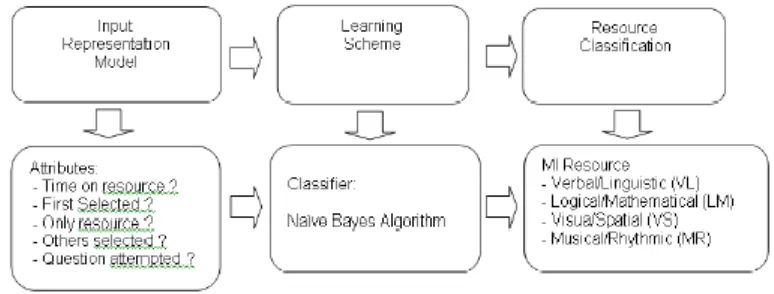
intelligence. EDUCE intended to use Gardner’s eight defined intelligences but this prototype
uses only four: logical/mathematical intelligence, verbal/linguistic intelligence, visual/spatial
[image:25.595.104.491.169.316.2]intelligence and musical/rhythmic intelligence.
Figure 1: The different stages in the predictive engine and their implementation within EDUCE. (Reproduced from Kelly and Tangney, 2004)
EDUCE makes use of Gardner’s theory combining it with a student model, a domain model,
a pedagogic model, a predictive engine and a presentation model. While the predictive
model uses the Bayesian algorithm, the pedagogic model focuses upon presentation and
selection but there are plans to use concept sequencing in later versions.
Learning performance is defined here according to learning gain, activity and motivation.
While the research study is still underway, one group of 18 boys have already tested the
system. The group was divided into two, with one part using the adaptive choice version of
EDUCE and the other using free choice. Rather surprisingly for the researchers, the findings
suggested that ‘learning gain increases where students do not get their preferred learning
resource. However on closer examination of the learning activity, it is found that students
when given their least preferred learning resource increase their learning activity and are
exposed to a wider range of resources’ (Kelly and Tangney, 2004, p. 687).
4.3 Learning styles and trails
Potentially learning styles could also be adapted to support the sequencing approaches of
LOs and be used in the formulation and development of learner trails (Peterson and Levene,
material is as important as the learning material itself – an approach developed in the IMS
Learning Design specifications (IMS, 2002). This emphasis upon sequencing of learning
content has been adapted from instructional design theory (Gagne, 1985) as well as
elaboration theory, where learning becomes increasingly more difficult (Reigeluth, 1983) and
has been applied most widely in industry and military training contexts. The sequencing
approach is based upon learning as a series of activities rather than reflections, and works
particularly well in training contexts where experiences rather than abstract concepts may be
learnt through repetitions and experiential learning (Kolb, 1984). However, with the
development of e-learning systems the popularity of this approach (which can be more easily
measured and evaluated) is now becoming more apparent in formal learning contexts. Based
upon the educational modelling language (EML) developed by Rob Koper (2001), systems
such as LAMS (Learning Activity Management System) are emerging. LAMS is based upon
the notion that smaller units of learning content can be sequenced differently depending
upon different context and learner requirements (Dalziel, 2003).
The LAMS system of sequencing reusable LOs is consistent with the notion of learner trails
and it is thought that learning styles could be applied to learner trails by using knowledge
about the learner's styles to inform the selection and sequencing of material providing
personalised learning content. The main advantages of this approach would be to allow for
greater adaptivity of the sequencing system (a current problem with the LAMS system) as
well as allowing for reflection upon the trails taken. Most notably, perhaps, Schoonenboom et al. also propose advantages for the approach in terms of supporting collaborative learning as well as individual study, through setting up trails that can be followed by a group of learners.
The LO system could also provide visual navigation for the learner or learner group, showing
the LOs completed and indicating LOs yet to be completed.
While it is still unclear which learning styles classification would be used most effectively, it is
clear that e-learning systems such as LAMS, based upon IMS Learning Design, could
potentially integrate learning styles approaches, allowing for greater flexibility in terms of the
choice of ordering LOs. However, the extent to which abstract and reflective learning could
be supported (as well as cognitive and perceptual skills based learning) is as yet untested.
Moreover, the main challenge here would be to ensure that pedagogical models and
approaches could support independent LOs used in different orderings and contexts and
whether specified learning outcomes and objectives consistent with the development of
4.4 Conclusions about the use of learning styles
Although there is some scepticism about the application of learning styles in e-learning and
adaptive hypermedia systems, the continued interest in the field and the range of possible
classification systems that have developed implies a continued interest in applying cognitive
learning styles in this way. Ongoing research and development in this area indicates that this
and other methods of learner classification will continue to structure the development of
prototypes that aim to structure and support stated learning outcomes, particularly those
based upon activities (e.g.: LAMS system). Many of these rely upon differences in the
sequencing of LOs, creating paths or trails to facilitate wider learner choice and reflecting
different learning pace and approaches. It is thought that in time these existent prototypes
and systems will become more widely used, however there is clearly a need for a more
evaluative and analytical approach to be taken to the different learning style classifications if
these systems are to be successful in modelling learning outcomes.
We have so far concentrated mainly on personalisation in web-based e-learning systems.
There is a move now to take technology-enhanced learning away from strictly desktop and
web-based environments through the use of mobile and wireless technologies. The next
section looks at personalisation within the mobile learning domain, which we will see has
some different connotations from in our discussion of personalisation so far.
5 Personalisation in mobile learning
Deliverable D22.2.1 (Schoonenboom et al., 2004a) included a selective review of research on the use of mobile learning in museums and related contexts (mainly concerning informal
learning) and also for field work in learning Science, with the aim of informing issues
concerning the use of mobile devices and personalised learning trails. It was argued that
“navigational learning” (Peterson and Levene, 2003), one of the areas that personalised trails should be able to support, often involves what has been termed a ‘free-choice learning’
activity (Falk and Dierking, cited by Proctor and Tellis, 2003, and Waycott, 2004,
forthcoming). Free-choice learning is defined as ‘the type of learning guided by a person’s
needs and interests’.
Challenges for trails in mobile learning
There has been an explosion of interest and projects in the area of mobile learning and it
would not be possible or productive to review this vast literature – see, for example, the links