Full Length Research Article
LIMING AND SELENIUM APPLICATION EFFECTS ON SELENIUM UPTAKE BY MAIZE (
ZEA MAYS
)
AND SELENIUM CONTENTS IN MAIZE GRAIN
1
Masanza, B.,
2Maida, J.H.A.,
3Chilimba, A.D.C.,
2Lowole, M.W. and
2Nalivata, P.C.
1
National Food Reserve Agency Private Bag B450, Lilongwe, Malawi
2
Lilongwe University of Agriculture and Natural Resources, Bunda Campus, P.O. Box 219, Lilongwe, Malawi
3Chitedze Agricultural Research Station, P.O Box 158, Lilongwe, Malawi
ARTICLE INFO ABSTRACT
Selenium, a ubiquitously occurring element in the environment, is classified as an essential element for human and animal health because, among others, it has antiviral and anticarcinogenic effects and plays a biological role as a component of the antioxidant enzyme glutathione peroxidase that catalyzes the decomposition of H2O2 and consequently protects cells from oxidative damage. Dietary Se intake in Malawi is <20 µg person-1 day-1, which is low compared to recommended 50-70 µg person-1 day-1 worldwide. Selenium bioavailability is affected largely by acidity effects. This study was aimed at determining liming effects on Se availability. Extractable Se significantly increased with increasing Se applications from 0.12 mg Se kg-1 to 0.32 mg Se kg-1. Extractable Se content of the soil to which no Se had been added was 0.09 mg kg-1 but increased with increasing liming effects to 0.15 mg kg-1 at 5 t lime ha-1. Selenium uptake also increased with increasing lime application. About 95% of total variation in Se contents in maize grain was accounted for by liming effects while Se application accounted for about 98% of the total variation in maize grain Se contents. Lime and selenium effects on grain Se contents were statistically significant (P 0.001).
Copyright © 2016, Masanza et al.This is an open access article distributed under the Creative Commons Attribution License, which permits unrestricted use, distribution, and reproduction in any medium, provided the original work is properly cited.
INTRODUCTION
Selenium is a ubiquitously occurring element in the environment which belongs to group VIA of the periodic table and has chemical and physical properties that are intermediate between metals and non-metals (Table I). Selenium occurs in nature as six stable isotopes and can exist in multiple oxidation states including -2, 0, +4, and +6 (Combs, 2001; Fordyce 2005). Selenium is a metalloid, having physical and chemical properties that are intermediate between those of metals and non-metals. Se, like S, can exist in either an amorphous state or in one of three crystalline forms (Combs, ibid.). The chemical and physical properties of Se are very similar to those of S. The two elements have similar atomic sizes and outer-valence shell electronic configurations. Their bond energies, ionization potentials and electron affinities are practically the same (Combs, ibid.).
*Corresponding author:Maida, J.H.A.,
Lilongwe University of Agriculture and Natural Resources, Bunda Campus, P.O. Box 219, Lilongwe, Malawi
The availability of selenium in soil solution as selenate (SeO24
) or selenite (SeO23) ions is dependent upon the activity of electron (pe) and hydrogen (pH) of the solution. The plant uptake of SeO24) is similar to that of sulphate (SO24). Both
SeO24 and SO24 enter root epidermal cells across the plasma membrane through sulphate transporters against their electrochemical gradients, with uptake being driven by the co-transport of three protons for each ion (Terry et al., 2000; Sors
et al., 2005). SeO24 uptake from the soil is through
high-affinity sulphate transporters in plants (Terry et al. 2000; Sors
et al., ibid.), whereas SeO23 accumulates through passive
diffusion and can be inhibited by phosphate (Terry et al., ibid.;
Sors et al., ibid.). SeO32 uptake in wheat is an active process, mediated by proton-coupled phosphate transporters (Li et al.,
2008). It has been observed that SeO24 ions are rapidly
absorbed and transported in plant xylem sap and that SeO32 absorption is slower, but the Se is more rapidly metabolized to
ISSN: 2230-9926
International Journal of Development Research
Vol. 6, Issue, 04, pp. 7280-7289, April,2016
DEVELOPMENT RESEARCH
Article History: Received 16th January, 2016
Received in revised form 21st February, 2016 Accepted 26th March, 2016
Published online 27th April, 2016
Key Words:
Dolomitic lime,
Extractable selenium, Soil pH, Sodium selenate,
organoselenium compounds and transported into upper portions of the plant (Mayland et al. 1991). Selenium is classified as an essential element for human and animal health (Rayman, 2000) because of its physiological role as a component of the antioxidant enzyme glutathione peroxidase, an enzyme that catalyzes the decomposition of hydrogen peroxide (H2O2), thus regulating intracellular redox state and protecting cells from oxidative damage (Rotruck et al., 1973). Selenium has antiviral and anticarcinogenic effects (Spallholz, 2001; Rayman, 2000; Rayman, 2000; Rayman, 2002; Reilly, 2006; Combs, 2001; WHO/FAO, 2004). Selenium deficiency in humans and animals adversely affects thyroid hormone metabolism, which is detrimental to growth and development (Arthur and Beckett, 1994), and can cause homeostasis of hepatic haem, disruption in microsomal and mitochondrial electron transport, problems related to immune response, motility of spermatozoa, infertility, promotion of vitamin-E related diseases, impaired vision, and loss of protection against xenobiotics and exercise stresses liked muscle stiffness and tenderness and disinclination to move (Oldfield et al., 1971; Shamberger, 1983; Underwood, 1956; WHO, 1987). Selenium deficiency has been observed to be a problem in areas where soil Se is particularly low, such areas as those in some parts of China, the USA as well as Australia, New Zealand and Finland (Oldfield, 2002).
Whereas the essentiality of Se for humans and animals has been established, its essentiality for plants has not yet been recognised. It is classified under the beneficial elements for plants (Pilon-Smits et al., 2009) because low level Se applications have been observed, inter alia, to stimulate growth and dry-matter yield of lettuce (Xue et al. 2001); ryegrass (Hartikainen et al. 2000); potato (Turakainen et al. 2004); green tea (Hu et al. 2003); rice (Liu et al. 2004); and
soybean (Djanaguiraman et al. 2005). Selenium varies widely
from 0.01 to 2 mg kg-1 in most soils, but most frequently
ranges between 0.2 and 0.4 mg kg-1 (McNeal and Balistrieri,
1989). In seleniferous areas, however, it can be up to 1200 mg Se kg-1 (White et al. 2007b). Some soils are low in selenium, ranging from 0.03 to 0.08 mg mg-1 (NAS, 1976). Soils deficient in Se contain less than 0.5 mg Se mg-1 of total Se (Mayland et al., 1989). In aerobic soil solutions with pH
ranging from pH 4 to 8, SeO24is the dominant Se species
(Séby et al., 2001). SeO24is highly soluble with low adsorption and precipitation capacities (Fordyce, 2007). Selenite (Se(IV)) is a weak acid (pK
1
a = 2.70 and pKa2=
8.54) and can exist as HSeO3 or SeO32 in soil solutions
(Séby et al., 2001). In reduced soil environments, SeO23is the major Se species present in solutions and its effective concentration in solutions is mainly governed by sorption/desorption processes on solid surfaces such as metal hydroxyoxides. The various Se species are differentially taken up by plants. Plants may take up both inorganic and organic Se via active membrane transport while the role of simple diffusion is limited (Terry et al., 2000; Li et al., 2008). The active transport of Se appears to occur via shared
transporter-proteins; SeO24 may be actively internalized by sulphate transporters (Terry et al., 2000; Ellis and Salt, 2003;
Zayed et al., 1998) while SeO32 is likely internalized via phosphate transporters (Terry et al., 2000, Barrow et al.,
1989; Chilimba et al., 2011; Gissel-Nielsen, 1971; Johnsson,
1991; De Temmerman et al., 2014) and, for example in rice,
Si-transporters (e.g in rice (Zhao et al., 2010). In the presence
of sulphate and phosphate, Se uptake is suppressed (Terry et
al., 2000; Hengl et al. 2014; Hopper and Parker, 1999;
Schiavon et al., 2015). Low S concentration enhances SeO24 uptake while low P concentration suppresses uptake of selenite in soils (Li et al., 2008) causing plants to increase the expression of sulphate and phosphate transporter genes in order to compensate for the lower availability of these
nutrients. Both SeO24 and SeO32 are consequently taken up more readily when present in solution in the absence of sulphate and phosphate. Response to lower availability of nutrients has been reported to be more pronounced for SeO
2
4 than for SeO
2
3 uptake, which could be due to a different
level of gene up-regulation in reaction to P or S starvation and/or to the lower affinity of the phosphate transporters for
SeO32 compared with that of sulphate transporters for SeO
2
4 (Li et al., 2008).
Plants grown in alkaline and well aerated soils tend to accumulate high concentration of Se as compared to those in acid soils (Gupta et al., 1975). In well-aerated, alkaline soils,
Se occurs primarily as SeO24 and is readily bioavailable. In
acid soils, SeO32 ions form complexes of very insoluble iron oxides and hydroxyoxides such as Fe2(OH)4SeO3. The low
solubility coupled with stronger adsorption makes SeO32less
bioavailable than SeO24. Soils in Malawi are dominated by Oxisols and Ultisols which are predominately acidic and inherently low in fertility. Because soil acidity has detrimental effects on both plants and soil organisms (1989; Runge and Rode, 1991; Bloom, 2000), and the environment (Bolan et al., 2003a, 2003b), farmers in Malawi are now commonly advised to apply liming materials to their soils. Liming effects generally increase soil Se availability and enhance the uptake of Se by plants (Adriano, 2001). Dietary Se intake levels mainly depend on the total concentration and bioavailability of Se in food sources. Selenium intake levels have, however, a relatively narrow range between deficiency and toxicity. It is currently estimated that intakes of 30 μg Se d-1 (d-1 = per day) are inadequate for humans, while Se
intakes exceeding 900 μg d-1 are potentially harmful
extent to which Se uptake by plants growing on the acidic soils of Malawi is affected by liming effects. This study was therefore conducted to assess the effect of liming on the uptake of Se added to acidic soils.
MATERIALS AND METHODS
Description of the Study Site
The study was carried out on Mpherero Estate, one of the sites where the Clinton Development Initiative (CDI) was multiplying seed for Malawian farmers under the Alliance for Green Revolution in Africa (AGRA) project. Mpherero Estate is in Mchinji District (Latitude: 13° 46' 19" S Longitude: 33° 00' 03" E), about 150 km from Lilongwe University of Agriculture and Natural Resources, to the west of Malawi’s Capital city, Lilongwe. The site topographically lies between 1200 and 1829 meters above sea level and has two distinct terrains: the hilly western part, comprising the Mchinji Mountain ranges with gentle slopes where almost all rivers found in the district originate from, and the rest of the district lying within a plain of mostly arable land that is
generally drained by water ways and there are some dambos
which are permanently or seasonally inundated wetlands characterized by grasses, rushes and sedges, contrasting with
surrounding woodland such as Miombo (Brachystegia)
woodland. Mchinji experiences annually mean temperatures ranging from 17 to 20°C. Lowest temperatures are experienced in June while high temperatures are experienced during the months of October and November. The district receives average rainfall of between 800 and 1230 mm per annum with the wet rainy season running from November to April.
Cropping History
The site topographically lies between 1200 and 1829 meters above sea level and has two distinct terrains: the hilly western part, comprising the Mchinji Mountain ranges with gentle slopes where almost all rivers found in the district originate from, and the rest of the district lying within a plain of mostly arable land that is generally drained by water ways and there
are some dambos which are permanently or seasonally
inundated wetlands characterized by grasses, rushes and
sedges, contrasting with surrounding woodland such as Miombo (Brachystegia) woodland. The experimental site is an area where the Anchor Farm Project, which is a Clinton Development Initiative (CDI)-operated commercial farm, was conducted. The CDI-sponsored project partners with thousands of neighbouring smallholder farmers and provides them with access to quality inputs for maize and soy production, as well as training and market access. Farmers in the project have access to improved soy seed and to training in advanced agronomic techniques. The Farm Manager of the commercial farm observed that crop yields were far below 2 t
ha1 and that a plant locally known as “Nzobwe” (Terminalia
superb), which is an indicator of acid soils (Bolan et al.,
1988), was thriving well on this site. After incorporating dolomitic limestone into the soil at a rate of 2 t ha 1 and
Super D (10.5 N + 24 P2O5 + 20 K2O + (6 S and 0.15 B) at
the rate of 300 kg ha‒1), the Farm Manager observed that the
crop yield increased significantly to an average of 2.9 t ha1
of soybean seed from an average of 1.5 t ha1 that was obtained from the plots that had not been limed (Ngwira, 2011). It was, however, impossible to conclude on whether the 2 t ha 1 of lime that was applied represented the maximum rate of dolomitic lime required to improve indices of chemical soil fertility to optimum yield of the soybean seed at the site.
Soil sampling and incubation
Top (0 0.15 m) soil samples were randomly collected from 20 spots and mixed together to form a composite sample weighing 1,000 kg. The composite soil samples were air dried at room temperature (25°C ± 2°C) and sieved to pass through a 2 mm sieve mesh. The experiment was carried out in two phases. The first phase entailed mixing thoroughly 24 kg of the sieved soils with three levels (0, 5, 10 g Se ha-1) of sodium selenate and five levels (0, 2.5, 5.0, 7.5, 10 t ha-1) of dolomitic limestone, placing the mixture in 25-litre plastic pots, adding water to each of the pots to reach the matric suction of 10 kPa, and then incubating, at 30ºC for 30 days under glasshouse conditions, the soils that were replicated three times and arranged in a randomized complete block design. Throughout the incubation period, moisture contents were maintained at field capacity. After 30 days of incubation, soil samples were taken and analysed. The second phase of the experiment entailed cropping the incubated
soils to maize (Zea mays) in a glasshouse under room
temperature.
Characterisation of physical and chemical properties of the soils
After the sieved soil samples were incubated for 30 days, aliquots of the soils were taken and analysed to assess liming effects on soil chemical properties after the incubation period. The soils were analysed for pH in a 1:2.5 soil to water slurry
using a pH electrode as outlined by described by Blakemore et
al., (1987), particle size distribution using the Bouyoucos hydrometer method (Day, 1965) as described by Anderson and Ingram (1993). The organic carbon contents of the soils were determined by the potassium dichromate (K2Cr2O7) oxidation method of Walkley and Black (1934) as described by Anderson and Ingram (1993). Organic matter was estimated by multiplying the total soil organic carbon with 1.724. Total nitrogen was determined using the Kjeldhal wet oxidation process as described by Anderson and Ingram (1993), while available phosphorus was extracted by the Mehlich 3 method (Mehlich, 1984) and P in the clear extracts was determined colorimetrically by the ascorbic acid method (Murphy and Riley, 1962) on a Perkin Elmer Lambda 25 UV/VIS spectrometer. The extract obtained by the Mehlich 3 method (Mehlich, ibid.) was used for the determination of K by flame emission photometry at a wavelength of 766.5 nm, and of both Ca and Mg using Atomic Absorbance Spectrophotometer model 6200 at a wave length of 422.7 and 285.2 nm respectively (Anderson and Ingram 1993).
Determination of extractable soil selenium
triamine pentaacetic acid), 1.47 g of CaCl2.2H2O and 14.2 g of Triethylamine (TEA) as described by Jump and Sabey (1989). An aliquot of 40 millilitres of extracting solution was added to 5 grams of air dried, 2-mm sieved soil in a plastic shaking bottle and covered tightly to avoid leakages. The bottles were then shaken for two hours on a reciprocal shaker. After shaking, the suspension was filtered into clean plastic bottles. The filtrates were then packed for selenium concentration determination using Atomic Absorption Spectrometer.
Statistical analysis
Data collected from the experiment were subjected to statistical analysis using Genstat statistical software 16th edition. The differences between and within treatments were analysed using ANOVA at 0.05 probability level and fisher’s LSD was used to separate means. The results were also subjected to regression analysis.
RESULTS AND DISCUSSION
Liming effects on soil properties after 30 days of incubation
The results presented in Tables 1 and 2 and Figure 1 show that the effects of lime, applied at the rate of 10 t ha-1, on soil
pH increased to HO
2
pH
7.64 at maize harvest from pH 5.3which was the soil reaction after the 30-day incubation period
(Table 2).This suggests that the liming material continued to
neutralise exchangeable acidity (easily replaceable H+ and Al3+ ions) after the H+ and Al3+ ions had been replaced on the soil colloidal surface by Ca2+ and Mg2+ as explained earlier in Section 2.10 of this thesis. The reaction of dolomitic limestone involved may be illustrated the process.
Ca,Mg(CO3)2 + H2O → Ca++ + Mg++ + 2CO32- ... (1)
CO32- + H2O → HCO3- + OH- ... (2)
Al3+ + 3OH- → Al(OH)3 ... (3)
Selenium (Se) deficiency (less than 0.125 mg kg-1) occurs when this element is not readily available for plant uptake (Fordyce, 2007). Soils with a Se concentration greater than 0.5
mg kg-1 have been found to produce vegetation absorbing Se at
levels toxic for animal consumption (Dhillon et al., 1992). An
exception to this was observed in Hawaii with up to 20 mg kg-1
total Se but without any effect on vegetation and livestock
because the element was held in iron and aluminium complexes in the humid lateritic soils of that region (Oldfield, 1999).
Table 2. Effects of liming on soil pH at harvest relative to the pH after the 30-day incubation
Lime rate
O
H2
pH ±
D30 AH
0.0 5.3 6.2 0.9 2.5 6.1 6.8 0.7 5.0 6.2 7.3 1.1 7.5 6.6 7.5 0.9 10.0 6.8 7.5 0.7
where:
[image:4.595.311.557.272.394.2]D30 denotes after 30-day incubation AH denotes at harvest
Figure 1. Relationship between lime rate and soil pH
The bioavailability of Se is a function of the effective concentration of Se in the soil solution. The effective concentration of Se in soil solution is dependent upon soil properties including soil pH, electron activity (pe), the speciation of the element, the presence of competitive ions in soil solution, organic matter, and soil texture. The effect of cations such as Mg2+, Ca2+ and K+ on the effective concentration of any of the Se species in soil solution is not yet well known but an increase in hydroxyl ions (Equation 2)
in soil solution with increasing rates of lime application can lead to not only the precipitation of aluminium ions but also excess OH ions exchanging with selenate (SeO24) and
[image:4.595.70.513.559.668.2]selenite (SeO23) adsorbed on the soil colloidal surfaces, thus rendering the Se species bioavailable. Such a ligand-exchange reaction has been suggested (Peack and Sparks, 2001). Anions
Table 1. Effects of liming on some soil chemical properties after 30-day incubation period
Organic matter
N
KCl
pH HO
2
pH P Ca Mg K
Lime rate g kg-1 (mg kg-1) cmol
c kg-1
0.0 1.92 0.10 4.84d 5.26d 52.5b 1.7c 0.4c 0.25
2.5 1.88 0.09 5.87c 6.13c 52.5b 2.3cb 0.6bc 0.21
5.0 1.86 0.09 5.98c 6.23c 57.4ba 2.6b 0.7b 0.22
7.5 1.93 0.10 6.18b 6.61b 58.1a 2.8ab 0.8b 0.20
10 1.73 0.09 6.37a 6.78a 57.5ba 3.4a 1.1a 0.19
F pr. 0.36ns 0.41ns <0.001** <0.001** 0.007* <0.001** <0.001** 0.083ns
LSD 0.21 0.01 0.16 0.12 4.0 0.6 0.2 0.04
CV(%) 1.2 1.2 2.9 2.0 7.5 2.4 3.3 2.18
such as phosphate and sulphate affect the bioavailability of Se through their competition with Se for adsorption on the surface of soil colloids. In this study, extractable (available) P increased with increasing rate of lime application and the difference between the P value extracted from the unlimed soil and the P extracted after 7.5 t ha-1 dolomitic limestone was incorporated into the soil was statistically significant (P
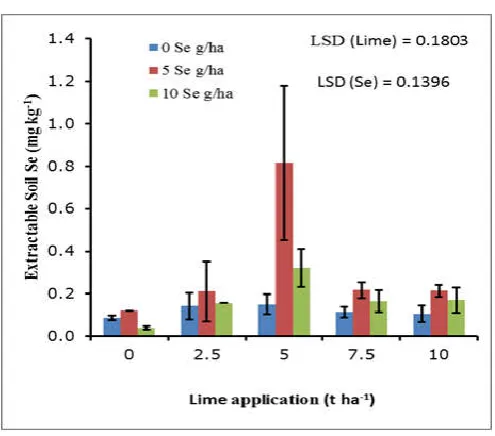
0.05). The increasing rates of dolomitic limestone considered in this study accounted for about 79% of the total variation in extractable P (Fig. 2). The increase in P bioavailability due to liming effects is in accord with past findings (Sime, 2001). Phosphate ions in the soil solution readily adsorb on the sorptive surfaces of soil colloidal particles thus decreasing the sorption of Se on the soil colloidal surface and increasing Se bioavailability. The present data show that after a 30-day incubation period, extractable Se in the soil to which Se had
not been added was low (0.087 mg Se kg-1) but increased with
[image:5.595.40.291.284.438.2]increasing liming effects to 0.151 mg Se kg-1 after 5 t lime ha-1 was added (Fig. 3).
Fig. 2. Liming effects on extractable P
Fig. 3. Liming effects on extractable Se
Since available Se less than 0.125 mg kg-1 is considered deficient (Fordyce, 2007), the results of this study suggest that during the first 30 days of a cropping period, the status of available Se in a soil deficient in this element may be improved due to the mineralisation of organically bound Se.
This is consistent with the observation of Zawislanski and Zavarin (1996) who have noted that a large portion of total Se in soils can be in the organic fraction, and have concluded that the release of low molecular-weight Se compounds during organic matter decomposition may eventually be a source of Se for plant uptake. The importance of organic-Se mineralisation in Se uptake by plants is explicit from the observation that about 50 per cent of Se in some soils is held in organic compounds (Fordyce, 2005). Selenomethionine and selenocysteine are the known organic Se forms.
Selenomethionine has been extracted from soils and has been found to be two to four times more bioavailable to plants than inorganic selenite while selenocysteine is less bioavailable than selenomethionine (Jacobs, 1989; Mayland, 1994; Neal, 1995). The mineralisation of selenium from seleniferous organic material has, however, been observed to be slow and a large proportion of Se (>80%) has been observed to remain unutilized by the following crops (Ajwa et al., 1998; Dhillon
et al., 2007). The extent to which the increase in the Se status
of the soil following the 30-day incubation observed in the present study may be bioavailable will depend on soil factors such as pH and redox potential as well as the presence of competitive ions such as SO24 and H2PO
4 and sorptive
colloidal surfaces. Dissolved polysaccharides such as starch, amylopectin, water-soluble lignin, cellulose acetate, chitosan and carboxymethlcellulose in soils can immobilise Se by forming stable compounds with selenate (Ferri and Sangiorgio, 1999). The chemical form of Se in soil is largely governed by the soil pH and pe. Se solubility and, therefore,
mobility increases with increasing redox potential. SeO23 is the dominant Se species under moderate soil redox potential, where it is strongly sorbed by iron and aluminium oxides and hydroxides, resulting in limited bioavailability and a low potential for leaching (Elrashidi et al., 1987). In the areas where diets do not contain sufficient Se to meet needs of humans and animals, there is need to promote use of Se-enriched fertilizers. The use of Se-Se-enriched multi-element fertilizer has, for example, been mandatory in Finland since 1984 because of the need to raise Se content in crops and in Finland’s Se intake (Varo, 1993). It has, however, been observed that the recovery of applied Se is usually 20-50% (Broadley et al., 2010) and this emphasises the need to ensure that any strategies aimed at promoting agronomic biofortification of crops or enhancing Se bioavailability by changing soil reaction through liming should optimise Se uptake and should not lead to too high Se intake and Se excess in the environment.
Effects of lime and selenium applications on Se uptake
[image:5.595.42.290.460.678.2]observed increase in soil HO 2
pH
from 5.3 to 6.2 might have [image:6.595.41.288.213.386.2]created soil conditions that were conducive to increased microbial activity that resulted in mineralisation of organically bound Se. Fungi and bacteria are the two principal organic matter decomposer groups in soil. High acidity inhibits the growth of soil bacteria in favour of more resistant fungi. In contrast, liming which increases the soil pH usually improves the bacteria growth. The increase of soil pH by liming has been observed to be favourable for the microbial growth, causing microbial biomass to increase after two years following application of liming materials compared to unlimed control (Bezdicek et al. 2003).
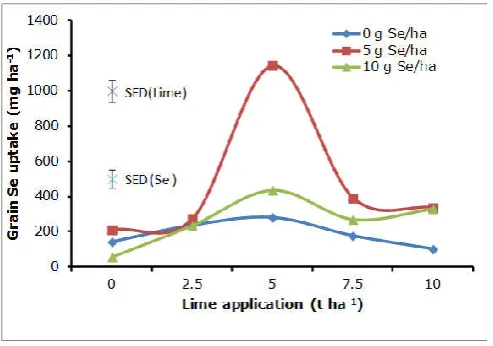
Figure 4. Effect of liming and Se application on grain Se uptake
(mg ha-1)
Selenite (SeO32) adsorption by clays has been observed to reach a maximum between pH 3 and 5 and then to decrease with increasing pH while its adsorption by Fe2O3 is observed to be almost constant between 3 and 8 (Gissel-Nielsen, 1971;
Läuchli,1993; Masscheleyn, 1991a). Whereas SeO23 is
specifically sorbed, SeO24 is coulombically
(electrostatically) attracted to positively charged surfaces of colloidal particles where they are not specifically sorbed on ligand-exchange sites. SeO24 is therefore labile. As the soil pH increases, the hydroxyl ion (OH-) is able to replace SeO
2
3 on the adsorption sites thus rendering the latter available
for uptake. It has, however, been suggested that between pH 4 and 8 Se solubility is governed by adsorption due to the fact
that the hydroxyl ions (OH-) are more effective in modifying
the selenium ion's adsorption capacity than in competing with selenium for common adsorption sites (Bar-Yosef and Meek, 1987). Selenium uptake also significantly increased with increasing Se application but stated to decrease after the liming material was applied at the rate of 5 t ha-1 (Fig. 4). Liming acid soils, inherently low in selenium, often increases availability and uptake of selenium by plants (Gupta et al., 1982). The effects of both lime and selenium applications were statistically significant (P 0.01) on Se taken up by maize grain. The interaction effects between lime and Se application on Se uptake, however, were not statistically significant (Fig. 4). The observed response may be attributed
to the reduced adsorption capacity of clays and Fe oxides
caused by the increased pH (Neal et al., 1987) and exchange
of hydroxyl ions for SeO23. The present study showed that seleniumm uptake by maize plant was increased from 17.1 to 186.2 mg ha-1 with an increase in selenium application. Liming, however, did not have any significant effect on selenium uptake by maize plant.
Effect of lime and selenium application on maize grain Se content
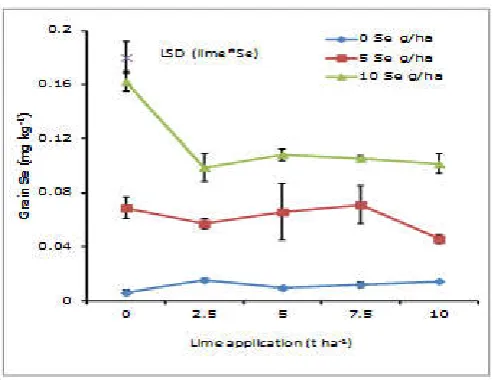
In the present study, lime applications to the soil that had not received sodium selenate resulted in an increase in Se contents of maize grain from 0.006 mg Se kg-1, which was the Se content of the maize grain produced on the soil to which no lime was applied, to 0.015 mg Se kg-1, the Se content of the maize grain produced on the soil to which the liming material was applied at the rate of 2.5 t ha-1 (Figs. 5(a) and 5(b)).
Figure 5(a). Effect of liming and selenium application on maize grain Se
Application of both dolomitic lime and sodium selenate had a statistically significant effect on grain selenium contents (P
0.001). Applications of dolomitic limestone and sodium selenate were conducive to an increase in Se contents of maize grains, each accounting for about 95% and 98% of the total variations in Se contents in maize grain respectively (Figs. 6 and 7). There was a significant interaction (P < 0.05) between liming and selenium application rates in influencing selenium content of the maize grain. Selenium application
increased maize grain selenium content from 0.054 mg Se kg
-1
to 0.079 mg Se kg-1 with no liming. An increase in lime rate had a negative effect on maize grain Se content. Increasing lime rate caused a reduction in grain Se content. The highest Se content of 0.079 mg Se kg-1 was found in maize grain produced on the soil to which no lime was applied. At lime rate of 2.5 t ha-1, mean grain Se value was 0.057 mg kg-1
which increased to 0.061 mg kg-1 following a lime
[image:6.595.311.553.293.460.2]Figure 5 (b). Effect of lime and selenium application on maize
[image:7.595.39.286.52.242.2]grain Se content (mg kg-1)
Figure 6. Lime application (t ha-1) on Se grain contents
[image:7.595.43.291.282.447.2](mg kg-1)
Figure 7. Selenium application (g ha-1) on Se grain contents
(mg kg-1)
The highest Se content of 0.115 mg kg-1 was found in maize grain produced on the soil to which lime was applied at the highest Se application rate of 10 g ha-1. The results are consistent with reports of increased Se content of most UK wheat grain at application of 10 g Se ha-1 (Broadley et al. 2010). The Se content in maize grain increased with increasing
application of sodium selenate (Fig. 5a, b). Similar findings were also observed in Finland, where Se content of bread
baked with wheat increased from 0.03 to 0.35 mg kg-1 (Eurola,
2005; Sager M. and Hoesch, 2006). Chilimba et al. (2011) has
also observed that an addition of selenium to soils leads to a significant increase in grain selenium.
Conclusions
It has been shown that the soils used in this study were inherently Se-deficient. Maintaining moisture contents of the soils at field capacity for 30 days resulted in an increase in available Se with increasing liming effects, reaching a maximum of available Se after dolomitic limestone was applied at the rate of 5 t ha-1. This suggested that crops growing on Se-deficient, acidic soils having adequate moisture contents may benefit from the availability of organically bound Se when the soils are limed but that the extent to which optimum benefits are obtained from the liming effects is dependent on the amount of liming materials applied. Both Se uptake and Se contents of maize grain increased with the rate of sodium selenate application, reaching their maxima after dolomitic lime was applied at the rate of 5 t ha-1. The highest Se uptake was obtained from the soil that received dolomitic limestone at the rate of 5 t ha-1 and to which 10 g Se ha-1 was added. An application of 5 g Se ha-1 to the soil that received dolomitic limestone at the rate of 5 t ha-1 resulted in the Se contents in the maize grain to be the highest. Both the availability of organically bound Se and the statistically significant increase in Se contents in the maize grain suggest the need for strategies aimed at enhancing Se contents in grains to take into account the potential contribution of organically bound Se. There is also need for the execution of collaborative investigations by soil scientists, agronomists, plant breeders and molecular biologists aimed at establishing the limiting factors of Se uptake, accumulation and biotransformation in plants and selecting cultivars for their higher accumulation of Se and the forms of organic Se that are distributed in the edible parts of a given crop and have impact on daily dietary Se intake.
Acknowledgements
The senior author gratefully acknowledges the financial support from the Alliance for Green Revolution in Africa (AGRA) which made it possible for her to undertake a postgraduate training programme. The authors are also grateful to Mr. Austin Ngwira, Director of the Clinton Development Initiative (CDI) Anchor Farm Business Development Project, for his permission to have soil samples for the present study collected from one of the CDI-funded farmers’ farms in the Mchinji district of Malawi, to Messrs L. K. Chirwa, B. Msukwa and S. Khombe for their assistance during the execution of the laboratory investigations, and to the Head of Chitedze Agricultural Research Station for grating the senior author permission to use the station’s facilities for incubation experiments.
REFERENCES
[image:7.595.42.294.463.653.2]Ajwa, H. A., Banuelos, G. S. and Mayland, H. 1998. Selenium uptake by plants from soils amended with inorganic and organic materials. Journal of Environmental Quality, 27, 1218-1227.
Anderson, J. M. and Ingram, J. S. I. 1993. TSBF: A Handbook of methods of analysis. CAB International. Wallingford, UK.
Arthur J. R. and Beckett G. T. 1994. New Metabolic Roles for Selenium, Proc. Nutr. Soc., 53, 615–624.
Barrow N. J. and Whelan B. R. 1989. Testing a mechanistic model. viii. The Effects of time and temperature of incubation on the sorption and subsequent desorption of selenite and selenate by a soil. J. Soil Sci., 40, 29–37. Bar-Yosef, B. and Meek, D. 1987. Se sorption by kaolintite
and montmorillonite. SoilScience 144, 11-19.
Bezdicek, D. F., Beaver, T. and Granatstein, D. 2003. Subsoil ridge tillage and lime effects on soil microbial activity, soil pH, erosion, and wheat and pea yield in the Pacific Northwest, USA. Soil Till. Res., 74: 55–63.
Blakemore, L. C., Searle, P. L. and Daly, B. K. 1987. Methods for Chemical Analysis of Soils. New Zealand Soil Bureau Scientific Report 80. p 103
Bloom, P. R. 2000. Soil pH and pH buffering. Chapter 10. In: M.E. Sumner (Ed.), Handbook of Soil Science. CRC Press, Boca Raton, FL.
Bolan, N. S., Adriano, D. and Curtin, D. 2003a. Soil acidification and liming interactions with nutrient and heavy metal transformation and bioavailability. Adv. Agron. 78, 215–272.
Bolan, N. S., Adriano, D. C., Natesan, R. and Koo, B.J. 2003b. Effects of organic amendments on the reduction and phytoavailability of chromate in mineral soil. J. Environ.
Qual. 32, 120–128.
Bolan, N. S., Syers, J. K., Tillman, R. W. and Scotter, D. R. 1988. Effect of liming and phosphate additions on sulphate leaching in soils. Journal of Soil Science, 39: 493-504. Broadley, M. R., Alcock, J., Alford, J., Cartwright, P., Foot, I.,
Fairweather-Tait, S. J., Hart, D. J., Hurst, R., Knott, P. and McGrath, S.P. 2010. Selenium biofortification of
highyielding winter wheat (Triticum aestivum L.) by liquid
or granular Se fertilisation. Plantand Soil, 332, 5-18. Brown, T. A. and Shrift, A. 1982. Selenium toxicity and
tolerance in higher plants. Biol. Rev. 57, 59–84.
Chen, L. C., Yang, F. M., Xu, J., Hu, Y., Hu, Q. H., Zhang, Y. L. and Pan, G. X. 2002. Determination of selenium concentration of rice in China and effect of fertilization of selenite and selenate on selenium content of rice, Journal of
Agricultural and Food Chemistry, 50: 5128-5130.
Chilimba, A. D. C., Young, S. D., Black, C. R., Meacham, M. C., Lammel, J. and Broaddley, M. R. 2011. Agronomic biofortification of maize with selenium (Se) in Malawi. Field Crops Research 125, pp. 118-128
Combs, G. F. 2001. Selenium in global food systems, British
Journal of Nutrition 85: 517-547.
Day, P.R. 1965. Particle fractionation and particle size analysis, pp. 545-567, in Black, CA ed., Methods of Soil Analysis, part 1, American Society of Agronomy, Madison, Wisconsin
De Temmerman, L., Waegeneers, N., Thiry, C., Du Laing, G., Tack, F. and Ruttens, A. 2014. Selenium content of Belgian cultivated soils and its uptake by field crops and vegetables.
Sci. Total Environ, 468, 77–82.
Dhillon, K. S., Bawa, S. S. and Dhillon, S. K. 1992. Selenium toxicity in some plants and soils of Punjab. J. Indian Soc. Soil Sci. 40, 132–136.
Dhillon, S.K., Hundal, B.K. and Dhillon, K.S. 2007. Bioavailability of selenium to forage crops in a sandy loam
soil amended with Serich plant materials. Chemosphere, 66,
1734-1743.
Djanaguiraman, M., Devi, D.D., Shanker, A. K., Sheeba, J. A. and Bangarusamy, U. 2005. Selenium - an antioxidative protectant in soybean during senescence. Plant and Soil,
272, 77-86.
Eich-Greatorex Susanne, Sogn Trine A., Øgaard Anne Falk and Ivar Aasen, 2007. Plant availability of inorganic and organic selenium fertiliser as influenced by soil organic matter content and pH. Nutr Cycl Agroecosyst, Springer Science+Business Media B.V.
Ellis, D. R. and Salt, D. E. 2003. Plants, selenium and human health. Curr. Opin. Plant Biol., 6, 273–279.
Elrashidi, M.A., Adriano, D.C. and Lindsay, W.L. 1987. Solubility, speciation, and transformation of selenium in
soils, In Selenium in agriculture and the environment. L W
Jacobes, ed. p. 233, SSSA special publication, Madison. Eurola, M. H., Ekholm, P. I., Ylinen, M. E., Varo, P. T. and
Koivistoinen, P. E. 1991. Selenium in Finnish foods after beginning the use of selenate-supplemented fertilisers.
Journal of theScience of Food and Agriculture, 56, 57-70.
Fairweather-Tait, S. J., Bao, Y., Broadley, M. R., Collings, R., Ford, D., Hesketh, J. R. and Hurst, R. 2011. Selenium in human health and disease. Antioxid. Redox Signal. 14, 1337–1383.
Ferri, T. and Sangiorgio, P. 1999. Voltammetric study of the interaction between Se(IV) and dissolved organic matter in environmental aqueous matrices. Anal. Chim. Acta 385, 337–343.
Fordyce, F. 2005. Selenium deficiency and toxicity in the environment. In: Selinus O, Alloway BJ (eds). Essentials of medical geology: Impacts of the natural environment on public health. Academic Press, London, U.K. pp. 373-415. Fordyce, F. 2007. Selenium geochemistry and health. AMBIO:
Journal of Human Environment, 36,94-97.
Gissel-Nielsen, G. 1971. Influence of pH and texture of the soil on plant uptake of added selenium. J. Agric. Food Chem.,
19, 1165–1167.
Gissel-Nielsen, G. 1971. Selenium content of some fertilizers and thefr influence on uptake of selenium in plants. J.
Agric. Food Chern., 19: 564-566
Gupta Umesh, C. and Winter, K. A. 1975. Selenium content of soils and crops and the effects of lime and sulphur on plant uptake. Can. J. Soil Sci. 55: 161-166
Gupta, U. C., McRae, K. B. and Winter, K. A. 1982. Effect of applied selenium on the selenium content of barley and forages and soil selenium depletion rates. Can. J. Soil Sci.
62: 145-154
Hartikainen, H., Xue, T., Piironen, V. 2000. Selenium as an anti-oxidant and pro-oxidant in ryegrass. Plant and Soil,
225, 193-200.
Hengl, T., Mendes de Jesus, J., MacMillan, R. A., Batjes, N. H., Heuvelink, G. B. M., Ribeiro, E., Samuel-Rosa, A., Kempen, B., Leenaars, J. G. B., Walsh, M. G. and Gonzalez, M. R. 2014. Soil Grids 1 km—global soil
information based on automated mapping. PLoS ONE, 9, 1–
Hopper, J. and Parker, D. 1991. Plant availability of selenite and selenate as influenced by the competing ions phosphate and sulfate. Plant Soil 1999, 210, 199–207.
Hu, Q., Xu, J. and Pang, G. 2003. Effect of selenium on the yield and quality of green tea leaves harvested in early spring. Journal of Agricultural and Food Chemistry, 51, 3379-3381.
Jacobs L. W. (Ed.) 1989. Selenium in Agriculture and the Environment, Soil Science Society of America Special Publication 23, SSSA, Madison, WI. Jacobs, L. W. (Ed.) (1989). Selenium in Agriculture and the Environment, Soil Science Society of America Special Publication 23, SSSA, Madison, WI.
Johnsson, L. 1991. Selenium uptake by plants as a function of soil type, organic matter content and pH. Plant Soil, 133, 57–64.
Jump R. and Sabey B. 1989. Soil test extractants for predicting selenium in plants. SSSA Special publication No. 23. Soil Sci.Soc. Am., Inc. Madison, Wisconsin. Pp. 95-106
Läuchli, A. 1993. Selenium in plants: Uptake, functions and environment toxicity. Bot. Acta. 106, 455–468.
Li H.F., McGrath S.P., Zhao F.J. 2008. Selenium uptake, translocation and speciation in wheat supplied with selenate or selenite. New Phytol., 178, 92–102.
Liu, Q., Wang, D. J., Jiang, X. J. and Cao, Z. H. 2004. Effects of the interactions between selenium and phosphorus on the growth and selenium accumulation in rice (OryzaSativa).
Environmental Chemistry and Health, 26, 325-330.
Masscheleyn, P. H., Delaune ,A. A., Patrick, Jr. W. H. 1991a. Arsenic and selenium chemistry as affected by sediment redox-potential and pH. J. Environ. Qual., 20: 522-527. Mayland H. F. 1994. Selenium in Plant and Animal Nutrition.
In Selenium in the Environment (W. T. Frankenberger and S. Benson, Eds.), Marcel-Dekker, New York, pp. 29-47. Mayland H. F., Gough L. P. and Stewart K. C. 1991. Selenium
mobility in soils and its absorption, translocation, and
metabolism in plants. Selenium in Arid and Semiarid
Environments, Western United States.US Geol.Sur.Cir,
1064, 55-64.
Mayland H. F., James L. F., Panter K. E. and Sonderegger J. L. 1989. Selenium in seleniferous environments. In: Selenium in Agriculture and Environments, Ed. L. W. Jacobs, pp.
15—50. Soil Sci. Am. Special Pub. 23, Madison WI.
McNeal J. M. and Balistrieri L. S. 1989. Geochemistry and occurrence of selenium: an overview. In: Selenium in Agriculture and the Environment, Jacobs, L. W., Ed., SSSA Special Publication.
Mehlich, A. 1984. Mehlich-3 soil test extractant: a modification of Mehlich 2 extract. Commun. Soil Sci. Plant Anal. 15(12): 1409-1416
Murphy, J. and Riley, J. P. 1962. A modified single solution method for the determination of phosphate in natural water.
Anal. Chem. Acta 27: 31-36.
NAS—National Academy of Sciences (1974, 1976), Geochem. Environ., 1, 57—63.
Neal, A. H., Sposito, G., Holtzclow, K. M. and Traina, S. J. 1987. Selenite adsorption on alluvial soils: 1- Soil composition and pH effects. Soil Sci. Soc. Am. J., 51: 1165-1169.
Neal, R. H. 1995. Selenium. In Heavy Metals in Soils (B. J. Alloway, Ed.), Blackie Academic and Professional, London pp. 260-283.
Ngwira, A. 2011. An Update on the Clinton Development Initiative (CDI) Anchor Farm Business Development Project, CDI/AGRA/07/2011
Oldfield J. E. 1999. Selenium World Atlas,
Selenium-Tellurium Development Association, Grimbergen,
Belgium.
Oldfield, J. E. 2002. Selenium World Atlas: Updated Edition; Selenium-Tellurium Dev. Assoc.: Grimbergen, Belgium. Oldfield, J. E., Allaway, W. H., Draper, H. H., Frost, D. V.,
Jensen, L. S., Scott, M. l. and Wright, P. L. 1971. Selenium nutrition, Washington, D.C., National Academy of Sciences, p79.
Peak, D. and Sparks, D. L. 2002. Mechanisms of selenate adsorption on iron oxides and hydroxides. Environ. Sci.
Technol., 36, 1460–1466.
Pilon-Smits, E. A. H., Quinn, C. F., Tapken, W., Malagoli, M. and Schiavon, M. 2009. Physiological functions of beneficial elements. Curr. Opin. Plant Biol., 12, 267–274. Rayman, M. P. 2000. Review: The importance of selenium to
human health. The Lancet 356: 233-241
Rayman, M. P. 2002. The argument for increasing selenium intake, Proc. Nutr. Soc., 61, 203-215;
Rayman, M. P. 2008. Food-chain selenium and human health: emphasis on intake. BritishJournal of Nutrition, 100, 254-268.
Reilly, C. 2006. Selenium in Food and Health, Second Edition,
Springer Science and Business Media
Rotruck, J. T., Pope, A. L., Ganther, H. E., Swanson, A. B., Hafeman, D. G. and Hoekstra, W. G. 1973. Selenium: Biochemical role as a component of glutathione peroxidase.
Science, 179, 588–590.
Schiavon, M., Pilon, M., Malagoli, M. and Pilon-Smits, E. A. 2015. Exploring the importance of sulfate transporters and ATP sulphurylases for selenium hyperaccumulation—A
comparison of Stanleya pinnata and Brassica juncea
(Brassicaceae). Front. Plant Sci., 6, 1–13.
Schrauzer, G. N. and Surai, G. 2009. Selenium in human and animal nutrition: resolved and unresolved issues. A partly historical treatise in commemoration of the 50th anniversary of the discovery of the biological essentiality of selenium, dedicated to the memory of Klaus Schwarz (1914-1978) on the occasion of the 30th anniversary of his death. Critical reviews in Biotechnology 29: 2-9.
Séby, F., Potin-Gautier, M., Giffaut, E., Borge, G. and Donard, O. F. X. 2001. A critical review of thermodynamic data for
selenium species at 25°C. Chem. Geol, 171,173-194.
Shamberger, R. J. 1983. Biochemistry of selenium: Biochemistry of the trace elements, Vol. 2, New York, Plenum Press, p333.
Spallholz , J. E. 2001. Selenium and the prevention of cancer, Part II: Mechanisms for carcinostatic activity of Se compounds. The bulletin of Selenium and Tellurium, pp 1-12. ISSN 1024-4204
Terry, N., Zayed, A. M., de Souza, M. P. and Tarun, A. S. 2000. Selenium in higher plants. Ann. Rev. Plant Physiol.
Plant Molec. Biol. 51, 401–432.
Turakainen, M., Hartikainen, H. and Seppanen, M. M. 2004. Effects of selenium treatments on potato (Solanum tuberosum L.,) growth and concentrations of soluble sugars
and starch, Journal of Agricultural and Food Chemistry 52:
Underwood, E. J. 1956. Trace elements in human and animal nutrition, New York, Academic Press, p 344.
Walkley, A. and Black, C. A. 1934. An examination of the digestion method for determining soil organic matter and proposed acid titration method. Soil Science 37:29-38 White, P. J., Broadley, M. R., Bowen, H. C. and Johnson, S. E.
2007b. Selenium and its relationship with sulphur. In:
Sulphur in plants: an ecological perspective, pp 225-252.
WHO, 1987. Environmental Health Criteria 58, Selenium. Geneva, World Health Organisation, p 306.
WHO/FAO, 2004. Selenium. Vitamin and mineral requirement
in human nutrition, Second Edition, Geneva: World Health
Organization, 194-216
Xue, T.L., Hartikainen, H. and Piironen, V. 2001. Antioxidative and growth-promoting effect of selenium on senescing lettuce. Plant and Soil, 237, 55-61.
Zawislanski, P. T., Zavarin, M. 1996. Nature and rates of selenium transformations: A laboratory study of Kesterson Reservoir soils. Soil Sci. Soc. Am. J. 60, 791-800.
Zayed, A., Lytle, C. M. and Terry, N. 1998. Accumulation and volatilization of different chemical species of selenium by plants. Planta, 206, 284–292.
Zhao, X. Q. Mitani, N., Yamaji, N., Shen, R. F. and Ma, J. F. 2010. Involvement of silicon influx transporter osnip2;1 in selenite uptake in rice. Plant Physiol., 153, 1871–1877.