IJPSR (2014), Vol. 5, Issue 4 (Research Article)
Received on 21 November, 2013; received in revised form, 03 January, 2014; accepted, 26 March, 2014; published 01 April, 2014
SIMULTANEOUS ESTIMATION OF CEFPODOXIME PROXETIL AND POTASSIUM CLAVULANATE IN TABLET FORMULATION BY RP-HPLC
Shweta B. Dighe
Padmashree Dr. D.Y. Patil Institute of Pharmaceutical Sciences and Research, Pimpri, Pune-18, Maharashtra, India
ABSTRACT: A new Reversed Phase-High Performance Liquid Chromatographic method was developed and validated for the quantitation of Cefpodoxime proxetil (Cef) and Potassium clavulanate (Pot. clav.) in pharmaceutical formulations. Determination was performed using a Hypersil-BDS (C-18) column (5 μm, 250 mm 4.60 mm), a mobile phase containing phosphate buffer (5.5 pH): acetonitrile (51:49 v/v), in isocratic flow rate 1 mL/min. with UV detection at 233.0 nm. The retention time (tR) for Cef and Pot. clav. were 5.63 min. and 2.49 min. respectively. Linear relationships were obtained between response and amount of drug with high correlation coefficients (r2) in the range 1-60 µg mL-1 for Cef (r2 = 0.9966 ) and 0.5-60 µg mL-1 for Pot. clav. (r2 = 0.9954). The method was validated for precision, accuracy and robustness as per ICH guidelines. Inter- and intraday relative standard deviation values for Cef were 0.801% and 0.692% respectively and 0.905% and 1.042% for Pot. clav. respectively. Total recoveries of Cef and Pot. clav. from the tablet formulation were 99.71% and 99.51% respectively. The specificity of the method evaluated by forced degradation studies, suggest that the method could effectively separate the drugs from its degradation products and can be used for stability-indicating analysis.
INTRODUCTION: Cefpodoxime proxetil (Cef) is
chemically (RS)-1(isopropoxycarbonyloxy) ethyl (+) - (6R, 7R) - 7 - [2 - (2 - amino - 4 - thiazolyl) - 2 - {(Z)methoxyimino}acetamido] - 3 – methoxy methyl - 8-oxo - 5 - thia - 1 - azabicyclo oct-2-ene- 2-carboxylate and is official in United State Pharmacopoeia and British Pharmacopoeia 1, 2.
Potassium clavulanate (Pot.clav.) is
monopotassium (Z)-(2R, 5R)-3-(2-hydroxyethyli dene)-7-oxo-4-oxa-1-azabicyclo heptane -2-carboxylate and is official in British Pharmacopoeia 2.
QUICK RESPONSE CODE
DOI:
10.13040/IJPSR.0975-8232.5(4).1566-71
Article can be accessed online on: www.ijpsr.com
DOI link: http://dx.doi.org/10.13040/IJPSR.0975-8232.5(4).1566-71
Cef is active against a wide-spectrum of Gram-positive and Gram-negative bacteria. The bactericidal activity of Cef results from its inhibition of cell wall synthesis. It is used in the treatment of acute otitis media, typhoid fever, pharyngitis and tonsillitis. The similarity in chemical structures allows the Pot. clav. to act as a competitive inhibitor of beta-lactamases secreted by certain bacteria which helps to restore the antimicrobial activity of Cef.
Literature survey reveals that several methods such as, U.V. spectroscopy 3-5, HPLC 6, HPTLC 7 which have been reported for the estimation of individual drugs as well as in combination with other drugs. The non-availability of UV-Spectrophotometric, HPLC and HPTLC method until now for the simultaneous analysis of these components made it worthwhile to pursue the present research work.
Keywords:
Cefpodoxime proxetil, Potassium clavulanate, RP-HPLC, Validation,
Stability-indicating method
Correspondence to Author:
Shweta Babasaheb Dighe
Therefore, in the proposed work a successful attempt has been made to develop a RP-HPLC method with due consideration of accuracy, sensitivity, rapidity and economy.
MATERIALS AND METHODS:
Materials: Analytical pure samples of Cef (%
purity -99.98) and Pot. clav.(% purity -98.70) (Emcure Pharmaceutical, India) were used in the study. The pharmaceutical dosage form used in this study was Cepodem XP 325 tablet (Ranbaxy Pharmaceutical, India) procured from local market and labeled to contain 200 mg of Cef and 125 mg of Pot. clav. per tablet. The solvents and chemicals used in the study were of analytical-grade (Qualigens fine chemicals, Mumbai).
Instrumentation: Gradient HPLC (Merck Hitachi)
with Quaternary gradient pump L-7400, UV detector L-7100 and Winchrom software.
Method:
Preparation of stock solutions: About 10 mg each
of Cef and Pot.clav. were accurately weighed and transferred to separate 100 ml volumetric flasks respectively. It was dissolved in the mobile phase consisting of phosphate buffer(5.5 pH): acetonitrile (51:49 % v/v) and the solutions were made up to volume with same solvent to obtain stock solutions of concentration 100 µg mL-1 of Cef and Pot.clav. each.
Selection and optimization of mobile phase: Pure
drug of Cef and Pot.clav were injected into the HPLC system and run in different solvent systems. Different mobile phases systems like 0.03M potassium dihydrogen phosphate: acetonitrile and 0.03M potassium dihydrogen phosphate: methanol, were initially tried in the isocratic mode in order to determine the best condition for the effective separation of Cef and Pot.clav. The mobile phase consisting of phosphate buffer (pH 5.5): acetonitrile (51:49 % v/v) in isocratic mode was selected as it gave high resolution of Cef and Pot.clav. with improved peak shapes under selected chromatographic conditions.
Chromatographic conditions:
HPLC Column: Hypersil-BDS-C18 column
ID)
Column temperature: Ambient temperature
Mobile Phase : Phosphate buffer(pH
5.5): acetonitrile (51:49 %v/v)
Flow rate : 1mL/min.
UV detection : 233.0 nm
Injection volume: 20 μL.
Run time : 10 mins.
Procedure:
Preparation of standard calibration curves:
Appropriate dilutions of the standard stock solutions of Cef and Pot.clav. were prepared in triplicate. From these triplicate solutions, 20 μL injections of each concentration of the drugs were injected into the RP-HPLC system two times separately. Evaluation of the drugs was performed with the UV detector set at 233.0 nm and the peak areas were recorded. Calibration plots were constructed by plotting peak areas against the concentration (µg mL-1) of the drugs. For Cef, response was linear in the concentration range 1-60 µg mL-1 and 0.5-60 µg mL-1 for Pot.clav. The regression coefficient (r2) for Cef and Pot.clav. were 0.9966 and 0.9954 respectively.
Analysis of mixed standards: The proposed
method was employed for the analysis of mixed standards of Cef and Pot.clav. in the concentrations ratio of 2:1.25 as in the tablet formulation. The analysis was performed under the optimized chromatographic conditions.
Estimation of Marketed Formulation: Twenty
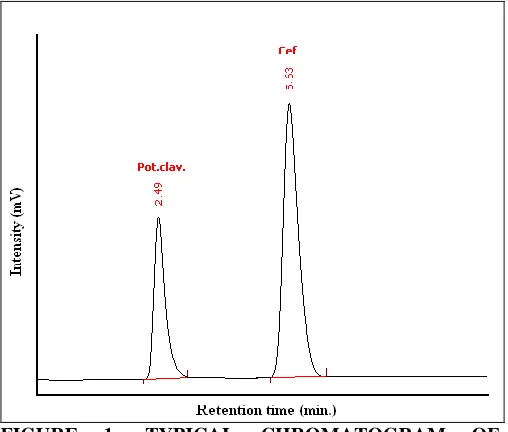
and Pot.clav. in the sample solutions were determined by the proposed method. The well resolved chromatogram of the tablet formulation is shown in Fig. 1. The method was validated in accordance with ICH guidelines 8.
FIGURE 1: TYPICAL CHROMATOGRAM OF
CEFPODOXIME PROXETIL AND POTASSIUM
CLAVULANATE IN TABLET FORMULATION
RESULTS AND DISCUSSION:
Method validation:
System suitability parameters: System suitability
tests are used to verify that resolution and reproducibility of the chromatographic system are adequate for the analysis to be done. Resolution is a measure of quality of separation of adjacent bands; obviously overlapping bands have small Rs values. The tailing factor, T, is a measure of peak tailing and is unity for perfectly symmetrical peaks and its value increases as tailing becomes more pronounced. As peak asymmetry increases, integration, and hence precision becomes less reliable. The developed chromatogram showed good resolution of peaks with Rs value of 2.21 between Cef and Pot. clav. with minimal tailing
(Table 1).
TABLE 1: SYSTEM SUITABILITY STUDIES
Parameter with Standard Values Cef Pot.clav.
Retention time (min.) ±RSD 5.63±0.02 2.49±0.02
Resolution NLT 2 2.21 -
Tailing factor NMT 2 1.05 0.99
Asymmetry factor (0.95-1.15) 0.96 1.05
NMT – Not more than. NLT – Not less than
Specificity: The specificity of the developed
method was determined by forced degradation studies. Standard stock solutions (100 µg mL-1) were prepared by dissolving 10 mg each of Cef and Pot.clav. in 100 mL mobile phase consisting of phosphate buffer (pH 5.5): acetonitrile (51:49 % v/v).
In the forced degradation studies, acid degradation (refluxed in 0.001M HCl for 30 min. at 40oC), base degradation (refluxed in 0.001M NaOH for 30 min. at 40oC), oxidative degradation (refluxed in 3% H2O2 for 30 min. at 40oC), wet degradation
(refluxed in mobile phase for 30 min. at 40oC), dry degradation (in oven at 40 oC for 24 hrs) and photo stability studies (in photo stability chamber for 24 hr.) were carried out.
In forced degradation study, it was found that Cef was not affected by the acid, oxidative, wet, dry and photo degradation conditions employed. However it shows degradation in basic condition and shows an additional peak at retention time (tR)
of 5.06 (9 % degradation) (Fig. 2). Pot.clav. was not affected only in the wet degradation condition employed but it was unstable to acid, base, oxidative, dry and photo degradation.
Pot.clav. showed an additional peak at retention time (tR) of 3.55 in acid (17% degradation) (Fig. 3),
3.35 in base (23% degradation) (Fig. 4), 3.31 and 3.74 in oxidative degradation (3% degradation)
(Fig. 5), 3.33 in dry degradation (4% degradation)
(Fig. 6) and 2.93, 3.16 in photo degradation
FIGURE 2: CHROMATOGRAM OF BASE DEGRADATION OF CEF
FIGURE 3: CHROMATOGRAM OF ACID
DEGRADATION OF POT.CLAV.
FIGURE 4: CHROMATOGRAM OF BASE
FIGURE 5: CHROMATOGRAM OF OXIDATIVE DEGRADATION OF POT.CLAV.
FIGURE 6: CHROMATOGRAM OF DRY
DEGRADATION OF POT.CLAV.
Precision: Precision of the method was determined with the marketed formulation. The repeatability of sample application and measurement of peak area were expressed in terms of % R.S.D. Inter- and intraday relative standard deviation values for Cef were 0.801% and 0.692% respectively and 0.905% and 1.042% for Pot.clav. respectively. The %RDS values were found to be less than 2%, indicating
that the proposed method provides acceptable intra-day and inter-intra-day precision.
Accuracy (Recovery study): The accuracy study
was performed at three different levels (80%, 100% and 120%), the mean recovery was found to be between 98–102% as required by ICH guidelines.
[image:5.612.46.568.182.280.2](Table 2)
TABLE 2: ASSAY AND RECOVERY DATA OF TABLET FORMULATION
Component Amount
present (mg)
Amount found*
% Relative standard Deviation*
Level of % recovery
% Recovery**
Relative standard Deviation**
Cef. 200 99.71 0.517
80 99.61 0.763
100 99.76 0.176
120 99.76 0.612
Pot.clav. 125 99.51 0.374
80 99.80 0.191
100 98.98 0.601
120 99.76 0.330
* Denotes average of six estimations; ** Denotes average of three estimations at each level of recovery.
Limit of detection (LOD) and limit of
quantitation (LOQ): The LOD and LOQ were
separately determined based on the standard deviation of the y- intercept and slope of the calibration curves with RSD values less the 2%.The LOD were found to be 0.046 µg mL-1 for Cef and 0.510 µg mL-1 for Pot.clav. Similarly, the LOQ were 0.139 µg mL-1for Cef and 1.547 µg mL-1 for Pot.clav.
Robustness and Ruggedness: To evaluate the
robustness of the developed HPLC method ,deliberate variations were made in method parameters such as change in flow rate [-0.1 level(0.9 ml/min.), 0.0 level(1 ml/min.), +0.1 level(1.1 ml/min.)], ratio of aqueous: organic composition and pH of the mobile phase [+1:-1 level-(52:48/pH-6.28), 0:0 level -(51:49/pH-6.29),
-1:+1 level - (50:50/ pH 6.30)]. The effect of the modified parameters on retention time, tailing factor and % content were determined which indicated that the developed method was unaffected by small changes in method parameters. The ruggedness of the developed method was evaluated by studying the effect of parameters like different analysts [Analyst 1 and 2] and chemicals and solvents (Brand 1-Qualigens fine chemicals, Mumbai, India, Brand 2- Universal lab, Mumbai, India) employed on retention time, tailing factor, and % content .The low %R.S.D values for retention time, tailing factor and % content indicated that the developed method is robust and rugged.
CONCLUSION: An isocratic RP-HPLC method
has been developed using a Hypersil-BDS (C-18)
column (5 μm, 250 mm 4.60 mm), a mobile phase containing phosphate buffer (5.5 pH): acetonitrile (51:49 v/v), in isocratic flow rate 1 mL/min. with UV detection at 233.0 nm for the simultaneous determination of Cef and Pot.clav. in tablet dosage form. The result of the marketed formulation analysis and its validation study indicates that the proposed method is simple, accurate, precise, specific, robust and rugged.
The method enabled successful separation and quantitative determination of Cef and Pot.clav. in tablet formulation. Also the specificity studies indicated that the method can be employed to assess the stability of the dosage form. As analytical methods are not available for this combination the developed RP-HPLC method can be used for the simultaneous estimation of Cef and Pot.clav. in tablet dosage form.
ACKNOWLEDGEMENT: The authors express
their gratitude to Padmashree Dr. D. Y. Patil Institute of Pharmaceutical Sciences and Research, Pune, Maharashtra, India, for providing necessary facilities, and to Emcure Pharmaceutical, India, for the generous gift samples of pure Cef and Pot.clav.
REFERENCES:
2. British Pharmacopoeia. Her Majesty’s Stationary Office, London, 2008; 1777-1779.
3. Thomas AB, Dighe SB, Nanda RK and Deshpande AD: Simultaneous Spectrophotometric methods for estimation of Cefpodoxime proxetil and Potassium clavulanate in pharmaceutical dosage form. Journal of Pharmaceutical Research 2010; 9(4): 167-171.
4. Thomas AB, Dighe SB, Nanda RK and Deshpande AD: Simultaneous spectrophotometric methods for estimation of Cefpodoxime proxetil and Potassium clavulanate in pharmaceutical dosage form. Asian Journal of Research in Chemistry 2011; 4(10): 1600-1604.
5. Gandhi SV, Patil UP and Patil NG: Simultaneous spectrophotometric determination of Cefpodoxime proxetil and Potassium clavulanate. Hindustan Antibiotic Bulletin 2009; 51(1-4): 24-28.
6. Malathi S, Dubey RN and Venkatnarayanan R: Simultaneous RP-HPLC Estimation of Cefpodoxime proxetil and Clavulanic acid in tablet. Indian Journal of Pharmaceutical Sciences 2009; 71(1): 102-105.
7. Thomas AB, Dighe SB, Nanda RK and Deshpande AD: A validated Stability-Indicating HPTLC Method for Simultaneous Estimation of Cefpodoxime proxetil and Potassium clavulanate in bulk and tablet dosage form. Journal of Liquid Chromatography and Related Technologies 2010; 33(18): 1689 – 1703.
8. ICH, Q2 (R1), Harmonised tripartite guideline. Validation of analytical procedures: Text and Methodology, International Conference on Harmonization ICH, Geneva, Nov. 2005.
All © 2013 are reserved by International Journal of Pharmaceutical Sciences and Research. This Journal licensed under a Creative Commons Attribution-NonCommercial-ShareAlike 3.0 Unported License.
This article can be downloaded to ANDROID OS based mobile. Scan QR Code using Code/Bar Scanner from your mobile. (Scanners are available on Google Playstore)
How to cite this article:
Dighe SB: Simultaneous estimation of Cefpodoxime proxetil and Potassium clavulanate in tablet formulation by RP-HPLC.