Full Length Research Article
A NOVEL STUDY ON CHROMIUM ELECTROCHEMICAL DEPOSITION FROM CR(III)-GLYCINE
COMPLEX SOLUTION
*1
Nguyen Xuan Huy,
2Nguyen Duy Ket and
3Le Xuan Que
1
Hanoi University of Industry
2
Institute of Chemistry and Material
3
Institute for Tropical Technology, Vietnam Academy of Science and Technology
ARTICLE INFO ABSTRACT
The chromium plating solution was prepared from Cr (III) salt mixed with a suitable chelating organic agents. The ratio of chelating agent concentration with Cr (III) concentration was selected object of this study before to apply in practice. Amino-acetic acid chelating compound was agent capable to form the complex with the Cr (III) ions but depending on the ratio of these substances present in solution. In this paper, the research was focused on the complexing of amino-acetic acid and Cr(III) ions, evaluation of plating capabilities of the complexes based on determining the reaction rate during scanning, CV. The experiment shows that the complex of Cr(III)-glycine exhibited a excellent compound to use in chromium electrochemical deposition. By this way the optimal Cr (III) and chelating agent concentration were be selected for making decorative chromium plating solution.
Copyright©2016, Nguyen Xuan Huy et al. This is an open access article distributed under the Creative Commons Attribution License, which permits unrestricted use, distribution, and reproduction in any medium, provided the original work is properly cited.
INTRODUCTION
Electrochemical plating from Cr (III) solutions depends strongly on the nature of Cr (III) complex with different ligands (Tran Minh Hoang, 2000, K. Dennis, T.E. Such, 1993, N.V. Mandich, D.L. Snyder, 2000), One of the chelating agents that are interested is the amino- acetic acid, an amino
acid called glycine acid (Elisabete S.C. et al., 2013). The
compound Cr (III) is generally toxic salts but lower Cr(VI). There are many Cr(III) salts having the properties and composition like the Al(III) salt, due to their ion size are similar such as Cr(III) (0,57 Å) and Al(III) (0.61 Å). Likewise
Cr (OH) 3 exhibits properties similar to Al (OH) 3; they can
form colloidal, chartreuse, insoluble in water and being amphoteric. The fresh Cr (III) hydroxide dissolved easily in acid, base as following reactions:
Cr(OH)3 + 3H3O+ = [Cr(H2O)6] 3+
Cr(OH)3 + OH- + 2H2O = [Cr(OH)4(H2O)2]-
*Corresponding author: Nguyen Xuan Huy
Hanoi University of Industry, Vietnam Academy of Science and Technology.
The formed ions like [Cr(OH)4(H2O)2]- , [Cr(H2O)6] 3+ are
less stable, when heated, easily decompose in solution to form
Cr(OH)3 precipitated. The fresh Cr(III) solution exhibits a red
purple at room temperature, but then turned into green when heated (red purple is the characteristic color of the ion [Cr
(H2O)6]3+. Cr(III) salt is paramagnetic compound, very durable
in dry air and stronger hydrolysis than Cr(II) salt. In an acid environment, Cr(III) ions are reduced to Cr(II) by metallic
zinc. But in alkaline Cr(III) can be oxidized by H2O2, PbO2,
chlorine water, bromine water to form chromate as follows:
2CrCl3 + 10KOH +3H2O2 = 2K2CrO4 + 6KCl +8H2O
Due to the big radius and charge of the Cr (III) ion it is one of the strong chelating agents that can form complex with the most known ligands. However, the stability of the Cr(III) complex still depends on the nature of the ligand and complex
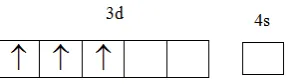
configurations. Electron configuration of Cr atoms is 1s2 2s2
2p6 3s2 3p6 3d5 4s1, when losing 3e formed Cr(III) with single
electron three, two empty orbitals in 3d- subclass, and with one empty orbital in subclass 4s so that the ability to form Cr(III) complex like anion and cation complexes becomes more easily. The electron configuration of Cr(III) is as follows
ISSN: 2230-9926
International Journal of Development Research
Vol. 06, Issue, 11, pp.10308-10312, November,2016
DEVELOPMENT RESEARCH
Article History: Received 17th August, 2016 Received in revised form 21st September, 2016 Accepted 20th October, 2016 Published online 30th November, 2016
Key Words:
Since being the intermediate state, Cr(III) ions exhibits both oxidizing (in acidic) reducing (in the environment or base) characteristics. Many Cr(III) complexes with coordination number of two, three, four in which ligand might be neutral molecules as
H2O, NH3, -NH2- , -CH2-CH2-NH2 or acidic as Cl-, (SO4) 2-,
(C2O4)2-, (SeO4)2-, HCOO-.
Aminoacetic acid chelating agents (symbol AAA)
Aminoacetic acid with chemical formula NH2CH2COOH,
usually denoted by AAA is an amino acid (acid glycine) and also an enzyme.
AAA in the aquatic environment can transform into the anionic or cationic ions depending on the pH of the solution as the following diagram:
Three types of these ions can be transformed into each other depending on pH values. Glycine has the formula shown in Figure 1a or 1b as follows
[image:2.595.89.238.54.96.2]a b
Figure 1. Some configurations of AAA
The AAA Cr(III) complex is a complex of amino acids
(Elisabete S.C. et al, 2013, Kun Sri Budiasih, et al, 2013,
Toepfer, E.W.et al, 1977). A good method of preparation of
amino acid Cr(III) complexes has been illustrated by their
stability, repeatability, and especially electrochemical
activation (Bryan, RF.et al, 1971, Wallace, W.M., et al, 1982).
The synthesis of complexes between Cr(III) - glycine with a high repeatability is very hard if does not maintain stable
synthetic conditions (Guindy NM., et al, 2000, Kita, E., et al,
El Sahrawi, 1995). Previously there have been studies on this complex synthetic process (Bryan RF, 1971). Recently the preparation of the complex Cr(III) - AAA with improvements has been completed. The complex was prepared by mixing the
(CrCl3.6H2O)-liquid reflux, glycine and sodium hydroxide
according to the molar ratio of 1:3:3 for 3 hours (Kun Sri
Budiasih et al, 2013). In aqueous solution containing ions
Cr(III), depending on the molar ratio between Cr(III) and glycine the complexes can create the following forms (J. Mc
DOUGALL, et al 1998, Anil Baral et al 2005, A. M. Smith, et
al 1993):
Monoglycine: Cr[(H2N-CH2-COO)(H2O)4]2+
Diglycine: Cr[(H2N-CH2-COO)2(H2O)2]+
Triglycine: Cr[(H2N-CH2-COO)3]
Thus the molar concentration ratio of Cr(III) and AAA can affect the formation, structure, and components of complexes. Without existing complex, only ion Cr(III) or AAA individual chelating agents in solution studies (ammonium sulfate, boric acid) do not appear the reduction reaction kinetics. This paper has introduced the kinetic research results of of Cr(III)-AAA complex deposition in solution with boric acid and ammonium sulfate.
Experimental part
Preparation of Cr(III)- AAA complex
Chemicals: All chemicals such as CrCl3 glycine, ammonium sulfate, boric acid were bought from Merch Company. Take initial concentration of AAA 0.8m and Cr(III) concentrations,
[image:2.595.329.535.334.389.2]the ratio Cr = [Cr(III)]/[AAA], A = [AAA]/[Cr(III] listed in
Table 1.
Table 1. Cr(III) conc. and Cr ,A
CCr3+, M 0.05 0.10 0.20 0.30 0.50 0.80 CA, M 0,80 0,80 0,80 0,80 0,80 0,80 Cr 0.063 0.125 0.250 0.375 0.625 1.00
A 16.00 8.00 4.00 2.67 1.60 1.00
Symbol Dd 1 Dd 2 Dd 3 Dd 4 Dd 5 Dd 6
Experimental method
Cyclic voltammetry method (CV) was implemented by the
instruments suggested in the document (Allen J. Bard, et al
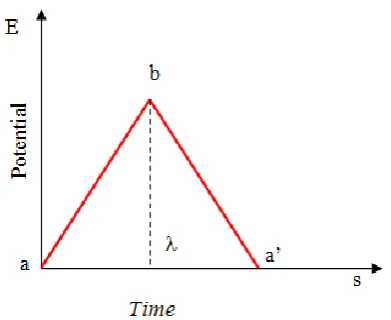
2001). In the CV method the potential was linearly increasing to a certain value then decreasing linearly on the initial value
(Figure 2). Meanwhile polarization potential dependence E t
was given by the equation
E = Esta + v(t-2)
in which: - Esta is initial potential, mV
- v : scanning rate, mV/s
- the reaction time corresponding to half the
scanning cycle, s
When t = polarization voltage reaches the value "end" Eend,
point b in Figure 1, then descending to Esta . The C2 cycle
polarization process was repeated in circulation. The polarized multi-cycle method (CV) is a strong electrochemical method that allows to survey kinetics and also mechanism of electrode
reactions (Toepfer et al., 1977).
RESULTS AND DISCUSSION
Formation of complex
The formation of the Cr(III)-AAA was characterized by the appeared color of solutions. The obtained complex solution
with different colors depends on the composition ratioA =
[image:2.595.55.282.449.524.2]Figure 2. Voltage variations vs. time in the multi cycle-scanning method
As the Cr(III) concentration decreasing the complexes were formed such as monoglycin forms, diglycine and triglycin
respectively in solution . If Cr is small so that the complex of
Cr(III)-triglycine will dominate. When Cr increases the
complexes of Cr(III) with diglycine and monoglycine will dominate in solution. After dispensing the plating solution according to the ratio as Table 1, the obtained plating solutions were denoted as numbers 1, 2, 3, 4, 5, 6 respectively with different colors as follows
Solution 1: purple red
Solution 2: black purple
Solution 3, 4: black green, black solution of 3 was
darker than 4 solution.
Solution 5, 6: green, the green color of 6 was stronger
than 5- solution
Influence of Cr = [Cr3+] / [AAA], Cr varying from 0 to 1
Study on CV cathode rate method
[image:3.595.310.559.247.392.2]The solutions after the preparation were contained in glass bottles for a day before measuring CV.
Figure 3. Cathode branch of the CV curve with the different
A or Cr ratio
The solutions were scanned (CV) using copper cathode
electrode with an area of 0.20 cm2 and composite TiO2 / RuO2
coated titanium mesh anode. A blank sample solution, M00 consists of ammonium sulfate, boric acid, their concentration and their pH like in the plating solutions 1-6. CV cuves obtained are presented in Figure 3. Compared with the cathode branch curve of the blank (M00), slope of the cathode branch
curve of the solutions 1 to 6 have changed, and the cuves position was shipted to more positive potentials. When the concentration of the complex Cr(III) are gradually increasing the cathodic CV currents also increse. This variation means there was a formation of different Cr coating as the result of cathodic reduction of Cr(III) complex in solution.
The dependence of electric current density J on the ratio
Cr , between the voltages from - 0.60 to -1.00V
Figure 4 shows that, when the polarization potential was small, there was an insignificant change in I current, but when the potential polarity increased from -0.60V to -1.00V cathodic reaction line in solutions also rose more sharply. The I current
also depends on Cr. There was a maximum I current at Cr =
0.375, then decreased in the rate of Cr increasing.
Figure. 4 The change of the electric current density J according to
Cr at different voltages
The dependence of I on Cr in the voltages from -1.00 to
1.40 V
Figure 5 shows, the polarization potential increased from -1.00V to -1.40V cathodic current has risen, reached maximum
at Cr = 0.375. However, at the polarization potential more
-1,25V current (I) in different solutions were negligibly increasing, tended to equal.
Fig. 5. The dependence of Ion Cr in the voltage from 1.00 to
-1.40V
Influence of I on Cr in the voltages from -1.40 -1.65 V
The Fig. 6 shows, when the voltage continues increasing, the
change of the current density I versus Cr was not significantly
different. With ratio Cr. increasing the I lines increase and then
[image:3.595.44.285.517.678.2] [image:3.595.314.555.539.695.2]Figure 6. The dependence of Ion the Cr in the voltage from -1.40
to -1.65 V
Study of Cr(III)-complex reaction at cathode
[image:4.595.315.555.56.215.2]Net discharge curve of the complex Cr(III) on the cathode
Figure 7 shows a variation of net discharge current I on Cr(III) complex at the cathode in the solution including Cr(III) varying from 0.05M to 0.80M and concentration of AAA-complexing agent 0.80M. In the plating process, according theory, beside the metal precipitated the hydrogen also exhausted. When curves of the cathode plating branch was measured in solution from sample 1 to 6 minus cathode curve branch of sample M00 we obtain net curve of Cr(III) complex reaction. The curves show that in the plating solution discharge speed of net complexes is disparate
Fig. 7. Net discharge flows of Cr(III) complexes at cathode electrod
The dependence of Net Cr(III) complex on ratio Cr
The voltage range form – 0.60 to -1.00 V
Figure 8 shows the variation of current velosity for the
potential range from -0.60V to -1.00V corresponding to Cr. At
the low potential cathodic reduction rates changed little and insignificantly. When the polarization potential reaches up to range -0.80V to -1.00 V, the reaction rate increases to
maximum value at Cr = 0,375. At this ratio the form
Cr(III)-diglycine complex might be formed mainly. This complex might exhibit small over potential so that is favorite to
precipitate chromium at electrode. When Cr ratio rises the
monoglycine complexes can be formed mainly containing water molecules with great over potential so hardly reducing at electrode causing smaller reaction current.
Figure 8. The dependence of the net reation current of Cr(III)
complexes on Cr in the voltage range from - 0.60 to -1.00 V
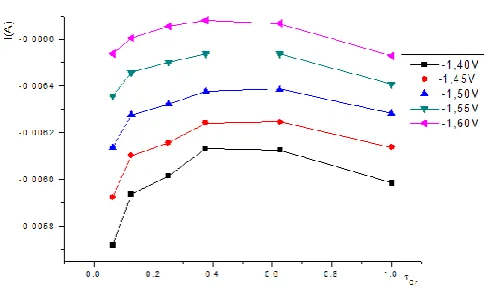
[image:4.595.313.553.364.509.2]The dependence of the net reation current of Cr(III) complexes on Cr in potential range -1.00V to -1.40 V
Fig. 9 shows the changes in net flows of complexes Cr (III) in
the range of voltages from -1.00 to -1.40V according Cr .
When the voltage gradually increased the net flows continue to
increase with the tCr increasing and reached a maximum at the
voltage of -1.05V.
Figure 9.The dependence of the net reation current of Cr(III)
complexes on Cr in potential range -1.00V to -1.40 V
At the same potential value, the peak of the net currents appear
at Cr = 0.375. When the CV potential increases from -1.20V to
-1.40V the net current lines of complexes at the ratio of Cr
differ slightly. It means that the net currents of monoglicine complex increased almost at par with complex or diglycine or
triglycine. At each different ratio of Cr there were various
kinds of complex formed in the solutions. At the Cr(III)
concentrations were very small corresponding Cr = 0.063;
0.125, in solution the complex with triglycine would be formed but with low concentrations and caused the small discharge speed and small precipitatation of chromium at
electrode. When Cr(III) concentration increased (Cr = 0,25),
the Cr(III) complex of triglycine, would be highly formed leading net current rate increasing. When Cr(III) concentration
continues to rise (Cr = 0,375; 0,625) in solution the diglycine
complex might be formed, with the its high electrical discharge causing the high net current. This net current reaches
to the maximum value at Cr = 0.375 and then decreases due to
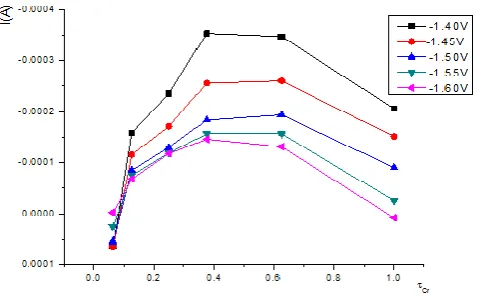
[image:4.595.45.281.414.575.2]The dependence of the net reation flow of Cr(III) complexes on Cr in potential range from - 1.40V to -1.60V
At the voltage in the range from -1.40 to 1.60V, the net
reaction flow of Cr(III) complexes versus to the ratio of Cr
[image:5.595.44.284.165.314.2]decreases. It is possibly that in more negative voltage values, beside the Cr (III) complex discharged there is also discharge of impurities or other
Figure 10. The net reation current of Cr(III) complexes
variation as a function of Cr , potential range - 1.40V to -1.60 V
Conclusions
The electrochemical plating using Cr(III) with amino acetic acid (called glycine - AAA) was studied in detail using CV polarization in this paper, as a novel investigation technique for Cr(III) plating kinetics. The plating solution using glycine chelating agents with the concentration of 0.80M, Cr(III) concentrations varying from 0.25M to 0.50M, corresponding
to the ratio of Cr = 0.250; 0.375; 0.625, can be used for the
chromiun decorative plating. The decorative plating can be carried out at the potential ranging from -0.90V to -1.15V,
giving the hight quality plating. With the different ratio of Cr
the Cr(III) complex with mono-, di-, triglycine can be formed during plating in the solution. The experiments indicated that the Cr(III) diglycine complex exhibited a more favorit form of discharge at cathode electrode than other forms.
The article was supported by ITT-VASTand completed at
HAUI and ITT–VAST.
REFERENCES
Allen, J. Bard, Larry R. Faulkner, 2001. Electrochemical Methods: Fundamentals and Applications, 2nd Edition, ISBN: 978-0-471-04372-0, Wiley Ed. , New York.
Anil Baral and Robert Engelken, Modeling, 2005. Optimization, and Comparative Analysis of Trivalent Chromium Electrode position from Aqueous Glycine and
Formic Acid Baths, Journal of The Electrochemical
Society, 152 (7) C504-C512.
Bryan RF, Greene P.T, Stokely P.F, Wilson E.W, 1971, Crystal and molecular structure of tris(glycinato)
chromium(III) monohydrate, Cr(C2H4NO2)3.H2O, J. Inorg.
Chem, vol.10, no.7, 1468-1473.
Bryan RF, Green P.T, Stokely P.F, Wilson E.W, 1971, Crystal and molecular structure of tris(glycinato) chromium(III)
monohydrate, Cr(C2H4NO2)3.H2O, J. Inorg. Chem, vol.10,
no.7, 1468-1473.
Cooper, J.A. Blackwell, L.F. Buckley, P.D. 1984. Chromium (III) complexes and their relationship to the Glucose Tollerance Factor, Part II: Structure and Biological
Activity of Amino Acid Complexes, Inorg.Chim. Acta, 92,
23-31
Dennis, K. and Such, T.E. 1993. “Nickel and Chromium
Plating”, Woodhead Publishing, 3rd Edition, Cambridge
El Shahawi, 1995. Chromium (III) Complexes of Naturally
Occurring Ligands, Spectrochim. Acta, vol 51A., no 2,
pp.161-170.
Elisabete S.C. Ferreira, C.M. Pereira, A.F. Silva, 2013.
Electrochemical studies of metallic chromium
electrodeposition from a Cr(III) bath, Journal of Electroanalytical Chemistry 707
Guindy NM., AbouGamra Z.M., Abdel Messih M.F. 2000. Kinetic Studies on the Complexation of Chromium(III) with some Amino Acids in Aqueous Acidic Medium, Monatshefte fur Chemie, 131, 857-866.
Kita, E., Marai. H., Muziol.,T., Lenart, K. 2011. Kinetic studies of Chromium Glicinato Complexes in Acidic and
Alkaline Media, Trans.Met. Chem, 36: 35-44.
Kun Sri Budiasih, Chairil Anwar, Sri Juari Santosa, and Hilda
Ismail, 2013. Synthesis and Characterization of
Chromium (III) Complexes with L-Glutamic Acid,
Glycine and L- Cysteine, International Journal of
Biological, Biomolecular, Agricultural, Food and Biotechnological Engineering Vol: 7, No:6.
Mandich, N.V. and D.L. Snyder, 2000. "Electrodeposition of Chromium", in: Modern Electroplating, Ed. M. Schlesinger, M. Paunovic, John Wiley & Sons, Inc., New York
Mc Dougall, J., M. El-sharif, S. MA, Chromium electrodeposition using a chromium(III) glycine complex, Journal of applied electrochemistry 28 (1998) 929-934
Smith, A. M., A. Watson, and D. H. Vaughan. 1993. Trans.
Inst. Met. Finish., 71, p.106
Toepfer, E.W., Mertz, W., Polansky, M.M., Roginski, E.E., Wolf, W.R. 1977. Preparation Of Chromium-Containing Material Of Glucose Tolerance Factor Activity From
Brewer's Yeast Extracts And By Synthesis, J. Agric. Food
Chem., 1977, 25 (1), pp 162–166
Tran Minh Hoang, 2000, Electical plating, NBX KH & KT, Ha Noi.
Wallace, W.M., Hoggard, P.E., 1982, In Search of The Purple
Isomer of Tris(glycinato)- Chromium (III), Inorg. Chim.
Acta,, 65, L3-L5.