182
A NEW CRYPTOSYSTEM FOR ENCRYPTION AND
DECRYPTION USING ELLIPITIC CURVES IN
CRYPTOGRAPHY OVER FINITE FIELDS
1MOHAMMED RAFIQ NAMIQ, 2WRYA K. KADIR, 3ARAM M. AHMED
1Department of Mathematics, College of Science, University of Sulaimani, Sulaymaniyah, Iraq. 2Department of Mathematics, College of Science, University of Sulaimani, Iraq. 2Information Technology Department, College of Science and Technology, University of Human
Development, Iraq.
3Kurdistan Institution for Strategic Studies and Scientific Research, Department of Information
Technology.
3Computer Science institute, Sulaimani Polytechnic University.
E-mail: 1[email protected], 2[email protected]1, [email protected]2, 3[email protected] , 3[email protected]
ABSTRACT
This paper considers the use of cryptography with elliptic curves. It is presented and defined a new cryptosystem algorithm for encryption and decryption using elliptic curves with more than one secret and public keys. Furthermore, it is described the mathematical concepts related to elliptic curves, particularly the discrete logarithm problem on elliptic curves. A description of the Diffie-Hellman algorithm on elliptic curves and elliptic curve encryption algorithm with the recipients’ public keys are represented.
Keywords:Cryptography, Public-Key Cryptography, Computer Security, Algebraic Geometry, Elliptic
Curves, And Finite Fields.
1. INTRODUCTION
The birth of cryptography and the art of hiding messages date back to ancient times. The encryption, after having played several different roles according to historical events, is today indispensable, for example, in commercial and private sectors. With the spread of the network and electronic commerce, symmetric encryption was not satisfactory as there was a major issue with the key exchanges that had to remain secret in order to maintain the security of the encryption methods. To solve this issue, the first public- key cryptosystem was introduced by Diffie and Hellman in 1976 [1]. Then, in 1978, R.Rivest, A.Shamir and L.Adleman created the first public-key cryptosystem for encryption and digital signatures; known as RSA [2]. After that time, the introduction of encryption algorithms based on elliptic curves cryptography (ECC) were, independently, suggested and then invented in 1985 by Miller [3] and Koblitz in 1986 [4]. The ECC is relatively recent, however, in the last twenty years this technique has rapidly established itself as an alternative to public-key cryptographic systems, which were already widely
used as RSA and digital signature standard (DSS) [5]. Furthermore, the main attraction of ECC is that elliptic curves over finite fields deliver an inexhaustible source of finite abelian groups [6], which (even if they are large) are convenient for computation and have a rich structure [7]. At this moment, there are no sufficiently fast algorithms that can solve the mathematical problems in which are based on elliptic curve discrete logarithm problems (ECDLP). Moreover, ECC offers the same degree of safety of traditional systems, such as RSA, DSA and Diffie-Hellman, by using a smaller key size [8,9]. The more general equation of an elliptic curve defined over a field is an algebraic curve formed from the left is conic and on the right is cubic:
183 with and are constants, the field can be the set of real, complex, but also any other field, for example, in encryption the finite fields are usually used. The curve must be smooth or non-singular, that is, the gradient (discriminant) must be different from zero for each pair of values . In the definition of the elliptic curve, there is also a single element denoted by , where and called the point at infinity; the name is derived from projective geometry, which has fundamental importance. Moreover, an elliptic curve over a field in the form of non-homogeneous coordinates is defined as follows:
In the present paper for the purpose of the encryption and decryption using elliptic curves, it is considered the equation:
This curve is symmetric about the -axis since for each value of , there are a positive and negative values of .
In addition, the ECC is asymmetric key cryptography, this is because two different keys are used: public and private, where the knowledge of the public key cannot determine the private key. From 1986 till now, a lot of research has been done to have efficient and secure implementations of these cryptographic schemes. In this paper, it is allowed each user to generate two private keys and three public keys to offer a stronger key to encryption and decryption.
2. THE STRUCTURE OF POINTS ON
ELLIPITIC CURVES
Let be a non-singular elliptic curve over field , with [10], and be given by:
with the discriminant:
and -invariant:
The addition operation, +, can be defined over elliptic curves in order to obtain an abelian group . This operation of addition is also called chord-and-tangent rule for its geometric interpretation. The addition operation that defined in an abelian group has the following properties:
1) Associativity. If , then
.
2) Identity. The point at infinity is the identity element of the group, that is, and for all we have that
.
3) Inverses. If then is the only other point on the curve with -coordinate equal to
and .
4) Commutativity. If , then
.
The group structure of points of elliptic curves over a field can be defined as follows:
2.1 Modular Arithmetic
For a positive integer , two integers and are called congruent modulo (or is congruent to modulo ), if and have the same remainder when divided by (or equivalently if is divisible by , ) [11]. It can be expressed as , where is called the modulus. That means
2.2 Addition and Inverse Formulas on Elliptic
Curves
Consider the points with
coordinates and ,
respectively [12] and where
then
1) Inverse of a point. The negative of the point is defined to be
2) Addition of points. The operation of addition of points is defined on the curve by
184
b) If , point doubling, :
2.3 Elliptic Curve Scalar Multiplication
Let be an integer and be a point on an elliptic curve defined over a field . In an abelian group, the multiplication is defined by the scalar integer , as it may be considered as the sum of the point of the curve in all times, defined as follows:
2.4 Discrete Logarithm Problem Using ECC
(DLPEC)
Given a curve on a finite field , we can represent the main operation called scalar multiplication in ECC as follows:
where and are points on ECC. That means, the problem of finding the smallest positive integer
, given the points and .
3. ELLIPITIC CURVES DEFFIE-HELLMAN
KEY EXCHANGE
The first encryption algorithms based on elliptic curves were, independently, purposed by Miller in 1985 and Koblitz in 1986 [3,4]. They did not in fact propose new algorithms, but applied the existing ones on the additive group formed by the points of an elliptic curve over a finite field. In this protocol, the two parties, Alice and Bob, want to share a secret key.
First of all, they openly select a prime number , , and choose an elliptic curve over a finite field . The key is based on a random point on the elliptic curve . If they have the random point , then, for example, it gives the -coordinate of the random element of , which can then be converted into an -bit integer in the -ary number system where , and this
number can be the key in their cryptosystem. They should choose the point , so that all of their messages to each other are open and so no one but the two of them would know anything about .
Secondly, Alice and Bob, openly choose a point as the base, plays the same role as a generator in the Diffie-Hellman algorithm for finite fields. However, it is not required that is a generator of the group of points of , in this protocol. This group may not be cyclic. Even whether it is cyclic group or not, time should not be wasted checking that is a generator element, or even finding the total number of points on that will not be needed in the future.
To generate a key Alice and Bob perform the following scheme:
1) Alice chooses an integer , . This number is Alice’s private key and must be kept in secret. Then Alice calculates her public key . The public key is a point in the group of points on the elliptic curve.
2) Similarly, Bob selects a private key , and calculates his public
key .
3) Alice and Bob share their public keys publicity over unsecured channel.
4) Alice calculates the secret key , and Bob calculates the secret key .
The last two expressions give the same result, because:
185
4. THE TWO SECRET KEYS
CRYPTOSYSTEM ON ELLIPTIC
CURVES
Now, we are going to describe the new cryptosystem, which adapts to use with elliptic curves. Suppose Alice wants to send a secret message to Bob. Alice and Bob choose an elliptic curve , defined over a finite field , so that the discrete logarithm problem is difficult to solve when using . First, Bob makes the public keys as follows:
1) He selects the points as a secret point and as a base point on such that the order of is a large prime number.
2) He chooses two secret integers and such
that .
3) He computes
with and being Bob’s public keys and and being Bob’s secret (privates) keys.
4) He sends and to Alice.
To send the message, Alice proceed as follows:
1) She obtains Bob’s public keys.
2) She encodes the message into a point .
3) She chooses two secret integers and
such that , and computes
4) She sends and to Bob.
After received the Alice’s information, Bob calculates his keys
Then to encrypt the message , Alice computes:
To decrypt the message , Bob calculates:
Note. It is important that each time Alice uses, she sends the encrypted message to Bob by using Bobs public key, a different private key or . In fact, if she uses the same private keys and keys for two different messages and , then an attacker who captured the two coded messages will notice and be able to calculate:
Suppose that for some reason the message was made public as soon as the information was no longer valid, then the attacker could easily calculate
, which would be .
4.1 Example
Consider the elliptic curve over a finite field described by the equation
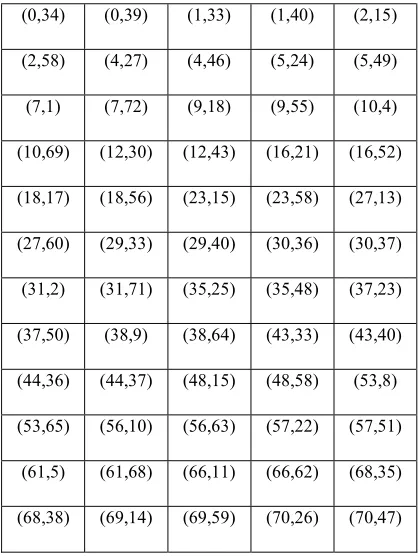
[image:4.612.313.522.448.727.2]The number of points on are the following:
Table 1: Points of the Elliptic Curve E.
(0,34) (0,39) (1,33) (1,40) (2,15)
(2,58) (4,27) (4,46) (5,24) (5,49)
(7,1) (7,72) (9,18) (9,55) (10,4)
(10,69) (12,30) (12,43) (16,21) (16,52)
(18,17) (18,56) (23,15) (23,58) (27,13)
(27,60) (29,33) (29,40) (30,36) (30,37)
(31,2) (31,71) (35,25) (35,48) (37,23)
(37,50) (38,9) (38,64) (43,33) (43,40)
(44,36) (44,37) (48,15) (48,58) (53,8)
(53,65) (56,10) (56,63) (57,22) (57,51)
(61,5) (61,68) (66,11) (66,62) (68,35)
186 (72,36) (72,37) O∞
Thus, the number points on over , . The order of group , the number of points on , is . Where
.
Let us apply our new Cryptosystem. 1) Bob selects two points on , say
and as a base point such that the order of is a large prime number.
2) He chooses two secret random integers and , which are in the
interval , since .
3) He computes
4) He sends and to Alice.
To send the message, Alice proceed as follows:
1) She obtains Bob’s public keys.
2) She chooses two secret integers, say and , which are in the interval and computes
3) She sends and to Bob.
After received the Alice’s information, Bob calculates his keys
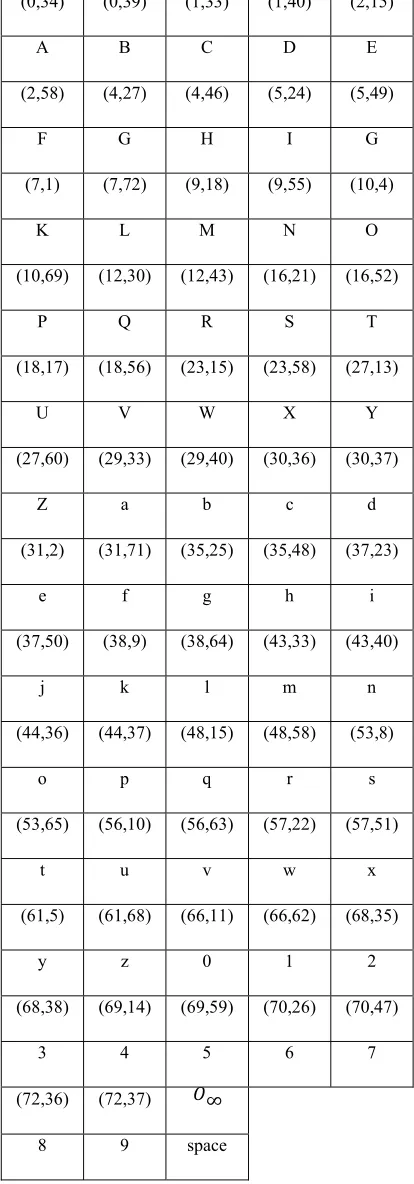
If Alice wants to send the message Go
Back to Bob, Alice must convert all the text
characters of the message into the points on the elliptic curves using the agreed upon code table. Now, let names the points on as follows:
(0,34) (0,39) (1,33) (1,40) (2,15)
A B C D E
(2,58) (4,27) (4,46) (5,24) (5,49)
F G H I G
(7,1) (7,72) (9,18) (9,55) (10,4)
K L M N O
(10,69) (12,30) (12,43) (16,21) (16,52)
P Q R S T
(18,17) (18,56) (23,15) (23,58) (27,13)
U V W X Y
(27,60) (29,33) (29,40) (30,36) (30,37)
Z a b c d
(31,2) (31,71) (35,25) (35,48) (37,23)
e f g h i
(37,50) (38,9) (38,64) (43,33) (43,40)
j k l m n
(44,36) (44,37) (48,15) (48,58) (53,8)
o p q r s
(53,65) (56,10) (56,63) (57,22) (57,51)
t u v w x
(61,5) (61,68) (66,11) (66,62) (68,35)
y z 0 1 2
(68,38) (69,14) (69,59) (70,26) (70,47)
3 4 5 6 7
(72,36) (72,37)
[image:5.612.314.521.119.711.2]187 To encrypt the massage Alice uses the new cryptosystem. Also, she uses code table (2) to converts the plain text into the points on , which are
and , respectively. Then she processes as follows:
• The first letter G corresponds to the point (4,27) in the code table (2).
• the letter O corresponds to the point (10, 4).
• the space .
• the letter B = (0, 39).
• the character a = (29, 33).
• the letter c = (30, 36).
• the character k = (38, 9).
Alice sends the encrypted massages
7aF6CGD to Bob. After Bob received the cipher
text 7aF6CGD, he converts the cipher characters into the points on , (70,47), (29,33), (2,58), (70,26), (1,33), (4,27), and (1,40), respectively, using the code table (2), and decrypts the messages as follows:
• The letter , to decrypt
• the character a = (29, 33).
• the character F = (2, 58).
• the letter 6 = (70, 26).
• the letter C = (1, 33).
• the letter G = (4, 27).
• the letter D = (1, 40).
The original massage is Go Back.
5. CONCLUSION
In recent decades, elliptic curve cryptography has become increasingly important, becoming part of industry standards. Elliptic curve cryptography appears as an alternative to traditional public key cryptosystems like RSA and ElGamal. The main advantage of elliptic curve cryptography is the ability to create smaller keys, thereby reducing storage requirements and transmission. One based on elliptic curve cryptography key can give the same level of security with 256-bit key as an RSA algorithm with a 2048-bit key. This article briefly describes the application of elliptic curves for asymmetric key encryption system. That is, using two secret keys to produce the encryption and decryption keys offer a greater difficulty for the discrete logarithm problem compared to the commonly used techniques of factorization of large numbers, Diffie-Hellman system or elliptic curves Diffie-Hellman key exchange. In addition, for the attacker Eve who knows one of private key cannot recover the massage because she needs the second private key for this purpose. As a result, the reliability of such cryptosystems depends heavily on the progress made in solving the discrete logarithm problems.
REFRENCES:
[1] W. Diffie and M. E. Hellman, “New directions in cryptography”, IEEE transactions on Information Theory, Vol 22, No. 6, 1976, pp. 644–654.
188 [3] V. S. Miller, “Use of elliptic curves in
cryptography” Conference on the Theory and
Application of Cryptographic Techniques,
Springer, 1985, pp. 417–426.
[4] N. Koblitz, “Elliptic curve cryptosystems” Mathematics of computation, Vol. 48, No. 177, 1987, pp. 203–209.
[5] FIPS 186, “Digital signature standard” Federal Information Processing Standards Publication 186, U.S. Dept. of Commerce/National Institute of Standards and Technology, 1994. [6] R. Schoof, “Elliptic curves over finite fields
and the computation of square roots mod p”, Mathematics of computation, Vol. 44, No. 170, 1985, pp. 483–494.
[7] R. Schoof, “Counting points on elliptic curves over finite fields”, Journal de theorie des nombres de Bordeaux, Vlo. 7, No. 1, 1995, pp. 219–254.
[8] G. Harper, A. Menezes and S. Vanstone, “Public-key cryptosystems with very small key lengths”, Work- shop on the Theory and
Application of of Cryptographic Techniques,
Springer, 1992, pp. 163–173.
[9] L. C. Washington, “Elliptic curves: number theory and cryptography”, Discrete
mathematics and its applications, Taylor and
Francis Group, LLC and CRC press, Vol. 20, 2008.
[10] J. H. Silverman, “The arithmetic of elliptic curves” Graduate Texts in Mathematics 106, Springer Science & Business Media, 2009, pp. 47–55.
[11] R. Lidl and H. Niederreiter, “Finite fields” Encyclopedia of Mathematics and its
Applications, Cambridge University Press,
Vol. 20, 1997.
[12] J. H. Silverman and J. T. Tate, “Rational points on elliptic curves”, Undergraduate
Texts in Mathematics, Springer 2nd, 1992, pp.
117–202.
[13] W. K. Kadir, O. H. Ahmed and M. R. Namiq. “A New Text Encryption Technique on Elliptic Curve Cryptography”, Journal of
Engineering and Applied Sciences, 2017, vol.