http://dx.doi.org/10.4236/am.2014.513199
Truncated Geometric Bootstrap Method for
Time Series Stationary Process
T. O. Olatayo
Department of Mathematical Science, Olabisi Onabanjo University, Ago-Iwoye, Nigeria Email: [email protected]
Received 28 April 2014; revised 30 May 2014; accepted 10 June 2014
Copyright © 2014 by author and Scientific Research Publishing Inc.
This work is licensed under the Creative Commons Attribution International License (CC BY).
http://creativecommons.org/licenses/by/4.0/
Abstract
This paper introduced a bootstrap method called truncated geometric bootstrap method for time series stationary process. We estimate the parameters of a geometric distribution which has been truncated as a probability model for the bootstrap algorithm. This probability model was used in resampling blocks of random length, where the length of each blocks has a truncated geometric distribution. The method was able to determine the block sizes b and probability p attached to its random selections. The mean and variance were estimated for the truncated geometric distribu-tion and the bootstrap algorithm developed based on the proposed probability model.
Keywords
Truncated Geometric Bootstrap Method, Stationary Process, Moving Block and Geometric Stationary Bootstrap Method
1. Introduction
differ-ent analytical argumdiffer-ents by taking advantage of fast computers. The bootstrap methods have and will continue to have a profound influence throughout science; as the availability of fast, inexpensive computing has enhanced our abilities to make valid statistical inferences about the world without the need for using unrealistic or unveri-fiable assumptions [9].
An excellent introduction to the bootstrap may be found in the work of [10]-[13]. Recently, [4] and [5] have independently introduced non-parametric versions of the bootstrap that are applicable to weakly dependent sta-tionary observations. Their sampling procedure have been generalized by [6] by resampling “blocks of blocks” of observations for the stationary time series process. On this note we propose a stationary bootstrap method generated by resampling blocks of random size, where the length of each block has a “truncated geometric dis-tribution”.
2. Materials and Method
The truncation is more than just theoretical interest as a number of applications have been reported in [14].
Estimating the Parameter of Truncated Geometric Distribution.
A random variable X may be defined to have a truncated geometric distribution, with parameter p. and N terms, when it has the probability distribution.
(
) (
)
1(
)
1 x 1, 2, ,
P X =x =k −P − P x= N (2.1) The constant K is found, using condition
(
)
1,P X=x =
∑
to be 1 1 − −(
1 P)
N.We shall introduce a truncated form of the geometric distribution and then demonstrate that it is suitable model for a probability distribution. Hence, the probability density function is:
(
)
1(
)
1(
)
0 0
1 jN r 1 r 1 jN
j j
P P P P P
α + − − α
= =
− = − −
∑
∑
(2.2)(
)
(
)
1 1 1 1 r N P P P − − =− − (2.3)
(
r=1, 2,,N)
These are the probabilities of truncated geometric distribution with parameter P and N terms. Therefore we intend to derive the distributional properties of our estimates by looking at the expectation and variance of trun-cated geometric distribution.
Thus,
( )
(
)
(
)
1 1 1 1 r N P P P r P − − = − −( )
( )
(
)
(
)
(
(
)
)
1 11 1 1
1 1
1 1 1
N N N
r r
N N
r r r
P P
E r rP r r P rq q p
q P − − = = = = = − = = − − − −
∑
∑
∑
(2.4)Recall some facts on geometric series,
(
)
1 2 1
1
N
N q q
q q q
q
−
+ + + =
−
(2.5)
Using method of moment we have;
(
)
(
)
(
)
1
2
1 1 1
d d
d 1 d 1 1
N N N N
q q q q q q Nq q
q q q q q
+ − − − + − − = = − − − (2.6a)
(
)
(
)
1 2 1 1 1 11 1 1
N N
N r
N N
r
q q Nq q
p q
rq
q q q
−
=
− + − −
−
=
( )
(
)
(
)
(
)
1 1 1 1 N N Nq q Nq q
E r
q q
− + − − =
− − (2.7)
Thus, E r
( )
is the sample mean, as demonstrated by [15]. In this paper, we derived the second moment further.( )
2( )
( )
21 1
N N
r r
V r r p r rp r
= =
= −
∑
∑
(2.8)Thus,
( )
(
)
(
)
1 2 1 1 1 1 1 r N N N r r p pr p r r
P − = = − = − −
∑
∑
(
)( )
1(
)
11 1 1 1 1 1 N N r r N r r q
r r p r p
q − − = = − − − + − −
∑
∑
For the second moment and by second differentiation we have,
(
)
(
)
(
)
(
)
2 2
1 1 1 1
1 d
d
1 1 1
N N N N
N
q Nq q q Nq q
q q
q
q q q
− − − − − − − + − − −
( )
2(
)
(
(
) (
(
2)
(
) (
)
)
(
(
)
)
)
21 1 1 1 1 1
1 1
N
N
q q q N N q N q
E r
q q
+ − − + + + + −
=
− − (2.9)
For the variance
( )
(
)
(
(
) (
(
)
(
) (
)
)
(
(
)
)
)
(
)
(
(
)
)
2 2
2
2
1 1 1 1 1 1 1 1
1 1
1 1
N N N
N N
q q q N N q N q q Nq q
V r q q q q + − − + + + + − − − + = − − − − −
The variance for truncated geometric distribution is:
(
)
(
)
(
)
(
)
(
)
2 2 2 1 2
2 2
1 1 1
1 1
N N N
N
q q q q N q N
q q
+
+ − + + −
⇒
− −
Therefore, when N = 0 we have q
p and 2 q
p corresponding to the mean and variance of geometric distribu-tion.
Suppose that length L, numbered 1 to N are to be selected randomly with replacement which is the principle of bootstrap as introduced by [8]. Then the process continues until it is truncated geometrically at r with an ap-propriate probability p attached to its random selections in form of r r, +1,r+2,,r+N−1.
3. Results and Discussions
In this paper, we take our N to be 4, that is, the random selections could be truncated between 1 to 4 at an ap-propriate probability attached to each of them respectively.
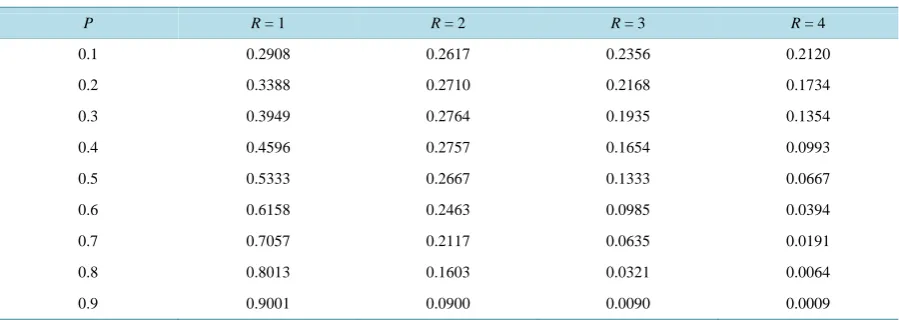
Using Equation (2.3) and from any fixed value of p in (0, 1). Different values of p can be generated for any values of r. Therefore our r here will represent the number of blocks to be selected and the appropriate values of p attached to it are the probabilities of being selected at each random selection with replacement.
Below are the table value generated for a number of fixed number of p in (0, 1), for different values of rth truncation geometrically.
Table 1. Summary Statistics values for truncated geometric distribution
P R = 1 R = 2 R = 3 R = 4
0.1 0.2908 0.2617 0.2356 0.2120
0.2 0.3388 0.2710 0.2168 0.1734
0.3 0.3949 0.2764 0.1935 0.1354
0.4 0.4596 0.2757 0.1654 0.0993
0.5 0.5333 0.2667 0.1333 0.0667
0.6 0.6158 0.2463 0.0985 0.0394
0.7 0.7057 0.2117 0.0635 0.0191
0.8 0.8013 0.1603 0.0321 0.0064
0.9 0.9001 0.0900 0.0090 0.0009
Suppose that L length, numbers 1 to N are to be selected randomly with replacement. Then, the process con-tinues until it is truncated geometrically at r with an appropriate probability P attached to its random selection in form of r r, +1,r+2,,r+N−1. We take our N to be 4, that is, the random selections could be truncated be-tween 1 to 4 at an appropriate probability.
Then, a description of the resampling algorithm when r > 1 is as follows: 1) Let X1,,XN be a random variables
2) Let X1
∗
be determined by the r-th truncated observation Xr in the original time series,
3) Let Xi1
∗
+ be equal to Xr+1 with probability 1 − P and picked at random from the original N observations
with probability p.
4) Let Bi b, =
{
X Xi, i+1,, Xi b+ −1}
, be the block consisting of b observation starting from Xi5) Let
1,1, 2, 2,
I L I L
B B be a sequence of blocks of random length determined by truncated geometric distribu-tion.
6) The first L1, observations in the pseudo time series X1,X2, ,XN
∗ ∗ ∗
are determined by the first block
1,1
I L
B of observation 1, , 1 1; i
I I L
X X
− +
the next L2observations in the pseudo time series are the observations in
the second sampled block XI2+ −L2 1.
.
7) The process is resampled with replacement, until the process is stopped once N observation in the pseudo time series have been generated.
8) Once X1, ,XN
∗ ∗
has been generated, one can compute the quantities of interest for the pseudo time se-ries.
The algorithm has two major components, the construction of a bootstrap sample and the computation of sta-tistics on this bootstrap sample, and repeats these operation many times through some kinds of a loop.
Proposition 1. Conditional on X X1, 2, ,XN,X1,X2, ,XN
∗ ∗ ∗
is stationary.
If the original observations X1,,XN are all distinct, then the new series X1, ,XN
∗ ∗
is, conditional on
1, , N
X X a stationary Markov chain. If, on the other hand, two of the original observations are identical and the remaining are distinct, then the new series X1, ,XN
∗ ∗
is a stationary second order Markov chain. The sta-tionary bootstrap resampling scheme proposed here is distinct from the proposed by [4] [5], but posses the same properties with that proposed by [2].
4. Conclusion
The truncated geometric bootstrap method proposed in this paper is a true probability model with the estimated parameters. The method was able to determine the block sizes b and probability p attached to its random selec-tions. The mean and variance were estimated for the truncated geometric distribution and the bootstrap algo-rithm developed based on the proposed probability model.
References
[2] Rider, P.R. (1953) Truncated Poisson Distribution. Journal of the American Statistical Association, 48, 826-830. http://dx.doi.org/10.1080/01621459.1953.10501204
[3] Rider, P.R. (1955) Truncated Binomial and Negative Binomial Distribution. Journal of the American Statistical Asso-ciation, 50, 877-883. http://dx.doi.org/10.1080/01621459.1955.10501973
[4] Kunsch, H.R. (1989) The Jacknife and the Bootstrap for General Stationary Observations. The Annals of Statistics, 17, 1217-1241. http://dx.doi.org/10.1214/aos/1176347265
[5] Liu, R.Y. and Singh, K. (1992) Moving Blocks Jackknife and Bootstrap Capture Weak Dependence. In: R. Lepage and L. Billard, Eds., Exploring the Limits of Bootstrap, John Wiley, New York.
[6] Politis, D.N. and Romano, J.O. (1994) The Stationary Bootstrap. Journal of American Statistical Association, 89, 303- 1313. http://dx.doi.org/10.1080/01621459.1994.10476870
[7] Barreto, H. and Howland, F.M. (2005) Introductory Econometrics, Using Monte Carlo simulation with Microsoft Excel. Cambridge University Press, Cambridge. http://dx.doi.org/10.1017/CBO9780511809231
[8] Efron, B. (1979) Bootstrap Methods: Another Look at the Jacknife. The Annals of Statistics, 7, 1-26. http://dx.doi.org/10.1214/aos/1176344552
[9] Leger, C., Politis, D. and Romano, J. (1992) Bootstrap Technology and Applications. Technometrics, 34, 378-398. http://dx.doi.org/10.1080/00401706.1992.10484950
[10] Efron, B. and Tibshirani, R. (1986) Bootstrap Measures for Standard Errors, Confidence Intervals, and Other Measures of Statistical Accuracy. Statistical Science, 1, 54-77. http://dx.doi.org/10.1214/ss/1177013815
[11] Efron, B. and Tibshirani, R. (1993) An Introduction to the Bootstrap. Chapman and Hall/CRC, London
[12] Diciccio, T. and Romano, J. (1988) A Review of Bootstrap Confidence Intervals (with Discussion). Journal of the Royal Statistical Society B, 50, 338-370.
[13] Davison, A.C. and Hinkley, D.V. (1997) Bootstrap Methods and their Application. Cambridge University Press, Cam-bridge. http://dx.doi.org/10.1017/CBO9780511802843
[14] Bancroft, G.A., Colwell, D.J. and Gillet, J.R. (1983) A Truncated Poisson Distribution. The Mathematical Gazette, 66, 216-218.
currently publishing more than 200 open access, online, peer-reviewed journals covering a wide range of academic disciplines. SCIRP serves the worldwide academic communities and contributes to the progress and application of science with its publication.
Other selected journals from SCIRP are listed as below. Submit your manuscript to us via either