Cluster-Head Selection on Link Quality Routing
Protocol for Wireless Sensor Network
ABSTRACT
In recent years, the researchers do lot of research on Wireless Sensor Network. But the most research going on the prolongation of the lifetime of the WSN and declined the energy consumed by the sensors. There are lots of protocols which are generated for routing in WSN but these have some limitations. In this article analyzes the cluster head selection phase of LEACH protocol and presents the improved approach of LEACH i.e. CSLQ (Cluster-head based on link quality) that improves the lifetime of the network. In CSLQ the cluster –head is selected on the basis of link quality so that number of packet loss is decreased as compared to the LEACH protocol. In this paper evaluated both modified LEACH [9] and CSLQ through extensive simulations using NS2 (Network Simulator 2) which shows that CBLQ protocol performs better than the LEACH protocol.
Keywords:
Wireless Sensor Network, CSLQ, LEACH, Energy efficiency, Routing1. INTRODUCTION
The WSN have a large number of sensor nodes that are deployed densely over the
network and a base station. The base station can be inside or outside the network [1]. The Protocols of WSN can be classified into two kinds of protocol flat routing protocol and network structure based routing protocol. But the flat routing protocol is not suitable for large area network for example single-hop transmission protocol [2]. The sensor is a device that is capable of producing a measurable response to change in any physical condition like temperature, magnetic field etc. In addition these sensor nodes takes part in communication they can process the gathered information, transmits the message to sink node and communication with each other. These nodes are operated at battery, with low power and limited storage capacity, the battery of that nodes are not replaceable. Hence the energy-efficient management plays a very critical role in increasing the lifetime of the Wireless Sensor Network [3]. In order to achieves network scalability and high energy efficiency, sensor nodes are grouped into clusters. Each cluster is managed by cluster head, which can aggregate the data from the other nodes
and sends that data to the sink node or base station. There are numbers of method to select the cluster head into a single cluster for example HEED, LEACH, PEGASIS etc [4].
The rest of the paper is organized as follow: Section 2 deals with the related work; section 3 specifies the system model and energy model whereas section 4 details the proposed protocol. Simulation results and performance analysis are providing under section 5, section 6 concludes the paper.
2. RELATED WORK
S. Kaur et al [5] have proposed Improvement in energy efficiency of Wireless Sensor Network. In this scheme WSN the energy efficiency is the greatest topic for the research purpose. Clustering in the wireless sensor network is very important to increase the lifetime of the network .There are several numbers of protocol which is based on it but here the LEACH protocol is used for clustering .In LEACH each node has to equal probability of select as the cluster head .In each round the cluster head is change because every node has equal probability for selecting as a cluster head .In this paper the focus is on the approach how could the number of cluster head are limited in the network if there are limited number of cluster head in the network than the lifetime of the network is increased and decrease the energy dissipation per node.
C. Guo et al [6] have proposed the Analysis and Optimization of Energy Efficient Cluster Forming for Wireless Sensor Networks. In this scheme Wireless Sensor Network should operate without protection for the long time before the replacement of battery; therefore characteristics such as self-organization and energy efficiency are of at most importance to the WSN. In the WSN we have meet with all these requirement by dividing the WSN network into clusters, where each the cluster managed by a cluster head. In this paper, provided the analysis of energy consumption in a clustered network and gain of energy with different number of nodes in the network. This analysis is generally proposed for minimize the energy consumption at the time of cluster head selection by the less cluster head selection. This provides the lifetime of the network is prolonged and easy to maintain the network.
Sitender Kumar
Arvind Kumar
Rohit Kumar vishwkarma
Research Fellow Astt. Professor Research Fellow
23 Hiren Kumar Deva Sarma et al [7] have proposed Energy
Efficient Routing Protocol for Wireless Sensor Networks with node and sink mobility. In this study, authors are going to propose a new protocol based on mobility of Node as well as Sink. In which the network is divided into some logical clusters which have contain sensor nodes, cluster head and gateway node. The proposed protocol is hierarchical in nature and the entire process is divided into two phases i.e. set-up phase and data forwarding phase. During set-up phase the network is divided into logical clusters and each cluster has contained ordinary sensor nodes, cluster head and gateway node. During the data forwarding phase ordinary sensor node sense the data from the environment and forward it to the cluster head and cluster head forward this aggregated data to the gateway node and then at last the gateway node has send that data to the sink either directly or with help of other gateway node. Cluster head selection is depending on sink, sink form geographically uniformly distributed clusters in the sensor field. Sink has selects two cluster head in a single cluster for removing the bottleneck problem at one central node. Gateway node is selected on the basis of highest energy level in the present cluster.
Caixia Li et al [8] have proposed A Sink-Controlled Energy-Efficient and Geographical Routing Protocol in Wireless Sensor Networks, which concentrates the energy dispersal on sink node to reduce the normal node energy load. At sink node, the Dijkstra algorithm is adapt for calculate the path which have minimal energy consume. In this scheme the Sink node control the whole routing procedure depending upon the nodes energy and location. In this article the authors assume a sensor network with the following properties:
A sink node has lot of energy, and it has large range to cover the whole sensor networks area.
All sensor nodes are energy constrained and has a initial energy which is allocated.
All sensor nodes are not movable.
If the nodes are alive in the network, than it will be send the data which is sensed from the environment.
All sensor nodes having power control capabilities to vary their transmitted power according to transfer distance and have same communication range.
3
.SYSTEM MODEL
3.1
NETWORK MODEL
In this paper, for a wireless sensor network the following assumptions about the network model have been made:
The sensor nodes are randomly deployed in a two-dimensional geographic area in WSN.
The sensor nodes are static i.e., the nodes remain stationary once they are deployed randomly in the network.
There is only one sink node that could be inside or outside the sensor network.
The sensor nodes are aware of its location or the position in the network.
The batteries of the sensor nodes are non-replaceable and not-rechargeable.
All nodes send data to the CH.
All nodes aggregate information about the link packet loss from all the neighbors.
3.2
Energy Model
In wireless communication, we can decrease attenuation of transmitted power by decreasing the distance. Two types of channel transmission model are proposed in [LEACH] i.e. multi-path attenuation and free space model.
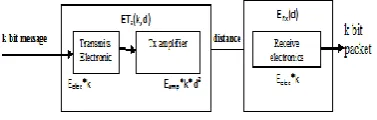
A simple radio model is used in LEACH protocol for transmits the k bit length message at d distance [9]. The energy is used for transmits the k bit message with distance d is taken by that radio model that shows in figure.3.2
ETx(k,d)=ETx_elec*k+ETx_amp k* d………..(1)
ETx(k,d)=k*Eelec+k*ϵfs*d2………d<d0..(2)
ETx(k,d)=k*Eamp+k*ϵfs*d4……d>=d0..(3)
And to receive k- bit message ERx= k* Eamp d0= √ϵfs/ϵamp
d= √(x2-x1)2 + (y2-y1)2
Where Eelec is the power used for dispatched per bit transmission between sender and receiver, Eamp is the energy that is used for amplify the signal, d0 is the threshold transmission distance and ϵfs, ϵamp are are the energy consumption factor of amplification in two radio models and x2 andx1 are the coordinates of x point,y2 and y1 are the coordinates of y and d is distance between two nodes.
[image:2.595.328.517.431.491.2]In addition the energy can lost during the aggregation of data from the nodes and signaling. It can be denoted as EDA .
Figure 1. Radio model of sensor node
4
.CSLQ
(CLUSTER-HEAD
SELECTION ON LINK QUALITY)
ROUTING PROTOCOL OPERATION
Cluster head based on link quality is a clustering routing protocol. Clustering plays an important role for designing the routing protocol for wireless sensor network, with the help of clustering the energy of the network is preserved so that the lifetime of the network is prolonged. CSLQ is designed for preserved the energy of the network and less the ratio of packet loss.
Figure 2 CSLQ process
4.1 Cluster formation and Cluster head
selection
During this phase the network is formed with deployment of nodes in a region. After that the network is partitioned into small regions known as clusters. The clusters are formed, now select the cluster head node those act as a gateway between its member and base station. The member nodes select the cluster head on the basis of the link quality those node has highest link quality that is act as a cluster head. In case of similar link quality of two nodes that check the other parameter that are node density, node connectivity, node id, node energy etc. That phase is categorized into three steps:
4.1.1 Node deployment
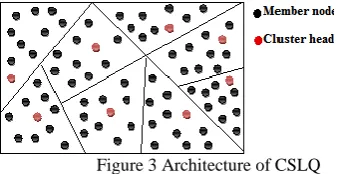
[image:3.595.80.249.629.716.2]In this step, the sensor nodes are deployed in a specific region and that sensor nodes and the base station are fixed in a network. Each node has its unique id and its location. These sensor nodes have contain all things which is need for transmission like memory for storage the information about the neighbor nodes, battery power microcontroller and radio transceiver. In wireless sensor network the sensor nodes are communicate with the base station which is connected to the server. A sensor node in a WSN is take part to communicate with another node which is connected to it and perform some processing, aggregate the sensing information shown in figure.
Figure 3 Architecture of CSLQ
4.1.2 Cluster formation
In this step, the sensor network is partitioned into small regions called clusters. Each cluster is managed by its
cluster head which has been discussed in next session in detail. The benefits of clustering in WSN are given below:
Clustering provides the spatial reuse of resource to increase system capacity. For example, if the clusters are not neighbored, they can use the same frequency for wireless communication.
Routing information of a cluster is shared only other cluster–heads or cluster gateways. This restriction reduces the numbers of transmission performed for distributing routing information. By using this advantage of clustering, more energy efficient routing protocol has been implemented.
4.1.3 Cluster head selection
In this step, the selection of cluster head is doing how the cluster head is selects. That step includes the following steps:
All nodes aggregate information about the link packet loss from all the neighbors.
By using this information each node will choose CH based on smallest packet loss on link from all neighbors rather than signal strength.
All nodes select the CH on the basis of a end-to-end link quality measurements and energy of the nodes.
Figure 4.1.3 Cluster head selection
Cluster head selection Puedocode
Step 1: All nodes Ni compare Link quality from other node Nj.
Step 2: Ni nodes compare Nj find highest link quality node.
Step 3: Let La and Lb Link quality of two nodes Ni and Nj Step 4: Set threshold Link quality LT
Step 5: If La and Lb > LT Then Step 7: CH selects
Step 8: Else
Step 9: La and Lb = weak link. Step 10: If La and Lb are equal then Step 11: compare node id Ni and Nj Step 12: If Ni > Nj then Ni selects as CH Step 13: End If
Step 14: End If Step 15: End If
4.2 Steady Phase
In steady phase the following steps are there:
The cluster head gives the TDMA schedule to all its member nodes when they start the transmission.
During this transmission the minimum energy is used.
Member nodes sense the environment, collect the data and send it to the CH.
When a particular node has not communicated with other node it will be at idle state.
25 Pseudo code for steady phase
Step 1: If CH selects then Step 2: Send TDMA to nodes Ni and Nj
Step3: CH aggregates (node ID, data packet) Step 4: Transfer to BS (node ID, data packet) Step 5: else
Step 6: If member node =slot time, then
Step 7: Transfer data to CH (node ID, data packet) Step 8: else
Step 9: Sleep Step 10: End if
Step 11: End if
Step 12: These steps of cluster head selection and steady phase are for one round
4.3 Re-clustering Phase
In LEACH protocol the re-clustering is performed after each round. In each round, new cluster head will be selected on the basis of some parameter like remaining energy, connected nodes, distance from base station etc. After that CH sends the signal strength message to its member nodes for joining them so that the energy is wasted for send the signal strength message but actually there is no need to do re-clustering, if re-clustering is done, same cluster head will be selected again. So in CSLQ routing protocol the threshold value is set for the cluster head selection procedure if the cluster head remaining energy greater than the threshold value than same cluster head is selects for next round.
Threshold value calculated by simple formula:
TH= Remaining energy after first round Initial energy of the Cluster head
If threshold value greater than 25 percentages than the re-clustering is not performed otherwise the cluster head select again by same procedure which is discussed in section 4.1.3
Pseudo code for re-clustering phase Step 1: Re-clustering is done if needed.
Step 2: Let EThreshold =25 % of initial energy of the CH. Step 3: If CH energy > EThreshold then same CH for next round
Step 4: else
Step 5: Go to step 1 of the pseudo code for cluster-head selection.
5 SIMULATIONS AND RESULTS
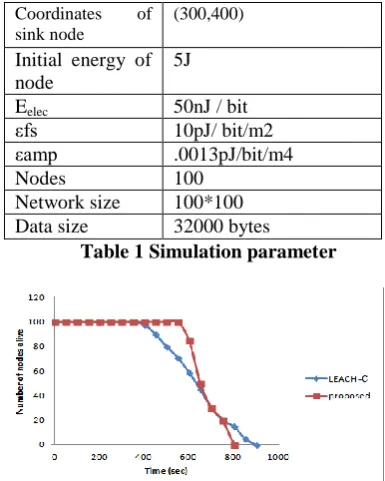
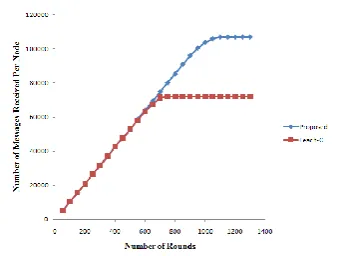
In this section the simulation and results of the proposed scheme is discussed. The proposed scheme is compared with existing protocol LEACH in term of network lifetime, number of alive node, Percentage of received packets against the number of mobile nodes, average energy consumption. Simulation parameters are taken as LEACH protocol shown in Table1 simulation parameter. Figure 4 and figure 5 shows that the proposed scheme is perform better than LEACH protocol in term of network lifetime and average energy consumption of the wireless sensor network. So that we can say that CSLQ protocol prolonged the life time of the network.
Coordinates of sink node
(300,400)
Initial energy of node
5J
Eelec 50nJ / bit
εfs 10pJ/ bit/m2 εamp .0013pJ/bit/m4 Nodes 100
Network size 100*100 Data size 32000 bytes
Table 1 Simulation parameter
[image:4.595.330.523.71.312.2]Figure 5 Number of node alive vs. time in sec
[image:4.595.324.526.73.617.2]Figure 6 Average energy consumption
Figure 5 Number of packet received per node over various round
6 CONCLUSIONS
In this paper a cluster head based on link quality routing protocol is proposed for energy efficient routing in Wireless Sensor Network. In this protocol the network is divided into the clusters and then each cluster is managed by its cluster head. Here the cluster head is choosing on the basis of link quality and it is fixed until its energy goes below some threshold value. In this proposed scheme the energy which is lost at the time of cluster head selection and doing re-clustering in original LEACH protocol after each round has been saved so that protocol has prolonged the lifetime of the network and reduced the number of packet loss during the transmission. The simulation results shows that the CSLQ is perform better than the original LEACH protocol.
7 REFERENCES
[1] S. Kumar, A. Kumar, R.K. vishwkarma,” A Survey On Routing Protocol For Wireless Sensor Network”, in proceeding of IJARCET, Vol 2, No. 2, 2013.
[2] Ameer Ahmed Abbasi , Mohammed Younis , “A survey on clustering algorithms for Wireless sensor networks”,in proceeding International Journal of Computer Applications (0975 – 8887) Volume 62– No.3, January 2013.
[3] B.A. Sabarish, R. Lavanya,” Modified LEACH protocol for Wireless Sensor Networks” in proceeding of International Journal of Computer Applications(0975-8887) Volume 62- No.3, January 2013.
[4] B. Krishnamachari, D. Estrin, and S. Wicker, “The Impact of Data Aggregation in Wireless Sensor Networks”, in Proceedings of IEEE Int’l Conference on Distributed Computing Systems Workshops (ICDCSW), 2002, pp. 575-578.
[5] S. Kaur, D. Prashar and R. Rani,“Improvement in energy efficiency of Wireless Sensor Network”, in International Journal of Computer & Technology, vol. 2 no.2 , 2012
[6] C. Guo, R. Hekmat and Przemyslaw, “Analysis and Optimization of Energy Efficient Cluster Forming for Wireless Sensor Networks”, in IEEE Publication, 2007.
[7] Hiren Kumar Deva Sarma, Avijit Kar, Rajib Mall.” Energy Efficient Routing Protocol for Wireless Sensor Networks with Node and Sink Mobility”,IEEE, 2011.
[8] Caixia Li,Fang Pu,Aiping Gu,Linlang Liu,Qiying Cao,”A Sink-controlled Energy-efficient and Geographical Routing Protocol in Wireless Sensor Networks”,IEEE, 2011.
[9] W.B. Heinzelman, A.P. Chandrakasan, H. Balakrishnan, “Application specific protocol architecture for wireless microsensor networks,” IEEE Transactions on Wireless Networking, 1(4), 2002, pp.660-670.