ScholarWorks @ Georgia State University
Art and Design Theses Ernest G. Welch School of Art and Design
Fall 11-30-2010
Changing the Traditional High School
Photography Curriculum: Integrating Traditional
and Digital Technologies
Julie A. Cooper
Georgia State University
Follow this and additional works at:https://scholarworks.gsu.edu/art_design_theses
This Thesis is brought to you for free and open access by the Ernest G. Welch School of Art and Design at ScholarWorks @ Georgia State University. It has been accepted for inclusion in Art and Design Theses by an authorized administrator of ScholarWorks @ Georgia State University. For more information, please [email protected].
Recommended Citation
Cooper, Julie A., "Changing the Traditional High School Photography Curriculum: Integrating Traditional and Digital Technologies." Thesis, Georgia State University, 2010.
CHANGING THE TRADITIONAL HIGH SCHOOL PHOTOGRAPHY CURRICULUM:
INTEGRATING TRADITIONAL AND DIGITAL TECHNOLOGIES
by
JULIE A. COOPER
Under the Direction of Dr. Melody Milbrandt
ABSTRACT
This thesis presents a photography curriculum for a beginning high school level photography
class. It is designed as a teaching guide to structure a photography class that incorporates both film
photography and digital photographic technology. One of the biggest challenges for teachers of
photography is how to structure a curriculum with a limited number of enlargers and space in the
darkroom, while incorporating digital technology with limited computer access for students. The
curriculum presented here includes three major parts: a traditional photographic film component, a digital
photography component, and a concepts component where students will experiment with different
photographic techniques of manipulation as well as tackle photographic history, criticism, and visual
literacy.
INDEX WORDS: Photography, Art education, Digital photography, Art and technology, Criticism,
CHANGING THE TRADITIONAL HIGH SCHOOL PHOTOGRAPHY CURRICULUM:
INTEGRATING TRADITIONAL AND DIGITAL TECHNOLOGIES
by
JULIE A. COOPER
A Thesis Submitted in Partial Fulfillment of the Requirement for the Degree of
Master of Art Education
in the College of Arts and Sciences
Georgia State University
95
Copyright by Julie Allison Cooper
CHANGING THE TRADITIONAL HIGH SCHOOL PHOTOGRAPHY CURRICULUM:
INTEGRATING TRADITIONAL AND DIGITAL TECHNOLOGIES
by
JULIE A. COOPER
Committee Chair: Melody Milbrandt
Committee: Melanie Davenport
Kevin Hsieh
Electronic Version Approved:
Office of Graduate Studies
College of Arts and Sciences
Georgia State University
97
ACKNOWLEDGEMENTS
I would like to express my sincerest thanks to my thesis committee for their time,
support, and guidance in helping me to develop this thesis. I particularly would like to thank Dr.
Melody Milbrandt who has guided me from the start as well as offered support and
encouragement along the way.
I would like to thank my husband, Craig Denison, for all the love and encouragement he
continues to give. Lastly, I would like to thank my parents, John and Jane Cooper, for always
TABLE OF CONTENTS
ACKNOWLEDGEMENTS iv
LIST OF TABLES vii
CHAPTER 1 Introduction andNeed for the Study 1
Purpose of the Study 2
CHAPTER 2 Review of Literature 5
Photographic History vs. Art History 5
Photographic Education 6
Incorporating Art Criticism and Photographic Art History 7
Visual Literacy and Photography 8
The Digital Camera and Digital Photographic Technology 8
Technologies Within Current Art Education Classrooms 14
Concerns 21
Summary 23
CHAPTER 3 Methodology 25
Limitations of the Study 28
CHAPTER 4 Semester Overview 29
CHAPTER 5 Instructional Lessons 33
Lesson 1: Leading Lines/ Texture Film Photography 33
Lesson 1A: Concept Lesson 42
99
Lesson 2A: Concept Lesson 57
Lesson 3: Industrial/Mechanical/Construction Film 61
Lesson 3A: Concept Lesson 70
Lesson 4: Abstract Photo Composition 74
Lesson 4A: Concept Lesson 84
Lesson 5: Formal Portraiture/ Lighting Film Photography 88
Lesson 5A: Concept Lesson 97
Lesson 6: Rhythm and Pattern 101
Lesson 6A: Concept Lesson 111
CHAPTER 6 Conclusions 115
Reflective Analysis 115
Analysis of Digital Photography Lessons 116
Analysis of Film Photography Lessons 117
Analysis of Photography Concept Assignments 118
Conclusions and Recommendations for Further Research 123
REFERENCES 125
LIST OF TABLES
Table 3.1 Student Subgroup Table 25
Table 3.2 Race/Ethnicity Table 25
Table 4.1 First Six-Week Grading Period 27
Table 4.2 Second Six-Week Grading Period 28
101
CHAPTER 1
Introduction and Need for the Study
The need for this study arises from the many problems and complications that happen
when teaching high school photography. One of the problems I have found in the past when
teaching photography is that there is so much down time for students who cannot use the
darkroom because the lack of enlargers for all the students. My current darkroom has 5
enlargers, while the average photography class I have usually falls between 15 and 20 students.
While I can only have 5 students printing on the enlargers at one time, I need to find interesting,
effective assignments for the students not using the enlargers. Some photography teachers find it
difficult to bring in the added component of art criticism, art history, visual literacy or even the
manual manipulations that can be done with photographs. What I propose will help solve the
issue of downtime for students who cannot be on the enlargers as well as bringing in those
additional components that would otherwise be difficult to add into the photography curriculum.
Secondly, film photography is slowly becoming obsolete. Because the world is making
the switch to digital, it only makes sense to begin to use digital photography in a high school
photography curriculum. However, I do feel strongly about keeping film as a part of the
curriculum as well. Students are very motivated by the “magic” that happens when the image
begins to appear in the developer and they feel they have even more control over their images.
However, one of the problems with film is that there is so much to remember and teach with
35mm film that students forget to focus on good compositions. The inclusion of digital
processes with 35mm photography is that each media can help support the other. In teaching
digital photography, there can be more of a focus on creating good composition, while in
processing. Therefore, digital photography can influence the creation of successful compositions
in film and the processing stage of film can help students when manipulating their images in
computer programs like Photoshop. Photoshop allows students to increase or decrease
brightness and contrast but also has dodge and burn buttons which are hard for students to grasp
if they have not used those techniques with the enlarger.
Another problem when teaching photography is the cost involved in teaching and
developing 35mm film. With the decrease in film usage, the cost of film and chemical
developing supplies continues to increase. Adding digital photography into a traditional film
photography curriculum, while can be pricy in the beginning, can save hundreds even thousands
of dollars in supplies in the long run.
Purpose of the Study
The purpose of the study serves to answer the following questions, how might I construct
a beginning level photography curriculum that aligns with Georgia Art Standards integrates
lessons for teaching traditional black and white dark room photography with digital media, visual
literacy, history and criticism of photography? And the question of what do photography teachers
do with the students who are not working in the darkroom, or if there is not enough photography
equipment to meet the needs of the entire classroom of students?
This study creates a curriculum model for teaching an introductory level high school
photography class that will integrate digital and traditional darkroom photography as well as
include concept assignments that students will complete when they are not on the enlargers.
Over the past 8 years of teaching photography, I have constantly been on the lookout as to how
to make my photography class better. For the past three years, I have been slowly incorporating
103
photography students as to how to improve the class with each passing year by analyzing the
quality of their work, observing their work habits, as well as observing their reactions to
incorporating those digital assignments. I believe I can construct a curriculum model that other
teachers could follow in order to solve some of the problems that come with teaching
photography.
One of my main solutions to the problem of what to do with the students who are not
working in the darkroom on the enlargers is the inclusion of “Photography Concept
Assignments” that focus on the concepts behind photography, elements of art and principles of
design related to photography, art criticism and visual literacy, as well as photo manipulation.
Throughout the completion of these concept assignments, I think it is important to include art
criticism as well as photographic art history. Students work on concept assignments during the
time that they are not in the darkroom. Students also alter between 35mm and digital photo
assignments, so when they are not in the darkroom working on 35mm assignments, they are
working on their next digital assignment on the computer.
Through incorporating digital photography into the curriculum, students have an
opportunity to focus on creating good compositions, and develop concepts of history during the
“non-darkroom” time. Also, once teachers have the computers and digital technology set up in
their classrooms, it will save them money in the long run on the expense of film photography
materials. My own classroom has two desktop computers, but I have access to two more in the
art room right next door. With a small photography class, four computers is fine, but for a class
larger than ten, the amount of digital assignments would have to be limited. As it stands now, I
am trying to get access for more computers in order to make it easier to have larger photography
with a traditional photography curriculum is a model that other photography teachers can use to
5
CHAPTER 2
Review of Literature
Photographic History vs. Art History
Why is it that photography is not viewed on the same level as other forms of art media
within art history? Diana Hulick (1992), insists that although photography arrived much later
than most traditional art forms, it should never have been alienated from other forms of art
media. However, those photographic works that are considered of vital importance in the history
of photography are not always recognized as being significant to the whole of art history;
photography is rarely touched on in most college level survey’s of art history (Hulick, 1992).
Another difference is that when one does study art history, Western art is traditionally presented
using individual masterpieces of artists as opposed an entire body of work as is the case when
presenting art history of photography. In addition, when most photographic history is presented,
it is categorized by subject matter, as opposed to traditional art history, where period or style is
the rule (Hulick, 1992). One of the best examples of the difference in generic art history in
relation to photographic art history is how they each view the work of Ansel Adams. The
generic art history world views Ansel Adams to be a foremost landscape photographer, while
photographic historians and photographers would recognize Adams for his invention of the
“zone system” as well as being an excellent teacher of the technical aspects of photography.
Another example is the work of photographer, Ralph Eugene Meatyard who is virtually unknown
outside the field of photography, but is considered by photographic historians as important for
his photographic subtlety (Hulick, 1992).
One possible reason for viewing the photography medium as less valuable than other art
media combined and when there is more of something, the value of that object decreases. Also,
because most forms of photography, digital, film, etc., have the ability have the ability to be
mass-produced, each individual photograph is worth less than individual one-of-a-kind artworks
such as paintings, for example. Therefore, the media of photography may be viewed as less of a
value than other media, which transfers to a less valued focus in art appreciation classes, art
history, art education, and even art research.
Photographic Education
Diana Hulick (1992) notes that, since photography arrived on the main scene, there has
been a fight for photography to be looked at as a fine art among other conventional art media.
Likewise, in relation to traditional arts education, Newberry (1997) insists, “photographic
education is an area that has inspired very little in the way of academic research” (p. 421). In
many cases, the history and culture of photography is left out of current photographic education,
which, instead focuses on the technical skill required in photography (Newberry, 1997).
Newberry (1997) suggests that “although research into the content of some photographic courses
may suggest that they are almost entirely technical, it is in the relationship between technology,
the student-photographer, and the social world that some of the most important learning takes
place” (p. 422). When students are given specific photographic assignments, they are rarely
required to question the meaning behind the imagery they are creating or to consider the context
in which their images can be read (Newberry, 1997). Stuart Oring (2000) notes that it is only at
the most advanced classes in photography that visual communication is taught, while at the
lower levels, the subject is barely covered at all. The view of Fey and Bashmore (2000), is that
medium, photography reflects a series of decisions by the artist that are informed by aesthetic,
social, and political influences” (p. 26).
Incorporating Art Criticism and Photographic Art History
Art criticism is an important part of the art curriculum, yet many photo classes neglect
this aspect and, instead, focus on technical skill and design. In a study done by Georgiana Short
(1998), she found that by incorporating art criticism into a traditional studio art curriculum,
students were able to achieve a higher rate of transfer. This allowed them to apply what they had
learned to later works of art or to apply that knowledge to their own studio projects. The teacher
provided guided practice for describing, analyzing, and interpreting works or art. Therefore, this
“consistent approach to examining artworks may also have allowed students to internalize a
method for describing and interpreting artworks” (Short, 1998, p. 60).
Candace Stout (1999) incorporated direct quotes from the photographers they studied in
the class as another technique for art criticism. For example, she used Alfred Stieglitz’s quotes
from his essay, “How The Steerage Happened”, in order to inform his photograph of The
Steerage. Stout found that combining direct quotes from Alfred Stieglitz with viewing his
artwork, gives much more motivation for student input (1999). As students are able to better
understand the artist’s viewpoint the art work becomes more real to them. This approach could
also help students understand more complex design ideas. Stout describes her use of a second
essay Stieglitz wrote on photographing clouds; “students were …surprised by Stieglitz’s heated
pursuit of art. Most importantly, the photographer’s writings on clouds dissipated the conceptual
fogginess these basic level students had about abstraction” (Stout, 1999, p. 233).
In an article by Fey and Bashmore (2000), the authors discuss using the work of
guide for examining and analyzing a photograph. It includes four sections: visual elements in a
photograph, what you see; design of a photograph, how things are arranged; how the photograph
was made, methods and equipment used; and finally, what the photograph communicates, feeling
and mood (Fey and Bashmore, 2000).
Visual Literacy and Photography
When students take art appreciation courses, they rarely deal with photography at all and
if photography is touched on, students are not taught how to analyze photography with a proper
visual language (Hulick, 1992). Stuart Oring (2000) emphasizes the importance of visual literacy
by saying that,
A wise man once said that a picture is worth a thousand words. But, when visual
symbols are used in place of words to express an idea, or to evoke a feeling or mood
within us, it is necessary for the viewer to be able to understand the message. (p. 58)
Oring values visual literacy as a technique that is vital to life because visual imagery surrounds
every one of us daily. If we fail to understand the visual language that is communicated by those
images, we fail to understand much of the world itself. So why is it that the technical aspects of
photography continue to be taught with little to no time focused on the visual language behind
the images created? Oring (2000) again emphasizes this importance stating that, “reading a
picture in a meaningful way is the only way that a true communication between the artist and the
viewer can take place” (p. 58).
The Digital Camera and Digital Photographic Technology
Several authors, when describing the benefit of digital photography as an alternative to
film, have noted either the ease of use or the cost savings benefits including Callow (2001),
Fisher and Lazaros (2009). Another benefit for art and classroom teachers is how easy it is to
copy digital images and insert them into other computer documents. Additionally, the space
saving that digital files have over film or actual prints is beneficial because digital files only take
up space on the computer, not precious storage space in the classroom (Cavanaugh &
Cavanaugh, 1997; Radclyffe-Thomas, 2008). Philip Callow (2001) notes the quickness that
digital photography allows in comparison to film because it removes, “the need to spend long
hours locked in a darkroom processing images in the traditional way” (p.47).
While the digital photography process is completely different from traditional, analog
photography, many of the concepts are the same. One of the initial worries was the selective
cropping of digital images would not be possible with the same clarity as analog technology.
But with the advancement in digital technology, pixel-by-pixel selection and manipulation is
possible. With film or analog photography, selective manipulation is achieved through framing,
dodging and burning, and timing of exposure, while digital computer programs and software are
used to manipulate digital photography (Hulick, 1990). In an article by Dybas (2005), reported
on findings from a college educational panel that was analyzing the changes in photography
education with the advent of new technologies. He found that a number of participating
individuals on the panel were changing the traditional photography curriculum to include
offering black and white, color, and digital photography within the course of a semester-long
introductory photography course (p. 11). Included below are examples of three different
photographic models of teaching that include either the use of digital cameras or digital
technologies, including online photography lessons, incorporated into the curriculum. The first
model uses digital photography and collaborative student learning to teach visual literacy to
classroom photography, which teaches technical skills with a Web based course, with lessons on
visual literacy and developing critical analysis of the content of photographs produced; this is a
supplement to the on-campus photography class. The third model is similar to the second in that
it combines a traditional on-campus photography class with an online component; but this
component is in the form of a virtual studio to teach complicated lighting concepts for students to
experiment with virtual equipment that would be limited in a real life studio situation.
Incorporating digital technology in fifth grade inner city- class
Phil Riner (2005) analyzed the effects of the incorporation of digital photography within
a fifth grade inner-city classroom. Many who were able to view the results on display at the
University of North Florida would have guessed that the work was done by intermediate to
advanced level photography students instead of at-risk fifth graders. However, Riner made sure
that the information the students were learning was broken down into small-sequential steps, in
order to compare photography to the students’ everyday decision making. Interestingly, the goal
in this project was to teach students to make better decisions, not to create masterpiece
photographs (Riner, 2005). This process is confirmed by Stuart Oring (2000) who notes that,
“photography can provide a child with critical skills in perception, conceptualization,
verbalization, and decision-making within experiences that are real for him or her” (p. 59). Riner
found that photography is a wonderful tool for understanding how we perceive events through
visual cues and how those perceptions of others could be slightly, yet significantly different
(2005). This has great potential for teaching visual literacy to students in order to help them with
greater decision-making skills.
It was found that through collaborative learning, the students learned more quickly than
motivation. One unexpected finding was that when students worked as a group, they were, “not
interested in identifying the photographer for the picture. Rather, the students generally viewed
pictures as belonging to the group” (Riner, 2005, p.630). With the step-by-step instruction,
students were able to tackle more complex issues in photography such as angles, framing, the
rule of thirds and negative space. Using digital cameras and technology was a benefit to the
learning environment in Riner’s case. Where some teachers find new technologies cold and
impersonal, Riner (2005) insists that,
Technology, in the form of inexpensive digital cameras, provided cost-effective
instruction in social guidance, creativity, design and language experience that enhanced
the humanity of the classroom, as well as capturing the spirited hearts and harnessing the
elusive motivation of children at every ability and economic level. (p.648)
Blended model of photography.
Dr. Shlomo Abrahmov and Miky Ronen (2008) indicated that because there is so much
technical and practical knowledge to be learned in photography, students tended to only focus on
that instead of critiquing the content or meaning behind photography. This prompted them to
conduct a study using a blended model class where, instead of a completely Web based course,
or a complete in-the-classroom course, a hybrid was used in which some online lessons or
component replaced or supported a part of the traditional on-campus activity. This blended
model shows that both visual meaning, as well as technical and practical skill, can be taught and
focused on in a photography class without giving up critical studio production time in class.
According to Abrahmov and Ronen (2008), their goal in using the Internet, “was not to replace
traditional activities, but to introduce the new teaching objectives that would not have been
practiced by nature” (p. 5). While the traditional course included lectures, practical and technical
learning of skill, discussions, class critiques, personal assignments, and a final project; the
blended model used the on-campus part for students to gain camera and photographic skills, and
the Web-based part for critical study and discussion to develop visual literacy. The practical
skills and techniques of photography were the focus of on-campus meetings, while a more
theoretical learning and determining how to read photographs was the focus of online learning
(Abrahmov & Ronen, 2008).
Darren Newbury (1997) also indicated his concerns with traditional photography teaching
and how teachers had a propensity to disregard the visual content and impact that photographs
can have; “the project briefs that students are set rarely ask them to question the meanings
implicit in the dominant imagery they produce in their own work, nor are they asked to consider
the social context in which images are used and given value” (p. 426). Most of the Web-based
photography assignments described in Abrahmov and Ronen’s study asked students to select a
photo from the World Wide Web using certain criteria for each assignment. They were to
analyze the photograph according to various factors such as, composition, lighting, or the
statement that the photograph makes. There were usually also asked to include a personal
response to the photograph selected. In many assignments, students were required to respond to
another student’s post in order to critique it and give feedback. This is a great way to incorporate
critique and visual literacy into a photography class; in my own classes, I could see using these
types of assignments as part of a weekly blog for student responses. Another way that teachers
could incorporate this type of lesson would be for them have students upload their own
photographs onto the web to analyze, interpret, and give a personal response. The results of
All students reported that the online activities were effective and contributed to their
ability to read photographs. Students were specifically asked to reflect on the open
submission approach and their use of peer examples. Most students reported that they
have examined peers’ work before submitting their own, and that they have improved
their analysis as a result of exposure to peer examples. (p. 11)
Virtual studio/ online photography lessons.
Another study that combined digital technologies with photography was done by Stephen
Brown and Iona Cruichkshank (2003), in which a unit on studio lighting was implemented
online. In their traditional photography classes, students were to use the language of light to
express an aspect of themselves. They were to use a thumbnail sketch to demonstrate the pose
they would be in, and how it would be cropped. Students were also to use shading to show
highlighted areas of their face, and how they wanted the background to be lit. Students should
have considered the type and directionality of the light source(s) used. The virtual studio came
about because of the high numbers of students in a traditional photography class. When the unit
on studio lighting was presented, very few of the students were able to experiment with the
equipment; this lead to questions and dissatisfaction because most students had to learn merely
through observation. They decided to develop a virtual simulation of the lighting studio in an
online environment. The online module was a computer-simulation program using a mannequin;
they could choose 22 options for the light positions, four options for the type of light beam, six
options for the pose of the mannequin, and five options of the mannequin in comparison to the
background. In total, this would generate 2,640 unique options for students to pick from. While
the initial cost of developing the program and learning the technology was considerable, it was
project will allow each and every student to experiment with lighting techniques in a virtual
environment (Brown & Cruichkshank, 2003). While the main investment for classroom teachers
wishing to try out virtual photography lessons would be time, it could definitely be beneficial for
student learning and could save teachers time in the long run.
Technologies within current art education classrooms
As an art educator, I feel that it is important to not only focus on technologies used by
photography classes, but also how technology might also be affecting other art educators as well
and to see how they can be used within a photography classroom as well. Included within the
following are other types of emerging technologies art educators are already using in the
classrooms to enhance their lessons and student learning. Today, high school students live in a
world surrounded by media and technology in the form of ipods, television, interactive computer
games, cell phones, BlackBerries, digital photography, Facebook, and other web blogging and
social networking sites. These types of digital technologies offer a great opportunity to bring
students’ own experience and computer interaction into the classroom to enhance learning
(Stanley, 2003). There are so many possibilities teachers have now with the new technologies
available. Whether it be in the form of digital hardware such as laptop computers, scanners, new
high quality printers, digital cameras and video equipment; or software programs such as digital
imaging software, web publishing software, and video and music editing software. Technology
also enables interaction and collaboration either among fellow students, or between students and
specialists from across the world. It is important for art and photography teachers to become
aware of these new technologies because they will have a huge impact on the way everyday
ActiveClass.
There are technologies on the market for teachers to enrich student collaboration as well
as gain feedback from all students, not just the most vocal ones. ActiveClass is a wireless tool
used at the University of California at San Diego to encourage class participation. This
technology utilizes wireless-enabled laptops and Persona Data Assistants, which lets many
students, who may not otherwise participate, share their ideas (Scholz, 2005). Not only does it
give teachers feedback, but Scholz indicates that ActiveClass “permits students to silently ask
questions, share responses, and provide other types of feedback. The results are compiled and
then broadcast to all of the students and the teacher, facilitating verbal discussion” (p. 96). The
implications for this type of technology for use not only at the university level, but also at the
high school level is impressive. Photography teachers could better tailor our lessons for
maximum comprehension with the feedback this technology could give us. I have seen some
students reluctant to collaborate and share their own ideas, yet using collaboration is such a great
learning tool for student understanding. This type of technology could help break the social
barriers to learning that I have observed inhibiting many of my students.
Videoconferencing.
Videoconferencing software allows teachers to get experts in their curriculum fields to be
participants in classroom discussions even though they may be located in a different state or even
a different country. According to Scholz (2005), Warren Sack, a professor at the University of
California at Santa Cruz, uses Apple’s Insight videoconferencing software to get his colleagues
from across the globe to participate in end-of-the-semester critiques with his students. Students
get to pair up with experts using a two-way Web cam to get personalized critiques over the
visual arts so that they “might become regular visitors to each other’s studios” (p.105). I believe
this could have a positive impact on students because when peer critiques and collaboration and
additional expert feedback from professional photographers or even professors of photography at
the college level can only serve to make student portfolios even better.
Online Portfolios.
In a similar manner, students can use the Internet to post their artwork online in an online
photography portfolio accessible to the entire world. These types of online galleries and
portfolios can encourage communication from others with a comment feature that viewers can
click to post comments about the work (Callow, 2001; Radclyffe-Thomas, 2008). I have found
that student weblogs, or blogs, are a great way to do this with my upper level high school art
students, including those in photography. Students can create blogs, to post their artwork and get
feedback from myself as the teacher, fellow students, or from the online community.
Student art exchanges.
Collaboration can also take place through the Internet with online student art exchanges
when students from schools in different locations visually respond to one another using a
common theme (Roland, 2003). In an annual digital art competition sponsored by Philip Callow,
students are challenged to digitally manipulate the same image and then submit their productions
for display in an online gallery (Wood, 2004). Another way art exchanges can take place is
through collaboration on a shared artwork. Artist collaboration to create artwork is not a new
idea; dating back before the Renaissance, masters and apprentices collaborated to form artwork,
but the Internet has helped bring forth a resurgence of artist collaboration. Artists and educators
Jeanne Brynie from Texas and Phi Callow from the United Kingdom created a collaborative
most of which were photos in their backyards that they finalized with filters to complete their
artistic collaboration. This collaboration influenced one of Callow’s students to collaborate with
an artist in Santa Cruz, California named Bob Slider. They began with the students altered
portrait and the artist added a tattoo-like pattern across the face (Callow, 2001). In addition to
demonstrating that it is possible to collaborate via the World Wide Web, this also illustrates how
students can be put in touch with experts with whom they share an interest; some may even be
able to work with these experts to create new artwork. This is exciting because teachers of all
subject areas could also use the Internet to find experts who would like to work collaboratively
with students. But this would be an incredible experience for collaborative work in a
photography class. Students could work collaboratively with professional photographers both
local and across the world, or they could also work in collaborative groups within the
photography class, combining photographs of each student in the group into one cohesive work
of art.
Students as Media Creators
Although some artists might have frustrations with existing digital technologies and
software programs, both teachers and students utilize using these existing technologies to be
creators of online content. Radclyffe-Thomas (2008) notes “the increasing accessibly of
electronically mediated experiences creates opportunities for students to become cultural
producers with global exposure rather than just mere consumers” (p. 164). Students are now
actively involved and participating instead of being passive consumers of information and media
images (Callow, 2001). The hardware of digital cameras, video cameras, and audio recorders
combined with video and audio editing software like Apple’s Imovie and GarageBand, as well as
indicated by Brown (2007), that ordinary people “are now creating music videos, animation, and
short films; podcasting; remixing their favorite songs; publishing Webzines; and blogging”
(p.306). Buckingham, Pini, and Willett (2007) note that part of the sales promotions for mobile
phones is the ability for amateurs to create their own movies using the technology on the phone
being advertised. It is only too easy for these movies to then be posted to an online format.
Online content creation can be used as a tool for students to create their own means of personal
expression to find their own creative voice, such as in a weblog. Although much of the online
creating does use art and technology, other disciplines could utilize these techniques to enhance
their curriculum through visual culture connections. Buckingham, Pini, and Willett (2007)
indicate that the simplification of technology is “blurring the lines between professional and
amateur filmmaking” (p. 189). With the ease of new technologies, photography students can
create high quality videos and images that can be incorporated into their artwork. Brown (2007)
suggests that teens are sometimes known as “media remixers” in that they use media materials
from online pictures, videos, songs, stories, etc. and refashion them into something new. These
could be parodies or photo collages of known media content that could easily have
interdisciplinary connections.
Digital manipulation.
Some photography teachers include digital manipulation as a part of their curriculum,
Philip Callow put together a Digital Art Workshop for his students in the United Kingdom that
combined aspects of digital photography, digital manipulation, and Internet collaboration to
create artworks that depicted each student’s personal self-expression. While students began with
digital portraiture, the goal was to introduce students to the possibilities of layering digital
and individual interests. Students were encouraged to incorporate materials taken from popular
culture from web sources, other digital photographs they had taken, as well as using a digital
scanner to scan actual artifacts of personal interest (Callow, 2001). This workshop has the
possibility of visual culture connections as well as visual literacy to find meaning in student
photography. This type of lesson could be used as part of a photography curriculum or a regular
visual arts curriculum.
Joyce Wood (2004) also discusses ways to use digital manipulation in the visual arts.
One of which is to start with a drawing or painting that can be scanned into the computer, and
then use digital manipulation software to add to it, using filters, or special effects to enhance the
artwork. Art educator James Naire does this with his students, and he comments that the
computer was, “a nice tool for getting them to work in a painterly way” (Wood, 2004, p. 185).
Sue Crudgington relates that the computer and digital technologies allows students the freedom
to try out new things without the fear of it being permanent. They can try it out, and if it doesn’t
work, a few keystrokes will get them back to the start. The same is true with digital photography
in that students can be more experimental and then be more selective about the final image they
choose to print out (as cited in Wood, 2004). Crudgington encourages her students to use the
digital scanner to scan items that filter light such as plastic wrap, film negatives, netting, etc; and
then uses these images along with other items to create digital collages. Wood also interviewed
art teacher, Jan McGranaghan, who uses scanners by letting students scan items and images to
use as a starting point for digital manipulation. McGranaghan reported that once these works are
completed, the finished products are saved so they can be scanned in again to be starting points
120
It is important to note that the use of computers as a tool for creating artwork should not
replace the teaching of basic design concepts; Busby, Parrott, and Olson (2000) reported that,
“instructors who used computers in art lessons found that students who understood the elements
of design and composition were more successful in creating computer art and graphics” (p. 190).
While students can create art quickly with a computer, they must be familiar with using the
elements and principles of design in their compositions, or their art will not be strong enough to
stand as fine art. Still, digital manipulation can help composition analysis because when students
work with changing the usual perception of an image, it helps students to become more sensitive
to what elements it takes to make a composition successful (Kirschenmann, 2001). But digital
manipulation can help in other ways as well. In using new technology as a tool, students can use
software tools to play with an image and explore ways they can change the composition; the
digital image just helps them see where they want to go, but the final image is done traditionally.
Digital manipulation software can take images and then alter them on the computer to be the
basis for a more traditional drawing or painting (Wood, 2004).
Artist and art educator, Ken Gonzales-Day, alters and manipulates photography to take a
medium that has its roots in real life documentation and turns it into abstraction. Part of his
photo manipulation series includes taking photographs with a conventional 35mm film camera,
which are then digitally cut up and reassembled. He tends to use portraiture for his subject
matter, yet he crops so close to the skin or the hair that the photograph changes to flat planes or
dynamic lines. He sometimes takes photographs that are cropped very close, so they have lost
the depth of space, and then adds drawing on top of them, relating to the overall theme of the
series. In his series on portraiture, he took detailed photographs of skin and then overlaid them
121
scientific slides of human skin cells. Gonzales-Day insists that photo manipulation can take
place either digitally or manually (Gonzales-Day, 2002).
Concerns
One of the drawbacks in working with digital technologies is keeping up with the
ever-changing rate of technological advances (Busby, Parrott, & Olson, 2000; Scholz, 2005). The
cost of keeping up with these advances is one concern, but another is the time and resources to
train teachers on the new technologies. Radclyffe-Thomas (2008) conveys that, “teachers and
students themselves report the biggest barrier to the use of [computer technology] is the problem
of learning and using the technology itself” (p.163). When deciding to invest in computer
technology, often other peripheral costs are overlooked such as scanners, printers, printer ink,
paper and digital cameras; making class teachers have to account for these items in their
continually shrinking budgets. In combination with this, teachers get frustrated with recurring
technical difficulties or poor Internet connections with a lack of technical support, which can
cause teachers to hesitate before delving into digital technology (Radclyffe-Thomas, 2008).
In a study done by Joyce Wood (2004), art teachers tend to approach technology with a
sense of adventure and they seemed more inventive and insightful about the impact of
technology than other teachers interviewed. That is not surprising, considering the
resourcefulness of most art teachers who can “make silk purses from sow’s ears” (p. 180), but
the art teachers interviewed were concerned about funds to acquire the technology. While most
teachers can get by on standard software, art and design software usually needs higher memory
and higher speed, and is usually more expensive (Wood, 2004). This is something I can relate
to in that I am extremely excited about the possibilities that new technologies can offer for my
122
computers and resources for my entire class of students to take part. I am not alone in this
frustration; in a study done in a higher education setting by Busby, Parrott, and Olson (2000), a
lack of computers for each student to use was seen as a key disadvantage for both the students
and the professor participating.
Other concerns about digital art include the loss of the exclusive quality of fine art, in that
any number of copies of the same piece can be made (Busby, Parrott, & Olson, 2000). Paintings,
drawings, and sculptures are one-of-a-kind pieces. Even printmaking artists limit the amount of
prints they do and then destroy the original plate so that the exclusivity of their work remains.
Some art teachers worried that computers might be misused for trivial purposes, because there is
no point in using a computer for some things that can be achieved with better effects in another
medium (Wood, 2004). For example, Photoshop has a charcoal filter that can mimic the visual
effect of a work in charcoal, but it could never replace an actual charcoal work of art. As art
educator, James Nairne, describes digital art:
With a digital image, you never know what you’re looking at. The human touch isn’t
there at all. There is more interposition or distance between myself and a digital image
than there would be with a painted image. Digital art is once-removed. (as cited in
Wood, 2004, p. 190)
Other teachers may believe that the computer is a barrier for artistic expression because students
appropriate images to use in their artwork from the World Wide Web instead of creating their
own images to use in their works. Or, they fear that students could overwork the image with
what technology can do, and depart from the original source that inspired them initially
(Radclyffe-Thomas, 2008). This relates to one of my own concerns in that I fear that
they loose site of the fact that they are trying to create an interesting composition. Or even that
they spend so much time playing with the options that the technology allows them, they don’t
have enough time to produce the composition they were originally intending in the first place.
Summary
I believe that technology is a great tool for art educators to help amplify student learning,
but can also to make their lives easier. While I don’t believe that art teachers should incorporate
digital art into every lesson, I think they could slowly incorporate it into lessons where it would
be appropriate. In my own quest to benefit my students, I have found that it is most important to
begin incorporating digital technology into my photography classes. Traditional film
photography is becoming more and more rare, and students should be taught technologies that
can help them succeed in the future. If teachers fail to embrace technological advancements,
those teachers and their outdated technologies may become irrelevant to students’ needs because
the world is going to be using these new digital technologies and it is the students who will get
left behind (Radclyffe-Thomas, 2008). I am inclined to focus on the benefits of using these
digital technologies and I am excited to see where they can take my teaching and my students’
learning in the future.
Nick Stanley (2003) indicates that so much of traditional photography teaching is
involved in the technical aspects of photography and more work needs to be done on critique and
meaning of the photographs being taken. This is one of the main reasons that I have integrated
digital photography and daily photography concepts into my traditional photography class. Over
the past seven years of teaching photography using the traditional film media, I have noticed that
my students get so caught up in the technical “how to” aspects of developing film and prints,
the photograph. Integrating digital photography together with film helps me to focus on
composition techniques with the digital images. This then transfers over as my students make
connections to the film assignments, while still being able to focus on the technical aspects of
film photography. Besides solving an essential problem of keeping students actively engaged
in learning photography when they are outside of the darkroom, one of the main reasons I
include daily photography concepts is to focus on critiquing and reading a photograph,
photographic history, and creating physical manipulations with photographs. Because
photography does have so many aspects to it, the types of digital technologies mentioned
previously as well as incorporating daily photography concepts can help make photography
classes run smoother, be more effective, and solve some of the problems that photography
CHAPTER 3
Methodology
The first step for data collection was a review of literature on teaching photography and
digital photography. These provide a foundation to support my curriculum. I also analyzed
articles from School Arts and Art and Activities that focus on teaching photography. These
provided the main inspiration for the “concept” activities, which are the activities that students
work on when they are not working in the darkroom. I also believe that traditional photography
assignments could be inspired from this analysis as well.
I then created a beginning level photography curriculum, which align with the Georgia
curriculum standards through the incorporation of traditional photography, digital photography,
and daily photography concept assignments. The beginning photography class meets five days a
week for a period of 90 minutes. The curriculum focuses on a six week time period. Throughout
this time period, I created six, interconnecting lessons with photography concept lessons that
supplement the each of the main six lessons. One of the main problems with teaching a large
photography class is the lack equipment, such as enlargers and computers. Therefore, students
were separated into groups with set times for the computers, set times to work in the darkroom,
and set times when they will be working on photography concept assignments. The curriculum
that I created has a traditional photography component, a digital photography component, and a
daily concept component. During this six-week time frame, I created three traditional
photography lessons, three digital photography lessons, and six daily concept lessons (one
concept lesson is due each week). Because students are responsible for three different types of
period in some way. During this six week time period, I have also reflected upon my own
teaching and noted my own observations of how the curriculum affected the students.
As stated in chapter one, my research questions are as follows: How might I construct a
beginning level photography curriculum that aligns with Georgia Art Standards integrates
lessons for teaching traditional black and white dark room photography with digital media, visual
literacy, history and criticism of photography? And the question of what do photography teachers
do with the students who are not working in the darkroom, or if there is not enough photography
equipment to meet the needs of the entire classroom of students. To answer the first question, I
created a curriculum that focuses on large portfolio assignments with a combination of
traditional photography and digital photography as one component of the class. The other
component of the class includes students working on daily photography concepts that cover a
myriad of topics from digital manipulation to art criticism and history as well as visual literacy.
The answer to the second research question lies in the creation of the second component of the
curriculum, which I will term “Photography Concepts.” These are what the students will focus
on when they are not in the darkroom or working on the computers to upload their digital
photography assignments. There are also a couple of sub-questions that are also be addressed
through my curriculum. How can photography teachers successfully integrate digital
photography within the traditional photography curriculum? And what are the benefits to
teaching traditional photography in a world that is becoming more and more digital? These I
have also explored through the creation of my curriculum component with large portfolio
assignments that incorporate both digital and traditional photography assignments.
The target audience of this study were my Photography I students at Kell High School. These
and Painting I required prerequisite. As a teacher, I am continually trying to keep in mind the
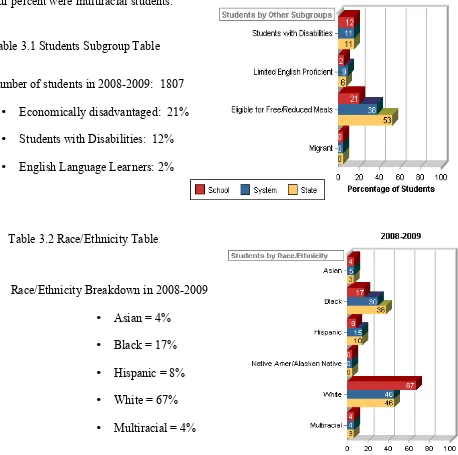
demographics of my student population. Kell High School’s demographics from the 2008-2009
Georgia Department of Education report card was 1807 students enrolled. Of those enrolled in
the 2008-2009 school year, twenty-one percent were economically disadvantaged, twelve percent
were students with disabilities and two percent were English language learners. Also that year
the race/ethnicity breakdown was the following: four percent of students were Asian, seventeen
percent were black, eight percent were Hispanic, sixty-seven percent of students were white, and
four percent were multiracial students.
Number of students in 2008-2009: 1807
• Economically disadvantaged: 21%
• Students with Disabilities: 12%
• English Language Learners: 2%
Race/Ethnicity Breakdown in 2008-2009
• Asian = 4%
• Black = 17%
• Hispanic = 8%
• White = 67%
[image:36.612.84.542.271.726.2]• Multiracial = 4%
I present an overview of the entire semester of a beginning photography class and I have
developed and analyzed an in depth six-week curriculum for this class. This is the six weeks in
the middle of the semester, so students had already learned the photography basics through
pinhole photography and had done at least one project using film. At this point, they had already
reviewed the elements and principles of design from their previous art classes and have analyzed
through teacher discussion and student concept assignments, how the elements and principles of
design can relate to photography. The middle six weeks is when I first began introducing digital
photography lessons in addition to traditional film photography.
Limitations of the Study
The limitation of this study is the lack of field-testing that took place. I analyzed my own
curriculum through reflection of my experience as the teacher. Any information on student
reactions to the curriculum or particular lessons was based on my own observations and
CHAPTER 4
Semester Overview
To explain the overall photography curriculum for an entire semester, I have broken it
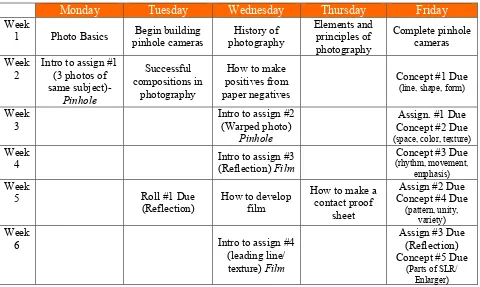
down into grading periods. The first six-week grading period, students learned about the basics
of photography, photographic history, and photography as it relates to elements and principles of
design and overall compositional elements. Students built their own pinhole cameras, which
helped them to understand the process of how photography works. They learned how to develop
paper negatives in the darkroom and then how to turn those paper negatives into positives.
Towards the end of the first six-weeks, they were taught the basics of their SLR camera, how to
load it with film, and then how to develop those film negatives. Finally they were taught how to
[image:38.612.68.548.428.715.2]develop those negatives into positives using the enlargers in the darkroom.
Table 4.1 First Six-Week Grading Period
Monday Tuesday Wednesday Thursday Friday
Week
1 Photo Basics pinhole cameras Begin building photography History of
Elements and principles of photography Complete pinhole cameras Week 2
Intro to assign #1 (3 photos of same subject)-
Pinhole
Successful compositions in
photography
How to make positives from paper negatives
Concept #1 Due (line, shape, form)
Week 3
Intro to assign #2 (Warped photo)
Pinhole
Assign. #1 Due Concept #2 Due (space, color, texture) Week
4 Intro to assign #3 (Reflection) Film
Concept #3 Due (rhythm, movement,
emphasis) Week
5 Roll #1 Due
(Reflection)
How to develop film
How to make a contact proof
sheet
Assign #2 Due Concept #4 Due
(pattern, unity, variety) Week
6 Intro to assign #4
(leading line/ texture) Film
Assign #3 Due (Reflection) Concept #5 Due
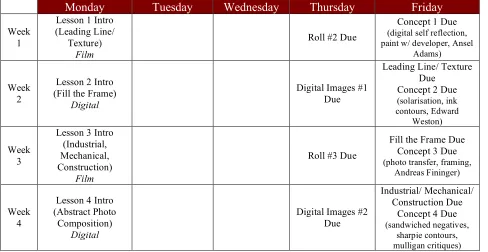
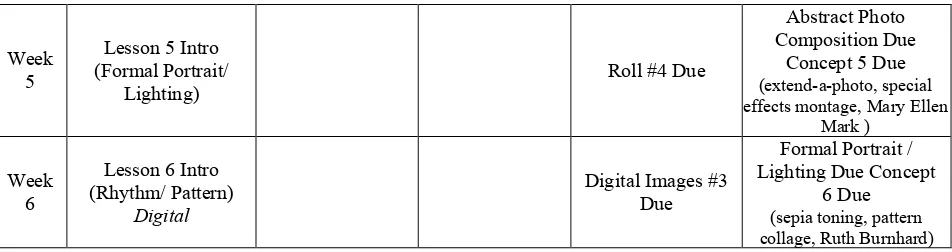
The second six-week grading period is the one I am presenting in this curriculum guide.
It contains six photography lessons; three lessons have a film portfolio assignment, and three
lessons have a digital portfolio assignment. Each of the six lessons presented have an additional
concept “mini-lesson” that helps to enhance the overall lesson objectives. These concepts either
deal with some sort of photographic concept that students should know, a type of digital
manipulation on the computer, some sort of manual manipulation of prints, photographic
criticism, or connections to important photographers the students should know about. When
looking at this particular six-week grading period, students were introduced to a new lesson each
week, yet, they have two weeks to work on each lesson. Therefore, the overlap of time gave
students the opportunity to work on the film assignments when their group had darkroom time,
the digital assignments when their group had computer time, and when their group wasn’t in the
darkroom or on the computers, they worked on either developing film, or concept assignments in
[image:39.612.66.554.459.711.2]the classroom.
Table 4.1 Second Six-Week Grading Period
Monday Tuesday Wednesday Thursday Friday
Week 1
Lesson 1 Intro (Leading Line/
Texture)
Film
Roll #2 Due
Concept 1 Due
(digital self reflection, paint w/ developer, Ansel
Adams)
Week 2
Lesson 2 Intro (Fill the Frame)
Digital
Digital Images #1 Due
Leading Line/ Texture Due
Concept 2 Due
(solarisation, ink contours, Edward
Weston)
Week 3
Lesson 3 Intro (Industrial, Mechanical, Construction)
Film
Roll #3 Due
Fill the Frame Due Concept 3 Due
(photo transfer, framing, Andreas Fininger)
Week 4
Lesson 4 Intro (Abstract Photo
Composition)
Digital
Digital Images #2 Due
Industrial/ Mechanical/ Construction Due
Concept 4 Due
Week 5
Lesson 5 Intro (Formal Portrait/
Lighting)
Roll #4 Due
Abstract Photo Composition Due
Concept 5 Due
(extend-a-photo, special effects montage, Mary Ellen
Mark )
Week 6
Lesson 6 Intro (Rhythm/ Pattern)
Digital
Digital Images #3 Due
Formal Portrait / Lighting Due Concept
6 Due
(sepia toning, pattern collage, Ruth Burnhard)
Once students reached the third six-week grading period, they were able to work more
independently on assignments. While I still gave introduction to new assignments, students had
more choices as to if they wanted to work on these in either film or digital. They collected all of
the work they had done during the final six-week grading period into their final photography
portfolio. At the end of the six weeks, students turned in a final portfolio of everything they had
done the entire semester and included the assignment checklist given to them at the beginning of
the semester. I graded all the new assignments they had done over the last six weeks, but they
also had everything else they had done from the entire semester, so that their portfolio was
[image:40.612.70.546.70.196.2]completely comprehensive.
Table 4.3 Third Six-Week Grading Period
Monday Tuesday Wednesday Thursday Friday
Week 1
Intro to childhood without children
Intro to tools of the trade
Concept Due (hand tinting photos,
scratch that)
Week 2
Intro to historical reference
Intro to Photo Essay
Concept Due (pop-up-photo, list of
historical reference artists)
Week 3
Intro to beauty in the ordinary
Work on final portfolio
Concept Due (Barbara Kruger article and collage, 5-10 ideas for photo
essay)
Week 4
Work on final portfolio
Concept Due (symmetrical balance collage, final idea for photo essay, sign up
Week 5
Work on final portfolio
Make up Concept Due (David Hockney article and collage) Week
6
CHAPTER 5
Instructional Lessons
Lesson 1: Leading Lines/ Texture Film Photography
Grade Level: High School Photo Students (10-12th grade)
Designer of Lesson: Julie Cooper Denison
QCC Standards:
VA.Pho.1 Creating Photographs
The learner will be able to develop ideas, plan, and produce a series of photographs within
constraints of selected problems with emphasis on particular elements of art and principles of
design; emphasis on a particular function; and emphasis on a particular idea, concept, or emotion.
VA.Pho.2 Objective, Abstract, and Nonobjective
The learner will be able to produce photographs from a variety of objective, abstract, and
nonobjective subjects and content.
VA.Pho.4 Safety and Maintenance
The learner will be able to demonstrate safe and proper use of photographic tools and processes.
VA.Pho.10 Objective, Abstract, and Non-Objective
The learner will be able to interpret the content of objective, abstract, and nonobjective photographs
and discusses why photographers might choose to work in each style.
VA.Pho.11 Artistic Choice and Content
The learner will be able to explain how the artist’s choices in technique,media, and style interrelate
to produce a particular expressive content in selected photographs.
VA.Pho.12 Art Styles
The learner will be able to compare two or more photographs of similar style and identifies those
qualities that relate to the artworks.
The learner will be able to make informed aesthetic responses by relating their own photographs to
photographs by major 20th-century photographers.
VA.Pho.14 Self-Evaluation
The learner will be able to evaluate, based on predetermined criteria, own performance and progress
on skills and written and visual products.
VA.Pho.18 Development of the Art of Photography
The learner will be able to identify and discuss selected artists who have contributed to the
development of photography and evaluates the influence of historical factors on their significance.
Lesson Theme:
Leading Line and Texture
Essential Questions:
• What is leading line?
• How can the use of elements and principles of design create superior photo compositions?
(How can the rule of thirds, the golden triangle, the golden spiral and well though out focal
points create a superior photo composition? How can leading lines create movement
leading to a focal point?)
• Why is lighting important when showing texture in a photograph?
Objectives:
Photography students will produce a series of 20 leading line and texture photo compositions
using the elements and principles of design to create successful compositions. (VA.Pho.1)
Students will discuss what makes successful photographic compositions including using the rule
of thirds, golden spiral, or golden triangle to place focal point within the composition.
After analyzing the principles of design and what makes good photographic compositions, students
will choose the 3 most successful of the leading line and texture exposures to print from their
contact proof sheet. (VA.Pho.4 & VA.Pho.1)
Students will use the enlargers to produce photographs in the darkroom, enhancing the contrast if
needed from filters. (VA.Pho.4)
Students will analyze from a contact proof sheet the best three photos to develop and turn in.
(VA.Pho.14)
Teacher Samples:
Resources:
Handout explaining what to look for to find leading lines and what to look for when finding
textures.
136
Powerpoint with examples of leading line and texture images from Ansel Adams as well as
student examples of each.
Introduction/Motivation:
Showing Student Examples:
Introduction begins with showing student work of compositions that use the leading lines
and textures, so the students can see what other students have done with that assignment and get
excited about what they can do.
Project Handout:
A handout explaining how to find leading lines and textures is given out for students to
have examples to take home with them.
Art Historical Examples:
Work from photography masters that use the leading lines and textures as subject matter
can be used for both introduction and motivation. In this case, the work of artist, Ansel Adams is
used to demonstrate leading line and texture.
Content Paper:
• Previous lessons on Compositional elements in Photography will be applied to this
Images THE BASICS OF PHOTO. Both of these are adapted from Powerpoints found
on the web.)
• See Powerpoint Presentation on Lines and Textures.
• See student handout on Lines and Textures.
Instructor’s Procedures:
Creating a productive and engaging work environment:
As this lesson is to take place after the fourth or fifth week of class, students will have
formed a cohesive work environment. This happens because students work in groups in
and out of the darkroom. They work in pairs to develop film and they are responsible for setting
up and cleaning up the darkroom within their groups. Wednesdays are reserved for group
critiques, introduction of new material, collaborative explorations, catch up days, and digital
photo scavenger hunts.
Previous Compositional Emphasis:
Previously, the students and teacher have discussed composition as it relates to
photography. Referring to the PowerPoints on the basics of photography and the principles of
photography, the teacher will remind the students the importance of using compositional
techniques such as the rule of thirds, golden spiral, or golden triangle to have a successful focal
point. The teacher will also remind students of the principles of design help to create successful
focal points within the composition.
Teacher Introduction:
• Student Samples: Introduction begins with showing student work using leading lines
and textures, so the students can see what other students have done with that