Mathematics Theses Department of Mathematics and Statistics
Spring 5-1-2012
Confidence Interval Estimation for Coefficient of Variation
Confidence Interval Estimation for Coefficient of Variation
Shuang Liu
Follow this and additional works at: https://scholarworks.gsu.edu/math_theses
Recommended Citation Recommended Citation
Liu, Shuang, "Confidence Interval Estimation for Coefficient of Variation." Thesis, Georgia State University, 2012.
https://scholarworks.gsu.edu/math_theses/124
This Thesis is brought to you for free and open access by the Department of Mathematics and Statistics at ScholarWorks @ Georgia State University. It has been accepted for inclusion in Mathematics Theses by an authorized administrator of ScholarWorks @ Georgia State University. For more information, please contact
by
SHUANG LIU
Under the Direction of Dr. Gengsheng Qin
ABSTRACT
The coefficient of variation (CV) is a helpful quantity to describe the variation in
eval-uating results from different populations. There are many papers discussing methods of
constructing confidence intervals for a single CV, such as exact method and approximation
methods for CV when the underlying distribution is a normal distribution. However, the
exact method is computationally cumbersome, and approximation methods can’t be applied
when the underlying distribution is unknown. In this thesis, we propose the generalized
confidence interval for CV when the underlying distribution is normal and three empirical
likelihood-based non-parametric intervals for CV when the underlying distribution is
un-known. Simulation studies are conducted to compare the relative performances of these
intervals based on the coverage probability and average interval length. Finally, the
appli-cation of the proposed methods is demonstrated by using some real examples.
by
SHUANG LIU
A Thesis Submitted in Partial Fulfillment of the Requirements for the Degree of
Master of Science
in the College of Arts and Sciences
Georgia State University
by
SHUANG LIU
Committee Chair: Dr. Gengsheng Qin
Committee: Dr. Xin Qi
Dr. Xu Zhang
Electronic Version Approved:
Office of Graduate Studies
College of Arts and Sciences
Georgia State University
ACKNOWLEDGEMENTS
First and foremost, I would like to sincerely thank my advisor, Dr. Gengsheng Qin, for
all his help and guidance. Without his support, advice and patience, this thesis would not
have been possible to accomplish. I feel very lucky to be one of Professor Qin’s student.
And I would like to thank other thesis committee members, Dr. Xin Qi and Dr. Xu
Zhang, for taking their precious time out from their busiest and important moment and
giving helpful suggestion to my thesis work. I would also like to show my gratitude to some
of my classmates studying in similar field, Binhuan Wang, Haochuan Zhou and Aekyung
Jung, for their unselfish help and support. In addition, I would like to thank those who have
been traveling in the statistical world with me, my other classmates Hanfang Yang, Shan
Luo, Hongwei Wang, Zhu Zi for their encouragement. And I also want thank Ruya Zhao
who has been always supporting and understanding.
Lastly, I owe my deepest gratitude to my parents who have been supporting and
encour-aging me with all their hearts in all the ways. I couldn’t have achieved any success without
TABLE OF CONTENTS
ACKNOWLEDGEMENTS . . . iv
LIST OF TABLES . . . vi
CHAPTER 1 INTRODUCTION . . . 1
1.1 Background . . . 1
1.2 Parametric inference on Coefficient of Variation . . . 2
1.3 The purpose of the present study . . . 6
CHAPTER 2 METHODOLOGY . . . 7
2.1 Existing method . . . 7
2.2 New Methods . . . 10
2.2.1 Generalized Confidence Interval . . . 10
2.2.2 Empirical likelihood based method . . . 13
2.2.3 Jackknife Empirical Likelihood Method . . . 18
CHAPTER 3 SIMULATION STUDIES . . . 22
CHAPTER 4 REAL EXAMPLE . . . 31
CHAPTER 5 DISCUSSION AND CONCLUSION . . . 34
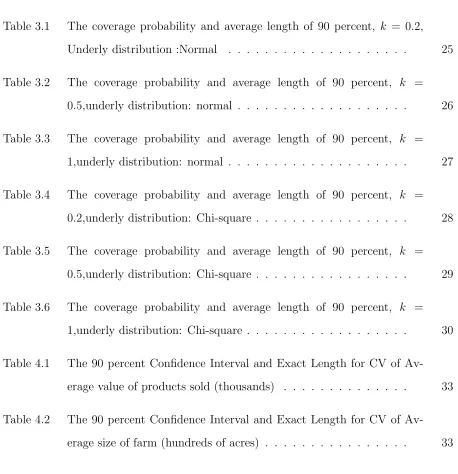
LIST OF TABLES
Table 3.1 The coverage probability and average length of 90 percent, k = 0.2,
Underly distribution :Normal . . . 25
Table 3.2 The coverage probability and average length of 90 percent, k =
0.5,underly distribution: normal . . . 26
Table 3.3 The coverage probability and average length of 90 percent, k =
1,underly distribution: normal . . . 27
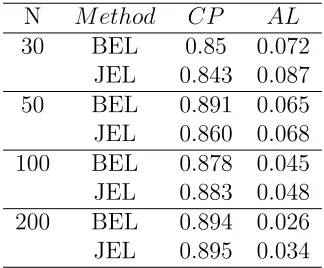
Table 3.4 The coverage probability and average length of 90 percent, k =
0.2,underly distribution: Chi-square . . . 28
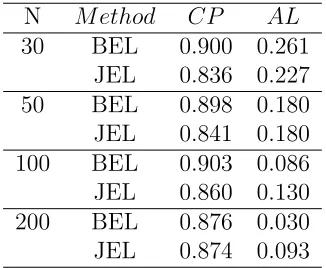
Table 3.5 The coverage probability and average length of 90 percent, k =
0.5,underly distribution: Chi-square . . . 29
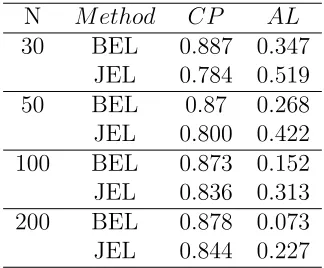
Table 3.6 The coverage probability and average length of 90 percent, k =
1,underly distribution: Chi-square . . . 30
Table 4.1 The 90 percent Confidence Interval and Exact Length for CV of
Av-erage value of products sold (thousands) . . . 33
Table 4.2 The 90 percent Confidence Interval and Exact Length for CV of
CHAPTER 1
INTRODUCTION
1.1 Background
The coefficient of variation (CV) is an important quantity to describe the variation. It
provides an alternative index besides the most commonly used measurements of variation
such as variance or standard deviation, which come across with difficulty in comparing the
variations from different populations with different units. Take the data from students
physical examination as an example. If one wants to analyze variations of both height and
weight, it is not appropriate and logically incorrect to directly compare the variances or
standard deviation, as the units from both populations are not matched. Another practical
example in which commonly used measurements of variation might fail to work properly
is to describe the relationship between the variation of average individual income and the
variation of tax income of States. The different scale of data makes the direct comparison
invalid or misleading. Nevertheless, With the property of standardization and unitlessness,
CV makes the comparison possible. It is a good measure of the reliability of the experiment,
which is, the smaller the CV values, the higher is the reliability of experiment (Gomez and
Gomez, 1984; Steel and Torrie, 1980). Hence, CV is frequently provided by researchers,
especially those in agricultural fields, in major publications. It is as well widely applied to
Let X be a random variable with mean µand variance σ2. The population coefficient
of variation is defined as follows:
k= σ
µ
Assuming that observationsXi, i=1, 2, ..., n, are the independent identically distributed
sample from N(µ,σ) . The sample mean ¯X and sample variance S2 are the unbiased point
estimates of µand σ2, respectively. An estimator of parameter k is
K = S¯
X,
where ¯X = n1 P
Xi, andS2 =
P
(Xi−X¯)2 n−1 .
1.2 Parametric inference on Coefficient of Variation
CV does not appear to be the top mentioned index to measure the variation. Therefore,
not those like standard deviation or variance which has no secret of anything at all, there
aren’t many papers published about the inference of CV. However, the helpful application
of the index in the agricultural research and engineering field still drew some attention from
statisticians. And some authors have already done some impressive work for the inference of
of CV is given by Hendricks and Robey (1936) as follows,
dFcv =
2
π12Γ(n−1
2 )
e
− n 2σµ2
cv2
1+cv2 cvn−2
(1 +cv2)n2 n−1
X
i=0
(n−1)!Γ(n−2i) (n−1−i)!i!
ni2
2i2(σ µ)i
1 (1 +cv2)2i
dcv.
Lehmann (1986) also derived the sample distribution of CV in order to give an exact
method for the construction of a confidence interval for CV. Suppose Xi are identically and
independently distributed from a normal distribution with mean µand variance σ2, then
¯
X S
√
n
∼N CTn−1(
µ√n σ ),
where N CTn−1(µ
√
n
σ ) denotes a noncentral t-distribution with n-1 degrees of freedom and
non-centrality parameter µ
√
n
σ . With this distribution function, the confidence interval of
CV can be developed with standard procedure, yet with cumbersome calculation.
Routinely constructing an exact confidence interval for CV appears to be with difficulty
thanks to the complexity of distribution function. Thus, statistician chose to sacrifice certain
level of accuracy and proposed some simpler but relatively accurate approximation methods.
McKay (1932) first published the approximation method for constructing confidence
inter-val for CV under normal assumption. Based on the McKay’s work, David (1949) proposed
method is selecting an appropriate pivot quantity, he proved that by selecting a very simple
or “naive” approximate pivot, confidence interval for CV can be still obtained with
accept-able accuracy. Later, based on analysis of the distribution of a class of approximate pivotal
quantities, Vangel (1996) modified McKay’s method. He compared David’s (1949)
approxi-mation with Mckay’s (1932) and pointed out that the “naive” method resulted less accuracy
than McKay’s method. He then proposed his own approximation by extending McKay’s
(1932) method and obtained the result with satisfactory accuracy. The form of
approxi-mate pivotal quantities are presenting in the later chapter and the method of constructing
confidence interval for CV is given in the same chapter too.
Besides all the approximate pivotal quantity methods, Barndorff-Nielsen (1986, 1991),
Pierce and Peters (1992) and Reid (1996) proposed various likelihood based inference
pro-cedures which can be as well used to construct confidence interval for CV.
Let θ = (k, µ) , where k and µ are population CV and mean respectively, and let
l(θ) = l(k, µ) be the log likelihood function of θ. The Signed log-likelihood ratio statistics
for k is
r(k) =sgnd(ˆk−k)2[l(ˆθ)−l( ˆθk)] 1 2,
where ˆθ = (ˆk,µˆ) is overall maximum likelihood estimate of θ = (k, µ) and ˆθk = (k,µˆk)
is a constrained maximum likelihood estimate of θ for a given k . Then it can be proved
that r(k) is asymptotically following the standard normal distribution. Thus, the confidence
interval for k can be constructed. However, Pierce and Peters(1992) pointed out that this
sample size. A modified Signed log-likelihood ratio statistic was proposed by
Barndorff-Nielsen(1986,1991) as follows:
r∗(k) =r(k) +r(k)−1log{u(k)
r(k)}.
And he also showed that r∗ is asymptotically distributed with N(0,1) with accuracy of
O(n−32). In order to obtain the 100(1−α)% confidence interval, a simplified signed
log-likelihood ratio statistics is also given as
r(k) = sgnd(ˆk−k){2nlog(kµˆk ˆ
kµˆ ) +
n k2µˆ2
k
[ˆk2µˆ2+ (ˆµ−µˆk)2]−n} 1 2,
where
ˆ
µk =
−y¯+py¯2+ 4k2(S2+ ¯y2)
2k2 , µˆ= ¯y
and
u(k) =√n{1
2+ 1 2(
ˆ
kµˆ
kµˆk
)2− µˆ
ˆ
µk
}( ˆ
kµˆ
kµˆk
)(1 +k2− µˆ
2ˆµk
Hence, with all the formulas above, r∗ can be easily obtained. Therefore, a 100(1−α)%
confidence interval for k is
CI ={k:|r∗(k)| ≤zα 2}.
1.3 The purpose of the present study
The goal of this thesis is to propose three new methods of constructing confidence
interval for CV. Comparison will be made with existing methods according to the coverage
probability and length of confidence interval. Methodology for different interval estimates
will be presented in detail in chapter 2 and adequate simulation work will be given to show
the performance of different interval estimates in Chapter 3. In Chapter 4 conclusion of this
CHAPTER 2
METHODOLOGY
2.1 Existing method
As mentioned in Chapter 1, the complication of distribution function for CV rises the
difficulty of routinely constructing exact confidence interval for CV with standard process.
In order to avoid the cumbersome calculation, many authors proposed relatively accurate
approximation methods. McKay (1932) first proposed the approximation method by using
the approximate pivotal quantity. And later David (1949) and Vangel (1996) gave the
modified methods based on different pivot quantity selections. Since the sufficient part of the
approximation method is selecting the appropriate pivot quantity, the detailed mathematical
procedure of Vangel’s (1996) work will be presented to illustrate the method.
LetYv be a random variable following the chi-square distribution with degree of freedom
v =n−1 , and define Wv = Yvv. For any α ∈(0,1) , let χ2v,α denote the 100α percentile of
the distribution of Yv , then t = χ2
v,α
v is the corresponding quantile for Wv . Vangel (1996)
defined the random variable as follows:
Q= K
where θ = θ(k, α) is a known function, K = S
¯
Y is the sample CV where S
2 and ¯Y is the
sample variance and sample mean respectively. Select a proper θ such that
P r(Q < t)≈P r(Wv ≤t).
The selection of θ is the most important part for the approximation method. The
approximation methods mentioned above basically were all trying to select an appropriate
θ. They are relatively simple but maintain relatively satisfactory accuracy. McKay (1932)
claims that the selection of θ = v+1v would make a good approximation for Q. And David
(1949) gave an even simpler selection of θ which set θ= 1 . Another “naive” approximation
was proposed by setting θ = 1t. Later Vangel (1996) proved that the distribution of Wv is
known and is free of K, and he proposed a modified θ with the expression of
θ = v
v + 1[ 2
χ2
v,α
In general, with the selected θ, the 100(1−α)% approximate confidence interval for k
is given as follows by using the approximate pivot:
CI = (p K
t1(θ1K2+ 1)−K2
,p K
t2(θ2K2+ 1)−K2 ),
where t1 =
χ2v,1−α 2 v , t2 =
χ2v, α 2
v , and θi =
2 (v+1)ti +
v
k+1, i = 1,2. So the McKay and Vangel’s
interval estimates are
CI1 ={K[(
u1
v+ 1 −1)K 2+ u1
v ]
−1
2, K[( u2
v+ 1 −1)K 2+u2
v ]
−1 2},
and
CI2 ={K[(
u1+ 2
v+ 1 −1)K 2+u1
v ]
−1
2, K[( u2
v+ 1 −1)K
2+u2+ 2
v ]
−1 2},
respectively, where ui ≡vti, fori= 1,2.
Although, by using the approximate pivot, one can obtain a confidence interval for
desired index with very satisfactory accuracy for some true values of k, the McKay and
Vangel’s methods come across some inevitable problem. With some simple calculation, one
can prove that the pivotal quantities may be a complex value when selecting a largek. That
that his methods could only be applied under the condition ofk < 0.33 (McKay, 1932). The
same drawback appears for Vangel’s method too. These unavoidable problems inspired us
for seeking some new methods introduced in next section.
2.2 New Methods
2.2.1 Generalized Confidence Interval
Inspiring by McKay(1932) and Vangel’s(1996) approximation methods which introduced
some pivotal quantities to construct the confidence interval, we are thinking about if it is
possible to propose a different type of pivotal quantity. Since lots of works about Generalized
Confidence Interval have been done based on Generalized Pivotal Quantity (GPQ) in the
literature, in this section, we proposed a method to develop a GPQ-based confidence interval
for CV. The definition of GPQ is as follows, cited from Weerahandi (1993):
Let X be an observable random vector with the cdfF(x|v), wherev = (θ, δ) is a vector of
unknown parameters,θis the parameter of interest, andδ is a vector of nuisance parameters.
Let χ be the sample space of possible values of X and let Θ be the parameter space of θ.
An observation from X is denoted by x, where x ∈ χ . Let R = r(X;x, v) be a function
of X, x, v (but not necessarily a function of all), where v = (θ, δ) . Then it is said to be a
generalized pivotal quantity if property A: R has a probability distribution free of unknown
parameters. Property B: The observed pivotal, defined as robs =r(x;x, v) , does not depend
on the nuisance parameter δ .
Then a two-sided 100(1−α/2)% confidence interval for parameterθ is (Rα/2, R1−α/2) ,
distribution R respectively. More detailed introduction of GPQ-based confidence interval is
referred to Weerahandi (1993) and Hanning et al. (2006).
Now let observationsX1, ..., Xm be the random sample from a normal distribution with
mean µ and standard deviation σ . Then the sufficient estimator for (µ, σ) is
(ˆµ,σˆ) = ( ¯X, S)
where ¯X = m1 Pm
i=1Xi, and S
2 = Pmi=1(Xi−X¯) m−1 .
Under normality assumption, the parameter of interest D is a function of parameters
(µ, σ) which is
(µ, σ2, k) = (µ, σ2,σ µ).
So the parameter can be estimated by
(ˆµ,σˆ2,ˆk) = ( ¯X, S2, S¯ X)
Let U ,Z be the quantities defined as follow:
U = (n−1)S 2
σ2 ∼χ 2
Z = (σ 2
n )
−1/2( ¯X−µ)∼N(0,1).
And we can easily verify that both properties A and B are satisfied in these quantities.
Therefore, defined quantities are the pivotal quantities corresponding to estimators.
Let ¯x and s2 be the observation of ¯X,S2 respectively. Then the GPQ ofσ2,and µis in
expression of
Rσ2 =
(n−1)s2
U , (2.1)
and
Rµ= ¯x−( Rσ2
n )
1/2Z. (2.2)
Based on this, the GPQ for the parameter of interest k is expressed as
Rk=
√
Rσ2 Rµ
. (2.3)
To construct a GPQ-based confidence interval with given observations x1, ..., xm from
N(µ, σ2), we propose the following Monte-Carlo algorithm:
STEP 1: Compute the sample mean and sample standard deviation using original
observation samples.
STEP 2: Randomly generate one U from corresponding chi-squared distribution with
STEP 3: Calculate Rσ2,Rµ by using (2.1) and (2.2).
STEP 4: Calculate Rk by using (2.3).
STEP 5: Repeat STEP2-STEP4 H times (10000 times is recommended) to obtain H
values of Rk .
Consequently, the 100(1−α)% GPQ-based confidence interval for CV can be obtained
as (Rk,α/2, Rk,1−α/2) , where Rk,α/2 and Rk,1−α/2 are the 100(α/2)−th and 100(1−α/2)−th
percentiles of Rk’s.
2.2.2 Empirical likelihood based method
Parametric methods of obtaining confidence interval for CV have been discussed and
improved by many authors over the past several decades as we mentioned above. When the
underlying distribution is a normal distribution, one is well-equipped of several methods to
construct a confidence interval for CV. Nevertheless, in practice, the normality assumption
may not be easily guaranteed. In these cases, which happen quite frequently, those methods
are performing poorly or even invalid. Then it is really crucial to introduce a non-parametric
method to compensate the incompletion of existing methods.
When addressing the non-parametric method for constructing confidence intervals,
Owen (1988, 1990) is the one who must be mentioned, because he proposed a very
pow-erful non-parametric method for constructing confidence interval for parameters of interest,
which is well-known as Empirical likelihood (EL). With a lot of advantages, EL method was
in the center of attention once the method purposed and has been widely applied to many
piv-otal statistic; 2. No prior constraints of the shape of confidence region is needed; 3. it may
confesses a Bartlett correction that tolerates low coverage error. More detailed information
on EL method can be refereed to Hall and La Scala (1990). However, the EL-based method
for CV has not been well-developed. So, in the following paragraph, we attempt to apply
the empirical method to the construction of confidence intervals for CV.
Recall that
k =
p
E(X2)−(E(X)2)
E(X)
is a smooth function of the mean m = (E(X), E(X2)). Owen (1988) showed that the
limiting distribution of the empirical log-likelihood ratio for m is a chi-square distribution
with 2 degree of freedom. Hence, an EL-based joint confidence region for mcan be obtained
from the chi-square distribution, and an EL-based confidence interval for the CV can be
found based on this confidence region. This is the original idea from Owen (1988) and an
indirect way to construct confidence interval for the CV. However, this method involves in a
2-dimensional confidence region and it is somewhat uncomfortable in implementation. Thus,
here we proposed a plugging-in EL method for constructing confidence interval of the CV.
We observe that the coefficient of variation k satisfies the following equation:
Let P = (p1, ..., pn) be a probability vector. Then the EL for k can be defined as follows:
L(k) =su Pp{
n
Y
i=1
pi :pi ≥0, n
X
i=1
pi = 1, n
X
i=1
piWi = 0},
whereWi =σ−kXi, i= 1,· · · , n. Since parameterσ is unknown in practice, we use sample
standard deviation S to estimate it. Then, the profile EL fork can be defined as follows:
ˆ
L(k) =su Pp{
n
Y
i=1
pi :pi ≥0, n
X
i=1
pi = 1, n
X
i=1
piWˆi = 0},
where ˆWi =S−kXi .
With Lagrange multiplier method, we can obtain the expression for pi , which is
pi =
1
n{1 +λ
ˆ
Wi}−1, i= 1, ..., n,
where λ is the solution to
1 n n X i=1 ˆ Wi
1 +λWˆi
Therefore, the profile EL ratio for k is:
R(k) =
n
Y
i=1
(npi) = n
Y
i=1
{1 +λWˆi}−1.
Then the corresponding empirical log-likelihood ratio for k is
l(k) = 2
n
X
i=1
log{1 +λWˆi}, (2.4)
where λ is the solution of the equation n1 Pn
i=1 ˆ
Wi
1+λWˆi = 0. Following Theorem 2.1 in Hjort
et al. (2009), we find out that l(k) actually asymptotically follows a scaled chi-square
distribution.
Theorem: If k is the true value of the coefficient of variation, then the limiting
distri-bution of l(k), defined by (3), is a scaled chi-square distribution with degree of freedom one.
i.e. ,
cl(k)−→d χ21,
where the scale constant is c≈ 1
Since c is an unknown constant, in order to construct confidence interval for the CV
based on this theorem, we have to estimate c. Here we propose the following bootstrap
procedure to estimate the scale constant.
Step 1: generate bootstrap sample X1∗,· · ·, Xn∗ from the original sample X1,· · ·, Xn.
Step 2: find the bootstrap estimate l∗(ˆk) ofl(k):
l∗(ˆk) = 2
n
X
i=1
log{1 +λ∗Wˆi∗}
where ˆWi∗ =S∗−kXˆ i∗ is the bootstrap version of ˆWi, ˆk is the sample coefficient of variation
from the original sample, and λ∗ is the solution of
1
n n
X
i=1 ˆ
Wi∗
1 +λ∗Wˆ∗
i
= 0.
Step 3: repeat steps 1-2 B times (B ≥ 200 is recommended) to obtain B bootstrap
copies of l(k):
Step 4: Estimate the constant c as follows:
c∗ = [1
B n
X
i=1
l∗i(ˆk)]−1
Based on Theorem and the estimated constant c∗, we can construct the bootstrap
EL-based confidence interval (BEL interval) for k as follows:
{k :c∗l(k)≤χ21(1−α)}
where χ2
1(1−α) is the (1−α)−th quantile of χ21 .
2.2.3 Jackknife Empirical Likelihood Method
In previous section, we introduced the bootstrap EL-based confidence interval (BEL
interval). Despite of all the advantages the method has, serious computational difficulty is
inevitably occurred, as well as one has to estimate the constant coefficientcfor the scaled
chi-square distribution, which may introduce extra bias. Recently, Jing, Yuan and Zhou (2009)
raised a new approach called jackknife empirical likelihood (JEL) method. The logarithm
of the Jackknife empirical likelihood ratio asymptotically follows the standard Chi-square
is extremely simple in calculation. In following context, we will develop the JEL-based
method to construct confidence interval for CV.
Let Xi, i = 1, ..., n be a random sample from a population with unknown underlying
distribution. The sample coefficient of variation can be calculated as follows:
ˆ
k = S¯
X
The corresponding jackknife pseudo values are
ˆ
Wi =nkˆ−(n−1)ki, i= 1, ..., n
where ki is the sample coefficient of variation computed with (n−1) sample observations
after deleting i−th observation from the original sample.
With similar argument in Tukey (1958), ˆWi’s are expected to be asymptotically
inde-pendent. Then standard empirical likelihood methods could be applied to these jackknife
be a probability vector. The jackknife empirical likelihood for CV can be defined as follows:
LJ(k) =su Pp{
n
Y
i=1
pi :pi ≥0, n
X
i=1
pi = 1, n
X
i=1
pi(Wi−k) = 0}.
And just as previous section, the Lagrange multiplier method provides the Jackknife
empir-ical log-likelihood ratio:
lJ(k) = 2 n
X
i=1
log{1 +λJ(Wi−k)},
where λJ is the solution of the equation:
1
n n
X
i=1
Wi−k
1 +λJ(Wi−k)
= 0.
The Jackknife empirical log-likelihood ratio asymptotically follows a chi-square
distri-bution with 1 degree of freedom. i.e.,
lJ(k) d
Therefore, the Jackknife empirical-based confidence interval fork can be constructed as
follows:
{k:lJ(k)≤χ21(1−α)}
where χ2
CHAPTER 3
SIMULATION STUDIES
Newly introduced methods need to be examined and we need to show more evidence to
illustrate the advantages of new methods over the existing ones. In this section, adequate
simulation studies have been conducted to give a clear comparison between newly proposed
confidence intervals and existing confidence intervals. The intervals being examined in the
simulation study are Vangel’s modified approximate method (Vangel), the Generalized
Piv-otal Quantity method (GPQ), Plug-in empirical likelihood with bootstrap-based confidence
interval (BEL) and the Jackkinfe empirical likelihood confidence interval(JEL).
Considering the practical application for agriculture and engineering fields, the finite
sample performance is the main issue we focus on. In the simulation studies, we carried
out the simulation with sample size n = 30,50,100,200, to examine the performance from
smaller sample size to larger sample size. According to the property of the coefficient of
variation, we selected the true value k = 0.2,0.5,1 to investigate the performance of all
methods mentioned above. Largek may result in a non-negligible probability of obtaining a
negative observation, and based on practical application, the scenario is of less interest. Thus
the selected true values are narrowed down to the range from 0 to 1. The iteration times
R = 1000 and bootstrap replication B = 200 were chosen for calculating BEL intervals
because of the computational extensiveness with bootstrap method, and R = 10000 was
Two underly distributions, normal distribution and Chi-square distribution, were selected
to generate the random observations. For the setting with normal distribution as the
pre-selected underly distribution, we consider all the methods mentioned above and make the
comparison. However, as k getting larger, the vangel’s method failed to work properly due
to the property of the pivotal quantity. We mark N/A as comparing the rest. In the other
setting, Chi-square distribution was selected as the underly distribution to examine the
proposed non-parametric approaches. Since the normality assumption is invalid, Vangel and
GPQ can not be applied to the setting.
We calculated the coverage probability (CP) and average length (AL) as the criteria
to evaluate the performance of these intervals. At the nominal confidence level 90%, we
calculated the percentages that the confidence intervals cover the true value of k. The closer
the percentage is to the nominal level, the better performance of the confidence interval.
Average length (AL) is the summation of all length of confidence intervals divided by total
number of iteration. With similar coverage probabilities, the shorter average length is, the
better performance of the confidence interval. All the simulation studies were conducted
with the statistical package R.
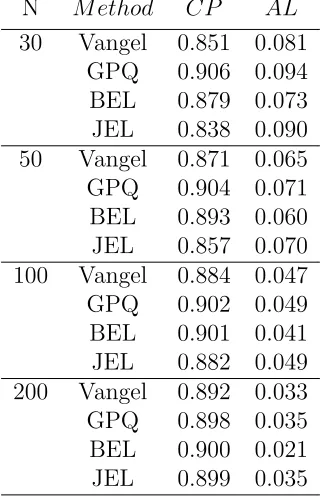
The simulation results are displayed in table 3.1 to table 3.6 . From table 3.1, we
conclude that GPQ interval has the best performance among the four intervals regardless
the sample size in this scenario. Its coverage probabilities are very close to the nominal level.
Vangel, BEL and JEL intervals undercover the true value with small to moderate sample sizes
(n = 30,50,100), but they are acceptable as sample sizenincreases to 200. Vangel’s method
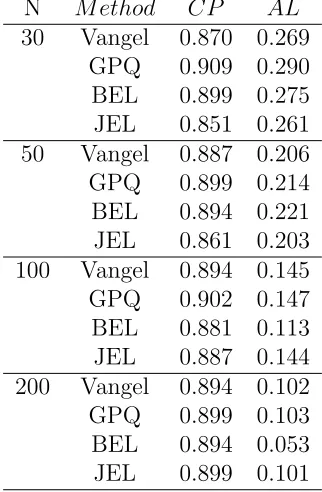
Table 3.2 shows the similar performances for all the methods as we selected k = 0.5. As k
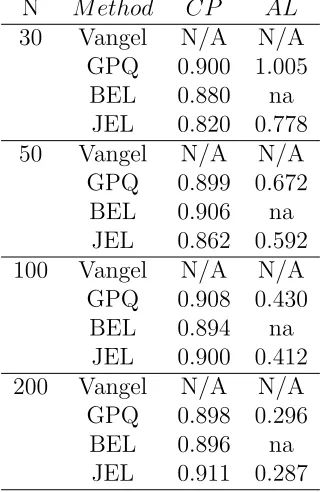
getting larger, the average lengths increase. Table 3.3 shows the simulation results fork = 1.
Due to the property of approximate pivotal, Vangel’s method is not available (N/A). And
the proposed methods still perform with satisfactory, especially the GPQ method. Tables
3.4 to 3.6 are the results from the setting of non-normality assumption. With the Chi-square
distribution as the underly distribution, GPQ and Vangel’s methods are no longer valid,
but we can apply the proposed non-parametric methods. The results show that, BEL and
JEL undercover the true values of k with small to moderate sample sizes (n = 30,50,100).
However, as sample size increases, the coverage probabilities are approaching to the nominal
level. Among different k values in this setting, BEL performs slightly better than JEL in
terms of coverage probability.
In sum, under normality assumption, GPQ has the best performance with the
appro-priate coverage probability and stability. Comparing to the existing method, GPQ is more
powerful as it expands the range of availability for the value of coefficient of variation. We
recommend GPQ when the underly distribution is normal. Under non-normality
assump-tion, the performances of the JEL and BEL intervals are acceptable when sample size is
big enough. Therefore, JEL and BEL are recommended when the underlying distribution is
Table 3.1. The coverage probability and average length of 90 percent,k = 0.2, Underly distribution :Normal
N M ethod CP AL
Table 3.2. The coverage probability and average length of 90 percent, k= 0.5,underly distribution: normal
N M ethod CP AL
Table 3.3. The coverage probability and average length of 90 percent, k= 1,underly distribution: normal
N M ethod CP AL
30 Vangel N/A N/A GPQ 0.900 1.005
BEL 0.880 na JEL 0.820 0.778 50 Vangel N/A N/A
GPQ 0.899 0.672 BEL 0.906 na
JEL 0.862 0.592 100 Vangel N/A N/A
GPQ 0.908 0.430 BEL 0.894 na
JEL 0.900 0.412 200 Vangel N/A N/A
GPQ 0.898 0.296 BEL 0.896 na
Table 3.4. The coverage probability and average length of 90 percent, k= 0.2,underly distribution: Chi-square
N M ethod CP AL
Table 3.5. The coverage probability and average length of 90 percent, k= 0.5,underly distribution: Chi-square
N M ethod CP AL
Table 3.6. The coverage probability and average length of 90 percent, k= 1,underly distribution: Chi-square
N M ethod CP AL
CHAPTER 4
REAL EXAMPLE
In this chapter, a real case is studied to illustrate the methods we introduced in the
previous chapters. The practice sample data set named Beef Council Check-off is obtained
from The Data and Story Library (DASL) at Carnegie Mellon University. Among 7 variables
in the data set, we chose 2 of them to conduct the experiment, Average size of farm (hundreds
of acres) and Average value of products sold (thousands). Each of the variable contains 56
observations, which is similar amount as moderate sample size we chose to conduct the
simulation study.
In order to check the normality of each variable, the normality test called Shapiro-Wilk
test has been conducted. The null hypothesis of Shapiro-Wilk test is that sample data
x1, x2, ..., xn is from normal distribution. The small p-value (smaller than the significant
level one selected) indicates the rejection of null hypothesis which means the sample data
is from non-normal distribution. And if one fails to reject the null hypothesis, we can treat
the sample data comes from normal distribution. More detailed information can be referred
to Shapiro and Wilk (1965).
For variable of average value of products sold (thousands), the sample coefficient of
variation ˆk = 0.4733. And regarding to Shapiro-Wilk test, the calculated p-value is 0.5037
which indicates that sample data is from a normal distribution. Based on the test results, we
for CV. Table 4.1 shows the simulation results. From Table 4.1, we can see that confidence
intervals calculated from all mentioned methods are very similar. We can conclude that BEL
and JEL are relatively better due to the slightly shorter Exact Length.
Similarly, the sample coefficient of variation for variable of average size of farm (hundreds
of acres) is ˆk = 0.6594. Shapiro-Wilk test was conducted to test the normality. With
calculated p-value 0.002981,the null hypothesis is rejected at the significant level of 0.05,
which indicates the sample is from a population with non-normality distribution. Therefore,
we can only apply the newly proposed non-parametric methods to calculate the confidence
interval for CV with the nominal level 0.9. The simulation results can be found in Table 4.2.
Table 4.1. The 90 percent Confidence Interval and Exact Length for CV of Average value of products sold (thousands)
Method Confidence Interval Exact Length Vangel (0.3986, 0.5755) 0.1769
GPQ (0.3973, 0.5872) 0.1898 BEL (0.4068, 0.5606) 0.1538 JEL (0.4067, 0.5579) 0.1512
Table 4.2. The 90 percent Confidence Interval and Exact Length for CV of Average size of farm (hundreds of acres)
Method Confidence Interval Exact Length BEL (0.5858, 0.7726) 0.1869
[image:41.612.194.441.298.345.2]CHAPTER 5
DISCUSSION AND CONCLUSION
The significance of the coefficient of variation may be underestimated by statisticians.
Comparing to other frequently mentioned indexes for variation, CV draws less attention
from statisticians. However, with the properties of unitlessness and mean-related,
coeffi-cient of variation appears more and more in applied researches such as agriculture field and
engineering field. In literature, several methods of constructing confidence interval for CV
have been introduced in the past decades. Nevertheless, most of existing methods are of
deficiency. The dependency of underlying distribution and narrowed availability range for
CV are the main motivation for this thesis study. In this thesis, we proposed a new
para-metric interval and two non-parapara-metric intervals for CV. Under the normality assumption,
the GPQ-based confidence interval shows a nearly perfect small sample performance, and
successfully extend the availability range for CV. Therefore, it is recommended to use
GPQ-based confidence interval for CV under normality assumption. Through plenty of simulation
studies, the BEL and JEL confidence intervals are shown to have acceptable finite sample
performances when sample size is big enough ( n ≥ 200). Since they are non-parametric
intervals, they are particularly useful to obtain confidence intervals for CV from the
popu-lation with non-normality assumption. Thus, these non-parametric methods are suggested
to obtain confidence intervals for the coefficient of variation with unknown underlying
shown in the simulation study when sample size is small. The future research will focus on
REFERENCES
[1] Barndorff-Nielsen, O.E. (1986), Inference on full or partial parameters based on the
standardized Signed log-likelihood ratio, Biometrika 73: 307-322.
[2] Barndorff-Nielsen, O. E. (1991). Modified Signed log-likelihood ratio. Biometrika 78:
557-563.
[3] David, F. N. (1949). Note on the application of Fisher’s k-statistics. Biometrika 36:
383-393.
[4] Hanning, J., Iyer, H.K., and Patterson, P.. (2006). Fiducial Generalized Confidence
Intervals. Journal of the American Statistical Association, 101, 254-269.
[5] Hjort, N. L.., McKeague, I. W. and Keilegom, I. V. (2009). Extending the scope of
empirical likelihood. Ann. Statistics 37, 1079-1111.
[6] Girma Taye and Peter Njuho (2008). Monitroing Field Variability Using Confidence
Interval for Coefficient of Variation, Communications in Statistics-Theory and Methods,
37: 831-846.
[7] Gomez, K. A., Gomez, A. A. (1984). Statistical Procedures for Agricultural Research.
2nd ed. New York: John Wiley and Sons, Inc.
[8] Hall P. and La Scala B. (1990), Methodology and Algorithms of Empirical Likelihood,
[9] Jing B., Yuan J. and Zhou W. (2009), Jackknife Empirical Likelihood, Journal of the
American Statistical Association, Vol.195, No. 487, pp. 1224-1232.
[10] Johnson, N. L., Welch, B. L. (1940), Application of the no- central t-distribution.
Biometrika 31: 362-389.
[11] Lehmann, E. L. (1986), Testing Statistical Hypothesis. 2nd ed. New York: Wiley.
[12] Loh W. (1991) , Bootstrap calibration for confidence interval construction and selection,
Statistica Sinika, Vol.1, pp. 477-491.
[13] McKay, A. T.(1932). Distribution of the coefficient of variation and the exextended
t-distribution. J. Roy. Statist. Soc. B 95: 695-698.
[14] Owen A.B. (1988), Empirical likelihood ratio confidence intervals for a single functional,
Biometrika, Vol.75, pp. 237-249.
[15] Owen A.B. (1990), Empirical likelihood ratio confidence regions, Biometrika, Vol.18,
pp. 90-120.
[16] Peter Sprent and Nigel C. Sweeton (2007), Applied Nonparametric Statistical Methods,
Chapman Hall/CRC, fourth edition.
[17] Pierce, D. A., Peters, D. (1992). Practical use of higher order asymptotic for
multipa-rameter exponential families (with discussion). J.Roy. Statist. Soc. B 54:701-738.
[18] Qin, G.S., and Zhou, X.H. (2006), Empirical likelihood inference for the area under the
[19] Qin J. and Lawless J. (1994), Empirical likelihood and general estimating equations,
The Annals of Statistics, Vol. 22, No.1, pp. 300-325.
[20] Reid, N. (1996), The roles of conditioning in inference. Statist. Soc. B 54: 701-738.
[21] Shapiro, S. S.; Wilk, M. B. (1965). An analysis of variance test for normality (complete
samples). Biometrika 52 (3-4): 591C611.
[22] Steel, R. G. D., Torrie, J. H. (1980). Principles and Procedures of Statistics, 2nd ed.
New York: McGraw-Hill.
[23] Tukey, J. W. (1958). Bias and confidence in not-quite large samples. Ann. Statist. 29,
614.
[24] Vangel, M. G. (1996). Confidence intervals for a normal coefficient of variation. Am.
Statist. 50: 21-26.
[25] Walter A. Hendricks and Kate W. Robey (1936) . The Sampling Distribution of the
Coefficient of Variation. Ann. Math. Statist. Vol. 7, No. 3, pp.129-132.
[26] Weerahandi S. (1993), Generalized confidence intervals, Journal of the American