Risk Management and Insurance Dissertations Department of Risk Management and Insurance
Summer 8-11-2012
Decisions under Risk, Uncertainty and Ambiguity: Theory and
Decisions under Risk, Uncertainty and Ambiguity: Theory and
Experiments
Experiments
Jimmy Martinez-Correa Georgia State University
Follow this and additional works at: https://scholarworks.gsu.edu/rmi_diss
Recommended Citation Recommended Citation
Martinez-Correa, Jimmy, "Decisions under Risk, Uncertainty and Ambiguity: Theory and Experiments." Dissertation, Georgia State University, 2012.
https://scholarworks.gsu.edu/rmi_diss/29
In presenting this dissertation as a partial fulfillment of the requirements for an advanced degree from Georgia State University, I agree that the Library of the University shall make it available for inspection and circulation in accordance with its regulations governing materials of this type. I agree that permission to quote from, to copy from, or publish this dissertation may be granted by the author or, in his/her absence, the professor under whose direction it was written or, in his absence, by the Dean of the Robinson College of Business. Such quoting, copying, or publishing must be solely for the scholarly purposes and does not involve potential financial gain. It is understood that any copying from or publication of this dissertation which involves potential gain will not be allowed without written permission of the author.
All dissertations deposited in the Georgia State University Library must be used only in accordance with the stipulations prescribed by the author in the preceding statement. The author of this dissertation is:
Jimmy Mart´ınez-Correa
35 Broad Street NW, 11th Floor, Atlanta, GA 30303 The director of this dissertation is:
Glenn W. Harrison
BY
Jimmy Mart´ınez-Correa
A Dissertation Submitted in Partial Fulfillment of the Requirements for the Degree Of
Doctor of Philosophy
In the Robinson College of Business Of
Georgia State University
GEORGIA STATE UNIVERSITY ROBINSON COLLEGE OF BUSINESS
This dissertation was prepared under the direction of Jimmy Mart´ınez-Correa’s Dissertation Committee. It has been approved and accepted by all members of that committee, and it has been accepted in partial fulfillment of the requirements for the degree of Doctoral of Philosophy in Business Administration in the J. Mack Robinson College of Business of Georgia State University.
H. Fenwick Huss, Dean DISSERTATION COMMITTEE
ABSTRACT
Decision under Risk, Uncertainty and Ambiguity: Theory and Experiments BY
Jimmy Mart´ınez-Correa April 27, 2012
Committee Chair: Glenn W. Harrison
Major Academic Unit: Department of Risk Management and Insurance
I combine theory, experiments and econometrics to undertake the task of disentangling the subtleties and implications of the distinction between risk, uncertainty and ambiguity. One general conclusion is that the elements of this methodological trilogy are not equally
The distinction between risk, uncertainty and ambiguity is a subtle and important one for individual decision-making Knight (1921, p. 19-20) was the first to explicitly make a distinction between two of the three concepts:
The essential fact is that “risk” means in some cases a quantity susceptible of measurement, while at other times it is something distinctly not of this character; and there are far-reaching and crucial differences in the bearings of the phenomenon depending on which of the two is really present and
operating...It will appear that a measurable uncertainty, or “risk” proper, as we shall use the term, is so far different from an unmeasurable one that it is not in effect an uncertainty at all. We shall accordingly restrict the term
“uncertainty” to cases of the non-quantitative type.
The measurable nature that Knight (1921, p. 198) confers to risk corresponds to situations in which “...all the alternative possibilities [states of nature] are known and the probability of occurrance of each can be accurately ascertained.” On the contrary, uncertainty
corresponds to situations in which the possible states of nature and/or the probability of occurrance of each state are not foreseeable with complete confidence.
Knight’s distinction between risk and uncertainty has been deemed operationally useless by some economists,1 the most likely reason being the implications for the theory of
Subjective Expected Utility (SEU) due to Savage (1972). A decision-maker that follows the postulates of SEU theory, in particular Postulate 2 or the Sure-Thing Principle, should treat equally a 50:50 chance of winning a prize in the roll of a fair die and a subjectively assessed 50:50 chance of winning the same prize if the price of a stock goes up. It is in this
1An example of this claim is the introduction by Borch (1968, p. xiii) in the proceedings of a conference
probabilistic sense that risk is identified with uncertainty in the theory of SEU:
independent of the nature of the event, two events should be treated equally as long as they are assigned the same probability weight.
Ellsberg (1961) was the first to challenge the latter implication of the SEU theory, adding a critical nuance between risk, uncertainty and ambiguity. He used thought experiments to characterize situations in which the risk-uncertainty identity may not be satisfied. In doing so he resuscitated some of the arguments of Knight (1921) and others. Ellsberg (1961) used thought experiments to characterize situations in which the risk-uncertainty identity may not be satisfied. Relying on the psychology literature, Ellsberg (1961) chose the term
ambiguity2 to describe situations under which it might not be desirable to behave
according to the postulates of SEU theory, or to describe cases in which these principles themselves might be inadequate to predict decision-makers’ behavior.
Ellsberg (1961, p. 657) argued that the violations of the postulates in Savage (1972) might be related to the ambiguity of information which, he defines as “a quality on the amount, type, reliability and ‘unanimity’ of information giving rise to one’s degree of ‘confidence’ in an estimate of relative likelihoods.” Ellsberg (1961, p. 657) also considers ambiguity to be a condition that lies between two polar cases: complete ignorance and risk. In the latter, “a subject is willing to base his decisions on a definite and precise choice of a particular distribution,” while in the former case, a “decision-maker lacks any information whatever on the relative likelihoods. In ambiguous situations, like the famous Ellsberg’s two-urns
2According to Hamilton (1957, p. 200) the term “‘[i]ntolerance to ambiguity’ was first conceptualized by
thought experiment, decision-makers do not know enough about the problem to rule out a series of possible probability distributions.
Ellsberg (1961) identified the Sure-Thing Principle as a key postulate to explain the type of violations of SEU theory that he studied. Segal (1987, 1990, 1992) argues that the Independence Axiom in the Expected Utility (EU) theory in von Neumann and
Morgenstern (1953), which is closely related to the Sure-Thing Principle, is best viewed as a combination of two axioms: the Compound Independence Axiom and the Reduction of Compound Lotteries (ROCL) Axiom.3 Segal (1987, 1990) also proposes that ambiguous situations can be characterized as a compound lottery where the first stage is over the possible probability distributions, each of which assigns weights to the relevant states of nature. In his framework ambiguity sensitive preferences do not satisfy ROCL under subjective probabilities. In fact, many contemporary models of decisions under ambiguity, such as Gilboa and Schmeidler (1989), Klibanoff et al. (2005), Ghirardato et al. (2004), share the same feature: under ambiguity people may have multiple priors, and even if subjects are able to define a non-degenerate subjective probability distribution over those priors, they will not behave as if they “boil down” the distribution to the weighted average probability.
One possible characterization of distinction between risk, uncertainty and ambiguity can be proposed.4 Risk corresponds to situations in which objective probabilities or subjective
probabilities, “tamed” by ROCL, can be assigned to the possible states of nature.
3See Harrison, Mart´ınez-Correa and Swarthout [2012] for a formal definition of the three axioms. 4The following definitions are my interpretations of how Harrison (2011a, p.§4) defines each of the three
Uncertainty corresponds to situations in which subjective beliefs do not satisfy ROCL. Ambiguity corresponds to situations in which there is not enough information to form a unique subjective belief distribution or, in an extreme case, to define a probability
distribution at all. In the rest of this dissertation, an using this terminology, by referring to objective probabilities we refer to situations in the risk domain, and when dealing with subjective probabilities we refer to situations under uncertainty and ambiguity that may or may not be in the risk domain depending on the validity of ROCL for the decision maker. One can restate this characterization of the distinction between risk, uncertainty and ambiguity in a way that puts the focus squarely on the validity of the ROCL axiom. Risk is defined as any situation in which the decision maker behave as if ROCL applies to well-defined objective or subjective belief distributions. Uncertainty can then be defined as any situation in which the decision-maker behaves as if a well-defined objective or
subjective belief distribution exists, but that ROCL does not apply to it. Hence the whole distribution matters for behavior, not just the weighted average of the distribution.
Ambiguity can then be defined as any situation in which the decision maker behaves as if no well-defined objective or subjective belief distribution exists, and ROCL cannot logically be applied.
This dissertation is a collection of interrelated essays that are building blocks to
decision-making towards risk management and insurance under ambiguity. Chapter 3, 4 and 5 build the path to empirically study decisions under uncertainty and ambiguity. These chapters focus on testing ROCL with objective probabilities and identifying the necessary methodologies to test its validity in the domain of subjective probabilities. The latter objective is a vital step to rigorously study decisions under uncertainty and ambiguity. The following paragraphs explained in more detail the main findings of each chapter.
Chapter 1 reviews the theoretical, experimental and econometric applications of different behavioral assumptions in the field of insurance that can help characterize the difference between RUA. This chapter defines some methodological guidelines for the emerging field of Behavioral Insurance. Chapter 2 theoretically studies the impact of ambiguity on risk management and insurance decisions, and the optimality of insurance contracts. The tractable approach used in this chapter allows one to study the interaction between risk and ambiguity attitudes. In particular, when insurance decisions are made independently of other assets, for a given increase in wealth, both risk and ambiguity attitudes interact in nontrivial ways to determine the change in insurance demand. When a non-traded asset is introduced, this model predicts behavior that is inconsistent with some implications of classical portfolio theory that assumes SEU theory. It is possible to characterize a counterexample to a classical result in insurance economics where an insurance contract with a straight deductible is dominated by a coinsurance contract. Finally, it is found that a modified Borch rule characterizes the optimal insurance contract with bilateral risk and ambiguity attitudes, as well as heterogeneity in beliefs.
objective probabilities. Subjects do not violate ROCL when they are presented with only one choice that is played for money. However, when subjects are provided with many choices and only one choice is chosen for payoffs, they violate ROCL. An important methodological conclusion, that has been made by others in similar studies,5 is that
payment protocols can create distortions in experimental tests of basic axioms of decision theory. This chapter is a necessary prelude to rigorously study ROCL with subjective probabilities, and Appendix A of the chapter outlines the implied experimental procedures and hypothesis testing methods to evaluate the validity of ROCL under subjective
probabilities.
Chapter 4 evaluates the binary lottery procedure for inducing risk neutral behavior. The main result is that the binary lottery procedure works robustly to induce risk neutrality when subjects are given one risk task defined over objective probabilities. Similarly, Chapter 5 evaluates the binary lottery procedure for inducing risk neutral behavior in a
subjective belief elicitation task. Therefore, this is a natural extension of Chapter 4 to the domain of subjective probabilities, and both contribute methodological “stepping stones” to the test of ROCL for subjective beliefs. Chapter 5 provides evidence which supports the hypothesis that the binary lottery procedure induces linear utility in a subjective
probability elicitation task that uses the Quadratic Scoring Rule. We also show that the binary lottery procedure can also induce direct revelation of subjective probabilities in subjects with certain Non-Expected Utility preference representations. These last two chapters are important building blocks to study decisions under RUA because inducing
ACKNOWLEDGEMENTS
I’d like to thank my parents who taught me the value of hard work and discipline. Also, I want to thank my brothers and the rest of the family for also giving me their unconditional love and support.
I want to especially thank my advisor and mentor, Glenn W. Harrison. His guidance, support and insights have been instrumental to my dissertation and my career.
I owe special thanks to Ajay Subramanian for choosing me 5 years ago as a new Ph.D student in the program. His constant, and almost fatherly, support helped me, and the rest of the Ph.D students in my year, through highs and lows.
I also want to thank Eric Ulm and James C. Cox for being part of my dissertation committee. The long conversations I had with them and their extremely insightful
comments raised many issues that I tried to answer in this dissertation. Special thanks to Todd J. Swarthout whose meticulous and systematic view of economic experiments has been enlightening to me.
I would like to thank Richard Phillips for taking really good care of his Ph.D students and the rest of the department. Additionally I would like to thank those that made this
dissertation financially possible. In particular, I want to thank the Center for the Economic Analysis of Risk, CEAR, which contributed with funds for the experiments in this
dissertation and to present my work in academic forums worldwide. I also want to thank those who donated to the RMI department. Their support is key to the development of the profession and their example will be followed. I am indebted to my good friends Mark Schneider, Carmen Brown, Ellie Diaz and Bettye Walker who were always there for me. I would like to extend my appreciation to those good collegues, friends and mentors that in one way or another helped me to become a better professional and person. Special
appreciation goes, in random order, to Juan Pablo Z´arate, Lisa Rutstr¨om, Daniel Bauer, Roberto Junguito, Omer F. Baris, Menna Bizunne, Camilo Zea, Ana Fernanda Maiuashca, Diego V´asquez, David Salamanca, Nancy Zamudio, Dairo Estrada, Esteban G´omez, Oscar Mart´ınez, Erin Coffman, Hern´an Vallejo, Michel Janna, Juanita Gonzales, Juan Pablo Arango, and the rest of my friends from Banco de la Rep´ublica and Fasecolda.
I would like to thank the Ph.D gang: Henny Jung, Fan Liu, Xue Qi, Thorsten Moenig and Nan Zhu. We all made it!
I heartfelt thank-you to my old and good friends: Diego Panqueva (R.I.P), Juli´an Palomino, Andr´es Ram´ırez, Rafael Arturo Ram´ırez and Claudia Estrada-Hart.
TABLE OF CONTENTS
ABSTRACT . . . vi
ACKNOWLEDGEMENTS . . . xiv
LIST OF FIGURES . . . xxiii
LIST OF TABLES . . . xxv
1 Behavioral Insurance: A Survey . . . 1
1.1 Introduction . . . 2
1.2 Preliminaries on Behavioral Economics . . . 3
1.2.1 Stylized Facts . . . 3
1.2.2 Straw Men . . . 5
1.2.3 Behavioral Econometrics . . . 5
1.2.4 Hypothetical Bias . . . 7
1.2.5 wwSs: What Would Savage Say? . . . 9
1.3 Theoretical Models . . . 11
1.3.2 Uncertainty and Ambiguity . . . 36
1.4 Experimental Evidence . . . 43
1.4.1 Estimating Preferences and Beliefs . . . 45
1.4.2 Letting the Data Speak for Itself . . . 49
1.4.3 General Methodological Issues for Experiments in Insurance Contexts 50 1.5 Further Topics . . . 55
1.5.1 Intertemporal Insurance: the Annuity Puzzle . . . 55
1.5.2 Information Problems . . . 63
1.5.3 Asset Integration . . . 64
1.5.4 Correlation Aversion . . . 66
1.5.5 Conclusions . . . 67
1.5.6 Appendix A: Basic Axioms . . . 67
2 Insurance Decisions Under Ambiguity . . . 69
2.1 Introduction . . . 70
2.2 Modeling Ambiguity and Attitudes towards Ambiguity . . . 76
2.3 Insurance Choices under Ambiguity . . . 80
2.3.1 Model for Coinsurance Demand under Ambiguity . . . 82
2.3.2 Model for Coinsurance Demand in the Presence of Ambiguity and a Non-traded Asset . . . 89
2.4.1 Optimality under Ambiguity of Insurance Contracts with a Straight
Deductible: A Counterexample . . . 110
2.4.2 The Borch Rule Under Ambiguity . . . 111
2.5 Conclusions . . . 114
2.6 Appendix A. Proofs of Results . . . 115
2.7 Appendix B. Baseline Model: Insurance Demand under Risk . . . 122
2.8 Appendix C. Insurance Demand in the Presence of a Non-traded Asset under Risk . . . 125
3 Reduction of Compound Lotteries with Objective Probabilities: Theory and Evidence . . . 127
3.1 Introduction . . . 128
3.2 Theory . . . 131
3.2.1 Experimental Payment Protocols . . . 134
3.3 Experiment . . . 135
3.3.1 Lottery Parameters . . . 135
3.3.2 Experimental Procedures . . . 138
3.3.3 Evaluation of Hypotheses . . . 141
3.4 Non-Parametric Analysis of Choice Patterns . . . 143
3.4.1 Choice Patterns Where ROCL Predicts Indifference . . . 143
3.4.2 Choice Patterns Where ROCL Predicts Consistent Choices . . . . 147
3.5.1 Econometric Specification . . . 154
3.5.2 Estimates . . . 161
3.6 Conclusions . . . 165
3.7 Appendix A. Reduction of Compound Lotteries with Subjective Probabilities: Theoretical, Experimental and Methodological Issues . . . 171
3.7.1 Theoretical Issues . . . 172
3.7.2 Experiments . . . 179
3.7.3 Conclusions . . . 183
3.8 Appendix B. Instructions . . . 185
3.8.1 Instructions for Treatment 1-in-1 . . . 185
3.8.2 Instructions for Treatment 1-in-40 . . . 189
3.9 Appendix C. Parameters . . . 193
3.10 Appendix D. Related Literature . . . 203
3.11 Appendix E. Nonparametric Tests . . . 206
3.12 Appendix F. Additional Econometric Analysis . . . 215
3.12.1 Analysis of Data from the 1-in-1 Treatment . . . 215
3.12.2 Analysis of Data from the 1-in-40 Treatment . . . 215
3.13 Appendix G. Detailed Binomial Test Results . . . 220
3.13.1 Binomial tests for treatment 1-in-1 . . . 220
3.14 Appendix H. Detailed Fisher Exact Test Results . . . 222
3.15 Appendix I. Detailed McNemar Test Results . . . 225
4 Inducing Risk Neutral Preferences with Binary Lotteries: A
Reconsid-eration . . . 238
4.1 Introduction . . . 239
4.2 Literature . . . 242
4.2.1 Literature in Statistics . . . 242
4.2.2 Literature in Economics . . . 244
4.3 Theory . . . 252
4.4 Experiment . . . 254
4.5 Results . . . 263
4.5.1 Do Subjects Pick the Lottery With the Higher Expected Value? . 264 4.5.2 Effect on Expected Value Maximization . . . 266
4.5.3 Effect on Expected Value Maximization . . . 267
4.6 Conclusions . . . 271
4.7 Appendix A. Instructions . . . 273
4.8 Appendix B. Parameters of Experiments . . . 281
4.9 Appendix C. Structural Estimation of Risk Preferences . . . 283
5 Eliciting Subjective Probabilities with Binary Lotteries . . . 291
5.1 Introduction . . . 292
5.2 Theoretical Issues . . . 295
5.2.2 Subjective Belief Elicitation with Scoring Rules and the Binary Lottery
Procedure . . . 297
5.2.3 Non-Expected Utility Theory Preference Representations . . . 302
5.3 Experiments . . . 305
5.3.1 Experimental Design . . . 305
5.3.2 Evaluation of Hypothesis . . . 310
5.4 Results . . . 312
5.4.1 Does the BLP Mitigate the Effects of Risk Aversion? . . . 312
5.4.2 Does the BLP Improve Accuracy? . . . 315
5.5 Conclusions . . . 316
5.6 Appendix A. Instructions . . . 321
LIST OF FIGURES
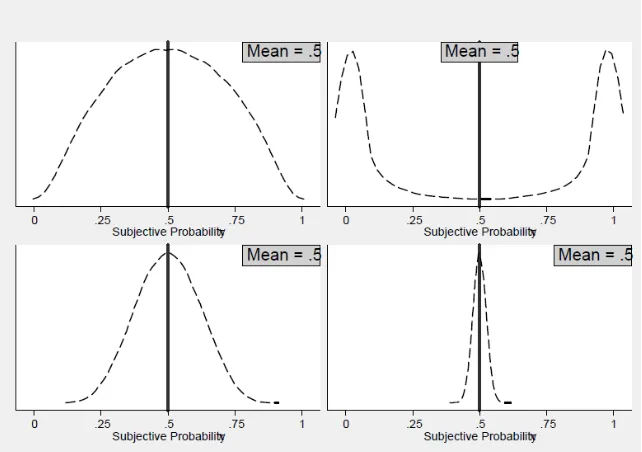
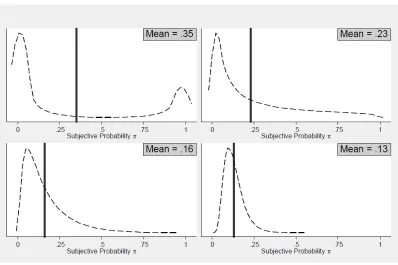
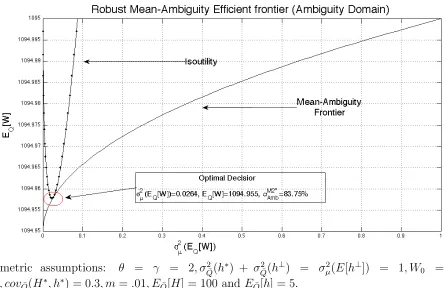
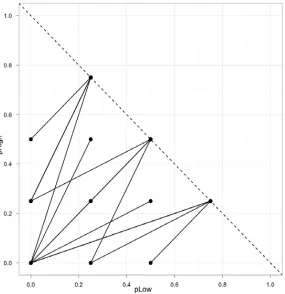
Figure 1.1 Symmetric Subjective Probability Distributions . . . 37 Figure 1.2 Asymmetric Subjective Probability Distributions . . . 38 Figure 1.3 ROCL at Work . . . 39 Figure 2.1 Portfolio Problem Interpretation of a Simple Insurance Decision . 97 Figure 2.2 Optimal Choice in the Risky Domain in the Presence of Ambiguity 99 Figure 2.3 Optimal Choice in the Ambiguity Domain . . . 100 Figure 2.4 Risk/Ambiguity Trade-off and Optimal Choice . . . 102 Figure 3.1 Battery of 40 Lotteries Pairs Probability Coverage . . . 136 Figure 3.2 Tree Representation of a Compound Lottery and its Corresponding
Actuarially-Equivalent Simple Lottery . . . 137 Figure 3.3 Choices Over Compound and Actuarially-Equivalent Lotteries . . 140 Figure 3.4 Choices Over Simple and Compound Lotteries . . . 140 Figure 3.5 Choices Over Simple and Actuarially-Equivalent Lotteries . . . . 141 Figure 3.6 Distribution of Parameter Estimates from the RDU Specification in
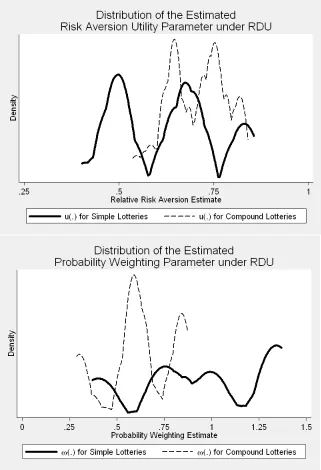
Figure 3.7 Distribution of Parameter Estimates from the RDU Specification in the 1-in-40 Treatment Assuming Heterogeneity in Preferences . . 170 Figure 3.8 Illustrative Subjective Beliefs . . . 172 Figure 3.9 Generalized Scoring Rule Using the Binary Lottery Procedure . . 178 Figure 3.10 Distributional Scoring Rule Initialization . . . 183 Figure 3.11 Illustrative Distributional Scoring Rule Response . . . 183 Figure 3.12 Binary Scoring Rule Initialization . . . 184 Figure 3.13 Illustrative Binary Scoring Rule Response . . . 184 Figure 3.14 Default Simple Lotteries . . . 199 Figure 3.15 Estimated Functions from the RDU Specification in the 1-in-1
Treat-ment Assuming Homogeneity in Preferences . . . 218 Figure 3.16 Estimated Functions from the RDU Specification in the 1-in-1
Figure 5.4 Frequency of Reports by Session . . . 314 Figure 5.5 Estimated Densities of Reports by Session . . . 315 Figure 5.6 Empirical Cumulative Distribution of Distance of Reports from 50 319 Figure 5.7 Empirical Cumulative Distribution of Distance Pooling Data From All
LIST OF TABLES
Table 3.1 Default Simple Lotteries . . . 138 Table 3.2 Generalized Fisher Exact Test on the Actuarially-Equivalent Lottery
vs. Compound Lottery Pairs . . . 145 Table 3.3 Binomial Probability Tests on Actuarially-Equivalent Lottery vs.
Com-pound Lottery Pairs . . . 146 Table 3.4 Cochran Q Test on the Actuarially-Equivalent Lottery vs. Compound
Lottery Pairs . . . 147 Table 3.5 Fisher Exact Test on Matched Simple-Compound and
Simple-Actuarially-Equivalent Pairs . . . 150 Table 3.6 Bonferroni-Dunn Method on Matched Compound and
Simple-Actuarially-Equivalent Pairs . . . 152 Table 3.7 McNemar Test on Matched Simple-Compound and
Simple-Actuarially-Equivalent Pairs . . . 153 Table 3.8 Estimates of Source-Dependent RDU and EUT Models Allowing for
Table 3.9 Estimates of Source-Dependent RDU and EUT Models Allowing for Heterogeneity . . . 169 Table 3.10 Default Simple Lotteries . . . 196 Table 3.11 Simple Lotteries vs. Compound Lotteries (Pairs 1-15) . . . 200 Table 3.12 Simple Lotteries vs. Actuarially-Equivalent Lotteries (Pairs 16-30) 201 Table 3.13 Actuarially-Equivalent Lotteries vs. Compound Lotteries (Pairs
31-40) . . . 202 Table 3.14 Estimates of Source-Dependent RDU and EUT Model Allowing for
Heterogeneity . . . 216 Table 3.15 Estimates of Source-Dependent RDU and EUT Model Allowing for
Chapter 1
Behavioral Insurance: A Survey
by Glenn W. Harrison and Jimmy Mart´ınez-Correa
Abstract
Behavioral insurance applies alternative models of human behavior to insurance decisions. The use of alternative models allows an evaluation of the effect of different behavioral assumptions on inferences about insurance markets. We consider
theoretical, experimental and econometric applications of different behavioral
assumptions. The literature is reviewed and some gaps filled, providing a systematic overview of the field of behavioral insurance. We consider the effect of allowing for rank-dependent probability weighting, loss aversion, ambiguity and the presence of traded and non-traded assets on the classic theorems of insurance economics. We review experimental evidence on different facets of insurance from the laboratory and the field, including randomized control trials of alternative insurance products. Finally, we review the subtle econometric issues that arise when estimating models of behavior towards insurance, particularly when using naturally occurring data. A unifying theme of our review is the importance of allowing for alternative behavioral assumptions when undertaking welfare evaluations of insurance products and
1.1
Introduction
of decision theory under risk and uncertainty as well as the frontier of behavioral insurance. We emphasize that this survey focuses on the behavioral foundations of individual decision making under symmetric information. One of the purposes is then to survey the different individual behavioral assumptions which, with respect to classical approaches, might have very different implications for market and aggregate behavior in the presence of
informational problems like moral hazard and adverse selection.
1.2
Preliminaries on Behavioral Economics
Behavioral economics is often presented as putting “people” back into economics, in the sense that the received paradigm had no essential role for agents that anyone would ever recognize as being human.
1.2.1
Stylized Facts
axiom that one then wants to reject. Many behavioral studies invoke something referred to as “the isolation effect,” which is often a behavioral assertion that a subject views each choice in an experiment as independent of other choices in the experiment. When used formally, this hypothesis is usually the same as the (mixture) independence axiom. Nonetheless, appeal to the “isolation effect” is often invoked informally as “an empirical matter,” much as a magic talisman is used to ward off evil spirits.
To illustrate the role of experimental procedures, consider ground zero, the Allais Paradox. It is now well documented that experimental subjects simply do not fall prey to the Allais Paradox like decision-making lemmings when one presents the task for real payments and drops the word “millions” after the prize amount: see Conlisk (1989), Harrison (1994), Burke et al. (1996) and Fan (2002). Subjects appear to crank out the EV when given real tasks to perform, and the vast majority behave consistently with EUT as a result. This is not to claim that all anomalies or stylized facts are untrue, but there is a casual tendency in the behavioral economics literature to repeatedly assume stylized facts that are simply incorrect.
2011a,b). If one does use student populations, then there is again evidence for roughly 50:50 mixtures of exponential discounting and hyperbolic discounting (Coller et al., 2012).
1.2.2
Straw Men
The second issue is the misrepresentation of received theory. Studies that claim to use the expression homo economicus provide a clear sign in an academic context that someone is engaged in polemics rather than science. The details of some prominent examples are provided by Harrison (2011b, §3), and need not be aired yet again, but the manner in which real economists have abused the definition of “received theory” is staggering. Actually, what is staggering is the manner in which this has been tolerated by consumers that know better. We prefer to address this by constructive discussion of what we can model, with care and qualification.
We also strictly avoid attaching the label “rational” to any set of axioms or theoretical structures. This is not because we have no interest in normative judgments, but simply to avoid a counterproductive bog of rhetoric.
1.2.3
Behavioral Econometrics
weighting and utility curvature to differ over gains and losses. These all involve delicate structural inferences, which cannot be avoided by not caring for rigor.
For example, Fehr and Goette (2007) estimate a loss aversion parameter using what we will call a Blind Loss Aversion model of behavior, “extending” the Myopic Loss Aversion model of Benartzi and Thaler (1995). They ask subjects to consider two lotteries, expressed here in equivalent dollars instead of Swiss Francs:
Lottery A: Win $4.50 with probability 1/2, lose $2.80 with probability 1/2. Otherwise get $0.
Lottery B: Play six independent repetitions of lottery A. Otherwise get $0. Subjects could participate in both lotteries, neither, or either. Fehr and Goette (2007) assume that subjects have a linear utility function for stakes that are this small, relying on the theoretical arguments of Rabin (2000). They also assume that there is no probability weighting: even though Quiggin (1982, p. §4) viewed 1/2 as a plausible fixed point in probability weighting, most others have assumed or found otherwise. If one is blind to the effects of curvature of the utility function and probability weighting then the only thing left to explain choices over these lotteries is loss aversion. On the other hand, it becomes “heroic” to then extrapolate those estimates to explain behavior that one has elsewhere (p.304) assumed to be characterized by stakes large enough that strictly concave utility is plausible a priori. Of course, the preferred model (p.306) assumes away concavity and only uses the loss aversion parameter, but without explanation for why behavior over such stakes should be driven solely by loss aversion instead of risk attitudes more generally.1
A second difficulty in behavioral econometrics is a tendency to use Ordinary Least Squares (OLS) for, well, everything. In some cases this is a safe and easy descriptive device, but in many other cases it can be dangerous. Imagine a setting in which subjects are choosing a portfolio allocation and over 95data-generating process for the “now that I am
contributing, how much” decision. And so on. These are all familiar issues, which we just conveniently forget.
A final difficulty in some quarters is the use of “parameter calibration” to fit a model, perhaps using some squared-error metric. This can be justifiable as approximating the point estimates from maximum likelihood tolerably well in many settings, but avoids any mention of sampling errors. Matters are compounded by these calibrated point estimates being used for hypothesis testing (e.g., a t-test on a vector of point estimates).
If academics do not object to statistical practices of this kind loudly and repeatedly in seminars, and they do not, then we get the quality of empirical behavioral research we pay for.
1.2.4
Hypothetical Bias
It is a pity to have to keep saying this, but hypothetical bias exists. In general one gets different answers if one asks hypothetical questions than if one asks comparable questions with real consequences. The abuse of experimental methods and results here is not due to subtle methodological error, but just plain bad scholarship that is uncritically tolerated. One common modus operandi in behavioral economics is to cite some casual, hypothetical
study of behavior that finds some odd and startling things, and then briefly mention that the same results are obtained when one uses real incentives, e.g., the literature on
discounting anomalies, such as (Loewenstein and Prelec, 1992, §II). The problems here are not fixed by thinking more carefully from a methodological perspective, but by simply calling a spade a spade.
One also has to object that there have been decades of mischievous debate about hypothetical bias that has diverted resources inefficiently. We stress that this is of
immediate policy significance in the area of environmental damage assessment (Harrison, 2006), and not just a procedural issue for backwater debate between experimenters. By all means do a hypothetical study to scope out an issue, if you must and are lazy, but dont leave it there if something interesting is discovered. Dont misquote assertions that one gets the same results: in general, and that is the key, one does not (Harrison and Rutstr¨om, 2008). Read (2005) is a wonderful, blunt satire of the arguments in favor of using
hypothetical rewards, although some might read him as seriously advocating the positions he so brilliantly undermines.
given lottery depending on whether one uses real or hypothetical responses, and (2) no difference between the effect of the EUT treatment on lottery pair responses depending on whether one uses real or hypothetical responses.
Furthermore, Camerer and Hogarth (1999) explicitly exclude from their analysis the mountain of data from experiments on valuation that show hypothetical bias. Their rationale for this exclusion was that economic theory did not provide any guidance as to which set of responses was valid. This is an odd rationale, since the mere fact that
hypothetical and real valuations differ so much tells us that at least one of them is wrong. Thus one does not actually need to identify one as reflecting “true preferences,” even if that is an easy taska priori, in order to recognize that there are differences in behavioral between hypothetical and real responses.
1.2.5
wwSs: What Would Savage Say?
One of the great, and lasting, contributions of behavioral economics is that we now have many rich models of behavior, potentially allowing structural understanding of insurance behavior.
with lab subjects suggest.
But the 600 pound gorilla confound is the subjective belief that decision-makers hold in many settings. This is the one that is widely ignored.2 What Savage (1971, 1972) showed was that, under some (admittedly strong) assumptions, one could infer a subjective
probability and a utility function from observable behavior. The subjective probability and the utility function would each be well-behaved in the classical senses, but one could not, in general, make claims about the one without knowing or assuming something about the other.3
The suggestion is not that casual assumptions about possible subjective beliefs should be used to rationalize “rational behavior” in every setting, but that inferences about cognitive failures, and the need for nudges, hinge on our descriptive knowledge of what explains behavior. If we rule out some factor, then something else may look odd, just as a balloon bulges on one side if you press it on the other side. To take a simple example, assume that there is a risk premium, but one uses either a model that assumes that 100 percent of the observed behavior is due to diminishing marginal utility or a model that assumes that 100 percent of the observed behavior is due to probability pessimism. The first model will generate concave utility functions and impose zero probability weighting, and the second model will generate convex probability weighting functions and impose linear utility
functions: both will likely explain the risk premium tolerably well. But the two models can
2An important exception, from the behaviorist side of the Force, is K¨oszegi and Rabin (2008). They
write (p.196ff.) about the “impossibility of Skinnerian welfare economics” in the absence of measurement of subjective beliefs.
3Machina and Schmeidler (1992) provide an important extension to show that “probabilistic
have very different implications for the design of development policy that “works” in any interesting sense.
Of course, in some settings it is simply not possible to “go back to the well” and elicit information of this kind. However, there is no reason why one cannot use information from one sample, even from a different population if necessary, to condition inferences about another sample, to see the effect.
1.3
Theoretical Models
We focus on the core setting in which there are no asymmetric information problems in the design of insurance. We later discuss extensions, but there are enough complexities in this core setting to warrant careful review.
1.3.1
Risk
Risk Attitudes, Utility Functions and Insurance Demand
Bernoulli (1738, p. 29-30) is perhaps one of the first references in the literature analyzing insurance and its rationality both for the person offering the insurance coverage and the one buying it. Bernoulli used an expected utility argument, that was later axiomatized by von Neumann and Morgenstern (1953), vNM henceforth, to calculate the threshold in personal wealth that provides a rationale for a person to buy or sell insurance of commodities shipped by sea.
consisted in a person foregoing the possibility of playing a gamble with infinite expected value for a finite and not very large amount. He proposed that individuals make choices according to the “moral expectation” or expected utility of uncertain alternatives, where a concave logarithmic utility function is assumed to model the utility of wealth. This was a novel approach in his time when expected value was the accepted normative approach to make decisions between uncertain prospects. One assumption implicit in Bernoulli’s moral expectation argument is that the concavity of the utility function implies decreasing marginal utility, an still widely accepted behavioral assumption. However, by the 1950’s many academics were puzzle by observed behavior, such as people gambling, which contradicts the generality of decreasing marginal utility. For example, ubiquitous
decreasing marginal utility would imply that a person would always reject a fair gamble in which it is equiprobable to win or lose one dollar. This brought into question the validity of EUT, even though decreasing marginal utility is not a requirement in the system of axioms in vNM.
strategy to explain the contradictory behavior is to allow for a utility function that exhibits decreasing marginal utility at lower levels of income, and increasing marginal utility at higher levels of income. These imply a utility function that is concave for lower levels of income and convex for higher levels of income. A utility function with these features would explain why people choose to buy insurance to protect themselves from relatively small losses, but buy lottery tickets that could imply attaining relatively high levels of income. Markowitz (1952, p. 155) advanced a relatively similar hypothesis to explain the joint observance of insurance purchasing and gambling behavior. Markowitz also proposed a utility function of wealth that does not exhibit decreasing marginal utility everywhere, as in Friedman and Savage (1948), but that avoids counterintuitive implications of their approach. For example, the explanation in Friedman and Savage (1948) would imply that a sufficiently rich man would be willing to offer insurance even if this means losses in
expected value terms or a sufficiently poor individual never gambling, both being
implications that are quite debatable. Markowitz (1952, p. 156) also pointed out that his explanation implies a preference for positively skewed distributions of wealth. This means that individuals would exhibit a preference for distributions that offer low probability of very high realizations of wealth and relatively high probability of lower levels of wealth; in other words, the opportunity of a long shot is very valued by subjects.
The concave-convex nature of the utility was early tested in the seminal work of Mosteller and Nogee (1951, p. 404) who concluded that “... there is some support for the
amendment to the Friedman-Savage utility function was tested by Weitzman (1965, p. 26) who used aggregate data from horse bets and found that the “results of this study show that the crowd at the race track behaves as if it were composed of a group of individuals each of whom possesses an identical utility function of the Markowitz variety.” However, Yaari (1965b) showed in an experimental setting that one doesn’t need to introduce the non-convexity4 in individuals’ preferences to explain the co-existence of gambling and insurance in the subjects’ portfolio. Yaari (1965b, p. 290) found that attitudes towards probabilities played a role and that “one finds that some subjects tend to overstate low probabilities and to understate high probabilities.”
Quiggin (1993) provided a similar explanation to the insurance-gamble puzzle but within the Rank-Dependent Utility (RDU) model. He proposes (p. 88ff.) an explanation that involves both optimism towards probabilities (concavity in the probability weighting function) and outcome risk aversion (concave utility function):
Assuming that U is concave, the choices of an optimist facing uncertainty will reflect a balance between two conflicting forces. Optimism encourages risk taking but decreasing marginal utility discourages it. Since the effects of probability weighting are independent of the scale of the bet, optimism will tend to predominate when bets are small (that is, when all the outcomes are near the current wealth level). Outcome risk aversion will tend to predominate when bets are large. For example, an optimist faced with the opportunity to participate in an actuarially fair bet will always wish to put some money on (since EU analysis shows that behavior approaches risk neutrality as
distributions collapses to the mean). However, as the stake increases outcome risk aversion will start to play a role. Thus, with small stakes, small winning probabilities and large prizes, there will be a trade-off between optimism and outcome risk aversion.
Machina (1982, p. 280-282) proposed the fanning out hypothesis which is capable of also
explaining the insurance-gambling puzzle by allowing subjects to have a tendency to prefer positively skewed distributions. For example, a subject exhibiting preferences that fan out would prefer to buy a lottery that induces a positively skewed distribution of wealth, if the initial wealth is assumed to be certain. Similarly, the same subject can exhibit a preference for insurance since in the simplest case it can transform a negatively skewed distribution into a symmetric certain one that assigns probability one to a given level of wealth. Consequently, buying a lottery or insurance induce a distribution of wealth that is relatively positively skewed with respect to the initial distribution. Thus a subject
satisfying the fanning out hypothesis of preferences can explain the seemingly contradicting the observation that people that buy insurance also gamble on lotteries. It is worth
mentioning that this observation can be explained within the assumption of general risk aversion by allowing for indivisibility of expenditure and goods (Ng, 1965; Flemming, 1969), commitments in expenditure (Chetty and Szeidl, 2007; Chen and Mahani, 2011), making consumption and not wealth the argument of the utility function and introducing a borrowing constraint (Hakansson, 1970) and imperfection in the capital markets and
intertemporal considerations (Kim, 1973).
The original formulation of prospect theory in Kahneman and Tversky (1979, p. 281), but also the cumulative version in Tversky and Kahneman (1992), can explain the popularity of insurance and gambling. They claim that the overweighting of small probability favors long shots like lottery tickets that pay large amounts with small probabilities over the expected value of the gambles. They also claim that people may prefer small losses
overweighted. Kahneman and Tversky (1979, p. 286) argue that the original version of Prospect Theory is able to predict both insurance and gambling for small probabilities, but they also claim that their “analysis fall far short of a fully adequate account for these complex phenomena.” They argue that there is evidence that purchase of insurance is often done in the medium range of probabilities but that small probabilities are often neglected below certain threshold. Slovic et al. (1977, p. 253), Kunreuther et al. (1978) and
Schoemaker and Kunreuther (1979) found that in hypothetical situations people prefer to buy insurance for low-loss events that have high probability to purchase insurance for low-probability, high-loss events.Laury et al. (2009) replicated the results in Slovic et al. (1977) with hypothetical questions, but found the under-insurance of low
probability/high-loss events, which is mainly based on field studies, does not hold in rigorous experimental conditions with real economic stakes. In fact Laury et al. (2009, p. 18) found that “individuals are more likely to purchase insurance for
Optimal Risk-Sharing Arrangements and Insurance Decisions in the Absence of Other Risks
One of the landmark contributions in insurance economics is Borch (1962) who used the framework in Arrow (1964) to model a problem of a reinsurance market where risk is the only commodity and many reinsurers bargain to come to a Pareto-optimal risk-sharing agreement. The most important results are that any risk sharing agreement includes a mutuality principle (Gollier, 1992, p. 7) where all parties give their endowments up to a pool, thus only aggregate social risks matter since they cannot be diversified. A risk sharing rule that depends on risk tolerances and the Pareto weights, known as the Borch rule, is used to assign the risk allocations to each party.
Arrow (1963, p. 971-973) showed in a bilateral setting that, if both the insured and the insurer are risk averse expected utility maximizers, the Borch rule applies. In particular, the Pareto optimal risk-sharing agreement is a coinsurance contract in which the
distribution of risk depends on the bargaining power and risk aversion of each party.
Machina (2000, p. 62-64) shows the robustness of the bilateral result in Arrow (1963) when subjects’ preferences have a non-expected utility (non-EU) representation that generalized expected utility. Machina (2000, p. 65-70) also shows that the mutuality principle does hold in a general environment with many parties that exhibit non-EU preference
representations; however, the original Borch’s risk sharing rule is no longer sufficient in this environment, it is only a necessary condition. One needs to further assume that the
There is evidence of Borch’s results both from the laboratory and from naturally occurring data. For instance, using data from three villages in India, Townsend (1994) tested what he calls the “full insurance” hypothesis in which all idiosyncratic risks are diversified and risk-sharing agreements depend on risk attitudes and bargaining power of the parties involved. Townsend (1994, p. 584) found that his hypothesis is rejected but individual consumption co-moves with the village’s consumption average, thus consumption is not seriously affected by idiosyncratic risk. In a more recent paper, using data from Thai households, Chiapori et al. (2011, p. 1) control for heterogeneity and found that they cannot reject the hypothesis of full risk-sharing, where more risk averse households are insured by less risk averse households. In an experimental setting Bone et al. (1999) found the puzzling behavior that the risk-sharing agreements among trading partners was
characterized by unconditional equal allocations across several prospects. In a follow-up study, Bone et al. (2004, p. 35) attributed this behavior partly to the complexity of the original task because they find that when giving simple choices to pairs of subjects with different elicited risk attitudes “partners largely favour ex ante efficiency over ex post equality.”
optimal contract involves a coinsurance arrangement above a deductible. Raviv also showed that the cost of insurance is the driving force of the deductible result and the coinsurance result is due to either risk sharing or cost sharing between the parties. Also, he finds that these results hold in the presence of several insurable losses and that only
aggregate losses matter, thus assuming that losses are substitutable. This means that one dollar of a given loss is valued by a subject in the same manner that one dollar of another loss. Therefore, one can aggregate the monetary value of losses into one number. The importance of this assumption will be clear when we discuss multivariate risk aversion and its implications to insurance.
Gould (1969) and Schlesinger (1981) studied in an EUT framework the optimal deductible that should be taken in a given insurance contract, where the classic results state that individuals with a higher probability of a loss, more risk aversion or lower initial wealth will buy more insurance. Schlesinger (1985) studied the sufficient second order condition, extensively studied in Boyle and Mao (1983), for the choice of optimal deductible in insurance arrangements. Schlesinger (1985, p. 522) found that this sufficient condition depends on the “growth rate of the net price of insurance coverage and a utility weight that reflects a measure of risk aversion.”
objective probabilities of an accident greater than the deductible” (p. 42).
However, there are other explanations to the demand for low deductibles that are related to the preference representations of individuals. Karni (1985) generalized the concept of risk aversion to state-dependent utility and found that higher risk aversion induces subjects to take lower deductibles. PT can also explain the demand for low deductibles. Schmidt (2012) studies in some detail the effect of different reference points for insurance demand within the PT framework and finds that wealth after buying full insurance seems to be a realistic reference point that can accommodate empirical evidence. Regret Theory (Loomes and Sugden, 1982; Bell, 1982; Sugden, 1993; Quiggin, 1994), which characterizes regret as not having chosen the ex post optimal choice, can also explain the demand for very low deductibles as shown by Braun Muermann (2004). Finally, the preference representation introduced by Gollier and Muermann (2012) can also rationalize the demand for low deductibles among other deviations from EUT like Allais paradoxes and the equity premium puzzle.
Mossin (1968) and Smith (1968) showed that if a decision maker is an expected utility maximizer and insurance is actuarially fair, in other words, that the proportional insurance loading is equal to zero, then full insurance is optimal. Since the loading is normally
Additionally, Mossin’s and Smith’s result may or may not hold depending on the subjects’ preference representation. For instance, Razin (1976) analyzed insurance purchasing using the minimax regret criterion suggested by Savage (1951). Razin showed that if a subject follows this criterion, it is optimal to buy full coverage even if the insurance contract is not actuarially fair. Also,
insurance is a financial claim... [t]hus it does not seem really appropriate to apply to insurance concepts which were derived to categorize consumption goods (Louberg´e, 2000, p. 9). Another reason might be that, as Hoy and Robson (1981, p. 51) claim, it seems empirically implausible for insurance to be a Giffen good since it would require unusually high loadings with respect to the probability of the loss.
However, it is a widely held view among practitioners that the demand for life and non-life insurance increases with wealth, which contradicts the behavioral implication of decreasing insurance demand of the widely accepted assumption of DARA. For example, Enz (2000) estimate the so called S-curve that documents a positive relationship across countries between income per capita and insurance penetration, which are used as proxies of wealth and insurance demand. A simple explanation would be that the size of the loss increases as wealth increases. Mossin (1968) assumed that the size of the loss is independent of changes in wealth. This assumption is arguably met in reality where increases in wealth normally increases the amount of loss the subject is exposed to (Chesney and Louberg´e, 1986). For example, a subject that observes an increase in wealth may decide to buy a more expensive house which implies a larger potential loss in case of earthquake.
the amount invested in the insurable asset. Under certain conditions insurance behaves as a normal good whenever the insurable asset is a normal good itself. Chen and Mahani (2011, p. 20) offer an alternative by assuming consumption commitments which can account for the normality of insurance at certain levels of wealth.
Another interesting explanation of insurance behaving as a normal good is the potential effect on insurance demand of liquidity constraints, at least for very poor households. It is relatively well-documented that poor households exhibit a low demand for insurance even though it might seem that they should be buying it since they are often also the ones more exposed to adverse random shocks.
Deaton (1990, 1991) argues that a model with liquidity constraints and prudent behavior, as defined by Kimball (1990), is a reasonable way to characterize consumption and saving behavior of poor farmers in least developed countries. If incomes are stationary and independent and identically distributed over time, as might be the case of a poor farmer, assets (e.g., harvested crops) play the role of a buffer stock and the decision maker adjusts saving to smooth consumption. The more prudent the individuals are and the more
uncertainty in income, the greater the demand for precautionary saving in detriment of insurance purchasing. In fact, Moffet (1977) found that saving and insurance are
substitutes in the absence of certainty. There is a close relationship between prudence and liquidity constraints. Carroll and Kimball (2005) explain why the introduction of a
be used to explain the low take-up of insurance among poor households and an increase in insurance demand as the level of wealth increases. On one hand, Gollier (2001, p. 238) shows that prudence is a necessary condition for decreasing absolute risk aversion (DARA). On the other hand, Mossin (1968) shows that the coinsurance demand is decreasing in initial wealth if the utility function exhibits DARA. Both results suggest that an increase in prudence would decrease the demand for coinsurance. Because of the relationship explained in Carroll and Kimball (2005), an equivalent result can be derived. If liquidity constraints increase precautionary saving, then tighter liquidity constraints should decrease the demand for insurance or even make it disappear. The intuition is that a liquidity constraint induces individuals to save to smooth consumption and this competes with the incentives to buy insurance. As wealth increases the liquidity constraints could be relaxed and this should increase the insurance demand since less saving is needed to smooth
consumption. This would make insurance behave as a normal good. However, is likely that at some point risk attitudes exhibiting DARA could overcome the augmenting effect on insurance demand of relaxing the liquidity constraints. Nevertheless, it could be possible that some of the explanations mentioned above that explain the normality of insurance could be driving the increase in insurance demand at higher levels of wealth. To the best of our knowledge there is no paper that studies such a comprehensive model.
Probabilistic Insurance: A Novel Kind of Insurance?
traditional insurance contract that offers full insurance, but that intuition would suggest is riskier than regular insurance with complete coverage. Kahneman and Tversky (1979, p. 269) define probabilistic insurance in the following way:
In this program [the probabilistic insurance contract] you pay half of the regular premium. In case of damage, there is a 50 per cent chance that you pay the other half of the premium and the insurance company covers all the losses; and there is a 50 per cent chance that you get back your insurance payment and suffer all the losses. For example, if an accident occurs on an odd day of the month, you pay the other half of the regular premium and your losses are covered; but if the accident occurs on an even day of the month, your insurance payment is refunded and your losses are not covered.
An EUT maximizer with a concave utility function would preferred a probabilistic
insurance over a contract that offers full insurance. A short proof of this claim is as follows. Suppose an individual with utility function u such thatu0 >0, u00>0 and initial wealth position w. The subject is exposed to a potential loss x with probabilityp. The premium of a contract that offers full insurance, π, is defined such that it makes this contract barely worth its cost:
pu(w−x) + (1−p)u(w) = u(w−π)
where the left (right) hand side of the equality is the expected utility of the individual without (with) insurance. Risk aversion, which is equivalent to concavity of the utility function under EUT, implies that the individual will prefer a probabilistic insurance contract over the full coverage contract:
where the left (right) hand side of the equality is the expected utility of the individual that takes the probabilistic (full) insurance contract.
Contrary to the EUT prediction, KT found in their hypothetical experiments that, out of 95 individuals, 80% preferred full insurance over probabilistic insurance, which is the opposite an EUT maximizer with concave utility function would do.
Kahneman and Tversky (1979, p. 270) claim that “[t]his is a rather puzzling consequence of the risk aversion hypothesis of the utility theory, because all insurance is, in a sense, probabilistic. The most avid buyer of insurance remains vulnerable to many financial and other risks which his policies do not cover.” They are able to explain this puzzling behavior within prospect theory by allowing the utility function to be convex in losses, or
equivalently, by claiming that individuals exhibit risk loving behavior over losses with respect to a reference point. More recently, using real stakes, Herrero et al. (2006) found that subjects that are indifferent between full insurance and no insurance, prefer full insurance to probabilistic insurance and the latter to no insurance. The first finding is incompatible with EUT and the second is incompatible with the original Prospect Theory. Herrero et al. (2006) suggest that Regret Theory, as described in Loomes and Sugden (1982, 1987), can accommodate both results.
returned and no insurance repayment is done or the other half of the premium has to be paid and the total loss is covered. Segal demonstrated that the rejection of probabilistic insurance is consistent with risk aversion and a concave utility function if the individual has a RDU preference representation and either satisfies the reduction of compound lotteries or the compound independence axiom but not both.5
Wakker et al. (1997) generalized the particular version of probabilistic insurance shown by Kahneman and Tversky (1979) and find survey evidence of hypothetical questions in which people dislike their version of probabilistic insurance. Wakker et al. (1997, p. 7-8) claim that “most insurance policies are, in fact, probabilistic. Insurance policies typically specify some events (e.g., wars, ‘acts of god,’ contributory negligence) in which the consumer is not reimbursed for losses, whether or not the consumer was aware of these contingencies ex ante. Furthermore, there is always a possibility however remote-that the insurer will not pay for some other reason such a insolvency or fraud. Although such default risks are not explicitly acknowledge, they are present in any real insurance setting.” In fact, the
unappealing nature of probabilistic insurance is also shared by Merton (1993, p. 43) who claims that “... many real world customers would consciously agree to accept non-trivial [default] risk on a $200,000 life insurance policy in return for a large reduction in the annual premium, say from $400 to $300.” Doherty and Schlesinger (1990) showed that this risk of contractual nonperformance renders invalid most of the standard results in
insurance economics. For example, if the risk of insolvency is non-negligible and the default
5Expected utility theory assumes the mixture independence axiom, which is in turn implied by the
is total, partial insurance is optimal even at actuarially fair prices, which is contrary to the Mossin (1968) and Smith (1968) full insurance result. Also, insurance as an inferior good when preferences exhibit DARA and more demand for insurance given higher risk aversion no longer hold. It is worth mentioning that this type of nonperformance in insurance contracts is conceptually related to what is called basis risk in hedging markets. For example, Clarke (2011) shows in a EUT framework and for a risk averse individual that zero demand for index insurance can be optimal depending on the transaction costs and the level of basis risk. Doherty and Richter (2002) show, in a mean-variance framework and in the presence of basis risk, that the availability of both an index-linked hedging product and gap insurance that covers the difference in payouts between the index product and actual losses can lead to efficiency gains.
Insurance as One Risk Management Strategy among Many and the Interaction of Many Risks
Ehrlich and Becker (1972) is considered the first theoretical paper in risk management which considered insurance as one tool among many to deal with hazards and their economic costs. Ehrlich and Becker derived four important results.
self-protection affects the probability of the loss itself.6
Second, market insurance and self-insurance are substitutes since both risk management strategies are able to redistribute resources from bad states of the world to good states of the world, thus affecting the size cost of the loss and smoothing consumption across states of nature. Third, market insurance and self-protection can be substitutes or complements. For example, the installation of a theft alarm at home might be enough to deter robbery so home insurance might not be necessary. On the contrary, a theft alarm might increase the demand for insurance if this self-protection strategy reduces the probability of a loss and the cost of insurance varies proportionally with this probability. An implication of this relationship is that if the price of insurance to cover certain risks is independent of expenditures on self-protection activities that reduce the probability of a loss, then the market will tend to consider those risks as uninsurable since moral hazard is more likely to arise. However, in contrast to the moral-hazard intuition, this relationship may also imply that the presence of market insurance may increase the self-protection activities.
Finally, Ehrlich and Becker’s framework is able to explain the insurance-gambling puzzle. They consider that behavior of people buying insurance and gambling at the same time can be explained if the options available are sufficiently favorable. Therefore, Ehrlich and Becker (1972, p. 627) consider that “inferences about attitudes towards risk cannot be made independently of existing market opportunities: a person may appear to be ‘risk avoider’ under one combination of prices and potential losses and a ‘risk taker’ in another.”
6Ehrlich and Becker recognize that many of the risk management strategies that people have at their
Using the EUT framework, several authors expanded the analysis in Ehrlich and Becker (1972) in different directions. Dionne and Eeckhoudt (1985) found that more risk aversion increases self-insurance activities but does not necessarily increase self-protection. Briys and Schlesinger (1990, p. 466) provided an explanation for these results: Self-insurance unambiguously reduces risk, while self-protection does not. Consequently, it is no surprise that an increase in risk aversion unambiguously increases the level of self-insurance, but sometimes it may decrease the level of self-protection. However, Hiebert (1989, p. 300-301) showed that self-insurance activities does not necessarily increase with more risk aversion if the effectiveness on loss mitigation of these activities is uncertain. Briys et al. (1991) take the analysis one step further and analyze the main tools of risk management when their reliability cannot be guaranteed, in other words, that there is as chance that these tools might not work as expected in the case of a loss, just like an insurer might default on its clients because of solvency issues. In contrast to Ehrlich and Becker (1972), Briys et al. (1991, p. 47) find that: (i) the “riskiness” of final wealth is not necessarily reduced by an increase in market insurance or self-insurance when they are not fully reliable; and (ii) market insurance and self-insurance might be complements without full reliability. Finally, Sweeny and Beard (1992) study the comparative statics of self-protection when initial wealth and the size of the loss changes.
Machina (1995, 2000) and Courbage (2001) showed that the main results in Ehrlich and Becker (1972) hold under RDU theory, generalized smooth Non-EU and Yaari’s Dual Theory.
The framework in Ehrlich and Becker can be used to study how policies or activities that change risks can affect individuals welfare. Shogren and Crocker (1991, p. 6, 9 and 11), using the EUT model, analyze the ex ante value of reducing risk when there are
self-protection possibilities and find three important results. First, when self-protection influences the probability and/or the severity of a loss, the ex ante valuation of a reduction in risk is a function of risk attitudes and the marginal rate of technical substitution
between self-protection and hazard concentrations. This implies that willingness to pay for reductions in risk cannot be studied just by looking at observable expenditures in
self-protection and exposure to risk. This also implies that one cannot simply sum the unweighted compensating or equivalent variation to study the societal impact of a policy that affects a risk individuals are exposed to. Second, even under very intuitive conditions such as individuals’ pecuniary costs of hazards being convex to risk, increased exposure to a hazard does not necessarily mean that the individual needs to be compensated. The intuition behind this result is that a change in exposure to risk induced by self-protection may have effects both on the probability and the severity of the loss. There are no ex ante
the subject’s ex ante value of a reduction in risk. Intuitively this may happen because these expenditures may not be necessarily increasing in risk.
Quiggin (1992, p. 41) claims that, under certain intuitive conditions, the negative results in Shogren and Crocker will not hold and the “standard willingness-to-pay approach to
valuing environmental hazards is valid under fairly general conditions.” These are
decreasing absolute risk aversion and a separability condition. The former is an assumption that deserves discussion but is widely accepted by economists, however, the latter implies that self-protection activities mitigates the individual’s exposure to risk but does not affect the risk itself. In a subsequent response to Quiggin’s results, Shogren and Crocker (1999) claim that the separability assumption is problematic and consider that risk is endogenous in many situations. This implies that self-protection activities can mitigate the
consequences of risk to the individual but can also affect the general level of risk itself. If this is in fact the case, then the analysis welfare analysis of risk reduction cannot avoid the identification of risk attitudes. This is an important example in which experiments can help identify risk attitudes in order to carry out welfare analysis.
A modern perspective in the analysis of financial decisions was formally introduced by Mayers and Smith (1983), but recognized earlier by Gould (1969, p. 151), who proposed that insurance decisions should be analyzed in the presence of traded and non-traded assets like human capital. The introduction of a non-traded asset can significantly change some of the standard results in insurance economics, such as a wealthier individual buying less insurance.
is of great relevance to the analysis of decisions under risk. As pointed out by Schlesinger and Doherty (1985), incomplete markets induce the presence of uninsurable background risks that can affect the standard results in the analysis in insurance decisions. Doherty and Schlesinger (1983) studied the robustness of the standard results to the presence of uninsurable background risk that is independent to the insurable loss. They found that under certain restrictive conditions the Mossin-Smith theorem holds and more risk averse people will choose a lower deductible. Turnbull (1983, p. 217) also showed that in the presence of many risks, the Arrow-Pratt measure of risk aversion is not a sufficient statistic to describe individuals’ behavior in insurance purchasing. Doherty (1984, p. 209) showed in an EUT framework that the Mossin-Smith theorem only holds if the covariance between the non-traded asset and the insurable loss is negative. The intuition is that even if the insurance premium is fair, the DM might still not be willing to fully insure if she can compensate high losses with high realizations of her human capital. However, if the covariance is negative, the individual might want to fully insure if a health shock affects negatively her productivity, which would undermine her human capital. Moreover, in the presence of a non-traded asset circumstances may arise where a risk averse individual prefers a coinsurance arrangement to an actuarially equivalent insurance contract with straight deductible.
(independent or not) will induce a higher demand for insurance. Standard risk aversion is satisfied if both absolute risk aversion and absolute prudence are decreasing in wealth. Gollier and Pratt (1996, p. 1109) derived a restriction on utility functions calledrisk vulnerability which is equivalent to “the condition that an undesirable risk can never be made desirable by the presence of an independent, unfair risk.”
General Characterizations of Risk aversion, Changes in Risks and Insurance Decisions
There is an important line of research that analyzes decisions under risk and uncertainty by studying very general definitions of risk aversion and the stochastic orders that the individual’s preference representation satisfies.