Ok-Hwa Kang
1†, Mi-Yae Shon
2†, Ryong Kong
1, Yun-Soo Seo
1, Tian Zhou
1, Do-Yeon Kim
2, Yeong-Soo Kim
3and Dong-Yeul Kwon
1*Abstract
Background:Black ginseng (Panax ginsengC. A. Meyer), three to nine times-steamed and dried ginseng, has biological and pharmacological activities. In this study, the anti-diabetic effects of the black ginseng ethanol extract (GBG05-FF) in typical type 2 diabetic model db/db mice were investigated.
Methods:The effect of GBG05-FF in Type 2 diabetic mice was investigated by their blood analysis, biological mechanism analysis, and histological analysis.
Results:The mice group treated with GBG05-FF showed decreased fasting blood glucose and glucose tolerance compared to that of the nontreated GBG05-FF group. In the blood analysis, GBG05-FF decreased main plasma parameter such as HbA1c, triglyceride, and total-cholesterol levels related to diabetes and improved the expression of genes and protein related to glucose homeostasis and glucose uptake in the liver and muscle. The histological analysis result shows that GBG05-FF decreased lipid accumulation in the liver and damage in the muscle. Moreover, GBG05-FF increased the phosphorylation of the AMPK in the liver and upregulated the expression of GLUT2 in liver and GLUT4 in muscle. Therefore, the mechanisms of GBG05-FF may be related to suppressing gluconeogenesis by activating AMPK in the liver and affecting glucose uptake in surrounding tissues via the upregulation of GLUT2 and GLUT4 expression.
Conclusion:These findings provided a new insight into the anti-diabetic clinical applications of GBG05-FF and it might play an important role in the development of promising functional foods and drugs from the viewpoint of the chemical composition and biological activities.
Keywords:Black ginseng, Anti-diabetic, AMPK, Glut
Background
Black ginseng (Panax ginsengC. A. Meyer), three to nine times-steamed and dried ginseng undergoes Maillard browning reaction. The biological and pharmacological activities of steam-processed ginseng are greater than that of nonsteamed ginseng. During the steaming and drying process, the percentage of main ingredients including
saponin, ginsenosides, proteins, and phenolics is altered, because of newly produced active ingredients [1–4]. Black ginseng contains newly discovered ginsenosides and exhibits more potent biological activities than white and red ginseng [5]. Black ginseng possesses anticarcinogen-esis, anti-diabetic, recovery from learning and memory damages, and antioxidative activities [6–9]. Previous studies were focused on verifying effectiveness of black ginseng on improvement of insulin resistibility or restor-ation ofβ-cell function [10]. In recent studies, we showed that supplementation with black ginseng extract improves diabetic parameters, thus it has a potential as a functional * Correspondence:[email protected]
†Equal contributors
1Department of Oriental Pharmacy, College of Pharmacy and Wonkwang-Oriental Medicines Research Institute, Wonkwang University, 344-2 Sinyong-dong, Iksan, Jeonbuk 570-749, South Korea
Full list of author information is available at the end of the article
food for diabetes mellitus patients [11]. In this study, we focused on the regulation of hyperglycemia and hyperlip-idemia caused by black ginseng extract.
Diabetes is a chronic metabolic disease that account for 3% of the world’s mortality, because of its complications; especially, disease incidence in South Korea is the highest out of all of the OECD countries. It is a metabolic disease caused by either the destruction of pancreaticβ-cells (type 1 diabetes) or unresponsiveness to insulin (type 2 dia-betes) [12]. In particular, type 2 diabetes is an alarming public health issue, because it causes a broad range of chronic diseases and metabolic syndromes such as cardio-vascular disease, hypertension, non-alcoholic fatty liver disease (NAFLD), and obesity.
The homeostasis of blood glucose is maintained as a result of the action of various vital organs. Blood glucose influx is mediated by glucose transporter (GLUT). When the hyperglycemia broke out, plasma glucose entered the cytoplasm of hepatocytes through GLUT2 [13]. In contrast, the glucose uptake in adipose tissue and muscle is mostly mediated by GLUT4 and plays an important role in glucose utilization by insulin stimulation [14]. Hepatic glucose up-take and glucose production are the key parameters in glu-cose homeostasis. Adenosine monophosphate-activated protein kinase (AMPK), a serine/threonine kinase, has a critical function in this process, because it can suppress gluconeogenesis in the liver and promote glucose uptake in peripheral tissues [15]. Previous studies have found that the activation of AMPK signal pathways increased the insu-lin- and contraction-stimulated GLUT4 translocation in muscles [16].
In this study, the anti-diabetic effects of black ginseng extract (GBG05-FF) in typical type 2 diabetic model db/ db mice were investigated. GLUT2 expression in the liver, GLUT4 expression in the skeletal muscle, AMPK protein levels in the liver and white fat was detected to validate the beneficial effects of GBG05-FF as an anti-diabetic agent and to clarify the mechanism of action.
Methods
Materials
3,3-Diaminobenzidine tetrahydrochloride (DAB) was purchased from Sigma-Aldrich (St Louis, MO, USA). Guinea pig antihuman insulin and rabbit antiglucagon were obtained from Millipore Corporation (Billerica, MA, USA). Glycated hemoglobin (HbA1c), triglyceride (TG) cholesterol (CHO), and oral glucose tolerance test (OGTT) were purchased from Bio-Rad variant II turbo (Bio-Rad Laboratories, Hercules, CA, USA). Glucose 6-phosphatase (G6pase), phosphoenolpyruvate carboxyki-nase (PEPCK), liver glycogen phosphorylase (LGP), car-nitine palmitoyltransferase 1α (CPT1α), citrate synthase (CS), glucokinase (GK), mitochondrial medium-chain acyl-CoA dehydrogenase (MCAD), Glucose transporter
2 (GLUT2) and glucose transporter 4 (GLUT4), and β -actin oligonucleotide primers were purchased from Bioneer Corp. (Daejeon, Korea). Anti-β-actin, GLUT2, and GLUT4 antibodies were obtained from Santa Cruz Biotechnology (Santa Cruz, CA, USA). Anti-pThr172–5′ AMP-activated protein kinase (AMPK) and antiAMPK antibodies were purchased from Cell Signaling Technol-ogy (Beverly, MA, USA). Standard ginsenosides were purchased from Ambo institute (Daejeon, Republic of Korea).
Preparation of GBG05-FF
GBG05-FF was made by the business of master-work for geumsan ginseng through International ginseng and Herb Research Institute, it was studied [11]. Briefly, 5-Year old Korean white ginseng (Panax ginseng C.A. Meyer) was purchased from a local ginseng center (Geumsan, Korea). The black ginseng was prepared from white ginseng by repeated steaming at 95 °C for 6 h and drying at 60 °C. The dried black ginseng samples were extracted twice with 10 volumes of 70% ethanol at 80 °C for 8 h, using a Soxhlet extractor with a heating mantle. The extracts were subsequently filtered and lyophilized. The extraction yields of black ginseng was 25%. Black ginseng extract was designated as GBG05-FF and used for the research.
Analytical methods
GBG05-FF sample was extracted with an equal volume of n-butanol. The n-butanol fraction was then evapo-rated to dryness, and 50% methanol was added. HPLC system (Santa Clara, CA, USA) equipped with a Poro-shell 120 EC-C18 column (3.0 mm × 50 mm, 2.7 μm, Agilent) was used at a detection wavelength of 203 nm. Water (A) and acetonitrile (B) were kept at 35 °C and used as the mobile phase at 0.8 ml/min with following gradient: 0–2 min, 10% B; 2–4 min, 11% B; 4–9 min, 13% B; 9–19 min, 21% B; 19–26 min, 28% B; 26–28 min, 28% B; 28–32 min, 32% B; 32–34 min, 32% B; 34– 40 min, 45% B; 40–42 min, 45% B; 42–50 min, 55% B; 50–55 min, 55% B; 55–55.01 min, 10% B; 55.01–62 min, 10% B. To investigate the stability of the GBG05-FF water decoction, the same extraction step was repeated to obtain GBG05-FF and then the berberine hydrochlor-ide content in GBG05-FF was detected by HPLC analysis at a detection wavelength of 203 nm with a C18 column (Fig. 1).
Experimental mouse model of diabetes
on fasting blood glucose levels, 30 C57BKS (db/db) mice (20–25 g, 4 weeks, male, BKS.Cg − +Leprdb/+Leprdb) and 10 C57BKS mice (20–25 g, four weeks, male, BKS.Cg-m+/+Leprdb) were used. All the animals were purchased from SAMTACO (Osan, Korea). All the ex-periments in this study were conducted for four weeks. The mice were given free access to water and kept at a constant room temperature under a 12/12–hour light/ dark cycle. All the mice were acclimatized for an adapta-tion period of seven days before the experiment, fed standard pellet chow, and given fresh water ad libitum. A total of 40 mice were randomly divided into four groups (ten mice per group): Group I (C57BKS group, Normal), Group II (C57BKS -db/db group, Control), Group III (C57BKS -db/db mice were fed a dietary sup-plement of 300 mg/kg of GBG05-FF, GBG05-FF 300), and Group IV (C57BKS-db/db mice fed a dietary supple-ment of 900 mg/kg of GBG05-FF, GBG05-FF 900). The weights were checked every week. Water and feed were always available. After four weeks, all the mice were sacrificed to collect blood and remove the liver and muscle.
Measurement of fasting blood glucose level
Fasting blood glucose levels were checked from blood samples taken from the tail vein of each mouse every week. To determine fasting blood glucose levels, mice were deprived of their diet for 12 h, but allowed free ac-cess to drinking water. Blood glucose levels were checked by using Acuu-Check (Roche Diagnostics Korea co., Ltd., Seoul, Korea).
Measurement of oral glucose tolerance test (OGTT)
After GBG05-FF administering for four weeks, the OGTT were performed. Briefly, a normal control group, diabetic control group, and GBG05-FF-fed groups (GBG05-FF 300 and GBG05-FF 900) were deprived of their diet, but allowed access to drinking water. After fasting for 16 h, blood was drawn from the mouse tail
veins and glucose levels were determined by using Acuu-Check of all the mice. Immediately after the blood check, glucose (0.2 g/100 g body weight) was orally administered to all mice. Blood glucose levels were checked at the indicated time intervals (0, 30, 60, 90, and 120 min).
Glycated hemoglobin, TG, and total cholesterol assays in the serum
After administering GBG05-FF for four weeks, the mice were sacrificed and the blood collected was used to evaluate HbA1c, TG, and total CHO levels. HbA1c levels were measured by a Bio-Rad variant II turbo (Bio-Rad Laboratories, Hercules, CA, USA). Plasma TG and total CHO levels were measured using an Automated chem-ical analyzer (Roche Diagnostics, Mannheim, Germany).
Histopathological analysis of liver and mucsle
The liver and muscle tissues were fixed in 4% formalin over 24 h. The fixed tissues were processed for paraffin embedding. The sections were counterstained with hematoxylin and eosin. To observe collagen content, picrosirius red staining was performed by using a picro-sirius red staining kit (Polysciences, Inc. Warrington). The sections of muscle were deparaffinized and rinsed with distilled water. The washed sections were soaked in picrosirius red solution A for 2 min. The sections were rinsed again with distilled water, soaked in picro-sirius red solution B for 60 min and picropicro-sirius red so-lution C for 2 min, immersed in 70% alcohol for 45 s, dehydrated, cleared, and mounted. Image acquisition was performed using an optical microscope (Nikon Eclipse 80i; Tokyo, Japan) with a magnifying power of 100 and 200.
Quantitative reverse transcription polymerase chain reaction (RT-PCR) analysis
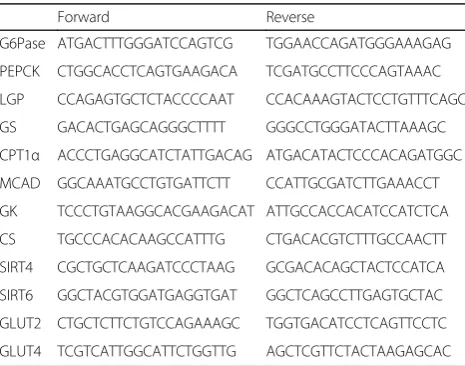
[image:3.595.53.541.88.244.2]Korea), and complementary deoxyribonucleic acid (cDNA) was synthesized using a the QuantiTect Re-verse Transcription kit (Qiagen, Seoul, Korea) accord-ing to the manufacturer’s instructions. Real-time PCR was performed in triplicate using power SYBR® Green PCR master mix (iNtRon, Seongnam, Korea) in a StepOnePlus Real-Time RT-PCR System. The expres-sion levels of the target genes relative to that of the en-dogenous reference gene β-actin were calculated using the delta cycle threshold method using StepOne soft-ware v2.3 (Applied Biosystems, Foster City, CA, USA). The primer sequences are listed in Table 1.
Western blot analysis
Protein expression was assessed by Western blot analysis according to the standard procedures. Each liver and muscle were homogenized in RIPA lysis buffer (ATTO Corp., Tokyo, Japan) on ice. The homogenates were centrifuged (13,000 rpm, 10 min, 4 °C), and the protein concentrations in the supernatant were determined using the Bio-Rad protein assay reagent (Bio-Rad Laboratories, Hercules, CA, USA) according to the manufacturer’s instructions. Equal amounts of protein (20μg) were sub-jected to sodium dodecyl sulfate-polyacrylamide gel elec-trophoresis and transferred to a polyvinylidene membrane (Millipore, Bedford, MA, USA). The membrane was blocked for >1 h with 5% skim milk in Tris-buffered saline buffer (150 mM NaCl and 20 mM Tris-HCl, pH 7.4) with 0.05% Tween 20. The membrane was incubated with primary antibodies for 18 h, washed with tris-buffered saline containing Tween 20, and incubated with anti-mouse or anti-rabbit immunoglobulin G horseradish peroxidase-conjugated secondary antibodies combined with primary antibody of target protein. The proteins were supplemented with the ECL prime Western blotting de-tection reagents (GE Healthcare, Parsippany, NJ, USA),
and ImageQuant LAS 4000 Mini Biomolecular Imager (GE Healthcare, Parsippany, NJ, USA) was used to evalu-ate the bands, which were quantified by Image j.
Statistical analysis
All the experimental results were compared by one-way analysis of variance (ANOVA) using the Statistical Pack-age for the Social Sciences (SPSS, ver. 22.0, SPSS Inc. Chicago, IL, USA). The data are expressed as means ± SEM. Group means were considered to be significantly different atp < 0.05, as determined by the technique of protective least significant difference.
Results
HPLC analysis of GBG05-FF
The contents of minor ginsenoside Rh4, Rk1 and Rg5 in BGE (GBG05-FF) were 1.93, 6.90, and 11.74 mg/g, respectively. GBG05-FF contained ginsenosides such as ginsenoside Rg5, Rk1, and Rh4. These unique ginseno-sides are nonexistent in white ginseng. The major ginse-nosides including Rb1, Rb2, Rc, and Rd. in white ginseng can be transformed to the minor ginsenoside Rg3. This ginsenoside may also be converted to Rg5 and Rk1 by heating (Table 2).
Effect of GBG05-FF on fasting glucose levels and glucose intolerance in type-2 diabetes model
To confirm the effect of GBG05-FF on the development of diabetes, fasting blood glucose levels and glucose tolerance were investigated in Type 2 diabetic db/db mice. Before GBG05-FF was administered to mice, the zero-time fasting blood glucose levels were not signifi-cantly different among the groups. During four weeks of GBG05-FF administering, GBG05-FF suppressed the increase in the fasting blood glucose level in Type 2 diabetic db/db mice (Fig. 2). Moreover, after GBG05-FF administration for four weeks, OGTT was performed. The result of glucose tolerance in the mice group ad-ministered with GBG05-FF showed decrease in glucose level compared to that of the control group (Fig. 2). However, the result showed no dose dependent effect both on fasting glucose levels and glucose tolerance.
Effect of GBG05-FF on plasma parameters related to diabetes
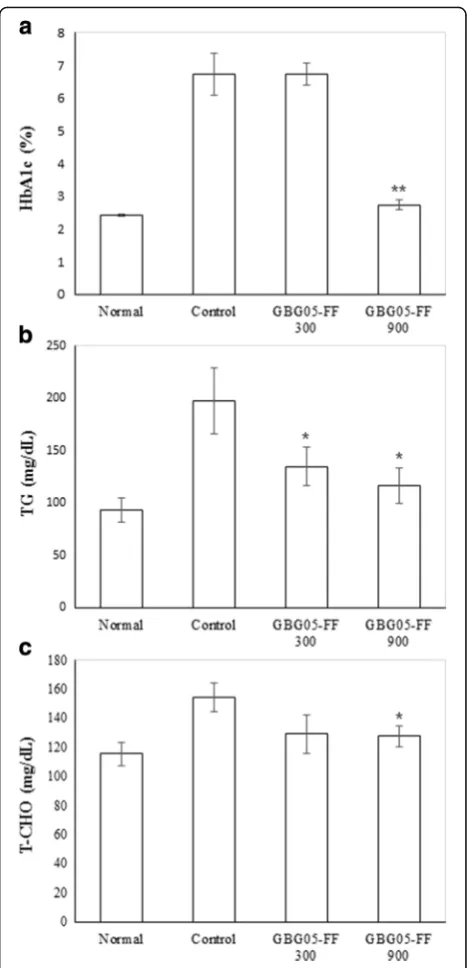
[image:4.595.57.290.548.731.2]To verify the effect of GBG05-FF in plasma parameters, blood samples were collected from mice after experiment during four weeks. The blood analysis results showed that
Table 1Primers for quantitative real-time polymerase chain reaction analysis
Forward Reverse
G6Pase ATGACTTTGGGATCCAGTCG TGGAACCAGATGGGAAAGAG
PEPCK CTGGCACCTCAGTGAAGACA TCGATGCCTTCCCAGTAAAC
LGP CCAGAGTGCTCTACCCCAAT CCACAAAGTACTCCTGTTTCAGC
GS GACACTGAGCAGGGCTTTT GGGCCTGGGATACTTAAAGC
CPT1α ACCCTGAGGCATCTATTGACAG ATGACATACTCCCACAGATGGC
MCAD GGCAAATGCCTGTGATTCTT CCATTGCGATCTTGAAACCT
GK TCCCTGTAAGGCACGAAGACAT ATTGCCACCACATCCATCTCA
CS TGCCCACACAAGCCATTTG CTGACACGTCTTTGCCAACTT
SIRT4 CGCTGCTCAAGATCCCTAAG GCGACACAGCTACTCCATCA
SIRT6 GGCTACGTGGATGAGGTGAT GGCTCAGCCTTGAGTGCTAC
GLUT2 CTGCTCTTCTGTCCAGAAAGC TGGTGACATCCTCAGTTCCTC
[image:4.595.305.537.690.732.2]GLUT4 TCGTCATTGGCATTCTGGTTG AGCTCGTTCTACTAAGAGCAC
Table 2Ginsenoside contents in GBG05-FF
Ginsenosides (mg/g)
Rh4 Rg5 Rk1
the TG and total CHO decreased in a dose-dependent manner, but HbA1c levels decreased only for the group administered to GBG05-FF 900 mg/kg with 900 mg/kg GBG05-FF (Fig. 3).
Effect of GBG05-FF on the expressions of genes related to glucose homeostasis in muscle and liver of type 2 diabetic db/db mice
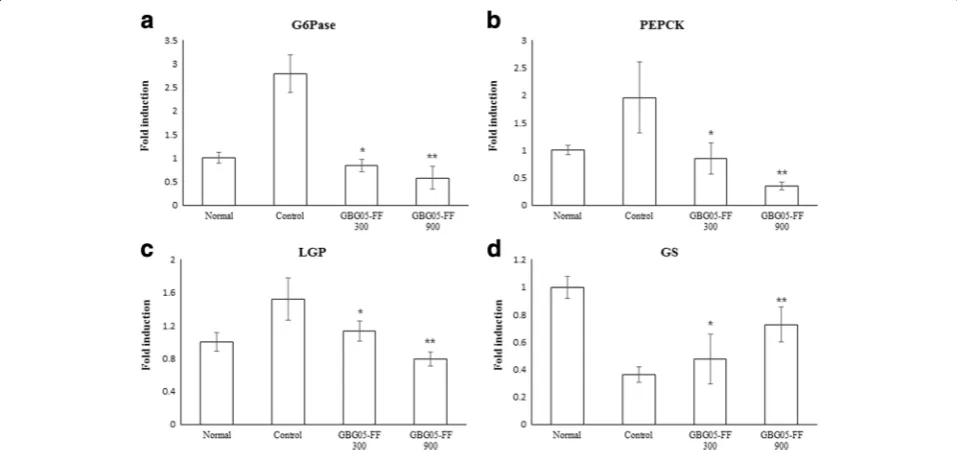
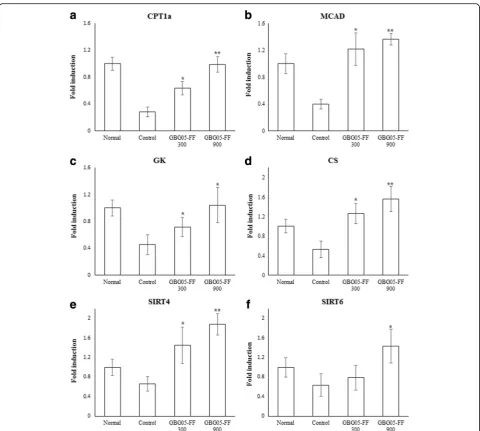
To prove the effect of GBG05-FF in glucose homeo-stasis mechanism of diabetic mice, quantitative real-time PCR analysis was performed. The results showed that GBG05-FF suppressed the expression of G6Pase, PEPCK, and LGP in the liver tissue, whereas GBG05-FF increased the expression of GS in the liver tissue and the expression of CPT1α, CS, GK, and MCAD in the muscle tissue.
Histological analysis on effect of GBG05-FF in muscle and liver tissue
To investigate the morphological changes of the liver and muscle, histological analysis was performed. The liver of db/db group not treated with GBG05-FF showed lipid accumulation. However, the liver of db/ db group treated GBG05-FF showed a significant
decrease on the lipid accumulation (Fig. 4a). The re-sult of the histological analysis of muscle showed that muscle of the non-treated GBG05-FF group signifi-cantly decreased myofibers compared to that of the normal group, whereas the mice group treated with GBG05-FF showed the restoration of myofibers by Fig. 2Effect of GBG05-FF on fasting blood glucose levels (a) and
glucose tolerance (b) in mice. Normal: dbh, Control: db/db, GBG05-FF 300: db/db fed the GBG05-FF 300 mg/kg, and GBG05-FF 900: db/db fed the GBG05-FF 900 mg/kg. Each value represents the mean ± SEM (n= 10 per group). *P< 0.05: Significant difference vs. control group
[image:5.595.305.540.85.570.2] [image:5.595.58.294.86.379.2]GBG05-FF. Moreover, through picrosirius red staining, we confirmed that GBG05-FF decreased muscle dam-age by Type 2 diabetes (Fig. 4b).
Effect of GBG05-FF on expresstion gene and protein levels and glucose uptake in liver and muscle of type 2 diabetic db/db mice
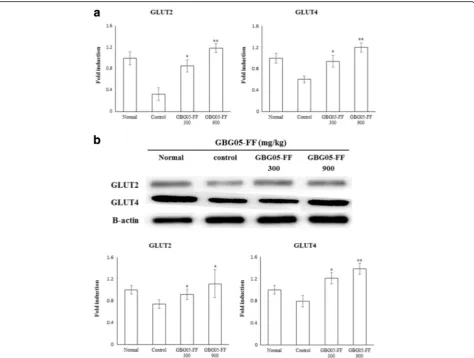
To confirm the effect of GBG05-FF in glucose uptake mechanism of diabetic mice, quantitative real-time PCR and western blotting analysis were performed. The results show that GBG05-FF increased gene expression of both GLUT2 and GLUT4. Moreover, GLUT2 in the liver and GLUT4 were upregulated by GBG05-FF in the muscles (Fig. 5).
Effect of GBG05-FF on AMPK phosphorylation in type 2 diabetic db/db mice
To confirm the effect of GBG05-FF on AMPK phosphoryl-ation in the liver of diabetic mice, western blotting analysis was performed. The result showed that phosphorylation of AMPK were increased by GBG05-FF in the liver (Fig. 6).
Discussion
In this study, we demonstrated that GBG05-FF de-creased hyperglycemia and hyperlipidemia by reducing the blood glucose levels and clarified the mechanism of action in type 2 diabetic C57BKS -db/db mice. Recently, there has been a growing interest in hypoglycemic agents from natural products, in particular, those derived from plants [17]. Therefore, searching for better agents from herbs or natural products that can be used to treat diabetes is necessary.
Ginseng is a well-characterized medicinal herb listed in the classic oriental herbal. Ginseng has diverse pharmacological and therapeutic properties such as immune function, cancer, and cardiovascular diseases, and has shown improved physical, cognitive, and sexual performance [18]. Moreover, many studies have reported that dietary ginseng saponins may have a beneficial effect on hyperlipidemia and obesity as well as reducing total serum cholesterol level [19, 20]. In Asia, there are a variety of commercial ginseng products including white, red, and black ginseng. Especially, black ginseng is pro-duced by a repeated steaming and drying process from three to nine times. Black ginseng possesses better bio-logical activity inducing anti-inflammatory, anti-cancer, anti-stress, and free radical scavenging effects than those of red ginseng [21, 22]. Although black ginseng is pharmacologically effective, the anti-diabetic effect of GBG05-FF has not been examined yet.
First of all, to investigate the major compound that has the effect to lower glucose levels, we were performed using several compounds contained in GBG05-FF pro-filed from HPLC assay (Fig. 1). GBG05-FF contained ginsenosides such as ginsenoside Rg5, Rk1, and Rh4. These unique ginsenosides are nonexistent in white gin-seng. The major ginsenosides including Rb1, Rb2, Rc, and Rd. in white ginseng can be transformed to the minor ginsenoside Rg3. This ginsenoside may also be converted to Rg5 and Rk1 by heating [23]. In particular, delycosylated minor ginsenosides have more pharma-ceutical activities than major ginsenosides [24].
Hepatic glucose uptake and glucose production in peripheral tissues are highly important in glucose homeostasis of the body. We proposed that GBG05-FF is effective in inhibiting hepatic gluconeogenesis and promoting glucose uptake of peripheral tissue. Elevated hepatic glucose production is a major cause of hyper-glycemia in Type 2 diabetes. G6pase, PEPCK, liver glycogen phosphorylase (LGP), and glycogen synthase (GS) enzymes are important factors related to gluco-neogenesis and glycogenolysis in the liver [25]. CPT1 is significant for fatty acid oxidation in the liver [26]. Mitochondrial medium-chain acyl-CoA dehydrogenase (MCAD) are significant for β-oxidation. Glucokinase (GK) and citrate synthase (CS) are related to glucose Fig. 4Effects of GBG05-FF on histological change in liver and in
[image:6.595.57.292.86.329.2]oxidation. [27]. Our results suggest that GBG05-FF suppressed the expression of G6Pase, PEPCK, and LGP in the liver tissue (Fig. 7), whereas it increased the expression of GS in the liver tissue and the expression of CPT1α, CS, GK, and MCAD in the muscle tissue. In addition, GBG05-FF increased the expression of SIRT4 and SIRT6, which belong to the sirtuin family of pro-teins that regulate insulin secretion and glucose homeostasis (Figs. 7 and 8) [28, 29]. Taken together, our results suggest that GBG05-FF significantly de-creased the lipid accumulation and muscle damage by Type 2 diabetes (Fig. 4).
AMPK is a phylogenetically conserved serine/threo-nine protein kinase that has been proposed to act as a target for the prevention of the metabolic syndrome, characterized in hypertension, obesity, dislipidemia and insulin resistance, eventually leading to type 2 diabetes. In particular, AMPK is an αβγheterotrimer, has a main function in regulating gluconeogenesis, and glucose
[image:7.595.62.537.87.445.2]and may be one of the reasons for insulin resistance [34]. To evaluate the effect of GBG05-FF on GLUT2 and GLUT4 expression in the surrounding tissue and AMPK protein in the hepatic tissue, quantitative RT-PCR and Western blot analysis were used in our study. As shown
in Fig. 5, GBG05-FF significantly increased GLUT2 and GLUT4 mRNA and protein level compared to the con-trol group. As expected, the data shows that GBG05-FF significantly induced AMPK phosphorylation in hepatic tissues and increased the expression of GLUT2 in liver Fig. 6Effects of GBG05-FF on the phosphorylation of AMPK in livers of mice. Normal: dbh, C2ntrol: db/db, GBG05-FF 300: db/db fed the GBG05-FF 300 mg/kg, and GBG05-FF 900: db/db fed the GBG05-FF 900 mg/kg. Each value represents the mean ± SEM (n= 10 per group) in three independent experiments. *P< 0.05, **P< 0.01: Significant difference vs. control group
[image:8.595.58.540.85.347.2] [image:8.595.58.537.468.694.2]and GLUT4 in skeletal muscle and abdominal fat of db/ db mice compared to the control group. These results indicate that GBG05-FF effectively inhibited AMPK-regulated gluconeogenesis and enhanced glucose uptake in surrounding tissues by upregulating the expression of GLUT2 and GLUT4.
Conclusion
We have proved in this study that GBG05-FF regulates hyperglycemia and hyperlipidemia in mice. And the re-sults confirmed that GBG05-FF possessed anti-diabetic activities in db/db mice. As a result of its fewer side effects, especially GBG05-FF has high potential in regu-lating glucose metabolism. Our data prove that
GBG05-FF has multiple targets in the hypoglycemic mechanism, such as suppressing gluconeogenesis through AMPK activation in the liver and affecting glucose uptake of surrounding tissues by upregulating the expression of GLUT2 in liver and GLUT4 in muscle. These findings suggest that black ginsengs might play an important role in the development of promising functional foods and drugs from the viewpoint of the chemical composition and biological activities of black ginsengs with a distinc-tion from those of white and red ginsengs.
Abbreviations
AMPK:5’adenosine monophosphate-activated protein kinase; ANOVA: One-way analysis of variance; CHO: Cholesterol; CPT1α: Carnitine
[image:9.595.58.539.85.516.2]tetrahydrochloride; G6pase: Glucose 6-phospatase; GBG05-FF: Black ginseng ethanol extract; GK: Glucokinase; GLUT: Glucose transporter; HbA1c: Glycated hemoglobin; LGP: Liver glycogen phosphorylase; MCAD: Mitochondrial medium-chain acyl-CoA dehydrogenase; NAFLD: Nonalcohlic fatty liver disease; OGTT: Oral glucose tolerance test; PEPCK: Phosphoenolpyruvate carboxykinase; RT-PCR: Reverse transcription polymerase chain reaction; SPSS: Statistical Package for the Social Sciences; TG: Triglyceride
Acknowledgments
This study was supported by the business of master-work for geumsan ginseng through the Geumsangun funded by the Geumsangun chungnam, Korea (No.2015-403-02).
Funding
This work was supported by the business of master-work for geumsan ginseng through the Geumsangun funded by the Geumsangun chungnam, Korea (No.2015–403-02).
Availability of data and materials
Data will not be available on a public repository because participants were not asked to consent for this.
Authors’contributions
Wonkwang-Oriental Medicines Research Institute did the biology part of the experimental work, while International Ginseng and Herb Research Institute did the experimental chemistry work. All authors took part in planning the study design, supervising the study design, contributed to the analysis and writing of the manuscript, edited the paper, reviewing it critically for important intellectual content and provided the final version. Two authors shared co-first authorship. All authors contributed to and have approved the final manuscript.
Competing interests
The authors declare that they have no competing interests.
Consent for publication
“Not applicable”in this section.
Ethics approval
All the animal experiments were performed in accordance with the guidelines established by the Animal Ethics Committee of Wonkwang University. This experiment was approved by the committee (Approval No. WKU15–101).
Publisher’s Note
Springer Nature remains neutral with regard to jurisdictional claims in published maps and institutional affiliations.
Author details
1Department of Oriental Pharmacy, College of Pharmacy and Wonkwang-Oriental Medicines Research Institute, Wonkwang University, 344-2 Sinyong-dong, Iksan, Jeonbuk 570-749, South Korea.2International Ginseng and Herb Research Institute, Geumsan 312-804, South Korea. 3Nakdonggang National Institute of Biological Resources, Sangju 37242, South Korea.
Received: 23 June 2016 Accepted: 15 June 2017
References
1. Baek NI, Kim DS, Lee YH, Park JD, Lee CB, Kim SI. Ginsenoside Rh4, a genuine dammarane glycoside from Korean red ginseng. Planta Med. 1996;62:86–7. 2. Kim SN, Ha YW, Shin H, Son SH, Wu SJ, Kim YS. Simultaneous quantification
of 14 ginsenosides inPanax ginsengC.A. Meyer (Korean red ginseng) by HPLC-ELSD and its application to quality control. J Pharm Biomed Anal. 2007;45:164–70.
3. Yun TK. Experimental and epidemiological evidence of the cancer-preventive effects ofPanax ginsengC.A. Meyer. Nutr Rev. 1996;54(11 Pt 2):S71–81. 4. Yun TK. Experimental and epidemiological evidence on non-organ specific
cancer preventive effect of Korean ginseng and identification of active compounds. Mutat Res. 2003;523–524:63–74.
5. Kim SN, Ha YW, Shin H, Son SH, Wu SJ, Kim YS. Simultaneous quantification of 14 ginsenosides inPanax ginsengC.A. Meyer (Korean red ginseng) by HPLC-ELSD and its application to quality control. J Pharm Biomed Anal. 2007;45(1):164–70.
6. Kim JH, Pan JH, Cho HT, Kim YJ. Black Ginseng Extract Counteracts Streptozotocin-Induced Diabetes in Mice. PLoS One. 2016; 11;11(1): e0146843. doi: 10.1371/journal.pone.0146843
7. Lee MR, Yun BS, In OH, Sung CK. Comparative study of Korean white, red, and black ginseng extract on cholinesterase inhibitory activity and cholinergic function. J Ginseng Res. 2011;35(4):421–8.
8. Park HJ, Shim HS, Kim KS, Shim I. The protective effect of black ginseng against transient focal ischemia-induced neuronal damage in rats. Korean J Physiol Pharmacol. 2011;15(6):333–8.
9. Lee SR, Kim MR, Yon JM, Baek IJ, Park CG, Lee BJ, et al. Black ginseng inhibits ethanol-induced teratogenesis in cultured mouse embryos through its effects on antioxidant activity. Toxicol in Vitro. 2009;23(1):47–52. 10. Kim JH, Pan JH, Cho HT, Kim YJ. Black ginseng extract counteracts
Streptozotocin-induced diabetes in mice. PLoS One. 2016; doi:10.1371/ journal.pone.0146843.
11. Seo YS, Shon MY, Kong R, Kang OH, Zhou T, Kim DY, et al. Black ginseng extract exerts anti-hyperglycemic effect via modulation of glucose metabolism in liver and muscle. J Ethnopharmacol. 2016;22(190):231–40. 12. Ko EM, Franasiak J, Sink K, Brewster WR, Gehrig PA, Bae-Jump VL. Obesity,
diabetes, and race in Type 1 and Type 2 endometrial cancers. J Clin Oncol. 2011;20;29(15_suppl):5111.
13. Wiederkehr A, Wollheim CB. Minireview: implication of mitochondria in insulin secretion and action. Endocrinology. 2006;147:2643–9. 14. Holman GD, Kasuga M. From receptor to transporter: insulin signaling to
glucose transport. Diabetologia. 1997;40:991–1003.
15. Steinberg GR, Kemp BE. AMPK in health and disease. Physiol Rev. 2009;89(3): 1025–78.
16. Kim SH, Hwang JT, Park HS, Kwon DY, Kim MS. Capsaicin stimulates glucose uptake in C2C12 muscle cells via the reactive oxygen species (ROS)/AMPK/ p38 MAPK pathway. Biochem Biophys Res Commun. 2013;439:66–70. 17. Goldfrank L, Lewin N, Flomenbaum N, Howland MA. The pernicious
panacea: herbal medicine. Hosp Physician. 1982;10:64–9.
18. Coon JT, Ernst E.Panax ginseng: a systematic review of adverse effects and drug interactions. Drug Saf. 2002;25:323–44.
19. Muwalla MM, Abuirmmeileh NM. Suppression of avian hepatic cholesterogenesis by dietary ginseng. J Nutr Biochem. 1991;1:518–21. 20. Francis G, Kerem Z, Makkar HP, Becker K. The biological action of saponins
in animal systems: a review. Br J Nutr. 2002;88:587–605.
21. Kim KT, Yoo KM, Lee JW, Eom SH, Hwang IK, Lee CY. Protective effect of steamed American ginseng (Panax quinquefoliusL.) on V79–4 cells induced by oxidative stress. J Ethnopharmacol. 2007;111:443–50.
22. Kang KS, Yamabe N, Kim HY, Park JH, Yokozawa T. Therapeutic potential of 20(S)-ginsenoside Rg(3) against streptozotocin-induced diabetic renal damage in rats. Eur J Pharmacol. 2008;591:266–72.
23. Kang KS, Kim HY, Yamabe N, Yokozawa T. Stereospecificity in hydroxyl radical scavenging activities of four ginsenosides produced by heat processing. Bioorg Med Chem Lett. 2006;16:5028–31.
24. Kim MK, Lee JW, Lee KY, Yang DC. Microbial conversion of major ginsenoside Rb(1) to pharmaceutically active minor ginsenoside Rd. J Microbiol. 2005;43:456–62.
25. Scott DK, O'Doherty RM, Stafford JM, Newgard CB, Granner DK. The repression of hormone-activated PEPCK gene expression by glucose is insulin-independent but requires glucose metabolism. J Biol Chem. 1998;37: 24145–51.
26. Cole MA, Murray AJ, Cochlin LE, Heather LC, McAleese S, Knight NS, et al. A high fat diet increases mitochondrial fatty acid oxidation and uncoupling to decrease efficiency in rat heart. Basic Res Cardiol. 2011;106(3):447–57. 27. Tucci S, Herebian D, Sturm M, Seibt A, Spiekerkoetter U. Tissue-specific
strategies of the very-long chain acyl-CoA dehydrogenase-deficient (VLCAD−/−) mouse to compensate a defective fatty acidβ-oxidation. PLoS One. 2012;7(9):e45429.
28. Song R, Xu W, Chen Y, Li Z, Zeng Y, Fu Y. The expression of Sirtuins 1 and 4 in peripheral blood leukocytes from patients with type 2 diabetes. Eur J Histochem. 2011; doi:10.4081/ejh.2011.e10.
• We accept pre-submission inquiries
• Our selector tool helps you to find the most relevant journal • We provide round the clock customer support
• Convenient online submission • Thorough peer review
• Inclusion in PubMed and all major indexing services • Maximum visibility for your research
Submit your manuscript at www.biomedcentral.com/submit