Citation:
Bray, O (2019) Perecquian Spaces for Performance Practice. In: Georges Perecs Geographies : Material, Performative and Textual Spaces. UCL Press. ISBN 9781787354425, 1787354423
Link to Leeds Beckett Repository record:
http://eprints.leedsbeckett.ac.uk/6160/
Document Version: Book Section
Creative Commons: Attribution-Noncommercial 4.0
The aim of the Leeds Beckett Repository is to provide open access to our research, as required by funder policies and permitted by publishers and copyright law.
The Leeds Beckett repository holds a wide range of publications, each of which has been checked for copyright and the relevant embargo period has been applied by the Research Services team.
We operate on a standard take-down policy. If you are the author or publisher of an output and you would like it removed from the repository, please contact us and we will investigate on a case-by-case basis.
PLEASE NOTE
This is a Self Archived version of the Author’s Accepted Manuscript.
Georges Perec’s Geographies: Material, Performative and Textual Spaces, Edited by Charles Forsdick, Andrew Leak, and Richard Phillips, UCL Press
ISBN: 9781787354425
Permalink when published: https://www.uclpress.co.uk/products/116894 Publication date: 14th Oct 2019
Perecquian Spaces for Performance Practice
OLIVER BRAYSince 1960 the Ouvroir de Littérature Potentielle (OuLiPo) has used imposed structural
constraints to generate writing. This chapter explores the influence of OuLiPo and Perec on the
spatial constraints of my own theatrical work The Elision of Scaff’.1This performance, a
two-hander play performed three times at the same time, can be considered a site for the exploration
of new terrain in contemporary performance making.
Oulipians are lovers of playing highly structured and rational games, a quite different
endeavour from the relative illogicality of the group’s artistic parentage. Scott Esposito points
out that ‘over the years, the strength of the work produced by its members moved the group
inexorably into the literary canon’.2 Indeed, Perec has been hugely influential in this movement
to literary recognition, authoring many of the OuLiPo’s most recognized works, and no doubt
contributing to the group becoming the longest running literary movement in French history.
Perec’s adroit and pervasive work with constraints is highlighted by Daniel Levin Becker when
forms of literature. As more members, notably Perec in 1967, were co-opted into the group,
emphasis shifted to include longer documentary and novelistic forms with a focus on exhaustion.
Perec’s An Attempt at Exhausting a Place in Paris (1975)is an example of such an oulipian
work focussed on exhaustion. The content of the book comprises Perec’s documentation of
everything that he observed over three days sat in cafés at the place Saint-Sulpice in Paris.
Although not a huge volume at first glance, the book’s effort towards exhaustion requires some
substantive literal space to exist in its entirety. Another example of the longer form is The Winter
Journeys (Voyages d’hiver) (2013) corpus, which started as a fictional short story, Le Voyage
d’hiver, written by Georges Perec in 1979. The Winter Journeys collection comprises this story
retold, extended and transformed by multiple Oulipian authors. Providing a fascinating insight
into the writing voices of Perec and the other Oulipians, these short stories combine to create a
serial novel that demonstrates the oulipian and Perecquian penchant for both playfulness and
rigour, serving as a kind of microcosm of their poetics. The group’s shift toward the tendency of
exhaustion brought with it a more complete kind of literary work, indeed the novelistic form
provides a greater literal space for text to occupy. Such works as the Winter Journeys corpus and
Perec’s 1978 masterpiece Life a User’s Manual (1996) demonstrate how a constellation of
constraints can be used in order to produce an OuLiPo ‘ard volume that contains multiple
constraining devices.4 The example of my own performance work, The Elision of Scaff’,
approaches an equivalence to the more substantive, or ‘ard, oulipian work that considers the
formal tendencies of the medium (literature/theatre) more overtly. Indeed, Perec’s influence on
the oulipian sensibility towards the ‘whole’ text pushes the notion of space, both literal and
conceptual, to prominence when considering how Perecquian constraints may be used to
notion of composition to the forefront of a practice that exists beyond the two-dimensional space
of literature. The Elision of Scaff’ is a vehicle for the consideration of generative spatial
constraint in a context of live theatre.
Constraints in Performance
In The Elision of Scaff’, the structural oddities of the performance that resulted from the various
constraints I imposed led the audience to consider the relationship between narrative and form. A
great deal of Perecquian output explores the possibilities that applied constraint can have on the
compositional properties of text on a page. However, the live space provides a complex synthesis
of spatial concerns that result from of the application of constraint on both narrative and form. In
the case of performance practice generated under constraint, it is the particular blending of
narrative and formal concerns that substantiate both. Spatial constraint leads to formal disruption
that so swamps narrative that it changes and transforms it.
Though the results of some constraints were obvious in the performances of The Elision
of Scaff’, such as Simultaneous Play Triplication for example (causing the play to be performed
three times, with triplicate casts, at the same time), but other constraints remained more subtly
present and in the moment of the performance would not be easily discernible or decipherable.
The question of constraint visibility and revelation to the reader forms a major part of the
discourse concerning Perec and the OuLiPo, not just in the conversations following the
publication of oulipian texts,but in the more general philosophy of the covert/overt position of
constraints that have impacted so prevailingly on the work generated. The late French literary
This is the classic dilemma of the practical joker: whether to play your joke and creep quietly away without revealing yourself, or to wait immodestly on the spot for the acclaim to start.5
Quoting Perec, Oulipian Daniel Levin Becker notes that ‘the problem, when you see the
constraint [..] is that you see nothing but the constraint’.6 There is a duel concern here, raising
consciousness of constraint for the writer in order to further control the variables is of course
central to Perecquian philosophy, but the desire to locate a constraint as a reader/audience is
another matter. This desire may overshadow and ultimately change the work itself, or at least
take its interpretation in a direction undesired by the author. Unsurprisingly OuLiPo place most
focus on the act of writing rather than the act of reading and the latter is perhaps a little
overlooked by the group, if not their critics. In both performance and literature, the visibility of
constraints is also dependent on the kind of constraints being used and the kind of work being
produced. For example, a Snowball constraint in a piece of poetry will certainly be more visible,7
to a casual observer at least, than taking a poem and submitting it to ‘tireur à la ligne’.8
Significantly, Raymond Queneau, according to Warren Motte, felt that ‘constraints must not
overshadow the finished work, and pretext should never override text’.9 This places a focus on
constraint as a generative tool rather than an observational lens. Nevertheless, the impact on
constraint visibility and revelation on readership is worth noting. The audience programme note
for The Elision of Scaff’ did not include a list of the constraints at play, deliberately muddying
the waters of the hypothesis of intention. ‘[T]he reader’s knowledge of a text’s oulipian status
exacerbates the tendency to over interpret’.10 This means that the mystification of revelation can
lead to the creation of ghost-constraints that never existed in the first place, something which has
Constraint as an observational lens means that an obvious or pronounced constraint has
the potential to become the central thematic content of the work. In The Elision of Scaff’, the
visually obvious constraint of Simultaneous Play Triplication may have been so overt in the
performance as to render some of the other constraints invisible. This is in addition to potentially
overshadowing the non-constraint-based content of the performance. Levin Becker observes that
the observational lens of constraint may destroy the art object completely, describing how many
readers opt out of reading La Disparition when they already know the lipogram by which it is
constrained.11 This posits a problem for those authors and architects of constraint who wish for
recognition of their craft through revelation. Even as the work of a group that privileges
potential, oulipian poetics still demand application and practice, and results must at some stage
be demonstrated. The idea of a novel in the lipogram of ‘e’ may be satisfying enough for the
(non)reader, but it is not unreasonable to assume that Perec would have wanted people to
actually read the book too. This tension is echoed by individual Oulipians’ desire either to
publish their constraints, perhaps as evidence of artistry (or at least labour), or more confidently
to make the reader aware of the complexity and cleverness contained within by letting them
work out the constraints for themselves.
In any case, the applicant of constraint to a process leading to live performance amplifies
the visibility of constraints considerably. The live moment of performance is a complicated,
multi-dimensional and layered composition, involving bodies sounding and moving through
unidirectional time in space. This, together with the nuances of observing (or reading) work
within the conventions of theatrical observation, puts overt emphasis on form and space for the
For considering the audience engagement with constraints in The Elision of Scaff’, Levin
Becker offers a comforting assertion that awareness of the constraint, either by its observable
mechanics or the possibility of its existence, is in the best cases:
a question of making you, the reader, aware of your own effort and engagement, of putting you in control, of diminishing the distance between finding and making.12
This observation presents a rare occurrence of an Oulipian considering the position of the reader
(audience) to generated material. As the maker of creative practice, I am only in control of the
flow of information one way and my efforts at control are unescapably inexhaustive; my
explanations of exactly how an audience may have read my work, or indeed the works of Perec,
are of course inevitably speculative.
The Elision of Scaff’
The Elision of Scaff’ was a theatre work comprising six performers (three couples) delivering a
re-appropriation of an existing playtext titled Enemies, written by Neith Boyce and Hutchins
Hapgood in 1921. The constraints used in the generation of the performance comprised existing
oulipian/Perecquian constraints appropriated to theatre, and others of my own design influenced
by oulipian poetics. What follows is an explanation of some of the constraints used during that
project that attempts to capture and reflect on how the application of spatial constraints can
impact the generation of performance material.
Experimental poet Christian Bök refers to oulipian structures and constraints as ‘an array
specifically those concerned with time and space, led to the imposition of more constraints, such
was the causal chain. Marcel Bénabou considers the results of the application of constraints:
Linguistic constraints, for their part, granted their arbitrary exigencies, directly create a sort of “great vacuum” into which are sucked and retained whole quantities of elements which, without this violent aspiration, would otherwise remain concealed.14(
This metaphor of the vacuum is similar to my articulation of a constraint causal chain in a
performance process, whereby one constraint decision leads to an unpredicted other. The
multiple ingredients of theatrical composition – voice, body, space and time – make causal
chains in this context extremely likely as constraint imposition can have affect so many
variables. While making this work, a constraint would quickly create a paradox, simultaneously
demanding strict adherence while forcing me to select the appropriate generative tools to
continue.
Threes in a Vacuum
If one can measure what one is talking about and express it in numbers, which constitute the sole reality, then one has some knowledge of one’s subject.15
The number three has a pleasing locus in mathematics and art. Three is the first odd prime
number, it features in the Fibonacci sequence and is the closest whole number to π. Three is the
smallest plural odd number, it makes symmetry problematic and so presents compositional
interests for me. My interest in the creative potential of the number links the mathematical
As the fundamental spatial constraint in my process, it is appropriate to start with
the previously mentioned Simultaneous Play Triplication (SPT), which dictated that the
play would be performed three times at the same time. This involved using triplicate
casts. This overt constraint was the most visible to the audience and disrupted their usual
viewing experience. This constraint simultaneously involved all spoken text and actions
of the play being performed three times. There was consequently potential that, even
though the narrative would be repeated and restated, the repetition would also make it
difficult for an audience to comprehend the narrative in a usual way. SPT sucked into its
vacuum additional number-three-based constraints. SPT created spatial problems that
required resolution through the application of new constraints, in keeping with the
OuLiPo’s most recognizable quotation: ‘Oulipians: rats who must build the labyrinth
from which they propose to escape.’16
Each constraint: a wall, a vacuum. The performance: the labyrinth, the map that determines
escape. Each constraint imposed on the process led to further necessary impositions that again
shaped the work created. The resulting performance work became evidence of spatial constraint,
simultaneously existing as both map and destination – a pure inculcation of process in product –
evidence of labour that encompasses both the labyrinth and the desire to escape it.
Speculating about a constraint’s potentiality involves discerning the extent to which it is apt to trigger variations and mutations; the extent to which it will naturally and productively participate families of constraints; and, finally, the extent to which it might evolve over the course of time.17
SPT was a constraint that triggered many more, it was the initial constraint that opened up the
An example of a constraint opened up by SPT is the 120° spatial wedging constraint. This
constraint dictates that each of the three versions of the play occupy a third of an in-the-round
performance space. This constraint pins down a decision that might seem both obvious and/or
unconventional, there are of course many ways that, scenographically, the space could have been
configured to make sense of the SPT constraint. The naming of a constraint is firstly a testament
to its open-ended, experimental, unpredictable nature and secondly a demand that it be upheld.
Bök points out, it simultaneously emancipates the artist from the infinite possibilities that could
exist and the fact that only one can – and if you don’t take control, you will fall foul of
convention.18 A theatrical version of this philosophy can also be found in Anne Bogart’s
reflections on violent decisions, ‘Art is violent. To be decisive is violent’.19
Space and Time
The 180-year time span constraint is also causally connected to SPT. Designed to explicitly
create differences between the versions of the play, this constraint alters the year in which each
version is set in graduations of 90 years. As a result, the first and last variants of the play are 180
years apart. The original play was written in 1921, approximately 93 years before the time I
began working on the project. 93 years rounded down, to keep the numbers clean, to the nearest
10 is 90. Adding 90 years to the original year places the middle play in the year 2011 (more or
less a contemporary year) and the third play in 2101. The time graduations of 90 years and the
total span of 180 years have clear, if coincidental, commonalities with the degree divisions of a
circle, although in hindsight, deviations of 120 years may have been even more aesthetically
180-year time spanopened another vacuum to be populated by its unpredicted offspring.
The conventional demands of theatre necessitate that the language and vocal qualities used by
the actors in a play will, along with design decisions, scenography, costume etc., indicate the
period of the play. While there exists no rule to achieve this over three differing time periods at
the same time, the notion that this is how time may be indicated led to the design of the assumed
period rewriting constraint. This constraint meant that the first variation of the play, set in 1921,
would remain true to the original text, the other variants would be re-written according to
playwrights’ assumptions of that period. The constraint was designed to mine the resource of the
author’s existing knowledge and know-how. This was not an automatic, surrealist inspiration
exercise, rather a conscious acknowledgement of one’s own subjective pre/mis-conception,
prejudice and general knowledge. The assumed period rewriting constraint was Perecquian in
character, simultaneously limiting and liberating. Rather like An Attempt at Exhausting a Place
in Paris, this kind of constraint makes the author/director operate according to their own
limitations, tastes and tendencies. The structure is restrictive and clear, but the subjectivity and
fallibility of the author/director is additionally important in terms of the content generated.
Writing the play to be set in 2011 involved the careful reading of the existing 1921 text
and modernising it through re-writing in contemporary language. This included replacing
cultural references where appropriate, through a kind of isosyntaxism.20 The results of this
relatively simple task of comprehension and translation were of course unique to me and based
on my own expectations, tastes and rules of accessibility, no one else would have made the exact
translation that I made. In the writing of the 2101 version, the causal chain demanded an
additional constraint. In this instance, I needed to address how I might predict how the spoken
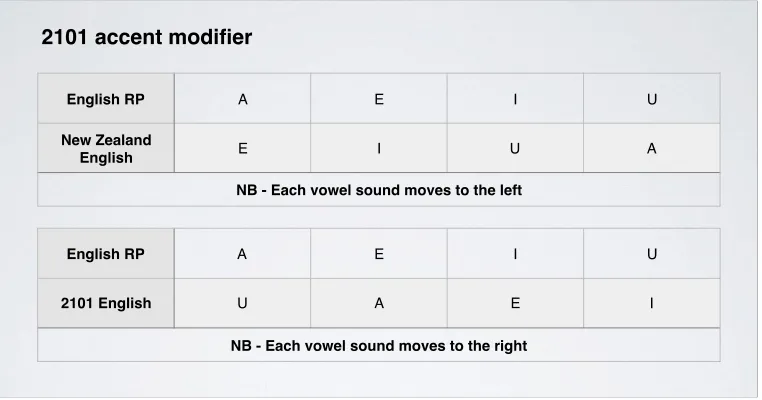
the vowel sounds of words in order to generate a new accent. With an understanding that vowel
sounds shift according to geographical barriers and the passing of time and that this, like any
other kind of evolution, is due to the relative levels of success and sustainability of those sounds,
[image:12.612.117.498.182.382.2]it felt legitimate to use the following accent modifier to alter the sounds of words:
Figure 1 Accent Modifier Diagram
Because the accent modifier was to have such a profound effect on how the text sounded, I
decided to only alter the sounds of the words and not to alter the actual words as well (perhaps
another kind of isosyntaxism), so no translation took place. The result was that the fundamental
syntax of the 2011 and 2101 texts were the same. By positioning the 2011 version as a
benchmark to aid the audience in listening to the 2101 version, an adherence was made to the
theatrical convention that the audience should understand the sense of what they were hearing.
This is a theatrical version of Esposito’s assertion that oulipian writing should ‘withstand the
strains of being made novelistic’.21The Elision of Scaff’ was a constrained performance
in performance time. The three spaces, notionally placed in three different time zones as well as
three different parts of the performance space, produced a new space of understanding. The
audience could not observe one third of this work only, the collective reading of three
simultaneous time zones side by side in one room (divided into three) produced a new triptychal
narrative space that was unfixed in time and place. The spatial and textual constraints applied
were realised as a kind of live map to their own complexity – the performers became
cartographers of unpredictable new narratives and localities in the performance space.
Maths in Space
This causal chain of development and permutation articulated previously is a result of the
inculcation of the Perecquian inclination towards exhaustion and the oulipian
forefathers’ ’pataphysical desire to see out a hypothesis, however bizarre:
Queneau and Arnaud […] have traced the spirals of their own cognitive
gidouille, deriving the reductio ad absurdum of an impossible hypothesis.22
However, not all constraints worked in such a directly causal way but were nonetheless
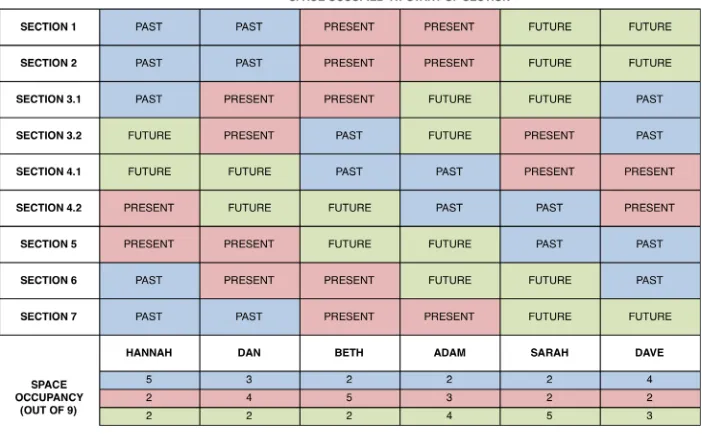
interrelated and clearly influenced by Perec. For example, my theatrical tastes desired all six of
the performers to occupy all of the different areas of the performance space that resulted from the
120° spatial wedging constraint. Through studying George Perec’s Life a Users Manual,I
became interested in Græco-Latin bi-squares.23 Perec utilised these squares while designing the
content of the chapters of his novel.24 In my version below, which is not technically a true use of
Figure 2 Græco-Latin Bi-square Diagram
By placing section markers down the left axis of the square, I was able to map these pairings and
space occupation in performance time. I was additionally attempting to achieve the satisfying
aesthetic resolution of having the performers’ locations end as they started. The bi-square takes
the role of a set of instructions for the performance, a constraint map that can then be applied to
existing material in order to transform it. In this way, the constraint of the bi-square became a
spatial practice. Although primarily functional, the bi-square table, absent from the audience’s
reading of the performance, exists rather like a map or supplement to the performance, a trace or
testimony to its existence. As a theatre maker there is great pleasure in having visual material
that sits alongside the ungraspable ephemerality that characterises live performance. In the
context of a discipline that primarily exists in the live moment only, the bi-square sits pleasingly
integral example of process. This is perhaps reminiscent of a cartographer’s map collection that
reminds her not only of the place recorded, but of the process of considering and cataloguing.
Another example of a non-causally linked constraint includes action according to body
weight, where each performer’s body weight was used to determine the frequency that they got
[image:15.612.131.484.330.627.2]up from their chairs in the performance. How this constraint worked is outlined here:
The action according to body weight constraint determined when each performer stood up from
their chair in the performance. The constraint demonstrates an arbitrary attribute of the material
of the performance (the performer’s body), directly influencing the spatial composition of the
theatrical work. This is the kind of constraint imposition that is simply not possible in a literary
work. The author of literature may of course choose to impose the arbitrary maths of their own
body to the composition of words on a page. However, the ability to manipulate the body that
has provided that data directly within the performance text is unique to this kind of undertaking.
The result is spatial constraint that has an embodied connection to the text. I am convinced that
the relationship of the spatial mathematical translation of physical attribute to performer action,
gives the resulting performance moments a specific embodied legitimacy. This is a particular
authenticity that is the result of the relationship between constraint, space, and the body in
performance.
The constraints of The Elision of Scaff’ have at their core a relationship to my subjective,
formal tendencies in theatre. It is the synergy between these tendencies and the imposed spatial
constraints of the project that have led to the realisation of a holistic theatrical event. Perec’s
inclination towards the use of generative constraint to produce a substantive literary form paved
the way for the consideration of imposing spatially oriented constraints on the generation of the
event of theatre. The time and space made possible by the three-dimensionality of theatre
allowed spatial constraints to affect both the form and content of a live viewing experience for an
audience.
The causal nature inherent in the imposition of Perecquian spatial constraint on
the diagrammatic and written reflective outcomes of my process do not only leave evidence and
documentation of a constraint-driven process. Additionally, they exist as spatial traces,
symptoms and (carto)graphic artefacts, that authenticate the ungraspable moment of
performance.
The intense difficulty posed by this sort of production…palls in comparison to the terror I would feel in writing ‘poetry’ freely.25
Spatial constraints have the ability, somewhat objectively and independently, to guide, record
and reflect on a creative theatre making process. Consequently, and provocatively, spatial
constraints in performance exclude the possibilities for true, and perhaps deadly, artistic
freedom.
Bibliography
Bellos, David. ‘Georges Perec’s Puzzling style’. Scripsi 5, no.1 (1988): 63-78.
Bray, Oliver. The Elision of Scaff’. Directed by Oliver Bray. First performance: April 2014.
Bogart, Anne. A Director Prepares: Seven Essays on Art and the Theatre. London: Routledge, 2001.
Bök, Christian. ‘Pataphysics: The Poetics of an Imaginary Science. Evanston, IL: Northwestern University Press, 2002.
Bök, Christian. ‘Unacknowledged Legislation’. I Armand, Louis, ed., Avant- Post,Bloomington: Indiana University Press, 2006.
Elkin, Lauren and Scott Esposito. The End of Oulipo? An Attempt to Exhaust a Movement.
Winchester: Zero Books, 2013.
Hugill, Andrew. ‘Pataphysics: A Useless Guide.Cambridge, MA: MIT Press, 2012.
Jarry, Alfred. Exploits & Opinions of Doctor Faustroll, Pataphysician.Translated and annotated by translated by Simon Watson Taylor. Boston: Exact Change Books, 1996.
Le Lionnais, François. ‘Lipo: First Manifesto’.In Warren Motte (ed.) Oulipo: A Primer of Potential Literature.London: Dalkey Archive Press, 2007.
Levin Becker, Daniel. Many Subtle Channels. Cambridge, MA: Harvard University Press, 2012.
Mathews, Harry and Alastair Brotchie, eds. Oulipo Compendium. London: Atlas Press, 2005.
Motte, Warren, ed. Oulipo: A Primer of Potential Literature. London: Dalkey Archive Press, 2007.
Perec, Georges. An Attempt at Exhausting a Place in Paris.Translated by Marc Lowenthal. Cambridge MA: Wakefield Press, 2010.
Perec, Georges. A Void. Translated byGilbert Adair. London: Vintage, 2008.
Perec, Georges. Life A User’s Manual. Translated by David Bellos. London: Harvill, 1996.
Perec, Georges and the Oulipo. Winter Journeys. London: Atlas Press, 2013.
Schott, Ben. OuLiPo. BBC Radio 4, 19 November 2009.
Sturrock, John. The Word from Paris: Essays on Modern French Thinkers and Writers. London: Verso, 1998.
1 Documentation of the performance can be viewed here: https://vimeo.com/241685687 (password - constraint).
2Lauren Elkin and Scott Esposito, The End of Oulipo? An Attempt to Exhaust a Movement (Winchester: Zero
Books, 2013), 5.
3 Daniel Levin Becker, Many Subtle Channels (Cambridge, MA: Yale University Press, 2012), 33.
4 Levin Becker, Many Subtle Channels, 62-63.
5 John Sturrock,The Word from Paris: Essays on Modern French Thinkers and Writers (London: Verso, 1998), 196.
6 Levin Becker, Many Subtle Channels, 80.
7 Snowball - a form in which each segment of a text is one letter longer than the segment preceding it. See Warren F.
8Tireur à la ligne (Puller on the line) - taking two sentences in a given text and interpolating a new sentence, then
two new sentences in the interstices thus created, and so forth. See Motte, Oulipo, 213.
9 Levin Becker, Many Subtle Channels, 79.
10 Alison James, Constraining Chance. Georges Perec and the Oulipo. Evanston, Il: Northwestern University Press,
2009), 126.
11 Levin Becker, Many Subtle Channels, 84.
12 Levin Becker, Many Subtle Channels, 86.
13 Christian Bök, “Unacknowledged Legislation,” in Avant- Post , edited by Louis I Armand (Bloomington: Indiana
University Press, 2006), 183.
14 Marcel Bénabou, cited in Motte, Oulipo, 43.
15 Alfred Jarry, Exploits & Opinions of Doctor Faustroll, Pataphysician, Translated and annotated by translated by
Simon Watson Taylor (Boston: Exact Change Books, 1996), 101-02.
16 Raymond Queneau, cited in Motte, Oulipo, 22.
17 Levin Becker, Many Subtle Channels, 168.
18 Bök, ‘Unacknowledged Legislation’, 82.
19 Anne Bogart, A Director Prepares: Seven Essays on Art and the Theatre ( London: Routledge, 2001), 45.
20 Iso-syntaxism – or Homosemantic translation. ‘A translation in which the vocabulary of the source text is changed
while its sense is kept. At its simplest, it applies the procedure normally used to translate a text from one language to
another to transforming a text within a single language.’ See Harry Mathews and Alastair Brotchie, Oulipo
Compendium (London: Atlas Press, 2005), 159.
21 Elkin and Esposito, The End of Oulipo?, 21.
22 Andrew Hugill, Pataphysics: A Useless Guide (Cambridge, MA: MIT Press, 2012), 68.
23 Græco-Latin bi-square – or orthogonal bi-square. ‘Claude Berge […] defines it: “a Græco-Latin bi-square of
order n is a figure with n x n squares filled with n different letters and n different numbers; each square contains one
letter and one number; each letter appears only once in each line and each column, each number appears only once