S T U D Y P R O T O C O L
Open Access
The STRIDE (Strategies to Increase confidence,
InDependence and Energy) study: cognitive
behavioural therapy-based intervention to reduce
fear of falling in older fallers living in the
community - study protocol for a randomised
controlled trial
Steve W Parry
1*, Vincent Deary
2, Tracy Finch
3, Claire Bamford
3, Neil Sabin
4, Peter McMeekin
3, John O
’
Brien
5,
Alma Caldwell
6, Nick Steen
3, Susan L Whitney
7, Claire Macdonald
3and Elaine McColl
3Abstract
Background:Around 30% to 62% of older individuals fall each year, with adverse consequences of falls being by no means limited to physical injury and escalating levels of dependence. Many older individuals suffer from a variety of adverse psychosocial difficulties related to falling including fear, anxiety, loss of confidence and
subsequent increasing activity avoidance, social isolation and frailty. Such‘fear of falling’is common and disabling, but definitive studies examining the effective management of the syndrome are lacking. Cognitive behavioural therapy has been trialed with some success in a group setting, but there is no adequately powered randomised controlled study of an individually based cognitive behavioural therapy intervention, and none using non-mental health professionals to deliver the intervention.
Methods/Design:We are conducting a two-phase study examining the role of individual cognitive behavioural therapy delivered by healthcare assistants in improving fear of falling in older adults. In Phase I, the intervention was developed and taught to healthcare assistants, while Phase II is the pragmatic randomised controlled study examining the efficacy of the intervention in improving fear of falling in community-dwelling elders attending falls services. A qualitative process evaluation study informed by Normalization Process Theory is being conducted throughout to examine the potential promoters and inhibitors of introducing such an intervention into routine clinical practice, while a health economic sub-study running alongside the trial is examining the costs and benefits of such an approach to the wider health economy.
Trial registration:Current Controlled Trials ISRCTN78396615
Keywords:Fear of falling, Falls, Elders, Community, Randomised controlled trial, Cognitive behavioural therapy, Complex intervention, Normalization process theory
* Correspondence:[email protected]
1Institute for Ageing and Health, Newcastle University, c/o Falls and Syncope
Service, Royal Victoria Infirmary, Queen Victoria Road, Newcastle upon Tyne NE1 4LP, UK
Full list of author information is available at the end of the article
Background
Falls are common, frequently devastating events for older people, with between 30% and 62% of older individuals falling per year [1,2]. Falls are responsible for considerable morbidity and mortality, with around 10% of falls resulting in fractures [1]. The cost of falls to the UK economy is estimated at £981 million [3], with more recent data showing that 0.07% to 0.20% of the gross domestic prod-uct and 0.85% to 1.5% of total healthcare expenditure in western economies was accounted for by falls and their consequences [4]. Adverse consequences of falls are by no means limited to physical injury and escalating levels of dependence. Many older individuals, both fallers and non-fallers, experience a variety of adverse psychosocial difficulties related to falling [5-15] including fear, anx-iety, loss of confidence, and impaired self-efficacy (the self-perception of ability to perform within a particular domain of activities) [9,12] resulting in activity avoidance, social isolation and increasing frailty [5-15]. The umbrella term for these problems is ‘fear of falling’, a common and disabling problem in older individuals, found in be-tween 3% and 85% of community-dwelling elders who fall, and up to 50% of those who have never fallen [7-9,15].
The optimal management strategy for fear of falling and its adverse physical and psychosocial sequelae is poorly understood. Much previous research has focused on phys-ical treatments including home- and community-based exercise interventions, tai chi and multifactorial inter-ventions aimed at reducing fall rates, with fear of fall-ing reported as a secondary outcome in the majority of these studies [7]. A recent systematic review found 12 high-quality randomised controlled trials (RCTs) reporting effects on fear of falling in such studies, but only one primarily aimed at reducing fear of falling [15]. The in-terventions were conducted across a variety of settings, but based exercise, community tai chi and home-based multifactorial interventions all improved fear of falling [7], though a recent geriatric outpatient-based multifactorial intervention study found no such bene-fit [16].
While such physical interventions may be of benefit in selected populations, the profile of the disorder and its psychosocial complications suggest that well-designed psychological interventions may help ameliorate fear of falling more definitively. Several studies have examined an explicitly cognitive behavioural therapeutic (CBT) ap-proach in fear of falling in community-dwelling elders, or used CBT techniques as part of a wider intervention strategy. Tennstedtet al.’s Matter of Balance study assessed the ability of an eight-session, 4-week group CBT with exercise instruction to improve fear of falling and re-lated activity restriction [17]. Significant differences be-tween intervention and control groups were seen in fear of falling as measured by the Falls Efficacy Scale (FES) [12]
commissioners and providers of healthcare, crucial in this context because of the size of the clinical problem.
Fear of falling is thus a common, disabling and debili-tating condition in older adults but the current under-standing of its management is limited. There is a small evidence base to support the use of some physical ther-apies to improve the syndrome, and promising early data from a few studies supporting the use of psychological therapies, in particular CBT. The cognitive behavioural model [21] of a problem situation being maintained by an interaction between physiological, behavioural, cognitive and affective responses is paradigmatic for fear of falling, and offers the hope of a viable therapeutic option. Previ-ous studies are hampered by the factors already described, while the issue of the economic viability of such a treat-ment has yet to be explored.
There is a need for many more trained cognitive be-havioural therapists than are currently available; the de-velopment of a cognitive therapeutic package for the management of fear of falling that can be delivered rou-tinely by non-specialist staff such as healthcare assistants (HCA) is vital if this common and debilitating condition is to be tackled effectively. CBT can be delivered by suitably trained non-psychotherapist staff [22,23], but to the best of our knowledge, this approach has not been attempted in a RCT in this context previously. In addition, only group in-terventions have been studied so far, with therapy deliv-ered on a one-to-one basis yet to be tested in a fear of falling cognitive behavioural intervention study.
Understanding the dynamics of developing, delivering and trialling a novel intervention as a process is useful because it will contribute to understanding the profes-sional and organisational factors that promote or inhibit adherence to treatment protocols and intervention deliv-ery; and how practical and methodological problems are defined, understood and resolved by the project team in the course of the study. The need for understanding the dynamics of complex interventions [24], and undertaking process evaluation is now well understood [25]. Such work is important to underpin the transportability, workabil-ity, and integration of interventions into routine clin-ical practice. In the case of this trial, our aim is to collect longitudinal ethnographic data that will help us to under-stand the social processes and relationships that lead the intervention and trial to take a particular shape and direc-tion. In earlier studies of trials and other interventions, May and Finch developed a robust explanatory model of normalization processes [26] that defines psychological and sociological mechanisms of behaviour and action that have been empirically demonstrated to be important in the implementation of complex interventions, and that have been revealed by evaluation in randomised controlled clinical trials. This approach is vital for the understanding and more widespread adoption of such an intervention.
In summary, we aim to develop a cognitive behaviour-based intervention to be delivered by HCAs on a one-to-one basis to community-dwelling older individuals attending falls services with an excessive or undue fear of falling and then to conduct a randomised controlled study of this intervention plus usual multidisciplinary care ver-sus usual multidisciplinary care alone. Our study, incorp-orating a qualitative process evaluation and economic evaluation alongside a patient RCT, will answer defini-tively the question of whether an enhanced intervention to reduce the fear of falling for community-living older people would be effective and cost effective in reducing anxiety through its rigorous design and carefully chosen primary and secondary outcome measures, while assessing the cost and outcomes of such an intervention.
Methods
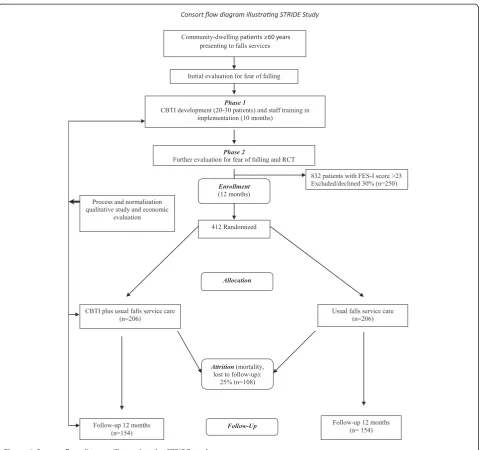
The study is divided into two distinct phases, the first de-veloping the novel cognitive behavioural therapy-based intervention (CBTI) and the second the RCT assessing the effectiveness of the intervention in reducing fear of falling. Qualitative and health economic studies straddle the two phases (Figure 1).
Phase 1
Pilot study developing a cognitive behavioural model tai-lored to older patients [27] with fear of falling, based on the Medical Research Council (MRC) model of complex intervention development [28] and incorporating elements of previously successful CBT-based interventions [16-19]. Patients with significant fear of falling attending our com-munity falls service were included in this phase of the study, and HCAs trained to deliver the intervention.
Phase 2
such groups could theoretically be open to contamination (that is patients allocated to the control condition receiv-ing CBTI). We believe that this risk is minimal, particu-larly at clinician level as the HCAs delivering the CBTI during Phase 2 will only be seeing the intervention group of patients and will not be part of the teams delivering usual care.
Across project duration
A qualitative process evaluation will be conducted across the duration of the study, in parallel to the Phase 1 and Phase 2 activities. Data collection will involve a variety of ethnographic methods, including semi-structured inter-views, observations and documentary analysis. Participants
will include health professionals and patients as well as members of the trial team.
Planned interventions
Phase 1: CBTI development methodology
The MRC revised their framework for the development of complex interventions [28], acknowledging that the process of development is circular and iterative, but that there are still distinct, if overlapping, stages that can be used to structure the intervention development process. The starting phase should be the establishment of the theoretical and empirical grounds of the intervention. This should involve a review of the extant evidence base and an identification or development of the theory on
Consort flow diagram illustrang STRIDE Study
Community-dwelling patients ≥60 years presenting to falls services
832 patients with FES-I score >23 Excluded/declined 30% (n=250)
Follow-up 12 months (n=154)
CBTI plus usual falls service care (n=206)
Follow-up 12 months (n= 154) Usual falls service care
(n=206)
Allocation
Follow-Up Enrollment
(12 months)
412 Randomized Initial evaluation for fear of falling
Phase 1
CBTI development (20-30 patients) and staff training in implementation (10 months)
Phase 2
Further evaluation for fear of falling and RCT
Process and normalisation qualitative study and economic
evaluation
Attrition(mortality, lost to follow-up):
[image:4.595.59.540.86.536.2]25% (n=108)
which the intervention will be based. They then recom-mend a modelling phase in which the nature of the intervention is specified. The key tasks of this stage are to identify the target problem, in our case fear of falling, the mechanisms whereby the proposed intervention will lead to change, and a specification of how this change will be measured. There is currently less consensus on how this part of the process should be enacted, but there is an agreement that the process of intervention devel-opment and implementation should be well documented enough to be independently replicable. The intervention should then be further refined and re-evaluated to en-sure its effectiveness. The objectives for development of the CBTI were therefore:
1. To further review the evidence base for fear of falling.
2. To investigate patients’experience of fear of falling using a cognitive behavioural model as an
assessment framework in a series of patient interviews.
3. To use data gathered in these first two stages to model a theoretically structured and empirically grounded intervention for this condition, including explicit formulation of therapeutic targets, change processes and outcome evaluation.
4. To interview patients and clinic staff to explore the acceptability of the proposed intervention and to adapt the intervention accordingly.
5. To use the data from steps 3 and 4 to further develop and formalise the components of a short CBT training package for the intervention delivery staff.
6. To produce clinician and patient treatment manuals for the CBTI and establish the form of the treatment as usual arm, since this forms the control condition, with the intervention comprising the CBTI plus treatment as usual.
Identification of existing theory and evidence base
From the existing literature (see‘Background’above) we already have some indications of falls and fear of falling epidemiology and patient characteristics, possible mecha-nisms involved in the predisposition to and maintenance of fear of falling, trials of psychosocial interventions in this condition and current service provision to this population. It is abundantly clear that fear of falling is a significant clinical problem, and those patients who experience it are also frequently anxious, depressed and activity avoidant.
Patient interviews for CBTI development
The perspectives of patients are important for interven-tion development, in terms of understanding both (i) the appropriateness of the intervention for managing the
clinical problem, and (ii) social and organisational factors that are likely to affect the patient’s uptake and involve-ment in the intervention. This part of the intervention development programme sought to further investigate patient characteristics, with a view to model develop-ment, by interviewing approximately 20 patients using a broad cognitive behavioural framework as an assess-ment tool. The cognitive behavioural model distin-guishes between what made a person vulnerable to a problem (predisposing factors), what triggered the current problem (precipitating factors) and what is currently maintaining it (perpetuating factors). The model further distinguishes between physical, emotional, cognitive, behavioural and social factors in each domain. Finally, it looks for interactions between perpetuating factors (such as how anxious thoughts may increase physio-logical arousal, and vice versa). Such an approach resonates with Zijlstra and colleagues recent cognitive behavioural intervention aimed at improving the perception of falls and falls risks and increasing activity and safe behaviour [19]. Using this model as a template, we further investi-gated the relevant factors in the cause and maintenance of fear of falling.
Also in this CBTI developmental phase, and as part of the qualitative process evaluation, a set of 10 interviews were conducted with a different sample of patients, to focus explicitly on social and organisational factors likely to affect normalisation of the intervention from the per-spective of patients.
CBTI model development
Data from the literature and interviews described were used to further refine the extant models of fear of falling. On the basis of current knowledge [16-19], we would expect anxious cognitions to be maintaining activity avoidance; physical tension and anxious cognitions to be interfering with walking; underactivity to be maintaining physical weakness and loss of confidence and/or compe-tence. Interventions were developed accordingly, target-ing these maintaintarget-ing factors or whatever else emerged from the preceding stages.
Interviews with staff
intervention becoming normal practice, and for describing the process whereby it does so. During Phase 1, the quali-tative process evaluation included a set of semi-structured interviews with key professionals involved in the develop-ment and delivery of the intervention (n = 5-7). This included clinical and other related professionals and pro-vided us with a framework for predicting and increasing the likelihood of the intervention’s implementation.
Putting the training and trial materials together
Our team has experience of training and supervising non-mental health professionals in psychosocial inter-ventions [23] and has already evolved materials and methods, which were further refined for this staff and patient group. These materials are now being trialled in the randomised trial, as detailed below.
Phase 2: RCT of CBTI versus usual care
Patients are recruited in the falls clinics following appro-priate identification of inclusion and exclusion criteria. They are then given study literature and an expression of interest form for return by post. A recruitment visit is then arranged, and informed written consent obtained. Patients are randomised in 1:1 ratio, with stratification by gender and referral to strength and balance train-ing classes to CBTI plus treatment as usual, or control (treatment as usual) groups. CBTI sessions last approxi-mately 45 minutes with 15 minutes of preparation time, and are based on an individualised formulation that iden-tifies and targets the factors maintaining fear of falling for that individual. Treatment is weekly for 8 weeks, with a single reinforcement CBTI session 6 months after the last CBTI session. Follow-up will be for 12 months to assess the longevity of CBTI’s effects. Treatment as usual com-prises the routine care that all patients at the falls clinic receive. All undergo detailed falls-oriented physiotherapy assessment, lying and standing blood pressure measure-ment, electrocardiography, bone health assessment using the FRAX™ [31] tool, Mini-Mental State Examination (MMSE) [32], 15-item Geriatric Depression Scale [33], FES-I [19] and visual acuity assessment [1]. A comprehen-sive overview with a falls expert, utilising the information gained from the other parts of the evaluation, rounds off the assessment.
Inclusion/exclusion criteria
Inclusions
Consecutive community-dwelling patients aged 60 years and over, of both sexes, attending falls services in the North East of England with excessive or undue fear of falling as assessed by a FES-I score of >23. The original FES [12] and its internationally validated derivative scale the FES-I [20] were not designed as scales with ri-gidly defined numerical cut-off values, rather as tools
to explore different aspects of falls and balance confi-dence in individual patients through the medium of self-efficacy evaluation. Use of the scales as tools for defining and quantifying fear of falling in the context of inclusion criteria for fear of falling RCTs has thus been controversial. Counterbalancing this is the FES-I’s undoubted clinical and research validity and utility, its validation in UK patient groups and its translation in multiple languages and cultures, allowing potential cross-cultural comparisons of data [7]. A number of stud-ies have provided some useful data on cut-off scores to define those likely to have significant fear of falling. Ersoy et al. followed 125 women age 50 years and over for 6 months, comparing confidence and fear of falling measures in those who fell versus those who did not. An FES-I score of >26 was a potent predictor of future falls in those who fell (OR = 7.28, per additional point, 95% CI 2.25 to 23.61,P= 0.001) [34]. A much larger and more re-cent longitudinal study showed that an FES-I score of >23 on the 16-item version used routinely in our clinic (and in this study corresponded with high concern about fall-ing) [35]. The authors, while sympathetic to the concerns expressed above, reasonably argued that intervention search in fear of falling was hampered by a dearth of re-sponsive, valid and sensitive instruments and that their approach allows such use of the FES-I [35]. Accordingly we have chosen to use the cut-off of >23 for participant inclusion in our study.
Exclusions
Patients with cognitive impairment (MMSE <24) are ex-cluded from the study given the paucity of data on the use of fear of falling measures in this patient group and the difficulties in conducting CBTIs in those with significant cognitive impairment. Patients with a life expectancy of < 1 year and those requiring psychosocial interventions unrelated to fear of falling will also be excluded.
Ethical and regulatory arrangements
Favourable ethical opinion from the Newcastle and North Tyneside 1 Research Ethics Committee (Phase 1 REC ref-erence: 11/NE/0090 Phase 2 REC Refref-erence: 12/NE/0006) has been obtained and subsequent Research and Develop-ment and Caldicott approvals have been granted to all parts of the study. The Newcastle upon Tyne Hospitals NHS Foundation Trust is the sponsor for the trial.
Risks and anticipated benefits for trial participants and society
who have hitherto considerably limited activity through fear of falling have the potential to increase activity levels through amelioration of the condition with the CBTI be-fore any physical interventions have been able to take ef-fect and therefore to increase their risk of an actual fall. In practice, this is unlikely given the prolonged course of the CBTI. We believe the potential benefits to individuals and society in terms of increasing activity, avoidance of social isolation, enhancement of independence and avoidance of injuries and hospitalisations from examining the effective-ness of psychological interventions in people with fear of falling are, nevertheless, worth such risks.
Sample size
Phase 1
Anxiety disorder tends to have a fairly narrow range of maintaining factors which, most usually, are catastrophic beliefs and activity avoidance. The psychological con-structs of fear of falling suggest that a similar range of maintaining factors is likely to be in operation. We therefore expected the number of patients needed to consistently identify such factors to be relatively small; prior work from our group showed that saturation was reached with 12 [23], and will be no more than 30, inter-views. Phase I was successfully completed with 15 such interviews.
Phase 2
Primary outcome is change in fear of falling (as mea-sured by the FES-I) at 12 months. The estimated stand-ard deviation is 12.5 [20]; the difference in group means that we wish to be able to detect is 4.0 (per clinical judg-ment in combination with observed effects in a range of studies) [18,35] corresponding to a standardized effect size of 0.32. Accordingly, the number required to pro-vide full outcome data (80% power, 5% significance level) is 154 per group, or 308 in total. To allow for 25% drop-out (from previous experience in falls studies run locally with this patient group and from the CBT in fear of fall-ing literature), we will recruit 412 subjects.
Qualitative process evaluation (running across Phases 1 and 2)
Participants in the process evaluation will include mem-bers of the trial team (n = 10-15, each interviewed two to three times during the project), professionals involved in the delivery of the intervention (n = 5-7, interviewed at multiple points during the study) and patients who would be eligible for the CBTI (Phase 1 n = 10) and those receiv-ing the intervention (Phase 2 n = 20).
Statistical analysis
The primary analysis will be based on fear of falling (FES-I) assessed at baseline and 12 months. The change in fear of
falling will be analysed using analysis of covariance. The dependent variable will be the FES-I score at 12 months; baseline FES-I will be included as a covariate. Stratifica-tion variables (gender, referral to strength and balance training classes) will be included as fixed effects. Potential differences between therapists will be investigated by fit-ting an additional random effect. Secondary outcomes will be assessed using similar methods.
Effect of missing data
This is a comparatively frail population and we can ex-pect some drop-out during the study. It is likely that those participants who are lost to follow-up during the trial may also be people with a tendency to experience poorer quality of life (in terms of fear of falling) than those who remain in the study. In this situation, the data cannot be considered to be missing at random. On the contrary, the event of a patient failing to complete the study may be informative. It is necessary to take into account any difference in drop-out rates and the non-randomness of the drop-out when comparing fear of falling per the FES-I between the two treatment groups. This will be done by jointly modelling ‘survival in the study’and the repeated measures of fear of falling simul-taneously [36] using software that has been developed as part of an MRC-funded programme of work (Grant G0400615; Statistical methodology for longitudinal stud-ies in clinical research; Williamson PR, Diggle PJ and Henderson R). Time to drop-out will be analysed using a Cox proportion hazards model incorporating random effects. Fear of falling will be modelled using mixed models appropriate for repeated measures. A key feature of each of these models is that within each of them it is possible to fit a latent variable that can be conceptualised as the pa-tient’s propensity to experience poor outcomes (both their likelihood to drop out of the study and their likelihood to have poorer FES-I scores). It is the inclusion of this latent variable that allows us to adjust our estimates of the treatment effect to allow for the different rates of drop-out in each group. Both models are estimated simultan-eously; parameter estimates are based on maximising the joint likelihood over both the survival and repeated mea-sures data.
Outcome measures
Primary outcome measure
Change in fear of falling as measured by the FES-I [20].
Secondary outcome measures
poor definitions and hence difficult interpretation of falls outcome data. As per recent consensus guidelines [38], falls will be defined as‘an unexpected event in which the participant comes to rest on the ground, floor, or lower level’. Participants and carers will be given verbal and writ-ten instructions to‘. . . record each day in weekly-returned postage paid falls diaries any fall including a slip or trip in which you lost your balance and landed on the floor or ground or lower level’; weekly telephone prompts will be used to ensure contemporaneous reporting. We have pre-viously used this technique successfully in similar popu-lations, with published data showing in excess of 90% return rates [39,40].
Domain-specific quality of life
Hospital Anxiety and Depression Scale (HADS): while fear of falling is the primary outcome measure, the inter-related nature of fear of falling and anxiety mean that change in anxiety is clinically highly relevant. In addition, it is vital to assess depression in this population [10]. The HADS, though widely used, was originally validated in a population with a maximum age of 65 years [41]. How-ever, a recent large scale UK study in four centres across England, Wales and Scotland has shown that the scale’s psychometric constructs are intact and applicable to community-dwelling older people [42].
Generic quality of life
World Health Organization Quality of Life questionnaire-older adults module (WHOQOL-OLD) [43], EuroQol 5-dimension scale (EQ-5D), the five-level version [44] and Short Form six-dimension health survey (SF-6D) [45]: the 24-item WHOQOL-OLD is a module of the World Health Organization’s broad measure of quality of life, the WHOQOL, which was designed for adults of all ages. The WHOQOL-OLD includes additional items specific to older people. The EQ-5D is a generic quality of life meas-ure that has the added benefits of enabling cost utility ana-lysis (below), as does the SF-6D.
Social participation and social isolation
Social Disconnectedness and Perceived Isolation Scales [46,47]: avoidance of social contact and social isolation are crucial co-factors both caused by, and contributing to, fear of falling. Recent work from Cornwellet al. has shown that the Social Disconnectedness and Perceived Isolation scales [46,47], which measure both social isola-tion and participaisola-tion, may be particularly useful in evaluating interventions in older people.
Impact on function
Short Physical Performance Battery (SPPB) [48-50], func-tional reach [51], handgrip strength [52]: the SPPB is a well-validated set of lower limb performance tests (measures
walking speed over the middle 8 feet of a 12-foot course at the participant’s own ‘usual speed’, a series of chair stands to assess muscle power, plus a test of balance), which has already been used in major surveys such as the Women’s Health and Aging [50]. Performed by one trained person, the SPPB takes 10 to 15 minutes to complete, with a composite score being derived by sum-ming the category scores for each of the three tests. Func-tional reach is a good indicator of confidence in balance and increased risk of having a fall, while the measure-ment of maximum isometric handgrip strength (using a dynamometer) has functional relevance for supporting weight (for example holding on to a stair rail). It has been included in numerous surveys, and is predictive of both disability and mortality.
Primary and secondary outcome measures are performed by research assistants in the participants’homes or at the falls clinic.
Health economic evaluation
The economic evaluation will address the following crit-ical resource allocation questions:
1. From the healthcare system perspective, what are the incremental costs and outcomes (FES-I) of treatment of usual falls service care that includes CBTI over usual falls service care usual among patients with a heightened fear of falling in the short term (12 months from the start of treatment, from the trial)?
2. From a more societal perspective, what are the in-cremental costs and quality-adjusted life years (QALYs) of the treatment options among patients with a height-ened fear of falling in the short term (12 months from the start of treatment)?
The interpretation of the economic evaluation will cru-cially depend upon the clinical outcome of the trial [53]. For each of 1 and 2, should the therapy result in improved outcomes and cost savings relative to normal care, then the therapy would, according to the economic evaluation, be unambiguously recommended for adoption. Otherwise, should the treatment result in both increased costs and QALYs over normal care, the incremental cost per QALY gained will be calculated, thus showing the rate of return of QALYs gained for additional resources invested.
To assess costs, data will be collected on:
1. Intervention and other outpatient expenditures: the costs for providing the therapy will be estimated on a per patient basis. This will be derived from the total costs of providing the therapy. This will include the training time for the falls service HCAs and any additional time and re-sources required over the eight weeks when the therapy is delivered, as well as the cost of initial evaluation for fear of falling. Data about levels of activity will also be used to inform sensitivity analyses.
2. Resource use outside of the falls service: trial partic-ipants will be asked, during the follow-up 12-month inter-views of RCT participants, about their use of primary and secondary care and other community-based services. Again, use of such services will be costed using local rates of pay and prices. The interview schedule will also include questions on private costs incurred by patients, including over-the-counter expenses and the cost of accessing med-ical care, such as travel expense and lost time from leisure and work activities in those who are still economically ac-tive. We also include questions about the amount of infor-mal care provided by friends and family of people with a heightened fear of falling. The cost of this care will be esti-mated from equivalent professional care providers pay when applicable and by the human capital approach [59].
To generate a cost per QALY,data on‘utility’or quality of life are required in combination with data on survival. Quality-of-life data will be gathered primarily using the EQ-5D [60,61]. The EQ-5D is a generic, preference-based measure of quality of life in which ‘health’ is defined in terms of five broad dimensions. Patients will be asked to rate their health status in terms of each of these dimensions every six months (when visiting clinics for follow-up). In the UK, health states in the EQ-5D classification have been allocated scores derived from a survey of values by members of the general public (where 0 = death and 1 = full health) [62]. The SF-6D will also be used to translate outcomes measured by the SF-36 into health state utilities using of a recently produced ‘tariff’ [45]. The requisite self-response items for these quality-of-life measures will be gained through self-completion questionnaires unless the patient requires support in which case they are inter-viewer administered during routine visits. In the case of failure to return, these data are collected by telephone interview. As quality-of-life data are not collected on a continuous basis, power curves (simply, a form of extrapo-lation) can be fitted to model quality-of-life profiles for the interventions groups from baseline to end of follow-up [45]. These power curves will take account of differences in survival between the groups, so permitting generation of a QALY for each mode of care and, more importantly, a QALY difference between them.
In addition to the above, we propose to better estimate the effect on quality of life of a fear of falling. Following
validation of the scale by factor analysis [63] to ensure that it adequately represents concerns about falling during social and physical activities, we will estimate the effect on quality of life of a fear of falling. We will do this by explor-ing the degree to which any discrepancy between EQ-5D tariff values and self-reported quality of life are explained by a fear of falling. Should the FES-I be unsuitable, we will attempt to estimate the effect of a fear of falling directly from patients by means of a standard gamble or similar preference elicitation method.
Qualitative process evaluation of the trial
The purpose of the process evaluation is to understand the organizing processes that underpin delivery of the trial and its reception by professionals and patients, we will undertake an ethnographic sub-study within the trial. May and colleagues have employed these methods previ-ously [64-66]. The aim of the study is therefore to identify, describe, and explain the professional and organizational factors that promote or inhibit the implementation and integration of the intervention.
checked, and edited to ensure participants’ anonymity (with particular attention to removing identifying data from professionals’ transcripts). Transcripts will be stored in password-protected computer systems, and non-anonymised voice recordings or transcripts will be handled only by members of the research team and transcribers who have signed appropriate confidentiality agreements. We will use Normalization Process Theory as a conceptual framework from which to develop a struc-tured qualitative analysis of the transcript data set using the Framework method pioneered by Ritchie and Spencer [67]. This analysis will lead to a robust conceptual model of the factors that have affected the course of the interven-tion. This model will be of value to other clinicians and re-searchers wishing to deploy the intervention since it will provide a guide to implementation, embedding, and inte-gration in everyday clinical practice.
Outcome data collection
Primary and secondary outcomes will be measured at baseline (pre-randomisation), at 8 weeks (that is at the end of CBTI) and 6 and 12 months post-randomisation. Assessment will also be made of harms, level of social care and dependency. Weekly symptom diaries (validated in similar populations [39,68]), completed and submitted weekly for 12 months, will record falls and injuries as de-scribed previously. Data will be collected for the purpose of the process evaluation on an ongoing basis over the course of the project.
Research governance
Sponsor
Newcastle Hospitals NHS Foundation Trust is the trial sponsor and the study was adopted by the Northumberland, Tyne and Wear Comprehensive Local Research Network.
Trial steering committee (TSC)
A trial steering committee comprising an independent topic area expert (Professor J Mason, Durham University) to act as chair of this important committee. Along with SWP (chief investigator (CI)), the study statistician (NS) and trial manager (CM), we also invited an independent falls expert (Dr C Bailey, Northumbria University), an in-dependent medical statistician (Dr C Ramsay, Aberdeen University) and lay representative (Mrs A Watt, Age UK North Tyneside). Observers from the National Institute of Health Research Health Technology Assessment (NIHR HTA) programme (the funding body) are invited to all TSC meetings.
Data monitoring and ethics committee (DMEC)
An independent chair (Professor RA Kenny, Dublin) leads the DMEC, with other members including an experienced trial statistician (Dr S Lewis), and a clinician with an
interest in falling (Professor D Skelton, Glasgow Caledonian University) who are not part of the trial. The DMEC reports to the TSC and (via the TSC) to the HTA programme. Adverse events amongst study participants are collected and classified with respect to serious-ness, causality and expectedness; the assessment of ad-verse events is made in the by the CI, and ultimately to the clinical members of the DMEC.
Project timetable
Study start date: 1 June 2011
Phase 1: 10 months, to 31 March.2012
Phase 2: Participant recruitment: to 28 February 2014, final follow-up 31 January 2015.
Data analysis and write up: 3 months. End of study: 30 April 2015.
Process evaluation data collection and analysis are conducted as appropriate at key stages throughout Phases 1 and 2 of the project.
Discussion and trial status
Phase I of the study was completed successfully, with the development of training materials and successful re-cruitment and training of the HCAs in delivering the CBTI to time and target. Despite pre-study qualitative work suggesting an appropriate timetable for recruit-ment, Phase II began to run into recruitment problems from an early stage. A recovery plan was put in place following qualitative interviews with potential study par-ticipants, actual parpar-ticipants, carers and staff members to identify barriers and promoters of recruitment. With the assistance of the TSC and agreement with the DMEC and the funder, NIHR HTA, alongside appropriate permis-sions and approvals, two further sites to the original single study site were brought on board. A 7-month extension to the study was granted, with the desired outcome of the appropriate recruitment target within reach at time of writing.
Abbreviations
CBT:cognitive behavioural therapy; CBTI: cognitive behavioural therapy-based intervention; DMEC: data monitoring and ethics committee; EQ-5D: Euroquol 5-dimension health questionnaire; FES: Falls Efficacy Scale; FES-I: Falls Efficacy Scale - International version; HADS: Hospital Anxiety and Depression Scale; HCA: healthcare assistant; MMSE: Mini-Mental State Examination; NIHR HTA: National Institute of Health Research Health Technology Assessment; QALY: quality-adjusted life year; RCT: randomised controlled trial; SPPB: Short Physical Performance Battery; SF-6D: Short Form 6-dimension health survey; TSC: trial steering committee; WHOQOL-OLD: WHO Quality of Life questionnaire-older adults module.
Competing interests
The authors declare that they have no competing interests.
Authors’contributions
SWP, VD, EM, TF, PM, JO’B, NSt, NSa, AC, CM, SW and CB contributed to the conception and design, manuscript writing and final approval of the manuscript. All authors read and approved the final manuscript.
Authors’information
SWP is a senior lecturer and consultant geriatrician with extensive experience in falls from both clinical and research perspectives. VD is a clinical psychologist and senior lecturer in psychology with experience of both cognitive behavioural therapy, and its implementation by non-mental health professionals. NSa is a clinical psychologist with particular expertise in the older patient. EM is director of the Newcastle Clinical Trials Unit while NSt is senior research associate in statistics with extensive experience of falls-related randomised controlled trials. TF and CB are highly experienced qualitative researchers with particular expertise in process normalization theory, while PM is a senior research associate in health economics with extensive experience of falls health economic evaluation. AC is chief executive of North Tyneside Age UK, while JO’B is professor of old age psychiatry with extensive experience of clinical research in the older patient with mental health problems. SW is an expert in balance confidence issues affecting the older person, with particular clinical and research expertise in function measures of physical performance in older age, while CM is the trial manager who contributed to protocol writing and design.
Acknowledgements
The authors would like to acknowledge the contribution of Ruth Pearce, Pat McCue and Helen Walker to the design of the case report forms and other study materials, Ruth Pearce for her careful review of social isolation measures, Ruth Pearce, Pat McCue, Emma McLellan and Christie Morley for data collection and the STRIDE therapists (David Green, Vicki Strassheim and Charlotte Dunkel) for their contribution to the design and implementation of CBTI materials and methods. We would also like to acknowledge the contribution of staff at the participating falls services and at Age UK North Tyneside, and to Mehda Singh, Arthur Affleck, Louise Sutcliffe, Sandra Davies and Aaron Jackson for their assistance with recruitment. In addition, we are grateful to the trial steering and data monitoring and ethics committees (see above for memberships) for their support, important suggestions and constructive criticism in equal measure. The study is funded in full by the NIHR HTA programme, grant number HTA 09/70/04.
Author details
1
Institute for Ageing and Health, Newcastle University, c/o Falls and Syncope Service, Royal Victoria Infirmary, Queen Victoria Road, Newcastle upon Tyne NE1 4LP, UK.2Department of Psychology, Northumbria University, Northumberland Road, Newcastle upon Tyne NE1 8ST, UK.3Institute of
Health and Society, Newcastle University, Baddiley Clark Building, Richardson Road, Newcastle upon Tyne NE2 4AX, UK.4Newcastle University, c/o STRIDE
Office, 3-4 Claremont Road, Newcastle upon Tyne NE2 4AE, UK.5Department of Psychiatry, University of Cambridge School of Clinical Medicine, Bradbury Centre, Level E4 Cambridge Biomedical Campus, Cambridge CB2 0SP, UK.
6Age UK North Shields, 13 Saville Street West, North Shields NE29 6QP, UK. 7
University of Pittsburgh, 6035 Forbes Tower, Pittsburgh, PA 15260, USA.
Received: 7 February 2014 Accepted: 8 May 2014 Published: 6 June 2014
References
1. American Geriatrics Society, British Geriatrics Society, and American Academy of Orthopedic Surgeons Panel on Falls Prevention:Guideline for the prevention of falls in older persons.J Am Geriatr Soc2001,
49:664–672.
2. Painter JA, Elliott SJ, Hudson S:Falls in community-dwelling adults aged 50 years and older: prevalence and contributing factors.J Allied Health
2009,38:201–207.
3. Scuffham P, Chaplin S, Legood R:Incidence of costs of unintentional falls in older people in the United Kingdom.J Epidemiol Community Health
2003,57:740–744.
4. Heinrich S, Rapp K, Rissmann U, Becker C, König HH:Cost of falls in old age: a systematic review.Osteoporos Int2010,21:891–902.
5. Vellas BJ, Wayne SJ, Romero LJ, Baumgartner RN, Garry PJ:Fear of falling and restriction of mobility in elderly fallers.Age Ageing1997,26:189–193. 6. Murphy SL, Williams CS, Gill TM:Characteristics associated with fear of
falling and activity restriction in community-living older persons.J Am
Geriatr Soc2002,50:516–520.
7. Zijlstra GA, Van Haastregt JCM, Van Rossum E, Van Eijk JTM, Yardley L, Kempen GIJM:Interventions to reduce fear of falling in community-living older people: a systematic review.J Am Geriatr Soc2007,55:603–615. 8. Zijlstra GA, Van Haastregt JC, Van Eijk JT, Van Rossum E, Stalenhoef PA, Kempen GI:Prevalence and correlates of fear of falling, and associated avoidance of activity in the general population of community-living older people.Age Ageing2007,36:304–309.
9. Scheffer AC, Schuurmans MJ, Van Dijk N, van der Hooft T, De Rooij SE:Fear of falling: measurement strategy, prevalence, risk factors and consequences among older persons.Age Ageing2008,37:19–24. 10. Van Haastregt JC, Zijlstra GA, Van Rossum E, Van Eijk JT, Kempen GI:
Feelings of anxiety and symptoms of depression in community-living older persons who avoid activity for fear of falling.Am J Geriatr Psychiatry
2008,16:186–193.
11. Jorstad EC, Hauer K, Becker C, Lamb SE, on behalf of the ProFaNE Group:
Measuring the outcomes of fear of falling: a systematic review.J Am
Geriatr Soc2005,53:501–510.
12. Tinetti ME, Richman D, Powell L:Falls efficacy as a measure of fear of falling.J Gerontol1990,45:P239–P243.
13. Reelick MF, Van Iersel MB, Kessels RP, Rikkers MG:The influence of fear of falling on gait and balance in older people.Age Ageing2009,38:435–440. 14. Deshpande N, Metter EJ, Lauretani F, Bandinelli S, Guralnik HJ, Ferrucci L:
Activity restriction induced by fear of falling and objective and subjective measures of physical function: a prospective cohort study.
J Am Geriatr Soc2008,56:615–620.
15. Austin N, Devine A, Dick I, Prince R, Bruce D:Fear of falling in older women: a longitudinal study of incidence, persistence and predictors.J Am Geriatr Soc2007,55:1598–1603.
16. BonnerupVind A, Elkjaer Andersen H, Damgaard Pedersen K, Joergensen T, Schwarz P:The effect of a program of multifactorial fall prevention on health-related quality of life, functional ability, fear of falling and psychological well-being. A randomized controlled trial.Aging Clin Exp Res2010,22:249–254.
17. Tennstedt S, Howland J, Lachman M, Peterson E, Kasten L, Jette A:
A randomized, controlled trial of a group intervention to reduce fear of falling and associated activity restriction in older adults.
J Gerontol: Psychological Sciences1998,53B:P384–P392.
18. Clemson L, Cumming RG, Kendig H, Swann M, Heard R, Taylor K:The effectiveness of a community-based program for reducing the incidence of falls in the elderly: A randomized trial.J Am Geriatr Soc
2004,52:1487–1494.
19. Zijlstra GA, Van Haastregt JCM, Ambergen T, Van Rossum E, Van Eijk JTM, Tennstedt SL, Kempen GIJM:Effects of a multicomponent cognitive behavioural group intervention on fear of falling and activity avoidance in community-dwelling older adults: Results of a randomized controlled trial.J Am Geriatr Soc2009,57:2020–2028.
20. Yardley L, Beyer N, Hauer K, Kempen G, Piot-Ziegler C, Todd C:Development and initial validation of the Falls Efficacy Scale-International (FES-I).
Age Ageing2005,34:614–619.
21. Williams C, Garland A:A cognitive-behavioural therapy assessment model for use in everyday clinical practice.Adv Psychiatr Treat2002,8:172–179. 22. Kennedy T, Jones R, Darnley S, Seed P, Wessely S, Chalder T:Cognitive
bowel syndrome in primary care: randomised controlled trial.BMJ2005,
331:435–437.
23. Daniilidou P, Carding P, Wilson J, Drinnan M, Deary V:Cognitive behavioural therapy for functional dysphonia: a pilot study.Ann Otol
Rhinol Laryngol2007,116:723–730.
24. Campbell NC, Murray E, Darbyshire J, Emery J, Farmer A, Griffiths F, Guthrie B, Lester H, Wilson P, Kinmonth AL:Designing and evaluating complex interventions to improve health care.BMJ2007,334:455–459. 25. Oakley A, Strange V, Bonell C, Allen E, Stephenson J, RIPPLE Study Team:
Health services research: process evaluation in randomised controlled trials of complex interventions.BMJ2006,332:413–416.
26. May C, Finch T:Implementation, embedding, and integration: an outline of Normalization Process Theory.Sociology2009,43:535–554.
27. Lunde LH, Nordhus IH, Pallesen S:The effectiveness of cognitive and behavioural treatment of chronic pain in the elderly: a quantitative review.J Clin Psychol Med Settings2009,16:254–262.
28. Craig P, Dieppe P, Macintyre S, Michie S, Nazareth I, Petticrew M, Medical Research Council Guidance:Developing and evaluating complex interventions: the new Medical Research Council guidance.BMJ2008,337:a1655. 29. Greenhalgh T, Robert G, Macfarlane F, Bate P, Kyriakidou O:Diffusion of
innovations in service organizations: systematic review and recommendations.Milbank Q2004,82:581–629.
30. May C:A rational model for assessing and evaluating complex interventions in health care.BMC Health Serv Res2006,6:86. 31. Kanis JA, Johnell O, Oden A, Johansson H, McCloskey E:FRAX and the
assessment of fracture probability in men and women from the UK.
Osteoporosis Int2008,19:385–397.
32. Folstein MF, Folstein SE, McHugh PR:“Mini-mental state”. A practical method for grading the cognitive state of patients for the clinician.
J Psychiatr Res1975,12:189–198.
33. Sheikh JI, Yesavage JA, Geriatric Depression Scale (GDS):Recent evidence and development of a shorter version.InClinical gerontology: a guide to
assessment and intervention.Edited by Brink TL. New York: The Haworth
Press; 1986:165–173.
34. Ersoy Y, Macwalter RS, Durmus B, Altay ZE, Baysal O:Predictive effects of different clinical balance measures and the fear of falling on falls in postmenopausal women aged 50 years and over.Gerontology2009,
55:660–665.
35. Delbaere K, Close JCT, Mikolaizak AS, Sachdev PS, Brodaty H, Lord SR:The Falls Efficacy Scale International (FES-I). A comprehensive longitudinal validation study.Age Ageing2010,39:210–216.
36. Henderson R, Diggle PJ, Dobson A:Joint modelling of longitudinal measurements and event time data.Biostatistics2000,1:465–480. 37. Cameron ID, Staford B, Cumming RG, Birks C, Kurrle SE, Lockwood K,
Quine S, Finnegan T, Salkeld G:Hip protectors improve falls self-efficacy.
Age Ageing2000,29:57–62.
38. Lamb SE, Jorstad-Stein EC, Hauer K, Becker C, Prevention of Falls Network Europe and Outcomes Consensus Group:Development of a common outcome data set for fall injury prevention trials: the Prevention of Falls Network Europe consensus.J Am Geriatr Soc2005,53:1618–1622. 39. Parry SW, Bexton RS, Steen N, Kenny RA:Pacing in elderly recurrent fallers
with carotid sinus hypersensitivity (PERF- CSH): a randomised, double-blind, placebo controlled cross-over trial.Heart2009,95:405–409. 40. Kenny RA, Richardson DA, Bexton RS, Steen N, Bond J:Carotid sinus
syndrome: a modifiable risk factor for nonaccidental falls in older adults (SAFE PACE).J Am Coll Cardiol2001,38:1491–1496.
41. Zigmond AS, Snaith RP:The hospital anxiety and depression scale.
Acta Psychiatr Scand1983,67:370.
42. Gale R, Allerhand M, AihieSayer A, Cooper C, Dennison EM, Starr JM, Ben-Shlomo Y, Gallacher JE, Kuh D, Deary IJ, the HALCyon Study Team:
The structure of the hospital anxiety and depression scale in four cohorts of community-based, healthy older people: the HALCyon Programme.Int J Geriatric Psych2010,22:559–571.
43. Power M, Quinn K, Schmidt S, WHOQOL-OLD Group:Development of the WHOQOL-old module.Qual Life Res2005,14:2197–2214.
44. The EuroQol Group:EuroQol: a new facility for the measurement of health-related quality of life.Health Policy1990,16:199–208. 45. Brazier JE, Roberts JR, Deverill M:The estimation of a preference-based
measure of health from the SF-36.J Health Econ2002,21:271–292. 46. Cornwell EY, Waite LJ:Social disconnectedness, perceived isolation, and
health among older adults.J Health Soc Behav2009,50:31–48.
47. Cornwell EY, Waite LJJ:Measuring social isolation among older adults using multiple indicators from the NSHAP study.J Gerontol B Psychol Sci
Soc Sci2009,64(Suppl 1):i38–i46.
48. Guralnik JM, Simonsick EM, Ferrucci L, Glynn RJ, Berkman LF, Blazer DG, Scherr PA, Wallace RB:A short physical performance battery assessing lower extremity function: association with self-reported disability and prediction of mortality and nursing home admission.J Gerontol1994,
49:M85–M94.
49. Bandinelli S, Lauretani F, Boscherini V, Gandi F, Pozzi M, Corsi AM, Bartali B, Lova RM, Guralnik JM, Ferrucci L:A randomized, controlled trial of disability prevention in frail older patients screened in primary care: the FRASI study. Design and baseline evaluation.Aging Clin Exp Res2006,18:359–366. 50. Simonsick EM, Guralnik JM, Volpato S, Balfour J, Fried LP:Just get out the
door! Importance of walking outside the home for maintaining mobility: findings from the Women’s Health and Aging Study.J Am Geriatr Soc
2005,53:198–203.
51. Duncan PW, Studenski S, Chandler J, Prescott B:Functional reach: predictive value in a sample of elderly male veterans.J Gerontol1992,47:M93–M97. 52. Rantanen T, Era P, Heikkinen E:Maximal isometric strength and mobility
among 75-year-old men and women.Age Ageing1994,23:132–137. 53. Donaldson C, Hundley V, McIntosh E:Using economics alongside clinical
trials: why we cannot choose the evaluation technique in advance.
Health Econ Lett1996,5:267–269.
54. Stinnett AA, Mullahy J:Net health benefits: a new framework for the analysis of uncertainty in cost effectiveness analysis.Med Decis Mak1998,
18:S68–S80.
55. Briggs AH:A Bayesian approach to stochastic cost-effectiveness analysis.
Health Econ1999,8:257–261.
56. Van Hout BA, Al MJ, Gordon GS, Rutten FF:Costs, effects and C/E ratios alongside a clinical trial.Health Econ1994,3:309–319.
57. Briggs AH, O’Brien BJ:The death of cost-minimisation analysis?Health Econ2001,10:179–184.
58. Briggs AH, O’Brien BJ, Blackhouse G:Thinking outside the box: recent advances in the analysis and presentation of uncertainty in cost-effectiveness studies.Annu Rev Public Health2002,23:377–401. 59. Drummond M, O’Brien B, Stoddart G, Torrance G:Methods for the economic
evaluations of health care programmes.2nd edition. Oxford: Oxford
University Press; 1997.
60. Kind P:The EuroQol instrument: an index of health-related quality of life.
InQuality of life and pharmacoeconomics in clinical trials.2nd edition. Edited
by Spiker B. Philadelphia: Lippincott-Raven Publishers; 1996.
61. Brooks R:EuroQol: the current state of play.Health Policy1996,37:53–72. 62. Dolan P, Gudex C, Kind P, Williams A:A social tariff for the EuroQol: results
from a UK general population survey. Centre for Health Economics, Discussion
Paper 138.York: Centre for Health Economics, University of York; 1995.
63. Hurley AE, Scandura TA, Schriesheim CA, Brannick MT, Seers A, Vandenberg RJ, Williams LJ:Exploratory and confirmatory factor analysis: guidelines, issues, and alternatives.J Organ Behav1997,18:667–683.
64. Robson SC, Kelly T, Howel D, Deverill M, Hewison J, Lie ML, Stamp E, Armstrong N, May CR:Randomised preference trial of medical versus surgical termination of pregnancy less than 14 weeks’gestation (TOPS).
Health Technol Assess2009,13:1–124. iii-iv.
65. Mort M, Williams T, Mair F, Gask L:Health technology assessment in its local contexts: studies of telehealthcare.Soc Sci Med2003,57:697–710. 66. May CR, Mair FS, Dowrick CF, Finch TL:Process evaluation for complex
interventions in primary care: understanding trials using the normalization process model.BMC Fam Pract2007,8:42.
67. Ritchie J, Spencer L:Qualitative data analysis for applied policy research.
InAnalysing Qualitative Data.Edited by Bryman A, Burgess R. London:
Routledge; 1994:173–194.
68. Parry SW, Steen N, Galloway SR, Kenny RA, Bond J:Falls and confidence related quality of life outcome measures in an older British cohort.
Postgrad Med J2001,77:103–108.
doi:10.1186/1745-6215-15-210