SPHERICAL SPACE FORMS
ESDRAS TEIXEIRA COSTA, OZIRIDE MANZOLI NETO, AND MAURO SPREAFICO
Received 12 March 2006; Accepted 13 March 2006
We consider the problem of enumerating theG-bundles over low-dimensional manifolds (dimension≤3) and in particular vector bundles over the three-dimensional spherical space forms. We give a complete answer to these questions and we give tables for the possible vector bundles over the 3-dimensional spherical space forms.
Copyright © 2006 Hindawi Publishing Corporation. All rights reserved.
1. Introduction
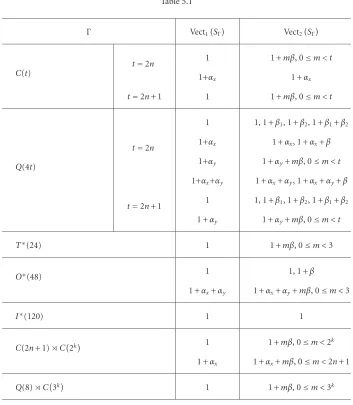
In this work we consider the class of the compact connected three-dimensional man-ifolds with positive constant curvature, also known as the three-dimensional spherical space forms. These spaces, or subclasses like generalized quaternions or lens spaces, ap-pear in many different contexts in topology and geometry, and have been completely classified; it is thus natural to ask if we can also count the bundles over them. We an-swer positively to this question, and give tables in Section 5to describe all the vector bundles of rank less than 3 over any three-dimensional spherical space form. Besides, in Section 2, we show that, under reasonably wide assumptions on the structure groupG, G-bundles over any low (lower or equal to three)-dimensional manifolds can be counted effectively.
2. Bundles over low-dimensional manifolds
LetGbe a Lie group andMm a closed manifold of finite dimensionm=1, 2, or 3. Let Ꮾ(M,G) be the set of the equivalence classes of principalGbundles overM. Recall that Ꮾ(M,G)=[M,BG] and, by dimensional reason and sinceπ2(G)=0, they coincide with the set [M, (BG)m],m=1 or 2, where (BG)m is the space appearing at level min the Postnikov decomposition ofBG. Thus, whenGis connected,
ᏮM1,G= {0},
ᏮM2,3,G=H2M;π1(G). (2.1)
Hindawi Publishing Corporation
International Journal of Mathematics and Mathematical Sciences Volume 2006, Article ID 47574, Pages1–11
WhenG is not connected we need local coefficients. We can proceed as in [7] and use the Larmore spectral sequence [6]. We introduce the following quite general assump-tion: we assume that the projectionp0:G→G/G0to the quotient by the connected com-ponent of the identity has a continuous section s:G/G0→G. If this is the case, then G=G/G0αG0, for some homomorphismα:G/G0→Aut(G0), and we can apply [7, Proposition 1].
Proposition 2.1. The classifying spaceBGis the total space of aG/G0-bundle overB(G/G0) with fibreBG0and projectionBp0:BG→B(G/G0). Moreover, the splitting mapsinduces a cross-sectionBs:B(G/G0)→BG.
Hence, the relevant Postnikov sections are twisted Eilenberg-Mac Lane spaces, and we obtain the exact sequence of sets
M,BG0 (Bi0)∗
−−−−→[M,BG]−−−−−→(Bp0)∗ M,BG/G0−→0. (2.2)
WhenMhas dimension 1, this gives
M1,BG=Homπ1M1,π0(G)/Pπ0(G), (2.3)
where the action is by conjugation, namely (φ,α)(x)→φα(x)=α−1φ(x)α, and PG= G/ZG denotes the quotient by the center. WhenM has dimension 2 or 3, we need to compute (Bp0)−1∗ (Bp0)∗([f]) for [f]∈[M,BG]0. By surjectivity, it is enough to compute (Bp0)−1∗ ([u]) for all [u]∈[M,B(G/G0)]0, and as before we can enumerate the elements [u]∈[M,B(G/G0)]0 by the correspondent elementsφu∈Hom(π1(M),π0(G)). We can use the Larmore spectral sequence [6] as in [7] (that has trivial differential in this case). We obtain (Bp0)−1∗ (uφ)=H2(M;π1(G,uφ)), and hence
[M,BG]0=
φ∈Hom(π1(M),π0(G))
H2M;π1G,u φ
. (2.4)
Eventually, we need to get the quotient by the action ofπ0(G) to get free classes. It follows from [6, Theorem 2.2.2] that the operation + commutes with the action ofπ0(G) as follows: (uφ+b)α=uαφ+ 1α∗(b), with 1α∗∈Aut(H2(M;π1(G,uφ))), and hence the quo-tient can be taken on the group of the homomorphisms. In summary, we have proved the following theorem.
Theorem 2.2. LetGbe a compact Lie group satisfying the above assumption andMa closed manifold of dimension 1, 2, or 3. Then,
ᏮM1,G=Homπ1M1,π0(G)/Pπ0(G), BM2,3,G=
¯
φ∈Hom(π1(M),π0(G))/Pπ0(G)
H2M;π1G,u
Notice that the action ofπ0(G) is trivial wheneverπ0(G) is abelian (in particular ifG is abelian) andBGis 2-simple.
3. Twisted cohomology of 3-dimensional spherical space forms
Letp:F→F/R=Gbe a presentation for a finite groupG, whereFandRare free on the setsSandT, respectively. By [3] or [1] we obtain a free resolution ofZoverZGas follows. LetAandBdenote ordered sets of abstract module’s generators, one generator for each element in the corresponding set of the group’s generatorsSandT, respectively, letebe a single abstract generator, and define the homomorphisms
φ1(a)=1−sae, φ2(b)=
a∈A
dsbraa, (3.1)
wheresbandradenote the elements in the group’s generators set corresponding to the abstract basis elements, and we recall that the group derivation is defined on the elements ofFbyds1=0,ds(uv)=ds(u) +udsv, anddsisj=δi j, for alls∈S. A free resolution ofZ overGis then
··· −→ZG[B]−−→ φ2
ZG[A]−−→ φ1
ZG[e]−→ Z−→0. (3.2)
LetΓbe a finite subgroup ofSO4(R) operating freely on the three sphereS3. The quo-tient spacesSΓ=S3/Γ are three-dimensional Riemannian orientable closed manifolds called (orthogonal) spherical space forms [10]. A first complete classification of these manifolds was given implicitly by Hopf [5] and in more details by Seifert and Threlfall [8]. This classification is given by the list of the possible groupsΓ(see also [4]). They are (for presentations seeSection 4)
(1) the cyclic group C(n), the generalized quaternionic group Q(4n), the binary tetrahedral groupT∗(24), the binary octahedral groupO∗(48), and the binary icosahedral groupI∗(120);
(2) the semidirect productsC(2n+ 1)C(2k),k≥2,n≥1; (3) the semidirect productsQ(8)C(3k),k≥1;
(4) the product of any of the above groups with a cyclic group of coprime order. Since SΓ is the three-skeleton of the Eilenberg Mac Lane space K(1,Γ), and all the groups appearing in the above list are finite and finitely presented, theZΓ-chain complex for the universal covering spaceSΓ(∼=S3) is given by the resolution (3.2). This provides the chain complex only up to level 2, but this is enough for our purpose since we can dualize the complex to compute the first cohomology groups and eventually apply a generalized version of the Poincar´e duality, that holds here without restrictions since the manifolds are orientable, to complete the calculations.
4. Calculations
of the groups listed inSection 3),G=On,G0=SOn,G/G0=π0(G)=Z/2, andπ2(BG)= π1(G)=0,ZorZ/2,n=1, 2, 3. Notice thatGis abelian andBGis 2-simple in all cases except one, when the action ofπ1(BG) corresponds to a change in the local orientation of the bundle. Actually, this case never arises, as appears from the tables inSection 5.
We proceed with the calculations as follows. Each time, we first compute Hom(π1(SΓ),
π0(G))=Hom(Ab(Γ),Z/2), that corresponds to the set of the real line bundles overSΓ. Next, we need the cohomology ofSΓ, twisted by all these line bundles ifn=2. Letube an element in [SΓ,B(G/G0)] that classifies a line bundle, and letφuin Hom(π1(SΓ),π0(G)) be the corresponding homomorphism. We need to computeH2(S
Γ;π1(G,u)). WhenG=O2, since (BG)1=G/G0, the sheafπ1(G,u) with fibreπ1(G)=Zand groupπ0(G)=Z/2, act-ing by the automorphism determined by a representationρ:π0(G)→Aut(π1(G)), corre-sponds bijectively to (is classified by) the twisting homomorphismsφ:π1(SΓ)→π0(G), that is, we can identify (in the other cases we just need the trivial sheaf)H2(S
Γ;π1(G,uφ)) =H2(S
Γ;Zρφ).
Therefore, for eachΓand each allowed representation for it, we give the explicit form of the chain complex described inSection 3, and we compute the twisted homology groups. We will use the following notation for the groups representations: for a subsetWof the set of the generators ofΓ, letρW:Γ→Aut(Z) denote the homomorphism determined by ρW(W)= −1 andρW(S\W)=1;ρ0will denote the trivial representation. Observe that not all suchWdefine a homomorphism, the relations of the presentation ofΓimpose restrictions on that. Notice also that, whenever we know a complete chain complex, we write it down explicitly.
4.1. Cyclic groups,C(t)=(x:xt=1). Allow representation: HomC(2n+ 1),Z/2= ρ0, HomC(2n),Z/2= ρ0,ρx.
(4.1)
In this case we have a full periodic resolution, see [3] or [2], that gives the chain com-plex
0−→ZΓ[d]−−→ d3
ZΓ[c]−−→ d2
ZΓ[b]−−→ d1
ZΓ[a]−→0,
d1(b)=(x−1)a,
d2(c)=1 +x+x2+···+xt−1b, d3(d)=(x−1)c.
(4.2)
The homology groups in the above representations are
Twisted homology
H0 H1 H2 H3
ρ0 Z Z/t 0 Z
while the cohomology with globalZ/2 coefficients is
Z/2-cohomology
H0 H1 H2 H3
Z/2 Z/(2,t) Z/(2,t) Z/2
where (n,m) denotes the gcd ofnandm.
4.2. Generalized quaternionic groups,Q(4t)=(x,y:xt=y2, xyx=y). Allow repre-sentation:
HomQ(8n),Z/2= ρ0,ρx,ρy,ρx,y, HomQ(8n+ 4),Z/2= ρ0,ρy, 0−→ZΓ[d]−−→
d3
ZΓc1,c2−−→ d2
ZΓb1,b2−−→ d1
ZΓ[a]−→0,
d1b1=(x−1)a, d1b2=(y−1)a, d2c1=1 +x+x2+···+xt−1b1+ (−y−1)b2,
d2c2=(xy+ 1)b1+ (x−1)b2, d3(d)=(x−1)c1+ (−xy+ 1)c2.
(4.3)
The homology groups in the above representations are
Twisted homology
H0 H1 H2 H3
ρ0 Z Z/2⊕Z/(2,t) 0 Z
ρx Z/2 Z/2 Z/2 0
ρy Z/2 Z/t Z/2 0
ρx,y Z/2 Z/2 Z/2 0
while the cohomology with globalZ/2 coefficients is
Z/2-cohomology
H0 H1 H2 H3
4.3. The binary tetrahedral group,T∗(24)=(x,y:yxy=x2,xyx=y2).
HomT∗(24),Z/2= ρ0, ··· −→ZΓ[d]−−→
d3
ZΓc1,c2−−→ d2
ZΓb1,b2−−→ d1
ZΓ[a]−→0,
d1b1=(x−1)a, d1(b2)=(y−1)a, d2c1=(y−x−1)b1+ (1 +yx)b2, d2c2=(1 +xy)b1+ (x−y−1)b2,
d3(d)=(x−1)c1+ (y−1)c2
(4.4)
(the resolution has been communicated by Svengrowski and Tomoda [9]),
Twisted homology
H0 H1 H2 H3
ρ0 Z Z3 0 Z
Z/2-cohomology
H0 H1 H2 H3
Z/2 0 0 Z/2
4.4. The binary octahedral group,O∗(48)=(x,y:xyx=yxy,xy2x=y2).
HomO∗(48),Z/2= ρ0,ρx,y, ··· −→ZΓ[d]−−→
d3
ZΓc1,c2−−→ d2
ZΓb1,b2−−→ d1
ZΓ[a]−→0,
d1b1=(x−1)a, d1b2=(y−1)a, d2c1=(1−y+xy)b1+ (x−1−yx)b2, d2c2=1 +xy2b1+ (x−1−y+xy)b2,
d3(d)=(1−xy)c1+ (y−1)c2
(the resolution has been communicated by Svengrowski and Tomoda [9]),
Twisted homology
H0 H1 H2 H3
ρ0 Z Z/2 0 Z
ρx,y Z/2 Z/3 Z/2 0
Z/2-cohomology
H0 H1 H2 H3
Z/2 Z/2 Z/2 Z/2
4.5. The binary icosahedral group,I∗(120)=(x,y:xy2x=yxy, yx2y=xyx).
HomI∗(120),Z/2= ρ0, ··· −→ZΓ[d]−−→
d3
ZΓc1,c2−−→ d2
ZΓb1,b2−−→ d1
ZΓ[a]−→0,
d1b1=(x−1)a, d1b2=(y−1)a, d2c1=1−y+xy2b1+ (−1 +x+xy−yx)b2, d2c2=(−1 +y+yx−xy)b1+ (1−x+yx2)b2,
d3(d)=(1−yx)c1+ (1−xy)c2
(4.6)
(the resolution has been communicated by Svengrowski and Tomoda [9]),
Twisted homology
H0 H1 H2 H3
ρ0 Z 0 0 Z
Z/2-cohomology
H0 H1 H2 H3
4.6.C(2n+ 1)C(2k)=(x,y:x2k
=y2n+1=1,xyx−1=y−1), k≥2,n≥1. HomC(2n+ 1)C2k,Z/2= ρ0,ρx,
··· −−→ d3
ZΓc1,c2,c3−−→ d2
ZΓb1,b2−−→ d1
ZΓ[a]−→0, d1b1=(x−1)a, d1b2=(y−1)a, d2c1=1 +x+···+x2k−1
b1, d2c2=1 +y+···+y2nb2, d2c3=1−y−1b1+x+y−1b2,
(4.7)
Twisted homology
H0 H1 H2 H3
ρ0 Z Z/2k 0 Z
ρx Z/2 Z/(2n+ 1) Z/2 0
Z/2-cohomology
H0 H1 H2 H3
Z/2 Z/2 Z/2⊕Z/2 Z/2
4.7.Q(8)C(3k)=(x,y,z:x2=(xy)2=y2,z3k
=1,zxz−1=y,zyz−1=xy),k≥1. HomQ(8)C3k,Z/2= ρ0,
··· −→ZΓc1,c2,c3,c4,c5−−→ d2
ZΓb1,b2,b3−−→ d1
ZΓ[a]−→0, d1b1=(x−1)a, d1b2=(y−1)a, d1b3=(z−1)a,
d2c1=1 +xy−xyxyx−1−xyxyx−2b1+ (x+xyx)b2, d2c2=(1 +xy)b1+x−xyxy−1b2, d2c3=1 +z+···+z3k−1
b3, d2c4=(z)b1+−zxz−1y−1b2+1−zxz−1b3,
d2c5=−zyz−1y−1x−1b1+z−zyz−1y−1b2+1−zyz−1b3,
(4.8)
Twisted homology
H0 H1 H2 H3
ρ0 Z Z/3k 0 Z
Z/2-cohomology
H0 H1 H2 H3
Table 5.1
Γ Vect1
SΓ Vect2
SΓ
C(t) t=
2n 1 1 +mβ, 0≤m < t
1+αx 1 +αx
t=2n+ 1 1 1 +mβ, 0≤m < t
Q(4t)
t=2n
1 1, 1 +β1, 1 +β2, 1 +β1+β2
1+αx 1 +αx, 1 +αx+β
1+αy 1 +αy+mβ, 0≤m < t
1+αx+αy 1 +αx+αy, 1 +αx+αy+β
t=2n+ 1 1 1, 1 +β1, 1 +β2, 1 +β1+β2
1 +αy 1 +αy+mβ, 0≤m < t
T∗(24) 1 1 +mβ, 0≤m <3
O∗(48) 1 1, 1 +β
1 +αx+αy 1 +αx+αy+mβ, 0≤m <3
I∗(120) 1 1
C(2n+ 1)C2k 1 1 +mβ, 0≤m <2k
1 +αx 1 +αx+mβ, 0≤m <2n+ 1
Q(8)C3k 1 1 +mβ, 0≤m <3k
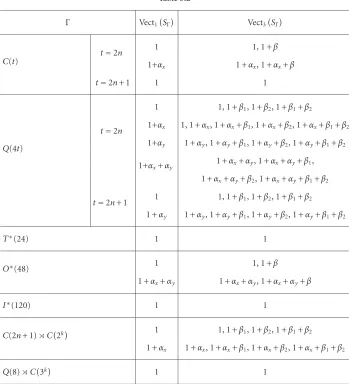
5. Vector bundles over 3-dimensional spherical space forms
Table 5.2
Γ Vect1SΓ Vect3SΓ
C(t) t=2n
1 1, 1 +β
1+αx 1 +αx, 1 +αx+β
t=2n+ 1 1 1
Q(4t)
t=2n
1 1, 1 +β1, 1 +β2, 1 +β1+β2
1+αx 1, 1 +αx, 1 +αx+β1, 1 +αx+β2, 1 +αx+β1+β2
1+αy 1 +αy, 1 +αy+β1, 1 +αy+β2, 1 +αy+β1+β2
1+αx+αy 1 +αx+αy, 1 +αx+αy+β1, 1 +αx+αy+β2, 1 +αx+αy+β1+β2
t=2n+ 1 1 1, 1 +β1, 1 +β2, 1 +β1+β2 1 +αy 1 +αy, 1 +αy+β1, 1 +αy+β2, 1 +αy+β1+β2
T∗(24) 1 1
O∗(48) 1 1, 1 +β
1 +αx+αy 1 +αx+αy, 1 +αx+αy+β
I∗(120) 1 1
C(2n+ 1)C2k 1 1, 1 +β1, 1 +β2, 1 +β1+β2
1 +αx 1 +αx, 1 +αx+β1, 1 +αx+β2, 1 +αx+β1+β2
Q(8)C3k 1 1
Here, theβiare fixed generators ofH2(SΓ;Zρs). InTable 5.2appear the real vector bundles of rank 3 with the same notation (but theβiare generators ofH2(SΓ;Z/2)).
References
[1] K. S. Brown, Cohomology of Groups, Graduate Texts in Mathematics, vol. 87, Springer, New York, 1982.
[2] H. Cartan and S. Eilenberg, Homological Algebra, Princeton University Press, New Jersey, 1956. [3] K. W. Gruenberg, Resolutions by relations, Journal of the London Mathematical Society 35
(1960), 481–494.
[5] H. Hopf, Zum Clifford-Kleinschen Raumproblem, Mathematische Annalen 95 (1925), no. 1, 313–
339.
[6] L. L. Larmore, Twisted cohomology and enumeration of vector bundles, Pacific Journal of Mathe-matics 30 (1969), 437–457.
[7] A. Minatta, R. Piccinini, and M. Spreafico, A note about the isotropy groups of 2-plane bundles
over closed surfaces, Collectanea Mathematica 54 (2003), no. 3, 283–291.
[8] H. Seifert and W. Threlfall, A Textbook of Topology, Pure and Applied Mathematics, vol. 89, Academic Press, New York, 1980.
[9] P. Svengrowski and S. Tomoda, private communication.
[10] J. A. Wolf, Spaces of Constant Curvature, McGraw-Hill, New York, 1967.
Esdras Teixeira Costa: ICMC-USP, 13560-970 S˜ao Carlos, Brazil
E-mail address:[email protected]
Oziride Manzoli Neto: ICMC-USP, 13560-970 S˜ao Carlos, Brazil
E-mail address:[email protected]
Mauro Spreafico: ICMC-USP, 13560-970 S˜ao Carlos, Brazil