Dream of Achieving Hundred Percent Universalization of Elementary
Education and Implementation of Right to Education Act in India: Aren’t
They Two Realities of the Same Coin
Shazli Hasan Khan
Assistant Professor,Dept. of Education& Training,
MANUU, Hyderabad
There has been a long cherished dream of achieving hundred percent Universalization of Elementary Education in India since independence. India has achieved close to Universal enrolment. The small proportion of children who are still out of school, the hardest to reach, will be pulled in by the efforts emanating from ‘The Right to Education (RTE) Act”. It is expected that an estimated over one crore children, who have either dropped out of school or who have neither been to any educational institution or school will get free and compulsory education, as it would be binding on the part of local, State and Central governments so as to ensure that all children in the age six to 14 years age group get schooling. Further, there is a strong need to generate awareness among various stakeholders responsible for its implementation, especially primary education in the rural areas, needs to be focused with a special attention. There is an urgent need to address some issues and challenges which are very critical for the success of RTE Act. Some of the issues are shortage of qualified teachers, infrastructure in schools, requirement of new schools and finances. Schools must also be made aware of provision of the twenty five percent reservations under the schedule. Rigorous efforts should be made to implement this Act, especially in rural areas, where more than 70% child labourer work in agriculture and where access to school is severely limited and the non-availability of qualified and trained teachers makes the situation worse.
There is not an iota of doubt that the RTE Act (2009) is a milestone initiative of the Government of India to strengthen the education system, but at the same time, it is also very necessary to involve the Panchayati Raj Institutions (PRIs) in rural areas for universalizing the elementary education. If PRI members are monitoring the enrolment procedure of their jurisdiction, then success would automatically come through this Act. Community
well as physical, which are related to RTE-Act. The author in the present paper tries to highlight the need of achieving hundred percent UEE, in the background of effective implementation of RTE Act. The present paper also focuses upon the various issues and challenges which are there in the effective implementation of RTE Act. The author has also tried to elaborate upon various shortcomings and gaps which have been noticed in the RTE Act, and therefore the author has given various suggestions for strengthening and improving the present RTE Act.
Key Words: Right to Education Act-2009, Sarva Shiksha Abhiyan, UEE, Panchayati Raj
Institutions
PART-I
INTRODUCTION
Education is one of the most important social indicators that is directly linked with economic development. Level of literacy or education is directly associated with poverty, population growth and health. Despite its importance, education continues to be a neglected area at the policy level. After 50 years of planning, enormous funding and promises, total literacy remains to be distant dream. Apart from overall low levels of literacy at the national level, disparities across regions, genders, social groups etc, are of serious concern. Education is recognized as a basic input for empowerment to individual and overall development of the society. Expenditure on education and its intra-sectoral allocation, in general, appears to be main factor influencing literacy levels and in realizing the dream of achieving hundred percent Universalization of Elementary Education (UEE), (Sharif & Ghosh, 2000)22. At the National level the expenditure on education in relation to Gross Domestic Product (GDP) continues to be much below the desired 6 percent level. The share of elementary education in the total expenditure on education continues to be below 50 percent as against the required 65-70 percent target so as to achieve total literacy and goal of complete UEE in India.
Universalization of Elementary Education has been a National goal since 1950. The recent 86th amendment (2002) to the constitution has made elementary education a fundamental right of every citizen. This guides the formulation of the policy and programmes in this area. Efforts made during last fifty years have resulted in a manifold increase in the number of institutions, teachers and students during the period 1951 to 2001. Census of India (2001)7 reported that the total population of the country increased from 36 crores to 103 crores. Accordingly school child population has also increased in the same proportion.
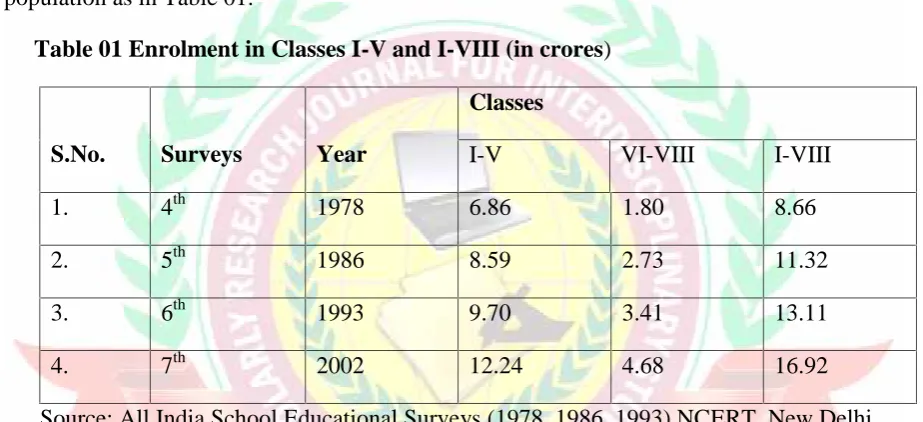
and covers children in the age group 11 to 14 years. However, there are minor variations in some states. Some have primary schooling up to class IV only, while a few have upper primary up to class VII only. NCERT conducted Seven All India Educational Surveys (1957 to 2002)1,2to collect basic educational facilities available in the country. Government of India conducted the First Educational Survey in 1957. The Second Survey, which was conducted in 1965, recorded total enrolment 5.91 crores in the classes I to VIII, the Fourth Survey in 1978 recorded enrolment of 8.66 crores, where as the Seventh Survey in the year 20021 recorded approximately 16.92 crores. Total enrolment at primary stage increased from 4.88 crores in 1965 to 6.86 crores in 1978 and to 12.24 crores in 2002. It increased from 1.02 crores, to 1.79 crores and to 4.68 crores during the same period at the upper primary stage. The figures of Seventh All India Educational Survey (2002)1 have been projecting the enrolment and child population as in Table 01.
Table 01 Enrolment in Classes I-V and I-VIII (in crores)
S.No. Surveys Year
Classes
I-V VI-VIII I-VIII
1. 4th 1978 6.86 1.80 8.66
2. 5th 1986 8.59 2.73 11.32
3. 6th 1993 9.70 3.41 13.11
4. 7th 2002 12.24 4.68 16.92
Source: All India School Educational Surveys (1978, 1986, 1993) NCERT, New Delhi
[image:3.595.75.529.367.755.2]The All India School Educational Surveys (1978, 1986, 1993 & 2002)1,2also reported that the child population in the age group six to 11 was 8.40 crores in 1978 and it increased to 13.17 crores in 2002. Similarly the child population in the age group 11 top 14 was 4.73 crores in 1978 and increased to 8.02 crores in 2002.
Table 02: Child Population for the Age Groups 6-11 and 11-14 years (in crores)
Surveys Year Age Groups
6 to below 11 11 to below 14 6 to below 14
4th 1978 8.40 4.73 13.13
5th 1986 9.37 5.69 15.06
6th 1993 11.85 6.28 18.14
Source: All India School Educational Surveys (1978, 1986, 1993) NCERT, New Delhi
The percentage of total children enrolment who are enrolled in different types of schools can be seen from the given table-03. The table-03 gives complete data of the percentage of the total children who are enrolled in different types of school in rural areas of India, as per Annual Status of Education Report (Rural)3, March 2013 Statistics.
Table03: Percentage of Total Children Enrolled in Different types of School-2013 Statistics
S.No. Age Group Govt. Private Other Not in School Total
1. 6-14 All 67.0 28.3 1.2 3.5 100
2. 7-16 All 64.8 28.2 1.1 5.9 100
3. 7-10 All 68.1 28.5 1.3 2.2 100
4. 7-10 Boys 65.2 31.7 1.2 1.9 100
5. 7-10 Girls 71.0 25.3 1.3 2.4 100
6. 11-14 All 65.6 28.0 1.0 5.4 100
7. 11-14 Boys 63.0 31.3 1.0 4.8 100
8. 11-14 Girls 68.2 24.8 1.1 6.0 100
9. 15-16 All 54.2 28.1 0.8 17.0 100
10. 15-16 Boys 53.6 29.6 0.7 16.2 100
11. 15-16 Girls 54.7 26.5 1.0 17.9 100
Source: Annual Status of Education Report (Rural)-2013
Note: ‘Not in School’= dropped out + never enrolled & ‘Other’ includes Madarsa and EGS
Literacy Rates in India
According to the document entitled, “Sarva Shiksha Abhiyan (2005)’ the literacy rates
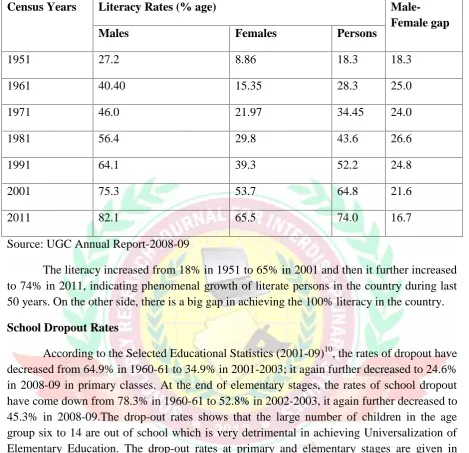
for the years 1951, 1961 and 1971 relates to the population aged groups five years and above, while those for the years 1981, 1991 and 2001 relate to the population seven years and above. These rates are given below in Table 04.
Census Years Literacy Rates (% age) Male-Female gap
Males Females Persons
1951 27.2 8.86 18.3 18.3
1961 40.40 15.35 28.3 25.0
1971 46.0 21.97 34.45 24.0
1981 56.4 29.8 43.6 26.6
1991 64.1 39.3 52.2 24.8
2001 75.3 53.7 64.8 21.6
2011 82.1 65.5 74.0 16.7
Source: UGC Annual Report-2008-09
The literacy increased from 18% in 1951 to 65% in 2001 and then it further increased to 74% in 2011, indicating phenomenal growth of literate persons in the country during last 50 years. On the other side, there is a big gap in achieving the 100% literacy in the country.
School Dropout Rates
[image:5.595.65.535.73.526.2]According to the Selected Educational Statistics (2001-09)10, the rates of dropout have decreased from 64.9% in 1960-61 to 34.9% in 2001-2003; it again further decreased to 24.6% in 2008-09 in primary classes. At the end of elementary stages, the rates of school dropout have come down from 78.3% in 1960-61 to 52.8% in 2002-2003, it again further decreased to 45.3% in 2008-09.The drop-out rates shows that the large number of children in the age group six to 14 are out of school which is very detrimental in achieving Universalization of Elementary Education. The drop-out rates at primary and elementary stages are given in Table 05.
Table 05: Dropout Rates at Primary and Elementary Stages
Year Primary (I-V) Elementary (I-VIII)
All Category SC ST All Category SC ST
1960-71 64.9 --- --- 78.3 ---
---1970-81 67.0 --- --- 77.9 ---
---1980-91 58.7 --- --- 72.7 ---
1995-96 42.1 45.7 56.6 58.8 67.0 66.0
2000-01 40.7 --- --- 53.7 ---
---2002-03 34.9 41.5 51.4 52.8 59.9 68.7
2003-04 31.5 39.7 48.6 51.3 58.3 66.3
2008-09 24.6 32.7 43.6 45.3 51.4 59.4
Source: SES, MHRD, Govt. of India
Centrally Sponsored Initiatives towards Universalization of Elementary Education
In 1950, India committed itself to provide free and compulsory education for all children in the age group from six to 11 years within a period of ten years from the commencement of the constitution, i.e., by the end of the year 1961. However this target was never met.
In the Indian constitution, school education was included in the State list. As such it was the responsibility of the State government to provide Universalization of Elementary Education. At the policy level the situation changed with Constitutional changes being made in 1976, by which school education was put in the concurrent list. UEE then became a shared responsibility of the Central and State government. The National government realized its direct responsibility in this field after adoption of National Policy of Education in 1986. In the 1990s there was very intensive activity in the field of literacy in elementary education. Issues of adult literacy in elementary education and its direct relationship to development entered public discourse. This led the Union Government to procure and channalize funds from international agencies for UEE initiatives and intervention in a big way in different states.
It is recognized that growth in elementary education is largely determined by State specific conditions. Mere funds and schemes from the centre will not guarantee the achievement of UEE goals. It is very dependent on the tradition and values of local communities, commitment and enthusiasm of State level educational leadership, political will of the State governments and the capacity to adopt innovative approaches. It is on account of these factors that differential success had been achieved in different states.
strategies of National Policy on Education (NPE)19 1986. Special attention has been paid to increase community involvement, improving teaching and learning materials and providing in-service teacher’s training for better performance.
One of the earliest such schemes known as Operation Blackboard was started in 1987. It aimed at improving the school climate and enhancing retention and learning achievement of children by providing certain minimum essential facilities in all primary schools. The scheme has brought about remarkable qualitative and qualitative improvement in primary education. More than 623000 primary schools have already been covered all over the country under this scheme.
Decentralised planning and management of elementary education is a goal set by the NPE (1986)19. The policy visualizes direct community involvement in the form of Village Education Committees (VECs) for management of elementary education. The action plan uses micro-planning as a tool for designing a family-wise and child-wise plan by which every child regularly attends the school or the Non-Formal Education (NFE) centres, continues his education in a near by place and completes at least eight years of schooling or its equivalent at some NFE centre. The 73rdand 74thconstitutional amendments provide for decentralization of the activities and facilitate transfer of power and participation of the local self-government institutions or the Panchayati Raj Institutions (PRIs). It has created a congenial ambience for the PRIs to play a more dynamic and proactive role. States are expected to evolve institutional arrangements both in rural and urban areas for undertaking these activities. These structures have been providing voice to women, Scheduled Castes and Tribes, minorities parents and educational functionaries. They have also, been delegated with responsibilities with regard to location and relocation of existing primary and upper primary schools on the basis of microplanning and school mapping. In this regard, decentralization of school management at the grassroot level bodies is an important policy initiative.
During the 8th plan period several innovative efforts have been made under the ongoing projects to establish decentralization. For instance, the District Primary Education Programme has shifted the planning mechanism from the state to the district level, and Lok Jumbish has gone one step further by assigning decision making processes to block level committee. At the village level, a VEC has the main responsibility for community mobilization, school mapping, microplanning, renovation and construction of school buildings and improvement of pedagogical curriculum. In fact, the VECs of Shiksha Karmi schools have been activated as a result of the Lok Jumbish programme. Since 1993-94, the scheme has been expanded to cover upper primary schools. More than 49,000 upper primary schools have been granted central assistance of rupees 40,000 each for purchase of teaching-learning materials. Also, primary schools with enrolment exceeding hundred have been augmented with a third teacher.
On 15th August 1995, the School Meal programme was started to increase enrolment, retention and improving attendance in primary classes by providing supplementary nutrition to all children in primary schools. The scheme has spread throughout the country. Hundred grams of food grains in the form of cooked meal is given to every child per school day in classes I to V. By 1997-98, 110 million children in primary classes were covered under this
scheme. Evaluation reports have confirmed the positive impact on students’ enrolment and
retention.
District Primary Education Programme (DPEP)
This programme was launched in November 1994 with a view to overhauling the primary education system. The programme aims at translating into action, the strategies for achieving UEE through the district specific planning and disaggregated target setting. It draws upon the cumulative experience of several State level initiatives started earlier. It makes a shift from the schematic piece-meal approach of the earlier programmes to a holistic view of primary education with emphasis on decentralised planning and community mobilization with district specific planning based on local conditions. The basic objectives of DPEP are as following:
1. To provide all children access to primary education through either formal or non-formal
stream.
2. To reduce differences in enrolment, drop-out rates and lea ring achievement among gender and
weaker section groups to less than five percent.
3. To reduce overall primary dropout rates for all children to less than ten percent.
4. To raise the average achievement rate by 25 percent by measured baseline level and ensuring
achievement of basic literacy and numeracy competencies and minimum of 40 percent
achievement in other competencies by all primary education children.
Shiksha Karmi and Lok Jumbish Project
In Rajasthan the Shiksha Karmi Project (SKP) was started in 1987 with assistance from Swedish International Development Corporation Agency. The project aims at Universalization and qualitative improvement of education in the remote and socio-economically backward villages of the State with primary focus on girls. To off-set the problems of teachers absenteeism, the project used an alternative strategy by recruiting local youths known as Shiksha Karmis in schools. They have been provided with training and supervisory support. The mobilization and participation of the community in the functioning of primary schools is an important feature of this project. The School Karmi project also runs non-formal classes. The project is being implemented as an externally aided scheme with reimbursement of 90% in Phase I and 50% in Phase II, from SIDA (Swedish International Development Authority). The project with an outlay of around Rs. 212 million in Phase I and Rs. 490 million in Phase II, places strong emphasis on vigorous and continuous in-service training. The SKP also runs non-formal classes called Prehar Pathshalas-schools of
convenient timings. For girls’ educationAngan Pathshalas are being run in three blocks. The programme at present covers over 150,000 students in 1,785 schools and 3,520 Prehar Pathshalas, involving over 4,271 Shiksha Karmis. The project is known for its open participative style to achieve its objectives. The approach, strategies and achievement of the SKP has attracted national and international recognition.
Another project called Lok Jumbish project has made a profound impression on the primary education scenario in Rajasthan. The project covers 75 blocks with total population of 12 millions. It ahs helped in bringing together government agencies, teachers, NGOs, elected representatives and people into an interactive group to promote universalization of primary education. The guiding principles of Lok Jumbish are that it is a process rather than a product, partnership, decentralised functioning, participator functioning, integration with main education system and creating multiple level of leadership committed to quality and mission mode.
Special attention has been given to environment building in all its programmes. This
helps in understanding the issues involved in people’s mobilization. In both these projects mobilizing village community ahs ensured quality education for every child. Community involvement is the key factor for the success of the two projects. Lok Jumbish has a positive effect on the empowerment of the locally elected people especially the women representative at village level who are often the active members of its core team. The SKP has constituted VEC in 2000 villages to promote community involvement and encourage village level planning. The role of VEC is to mobilize resources for construction of schools and for infrastructure. It also helps in framing the school calendars and deciding about school timings. The two projects have demonstrated how the deeply rooted problems of primary education in rural India can be addressed.
The SSA is a flagship programme of the National Government in the new millennium. It seeks to achieve the goal of Universal primary education by 2005 and the goal of UEE by 2010. This would mean that children in all States would complete at least five years of schooling or its equivalent through the non-formal means by the year 2005. SSA is an effort to universalize elementary education through non-formal means by the year 2005. SSA is an effort to universalize elementary education by community ownership of the school system. It is a response to the demand for quality basic education all over the country. It is also an attempt to provide an opportunity for improving human capabilities of all children through provision of community owned quality education in a mission mode.
Meaning of Sarva Shiksha Abhiyan
a) A programme for clear time frame for universal elementary education. b) A response to the demand for quality basic education all over the country. c) An opportunity for promoting social justice through basic education.
d) An effort at effectively involving the Panchayati Raj Institutions, School Management
Committees, Village and Urban Slum Level Education Committees. Parent’s Teacher’s
Associations. Mother Teacher Associations, Tribal Autonomous Councils and other grass root level structures in the management of elementary schools.
e) An expression of political will for universal elementary education across the country. f) A partnership between the Central, State and the local Government.
g) An opportunity for States to develop their own vision of elementary education. Aim of Sarva Shiksha Abhiyan
The SSA seeks to provide useful and relevant elementary education to all children in six to fourteen age groups by 2010. Its other goal is to bridge social, regional and gender gaps with the active participation of the community in the management of schools. It is a quest for an education system that does not alienate the child from the society and seeks to promote community solidarity. The children are allowed to learn about their natural environment in a manner that harness the human potential, both spiritually and materially. The stress is on value based learning which gives an opportunity to children to work for teach other well being rather than to permit selfish pursuits. SSA realizes the value of early childhood care and education and looks upon the 0-14 age as a continuum. It will try to support pre-school learning in ICDS centres or special pre-school centres in non-ICDS areas.
Objectives of Sarva Shiksha Abhiyan
The objectives of Sarva Shiksha Abhiyan are as following:
1. All children in school, Education Guarantee Centre, Alternate School, ‘Back to School’
camp
by 2003.
3. All children complete eight years of elementary schooling by 2010.
4. Focus on elementary education of satisfactory quality with emphasis on education for a life.
5. Bridge all gender and social category gaps at primary stage by 2007 and at elementary
education level by 2010.
6. Universal retention by 2010.
The SSA has setup a framework for its implementation. It allows State to formulate context specific guideline within the overall framework. It encourages district to reflect local specificity. It promotes local need based planning on the lines provided by National policy norms. It aims to make planning a realistic exercise by adopting broad norms. It is expected that various districts and States are likely to achieve Universalization in their own context and time frame. 2010 is the outer limit for achieving the target. The emphasis is on mainstreaming out of school children through diverse strategies so that eight years of schooling for all children in the age group of 6-14 is provided. The thrust is on bridging gender and social gaps and a total retention of all children in schools. It is also expected that the education system will be made more relevant so that children and parents find the schooling a joyful experience in their own natural and social environment.
Thus, SSA has two important aspects i) it provides a wide convergent framework for implementation of elementary education schemes, ii) it is also a programme with budget allocation for strengthening wider areas to achieve UEE.
Education of Girls under UEE
For millions of women around the globe, lack of education is a handicap for which the3y pay a heavy price. Some 865 million women in India are illiterate, mainly in poor rural areas. These women cannot sign their names, decipher simple instructions, or fill out an application form. Their lack of education limits their ability to earn money and get credit, to participate in decision-making in their families and communities. The failure to educate these women when they were girls is the result of a range of factors, including the need for girls’ labour in the home, attitudes that devalue education for girls, fears about girls’ security
outside home, and lack of resources to pay for their education.
governments, local communities, and development organizations around the world now recognize the need to educate girls and are implementing programmes for doing so, 73 million girls of primary school age are still without access to basic education, according to the UNICEF.
Educating the Girl Child for a Better Tomorrow
Education improves girls’ own lives now as well as their lives in the future. It was found that “girls’ access to education creates a better environment for economic growth and
that the result is particularly strong for middle-income countries. Thus, societies that have a preference for not investing in girls pay a price for it in terms of slower growth and reduced
income”.
Girls’ education also has effects that cannot be quantifies but are powerful nonetheless.
It can transform consciousness, not only of women but of men as well. The fundamental
importance of female education for raising children’s’ nutrition levels is beyond question,
because a mother uses her knowledge and the additional income she earns form it to improve diets, care, and sanitation for her children, female education is probably the strongest instrument which we can have for reducing infant mortality and child malnutrition. In rural
India a women’s dowry is almost three-fourths lower if she has a few years of education, probably because her prospective husband thinks she will participate more in the education of their children.
Girls (Rural) Access to School
Literacy level show a positive correlation with income, and female literacy is correlated with a time lag to male literacy. At household income levels of under Rs. 20,000 per annum, 57 percent males and 32.5 percent females are literate; at levels over Rs. 86,000 the corresponding figures are 86.4 and 62.2. Ownership of land makes a difference too. Among all landowners, literacy levels are 68 per cent (male) and 41.3 percent (female), compared to 60.4% and 37.6% among the landless. Among occupation groups, wage earners have the lowest literacy levels. Each source of vulnerability increases the gender gap. Thus, for female wage earners in Rajasthan, the literacy rate is 6%, as compared to 44% for men in the same group (NCEAR, 2006)18.
Enrolment by category of schools in rural areas is presented in Table-06. It is evident that in all stages boys are enrolled more than girls. However, this difference is higher towards the higher stages.
Table 06: Enrolment by Category of Schools in Rural Areas (in Million)
Year Primary Middle Upper Primary Secondary/Hr. Sec.
1965-66 25.09 13.06 38.15 4.71 1.19 5.90 1.88 0.33 2.21
1973-74 30.18 16.86 47.04 6.27 2.13 8.40 2.96 0.69 3.65
1978-79 33.14 18.79 51.93 7.91 3.05 10.96 3.26 0.90 4.16
1986-87 39.82 25.98 65.80 12.08 5.64 17.72 5.71 2.08 7.79
1993-94 42.06 30.14 72.47 14.19 7.28 21.47 7.17 3.33 10.50
2002-03 42.28 38.09 80.37 29.83 24.31 54.14 37.71 28.59 66.30
2004-05 45.34 42.07 87.41 34.73 27.43 62.16 41.86 32.47 74.33
2008-09 47.65 45.57 93.22 38.77 33.56 72.33 47.82 38.43 86.25
Source: Selected Educational Statistics (SES), MHRD, Govt. of India-2008-09
Girls Enrolment
The participation of girls at all stages of education has been increasing steadily through the years as may be seen from Table-07. Since 1950-51 girl’s participation has
increased many fold in Primary, Middle Sec./Hr.Sec. Stages and Higher Education levels from 28.1% to 48.8%, from 16.1% to 47.3%, from 13.3% to 44.5% and from 10.0% to 43.4%
respectively. However, the girl’s participation is still below fifty percent at all stages of
education.
Table-07: Percentage of Girls Enrolment to Total Enrolment by Stages
Year Primary Middle Sec/Hr.Sec./(IX-XII) Hr. Education
1950-51 28.1 16.1 13.3 10.0
1960-61 32.6 23.9 20.5 16.0
1970-71 37.4 29.3 25.0 20.0
1980-81 38.6 32.9 29.6 26.7
1990-91 41.5 36.7 32.9 33.3
2000-2001 43.7 40.9 38.6 39.4
2002-2003 46.8 43.9 41.3 40.1
2004-2005 47.5 44.8 42.4 41.7
2008-2009 48.8 46.7 44.3 43.4
Source: Selected Educational Statistics (SES)-2008-09, MHRD, Govt. of India
Dropout of Girls: A Potential Hurdle in the Education of Girls under UEE
There are obstacles which are many and complex in the education of girls. Some are common to many different geographic areas, while others are specific to a particular country or village. But the most potent hurdle in the education of girls is dropout. It is very much clearly evident form the table-08 that school dropout rates among girls are higher than boys. But if we look at the table-08, we would find that over the year it has gone down at different stages of school education (from 1960-61 to 2001-2002). It could be seen from table-08, that generally, two points are emerging; one the reducing trend of dropout rates, both at the primary and upper primary stages and two, a near-gender neutrality among the dropout rates. Although the trend is encouraging, concerted efforts would be needed to ensure further reduction.
Table08 Dropout rates (%) at different stages of School Education (1960-61 to 2008-09)
Year Primary (I-V) Elementary (I-VIII) Secondary (I-X classes)
Boys Girls Total Boys Girls Total Boys Girls Total
1960-61 61.7 70.9 66.3 75.0 85.0 78.3 N.A N.A N.A
1970-71 64.5 70.9 67.6 74.6 83.4 77.9 N.A N.A N.A
1990-91 40.1 46.0 42.6 59.1 65.1 60.9 67.5 76.9 71.3
1992-93 43.8 46.7 45.0 58.2 65.2 61.1 70.0 77.3 72.9
1999-00 38.7 42.3 40.3 52.0 58.0 54.5 66.6 70.6 68.3
2001-02 38.4 39.9 39.0 52.9 56.9 54.6 64.2 68.6 66.4
2008-09 27.6 31.4 29.5 48.6 49.3 48.9 57.3 59.2 58.3
Source: - Selected Educational Statistics 2008-2009, MHRD, Govt. of India, New Delhi.
The main reasons for school dropout are presented in Table-09.
Table-09 Main Reasons for Dropout of Girls (2008-09)
Reasons for Dropout of Girls
Rural Urban Total
M F M F M F
Schools too far away 1.0 5.9 0.2 1.0 0.8 4.8
Transport not available 0.4 1.6 0.1 0.2 0.3 1.3
Further education not considered necessary 2.3 4.3 2.4 5.4 2.4 4.5
Required for household work 8.7 17.3 5.7 14.7 8.0 16.7
Required for outside work for earning cash 9.9 3.7 11.3 3.0 10.3 3.5
Cost too much 13.3 11.4 15.2 17.0 13.8 12.6
No proper school facilities for girls 0.0 3.5 0.0 1.2 0.0 3.0
Required for care of siblings 0.6 2.3 0.2 1.5 0.5 2.2
Not interested in studies 40.0 24.8 42.5 30.2 46.6 26.0
Repeated failures 5.3 3.7 6.0 6.1 5.5 4.2
Got married 0.2 8.5 0.1 4.9 0.2 7.7
Required for work on farm/family business 9.2 2.9 4.7 1.6 8.0 16.7
Other 5.3 6.2 5.8 8.2 5.5 6.6
Don’t know 3.8 4.0 5.7 5.1 4.2 4.2
Number of Children 5475 61221 1852 1747 7327 7868
Source: Women and Men in India 2009. Central Statistical Organization, CSO, GOI, p. 68
M = Male & F = Female
From the table-09, it could be seen that both boys and girls have hurdles to overcome. For girls the hurdles are, for the most part, higher and more frequent-simply because they are girls. Family poverty is also a barrier to education. Sending children to school may result in the loss of their income or help at home. The school may charge fees that the family knows it cannot meet or require a uniform that a family cannot afford. And often, when a choice is to be made between sending a girls or a boy to school, the family will put its scarce resources into the education of the boys, believing that it is a better long-term investment (Verma, 2006)28.
The legal framework around education can be weak, and may put girls at a particular disadvantage. For example; one of the barriers in education of girls could be that, compulsory
and/or “free” education laws may not exist, or may not be enforced. Another reason could be
early marriage and pregnancies are widespread in many counties, especially in rural areas, yet most have laws and policies that prohibit pregnant girls from attending school or returning to school after the birth of their child. Issues of safety and security in and around school, particularly affect girls in rural areas. If children have to travel long distances to school, parents are less likely to allow their daughters to make the journey because of the risks to their personal safety. Another, hurdle in the education of girls could be lack of female teachers, particularly as role models and possible confidantes, can make female pupils feel less secure in the school environment. Inadequate school facilities can also keep girls away from attending the schools. For example, when a girl reaches puberty and there is no sanitary facility, which becomes a problem.
There are many other factors, which are serious impediments in the education of girls, and that also contribute to their very high drop out of girls both at upper primary and secondary levels, besides those given in Table-09. The major factor is poverty and its adverse impact on gender. Young girls are stopped from going to school and become engaged with child-care of siblings and other domestic work by their own families. They are also engaged with labour outside the home to compensate household income and support education of their
male siblings. Poverty and other social exclusion that impede girl child’s participation in
education are inextricably linked with the phenomenon of working girl child. Issues of sexuality, mobility and security also combine to create obstacles in the path of education of
girls. The cultural and social context of controlling girls’ sexuality once puberty is attained
Infrastructural problems like lack of separate toilets, lack of water, lack of female teachers and lighting in streets and in schools affect girls more adversely than boys. The dividends from education do not easily translate for families to understand the significance of it. With no forward linkages with employment and skill-building, education seems like a waste of time and energy for these girls. Violence against women, alcoholism of male members in the family and inability by students to cope with course curriculum are also reasons for their inability to complete their education.
Kasturba Gandhi Balika Vidyalaya Scheme: A Remedy for Educationally Backward girls
The Government of India has approved a new scheme called Kasturba Gandhi Balika Vidyalaya (KGBV) Scheme. Under this scheme, a total of 750 residential schools would be set up with the provision of boarding facilities at elementary level for girls belonging predominantly to the SC, ST, OBC and minorities in identified educationally backward blocks where the rural female literacy is below the national average and gender gap in literacy is more than the national average. The scheme provides that a minimum of 75 percent of the enrolment be reserved for the girls from SC, ST, OBC or minority communities and for the remaining 25 percent priority would be accorded to girls from the families of Below Poverty Line (BPL). A total of 106 KGBVs have been sanctioned for Educationally Backward Blocks with a concentration of Muslim population. A sum of Rs. 689 crores has been provided for this in the 11th Five Year Plan. The pattern of financing will be 75:25 ratio of sharing between the Centre and the States during the Eleventh Five Year Plan.
The scheme, presently is implemented in 20 States, Andhra Pradesh has taken the lead in getting sanction for setting up of 94 schools followed by Jharkhand (74) and Madhya Pradesh (70).The scheme will be coordinated with the existing schemes of Department of Elementary Education & Literacy viz., Sarva Shiksha Abhiyan (SSA), National Programme for Education of Girls at Elementary Level (NPEGEL) and Mahila Samakhya (MS). According to this scheme at the primary level, the emphasis will be on the slightly older girls who are out of schools and were unable to complete primary schools (10+). However; in difficult areas (migratory populations, scattered habitations that do not qualify for primary/upper primary schools) the focus will be on young girls. At the upper primary level, emphasis will be on girls, especially adolescent girls, who are unable to go to regular schools. Established NGOs and other non-profit making bodies will be involved in the running of the schools, wherever possible. These residential schools can also be adopted by corporate groups.
and quality education to the girls of disadvantaged groups of society by setting up residential schools with boarding facilities at elementary level.
Mahila Samakhya Scheme for Education of Girls
The Mahila Samakhya Scheme was started in 1989 to translate the goals enshrined in the NPE 1986, into a concrete programme for the education and empowerment of women in rural areas particularly those from socially and economically marginalized groups through informal learning. The MS scheme recognizes the centrality of education in empowering women to achieve equality. The Mahila Sanghas or women’s collectives at the village level
provide the women a space to meet, reflect, ask questions and articulate their thoughts and needs and make informed choices. The programme has focused on awareness of the need to educate the children, especially girls, which ahs resulted in a direct impact on enrolment and retention of girls in schools. In case of education, Public-Private-Partnership (PPP) has been proposed as an important strategy in the Eleventh Five-Year Plan. Among many things, the Eleventh Plan has proposed the setting up of 6,000 new model schools in secondary education, affiliated to the Central board of Secondary Education. Of these, 2,500 are to be under the PPP model. The intention is to set up these schools in the backward regions and remote areas where good schooling facilities do not exist, so that quality education is accessible in the backward regions as well.
Bihar Education Project: An Initiative to Achieve to Complete UEE in Bihar
Bihar Education Project (BEP) was launched in 1991 with the sole purpose of bringing about quantitative and qualitative improvement in the elementary system in Bihar. The project lays emphasis on the education of deprived sections of society, such as SCs, STs and women. Participatory planning and implementation are crucial ingredients of the project. A midterm review of this project highlighted certain major achievements such as: i) a strong Mahila Samakhya component; ii) organization of VECs and community involvement in programme implementation at grass-root level; and iii) non-formal education through NGOs. The review suggested the following considerations:
a) Consolidation of the programmes in the existing seven districts.
b) Establishing strong linkages between BEP and the education system in Bihar.
c) Giving greater focus to the primary stage of classes I-V.
d) Building better linkages with the activities in other states under DPEP and other programmes.
e) Providing more emphasis to Minimum Levels of Learning (MLLs) and teacher training and
It has now been decided to extend the project to the second phase of two years duration. The total outlay for the second phase (1996-98) is estimated to be Rs. 613 million to be shared between UNICEF, Government of India and Government of Bihar as per the existing funding formula of 3:2:1. The total project outlay for BEP is Rs. 3600 million. It is proposed to merge the project with DPEP during the next five years.
Uttar Pradesh Basic Education Programme: An Initiative to Achieve UEE in Uttar Pradesh
Uttar Pradesh Basic Education Programme is an initiative to achieve complete UEE in
Uttar Pradesh. A project, “Education for All” prepared by the Government of Uttar Pradesh
was approved by the World Bank in June, 1993. The project is currently in operation in 12 districts. It is planned to expand the coverage to 15 districts under DPEP-II. It has an annual outlay of Rs. 7,288 million spread over seven years. International Development Agency (IDA), the soft loan window of the World Bank, would provide a credit grant of US $ 163.1
million and the State government’s share would be approximately 13 percent of the total
project cost.
The progress of implementation of the project so far has been satisfactory. The construction work of schools and Block Resource Centres is being completed as per schedule. Training materials for teacher trainees of DIETs have been prepared. The first cycle of in-service teacher training was completed in October, 1995. About 40,000 teachers have been trained.
Andhra Pradesh Primary Education Project: another Initiative to achieve UEE in AP
The Andhra Pradesh Primary Education Project (APPEP), has been undertaken in the south central state of Andhra Pradesh, with a female literacy of just 34 %, adopts a two-pronged strategy for improving classroom transaction by training teachers and giving a fillip to school construction activities. The project has trained an estimated 80,000 teachers in 23 districts and more than 3,000 teaching centres have become operational. The project is assisted by the ODA with an estimated outlay of Rs. 1,000 million in the 8thPlan.
National Elementary Education Mission: An Innovative Effort to Achieve complete UEE
The main objectives of the National Elementary Education Mission are as follows:
a) Universal access and enrolment
b) Universal retention of children up to 14 years of age; and
c) A substantial improvement in the quality of education to enable all children to achieve
essential levels of learning.
The approach and strategy of the Mission would incorporate the following events:
1.) Genuine and effective involvement and participation of all people-Political parties, mass
organizations, trade unions, peasants, youth groups, women’s collectives, individuals and
social activists so as to make UEE a mass movement.
2.) National arousal and social mobilization through media-print, theatre, fold culture and kala
jathas.
3.) A time bound and decentralized perspective with rigorous planning at district, block and
cluster levels for achieving the goal of UEE.
4.) Accountability and transparency at all levels of the elementary education system.
The political resolve, to make the right to elementary education a fundamental right has cast a greater responsibility on the Government to achieve UEE. The National Elementary Education Mission is expected to play a pivotal role in realizing the dream of achieving complete UEE.
Thus, it can be said that, India’s goal of achieving complete UEE revolves around three
main challenges: expanding access, raising learning achievement and reducing disparities in education outcomes across states and among groups.
The Government of India is geared to meet these challenges through multi-pronged strategies which are as following:
--- Making elementary education a fundamental right.
--- Consolidating the quantitative expansion achieved.
--- Provision of adequate finances for promotion of basic education.
--- Promoting alternative modes of delivery within an integrant perspective.
--- Quality improvement in primary education.
--- Sharpening the focus on the girl child.
--- Priority attention to SCs and STs.
--- Provision of education for working children that is child labour.
--- Extension of efficient delivery of incentives.
--- Meeting nutritional and health needs of children.
--- Social mobilization and decentralised management for elementary education.
--- Improving monitoring/evaluation system for achieving complete UEE.
--- Exploiting the potential among NGOs.
--- Partnership of public and private sector.
India faces these challenges with many assets. It has an expanded primary education system that has put the school within reach of most children.
References
1. All India School Education Survey (2002), NCERT, New Delhi.
2. All India School Educational Survey (1978, 1986, 1993 & 2002). National Council of
Educational Research & Training, New Delhi.
3. Annual Status of Education Report (Rural). 2013 Final Report ASER Centre, New Delhi.
4. Annual Status of Education Report (2009), ASER Centre, New Delhi-110029.
5. Aradhya, N & Kashyap, A (2006). The ‘Fundamental’ Right to Education in India, Centre
for
the Child & the Law, National Law School of India University, Bangalore.
6. Bose, Ashish. ‘Census of India, 2011: Some Highlights’. Yojna Magazine, July, 2011. pp 5-9.
7. Census of India (2001), Central Statistical Organization ( CSO), Government of India, New
Delhi.
8. Department of Education (2005), SSA, Ministry of HRD, Govt. of India, New Delhi.
10. Government of India (2009). “Selected Educational Statistics (SES)”. Ministry of Human
Resource Development, Govt. of India, New Delhi.
11. Government of India (2003). Education for All: Indian Scene, Ministry of Human Resource
Development, New Delhi.
12. Govinda, R (2004): India Education Report, Oxford University Press, New Delhi.
13. HT (2010). “Education is now a Fundamental Right of Every Child”. Hindustan Times.
1st
April, 2010. Retrieved. 8thJuly, 2010.
14. Jha & Parvati, P (2010). “Right to Education Act, 2009: Critical Gaps and Challenges”,
Economic & Political Weekly, Vol XLV, No.13, pp 20-23.
15. Kulkarni, Pallavi (2010). “Right to Education Act Faces Financial Hurdles”,Education Master, March 25.
16. Kumar, Sandeep (2004). ‘Education of Girls: Building Bridges for Future’.Kurukshetra, Sept. pp 14-16, New Delhi.
17. Mehta, B.C. & Kapoor, K (2010). “Implementing Right to Education Act”, Mainstream, Vol
XLVIII, No. 10.
18. National Council for Education & Research (NCEAR), 2006, Govt. of India, New Delhi.
19. National Policy on Education (NPE), 1986, Govt. of India, New Delhi.
20. Nitst (2010). “Right to Education Act, India: The Challenges Ahead”, accessed on
http://www.indiastudychannel.com/resources/111415-Right-Education-Act-India-The
Challenges.aspx.
21. Ramachandaran, Vimla (2009). “Right to Education Act: A Comment”, Economic & Political
Weekly, Vol XLIV, No. 28, pp 155-157.
22. Shariff A & Ghosh, P.K. (2000). Indian Education Scene & Public Expenditure Gap’.
23. Shubhi,V (2009). “Poor Quality Education in Government Schools”, The Views Paper, July
3.
24. Sibal, Kapil (2011). “Joining Hands in the Interest of Children”, The Hindu, April, 2011,p-10.
25. Sripati, V., Thiruvengadam, AK (2004). “India: Constitutional Amendment Making the
Right
to Education a Fundamental Right”.International Journal of Constitutional Law.
26. The Right of Children to Free & Compulsory Education Act, 2009, No. 35 of 2009, 26th Aug
2009, Published by Gazette of India, New Delhi.
27. UNDP (2000). Human Development Report, Oxford University Press. New Delhi.
28. Verma (2006). National Focus Group on Gender Issues in Education, Position Paper,
NCERT, New Delhi, 2006.
29. World Bank Report (2005). The World Bank in India. Washington, DC: The World Bank.
Note: The present research paper, entitled,“Dream of Achieving Hundred Percent
Universalization of Elementary Education and Implementation of Right to Education
Act in India: Aren’t They Two Realities of the Same Coin” has been divided into two
(02) parts, namely; PART-I and PART-II. The PART-II of this present research paper
would be there in the forthcoming issues of this prestigious International Journal,