https://doi.org/10.5194/nhess-18-1233-2018 © Author(s) 2018. This work is distributed under the Creative Commons Attribution 4.0 License.
The role of minimum supply and social vulnerability
assessment for governing critical infrastructure
failure: current gaps and future agenda
Matthias Garschagen and Simone Sandholz
United Nations University, Institute for Environment and Human Security (UNU-EHS), UN Campus, Platz der Vereinten Nationen 1, 53113 Bonn, Germany
Correspondence:Matthias Garschagen ([email protected]) Received: 19 October 2017 – Discussion started: 23 October 2017
Revised: 13 March 2018 – Accepted: 14 March 2018 – Published: 27 April 2018
Abstract.Increased attention has lately been given to the re-silience of critical infrastructure in the context of natural haz-ards and disasters. The major focus therein is on the sensitiv-ity of critical infrastructure technologies and their manage-ment contingencies. However, strikingly little attention has been given to assessing and mitigating social vulnerabilities towards the failure of critical infrastructure and to the de-velopment, design and implementation of minimum supply standards in situations of major infrastructure failure. Ad-dressing this gap and contributing to a more integrative per-spective on critical infrastructure resilience is the objective of this paper. It asks which role social vulnerability assessments and minimum supply considerations can, should and do – or do not – play for the management and governance of criti-cal infrastructure failure. In its first part, the paper provides a structured review on achievements and remaining gaps in the management of critical infrastructure and the understanding of social vulnerabilities towards disaster-related infrastruc-ture failures. Special attention is given to the current state of minimum supply concepts with a regional focus on poli-cies in Germany and the EU. In its second part, the paper then responds to the identified gaps by developing a heuristic model on the linkages of critical infrastructure management, social vulnerability and minimum supply. This framework helps to inform a vision of a future research agenda, which is presented in the paper’s third part. Overall, the analysis suggests that the assessment of socially differentiated vul-nerabilities towards critical infrastructure failure needs to be undertaken more stringently to inform the scientifically and politically difficult debate about minimum supply standards and the shared responsibilities for securing them.
1 Why the integration of critical infrastructure, social vulnerability and minimum supply matters
Critical infrastructure (CI) plays a key role in shaping a so-ciety’s vulnerability towards natural hazards and the result-ing risk of disasters (see Grubesic and Matisziw, 2013; Sage et al., 2015; Pescaroli and Alexander, 2016). Infrastructure for electricity, water, transport, health and law enforcement, for example, plays a critical role for the day-to-day func-tioning of a society. The importance of such infrastructure becomes particularly evident in situations of disasters and crises, when CI is prone to fail, thereby causing wider im-pacts on the society. The vulnerability and/or resilience of CI itself is therefore increasingly moving into the focus of sci-entists, risk practitioners and political decision makers (see Critical 5, 2014, 2015; Herzog and Roth, 2014; McGee et al., 2014). This attention is further driven by the growing role of CI resulting from the rising societal dependence on technol-ogy, the ever-growing connectedness of infrastructure sys-tems in the age of information technology and the growing global connectedness of people, production, trade and com-munication (Collins et al., 2011; Miles, 2015).
dia-logues1suggest that risk in relation to CI failure is currently captured in rather narrow and technocratic ways, focusing largely on technical parameters of individual infrastructure branches (e.g., water supply or power generation) whilst fail-ing to sufficiently capture the wider effects of CI failure on societal risk and risk cascades (e.g., disruption in water sup-ply due to electricity blackouts or a standstill of public trans-portation due to disruptions in ICT technology). Most im-portantly, however, it seems that the technical discourse on CI failure does not adequately link into the domain of social vulnerabilities. It is not well understood which differential impacts CI failure may have on different parts of the society (e.g., different age groups, neighborhoods, people with spe-cial need for care) and how these differential impact patterns relate to different hazard and crisis scenarios (e.g., a power blackout during a summer heat wave, affecting the poten-tial for air conditioning and water supply, vs. a flood-induced blackout during autumn or winter, affecting issues such as electric heating).
Social vulnerability studies provide powerful analytical lenses to approach such questions. Vulnerability thinking is, at its core, tailored to bring together (hypothetical) hazard scenarios with the societal predispositions for suffering harm when affected by such hazards (Blaikie et al., 1994). One of the core interests in vulnerability studies has therefore al-ways been to ask whether and how hazards and crises (such as a compound flood-cum-blackout hazard) have differenti-ated effects on different groups within society.
For the management of CI failure, the vulnerability per-spective also begs important scientific, normative and politi-cal questions with respect to the linkages between CI failure, social vulnerability and minimum supply: which levels of minimum supply (e.g., of electricity and water) are needed to avoid disastrous effects of natural-hazard-induced infrastruc-ture failure? How are these minimum supply requirements perceived to differ between social groups (e.g., single elderly vs. family households or rich vs. poor neighborhoods) as well as between different other infrastructure elements (e.g., hos-pitals vs. water treatment plants vs. shopping malls)? Who ought to be responsible for securing a level of minimum sup-ply (e.g., state authorities vs. private households)? Such de-bates are far from being at the core of ongoing discourses, posing serious questions about preparedness. One example is the 2016 German Civil Defence Concept (Konzeption Zivile 1For example within the expert round-table discussion on
“tegrated Research for Enhancing the Resilience of Critical In-frastructures through Strategic Assessments and Innovative Plan-ning Approaches”, sponsored by the German Research Founda-tion and hosted by the University of Stuttgart on 26–27 Oc-tober 2016 (http://www.uni-stuttgart.de/ireus/forschung/Initiativen/ index.html), or within the expert meetings during the design phase of the KIRMIN (Critical Infrastructures Resilience as a Mini-mum Supply Concept) project (http://ehs.unu.edu/research/critical-infrastructures-resilience-as-a-minimum), now sponsored by the German Federal Ministry for Science and Education.
Verteidigung, KZV) requiring Germans to stockpile private supplies for the case of widespread infrastructure failure. In-stead of being taken seriously, the plan was widely ridiculed (within Germany as well as in international media coverage, such as BBC, 2016; Financial Times, 2016; Spiegel, 2016), indicating an overreliance on continuous infrastructure pro-vision, making the German case particularly interesting to look at.
Against this background, the paper asks which role social vulnerability assessments and minimum supply considera-tions can, should and do – or do not – play for the manage-ment and governance of CI failure. In doing so, the paper an-alyzes the current scientific debate as well as the situation in terms of policies and legal provisions in different contexts, including predominantly the case of Germany. This contri-bution seeks to explore current gaps and inform a future re-search agenda on the nexus of CI failure, social vulnerability and minimum supply.
The paper is structured into six sections. The next section presents our methods and data for the literature and doc-ument analysis. Section 3 provides key results. Section 4 builds on the findings to sketch a heuristic model that helps to conceptually frame the relationships between CI failure, social vulnerability and minimum supply. Section 5 presents and debates a future agenda for science and practices. Sec-tion 6 presents key conclusions.
2 Data sources and methods of analysis
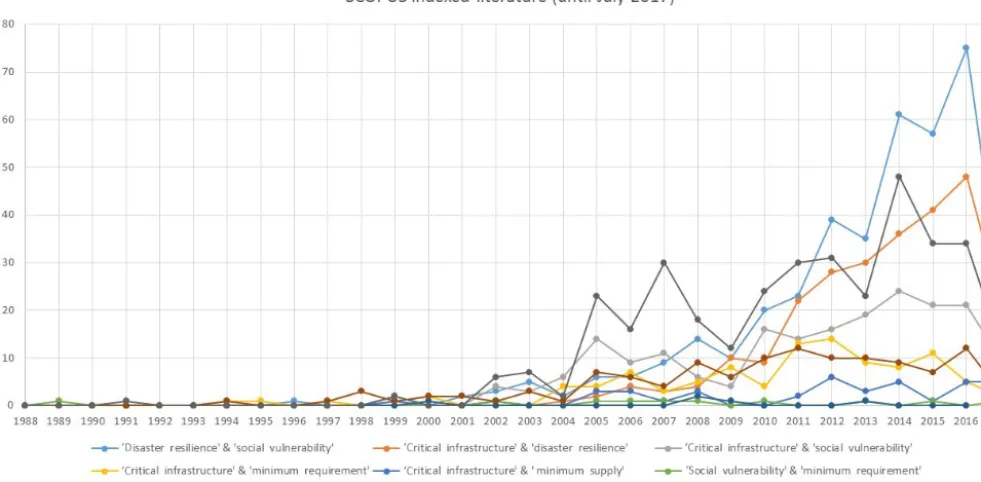
Figure 1.Scientific publications related to critical infrastructure.
The second body of data captured in the analysis is com-posed of legal, policy and practice documents, published by national or international authorities and organizations. Iden-tified by strategic Google searches and snowball sampling, the final set of data analyzed in this group contained 73 doc-uments. Different from the scientific literature, the focus of these documents is a more applied one, mostly aiming at reg-ulating or defining different infrastructure standards or at dis-seminating information on preparedness. In terms of the leg-islative documents, a regional focus was put on Germany and the EU since policies could not be assessed for each country on a global scale and this research was conducted as part of the research project KIRMIN focusing on a German case study. The policy and practice documents covered publica-tions by international, European and German organizapublica-tions working in the field of disaster risk reduction and civil pro-tection (e.g., the United Nations Office for Disaster Risk Re-duction) as well as research councils, consultancies and other bodies. All documents in both streams (roughly 5500 pages in total) were then analyzed through an in-depth content anal-ysis using MaxQDA software. The analanal-ysis was guided by the following question: how are CIs, minimum supply and social vulnerability to CI failures dealt with in terms of
– definitions and relevant actors with their responsibili-ties;
– thematic foci and context of application;
– gaps within and between CI, minimum supply and so-cial vulnerability?
These three categories will guide the structure of the next chapter.
3 Review results: the role of minimum supply and social vulnerability in critical infrastructure discourses
A number of general patterns and trends emerge from the analysis. The overall number of scientific publications deal-ing with CI in the context of disaster risk has been rapidly rising since the early 2000s (Fig. 1), indicating the grow-ing significance of the topic. The increase can be ascribed to a mounting recognition of CI protection on national levels since the mid-1990s. During this time, the US President’s Commission on Critical Infrastructure Protection (PCCIP) was created (Dahlberg et al., 2015). Over the next years sev-eral other countries followed with their own programs on in-frastructure protection (Lindovsky, 2014). The review sug-gests that a major focus has been on CI protection in relation to terrorist attacks, natural hazards and industrial disasters (see also Rey, 2013).
3.1 Definitions and actors
CI is defined as “organisational and physical structures and facilities of such vital importance to a nation’s society and economy that their failure or degradation would result in sustained supply shortages, significant disruption of public safety and security, or other dramatic consequences” (BMI, 2009). A review of the academic papers suggests that defin-ing CI is not a research topic in itself, as definitions in re-search documents are either taken from policy, e.g., national definitions, or adapted from these sources.
Responsibilities for CI and CI protection vary between dif-ferent countries and even between federal states, as there are often differences, for instance, with regards to legal and ad-ministrative provisions. Hence actors and their roles also dif-fer. In many countries the military or federal relief organiza-tions play a major role in disaster relief. In the German case responsibilities for protecting CI are mainly with the Federal Ministry of the Interior and its subsidiary organizations, par-ticularly the Federal Office for Civil Protection and Disaster Response and the Federal Office for Information Security, BSI (BSI, 2015b). The primary responsibilities for civil pro-tection, however, are on the federal state levels (BMI, 2005a). Each federal state has its own disaster management law while there are national laws for different aspects of CI such as water (Bundesregierung, 1970) or food supply (Bundestag, 2017) and IT (BSI, 2015b; Kaschner and Jordan, 2015; Di-etzsch et al., 2016). In case of a CI failure, e.g., triggered by natural hazard events such as floods, responsibilities are with governmental authorities at the affected level, depend-ing on the scale of the event at either district, federal state or national (BBK, 2015a).
The responsibilities for CI management in disaster situa-tions are addressed mainly in policy documents. Across most contexts and sectors, duties and responsibilities are shared between governmental authorities and private infrastructure providers, the latter of which usually take care of the sup-ply under normal conditions. This is also the case in Ger-many, where estimates suggest that around 80 % of the CIs are managed by private operators or state-owned enterprises (BBK, 2010b), e.g., there are overall around 370 000 op-erators in the food production and wholesale sector (BSI, 2015a). While in crisis situations these food operators are still responsible for the continuous supply, government au-thorities assume responsibility for the distribution, including the protection of necessary CI (BMI, 2005b; BBK, 2012a, b; UP-KRITIS, 2014a,b, 2016).
In terms of minimum supply with CI services there is no universal definition, in either research or policy. If at all, minimum supply levels are given for selected infrastructures, such as drinking water. In principle, minimum supply ques-tions are addressed predominantly by international humani-tarian relief agencies (e.g., IFRC, 2011; IRP, 2010; UNISDR, 2017) or in (national) policies (e.g., Bundesregierung, 1970; Bundestag, 2017; EC, 2016b) and to a much lesser extent in scientific publications.
Interestingly, the discussion of responsibilities for secur-ing minimum supply levels in times of major CI failure is almost entirely limited to policy documents. Actors seen as being responsible for securing minimum supply levels are mainly those who are also in charge of the regular supply with the respective CI. Policy documents from different na-tional and internana-tional contexts mention the growing impor-tance of involving private suppliers in CI protection strate-gies (e.g., Bundeskanzleramt Österreich, 2015; NATO, 2007; OECD, 2008). In addition, actors in the field of emergency response, e.g., civil defence authorities, fire brigades or ac-tors from healthcare, are typically seen as having a shared responsibility to supply populations in need. Furthermore, most policy contexts hold the population partly responsible for their own basic supply, e.g., in the case of the German civil defence strategy (BMI, 2016).
Social vulnerability is hardly mentioned in policy doc-uments dealing with CI failure. Further, it is typically not defined clearly. Most documents consider supply for “the population” as a whole in crisis situations instead of dis-tinguishing between different societal groups with differen-tiated social vulnerabilities. If used, the notion of vulnerabil-ity is mostly applied to healthcare contexts or the analysis of previous outages and their impacts. Scientific literature, in contrast, is increasingly taking up the topic, mostly based on disaster case studies that analyze vulnerabilities of differ-ent societal groups. However, it does not yet do so in a very structured way, including the treatment of definitions.
3.2 Thematic foci and context of application
While CI in general is not a new topic, most of the research and policy on the topic was and is focussed on technical as-pects of infrastructure system and questions of how to main-tain and restore functionality despite hazards. The vast ma-jority of scientific papers covered in the review are writ-ten from a rather technological point of view. They concen-trate heavily on technological challenges with CI systems and their management. If challenges beyond such technolog-ical perspectives are considered, they mostly revolve around the management of CI, especially in terms of transbound-ary management as well as public–private constellations (see NATO, 2007; Smedts, 2010). End users – whether businesses or households – tend, if mentioned at all, to be treated as rather passive recipients of CI services and policies or as small-scale crisis responders in case of CI failure. Yet, they are typically not seen as key actors in the set-up and design of the rules that govern CI failure, let alone in minimum supply standards. Businesses are mostly mentioned in the context of economic damages in case of CI disruption, while individu-als or households remain mostly generalized without refer-ring to specific societal groups with distinct demands.
McGee et al., 2014). A growing number of countries either have adopted a resilience framing to CI over the past years, e.g., Australia (Australian Government, 2010; Giannopoulos et al., 2012), Canada and New Zealand (New Zealand Gov-ernment, 2011; Critical 5, 2014), or show tendencies to in-tegrate CI aspects into wider resilience debates, e.g., in the US (Dahlberg et al., 2015), the EU and various European countries (Brasset and Vaughan-Williams, 2015; UP KRI-TIS, 2014b). Here CI resilience is almost exclusively seen in a rather technological perspective with a focus on continuous provision or timely recovery of CI services even in times of hazards, crises and disasters (Collins et al., 2011; D-A-C-H, 2013; Ortenzy, 2013; Münzberg et al., 2015). Also the aca-demic literature has a strong focus on achieving CI resilience from a technological perspective (Pye et al., 2011; Cimellaro, 2014; Liu et al., 2014; Pregnolato et al., 2016; Shafieezadeh and Burden, 2014).
Besides CI infrastructure, another focus in policy is on aspects of civil protection in case of an outage. In the Ger-man context a huge number of documents from governmen-tal authorities are available to inform citizens about private precautionary measures, including the stockpiling of mini-mum supplies as preparatory measure for potential black-outs. The 2016 civil defence strategy recommends German citizens to equip themselves with food for 10 days and 2 L of potable water for a period of 5 days as well as to keep warm clothing and blankets in stock to cope with power outages (BMI, 2016). On the supply side the German water security law (Wassersicherstellungsgesetz) calculates a vital supply of 15 L of drinking water per day per capita for each citizen, but 75 L per day per bedside for hospitals and healthcare facili-ties and 150 L per day per bedside for surgery and infection facilities or respective departments for at least 14 days in case of crisis (Bundesregierung, 1970). Further, both documents (BMI, 2016; BBK, 2016c) recommend private stocking of necessary medical equipment and to prepare for short-term power outages. However, except for medicine there is no dif-ferentiation between societal groups. Other publications also recommend backup generators or other devices to cope with (longer) power outages (BBK, 2010a, 2015b). For some CIs there are no regulations to maintain minimum functions, e.g., for sewage where no backup generators are required in case of a power outage (BBK, 2010a).
All of this can be considered as related to minimum supply, although the term itself is not mentioned. Besides (national) policy, international humanitarian literature gives some guidance on minimum standards, although mostly limited to water, food and healthcare. Among others the SPHERE handbook (IFRC, 2011) provides guidance on min-imum supply with water, food and other things in case of dis-aster. However, it does not mention CIs as such, indicating a potential missing link between the views of infrastructure and humanitarian communities on minimum CI supply stan-dards. Scientific literature in this field seems still scarce.
Some publications in the scientific and policy literature ad-dress vulnerabilities in relation to CI failures. The case stud-ies given in the body of literature can be divided into two main groups. While cyberattacks and ICT failures are men-tioned in a number of papers, there are hardly any concrete cases assessed extensively. Concrete case studies of CI fail-ure are rather limited to disasters induced by natural hazards, mostly flooding, storms and snow storms. Also, there is a re-gional focus on cases from developed countries, particularly in the US. Especially the impacts of hurricanes Katrina (see Oh et al., 2010a, 2013; Grigg, 2012; Grubesic and Matisziw, 2013; Urlainins et al., 2014; Pescaroli and Kelman, 2017; Cutter, 2016) and Sandy (see Kelman et al., 2014; Pescaroli and Alexander, 2016) have been assessed in a number of sci-entific publications. Economic impacts make for the predom-inant emphasis in such assessments (e.g., Oh et al., 2010b; Chopra and Khanna, 2015; Pant et al., 2016; Critical 5, 2015) as, for example, in the case of the Fukushima event in 2011 (UNISDR, 2017; Urlainis et al., 2014; Pescaroli and Kelman, 2017). Another emphasis is put on the need for improved pre-paredness in these countries (e.g., Kaneberg et al., 2016). Pa-pers on disasters in developing countries (e.g., the earthquake in Haiti) focus on humanitarian impacts from CI failure (e.g., Oh et al., 2013; Urlainis et al., 2014; Pescaroli and Kelman, 2017).
Most of the policy documents in the German context stress the vulnerability of the population at large to CI failures and stress private prevention measures (e.g., BBK, 2015a, b, 2016b). The review suggests that the only context in which differential vulnerability within the society is discussed ex-plicitly is the health sector. In a crisis situation with limited availability of medical services, the classification and prior-itization of groups of patients, based on survival rates and available resources, seems to be widely accepted across dif-ferent contexts (Rosenbrock and Gerlinger, 2004; Christian et al., 2014; BSI, 2016). Differences between rural and urban communities are mentioned in case of emergency water sup-ply, where scarcely populated rural areas pose bigger chal-lenges for authorities to provide the statutorily determined minimum supply (BBK, 2013, 2016a).
2016, in the case of Hurricane Matthew’s impacts on North and South Carolina, USA).
However, the vast majority of the reviewed documents fo-cuses on vulnerabilities of the CIs themselves rather than the social vulnerabilities to CI failure. If social vulnerabil-ity is addressed at all, it is mostly only mentioned briefly and vaguely. A significant gap therefore exists, which applies to both fields of research and application. Only a few papers are available which focus on social vulnerability and specif-ically to minimum supply failure. Even fewer papers exist with an analysis or debate on minimum supply requirements and concepts for CI failure.
3.3 Gaps within and between CI, minimum supply and social vulnerability
Challenges and gaps detected are hardly related to CI “hard-ware” but focus on lacking or insufficient policies, improv-ing individual and state preparedness to CI disruptions and the shortcomings of a limited technological perspective on CI. Policy challenges, such as the difficulties in coordinating CI among EU countries and unclear responsibilities, are ad-dressed in both policy documents (CEPS, 2010; EC, 2006, 2008, 2012, 2013a, 2016a) and research papers (Van Aaken and Wildhaber, 2015; Kaneberg et al., 2016; Rehak et al., 2016; Kitagawa et al., 2016), potentially resulting in murky responsibilities with unclear risk burdens and liability in cri-sis situations, as Van Aaken and Wildhaber (2015) describe it for the German context.
Sage et al. (2015) call for a socioecological understand-ing of infrastructure instead of focusunderstand-ing only on structural and technological stability. This is in line with Comes (2016) who claims that although communities are recognized as be-ing at the heart of resilience, the consideration of individuals and communities as actors with agency is still surprisingly weak in the research. Empirical studies on CI resilience are still rare and “still focus on activities within the boundaries of the CI” (Labaka et al., 2014, p. 431) and much less on the “well-being of all citizens through the availability of essen-tial goods and services” (Ridley, 2011, p. 111), underlining the demand for more studies on community or societal group level (Stewart et al., 2009).
Another gap detected in scientific and policy literature is related to the question how the demands for minimum sup-ply differ between societal groups. Also scientific papers pro-vided only few statements on minimum supply of local com-munities or distinctly vulnerable societal groups. In a study on healthcare infrastructure in Ghana, Kenya, Rwanda, Tan-zania and Uganda, Hsia et al. (2012) found that less than 65 % of all hospitals have basic infrastructure components such as reliable sources of water and electricity. This is far the below the global level of coverage recommended by the World Health Organization (WHO). Miles et al. (2011) re-port that in case of a blackout in San Diego, USA, patients are transported to those healthcare facilities that have backup
generators. Münzberg et al. (2015) discuss the importance of knowing the critical point in time at which all backup capac-ity is depleted.
Only a few research papers address the relationship be-tween CI, (social) vulnerability and supply problems in past CI failures. However, there was not a single paper for which this relationship provided the major or explicit emphasis. Rather, the few documents addressing the relationship did so in a side note, e.g., mentioning risks for dialysis patients in need of healthcare facilities with energy backup systems during 2011 Hurricane Sandy (Kelman et al., 2014; Pescaroli and Alexander, 2016) and a power outage in San Diego in the same year (Miles et al., 2014). The San Diego event was par-ticularly problematic for low-income households that could not afford backup power and faced problems with the unex-pected need to facilitate the replacement of food stamp ben-efits (Miles et al., 2014). Reports on other events describe a general societal vulnerability to CI failures, e.g., in the case of the 1998 ice storm in Canada (CEPS, 2010; Chang et al., 2007), or the severe snow storms in 2005 in Münsterland, Germany, where affected people were not able to purchase food in local stores due to power outages (BMI, 2015; BSI, 2015a; Menski and Gardemann, 2008). Hunter et al. (2016) studied 45 local health departments in 20 US states and found certain groups to be more vulnerable to power outages, in particular the elderly, people living in high-rise buildings and persons dependent on medical devices like home ventilators. Some papers acknowledge conceptually that social vulner-abilities interact with CI failures and are likely to amplify disaster impacts. As a consequence, CI failures with rela-tively minor impacts in one locality may have major ones in another place (McGee et al., 2014). These differences and the potential of individual or community preparedness for CI failures are, however, addressed by very few papers only. Grigg (2012) and Moore et al. (2007) claim a culture of cit-izen and community preparedness in the context of Hurri-cane Katrina, including preparedness to CI disruptions. Dur-ing a 2013 snowstorm in Jordan, Sawalha (2014) witnessed a lack of community cooperation which could have sup-ported the restoration of basic community services.
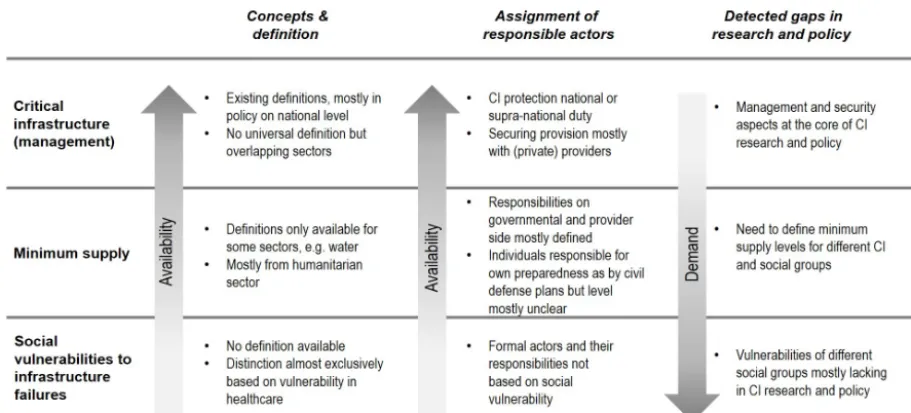
Figure 2.Summary of concepts, actors and gaps in dealing with critical infrastructure, minimum supply and social vulnerabilities.
the question of how long their emergency supply could be sustained (BBK, 2012b).
Apart from very few exceptions (policy documents such as D-A-CH, 2013; BMI, 2016; research papers such as Pye et al., 2011; Oh et al., 2013; Miles, 2015; Pescaroli and Alexander, 2016), there is a distinct lack of documents that discuss CI resilience, minimum supply and social vulnera-bility in an integrated manner – or even name the three ele-ments in the same document. These exceptions share a non-technocratic perspective which addresses societal demands (see Lauta, 2015; Lievanos and Horne, 2017).
The detected gaps within and between CI, minimum sup-ply and social vulnerability are summarized in Fig. 2. Par-ticularly social vulnerabilities to CI failures are hardly dealt with in CI research and policy. Thus, a significant gap in research of the vulnerabilities of different social groups to CI outages as well as related policies was detected. In ad-dition, potential mutual intensification or reduction of mini-mum supply and social vulnerabilities is greatly neglected.
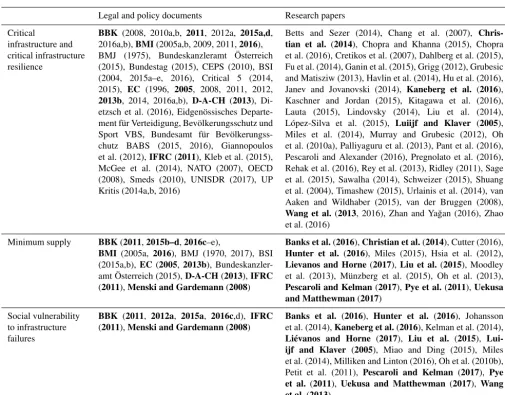
To provide a reference guide to the reader, Table 1 lists the most important policy and research papers in the three fields of CI resilience, minimum supply and social vulnerability to CI failure.
4 Framing the relationships between critical infrastructure, social vulnerability and minimum supply
Building on the results of the review, Fig. 3 provides a heuris-tic model for capturing the relationship between CI failure, minimum supply and social vulnerability. We argue that the impacts from CI failure are modulated – i.e., amplified and/or
Figure 3.Heuristic model for capturing the relationship between critical infrastructure failure, minimum supply and social vulnera-bility.
ef-Table 1.List of key references per subcategory (few papers deal with more than one category; these papers are highlighted in bold).
Legal and policy documents Research papers Critical
infrastructure and critical infrastructure resilience
BBK (2008, 2010a,b, 2011, 2012a, 2015a,d, 2016a,b),BMI(2005a,b, 2009, 2011,2016), BMJ (1975), Bundeskanzleramt Österreich (2015), Bundestag (2015), CEPS (2010), BSI (2004, 2015a–e, 2016), Critical 5 (2014, 2015), EC (1996, 2005, 2008, 2011, 2012,
2013b, 2014, 2016a,b),D-A-CH (2013), Di-etzsch et al. (2016), Eidgenössisches Departe-ment für Verteidigung, Bevölkerungsschutz und Sport VBS, Bundesamt für Bevölkerungss-chutz BABS (2015, 2016), Giannopoulos et al. (2012),IFRC(2011), Kleb et al. (2015), McGee et al. (2014), NATO (2007), OECD (2008), Smeds (2010), UNISDR (2017), UP Kritis (2014a,b, 2016)
Betts and Sezer (2014), Chang et al. (2007), Chris-tian et al. (2014), Chopra and Khanna (2015), Chopra et al. (2016), Cretikos et al. (2007), Dahlberg et al. (2015), Fu et al. (2014), Ganin et al. (2015), Grigg (2012), Grubesic and Matisziw (2013), Havlin et al. (2014), Hu et al. (2016), Janev and Jovanovski (2014), Kaneberg et al. (2016), Kaschner and Jordan (2015), Kitagawa et al. (2016), Lauta (2015), Lindovsky (2014), Liu et al. (2014), López-Silva et al. (2015), Luiijf and Klaver (2005), Miles et al. (2014), Murray and Grubesic (2012), Oh et al. (2010a), Palliyaguru et al. (2013), Pant et al. (2016), Pescaroli and Alexander (2016), Pregnolato et al. (2016), Rehak et al. (2016), Rey et al. (2013), Ridley (2011), Sage et al. (2015), Sawalha (2014), Schweizer (2015), Shuang et al. (2004), Timashew (2015), Urlainis et al. (2014), van Aaken and Wildhaber (2015), van der Bruggen (2008),
Wang et al.(2013, 2016), Zhan and Ya˘gan (2016), Zhao et al. (2016)
Minimum supply BBK(2011,2015b–d,2016c–e),
BMI (2005a, 2016), BMJ (1970, 2017), BSI (2015a,b),EC(2005,2013b), Bundeskanzler-amt Österreich (2015),D-A-CH(2013),IFRC
(2011),Menski and Gardemann(2008)
Banks et al.(2016),Christian et al.(2014), Cutter (2016),
Hunter et al. (2016), Miles (2015), Hsia et al. (2012),
Lievanos and Horne(2017),Liu et al.(2015), Moodley et al. (2013), Münzberg et al. (2015), Oh et al. (2013),
Pescaroli and Kelman(2017),Pye et al.(2011),Uekusa and Matthewman(2017)
Social vulnerability to infrastructure failures
BBK (2011, 2012a, 2015a, 2016c,d), IFRC
(2011),Menski and Gardemann(2008)
Banks et al. (2016), Hunter et al. (2016), Johansson et al. (2014),Kaneberg et al.(2016), Kelman et al. (2014),
Liévanos and Horne (2017), Liu et al. (2015), Lui-ijf and Klaver (2005), Miao and Ding (2015), Miles et al. (2014), Milliken and Linton (2016), Oh et al. (2010b), Petit et al. (2011), Pescaroli and Kelman (2017), Pye et al. (2011),Uekusa and Matthewman (2017), Wang et al.(2013)
fects of minimum supply and social vulnerability, the result-ing impacts from CI failure can therefore be higher or lower. In any case, the impacts can be expected to be differentiated socially, spatially and functionally.
5 Discussion: a future agenda for science and practice
In combining the gaps identified in the review (Sect. 3) and the conceptual framing (Sect. 4) we argue that a number of needs can be identified that can drive future science, practice and policy agendas.
The literature review revealed that considerable knowl-edge gaps remain with regards to the ways in which different parts of the society are vulnerable to the failure of CI ser-vices, most importantly water and electricity. While vulnera-bility assessment in the context of environmental hazards has made great methodological advancements over the past two decades (Birkmann, 2013), these studies have almost
in the 2016 civil defense strategy was not taken seriously be-cause of, inter alia, the very high reliability of CI.
An additional challenge deserving attention is the poten-tially fine-gridded differentiation across social groups, space-and time (following up on authors like Hspace-andmer, 2003, and Barnet et al., 2008, who stressed the need for scale-and context-specific approaches for vulnerability reduction). While such differentiation is a common property of vulner-ability in many contexts, it is particularly challenging in the context of minimum supply. This is because the infrastruc-ture behind most services, e.g., electricity and water, is de-signed for larger system entities. For instance, the social vul-nerability towards suffering impacts from a sustained black-out might differ within a single multi-apartment block, e.g., comparing an elderly and immobile person with a cardiovas-cular disease and dependence on electrical medical equip-ment to a group of young students sharing the apartequip-ment next door. Yet at the same time, the electricity grid cannot deliber-ately supply at such a high resolution as it functions in much larger entities, e.g., switching on or off entire neighborhoods of a city. Questions of timing complicate the situation even further, as secondary concerns such as power for food pro-duction facilities can become primary concerns over time in the case of a prolonged CI failure.
Apart from these rather technical scientific problems, very important questions emerge at the science–policy interface. These questions address normative and procedural issues of distributional justice and responsibility. The review of prac-tical management contingencies and legal as well as policy documents (Sect. 3) suggests that practice and policy has been cautious in defining minimum supply levels for few CI sectors – however, they hardly differ for different social groups, regions, secondary infrastructure, etc. While it seems to be easier to provide numbers for certain sectors, e.g., for water supply (see above), for other sectors supply levels stay rather vague or are limited to general statements that the in-frastructure provision should be restored as soon as possible after a disruption. Along the same line, practice and policy have also struggled to define the ways in which minimum supply is to be prioritized in situations of limited capabilities and resources, i.e., in crises and disaster situations. Lastly, the question of who is – and should – be responsible for the provision of minimum supply remains strikingly open in many respects and contexts. Most likely a higher resilience would demand efforts at both ends: the side of the supplier and the side of the end user. However, how the burden is – and should be – shared is of surprisingly little societal, polit-ical and academic debate.
While science can and should play a key role in tackling these questions, we argue that none of these questions can and should be resolved in a technocratic manner. Scientific knowledge of, for instance, sociospatial patterns of vulner-ability does not automatically lead to “objective” prescrip-tions or even recommendaprescrip-tions for necessary action, prior-itization and responsibility. These aspects rather need to be
tackled and resolved in a wider societal debate that addresses the social contract for risk reduction and shifts the decision-making into the political realm of wider risk governance. In that sense, the agenda ahead is one of transdisciplinary co-production and societal debate rather than of risk science and CI management alone.
6 Conclusions
The analysis presented in this paper has shown that scien-tists, risk practitioners and policy makers are increasingly concerned about the links between CI and disasters. Scien-tific literature, policy documents, legal frameworks and guid-ance documents for risk reduction practices therefore engage evermore with the topic of CI resilience and its management in crises and disaster situations. However, the links drawn to minimum supply contingencies or the assessment of so-cially differentiated vulnerability towards CI failure remain strikingly weak, if not absent in many contexts. The exist-ing gap between these perspectives is a grave shortcomexist-ing as it inhibits a comprehensive understanding of the risks re-lated to CI failure and successful disaster risk reduction poli-cies and practices. The paper therefore put forward a heuris-tic model that helps to decipher the linkages between CI re-silience, minimum supply and social vulnerability in an in-clusive manner, thereby providing guidance for future re-search agendas and policy as well as practice. However, the analysis also strongly shows that the main challenges might not lie within the technological or managerial questions to be solved, but in the normative, ethical and political questions around the responsibility for and prioritization of minimum supply at the fuzzy interface of state organs, private-sector CI utilities, civil society and affected individuals themselves; the latter of which are more often than not amongst the weakest, most vulnerable and resource-poor parts of society. Moving the discourse on the responsibility for minimum supply and preventive risk reduction to a stage of more explicit political and societal debate is therefore urgently needed, particularly in view of the increasing levels of disaster risk to be expected in the future.
Data availability. No data sets were used in this article.
Competing interests. The authors declare that they have no conflict of interest.
Edited by: Sven Fuchs
Reviewed by: two anonymous referees
References
Australian Government: Critical Infrastructure Re-silience Strategy, Commonwealth of Australia, Barton, http://ccpic.mai.gov.ro/docs/Australian+Government+s+ Critical+Infrastructure+Resilience+Strategy.pdf (last access: 19 April 2018), 2010.
Banks, L. H., Davenport, L. A., Hayes, M. H., McArthur, M. A., and Toro, S. N., King, C. E., and Vazirani, H. M.: Disaster impact on impoverished area of US: an inter-professional mixed method study, Prehospit. Disast. Med., 31, 583–592, 2016.
Barnett, J., Lambert, S., and Fry, I.: The hazards of indicators: in-sights from the environmental vulnerability index, Ann. Assoc. Am. Geogr., 98, 102–119, 2008.
BBC: Germans told to stockpile food and water for civil defence, available at: http://www.bbc.com/news/world-europe-37155060 (last access: 9 February 2018), 2016.
BBK: Schutz Kritischer Infrastruktur: Risikomanagement im Krankenhaus Leitfaden zur Identifikation und Reduzierung von Ausfallrisiken in Kritischen Infrastrukturen des Gesundheitswe-sens, BBK, Bonn, 2008.
BBK: Krisenmanagement Stromausfall – Kurzfassung: Krisenman-agement bei einer großflächigen Unterbrechung der Stromver-sorgung am Beispiel Baden-Württemberg, BKK, Bonn, 2010a. BBK: Schutz kritischer Infrastrukturen, BBK, Bonn, 2010b. BBK: Schutz Kritischer Infrastrukturen: Studie zur
Ver-sorgungssicherheit mit Lebensmitteln, BBK, Bonn, 2011. BBK: Schutzkonzepte Kritischer Infrastrukturen im
Bevölkerungsschutz: Ziele, Zielgruppen, Bestandteile und Umsetzung im BBK, Wissenschaftsforum, Band 11, BBK, Bonn, 2012a.
BBK: Schutz Kritischer Infrastrukturen, Studie zur Ver-sorgungssicherheit mit Lebensmitteln, BBK, Bonn, 2012b. BBK: Trinkwassernotbrunnen – Wasserversorgung in
Extremsitua-tionen, BBK, Bonn, 2013.
BBK: Die unterschätzten Risiken “Starkregen” und “Sturzfluten”. Ein Handbuch für Bürger und Kommunen, BBK, Bonn, 2015a. BBK: Stromausfall – Vorsorge und Selbsthilfe, BBK, Bonn, 2015b. BBK: Trinkwassernotbrunnen. Wasserversorgung in
Extremsitua-tionen, BBK, Bonn, 2015c.
BBK: Tagungsband Lükex 2015. 2. Thementag: Ausfall von Kritis-chen Infrastrukturen, BBK, Bonn, 2015d.
BBK: Sicherheit der Trinkwasserversorgung – Teil 1: Risikoanal-yse, BBK, Bonn, 2016a.
BBK: Trinkwassernotversorgung, BBK, Bonn, 2016b.
BBK: Ratgeber für Notfallvorsorge und richtiges Handeln in Notsi-tuationen, BBK, Bonn, 2016c.
BBK: Kapazitäten der Bevölkerung bei einem Stromausfall. Em-pirische Untersuchung für das Bezugsgebiet Deutschland, BKK, Bonn, 2016d.
BBK: Trinkwassernotversorgung, BKK, Bonn, 2016e.
Betts, J. and Sezer, S.: Ethics and privacy in national se-curity and critical infrastructure protection, in: IEEE In-ternational Symposium on Ethics in Engineering, Science,
and Technology (ETHICS), 23–24 May 2014, Chicago, 1–7, https://doi.org/10.1109/ETHICS.2014.6893417, 2014.
Birkmann, J.: Measuring Vulnerability to Natural Hazards: Towards Disaster Resilient Societies, 2nd Edn., UNU Press, Tokyo, 2013. Blaikie, P., Cannon, T., Davis, I., and Wisner, B.: At Risk: Natural Hazards, People’s Vulnerability and Disasters, Routledge, Lon-don, 1994.
BMI: Nationaler Plan zum Schutz der Informationsinfrastruk-turen (NPSI), BMI, Berlin, 2005a.
BMI: Schutz kritischer Infrastrukturen – Basisschutzkonzept. Empfehlungen für Unternehmen, BMI, Berlin, 2005b.
BMI: Nationale Strategie zum Schutz Kritischer Infrastrukturen (KRITIS-Strategie), BMI, Berlin, 2009.
BMI: Schutz Kritischer Infrastrukturen – Risiko- und Krisen-management. Leitfaden für Unternehmen und Behörden, BMI, Berlin, 2011.
BMI: Verordnung zur Bestimmung Kritischer Infrastrukturen nach dem BSIGesetz (BSI-Kritisverordnung – BSI-KritisV), BMI, Berlin, 2015.
BMI: Konzeption Zivile Verteidigung (KZV), BMI, Berlin, 2016. BMJ: Erste Wassersicherstellungsverordnung (1. WasSV), BMJ,
Bonn, 1970.
BMJ: Gesetz zur Sicherung der Energieversorgung (En-ergiesicherungsgesetz 1975), BMJ, Bonn, 1975.
BMJ: Gesetz über die Sicherstellung der Grundversorgung mit Lebensmitteln in einer Versorgungskrise und Maßnahmen zur Vorsorge für eine Versorgungskrise (Ernährungssicherstellungs-und -vorsorgegesetz – ESVG), BMJ, Berlin, 2017.
Brassett, J. and Vaughan-Williams, N.: Security and the performa-tive politics of resilience: critical infrastructure protection and humanitarian emergency preparedness, Secur. Dialogue, 46, 32– 50, 2015.
BSI: Critical Infrastructure Protection: Survey of World-Wide Ac-tivities, BSI, Bonn, 2004.
BSI: KRITIS-Sektorstudie Ernährung und Wasser, BSI, Bonn, 2015a.
BSI: KRITIS-Sektorstudie Informationstechnik und Telekommu-nikation (IKT), BSI, Bonn, 2015b.
BSI: KRITIS-Sektorstudie Energie, BSI, Bonn, 2015c. BSI: KRITIS-Sektorstudie Logistik, BSI, Bonn, 2015d.
BSI: KRITIS-Sektorstudie Transport und Verkehr, BSI, Bonn, 2015e.
BSI: KRITIS-Sektorstudie Gesundheit, BSI, Bonn, 2016.
Bundeskanzleramt Österreich: Österreichisches Programm zum Schutz kritischer Infrastrukturen (APCIP), Masterplan 2014, Bundesministerium für Inneres, Wien, 2015.
Bundesregierung: Erste Wassersicherstellungsverordnung vom 31. März 1970 (Bundesgesetzblatt I S. 357), Bonn, 1970. Bundestag: Gesetz zur Erhöhung der Sicherheit
information-stechnischer Systeme (IT-Sicherheitsgesetz), Bundesgesetzblatt Jahrgang 2015 Teil I Nr. 31, Bonn, 2015.
Bundestag: Gesetz über die Sicherstellung der Grundversorgung mit Lebensmitteln in einer Versorgungskrise und Maßnahmen zur Vorsorge für eine Versorgungskrise (Ernährungssicherstel-lungs und -vorsorgegesetz – ESVG) Ernährungssicherstel(Ernährungssicherstel-lungs- Ernährungssicherstellungs-und -vorsorgegesetz vom 4. April 2017 (BGBl. I S. 772), Bonn, 2017.
Chang, S. E., McDaniels, T. L., Mikawoz, J., and Peterson, K.: In-frastructure failure interdependencies in extreme events: power outage consequences in the 1998 ice storm, Nat. Hazards, 41, 337–358, 2007.
Chopra, S. S. and Khanna, V.: Interconnectedness and interdepen-dencies of critical infrastructures in the US economy: implica-tions for resilience, Physica A, 436, 865–877, 2015.
Chopra, S. S., Dillon, T., Bilec, M. M., and Khanna, V.: A network-based framework for assessing infrastructure resilience: a case study of the London metro system, J. R. Soc. Interface, 13, 20160113, https://doi.org/10.1098/rsif.2016.0113, 2016. Christian, M. D., Sprung, C. L., King, M. A., Dichter, J. R.,
Kisson, N., Devereaux, A. V., and Gomersall, C. D.: Triage: Care of the critically ill and injured during pandemics and disasters: CHEST consensus statement, Chest, 146, e61–74, https://doi.org/10.1378/chest.14-0736, 2014.
Cimellaro, G. P.,. Solari, D., and Bruneau, M.: Physical infrastruc-ture interdependency and regional resilience index after the 2011 Tohoku Earthquake in Japan, Earthq. Eng. Struct. D., 43, 1763– 1784, https://doi.org/10.1002/eqe.2422, 2014.
Collins, M., Carlson, J., and Petit, F.: Community resilience: mea-suring a community’s ability to withstand, WIT Trans. Built Env., 2, 111–123, https://doi.org/10.2495/DMAN110111, 2011. Comes, T.: Designing for networked
commu-nity resilience, Procedia Eng., 159, 6–11, https://doi.org/10.1016/j.proeng.2016.08.057, 2016.
Commission of the European Communities: Communication from the Commission on a European Programme for Infrastructure Protection, COM(2006) 786 final, EC, Brussels, 2006.
Cretikos, M. A., Merritt, T. D., Main, K., Eastwood, K., Winn, L., Moran, L., and Durrheim, D. N.: Mitigating the health impacts of a natural disaster – the June 2007 long-weekend storm in the Hunter region of New South Wales, Med. J. Australia, 187, 670– 673, 2007.
Critical 5: Forging a Common Understanding for Crit-ical Infrastructure, Shared Narrative, March 2014, available at: https://www.publicsafety.gc.ca/cnt/rsrcs/ pblctns/2016-frgng-cmmn-ndrstndng-crtcalnfrstrctr/
2016-frgng-cmmn-ndrstndng-crtcalnfrstrctr-en.pdf (last ac-cess: 24 July 2017), 2014.
Critical 5: Role of Critical Infrastructure in Na-tional Prosperity, Shared Narrative, October 2015, available at: https://www.publicsafety.gc.ca/cnt/ rsrcs/pblctns/2016-rl-crtclnfrstrctr-ntnlprsprty/
2016-rl-crtclnfrstrctr-ntnlprsprty-en.pdf (last access: 24 July 2017), 2015.
Cutter, S.: The perilous nature of food supplies: natural hazards , social vulnerability, and disaster resilience, Environ.: Sci. Policy Sustain. Dev., 59, 4–15, 2016.
D-A-C-H: CSS Tagungsbericht Dritter D-A-C-H Workshop – Schutz Kritischer Infrastrukturen, Center for Security Stud-ies (CSS), Zürich, 2013.
Dahlberg, R., Johannessen-Henry, C. T., Raju, E., and Tulsiani, S.: Resilience in disaster research: three versions, Civ. Eng. Environ. Syst., 32, 44–54, 2015.
Dietzsch, F., Feldhaus, J., Fricke, D., and Wagner, J. W.: Neue Gesetze und Regelungen für kritische Infrastrukturen, DVGW energie|wasser-praxis, 4/2016, 44–53, 2016.
EC: Council Regulation (EC) No 1257/96 of 20 June 1996 Concern-ing Humanitarian Aid, Official Journal of the European Union, European Union, Brussels, L 163, 02/07/1996, 1996.
EC: Grünbuch über ein europäisches Programm für den Schutz kri-tischer Infrastrukturen, Kommission der Europäischen Gemein-schaften, Brüssel, KOM(2005) 576, 2005.
EC: Council Directive 2008/114/EC of 8 December 2008 on the identification and designation of European critical infrastructures and the assessment of the need to improve their protection, Offi-cial Journal of the European Union, OffiOffi-cial Journal of the Euro-pean Union, EuroEuro-pean Union, Brussels, 345, 2008.
EC: Council conclusions on the development of the external dimen-sion of the European Programme for Critical Infrastructure Pro-tection, 3096th JUSTICE and HOME AFFAIRS Council meet-ing, 9 and 10 June 2011, Luxembourg, 2011.
EC: Commission staff working document on the review of the Euro-pean Programme for Critical Infrastructure Protection (EPCIP), SWD (2012) 190 final, EC, Brussels, 2012.
EC: Commission staff working document on a new approach to the European Programme for Critical Infrastructure Protection Mak-ing European Critical Infrastructure more secure, SWD (2013) 318 final, EC, Brussels, 2013a.
EC: Decision No 1313/2013/EU of the European Parliament and of the Council of 17 December 2013 on a Union Civil Protection Mechanism, Official Journal of the European Union, European Union, Brussels, 2013b.
EC: Commission implementing Decision of 16 October 2014 laying down rules for the implementation of Decision No 1313/2013/EU of the European Parliament and of the Coun-cil on a Union Civil Protection Mechanism and repealing Com-mission Decisions 2004/277/EC, Euratom and 2007/606/EC, Eu-ratom (notified under document C(2014) 7489), Official Journal of the European Union, European Union, Brussels, 2014. EC: The European Reference Network for Critical Infrastructure
Protection, Project first phase (2011–2014): from concept to im-plementation, Publications Office of the European Union, Lux-embourg, 2016a.
EC: Council Regulation (EU) 2016/369 of 15 March 2016 on the provision of emergency support within the Union, EC, Brussels, 2016b.
Eidgenössisches Departement für Verteidigung, Bevölkerungss-chutz und Sport VBS, Bundesamt für BevölkerungssBevölkerungss-chutz BABS: Leitfaden Schutz kritischer Infrastrukturen, Bundesamt für Bevölkerungsschutz, Bern, 2015.
Eidgenössisches Departement für Verteidigung, Bevölkerungss-chutz und Sport VBS, Bundesamt für BevölkerungssBevölkerungss-chutz BABS: Umsetzung Strategie Bevölkerungsschutz und Zivilschutz 2015+, Eidgenössisches Departement für Vertei-digung, Bevölkerungsschutz und Sport VBS, Bundesamt für Bevölkerungsschutz BABS, Bern, 2016.
Financial Times: Germans ridicule food stockpiling idea in new civil defence plan, available at: https://www.ft.com/content/ 88c0684e-6945-11e6-ae5b-a7cc5dd5a28c (last access: 9 Febru-ary 2018), 2016.
Ganin, A. A., Massaro, E., Gutfraind, A., Stehen, N., Keisler, J. M., Kott, A., Mangoubi, R., and Linkov, I.: Operational re-silience: concepts, design and analysis, Sci. Rep.-UK, 6, 19540, https://doi.org/10.1038/srep19540, 2015.
Giannopoulos, G., Filippini, R., and Schimmer, M.: Risk Assess-ment Methodologies for Critical Infrastructure Protection, Part I: A State of the Art, EUR 25286 EN, Publications Office of the European Union, Luxembourg, 2012.
Grigg, N. S.: Large-scale disasters: leadership and management lessons, Leadership Manage. Eng., 12, 97–100, 2012.
Grubesic, T. H. and Matisziw, T. C.: A typological framework for categorizing infrastructure vulnerability, GeoJournal, 78, 287– 301, 2013.
Handmer, J.: We are all vulnerable, Austr. J. Emerg. Manage., 18, 55–60, 2003.
Havlin, S., Kenett, D. Y., Bashan, A., Gao, J., and Stanley, H. E.: Vulnerability of network of networks, Eur. Phys. J. Spec. Top., 223, 2087–2106, 2014.
Herzog, M. and Roth, F.: Dritter Trilateraler Workshop D-A-CH – Schutz Kritischer Infrastrukturen, CSS Tagungsbericht, Jan-uary 2014, Center for Security Studies (CSS), ETH Zürich, 2014. Hsia, R. Y., Mbembati, N. A, MacFarlane, S., and Kruk, M. E.: Access to emergency and surgical care in sub-Saharan Africa: the infrastructure gap, Health Policy Plan., 27, 234–244, 2012. Hu, X., Yeung, C. H., Yang, S., Wang, W., and Zeng, A.: Recovery
of infrastructure networks after localised attacks, Sci. Rep.-UK, 6, 24522, https://doi.org/10.1038/srep24522, 2016.
Hunter, M. D., Hunter, J. C., Yang, J. E., Crawley, A. W., and Aragón, T. J.: Public health system response to extreme weather events, J. Public Health Man., 22, E1–E10, 2016.
IFRC: Humanitarian Charter and Minimum Standards in Humani-tarian Response, Sphere Project, Geneva, 2011.
IRP: Guidance Note on Recovery – Infrastructure, International Re-covery Platform Secretariat, Kobe, 2010.
Janev, M. H. and Jovanovski, V.: The concept of resilience and pro-tection of critical infrastructure against natural and man-made disasters in Republic of Macedonia, Collegium Antropol., 38, 143–153, 2014.
Johansson, J., Hassel, H., and Svegrup, L.: The Effect of Including Societal Consequences for Decisions on Critical Infrastructure Vulnerability Reductions, Probabilistic Safety Assessment and Management (PSAM), PSAM12, 22–27 June 2014.
Kaneberg, E., Hertz, S., and Jensen, L.-M.: Emergency prepared-ness planning in developed countries: the Swedish case, J. Hu-man. Log. Supply Chain Manage., 6, 145–172, 2016.
Kaschner, H. and Jordan, T.: Resilience and legislation: will IT se-curity legislation boost critical infrastructure resilience in Ger-many?, J. Business Contin. Emergency Plan., 9, 164–176, 2015. Kelman, J., Finne, K., Bogdanov, A., Worral, C., Margolis, G., Ris-ing, K., MaCurdy, T. E., and Lurie, N.: Dialysis care and death following Hurricane Sandy, Am. J. Kidney Dis., 65, 109–115, https://doi.org/10.1053/j.ajkd.2014.07.005, 2014.
Kitagawa, K., Preston, J., and Chadderton, C.: Preparing for disaster: a comparative analysis of education for crit-ical infrastructure collapse, J. Risk Res., 20, 1450–1465, https://doi.org/10.1080/13669877.2016.1178661, 2016. Kleb, U., Kath, N., Schinagl, C., and Angermann, A.:
Risiko-und Krisenmanagement für die Ernährungsvorsorge in Österre-ich (EV-A), Johanneum Research, Graz, 2015.
Labaka, L., Hernantes, J., Comes, T., and Sarriegi, J. M.: Defin-ing policies to improve critical infrastructure resilience, in: ISCRAM 2014 Conference – Proceedings of the 11th Inter-national ISCRAM Conference, University Park, Pennsylvania, USA, May 2014.
Lauta, K.: Regulating a moving nerve: on legally defining critical infrastructure, Eur. J.Risk Regul., 6, 176–184, 2015.
Liévanos, R. S. and Horne, C.: Unequal resilience: the duration of electricity outages, Energ. Policy, 108, 201–211, 2017.
Lindovsky, M.: Analysis of crisis management water supply system, Inzynieria Mineralna, 15, 89–94, 2014.
Liu, C., Li, D., Zio, E., and Kang, R.: A modeling framework for system restoration from cascading failures, PLoS ONE, 9, e112363, https://doi.org/10.1371/journal.pone.0112363, 2014. Liu, H., Behr, J. G., and Diaz, R.: Population vulnerability to storm
surge flooding in coastal Virginia, USA, Integr. Environ. Assess., 12, 500–509, 2015.
López-Silva, J., Bañuls, V. A., and Turoff, M.: Scenario Based Risks Analysis in Critical Infrastructures Scenario Based Approach for Risks Analysis in Critical Infrastructures, Short Paper – Analyti-cal Modeling and Simulation Proceedings of the ISCRAM 2015 Conference, 9, 24–27 May 2015, Kristiansand, 2015.
Luiijf, E. A. M. and Klaver, M. H. A.: Critical Infrastructure Aware-ness Required by Civil Emergency Planning, in: Proceedings of the 2005 First IEEE International Workshop on Critical In-frastructure Protection (IWCIP’05), 3–4 November 2005, Darm-stadt, Germany, https://doi.org/10.1109/IWCIP.2005.6, 2005. McGee, S., Frittman, J. Ahn, S. J., and Murray, S.: Risk
Relation-ships and Cascading Effects in Critical Infrastructures: Implica-tions for the Hyogo Framework, Input Paper Prepared for the Global Assessment Report on Disaster Risk Reduction 2015, UNISDR, available at: https://www.preventionweb.net/english/ hyogo/gar/2015/en/bgdocs/McGeeetal.,2014.pdf (last access: 17 April 2018), 2014.
Menski, U. and Gardemann, J.: Auswirkungen des Ausfalls Kritischer Infrastrukturen auf den Ernährungssektor am Beispiel des Stromausfalls im Münsterland im Herbst 2005: Empirische Untersuchung im Auftrag der Bundesanstalt für Landwirtschaft und Ernährung (BLE), 2008, available at: http://www.hb.fh-muenster.de/opus/fhms/volltexte/2011/677/ pdf/Stromausfall_Muensterland.pdf (last access: 9 Febru-ary 2018), 2008.
Miao, C. and Ding, M.: Social vulnerability assessment of geo-logical hazards based on entropy method in Lushan earthquake-stricken area, Arab. J. Geosci., 8, 10241–10253, 2015.
Miles, S. B.: Foundations of community disaster resilience: well-being, identity, services, and capitals, Environ. Hazards, 14, 103– 121, https://doi.org/10.1080/17477891.2014.999018, 2015. Miles, S. B., Gallagher, H., and Huxford, C. J.:
Restora-tion and impacts from the September 8, 2011, San Diego power outage, J. Infrastruct. Syst., 20, 05014002, https://doi.org/10.1061/(ASCE)IS.1943-555X.0000176, 2014. Milliken, J. and Linton, D.: Prioritisation of citizen-centric
informa-tion for disaster response, Disasters, 40, 476–493, 2016. Moodley, K., Hardie, K., Selgelid, M. J., Waldman, R. J., Strebel, P.,
Moore, D. A. and Kellogg, D. A.: Infrastructure impacts and facility siting issues during hurricanes, Process Saf. Prog., 26, 108–113, 2007.
Münzberg, T., Wiens, M., and Schultmann, F.: The effect of coping capacity depletion on critical infrastructure resilience, in: Pro-ceedings of the ISCRAM 2015 Conference, 24–27 May 2015, Kristiansand, 2015.
Murray, A. T. and Grubesic, T. H.: Critical infrastructure protec-tion: the vulnerability conundrum, Telemat. Inform., 29, 56–65, https://doi.org/10.1016/j.tele.2011.05.001, 2012.
NATO: The Protection of Critical Infrastructures, 162 CDS 07 E REV 1, NATO Parliamentary Assembly Special Rapport by Lord Jopling, available at: https://www.nato-pa.int/document/ 2007-162-cds-07-e-rev1-critical-infrastructures-jopling-report (last access: 17 April 2018), 2007.
New Zealand Government: National Infrastructure Plan 2011, avail-able at: http://www.infrastructure.govt.nz/plan/2011, last access: 12 January 2017.
OECD: Protection of “Critical Infrastructure” and the Role of In-vestment Policies Relating to National Security, OECD, Paris, 2008.
Oh, E. H., Deshmukh, A., and Hastak, M.: Disaster impact analysis based on inter-relationship of critical infrastructure and associ-ated industries: a winter flood disaster event, Int. J. Disast. Resil. Built Environ., 1, 25–49, 2010a.
Oh, E. H., Deshmukh, A., and Hastak, M.: Vulnerability As-sessment of Critical Infrastructure, Associated Industries, and Communities during Extreme Events, edited by: Oh, E. H., Deshmukh, A., and Hastak, M., Construction Research Congress 2010: Innovation for Reshaping Construction Practice, https://doi.org/10.1061/41109(373)45, 2010b.
Oh, E. H., Deshmukh, A., and Hastak, M.: Criticality assessment of lifeline infrastructure for enhancing disaster response, Nat. Haz-ards Rev., 14, 98–107, 2013.
Ortenzi, M., Petrini, F., and Bontempi, F.: RISE: a method for the design of resilient infrastructures and structures against emer-gencies. Safety, reliability, risk and life-cycle performance of structures and infrastructures, in: Proceedings of the 11th Inter-national Conference on Structural Safety and Reliability, ICOS-SAR 2013, 16–20 June 2013, New York, USA, 2013.
Palliyaguru, R., Amaratunga, D., and Haigh, R.: Developing an approach to assess the influence of integrating disaster risk re-duction practices into infrastructure reconstruction on socio eco-nomic development, Disaster Prev. Manag., 22, 160–171, 2013. Pant, R., Hall, J. W., and Blainey, S. P.: Vulnerability assessment
framework for interdependent critical infrastructures: case-study for Great Britain’s rail network, Eur. J. Transp. Infrast., 16, 174– 194, 2016.
Petit, F., Fisher, R., Yaeger, J., and, Collins, M.: Capturing com-munity influence on public preparedness, in: Transactions on the Built Environment – Reducing Risk, Improving Outcomes, WIT, Southampton, 183–194, 2011.
Pescaroli, G. and Alexander, D.: Critical infrastructure, panarchies and the vulnerability paths of cascading disasters, Nat. Hazards, 82, 175–192, 2016.
Pescaroli, G. and Kelman, I.: How critical infrastructure orients in-ternational relief in cascading disasters, J. Conting. Crisis Man., 25, 56–67, 2017.
Pregnolato, M., Ford, A., Robson, C., Glenis, V., Barr, S., and Daw-son, R.: Assessing urban strategies for reducing the impacts of extreme weather on infrastructure networks, Roy. Soc. Open Sci., 3, 160023, https://doi.org/10.1098/rsos.160023, 2016.
Pye, G., Warren, M., and Hutchinson, W.: Critical infrastruc-ture protection: an ethical choice, in: ICT ethics and secu-rity in the 21st century: new developments and applications, IGI Global, edited by: Quigley, M., Hershey Pa., 214–230, https://doi.org/10.4018/978-1-60960-573-5.ch011, 2011. Rehak, D., Hromada, M., and Novotny, P.: European critical
infras-tructure risk and safety management: directive implementation in practice, Chem. Engineer. Trans., 48, 943–948, 2016. Rey, B., Tixier, J., Bony-Dandrieux, A., Dusserre, G., Munier, L.,
and Lapebie, E.: Interdependencies between industrial infras-tructures: territorial vulnerability assessment, Chem. Engineer. Trans., 31, 61–66, 2013.
Ridley, G.: National security as a corporate social responsibility: critical infrastructure resilience, J. Bus. Ethics, 103, 111–125, 2011.
Rosenbrock, R. and Gerlinger, T.: Gesundheitspolitik, Huber Ver-lag, Bern, 2004.
Sage, D., Sircar, I., Dainty, A., Fussey, P., and Goodier, C.: Under-standing and enhancing future infrastructure resiliency: a socio-ecological approach, Disasters, 39, 407–426, 2015.
Sawalha, I. H.: Collaboration in crisis and emergency management: identifying the gaps in the case of storm “Alexa”, J. Business Contin. Emerg. Plan., 7, 312–323, 2014.
Schweizer, R. J.: State duties to protect. A Swiss constitutional law perspective, Eur. J. Risk Regul., 6, 219–228, 2015.
Shafieezadeh, A. and Ivey Burden, L.: Scenario-based resilience assessment framework for critical infrastructure systems: case study for seismic resilience of seaports, Reliab. Eng. Syst. Safe., 132, 207–219, 2014.
Smedts, B.: Critical Infrastructure Protection Policy in the EU: State of the Art and Evolution in the (Near) Future, Royal High Insti-tute of Defence – Center for Security and Defence Studies, Brus-sels, 2010.
Spiegel Online: Bundesregierung will Bevölkerung zu Hamsterkäufen raten, available at: http://www.spiegel.de/politik/deutschland/
katastrophenfall-bevoelkerung-soll-vorraete-anlegen-a-1108760. html (last access: 9 February 2018), 2016.
Shuang, Q., Zhang, M., and Yuan, Y.: Performance and reliability analysis of water distribution systems under cascading failures and the identification of crucial pipes, PLoS ONE, 9, e88445, https://doi.org/10.1371/journal.pone.0088445, 2004.
Stewart, G. T., Kolluru, R., and Smith, M.: Leveraging public-private partnerships to improve community resilience in times of disaster, Int. J. Phys. Distr. Log., 39, 343–364, https://doi.org/10.1108/09600030910973724, 2009.
Timashev, S. A.: Infrastructure resilience: definition, cal-culation, application, in: 2015 IEEE International Con-ference on Interactive Collaborative Learning (ICL), 20–24 September 2015, Florence, Italy 1075–1078, https://doi.org/10.1109/ICL.2015.7318180, 2015.
UNISDR: Disaster Resilience Scorecard for Cities, De-tailed level assessment, United Nations Office for Dis-aster Risk Reduction (UNISDR), https://www.unisdr.org/ campaign/resilientcities/assets/documents/guidelines/UNISDR_ Disasterresiliencescorecardforcities_Detailed.pdf (last access: 19 April 2018) 2017.
UP-KRITIS: IT-Notfall- und Krisenübungen in Kritischen In-frastrukturen, Geschäftsstelle des UP KRITIS, Bundesamt für Sicherheit in der Informationstechnik, Bonn, 2014a.
UP-KRITIS: Öffentlich-Private Partnerschaft zum Schutz Kritis-cher Infrastrukturen, Geschäftsstelle des UP KRITIS, Bundesamt für Sicherheit in der Informationstechnik, Bonn, 2014b. UP-KRITIS: Best-Practice-Empfehlungen für Anforderungen an
Lieferanten zur Gewährleistung der Informationssicherheit in Kritischen Infrastrukturen, Geschäftsstelle des UP KRITIS, Bun-desamt für Sicherheit in der Informationstechnik, Bonn, 2016. Urlainis, A., Shohet, I. M., Levy, R., Ornai, D., and Vilnay, O.:
Damage in critical infrastructures due to natural and man-made extreme events – A critical review, Procedia Eng., 85, 529–535, https://doi.org/10.1016/j.proeng.2014.10.580, 2014.
Van Aaken, A. and Wildhaber, I.: State liability and critical in-frastructure: a comparative and functional analysis, Eur. J. Risk Regul., 6, 244–254, 2015.
Van der Bruggen, K.: Critical infrastructures and responsibility: a conceptual exploration, Safety Sci., 46, 1137–1148, 2008. Wang, S., Hong, L., Ouyang, M., Zhang, J., and Chen, X.:
Vulnerability analysis of interdependent infrastructure systems under edge attack strategies, Safety Science, 51, 328–337, https://doi.org/10.1016/j.ssci.2012.07.003, 2013
Wang, Y., Fan, H., Lin, W., Lai, Y.-C., and Wang, X.: Growth, col-lapse, and self-organized criticality in complex networks, Sci. Rep.-UK, 6, 24445, https://doi.org/10.1038/srep24445, 2016. Wisner, B.: At Risk: Natural Hazards, People’s Vulnerability and
Disasters, Routledge, London, 2004.
Zhang, Y. and Ya˘gan, O.: Optimizing the robustness of electri-cal power systems against cascading failures, Sci. Rep.-UK, 6, 27625, https://doi.org/10.1038/srep27625, 2016.