S T U D Y P R O T O C O L
Open Access
Comparison of effectiveness between warm
acupuncture with local-distal points
combination and local distribution points
combination in breast cancer-related
lymphedema patients: a study protocol for
a multicenter, randomized, controlled
clinical trial
Chien-Hung Yeh
1†, Tian Yi Zhao
1†, Mei Dan Zhao
1, Yue Wu
1, Yong Ming Guo
1, Zhan Yu Pan
2, Ren Wei Dong
1,
Bo Chen
1, Bin Wang
2, Jing Rong Wen
1, Dan Li
1, Yi Guo
3,4and Xing Fang Pan
1*Abstract
Background:Lymphedema is the most common complication after breast cancer treatment, but management of lymphedema remains a clinical challenge. Several studies have reported the beneficial effect of acupuncture for treating breast cancer-related lymphedema (BCRL). Our objective is to verify the effectiveness of warm acupuncture on BCRL and compare the effectiveness of a local distribution acupoint combination with a local-distal acupoint combination for BCRL.
Methods:This is a study protocol for a multicenter, three-arm parallel, assessor blinded, randomized controlled trial. A total of 108 participants diagnosed as BCRL will be randomly allocated in equal proportions to a local distribution acupoint (LA) group, a local-distal acupoint (LDA) group, or a waiting-list (WL) group. The LA and LDA groups will receive 20 acupuncture treatment over 8 weeks with local distribution acupoint combination and local-distal acupoint combination, respectively. The WL group will receive acupuncture treatment after the study is concluded. The primary outcome is the mean change in inter-limb circumference difference from baseline to week 8. The secondary outcomes include volume measurement, skin hardness, common terminology criteria for adverse events 4.03 (edema limbs criteria), stages of lymphedema from the International Society of Lymphology, Disabilities of the Arm, Shoulder and Hand questionnaire, and the Medical Outcome Study 36-item Short-form Health Survey.
Discussion:This study aims to provide data on warm acupuncture as an effective treatment for BCRL and at the same time compare the effectiveness of different acupoint combinations.
Trial registration:ClinicalTrials.gov: IdentifierNCT03373474. Registered on 14th December 2017.
Keywords:Acupuncture, Lymphedema, Breast cancer
© The Author(s). 2019Open AccessThis article is distributed under the terms of the Creative Commons Attribution 4.0 International License (http://creativecommons.org/licenses/by/4.0/), which permits unrestricted use, distribution, and reproduction in any medium, provided you give appropriate credit to the original author(s) and the source, provide a link to the Creative Commons license, and indicate if changes were made. The Creative Commons Public Domain Dedication waiver (http://creativecommons.org/publicdomain/zero/1.0/) applies to the data made available in this article, unless otherwise stated.
* Correspondence:[email protected];[email protected]
†Chien-Hung Yeh and Tian Yi Zhao contributed equally to this work.
1College of Acupuncture and Massage, Tianjin University of Traditional
Chinese Medicine, No. 312, Anshan West Road, Nankai District, Tianjin 300193, China
Background
Lymphedema is the most common complication after breast cancer treatment, with an average incidence rate of 21% [1]. Some of the symptoms associated with breast cancer-related lymphedema (BCRL) are discomfort, pain, heaviness, tightness, stiffness, weakness, and a decreased range of motion in the affected arm, which can cause severe physical morbidity. The swollen appearance of the arm can also cause psychological distress, such as depression and anxiety, since it is a constant reminder of breast cancer [2].
Although several treatment options are available, including manual lymphatic drainage, compression banda-ging, and complete decongestive therapy, a clinical guide-line on the integrative therapies used after breast cancer treatment reported that there were no A-graded or B-graded therapies to report for lymphedema [3]. Therefore, the treatment of lymphedema is difficult and probably re-quires multi-disciplinary attention. In several National Comprehensive Cancer Network guidelines, acupuncture is recommended for the supportive care of cancer to re-duce symptoms and side effects of conventional cancer care [4]. Recent studies have begun to investigate the therapeutic effect of acupuncture on BCRL and results showed the potential of acupuncture treatment for BCRL [5–10]. However, previous studies were mostly pilot and observational studies with small sample sizes and, thus, the effectiveness of acupuncture needs to be further confirmed with a larger trial. In addition, no consensus has been reached on the choice of acupoints to achieve optimal re-sults. For example, Cassileth et al. [8] performed a whole-body treatment that included acupoints on the abdomen, legs, and affected and unaffected arms, while Yao et al. [5] performed acupuncture treatment on the affected arm only. Although both acupuncture prescriptions were able to reduce arm circumference, which of the two provides better results remains unclear. Therefore, we propose a multi-center, randomized controlled trial to determine the optimal acupoint combination for the treatment of BCRL.
In this study, we aim to determine the effectiveness of warm acupuncture in the treatment of BCRL with a rigorous, larger, multicenter, randomized controlled trial. In addition, we will compare the effectiveness between different acupoint combinations. Specifically, we aim to determine whether a local-distal acupoint combination or a local distribution acupoint combination is more ef-fective in the treatment of BCRL.
Methods
Study design
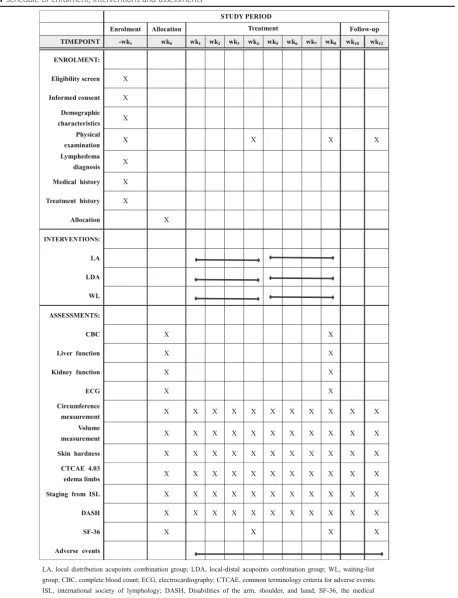
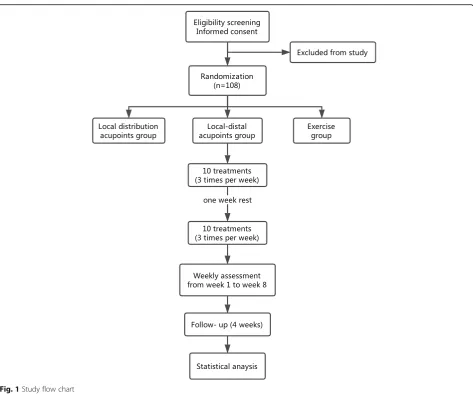
This study is a multicenter, three-arm parallel, assessor blinded, randomized controlled trial conducted in China. A total of 108 patients will be randomly assigned to local acu-point (LA) group, a local-distal acuacu-point (LDA) group, or a waiting-list (WL) group in a 1:1:1 ratio. The schedule of
enrolment, interventions, and assessments is summarized in Table1, and the study flow chart is shown in Fig.1. Standard Protocol Items: Recommendations for Interventional Trials (SPIRIT) 2013 Checklist is attached as Additional file1.
Recruitment
Participants will be recruited from the Tianjin Medical University Cancer Institute and Hospital, Baokang Hospital Affiliated to Tianjin University of Traditional Chinese Medicine, The Second Affiliated Hospital of Baotou Medical College, Henan Cancer Hospital, Gansu Provincial Cancer Hospital, and Sichuan Cancer Hospital by billboard advertisement and practitioner referrals.
Inclusion criteria
1. At least 6 months after breast cancer surgery and with persistent breast cancer-related upper
extremity lymphedema for at least 3 months. Upper extremity lymphedema is defined as more than 2 cm circumference difference or 5% volume difference between the affected and unaffected arms. 2. Presence of stage II or III lymphedema according to
the 2016 consensus by the International Society of Lymphology [11].
3. A Karnofsky Performance Score≥70 4. Men or women aged 18–80 years 5. Out-patients
6. Estimated life expectancy >6 months
Exclusion criteria
1. Bilateral BCRL 2. Taking diuretics
3. History of primary lymphedema
4. A diagnosis of severe heart, liver, kidney, or hematologic disease
5. Edema caused by upper extremity disability or other conditions such as heart failure, kidney disease or malnutrition
6. Edema caused by recurrent or metastatic breast cancer 7. Hypoproteinemia
8. Inflammation, scar, or trauma at the site of operation, or other active skin infections 9. Unable to self-care, history of psychological
disorders, or unable to communicate
10. Received lymphedema treatment within the past 1 month
11. Pregnancy or breastfeeding
12. The presence of electronic medical device implants 13. Denial to sign the informed written consent or
unwillingness to conform to randomization 14. Participation in other clinical trials during the
Table 1Schedule of enrolment, interventions and assessments
Randomization and allocation concealment
After signing the informed consent, eligible participants will be randomly assigned to one of the three groups by center randomization. The Clinical Evaluation Center at the China Academy of Chinese Medical Science in Beijing will be responsible for the generation of a ran-dom number and group assignment, which will be pro-vided through the website at http://118.144.35.11/crivrs/ index.htm. The practitioner who will perform the acu-puncture treatment will then assign the participant to that intervention.
Blinding
The assessor who will collect the data and the statisti-cian who will perform the statistical analysis will be blinded to group assignment. Acupuncturist blinding cannot be achieved due to the nature of the intervention. Participant blinding is limited to the LA group and LDA group, since the WL group cannot help but notice their allocation.
Interventions
[image:4.595.63.537.84.478.2]the increasing temperature. All treatment that may affect the result of the study will be restricted, including surgical interventions, acupuncture, blood-letting, diuretics, exer-cise, complete decongestive therapy, compression therapy, and manual lymphatic drainage. Treatments that the par-ticipants had been using prior to the trial may be allowed at the discretion of the investigator after evaluation of the patient’s condition.
Acupoint prescription set
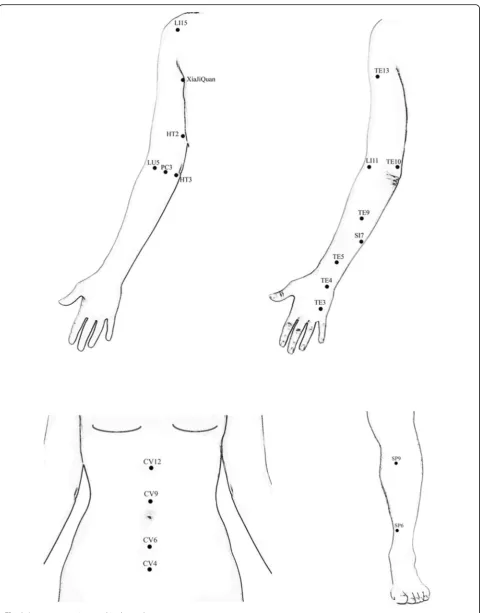
Local points set: Waiguan (TE5), Quchi (LI11), Sidu (TE9), Shaohai (HT3), Naohui (TE13), and Xiajiquan on the affected arm.
Additional local points set: Chize (LU5), Quze (PC3), Zhizheng (SI7), Yangchi (TE4), Zhongzhu (TE3), Qingling (HT2), Tianjing (TE10), Jianyu (LI15), and two other points according to symptoms on the affected arm.
Distal points set: Waiguan (TE5), Quchi (LI11), Shaohai (HT3), Xiajiquan on the unaffected arm; Guanyuan (CV4), Qihai (CV6), Shuifen (CV9), Zhongwan (CV12), bilateral Sanyinjiao (SP6), and Yinlingquan (SP9).
Detailed location of the acupoints are shown in Fig.2.
LA group
Participants will receive acupuncture treatment using the local points set plus the additional local points set (local distribution points combination). Warm acupunc-ture will be applied at Naohui (TE13), Quchi (LI11), and Sidu (TE9) if permitted, and one other acupoint accord-ing to the symptom on the affected arm.
LDA group
Participants will receive acupuncture treatment using the local points set plus the distal points set (local-distal combination). Warm acupuncture will be applied simi-larly to the LA group, with the addition of Qihai (CV6), Shuifen (CV9), bilateral Yinlingquan (SP9), and Quchi (LI11) on the unaffected arm.
WL group
Patients in the WL group will not receive any acupunc-ture treatment during the study. However, for ethical consideration, 20 free acupuncture treatments will be of-fered after the study is completed.
Outcomes
Primary outcome measures
Various assessment methods are available, but circumfer-ence measurement is simple, convenient, low cost, and re-liable [12]. Therefore, the primary outcome measures will be the mean change in inter-limb circumference differ-ence from baseline to the end of the 8-week intervention. The circumference will be measured using a measurement tape (Hoechstmass Balzer Gmbh, Sulzbach,Germany) at
the wrist crease, 10 cm above the wrist crease, elbow crease, 10 cm above the elbow crease, where the lymphedema is most severe, and at its corresponding loca-tion on the unaffected limb. The circumference difference will be assessed at baseline and before intervention at weeks 1–8.
Secondary outcome measures
Volume measurement is also commonly used for the evaluation of lymphedema and the mean change in inter-limb volume difference from baseline to the end of the 8-week intervention will be included as the second primary outcome measure. The volume of the affected and unaffected limbs will be measured by the volumetric measuring device (Baseline, USA) using the water displacement method, which is considered as the most reliable method for volume measurements [13]. The volume difference will be assessed at baseline and before intervention at weeks 1–8.
Skin hardness will be measured at places where the skin feels most tense to the touch by the NSCING SHORE LX-A durometer (Nanjing SuCe Measuring In-strument Co., Ltd., Nanjing, China). Skin changes such as increased tissue resistance and skin elasticity are often found in lymphedematous skin [14]. Our preliminary study found that patients felt more comfortable and less tense in the affected limb after acupuncture treatments. Therefore, we will use the muscle hardness tester to evaluate the effect of acupuncture on soft tissue tension. The change in skin hardness will be assessed at baseline and before intervention at weeks 1–8.
The Common Terminology Criteria for Adverse Events (CTCAE 4.03) [15] will be used to grade the se-verity of swelling using the edema limbs criteria. A grad-ing of mild, moderate or severe swellgrad-ing will be assessed based on the inter-limb circumference or volume dis-crepancy, anatomic architecture, appearance, or activities of daily living. The CTCAE 4.03 will allow us to evaluate the clinical significance of circumference change. The CTCAE 4.03 edema limb grading will be assessed at baseline and before intervention at weeks 1–8.
Stages of lymphedema from the International Society of Lymphology will be used to grade the severity of lymphedema [11]. Staging of 0, I, II, or III will be assessed based on severity of swelling, ability to reduce swelling by elevation, and skin changes. Staging of lymphedema will be assessed at baseline and before intervention at weeks 1–8.
to 100, with higher scores representing worse symptoms and function. The DASH has good validity and respon-siveness and it is recommended to assess upper extrem-ity function in breast cancer survivors [16]. The validated Chinese version of the DASH will be used in this study [17]. The DASH will be assessed at baseline and before intervention at weeks 1–8.
The Medical Outcome Study 36-item Short-Form Health Survey (SF-36) is a commonly used instrument to assess quality of life and has good validity [18]. The SF-36 includes the following eight concepts: physical functioning, role limitations due to physical problems, social functioning, bodily pain, general mental health, role limitations due to emotional problems, vitality, and general health perception [19]. The validated Chinese version of the SF-36 will be used in this study [20]. The SF-36 will be assessed at baseline and before interven-tion at weeks 4 and 8.
Safety assessment
All adverse event occurrences will be informed immedi-ately to the clinical research coordinator and the principle investigator. Together with the acupuncturist in charge, they will evaluate, consult on the case, and take proper ac-tion. All expected (feeling faint after acupuncture treat-ment, stuck needles, broken needles, minor burning and vesicles during or after warm acupuncture, hematoma and bruising after needle removal) and unexpected (exacerba-tion of lymphedema, inflamma(exacerba-tion, infec(exacerba-tion, local or sys-tematic reaction) adverse events will be reported immediately and recorded in the case report form (CRF). Any significant change of health state after baseline will also be recorded as an adverse event. All adverse events will be closely monitored and followed up until sta-bilization or resolution. Complete blood count, liver func-tion, kidney funcfunc-tion, and electrocardiography will be assessed at baseline and at week 8 to detect adverse events.
Sample size calculation
According to the results of our preliminary trial (9 partici-pants in the LDA group, 7 participartici-pants in the LA group, and 10 participants in the WL group), the biggest circum-ference difcircum-ference after 20 treatments was 2.34 ± 1.6 cm, 3.32 ± 1.53 cm, and 3.74 ± 1.1 cm in the LDA, LA, and WL groups, respectively. According to the formula:
n¼Ψ2 X Si2 =K
=hXXi−X2=ðK−1Þi
(1)α= 0.05 (2)β= 0.10 (3) K = 3
(4)Ψ: K = 3, degree of freedom V1 = K–1 = 2; degree of freedom V2 = N–1, N is unknown, assume N as∞,
according to the T distribution critical values table whenα= 0.05 andβ= 0.10:Ψ α,β, K–1,∞= 2.52 (5)Xiand Si represent mean number (X1 = 2.34,
X2 = 3.32, X3 = 3.74) and standard deviation (S1 = 1.6, S2 = 1.53, S3 = 1.1) of group i according to the preliminary trial.
(6)X= (X1 + X2 + X3)/K = (2.34 + 3.32 + 3.74)/3 = 3.13
The result of calculation was 30 participants in each group. Assuming a 20% dropout rate, a total of 108 par-ticipants are required with 36 parpar-ticipants in each group.
Statistical analysis
A full analysis set will include all randomized partici-pants who received at least one treatment and one follow-up. The principle of the last observation carried forward will be used in the case of missing data. The number of end point evaluations in each group will be kept the same as the number of participants in each group at the beginning of the trial.
A per-protocol set will include the following: (1) ticipants who meet the criteria of the protocol, (2) par-ticipants with measurable primary outcomes, and (3) participants without major violation of the protocol.
The statistical analysis of the primary outcome will be analyzed with a full analysis set and per-protocol set sep-arately. The safety set will include all randomized partic-ipants who received at least one treatment.
Data will be coded and entered into SPSS (v.22) for statistical analysis. The Cochran–Mantel–Haenszel test will be used for analysis of center effect. Descriptive sta-tistics of all sociodemographic and clinical data will be included. Continuous variables will be reported using mean and SD for normally distributed data or median and range for skewed data. Categorical variables will be expressed as number and percentage. For outcome mea-sures, the mean differences from baseline values to the end of treatment will be compared using ANCOVA. Re-peated measures analysis of variance (R-ANOVA) will be used to assess the inter-limb circumference difference, inter-limb volume difference and skin hardness between the three study groups. Inter-group differences in cat-egorical data (CTCAE 4.03, stages of lymphedema) will be assessed using the χ2test or Fisher’s exact tests (two-tailed), as appropriate. Linear mixed models (for con-tinuous outcome variables) and generalized estimating equations (for categorical outcome variables) will be used to examine the change of intensity in inter-limb circumference difference and SF-36. P values of <0.05 will be considered statistically significant.
Patient and public involvement
Data collection and management
To warrant quality of the data, a well-trained assessor will be responsible for data collection and recording on the CRF. Double entry of the data into the online trial database will be implemented by clinical research coordinators. Regular monitoring of the recruitment, intervention and assessment processes will be performed to ensure predetermined protocol and standard operat-ing procedures are followed. All CRFs will be stored in a locked cabinet in an area with limited access. All participant information will be stored in a separate locked cabinet.
Ethics and dissemination
This protocol has been approved by the Medical Ethics Committees at Tianjin University of Traditional Chinese Medicine (TJUTCM-EC20170004). Written and in-formed consent will be fully explained by the acupunc-turist and signed by the participants before entering the trial. The protocol has been registered at ClinicalTrials.-gov. Any modification of the protocol will be docu-mented at ClinicalTrials.gov. The results of this study will be published in a peer-reviewed journal.
Discussion
BCRL is a common complication after breast cancer treatment despite the application of less invasive surgical techniques and BCRL patients often suffer from severe physical and psychological morbidity. Patients are in constant need of an effective treatment to manage lymphedema [21]. Conservative intervention such as complete decongestive therapy (CDT) is often consid-ered as the first-line intervention and different studies have shown that CDT may be able to reduce lymph-edema volume of the affected limb [22]. However, CDT is an intensive treatment program that requires daily one-on-one treatment for 4–6 weeks with a spe-cialized therapist [23]. Therefore, it is often consid-ered costly and time-consuming [24, 25]. In addition, long-term use of compression garments is required to maintain the initial limb-volume reduction [26], which results in significant inconvenience and discomfort for the patients.
According to several pilot studies, acupuncture emerges as a potential treatment option given it convenient treat-ment modality with very few side effects. Our preliminary study also found satisfactory results with sustained effect up to 1-month follow-up. Acupuncture is also more con-venient and less expensive when compared to CDT. How-ever, since lymphedema is a rather modern disease, the most effective acupuncture prescription has not been established. Indeed, a thorough search of the PubMed database showed a variety of acupoint prescriptions for the treatment of BCRL – one study [9] with flexible
acupuncture points, one study [5] with acupuncture points on the affected limb only (local distribution acupoint combination), two studies [6, 7] with distal acupuncture points only (distal distribution acupoint combination), and two studies [8, 10] with whole body acupuncture points (local-distal acupoint combination). Therefore, additional research is required to compare the effectiveness of different acupuncture point combinations.
In this study, we will compare the two classic methods for combining acupuncture points – local distribution combination and local-distal combination. A local distri-bution combination is defined as local acupoints on the affected arm where the symptoms manifest and a local-distal combination is defined as acupoints on the affected arm combined with acupoints distant from the affected arm such as on the abdomen, unaffected arm, or legs. In clinical practice, a local-distal combination is the most commonly used treatment prescription, but a local distribution combination can be very effective when targeting a local symptom. By comparing the two methods, we will be able to gain knowledge of general principles in treating BCRL, which will then serve as a fundamental basis for future refinement of points pre-scription. In both acupuncture groups, we will inte-grate needle-top moxibustion to the treatment plan since moxibustion can resolve fluids according to traditional Chinese medicine theories. An observa-tional study by Li et al. [27] also showed that thermo-therapy was able to reduce swelling and improve quality of life. Therefore, acupuncture combined with needle-top moxibustion (warm acupuncture) may be more effective in managing BCRL.
There are some limitations in this study. First, the follow-up period is only 1 month. A longer follow-up period will allow us to assess the long-term effect of acu-puncture treatments. Second, the amount of moxibus-tion applied is different in the LA and LDA groups. The probable compounding effect of greater moxibustion application and the local-distal acupoint combination in the LDA group may result in increased therapeutic dos-age in that group and thus interfere with the comparison between local distribution acupoint combination and local-distal acupoint combination.
In conclusion, this is a rigorous, larger, multi-center, randomized controlled trial, which will enable us to fur-ther assess the effectiveness of acupuncture in the treat-ment of BCRL and also compare the effectiveness between local distribution and local-distal acupoint combinations.
Trial status
Protocol version number: 1.2 (2017/12/5) Date recruitment began: 2018/1/19
Additional file
Additional file 1:SPIRIT 2013 Checklist: recommended items to address in a clinical trial protocol and related documents*. (DOC 124 kb)
Abbreviations
BCRL:Breast cancer-related lymphedema; CDT: Complete decongestive therapy; CRF: Case report form; CTCAE: Common Terminology Criteria for Adverse Events; DASH: Disabilities of the Arm, Shoulder, and Hand; SF-36: Medical Outcome Study 36-item Short-Form Health Survey
Publisher’s Note
Springer Nature remains neutral with regard to jurisdictional claims in published maps and institutional affiliations.
Acknowledgements
Not applicable.
Authors’contributions
CHY, TYZ, and XFP planned the overall study protocol. CHY and TYZ drafted the manuscript. MDZ and YW participated in the design of the study and made critical revisions to the manuscript. YMG, ZYP, RWD, BC, BW, JRW, and DL provided clinical advice and contributed to the refinement of the protocol. XFP and YG have the final responsibility for the decision to submit for publication. All authors have read and approved the final manuscript.
Funding
This work was supported by the National Basic Research Program of China under Grant No. 2014CB543201. The funding source had no role in the design of this study and will not have any role during its execution or analyses, interpretation of the data, or decision to submit results.
Availability of data and materials
Data supporting the findings of this study are available from the corresponding author.
Ethics approval
The Medical Ethics Committee at Tianjin University of Traditional Chinese Medicine has approved the study protocol (TJUTCM-EC20170004). The study is registered at ClinicalTrials.gov (NCT03373474), date of registration 14th December 2017. Prior to registration written informed consent will be obtained in all patients. We are currently recruiting patients in the Tianjin Medical University Cancer Institute and Hospital, Baokang Hospital Affiliated to Tianjin University of Traditional Chinese Medicine, The Second Affiliated Hospital of Baotou Medical College, Henan Cancer Hospital, Gansu Provincial Cancer Hospital, and Sichuan Cancer Hospital. Ethical approval was obtained from all recruiting hospitals.
Consent for publication
Not applicable.
Competing interests
The authors declare that they have no competing interests.
Author details 1
College of Acupuncture and Massage, Tianjin University of Traditional Chinese Medicine, No. 312, Anshan West Road, Nankai District, Tianjin 300193, China.2Department of Combined Chinese & Western Medicine, Tianjin Medical University Cancer Institute & Hospital, National Clinical Research Center of Cancer, Tianjin, China.3Department of Traditional Chinese Medicine, Tianjin University of Traditional Chinese Medicine, Tianjin, China. 4Acupuncture Research Center of Tianjin University of Traditional Chinese
Medicine, Tianjin, China.
Received: 9 January 2019 Accepted: 3 June 2019
References
1. DiSipio T, Rye S, Newman B, Hayes S. Incidence of unilateral arm lymphoedema after breast cancer: a systematic review and meta-analysis. Lancet Oncol. 2013;14(6):500–15.
2. Maunsell E, Brisson J, Deschenes L. Arm problems and psychological distress after surgery for breast cancer. Canadian journal of surgery. Can J Surg. 1993;36(4):315–20.
3. Greenlee H, DuPont-Reyes MJ, Balneaves LG, Carlson LE, Cohen MR, Deng G, et al. Clinical practice guidelines on the evidence-based use of integrative therapies during and after breast cancer treatment. CA Cancer J Clin. 2017;67(3):194–232.
4. Zia FZ, Olaku O, Bao T, Berger A, Deng G, Fan AY, et al. The National Cancer Institute’s Conference on Acupuncture for Symptom Management in Oncology: state of the science, evidence, and research gaps. J Natl Cancer Inst Monogr. 2017;2017(52).https://doi.org/10.1093/jncimonographs/lgx005. 5. Yao C, Xu Y, Chen L, Jiang H, Ki CS, Byun JS, et al. Effects of warm
acupuncture on breast cancer-related chronic lymphedema: a randomized controlled trial. Curr Oncol. 2016;23(1):E27–34.
6. Jeong YJ, Kwon HJ, Park YS, Kwon OC, Shin IH, Park SH. Treatment of lymphedema with saam acupuncture in patients with breast cancer: A pilot study. Med Acupunct. 2015;27(3):206–15.
7. Smith CA, Pirotta M, Kilbreath S. A feasibility study to examine the role of acupuncture to reduce symptoms of lymphoedema after breast cancer: a randomised controlled trial. Acupunct Med. 2014;32(5):387–93. 8. Cassileth BR, Van Zee KJ, Yeung KS, Coleton MI, Cohen S, Chan YH, et al.
Acupuncture in the treatment of upper-limb lymphedema: results of a pilot study. Cancer. 2013;119(13):2455–61.
9. de Valois BA, Young TE, Melsome E. Assessing the feasibility of using acupuncture and moxibustion to improve quality of life for cancer survivors with upper body lymphoedema. Eur J Oncol Nurs. 2012;16(3):301–9. 10. Cassileth BR, Van Zee KJ, Chan Y, Coleton MI, Hudis CA, Cohen S, et al. A
safety and efficacy pilot study of acupuncture for the treatment of chronic lymphoedema. Acupunct Med. 2011;29(3):170–2.
11. BENDA K. The diagnosis and treatment of peripheral lymphedema: 2016 consensus document of the International Society of Lymphology. Lymphology. 2016;49:170–84.
12. Chen YW, Tsai HJ, Hung HC, Tsauo JY, et al. Reliability study of measurements for lymphedema in breast cancer patients. Am J Phys Med Rehabil. 2008;87(1):33–8.
13. Megens AM, Harris SR, Kim-Sing C, McKenzie DC. Measurement of upper extremity volume in women after axillary dissection for breast cancer. Arch Phys Med Rehabil. 2001;82(12):1639–44.
14. Killaars RC, Penha TR, Heuts EM, van der Hulst RR, Piatkowski AA. Biomechanical properties of the skin in patients with breast cancer-related lymphedema compared to healthy individuals. Lymphat Res Biol. 2015;13(3):215–21. 15. US department of Health and Human Services. National Cancer Institute:
National Institutes of Health (2010). Common Terminology Criteria for Adverse Events (CTCAE) Version 4.0. National Institutes of Health. 2010. https://evs.nci.nih.gov/ftp1/CTCAE/CTCAE_4.03/Archive/CTCAE_4.0_2009-05-29_QuickReference_8.5x11.pdf. Accessed 16 Jul 2018.
16. Harrington S, Michener LA, Kendig T, Miale S, George SZ. Patient-reported upper extremity outcome measures used in breast cancer survivors: a systematic review. Arch Phys Med Rehabil. 2014;95(1):153–62. 17. Liao CL, Wang C, Zhou X, Wang XJ. Checkout reliability and validity of
Chinese version of DASH short form scale applied in upper limb dysfunction evaluation research of breast cancer patients [in Chinese]. Chin Nurs Res. 2014;28(10):3581–3.
18. Pusic AL, Cemal Y, Albornoz C, Klassen A, Cano S, Sulimanoff I. Quality of life among breast cancer patients with lymphedema: a systematic review of patient-reported outcome instruments and outcomes. J Cancer Surviv. 2013;7(1):83–92.
19. Ware JE Jr, Sherbourne CD. The MOS 36-item short-form health survey (SF-36). I. Conceptual framework and item selection. Med Care. 1992;30(6):473–83.
21. Greenslade MV, House CJ. Living with lymphedema: a qualitative study of women's perspectives on prevention and management following breast cancer-related treatment. Can Oncol Nurs J. 2006;16(3):165–79.
22. Ezzo J, Manheimer E, McNeely ML, Howell DM, Weiss R, Johansson KI, et al. Manual lymphatic drainage for lymphedema following breast cancer treatment. Cochrane Database Syst Rev. 2015;5:CD003475. 23. Boris M, Weindorf S, Lasinski B, Boris G. Lymphedema reduction by
noninvasive complex lymphedema therapy. Oncology (Williston Park). 1994;8(9):95–106 discussion 109-10.
24. Kärki A, Anttila H, Tasmuth T, Rautakorpi UM. Lymphoedema therapy in breast cancer patients: a systematic review on effectiveness and a survey of current practices and costs in Finland. Acta Oncol. 2009;48(6):850–9. 25. Basta MN, Fox JP, Kanchwala SK, et al. Complicated breast cancer-related
lymphedema: evaluating health care resource utilization and associated costs of management. Am J Surg. 2016;211(1):133–41.
26. Rockson S. Current concepts and future directions in the diagnosis and management of lymphatic vascular disease. Vasc Med. 2010;15(3):223–31. 27. Li K, Zhang Z, Liu NF, Feng SQ, Tong Y, Zhang JF, et al. Efficacy and safety