Journal of Chemical and Pharmaceutical Research, 2014, 6(7):1103-1108
Research Article
CODEN(USA) : JCPRC5
ISSN : 0975-7384
The research of P2P network security model based on group trust relationship
Xue Ming
Henan University of Technology, Henan, Zhengzhou, China
_____________________________________________________________________________________________
ABSTRACT
At present, it is lack effective mechanism to improve the security of the system in the P2P network. There is a lot of malicious behaviors. Network security model has become an important subject of P2P application research. This paper will study P2P network based on group trust relationship. Set up different groups according to the node interests. The overall trust is compounded by direct trust between nodes, trust between groups and nodes, trust between groups and multiple parameters. Through the simulation experiment, this model is verified to have high ratio of successful download, and the peer load can be controlled in a admissible range. The performance of this model is studied through simulation experiment. The results show that the model can identify malicious nodes effectively. According to the trust value of the responder select the download source. In the P2P network, cooperative nodes have the high request rate of success and node degree of satisfaction in different malicious nodes attack mode.
Key words:
Peer-to-peer, Reputation, Trust model, Security
_____________________________________________________________________________________________
INTRODUCTION
P2P network obtain a rapid development because of its resource sharing, node peer-to-peer communications and network flexible self-organizing characteristics. But due to the essential characteristics of P2P network anonymity, there are a large number of fraud and other malicious behavior in the system. Therefore, establishing an effective, safe trust mechanism is particularly important. It can be the next definition. Trust model is establishing a set of quantitative evaluation system through some kind of strategy. It can give the trust evaluation of the trading node and inform the evaluation to the other nodes in a network. At present, there are a lot of related researches at home and abroad [1-5]. More famous algorithm is P2P network users Eigen Trust put forward by Kamvar at Stanford university.
It is published services and e-commerce community, Peer Trust trust model based on reputation as well as the literature [6,7] trust model in 2003. The several most influential organizations and companies in world computer field, such as ACM, IEEE, Microsoft, IBM, HP are engaged in the research of this area. Domestic, Chen Guihai of nanjing university professor, Dou Wen of national university of defense technology also done a lot of research work in this field. Refer to human social management way, man is not a single individual, they are social. They always form a group according to certain strategy. Then these groups constitute the human society again. Each person has a trust in his own group. They will evaluate each other's trust between groups and groups. Based on this kind of management mode of human society, we propose a trust model GBTM based on group in this paper [8]. They can establish different groups according to interest hobby of the node. The overall trust is compounded by direct trust between nodes, trust between groups and nodes, trust between groups and multiple parameters.
P2P NETWORK SECURITY MODEL BASED ON GROUP
reliable. The whole of the model should include the following several parts: group divisions, nodes trusted computing within the same group, nodes trusted computing between different groups. Finally, the implementation strategy is given and the model is used to supplement and analyze.
The Group Divisions. In Trust Frame, the nodes form a group according to certain rules. Groups constitute the
whole P2P network. The group mark with GID. The nodes are marked with the PID identification. {GID, PID} mark the only node in a group.
Trusted Computing of the Same Group Node.
a. The node trust value. After a transaction, node i makes satisfaction evaluation to node j services. We use n ij
r to
show. Where n is the nth trade. The method of probability possibility is used to distinguish nodes to provide different quality of service. n
ij
r ∈[0,1], 0 means node i to node j is entirely unsatisfactory. The critical value of 0.5 is satisfied
and unsatisfied. 1 shows node i to node j is fully satisfied. The larger the value is, the higher the satisfaction is. Node
i to node j is expressed as an evaluation information. It is< n
, ,
n ijr t m
>. Thet
n as ageing time that seems to node ifor the nth transactions. The initial value is t. It decreases with time. When the duty is 0, <
r t m
ijn, ,
n > is deleted. Nnodes said i and j are the maximum effective transaction serial number. If the evaluation information be deleted because of the aging time expires. Then the rest of the serial number of evaluations information automatically adjust.
m shows trading relevant other information.
t
ncan be shown by the following.{
n 1n t
t
t
=
− (1)Direct trust value of node i to node j can be said by
R
ij.1 1 0 0 k k n ij n k l l initial r t n t ij R n
R
− = ≠ =
∑
∑
=
(2) In the type,R
initial is initial trust value for the new node.b. The similarity degree of node. The node i and j trust evaluation similarity is expressed by
S
ij. The higher similarity degree of i and j, it shows the view of i and j to other nodes is consistent in the network. Calculate the similarity of the i and j using the modified cosine similarity.2 2
(
)(
/[
(
)
(
)]
ij ij ij
ij c I ic i jc j c I ic i c I jc j
S
R
R
R
R
R
R
R
R
∈ ∈ ∈
=
∑
−
−
)
∑
−
∑
−
(3)
In the formula,
I
ishows node set with i direct trust relationship.I
jshows node set with j direct trust relationship.ij
I
shows node set with i and j direct trust relationship.R
icshows direct trust for node i to node c.R
i andR
jrespectively mean direct trust arithmetic mean value about node i and j to other nodes.
c. The reputation values of the node. In group
G
i, from the node i, the reputation values of node j expresses inT
ij./ (
2)
i
ij k G k i k j ik kj i
T
=
∑
∈ I ≠I ≠S R
G
−
(4)( 0 or 0)
0( 0 0)
ij R Aij and
R
α α β α β α β ≠ ≠ + = =
=
(5)αandβrespectively mean the weight of direct trust and indirect trust in the nodes. The value of α and β are
changing. They are affected by the factors such as transaction number, transaction amount. We define that the transaction efficiency is the ratio of transaction amount and transaction number in order to quantify α andβ. The
higher the transaction efficiency, the greater the understanding between the nodes.
( ) ( )
0 ( )
Qij
Nij S
Have atransaction record T
No transaction record
α
=
(6)(i) / (i) (Have atransaction record)
0 ( )
Qik Nik
K T k jS K T k jT
No transaction record
β
∈ = ∈ =
∑
∑
=
I I (7) NijT
means "effective" transaction number between node i and j.S
Qijmeans "effective" transaction amount between node i and j. Each transaction amount is stored in the m field of satisfaction evaluation. T(i) means "efficient" nodeset deal with node i. The meaning of "effective" refers to
S
Qij. T(i) and other relevant information, they are not deleted because of the aging time expires.Nodes trusted computing between different groups.
a. Direct trust between the groups. The direct trust group
G
i to groupG
j shows withi j
G G
R
,
/ [
]
i j
G G i j ij i j
R
=
∑
R
G
×
G
.,
/ [
]
i j
G G i j ij i j
R
=
∑
R
G
×
G
iϵG
i, jϵG
j (8)b. The reputation of nodes in the groups. Reputation value of node j in their group expresses in Gj
j
R
./ [
1]
j
j
G
j k G k j kj i
R
=
∑
∈ I ≠R
G
−
(9)c. Reliability of nodes in the group. Reliability evaluation is shown by
R
Aij.{
j}
min
,
ji j
G
Aij G G
R
=
R
R
(10)A supplement of the model robustness.
a. The management of the group. The trusted computing involves in nodes trust within the same group and the different groups of nodes. In order to facilitate the node reputation maintenance in the group and trust information interaction between the groups, we set up three high reputation nodes as a group manager. Group manager is responsible for maintaining the node reputation and the trust information between groups. Their content exactly consistent, so as to prevent the happening of the "single point of failure".
and Whitewashing nodes. In this paper, we dynamically adjust the initial trust evaluation of a new node. Set the silent time t, encourage the good behavior of the normal new node, and restrict malicious behavior of Whitewashing node. At the same time, the node Whitewashing behavior is limited within the group, so it reduces the overall cost. In the t time of new node just joined, the node can only provide services, do not request service. Then the group manager respectively collect the satisfaction evaluation of a new node. Calculate the reputation of the nodes according to the type (3) and (4). We can obtain the new node reputation from the three managers. It can be denoted
by
T
new1 ,T
new2 ,T
new3 .At the same time, according to the type (10) to calculate the average value of group nodesreputation. It can be denoted by
R
ave. In the silent time, the new node reputation values are all greater than theR
ave,a new node initial trust value
R
in=
max(0.5,
R
ave)
.Otherwise,1 2 3
m in(0.5, T
T
, T
in new new new
R
=
,
)
after thesilence time, group managers will put initial trust of the new node broadcasted to the members of the group. Each node updates the related trust information to the new node. c. The service control strategy. The higher reliability
evaluation a node obtains, the better corresponding service quality they obtain. When
R
Aij respectively belong to [0,0.2), [0.2, 0.4), [0.4, 0.6) ,[0.6, 0.8), [0.8, 1.0), the service quality obtained by nodes is "denial of service", "low-level service", "general service", "good service", "best service". At the same time, group managers will take adifferent strategy to punishment according to monitoring nodes' behavior and reputation in the group. When Gi
i
R
respectively belong to [0,
R
ave/ 3
],[R
ave/ 3, 2
R
ave/ 3
],[2
R
ave/ 3,1
], for node punishment strategy, they are respectively "clear the node out of the group", "set silent time t, node can only provide services, do not request service", "no punitive actions".The analysis of model versatility and expansibility.
a. A satisfaction evaluation
r
ijn and transaction amountS
Qij are associated with specific application. Evaluating a file download service in the file sharing, selecting the file quality, downloading bandwidth and popularity are evaluation standard. In e-commerce systems, we mainly consider the transaction duration, transaction costs, transaction important degree. We extract the different satisfaction evaluation factors in different P2P application andcalculate
r
ijn,S
Qij is defined as the size of the transaction.b. In the <
r t m
ijn, ,
n > evaluation information, the content of the m field is the extended trust data. With theunceasing change of P2P application requirements, record the related factors of new trust evaluation in the m field. Finally, the model has certain extensibility.
THE RESULTS OF SIMULATION AND ANALYSIS
The simulation environment. In this paper, the application of scenarios is file sharing. Based on the P2P research
group in Stanford, Query Cycle Simulator has accomplished some classical trust model. Such as: Eigen Trus; Cup-pens; Trust Frame. In the network nodes are divided into three categories: good nodes, evil and bad meaning node. Goodwill node refers to the services or the evaluation of other nodes is reliable. Malicious nodes behavior mainly include: provide low level service; offer unreal evaluation; vilified goodwill node and exaggerate the same node. Whitewashing and Freeriding node is divided into bad behavior.
The results of simulation and analysis. a. Request success rate. Request success rate is the number of successful
download goodwill node ratio of all downloads. It reflects the trust models application effect intuitively. Trust Frame, Cuppens model、Eigen Trust、Random successful request rate comparison is shown in figure 1.
Curve of 4 Random refers to the model does not use any trust mechanism. Each node selected download resources randomly. Figure 4 illustrates when the malicious nodes up to 50%,TrustFrame still has high success rate of requests. This is due to Trust Frame's aging time、the degree of similarity node enhanced the accuracy of the trusted
computing. At the same time the implementation of service control strategy for penalizing and motivation node.
Figure 1: The successful request rate of the different size malicious nodes
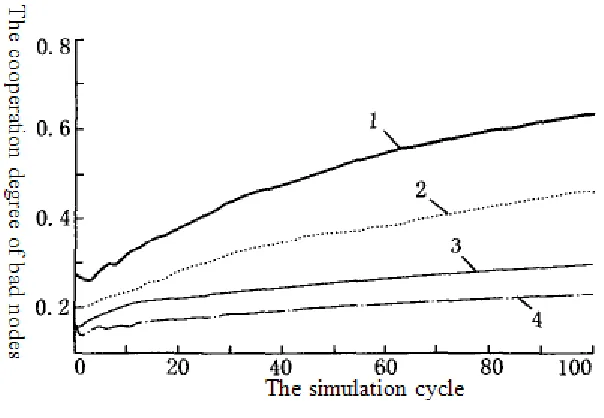
Figure 2: The inhibition of bad nodes
The inhibitory effect is more obvious for bad nodes in Trust Frame, the cooperation degree tend to be more reasonable.
c. The system overhead. The system overhead is measured by network traffic in the process of trust mechanism running. It includes all the query request, response message, connection information and so on. The network traffic is shown in figure 3 when well-meaning node successfully downloaded more than 90% in the different network scales.
[image:5.595.136.438.376.585.2]system overhead.
Figure 3: The network traffic contrast
CONCLUSION
This paper proposes a trust management model based on group. The calculation results of general trust in the model consider the node trust directly; trust in the group; trust between groups. And introduces the feedback credibility factor and multiple weighting factor to adjust trust. So the model can adapt to a variety of network environment. The simulation shows that this model can effectively inhibit a variety of malicious behavior, improve the success rate of interaction.
REFERENCES
[1]Liu Xiao-lan. China Sport Science and Technology. 1984, 29(13), 46-49.
[2]Luo Yang-chun. Journal of Shanghai Physical Education Institute. 1994, 23(12), 46-47. [3]Wan Hua-zhe. journal Of Nanchang Junior College. 2010, 3, 154-156.
[4]Li Ke. Journal of Shenyang Sport University. 2012, 31(2), 111-113.