
1151
AUTOMOTIVE WIMAX RADAR NETWORKS: THE FUTURE
OF INTELLIGENT TRANSPORTATION SYSTEMS
1NIRMALENDU BIKAS SINHA, 1SAMIRAN PRAMANIK, 2CHADAN KUMAR SARKAR AND 3
RABINDRANATH BERA
1
College of Engineering & Management, Kolaghat, K.T.P.P Township,
Purba Medinipur, 721171, W.B, India.
2Jadavpur University, Kolkata 700032, W.B, India
3Sikkim Manipal University, Majitar, Rangpo, East Sikkim, 73713
E-mail: [email protected]
ABSTRACT
This paper addresses the developmental efforts towards the realization of vehicle to vehicle cooperative collision warning system for ITS. In this intelligent system either the vehicle or the infrastructure can communicate its location or other information to surrounding vehicles or nearby infrastructure for its implications in cooperative driving and vehicle safety. Commercial vehicles with radar system operating in ‘SKIN’ or ‘TRANSPONDER’ mode is used for this intelligent system. In the ‘SKIN’ mode of operation only one vehicle is associated with the radar whereas in the ‘TRANSPONDER’ mode both the vehicles will be fitted with the radar and communication system. Vehicles will be ‘friends’ to each other by integrating the local radar mounted on each vehicle with vehicular communication. The goals of this paper are twofold: Providing an engineering argument of possible functional architectures of such systems and presenting a plausible example of the proposed future-trajectory-based design, which estimates and communicates vehicle positions, predicts and processes the future trajectories for collision and decision making using WiMAX waveforms. However for real time implementation of the system, a careful selection of the latest high speed wireless technology WiMAX is to be embedded with the SKIN or TRANSPONDER mode of radar operation for safe communication purposes in order to avoid collision on road. The authors have developed automotive WiMAX radar networks for SKIN and TRANSPONDER mode utilizing the VLSI based advanced development platforms. This paper will highlight the achievements of the model to develop an intelligent transport system.
Keywords: WiMAX, ITS, TCF, FCF, Skin Mode And Transponder Mode.
1. INTRODUCTION:
Scientists and Technologists are involved in the development of communication and remote sensing systems all over the world and Exploring the advantage of the above mentioned technologies authors are trying to develop an intelligent transport system by reutilizing their previous concept in 60 GHz WiMAX waveform [1][2]. Large scale national ITS projects began in Europe, the US and Japan in the mid-1980s but recent ITS efforts have seen a markedly greater focus on communication and thus safety grew tremendously over a few years. The EU’s Safety initiative [3], announced in November 2002, aims to half the number of annual traffic accident fatalities in the EU by 2010. The United States’ ITS Ten-Year Plan [4], announced in
January 2002, talks about achieving a 15% reduction in the number of annual traffic fatalities by 2011.The collision avoidance sensor, which is a part of AVCS can identify nearby vehicles and other obstacles in order to prevent collisions. A study shows that 90% of rear-end and 60% of head-on collisihead-ons could have been prevented if the driver could have been warned [5][6].
1152 numerous advantages. Most importantly, passive radars are virtually undetectable to surveillance receivers and there is no constraint in spectrum allocation and thus can be effectively used for target detection. Various developmental efforts towards individual and separate communication and radar systems are in progression for utilization in vehicular application [7]-[11].Collision avoidance and warning system can be implemented considering the two special cases:
Case 1: Only one vehicle is fitted with radar, whereas the second vehicle is an ordinary one having no such system. This is called the SKIN mode of radar operation and falls under the category of Primary radars. The disadvantages of primary radar are firstly, enormous amounts of power must be radiated to ensure returns from the target. This is especially true if long range is desired. Secondly, because of the small amount of energy returned at the receiver, signals may be easily disrupted due to factors like changes in target attitude or signal attenuation due to heavy rain. This may cause the displayed target to 'fade'. Thirdly, correlation of a particular radar return with a particular vehicle requires an identification process.
Case 2: Both the vehicles are fitted with radar and communication system. This is called the Transponder mode of radar operation and falls under the category of secondary radars. Better collision avoidance is possible with this radar.
The great advantages of Secondary radar are three: firstly, because the reply signal is transmitted from the vehicle it is much stronger when received at the objective vehicle, thus giving the possibility of much greater range and reducing the problems of signal attenuation; hence the transmitting power required by the objective vehicle for a given range is much reduced, thus providing considerable economy; and thirdly, because the signals in each direction are electronically coded the possibility is offered to transmit additional information between the two vehicles.
Mercedes Benz S class vehicle is available with such technology. This S class vehicle is fitted with several sensors for safety applications including Radar and also enriched with latest communication. But this car suffers from the disadvantages of the active radars and Communication is also not reliable. The challenge is therefore, a careful selection of the latest high speed wireless technology- WiMAX to be embedded for safety and communication purposes in SKIN mode or Transponder mode of radar operation in order to avoid collision on road.
2. IMPLEMENTATION OF WIMAX RADAR WITH SKIN MODE
The code transmission and its autocorrelation at the receiver used in WiMAX radar is the major achievement. Further performance improvement is possible with the use of FCF
(Frequency correlation function) and matched filtering at the receiver. With this aim a new development of the WiMAX radar is also tried by the authors. In this case FCF implementation is more effective in frequency domain mode of radar operation. Therefore, for FCF realization, the WiMAX mode is changed to FHSS mode.
To generate the sharp antenna beam width, a dish antenna with prime focus horn is used both at the transmitter and the receiver. At the receiver, one Ku-band LNBC (Low Noise Block Converter) having a noise temperature of 4 degree Kelvin is used. The block diagram of the said radar in SKIN mode is as shown in the Fig.1. A GUNN diode at X band is used as the main carrier oscillator tunable between 8 to 12 GHz. A PIN modulator is used as a modulator connected in series with the GUNN. The other end of the PIN is connected to a VSG model no R&S SMBV100 which is programmed for the BARKER code generation. The entire transmitter sub system is mounted at the focus of a Dish antenna achieving a beam width of 2 degrees. The receiver composed of another dish having a LNBC connected at its focus. The LNBC output is connected to one RTSA receiver.
3. TRANSMITTER MATCHED FILTER IMPLEMENTATION
A. Waveform generation of Barker code and Transmit Filter design
1153 Fig. 2: Barker Code +++---+--+- Generation Using
Vector Signal Generator VSG At The VSG Display.
[image:3.612.73.531.69.317.2]B. Reception Of Pulsed Barker Waveform (Fig.5) At The Rtsa (Through Target Return):
Fig. 3: Received Pulsed Barker Waveform At The RTSA
4. RECEIVED MATCHED FILTER DESIGN
Conventionally, the road vehicles are classified in terms of their dimensions i.e. in terms of their RCS amplitude returns towards the radar. The larger the dimension, the larger may be the RCS values. The interference and clutter are more sensitive to such method as they increase the AM noise for RCS measurement. New research works are progressing towards the classification of vehicles utilizing the frequency response of the vehicles. It is also experimented that, the road vehicle bandwidth is more as compared to other objects like trees, ground on the road. So, a reference frequency response of different road vehicles may be generated previously during the production of the vehicles. This is a reference frequency response of the vehicles without clutter. So a FCF function can be invoked at the radar signal processing to reduce the clutter and unwanted returns to a great extent. Single Target detection with FHSS mode of WiMAX radar operation is shown in Fig.4.
Antenn
a
Antenn
a
Q
TargetLNA
Transmit Filter g(t)
PIN Modulator Barker code
generator
GUNN Sources
VSA
I
Receive
Filter
FCF
Nyquist Sampling
TCF
[image:3.612.93.310.359.456.2]Display
[image:3.612.93.299.518.668.2]1154
Fig. 4: Single Target detection with FHSS mode of WiMAX radar operation.
5. IMPLEMENTATION OF WIMAX RADAR WITH TRANSPONDER MODE
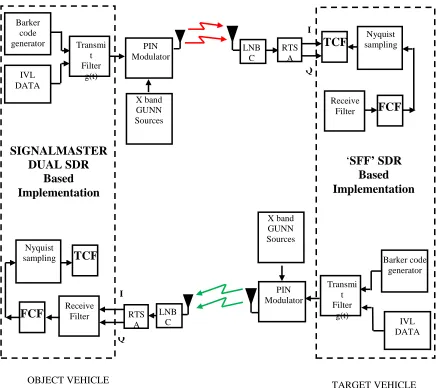
In the above section authors successfully realize the FHSS mode of WiMAX radar operation. Therefore, this development is extended towards Transponder mode of operation as diagrammed in Fig. 5. The FHSS block is repeated for two vehicles namely object and target vehicle with transmitter and receiver implemented in each vehicle. The baseband transmit portion for barker code generation and the IVL data and the baseband receiver portion for FCF, TCF and others are implemented using SDRs.
SIGNALMASTER
DUAL SDR
Based
Implementation
PIN Modulator
X band GUNN Sources
TCF
Nyquist sampling
FCF
Receive Filter Barkercode
generator Transmi
t Filter
g(t) IVL
DATA
I
Q
RTS A
LNB C
Q I
PIN Modulator
X band GUNN Sources
RTS A LNB
C
TCF
sampling NyquistFCF
Receive Filter
IVL DATA Barker code
generator Transmi
t Filter
g(t)
‘
SFF’ SDR
Based
Implementation
OBJECT VEHICLE TARGET VEHICLE
1155
o The transmitter testing:
[image:5.612.90.298.154.317.2]The following performance is evolved out of the experiment.
Fig.6: FHSS Mode Of Wimax Radar With Clutter And Multipath Effect.
FHSS radar was implemented using FCF and TCF correlation receiver. The basic principle of this radar is described by the block diagram shown in Fig.3. The design goal for the complete system is to create a multipath environment when the emitted signal will be reflected by targets at a long distance from the radar. At the receiver section by proper filtering and computes the frequency correlation between the received signal different obstacles can be determined (Fig.6).
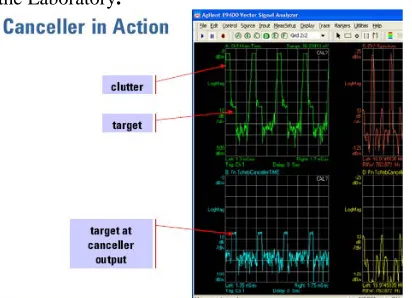
6. CLUTTER AND INTERFERENCE REJECTION
The program will be ported to AWG and VSA for their model realization in hardware for clutter cancellation ratio and interference suppression at the Laboratory.
Fig. 7: Clutter Rejection Capability Of SRR Conclusion
7. CONCLUSION
This paper is intended towards developing collision avoidance architecture for the latest Intelligent Transport System. We have investigated and thoroughly explored automotive WiMAX radar networks for SKIN mode and Transponder mode for vehicle to vehicle cooperative collision warning system. It is then noticed that on road condition SKIN mode is better than transponder mode if two vehicles embedded with radar. The clutter and multipath are the major issues in actual implementation of the system. The performance of the system will be highly degraded under those channel conditions. Therefore, this paper critically analyzed and evolved clutter and multipath using proper DSP techniques for restoration of performance under worst channel conditions. Finally SKIN mode and Transponder mode systems using WiMAX waveform is being implemented using VSG and RTSA. Hardware was programmed from Work Station using MATLAB/SIMULINK for its vehicular realization. Putting brains i.e. intelligence into the above embedded system, the system should be COGNITIVE DYNAMIC SYSTEM. Majority of the problems will be solved by this cognitive technique and we look forward for the improved society with intelligent vehicles.
REFERENCES
[1] R. Bera , N.B. Sinha ,R. purandare,S. Sil and S. Dogra, “Wireless Multimedia Campus Networking Utilizing WiFi and WiMax Radio”, International symposium of IEEE MOROCCO on Information and Communication Technologies(ICTIS-07), Fez, 3-5 April 2007.
[2] Bera,R. Sinha, N,B. Paul,B. Guchhait,A. Sil,S. and Dogra,S, “Wireless Embedded System for Multimedia Campus Network Utilizing IEEE 802.11N (draft) &WiMax radio”, Proc. of International conference on Wireless and Optical Communication Networks (IEEE WOCN '07), Singapore, pp.1-5, 2-4 July 2007.
[3] EU. Safety, “Final Report of the eSafety Working Group on Road Safety”, November, pp.7-39, 2002.
[4] J. K. Hedrick, et al., “Control Issues in Automated Highway Systems”, IEEE Control Systems, pp.21-31, Dec.1994.
750 800 850 900 950 1000 -70
-65 -60 -55 -50 -45 -40 -35 -30 -25 -20 -15
No Clutter at reference target
* Shaded Zone indicates clutter region MULTIPATH ABSENT
MULTIPATH PEAK AT F= 960 MHZ MULTIPATH PEAK AT F = 970 MHZ
MULTIPATH PEAK AT F = 960 MHZ with barker code for TCF
T
ar
g
et
r
et
ur
n
in
dB
[image:5.612.91.297.564.713.2]1156 [5] K.Enke, “Possibilities for improving safety
within the driver vehicle environment control loop”, proceedings of the 7th International technological conference on experimental safety vehicles, PP.789-802, 1979.
[6] S. Tsugawa, et al. “ An Overview on Demo 2000 Cooperative Driving”, Proceedings of IEEE Intelligent Vehicles Symposium, pp.327-332, 2001.
[7] K. Mizutani and R. Kohno,“Inter-vehicle spread spectrum communication and ranging system with concatenated EOE sequence,” IEEE Trans on Intelligent Transport. Syst., vol. 2, no. 4, pp. 180–191, Dec. 2001.
[8] S. Nishikawa and H. Endo, “Application of millimeter-wave sensors in ITS,” Furukawa Review, no. 18, pp.1–5, 1999.
[9] J. K. Hedrick, et al., “Control Issues in Automated Highway Systems”, IEEE Control Systems, Vol.14, No. 6, pp.21-32, 1994.
[10] S. Nishikawa and H. Endo, “Application of Millimeter-wave sensors in ITS,” Furukawa Review, No. 18, pp. 1–5, 1999.

![Assessment of Physiological Health Status in Relations to Different Anthropometric and Cardio respiratory Measures of Head Supported Load Carrying Male Porters of Sikkim, India [Article Retracted]](data:image/gif;base64,R0lGODlhAQABAIAAAP///wAAACH5BAEAAAAALAAAAAABAAEAAAICRAEAOw==)